

Learning Basic Music Theory with Piano 2
 |
Description
Book Introduction
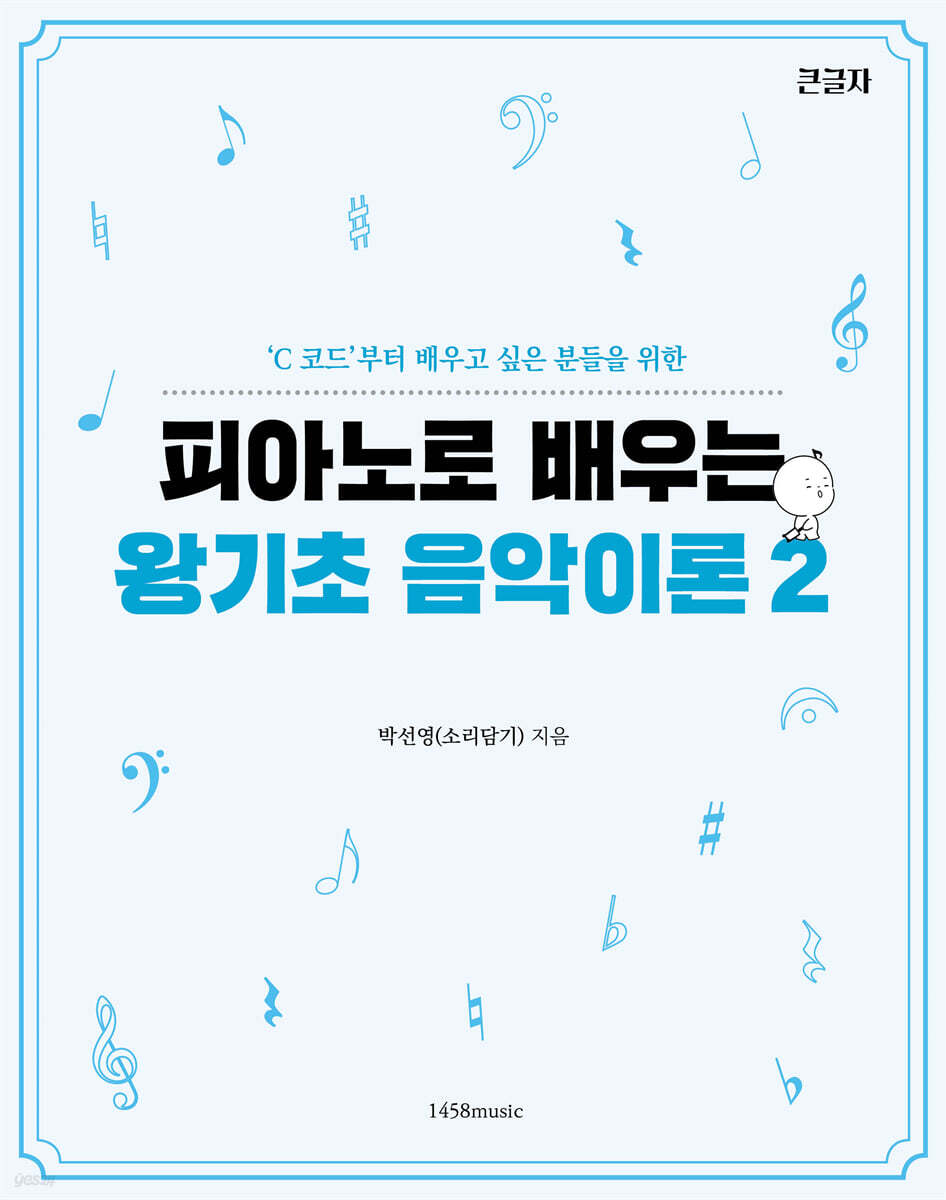
The second series from Park Seon-young, the master of music textbooks that has introduced countless beginners to the world of music! From triads to chord progressions, learn in the easiest way yet! It's finally out. The second series of “Basic Music Theory: Learn with Piano,” which has helped many beginners take their first steps into music, has been published. If you learned how to read sheet music through Volume 1, Volume 2 is designed to help you learn more in-depth music theory, from various changes in triads to seventh chords, scales, chord progressions, substitute chords, circles of fifths, minoring, and transposition. In particular, Volume 2 provides video lectures in which the author personally explains all the contents of the book so that beginners can easily understand the theory. Video lectures are also provided for example songs and practice problems, helping even those who have previously only been able to read sheet music to learn with confidence. For those who are struggling to improve their playing or want to learn music theory in more depth, this will be the best textbook to perfectly fill in any gaps. |
index
Chapter 1.
Various variations of 3-note chords and 4-beats
01.
Major and minor chords
02.
Augmented Code
03.
Diminished Code
04.
sus4 code
05.
4 Beat
Chapter 2.
7th chords and arpeggios
06.
Major seventh and minor seventh
07.
7th chord (7th note)
08.
8 Beat
09.
Arpeggio technique
Chapter 3.
Understanding Code Progression
10.
The names and roles of the scales
11.
diatonic 7th chord
12.
Function of the code
13.
Dominant motion
14.
proxy code
15.
Transposition code
16.
Fraction code
17.
Sequential progress
Chapter 4.
Understanding forging
18.
Major and minor keys
19.
Code composition of the single key
20.
Clock of the fifth degree
21.
transposition
Comprehensive exercise
Various variations of 3-note chords and 4-beats
01.
Major and minor chords
02.
Augmented Code
03.
Diminished Code
04.
sus4 code
05.
4 Beat
Chapter 2.
7th chords and arpeggios
06.
Major seventh and minor seventh
07.
7th chord (7th note)
08.
8 Beat
09.
Arpeggio technique
Chapter 3.
Understanding Code Progression
10.
The names and roles of the scales
11.
diatonic 7th chord
12.
Function of the code
13.
Dominant motion
14.
proxy code
15.
Transposition code
16.
Fraction code
17.
Sequential progress
Chapter 4.
Understanding forging
18.
Major and minor keys
19.
Code composition of the single key
20.
Clock of the fifth degree
21.
transposition
Comprehensive exercise
Detailed image

Into the book
Following Volume 1, Volume 2 explains music theory in a total of 21 topics.
This is suitable for those who want to improve their playing skills or learn music theory in more depth.
--- p.7
Major and minor chords are triads made up of the root, third, and fifth notes.
The difference between two chords is determined by the interval between the root and the third note.
Both major and minor chords have the same interval of a perfect fifth between the root and the fifth note, but different intervals between the root and the third note.
--- p.12
In Diminished Chord, Diminish means 'to decrease, to reduce'.
Therefore, diminished chords can be interpreted as 'reduced chords', and are therefore also called diminished triads.
So, what has been reduced? Let's compare it to major and minor chords.
If you lower the third note of the C chord by a semitone, you get the Cm chord.
If you lower the 5th note here by a semitone, this chord is called a diminished chord.
--- p.26
As the word 'substitute' suggests, a substitute chord is a chord that replaces a major triad.
It might be easier to understand if you think of it as a stand-in for the main character in a movie.
We studied the major triads corresponding to the 1st, 4th, and 5th notes above.
But if you only use these three chords, the song can become too monotonous.
To break this monotony, we use proxy code.
The surrogate chords are the four chords other than the major triad.
This is suitable for those who want to improve their playing skills or learn music theory in more depth.
--- p.7
Major and minor chords are triads made up of the root, third, and fifth notes.
The difference between two chords is determined by the interval between the root and the third note.
Both major and minor chords have the same interval of a perfect fifth between the root and the fifth note, but different intervals between the root and the third note.
--- p.12
In Diminished Chord, Diminish means 'to decrease, to reduce'.
Therefore, diminished chords can be interpreted as 'reduced chords', and are therefore also called diminished triads.
So, what has been reduced? Let's compare it to major and minor chords.
If you lower the third note of the C chord by a semitone, you get the Cm chord.
If you lower the 5th note here by a semitone, this chord is called a diminished chord.
--- p.26
As the word 'substitute' suggests, a substitute chord is a chord that replaces a major triad.
It might be easier to understand if you think of it as a stand-in for the main character in a movie.
We studied the major triads corresponding to the 1st, 4th, and 5th notes above.
But if you only use these three chords, the song can become too monotonous.
To break this monotony, we use proxy code.
The surrogate chords are the four chords other than the major triad.
--- p.100
Publisher's Review
The second book by Park Seon-yeong, who has been receiving rave reviews from subscribers for her easy explanations and examples on her YouTube channel, Sound Damgi, has been released.
We spent a year focusing solely on 'easy-to-understand explanations' to create a detailed textbook that even beginners can easily understand.
I highly recommend this to anyone who wants to understand the principles of chord progression beyond simply reading sheet music, and to anyone who wants to play with satisfaction through deeper musical knowledge.
It was created in large letters so that anyone, regardless of age, can read it comfortably.
Author's Note
Readers who hold this book in their hands may have the same concerns or dreams as I did.
It could be a dream of playing a great song, or it could be some other personal wish.
So, how about trying just one a day? If you only look toward the summit and walk, wondering when you'll reach it, every step can feel burdensome.
But, if you enjoy this moment of walking today and take each step forward, you will reach the place you thought was your dream, just like me.
We spent a year focusing solely on 'easy-to-understand explanations' to create a detailed textbook that even beginners can easily understand.
I highly recommend this to anyone who wants to understand the principles of chord progression beyond simply reading sheet music, and to anyone who wants to play with satisfaction through deeper musical knowledge.
It was created in large letters so that anyone, regardless of age, can read it comfortably.
Author's Note
Readers who hold this book in their hands may have the same concerns or dreams as I did.
It could be a dream of playing a great song, or it could be some other personal wish.
So, how about trying just one a day? If you only look toward the summit and walk, wondering when you'll reach it, every step can feel burdensome.
But, if you enjoy this moment of walking today and take each step forward, you will reach the place you thought was your dream, just like me.
GOODS SPECIFICS
- Date of issue: December 20, 2024
- Page count, weight, size: 160 pages | 213*270*9mm
- ISBN13: 9791189598655
You may also like
카테고리
korean


korean

![GQ KOREA Mark (Monthly): December [2025]](http://librairie.coreenne.fr/cdn/shop/files/8ef265dbbfbf186523ed75ba7319009d.jpg?v=1765340328&width=3840)


