

We are always in a process
 |
Description
Book Introduction
Documenting the 10 years of Puhahaha Friends, always in the process
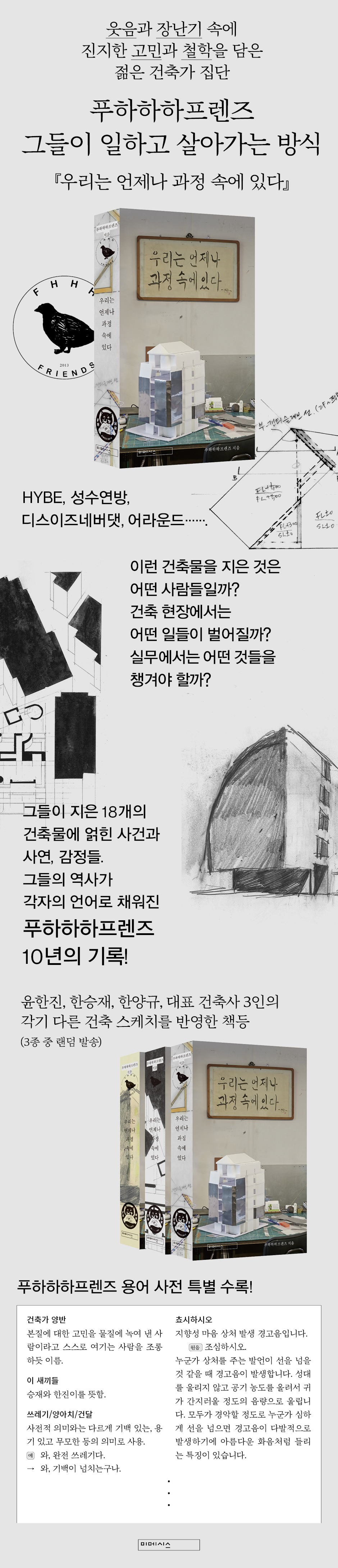
A book documenting the 10 years of the young architect group Puhahaha Friends has been published by Mimesis.
Puhahaha Friends is an architectural firm co-founded in 2013 by three architects, Hanjin Yoon, Seungjae Han, and Yanggyu Han. Currently, thirteen people work together to create large-scale buildings such as HYBE, Seongsu Federation, This Is Never That, Around, and Ter 101.
Puhahaha Friends is famous for their unique architecture, but they are also known for their good writing.
When they first decided to publish their own book, the thirteen of them got together and decided on the spot what each person would write for each project.
Both format and quantity are free.
You can swear, write poetry, or draw an MBTI chart.
『We are always in the process』, which consists of a total of 42 chapters, is full of the fun of reading.
Some of the writing is short stories, some is just an architectural checklist, and it's still funny.
Not only the three directors, but even the writings of employees who interned for a few months and then left the company are full of their own individuality.
Each faucet is relocated into one of the 18 structures built by Puhahaha, and you naturally learn what emotions were felt and what happened when each building was built.
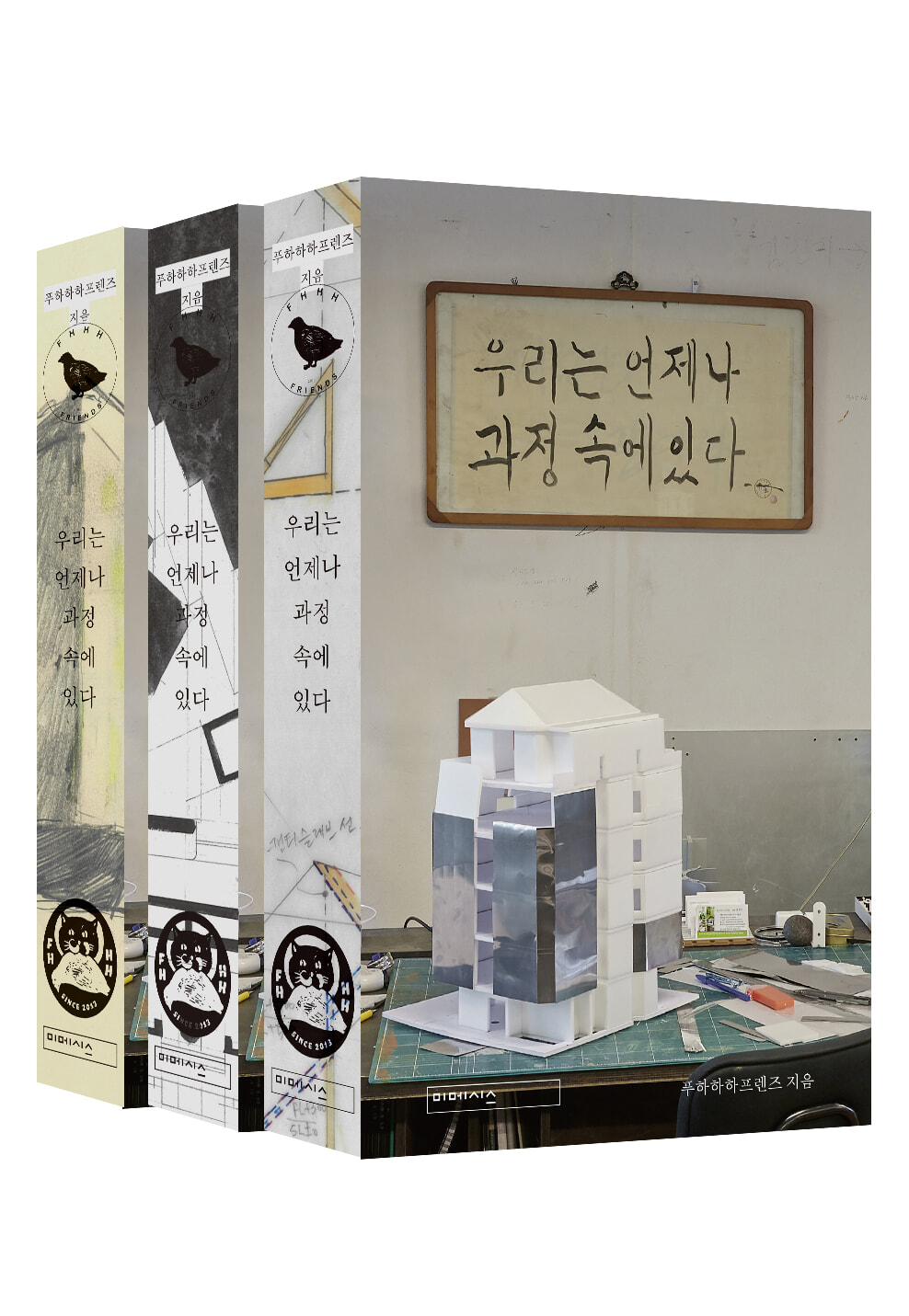
As you can see from the cover, the title of the book, “We are always in the process,” is Puhahaha’s motto.
One day, we decided to hold a contest to create a motto, post the candidate mottos on Facebook, and have people vote to decide.
The candidate who received the most votes was 'We are always in a process'.
At first, I was wondering if I could reverse the vote on this motto, resenting the humor of those who voted for it, but now everyone loves this sentence so much.
Because the construction of Puhahaha Friends is always in process.
A book documenting the 10 years of the young architect group Puhahaha Friends has been published by Mimesis.
Puhahaha Friends is an architectural firm co-founded in 2013 by three architects, Hanjin Yoon, Seungjae Han, and Yanggyu Han. Currently, thirteen people work together to create large-scale buildings such as HYBE, Seongsu Federation, This Is Never That, Around, and Ter 101.
Puhahaha Friends is famous for their unique architecture, but they are also known for their good writing.
When they first decided to publish their own book, the thirteen of them got together and decided on the spot what each person would write for each project.
Both format and quantity are free.
You can swear, write poetry, or draw an MBTI chart.
『We are always in the process』, which consists of a total of 42 chapters, is full of the fun of reading.
Some of the writing is short stories, some is just an architectural checklist, and it's still funny.
Not only the three directors, but even the writings of employees who interned for a few months and then left the company are full of their own individuality.
Each faucet is relocated into one of the 18 structures built by Puhahaha, and you naturally learn what emotions were felt and what happened when each building was built.
As you can see from the cover, the title of the book, “We are always in the process,” is Puhahaha’s motto.
One day, we decided to hold a contest to create a motto, post the candidate mottos on Facebook, and have people vote to decide.
The candidate who received the most votes was 'We are always in a process'.
At first, I was wondering if I could reverse the vote on this motto, resenting the humor of those who voted for it, but now everyone loves this sentence so much.
Because the construction of Puhahaha Friends is always in process.
- You can preview some of the book's contents.
Preview
index
prolog
01 The Top House in Yeonhui-dong_Our Precious Dream / Eugene Interior CEO Ma Cheol-gap
02 Fairy Tale Village Houses_Development of Measurement Technology / Yang Gyu's Emergency
03 Earthen Wall_Mom's Grave / Cute Things / Sewerage Cause Burden
04 This Is Never That 1_Veranda from Hell / Hakseong's Diary
05 Seongsu Federation_S Building Incident Log / New Jeans and Vitruvius
06 HYBE_Youngho's Minutes / Towards a Supra-Legal Architecture
07 Geojedo Guest House_Brick Brick
08 Around_Imperfect People
09 Goesan No. 27_Yang Gyu's Writing / Book of Discontent
10 Seogyo-dong Concrete Shopping Mall_As unrealistic as reality
11 ㅁㅁㄷ_Introduction to Architecture / Architecture Checklist
12 Alleys in the House_Goodbye Bruce
13 Teo 101_Gap
14 Elephant Sleep_Drawings that you draw as you like / Drawing MBTI
15 Empty Corner House_Unsent Reply
16 This Is Never That 2_Han Yang-gyu's Super Special Schedule / On Jin-seong's Class Materials
17 Designed Decorations_Dung Beetle Man / Why Are You Only Bullying Me? / National Chronicles
18 Huam-dong_There is an order to dieting.
19 Interior_Run away
20 Puhahaha_Trio's Travels / Escape Diary / Over the Rainbow / Simhalseo / Self-Made Manager / The Reality of a Cripple / First Impressions / Puhahaha Glossary
Epilogue
01 The Top House in Yeonhui-dong_Our Precious Dream / Eugene Interior CEO Ma Cheol-gap
02 Fairy Tale Village Houses_Development of Measurement Technology / Yang Gyu's Emergency
03 Earthen Wall_Mom's Grave / Cute Things / Sewerage Cause Burden
04 This Is Never That 1_Veranda from Hell / Hakseong's Diary
05 Seongsu Federation_S Building Incident Log / New Jeans and Vitruvius
06 HYBE_Youngho's Minutes / Towards a Supra-Legal Architecture
07 Geojedo Guest House_Brick Brick
08 Around_Imperfect People
09 Goesan No. 27_Yang Gyu's Writing / Book of Discontent
10 Seogyo-dong Concrete Shopping Mall_As unrealistic as reality
11 ㅁㅁㄷ_Introduction to Architecture / Architecture Checklist
12 Alleys in the House_Goodbye Bruce
13 Teo 101_Gap
14 Elephant Sleep_Drawings that you draw as you like / Drawing MBTI
15 Empty Corner House_Unsent Reply
16 This Is Never That 2_Han Yang-gyu's Super Special Schedule / On Jin-seong's Class Materials
17 Designed Decorations_Dung Beetle Man / Why Are You Only Bullying Me? / National Chronicles
18 Huam-dong_There is an order to dieting.
19 Interior_Run away
20 Puhahaha_Trio's Travels / Escape Diary / Over the Rainbow / Simhalseo / Self-Made Manager / The Reality of a Cripple / First Impressions / Puhahaha Glossary
Epilogue
Detailed image
Into the book
Taking measurements is more troublesome and unpleasant than you think.
Even if you work hard, the results are not good and errors are bound to continue to occur.
That's why, when I go to the site, I often use a laser cutter to measure the width, length, and height once and then come back.
But if we stop here, we will never end up making excuses to block the storm that will come later.
--- p.34
Yang Gyu's architecture has no human touch.
Only when emotions are excluded can Yanggyu stand upright.
Thorough structure, formality, and strict order were not pursued, but remained.
This is also the difference between structuralist architects and Yang Gyu.
--- p.51
In Seungjae's recently designed Yeonhui-dong house (an alley within the house), the veranda functions as a device that connects the neighborhood and every corner of the house.
Seungjae uses the device called veranda when talking about connection and uses the expression [desperately].
It is interesting that in Seungjae's space, the veranda can no longer be a confined space.
--- p.87
The ThisIsNeverThat project has a special meaning to me.
Thisisneverthat was a project that gave me the opportunity to revisit my thoughts on architecture, which had been fading away over the years of my work.
One of the most memorable was the question of how the curtain wall we planned would meet the concrete panels used in the existing building.
I didn't want to mix the two materials together with an easy material like silicone and end up with a blunt finish.
--- p.93
The architecture and interiors throughout Seoul are full of such plays.
It is full of places that are made to seem as if they are still valid today, even though their prototypes are all romantic images created by industrial situations of different times or constructive images of materials from a specific era.
Because it is a space with a short lifespan, using cheap, easy, and lightweight materials to make it look old and eternal is far beyond the threshold of past rustification.
--- p.112~113
A total of 40 site visits and meetings were held over a period of six months (approximately 27 weeks) until the HYBE site was operational and completed.
This means that an average of 1.5 meetings are held per week.
Once a meeting started, it usually lasted all day.
So, 1.5 days out of 5 days a week were lost to attending meetings.
But it didn't end there.
All that remained was to proofread the minutes, compare them with other minutes, and polish them, which was a day's work in itself.
About half of the week was spent writing meeting minutes.
--- p.128~129
Just as everyone uses different ingredients and methods to make kimchi stew, the construction process is the same.
The process by which architecture, the largest artificial object that humans can create, stands tall cannot but be the product of purely subjective thought.
Therefore, realistic restrictions such as laws and regulations cannot come first.
The moment we first contemplate and define the essence of existence, the building ceases to be an artificial object and acquires the soul of a natural object.
--- p.134
For architects, who plan to build walls to keep out wild animals, roofs to keep out the cold rain and hot sun, and fences to protect what is theirs from others, breaking down their own positions to welcome others has long been a professional contradiction and a source of pride.
--- p.187
[We are always in a process.] Some people think of architecture as a process.
I thought that if what we do were verbs rather than nouns, then architecture could be endless caretaking.
--- p.227
This is the home of dung beetles.
A scene of life strewn with shit scattered everywhere.
--- p.338
It's always difficult to talk about our work.
Because our creations always start from something we hate.
We've been asked many times about the values we pursue, but we've never been able to give a satisfactory answer.
I couldn't even come up with a lie to the persistent question, "So what do you really want to do?"
What we actually want to do is always changing, and we don't always have a consistent reason for what we want to do.
--- p.370
The question, “What do you pursue through architecture?” is no different from the question, “What do you live for?”
Every act of life is a struggle to forget.
Running away from something that cannot be escaped.
That alone can be the sole motive for action.
--- p.377
When I think that through someone else's work I can understand the person who created it, that is also, to some extent, understanding myself.
The decorations he devised made it clear that life is a play and architecture is the stage for the play.
--- p.383
This is a group similar to the tidal flats off the coast of Incheon.
It's not easy to get out.
--- p.433
But we are in the process.
The process is something that can never be reached.
We dream of perfection, but we cannot become perfect. We dream of eternity, but we cannot become eternal.
Even if you work hard, the results are not good and errors are bound to continue to occur.
That's why, when I go to the site, I often use a laser cutter to measure the width, length, and height once and then come back.
But if we stop here, we will never end up making excuses to block the storm that will come later.
--- p.34
Yang Gyu's architecture has no human touch.
Only when emotions are excluded can Yanggyu stand upright.
Thorough structure, formality, and strict order were not pursued, but remained.
This is also the difference between structuralist architects and Yang Gyu.
--- p.51
In Seungjae's recently designed Yeonhui-dong house (an alley within the house), the veranda functions as a device that connects the neighborhood and every corner of the house.
Seungjae uses the device called veranda when talking about connection and uses the expression [desperately].
It is interesting that in Seungjae's space, the veranda can no longer be a confined space.
--- p.87
The ThisIsNeverThat project has a special meaning to me.
Thisisneverthat was a project that gave me the opportunity to revisit my thoughts on architecture, which had been fading away over the years of my work.
One of the most memorable was the question of how the curtain wall we planned would meet the concrete panels used in the existing building.
I didn't want to mix the two materials together with an easy material like silicone and end up with a blunt finish.
--- p.93
The architecture and interiors throughout Seoul are full of such plays.
It is full of places that are made to seem as if they are still valid today, even though their prototypes are all romantic images created by industrial situations of different times or constructive images of materials from a specific era.
Because it is a space with a short lifespan, using cheap, easy, and lightweight materials to make it look old and eternal is far beyond the threshold of past rustification.
--- p.112~113
A total of 40 site visits and meetings were held over a period of six months (approximately 27 weeks) until the HYBE site was operational and completed.
This means that an average of 1.5 meetings are held per week.
Once a meeting started, it usually lasted all day.
So, 1.5 days out of 5 days a week were lost to attending meetings.
But it didn't end there.
All that remained was to proofread the minutes, compare them with other minutes, and polish them, which was a day's work in itself.
About half of the week was spent writing meeting minutes.
--- p.128~129
Just as everyone uses different ingredients and methods to make kimchi stew, the construction process is the same.
The process by which architecture, the largest artificial object that humans can create, stands tall cannot but be the product of purely subjective thought.
Therefore, realistic restrictions such as laws and regulations cannot come first.
The moment we first contemplate and define the essence of existence, the building ceases to be an artificial object and acquires the soul of a natural object.
--- p.134
For architects, who plan to build walls to keep out wild animals, roofs to keep out the cold rain and hot sun, and fences to protect what is theirs from others, breaking down their own positions to welcome others has long been a professional contradiction and a source of pride.
--- p.187
[We are always in a process.] Some people think of architecture as a process.
I thought that if what we do were verbs rather than nouns, then architecture could be endless caretaking.
--- p.227
This is the home of dung beetles.
A scene of life strewn with shit scattered everywhere.
--- p.338
It's always difficult to talk about our work.
Because our creations always start from something we hate.
We've been asked many times about the values we pursue, but we've never been able to give a satisfactory answer.
I couldn't even come up with a lie to the persistent question, "So what do you really want to do?"
What we actually want to do is always changing, and we don't always have a consistent reason for what we want to do.
--- p.370
The question, “What do you pursue through architecture?” is no different from the question, “What do you live for?”
Every act of life is a struggle to forget.
Running away from something that cannot be escaped.
That alone can be the sole motive for action.
--- p.377
When I think that through someone else's work I can understand the person who created it, that is also, to some extent, understanding myself.
The decorations he devised made it clear that life is a play and architecture is the stage for the play.
--- p.383
This is a group similar to the tidal flats off the coast of Incheon.
It's not easy to get out.
--- p.433
But we are in the process.
The process is something that can never be reached.
We dream of perfection, but we cannot become perfect. We dream of eternity, but we cannot become eternal.
--- p.468
Publisher's Review
Puhahaha Friends talks about how they work and live
Puhahaha Friends has its own [Glossary].
For example, [cute] in item G is an extreme compliment that can be used in all situations.
The [Desigun] in the D item comes from the fact that when Director Han Yang-gyu was a student, he read design as [Desigun].
The [severe criticism] of the S item will not be revealed here for the enjoyment of the readers of this book.
There are currently 37 words included in the Puhahaha glossary, but it will continue to be updated in the future.
Perhaps because it is the only architectural firm with its own unique glossary, Puhahaha Friends is also widely known as the company that many architecture students most want to work for.
So what style is their architecture?
Looking at Kim Min-sik's article comparing the styles of three directors, Director Han Yang-gyu [is very reluctant to leave food behind.
Architecture is the same.
It's hard to bear the regret of wasting space as public space.
[I want to use them all somehow].
Director Yoon Han-jin values [proportion], and Director Han Seung-jae has [unbound purity].
The three directors are members who met as classmates at an architectural firm a long time ago and decided to become independent and reunite.
The history of those ten years of fierce fighting and hard work that led them to this point is filled with each person's own language, and when you read it, it is no different from [love and war] toward each other.
It's worth seeing the architectural stories of not only the three directors, but also the Puhahaha Friends team members.
Unlike the somewhat emotionally intense directors, these ten people - Kim Hak-seong, Yoon Na-ra, On Din-seong (real name On Jin-seong), Hong Hyeon-seok, Choi Yeong-gwang, Jo Yeong-ho, Jeon Jung-seop, Kim Min-sik, Lee Ho-rim, and Lee Ho-jeong - tell their experiences as they are, without adding or subtracting anything from their practical work.
For architecture majors, [Development of Field Measurement Technology], [Hakseong's Diary], [S Building Incident Log], [Youngho's Minutes], [Towards Extra-Legal Architecture], [Drawings Drawn Freely], and [On Jinseong's Class Materials] will be great tips. They will help you learn in detail what actually happens in construction sites and what you should basically take care of.
Just like the space of Puhahaha Friends, this book will have a positive influence on everyone.
Puhahaha Friends has its own [Glossary].
For example, [cute] in item G is an extreme compliment that can be used in all situations.
The [Desigun] in the D item comes from the fact that when Director Han Yang-gyu was a student, he read design as [Desigun].
The [severe criticism] of the S item will not be revealed here for the enjoyment of the readers of this book.
There are currently 37 words included in the Puhahaha glossary, but it will continue to be updated in the future.
Perhaps because it is the only architectural firm with its own unique glossary, Puhahaha Friends is also widely known as the company that many architecture students most want to work for.
So what style is their architecture?
Looking at Kim Min-sik's article comparing the styles of three directors, Director Han Yang-gyu [is very reluctant to leave food behind.
Architecture is the same.
It's hard to bear the regret of wasting space as public space.
[I want to use them all somehow].
Director Yoon Han-jin values [proportion], and Director Han Seung-jae has [unbound purity].
The three directors are members who met as classmates at an architectural firm a long time ago and decided to become independent and reunite.
The history of those ten years of fierce fighting and hard work that led them to this point is filled with each person's own language, and when you read it, it is no different from [love and war] toward each other.
It's worth seeing the architectural stories of not only the three directors, but also the Puhahaha Friends team members.
Unlike the somewhat emotionally intense directors, these ten people - Kim Hak-seong, Yoon Na-ra, On Din-seong (real name On Jin-seong), Hong Hyeon-seok, Choi Yeong-gwang, Jo Yeong-ho, Jeon Jung-seop, Kim Min-sik, Lee Ho-rim, and Lee Ho-jeong - tell their experiences as they are, without adding or subtracting anything from their practical work.
For architecture majors, [Development of Field Measurement Technology], [Hakseong's Diary], [S Building Incident Log], [Youngho's Minutes], [Towards Extra-Legal Architecture], [Drawings Drawn Freely], and [On Jinseong's Class Materials] will be great tips. They will help you learn in detail what actually happens in construction sites and what you should basically take care of.
Just like the space of Puhahaha Friends, this book will have a positive influence on everyone.
GOODS SPECIFICS
- Date of issue: October 15, 2023
- Page count, weight, size: 472 pages | 468g | 115*190*30mm
- ISBN13: 9791155352977
- ISBN10: 1155352971
You may also like
카테고리
korean


korean

![GQ KOREA Mark (Monthly): December [2025]](http://librairie.coreenne.fr/cdn/shop/files/8ef265dbbfbf186523ed75ba7319009d.jpg?v=1765340328&width=3840)


