

Blackout
 |
Description
Book Introduction
The greatest horror of summer is coming!
In 2003, the eastern United States and Canada experienced a three-day blackout.
With transportation, communication, and even drinking water cut off, 55 million citizens were left in darkness.
Economic losses amounted to $6 billion.
Many countries have experienced social unrest, including looting and riots, due to large-scale power outages.
Our country is no exception.
The nationwide blackout in 2011 was an incident in which electricity was cut off in rotation across the country to overcome a power shortage that was on the verge of a blackout.
Every summer, power emergencies become a hot topic.
News about record-breaking electricity demand and concerns about power reserve ratios is not unfamiliar.
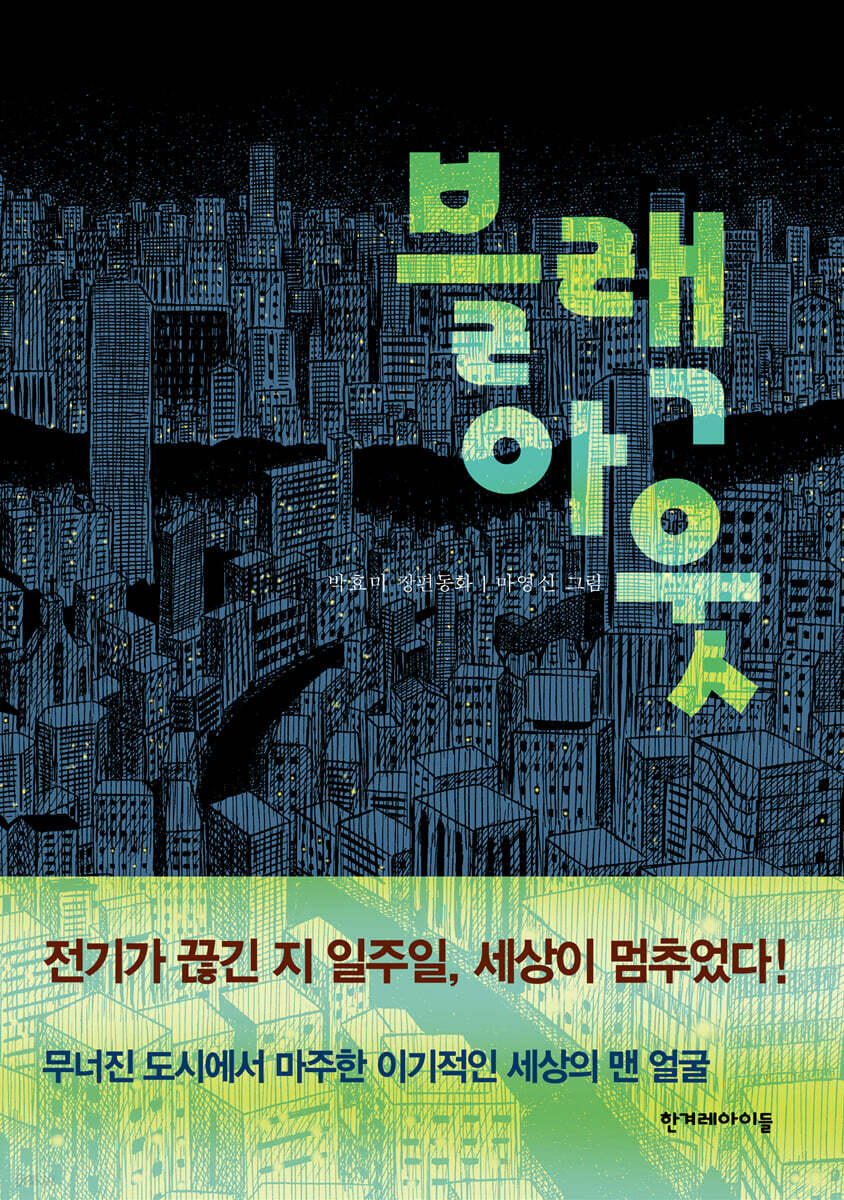
Hankyoreh Children's new book, "Blackout," is a full-length children's book for older students that deals with a fictional, large-scale power outage that occurs over a week.
This work, which embodies a sense of social crisis in a highly polished form through children's literature, is a meaningful publication as we approach the height of the summer heat.
This work is particularly noteworthy for not only predicting the serious damage that a blackout would bring, but also sharply pointing out the distorted nature of adults who reveal their selfishness in the face of crisis and the flawed social system from a child's perspective.
In 2003, the eastern United States and Canada experienced a three-day blackout.
With transportation, communication, and even drinking water cut off, 55 million citizens were left in darkness.
Economic losses amounted to $6 billion.
Many countries have experienced social unrest, including looting and riots, due to large-scale power outages.
Our country is no exception.
The nationwide blackout in 2011 was an incident in which electricity was cut off in rotation across the country to overcome a power shortage that was on the verge of a blackout.
Every summer, power emergencies become a hot topic.
News about record-breaking electricity demand and concerns about power reserve ratios is not unfamiliar.
Hankyoreh Children's new book, "Blackout," is a full-length children's book for older students that deals with a fictional, large-scale power outage that occurs over a week.
This work, which embodies a sense of social crisis in a highly polished form through children's literature, is a meaningful publication as we approach the height of the summer heat.
This work is particularly noteworthy for not only predicting the serious damage that a blackout would bring, but also sharply pointing out the distorted nature of adults who reveal their selfishness in the face of crisis and the flawed social system from a child's perspective.
- You can preview some of the book's contents.
Preview
index
First day
Second day
Third day
Fourth day
Fifth day
Sixth day
Seventh day
Epilogue
Second day
Third day
Fourth day
Fifth day
Sixth day
Seventh day
Epilogue
Publisher's Review
A record of seven days of breathtaking blackouts
The war between eating and pooping has begun!
"Blackout" is a story that takes place over a week in a small city in the metropolitan area.
From the first day to the seventh day, the story of one full day is organized into each chapter.
A series of events that unfold in a limited space and time are meticulously described, heightening the tension.
The main characters are Dongmin, an elementary school student, and his older sister Donghee, a middle school student.
An unprecedented power outage while their parents are away on a business trip abroad throws two children into an unexpected situation.
One summer day, during an unprecedented heat wave, a sudden power outage strikes the city.
On the first day, roads are immediately paralyzed and shops close.
The cell phone I was carrying around in my hand was useless.
The times when I can't make calls or search are just frustrating.
Children are unfamiliar with the pitch-black darkness of 9 p.m.
On the second day, the apartment's emergency power supply is quickly cut off, the elevator stops, and the emergency lights go out.
Dongmin, who has to climb up and down the top floor of an apartment building while sweating, is reminded of the fact that he lives on the 15th floor in the air.
The heat is unstoppable, and the exhausted adults begin to growl.
On the third day, the water and gas are cut off.
Children are excited as school closures are announced nationwide.
People gather in the square and listen to breaking news that repeats, "Normalization is coming soon."
You need to get water and food, but big box stores are operating with reduced hours, and all the shops in the city are locked down.
But the children still believe.
As I've heard, the engineers from the powerful nation of Haiti, South Korea, will soon resolve this situation.
On the fourth day, the battle over eating and pooping began.
All the toilets in the city begin to overflow with sewage.
Buying daily necessities at the supermarket is no easy task.
You have to stand in line, wait, and pay high prices.
But Dong-hee and Dong-min had their hard-earned purchases stolen.
The children begin to change when they realize that no one, not even the police right in front of them, is protecting them.
On the fifth day, cars completely disappear from the roads.
The sewers back up and the streets are overflowing with garbage.
You have to wait in line at the fire station to get water.
People who don't know the exact cause of the power outage or the progress of the situation are anxious.
As things get worse, some adults reveal their true selfishness.
Jin-su's mother, who lives next door, takes away the bags of rice that were left at Dong-min's house, demanding that he pay off his debt.
On the sixth day, you must find food and water to eat immediately.
Dong-hee and Dong-min hear a rumor that the church is distributing water, so they go there, but are turned away.
He tries to find necessities by asking around at stores that are operating secretly, but even those are soon robbed.
The world is not easy.
Not all materials and information are shared.
Children are taken away and neglected because they are children.
On the seventh day, the citizens' anxiety reaches its peak.
The footsteps of people who gathered at the apartment management office to vent their complaints naturally head towards the supermarket.
The line of people moving in groups of three or five suddenly grows like a snowball.
And then there is a confrontation with the police escorting the mart.
A 'riot' breaks out, with people entering the supermarket by force, looting and destroying everything in their path.
In the midst of the scorching heat, darkness, and a whirlwind of anger, rain begins to fall.
At that moment, as if by magic, the electricity came back on.
The events that occur consecutively over the course of a week are all depicted through Dongmin's experiences and perspectives.
Left alone without parents, siblings Dong-hee and Dong-min faced their situation head-on, rather than avoiding or ignoring it.
Thanks to this, we can look into the distorted aspects of our society through the eyes of a child.
Another important aspect of this story is the episode of the stray cat that Dongmin brought home.
A stray kitten left alone after losing its mother reflects the plight of children well.
Dongmin sees himself as weak and helpless in the kitten that continues its precarious life.
Dongmin, who cannot take responsibility and lets the cat out again, but has no choice but to take responsibility and brings it back.
When the cat finally dies, Dongmin becomes angry at the world.
A distorted self-portrait of our society through the eyes of children
Park Hyo-mi, the children's author who wrote this book, is a popular author who wrote 『Diary Library』 『Stray Cat Cushion』 『Speech Bubble Mirror』 『Yellow Box』.
It has been loved by many children from elementary to high school for its rich material and novel stories that closely relate to their daily lives and interests.
The protagonists he creates always face a difficult world, but they face it with their own unique confidence and liveliness.
『Blackout』is also an extension of that.
The self-directed nature of making a living in 『Let's Make Money, Mom?』 and the timely interest in social issues shown in 『Park Soon-mi's Beauty Salon』 are also well represented in 『Blackout』.
Could the energy challenges we face be more starkly portrayed?
Electricity is more than just the environment that surrounds us.
This book tells us that electricity is the basis of the fundamental problem of 'eating and excreting', the driving force of the economy, education, and safety, and the very life of urban residents.
Conflicts continue to arise over the safety of nuclear power plants and transmission towers and their construction, but no one has a clear solution.
Saving electricity may no longer be the answer.
This book asks readers to expand the energy problem into a social structural problem.
It was only a few days before the world we believed to be perfect collapsed.
Children never learn how to navigate emergencies, neither in school nor in books.
The world seen through the eyes of such children is absurdly unfamiliar and absurd.
Adults who throw away their conscience for a bucket of water, police officers who forget their duty and confront citizens, groups who unite and take sides, a government that tries to silence public opinion with a few words…
It is a familiar, painful self-portrait of our society.
There are no far-fetched settings or fantasies in 『Blackout』.
The most frightening thing is that it wouldn't be strange if the same thing happened right now, right around us.
This summer, I recommend 『Blackout』, a story that will chill your liver and heart more than any other horror story.
The war between eating and pooping has begun!
"Blackout" is a story that takes place over a week in a small city in the metropolitan area.
From the first day to the seventh day, the story of one full day is organized into each chapter.
A series of events that unfold in a limited space and time are meticulously described, heightening the tension.
The main characters are Dongmin, an elementary school student, and his older sister Donghee, a middle school student.
An unprecedented power outage while their parents are away on a business trip abroad throws two children into an unexpected situation.
One summer day, during an unprecedented heat wave, a sudden power outage strikes the city.
On the first day, roads are immediately paralyzed and shops close.
The cell phone I was carrying around in my hand was useless.
The times when I can't make calls or search are just frustrating.
Children are unfamiliar with the pitch-black darkness of 9 p.m.
On the second day, the apartment's emergency power supply is quickly cut off, the elevator stops, and the emergency lights go out.
Dongmin, who has to climb up and down the top floor of an apartment building while sweating, is reminded of the fact that he lives on the 15th floor in the air.
The heat is unstoppable, and the exhausted adults begin to growl.
On the third day, the water and gas are cut off.
Children are excited as school closures are announced nationwide.
People gather in the square and listen to breaking news that repeats, "Normalization is coming soon."
You need to get water and food, but big box stores are operating with reduced hours, and all the shops in the city are locked down.
But the children still believe.
As I've heard, the engineers from the powerful nation of Haiti, South Korea, will soon resolve this situation.
On the fourth day, the battle over eating and pooping began.
All the toilets in the city begin to overflow with sewage.
Buying daily necessities at the supermarket is no easy task.
You have to stand in line, wait, and pay high prices.
But Dong-hee and Dong-min had their hard-earned purchases stolen.
The children begin to change when they realize that no one, not even the police right in front of them, is protecting them.
On the fifth day, cars completely disappear from the roads.
The sewers back up and the streets are overflowing with garbage.
You have to wait in line at the fire station to get water.
People who don't know the exact cause of the power outage or the progress of the situation are anxious.
As things get worse, some adults reveal their true selfishness.
Jin-su's mother, who lives next door, takes away the bags of rice that were left at Dong-min's house, demanding that he pay off his debt.
On the sixth day, you must find food and water to eat immediately.
Dong-hee and Dong-min hear a rumor that the church is distributing water, so they go there, but are turned away.
He tries to find necessities by asking around at stores that are operating secretly, but even those are soon robbed.
The world is not easy.
Not all materials and information are shared.
Children are taken away and neglected because they are children.
On the seventh day, the citizens' anxiety reaches its peak.
The footsteps of people who gathered at the apartment management office to vent their complaints naturally head towards the supermarket.
The line of people moving in groups of three or five suddenly grows like a snowball.
And then there is a confrontation with the police escorting the mart.
A 'riot' breaks out, with people entering the supermarket by force, looting and destroying everything in their path.
In the midst of the scorching heat, darkness, and a whirlwind of anger, rain begins to fall.
At that moment, as if by magic, the electricity came back on.
The events that occur consecutively over the course of a week are all depicted through Dongmin's experiences and perspectives.
Left alone without parents, siblings Dong-hee and Dong-min faced their situation head-on, rather than avoiding or ignoring it.
Thanks to this, we can look into the distorted aspects of our society through the eyes of a child.
Another important aspect of this story is the episode of the stray cat that Dongmin brought home.
A stray kitten left alone after losing its mother reflects the plight of children well.
Dongmin sees himself as weak and helpless in the kitten that continues its precarious life.
Dongmin, who cannot take responsibility and lets the cat out again, but has no choice but to take responsibility and brings it back.
When the cat finally dies, Dongmin becomes angry at the world.
A distorted self-portrait of our society through the eyes of children
Park Hyo-mi, the children's author who wrote this book, is a popular author who wrote 『Diary Library』 『Stray Cat Cushion』 『Speech Bubble Mirror』 『Yellow Box』.
It has been loved by many children from elementary to high school for its rich material and novel stories that closely relate to their daily lives and interests.
The protagonists he creates always face a difficult world, but they face it with their own unique confidence and liveliness.
『Blackout』is also an extension of that.
The self-directed nature of making a living in 『Let's Make Money, Mom?』 and the timely interest in social issues shown in 『Park Soon-mi's Beauty Salon』 are also well represented in 『Blackout』.
Could the energy challenges we face be more starkly portrayed?
Electricity is more than just the environment that surrounds us.
This book tells us that electricity is the basis of the fundamental problem of 'eating and excreting', the driving force of the economy, education, and safety, and the very life of urban residents.
Conflicts continue to arise over the safety of nuclear power plants and transmission towers and their construction, but no one has a clear solution.
Saving electricity may no longer be the answer.
This book asks readers to expand the energy problem into a social structural problem.
It was only a few days before the world we believed to be perfect collapsed.
Children never learn how to navigate emergencies, neither in school nor in books.
The world seen through the eyes of such children is absurdly unfamiliar and absurd.
Adults who throw away their conscience for a bucket of water, police officers who forget their duty and confront citizens, groups who unite and take sides, a government that tries to silence public opinion with a few words…
It is a familiar, painful self-portrait of our society.
There are no far-fetched settings or fantasies in 『Blackout』.
The most frightening thing is that it wouldn't be strange if the same thing happened right now, right around us.
This summer, I recommend 『Blackout』, a story that will chill your liver and heart more than any other horror story.
GOODS SPECIFICS
- Date of issue: April 7, 2023
- Page count, weight, size: 244 pages | 153*223*15mm
- ISBN13: 9791160409796
- ISBN10: 116040979X
You may also like
카테고리
korean


korean

![GQ KOREA Mark (Monthly): December [2025]](http://librairie.coreenne.fr/cdn/shop/files/8ef265dbbfbf186523ed75ba7319009d.jpg?v=1765340328&width=3840)


