

We Can't Stop 1
 |
Description
Book Introduction
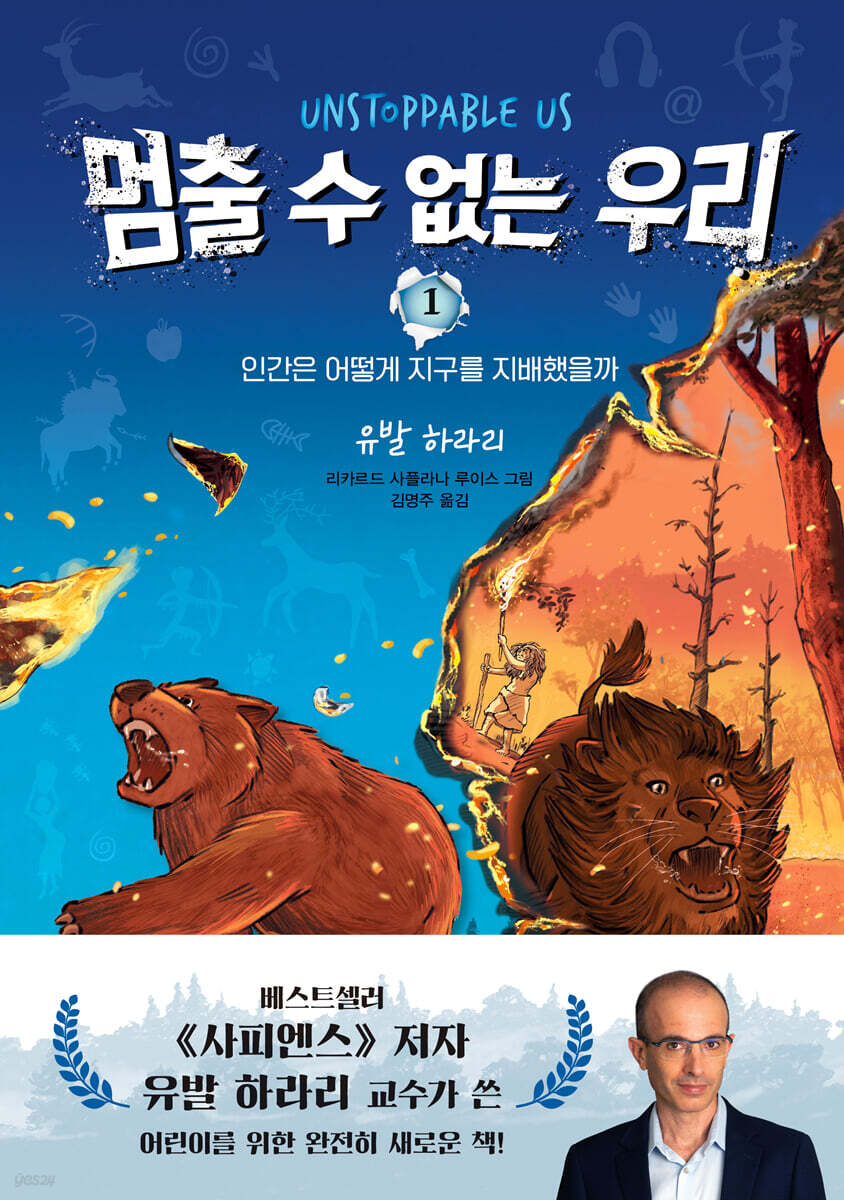
Written by Professor Yuval Harari, author of the world-wide bestseller Sapiens My first book for children and young adults! “The world we live in doesn’t have to be exactly like it is now. “We are the ones who created the world we live in today, and we are the ones who can change it.” Historian Professor Yuval Harari is one of the most influential intellectuals of our time. His book Sapiens became an instant bestseller and remains a bestseller in the humanities and liberal arts category for the next ten years. Professor Yuval Harari has published a series of human stories for children and young adults titled “Unstoppable Us 1: How Humans Ruled the Earth.” It is planned to be a four-part series, with one volume to be published each year. This book tells the story of humanity from the time we were apes on the African savannah to the present day, when we have become almost god-like, flying through the skies in airplanes and spaceships. This book will answer questions like why people go to war, why they have nightmares, why they like sugar, and why they believe in God. The author added a note about the book, saying that it was the book he wished he had read when he was a child. |
- You can preview some of the book's contents.
Preview
index
About this book
Preface to the Korean edition
Preface: What is a Human?
Chapter 1: Humans are animals.
Chapter 2: Sapiens' Superpowers
Chapter 3: How did our ancestors live?
Chapter 4: Where Did All the Animals Go?
Acknowledgements
Preface to the Korean edition
Preface: What is a Human?
Chapter 1: Humans are animals.
Chapter 2: Sapiens' Superpowers
Chapter 3: How did our ancestors live?
Chapter 4: Where Did All the Animals Go?
Acknowledgements
Detailed image
Into the book
This story begins millions of years ago.
At that time, humans were very ordinary animals.
I didn't build a house or live in it, I didn't go to work or school, I didn't have a car, a computer, or a supermarket.
People lived in the mountains and fields.
I climbed trees and picked fruit, sniffed around for edible mushrooms, and caught and ate any earthworms, snails, and frogs I saw.
Other animals, such as giraffes, zebras, and baboons, were not afraid of humans, and didn't even care about them.
No one could have imagined that one day humans would go to the moon, build an atomic bomb, or write the book you're reading now.
At first, I didn't even know how to make tools.
There were no bows, arrows, spears, or swords, except for the occasional stone to break the fruit.
Humans were weak compared to other animals.
So, whenever a lion or a bear appeared, I had to run away.
That too, in a nutshell.
--- p.17
By using fire, humans were reborn as special beings.
Animals usually use their bodies when exerting force.
Use strong muscles, large teeth, and sharp claws.
But thanks to fire, humans have gained infinite power, independent of their physical condition.
With just a lit stick, a single, weak human being could burn down an entire forest in a matter of hours, destroying thousands of trees and killing thousands of animals.
Fire drove away the lions and brought warmth and light.
But most importantly, fire allowed ancient humans to cook.
Before using fire, humans had to spend a lot of time and effort eating raw food.
Because I had to cut it into small pieces and chew it for a long time.
But it still didn't digest well.
So humans needed big teeth and a big stomach, and they also had to develop patience.
But with the use of fire, eating became much easier.
Cooking makes food softer, reducing the time and energy it takes to eat and digest it.
As a result, people's bodies began to change.
My teeth and stomach got smaller, and most importantly, I got a lot more free time!
--- p.21~22
When scientists named their species, they naturally chose very noble Latin names.
That's right, it was Homo sapiens.
What does it mean? In Latin, 'sapiens' means 'wise'.
So, Homo sapiens means 'wise man'.
We decided to call ourselves 'the wise people'.
It's a name that's far from humble.
Because there is absolutely no reason to believe that we Sapiens are any more intelligent than the rest of humanity.
But what can we do if Sapiens becomes our name?
You are a sapiens, and your friends, family, and relatives are all sapiens.
Everyone in the world today is a sapiens.
Germans are sapiens, Nigerians are sapiens, Koreans are sapiens, Brazilians are sapiens.
About 100,000 years ago, our Sapiens ancestors lived mainly in Africa.
Sapiens ancestors already looked similar to modern humans at that time.
If you had a sleek haircut and worn jeans and a t-shirt instead of animal skins, you would have looked like a modern man.
But ancient Sapiens were still quite different from us.
--- p.36
What would the world be like today if our ancestors had been more kind and left the Neanderthals and the tiny humans of Flores alone? Isn't it exciting to imagine other species living alongside us?
Perhaps you had a brawny Neanderthal friend on your school track team? Perhaps a tiny human from Flores lived next door? What about politics and religion? Did Denisovans have the right to vote? Did priests bless marriages between Neanderthals and Sapiens? Could Neanderthals also become religious leaders, like priests, rabbis, or imams?
Would you have befriended a Neanderthal? If other humans had lived alongside us, our perception of ourselves might have changed.
We think we are very special beings.
When you say, 'Humans are animals too,' many people get serious and angry.
Because we think we are completely different from animals.
--- p.42
What happened about 50,000 years ago? What superpowers did Sapiens acquire that allowed them to dominate the Earth today? The answer is not obvious.
The reason Superman, Spiderman, Wonder Woman, and all the superheroes in comics have such incredible powers is because they are strong, fast, and brave.
But Sapiens are not stronger, faster, or braver than Neanderthals.
The same is true compared to countless other animals.
There was little chance that Sapiens could win a fight against wolves, crocodiles, or chimpanzees.
Even an old chimpanzee could beat a world boxing champion.
The only reason Sapiens can chase away wolves and keep chimpanzees in zoos is because so many people cooperate with each other.
One human cannot beat one chimpanzee, but when a thousand humans come together, they can accomplish amazing things that chimpanzees can't even dream of.
And the reason we can cooperate better than any other animal is because of that secret superpower.
We can collaborate with people we don't even know.
At that time, humans were very ordinary animals.
I didn't build a house or live in it, I didn't go to work or school, I didn't have a car, a computer, or a supermarket.
People lived in the mountains and fields.
I climbed trees and picked fruit, sniffed around for edible mushrooms, and caught and ate any earthworms, snails, and frogs I saw.
Other animals, such as giraffes, zebras, and baboons, were not afraid of humans, and didn't even care about them.
No one could have imagined that one day humans would go to the moon, build an atomic bomb, or write the book you're reading now.
At first, I didn't even know how to make tools.
There were no bows, arrows, spears, or swords, except for the occasional stone to break the fruit.
Humans were weak compared to other animals.
So, whenever a lion or a bear appeared, I had to run away.
That too, in a nutshell.
--- p.17
By using fire, humans were reborn as special beings.
Animals usually use their bodies when exerting force.
Use strong muscles, large teeth, and sharp claws.
But thanks to fire, humans have gained infinite power, independent of their physical condition.
With just a lit stick, a single, weak human being could burn down an entire forest in a matter of hours, destroying thousands of trees and killing thousands of animals.
Fire drove away the lions and brought warmth and light.
But most importantly, fire allowed ancient humans to cook.
Before using fire, humans had to spend a lot of time and effort eating raw food.
Because I had to cut it into small pieces and chew it for a long time.
But it still didn't digest well.
So humans needed big teeth and a big stomach, and they also had to develop patience.
But with the use of fire, eating became much easier.
Cooking makes food softer, reducing the time and energy it takes to eat and digest it.
As a result, people's bodies began to change.
My teeth and stomach got smaller, and most importantly, I got a lot more free time!
--- p.21~22
When scientists named their species, they naturally chose very noble Latin names.
That's right, it was Homo sapiens.
What does it mean? In Latin, 'sapiens' means 'wise'.
So, Homo sapiens means 'wise man'.
We decided to call ourselves 'the wise people'.
It's a name that's far from humble.
Because there is absolutely no reason to believe that we Sapiens are any more intelligent than the rest of humanity.
But what can we do if Sapiens becomes our name?
You are a sapiens, and your friends, family, and relatives are all sapiens.
Everyone in the world today is a sapiens.
Germans are sapiens, Nigerians are sapiens, Koreans are sapiens, Brazilians are sapiens.
About 100,000 years ago, our Sapiens ancestors lived mainly in Africa.
Sapiens ancestors already looked similar to modern humans at that time.
If you had a sleek haircut and worn jeans and a t-shirt instead of animal skins, you would have looked like a modern man.
But ancient Sapiens were still quite different from us.
--- p.36
What would the world be like today if our ancestors had been more kind and left the Neanderthals and the tiny humans of Flores alone? Isn't it exciting to imagine other species living alongside us?
Perhaps you had a brawny Neanderthal friend on your school track team? Perhaps a tiny human from Flores lived next door? What about politics and religion? Did Denisovans have the right to vote? Did priests bless marriages between Neanderthals and Sapiens? Could Neanderthals also become religious leaders, like priests, rabbis, or imams?
Would you have befriended a Neanderthal? If other humans had lived alongside us, our perception of ourselves might have changed.
We think we are very special beings.
When you say, 'Humans are animals too,' many people get serious and angry.
Because we think we are completely different from animals.
--- p.42
What happened about 50,000 years ago? What superpowers did Sapiens acquire that allowed them to dominate the Earth today? The answer is not obvious.
The reason Superman, Spiderman, Wonder Woman, and all the superheroes in comics have such incredible powers is because they are strong, fast, and brave.
But Sapiens are not stronger, faster, or braver than Neanderthals.
The same is true compared to countless other animals.
There was little chance that Sapiens could win a fight against wolves, crocodiles, or chimpanzees.
Even an old chimpanzee could beat a world boxing champion.
The only reason Sapiens can chase away wolves and keep chimpanzees in zoos is because so many people cooperate with each other.
One human cannot beat one chimpanzee, but when a thousand humans come together, they can accomplish amazing things that chimpanzees can't even dream of.
And the reason we can cooperate better than any other animal is because of that secret superpower.
We can collaborate with people we don't even know.
--- p.47
Publisher's Review
- A completely new book for children and young adults written by Professor Yuval Harari, author of the world-renowned bestseller Sapiens!
- The magnificent true story of humanity, civilization, and culture unfolds like an epic!
- From the African savannah to the Greenland ice caps, how have humans dominated the planet?
-[New York Times] Bestseller!
-Includes preface to Korean edition
Did you know you have super powers?
Who are we and how did we get here?
How did we become so powerful?
This book covers the period from the emergence of the last common ancestor of humans and chimpanzees 6 million years ago to the spread of humans and the extinction of Neanderthals.
I asked him if he knew why Homo sapiens was the only one to survive among all the other human species.
The author explains this in two main ways.
First, Homo sapiens were relatively weak in nature, but through cooperation, they were able to dominate the Earth and even drove the giant animals, mastodontids and mammoths, into extinction.
The second is said to be because he had the ability to invent stories and imagine the invisible.
These two things are the reasons why Homo sapiens emerged as the only surviving human species and spread to almost every corner of the Earth.
As humans evolved and adapted, language developed, they began to believe in God, invented money, and developed a production system necessary for consumption, leading to the emergence of corporations.
It also gave birth to a way to work together.
Now humans have become so powerful that the fate of other animals depends on them.
Lions, eagles, and dolphins still exist because humans have kept them alive.
So the author says that in order to become a good person, you must understand and realize what you must do with the power you have.
Humans are the only animals capable of dreaming of things that do not actually exist, of imagining anything, of inventing and believing in legends, fairy tales and myths.
By working together, we can use our power for good.
If we understand how businesses work and collaborate, we can save these endangered whales.
This part may be like a hero from the whale's perspective, and humans are capable of such amazing things.
Just as our ancestors shaped the world we live in today, we too can determine what the world will become.
This story of human progress is the most amazing story ever told, and it is a true story.
In this book, Yuval Harari crosses the boundaries of various fields of study, including anthropology, archaeology, sociology, philosophy, history, and science, and explains that history is not the past but the present through a three-dimensional structure that goes back and forth between the past and the present.
It thus unfolds the growth of civilization, the industrial revolution, and how we deal with the various problems facing humanity today.
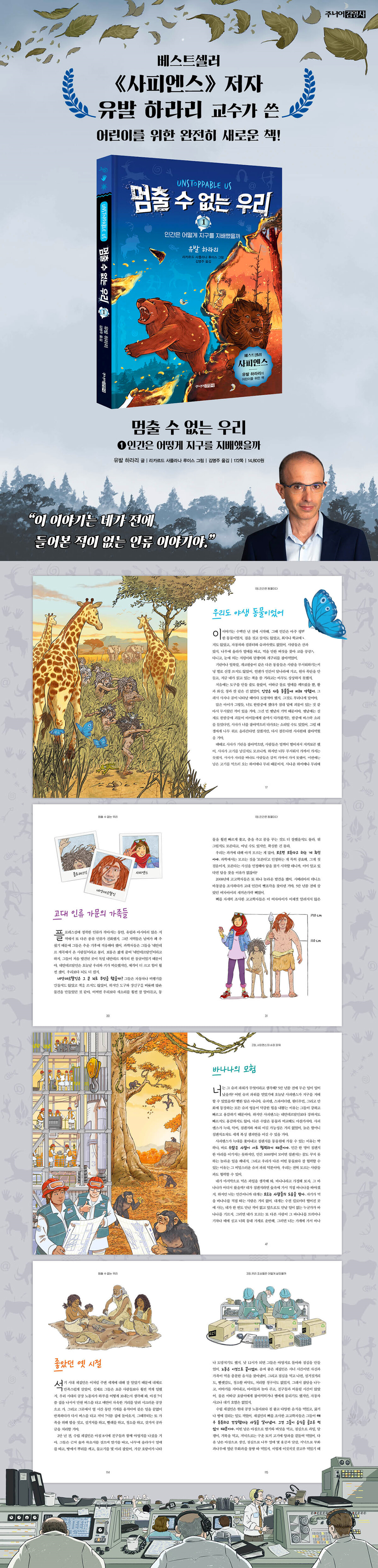
A vivid picture depicting human activities from prehistoric times to the present.
This book contains illustrations on almost every page.
Animals fleeing fire, the Great Migration, the timeline of history, the development of modern industrial society, and even lifestyles.
Vivid illustrations unfold.
The paintings, which combine past and present, contrast the human condition, seemingly asking the question of what made us who we are.
In particular, the cover background, which feels like a modernly reconstructed petroglyph, is a combination of archaeological discoveries and symbols of modern society, supporting Yuval Harari's argument that history is the present.
- The magnificent true story of humanity, civilization, and culture unfolds like an epic!
- From the African savannah to the Greenland ice caps, how have humans dominated the planet?
-[New York Times] Bestseller!
-Includes preface to Korean edition
Did you know you have super powers?
Who are we and how did we get here?
How did we become so powerful?
This book covers the period from the emergence of the last common ancestor of humans and chimpanzees 6 million years ago to the spread of humans and the extinction of Neanderthals.
I asked him if he knew why Homo sapiens was the only one to survive among all the other human species.
The author explains this in two main ways.
First, Homo sapiens were relatively weak in nature, but through cooperation, they were able to dominate the Earth and even drove the giant animals, mastodontids and mammoths, into extinction.
The second is said to be because he had the ability to invent stories and imagine the invisible.
These two things are the reasons why Homo sapiens emerged as the only surviving human species and spread to almost every corner of the Earth.
As humans evolved and adapted, language developed, they began to believe in God, invented money, and developed a production system necessary for consumption, leading to the emergence of corporations.
It also gave birth to a way to work together.
Now humans have become so powerful that the fate of other animals depends on them.
Lions, eagles, and dolphins still exist because humans have kept them alive.
So the author says that in order to become a good person, you must understand and realize what you must do with the power you have.
Humans are the only animals capable of dreaming of things that do not actually exist, of imagining anything, of inventing and believing in legends, fairy tales and myths.
By working together, we can use our power for good.
If we understand how businesses work and collaborate, we can save these endangered whales.
This part may be like a hero from the whale's perspective, and humans are capable of such amazing things.
Just as our ancestors shaped the world we live in today, we too can determine what the world will become.
This story of human progress is the most amazing story ever told, and it is a true story.
In this book, Yuval Harari crosses the boundaries of various fields of study, including anthropology, archaeology, sociology, philosophy, history, and science, and explains that history is not the past but the present through a three-dimensional structure that goes back and forth between the past and the present.
It thus unfolds the growth of civilization, the industrial revolution, and how we deal with the various problems facing humanity today.
A vivid picture depicting human activities from prehistoric times to the present.
This book contains illustrations on almost every page.
Animals fleeing fire, the Great Migration, the timeline of history, the development of modern industrial society, and even lifestyles.
Vivid illustrations unfold.
The paintings, which combine past and present, contrast the human condition, seemingly asking the question of what made us who we are.
In particular, the cover background, which feels like a modernly reconstructed petroglyph, is a combination of archaeological discoveries and symbols of modern society, supporting Yuval Harari's argument that history is the present.
GOODS SPECIFICS
- Date of issue: February 27, 2023
- Format: Hardcover book binding method guide
- Page count, weight, size: 172 pages | 498g | 168*236*15mm
- ISBN13: 9788934958987
- ISBN10: 8934958987
- KC Certification: Certification Type: Conformity Confirmation
You may also like
카테고리
korean


korean

![ELLE 엘르 스페셜 에디션 A형 : 12월 [2025]](http://librairie.coreenne.fr/cdn/shop/files/b8e27a3de6c9538896439686c6b0e8fb.jpg?v=1766436872&width=3840)


