

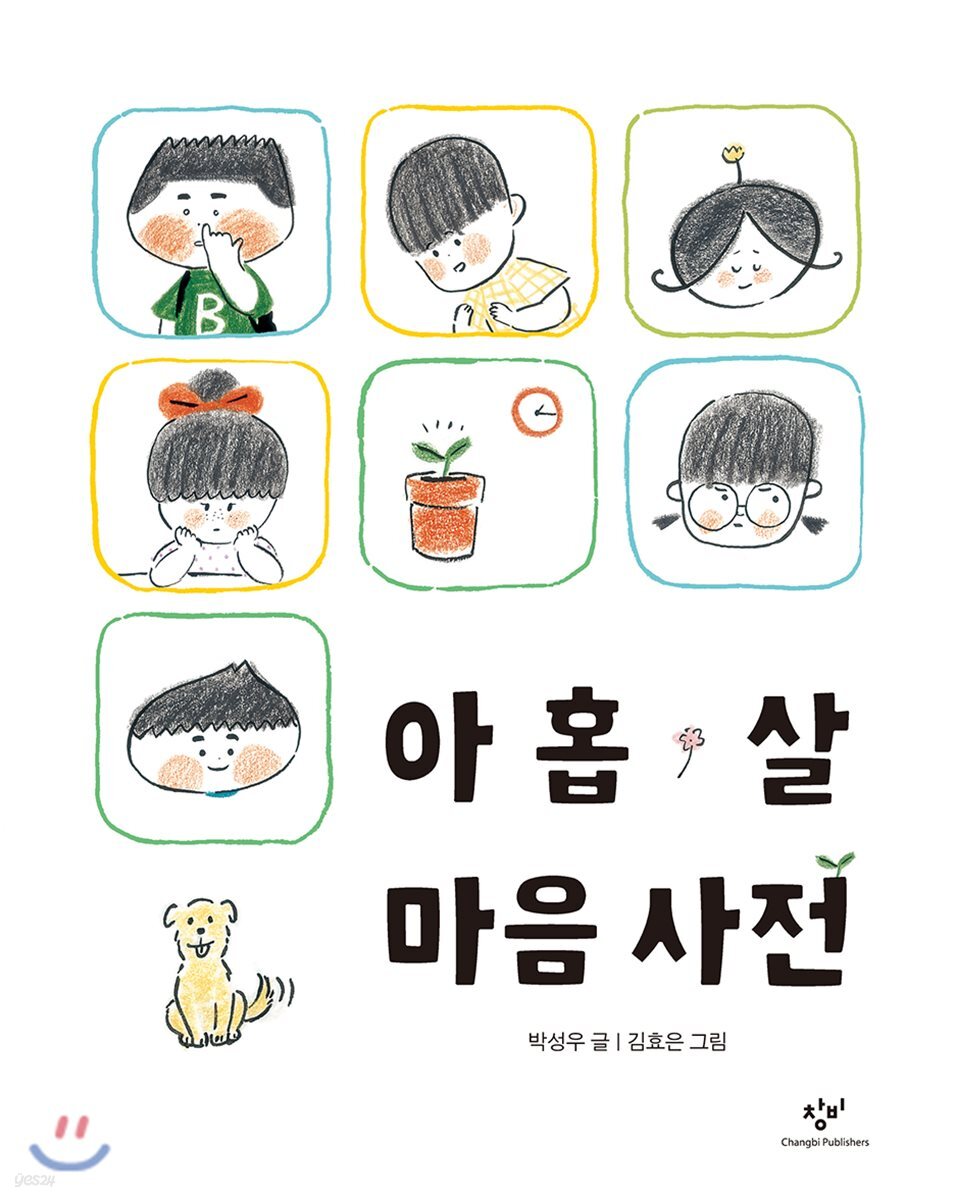
Nine-Year-Old's Dictionary of the Mind
 |
Description
Book Introduction
- A word from MD
- [Emotional dictionary containing 80 words that express children's feelings] Contains words that express emotions that even adults have difficulty using, such as proud / refreshing / empty.
Poet Park Seong-woo personally selected the poems to better express the emotional movements felt in children's daily lives - Children's MD Kim Su-yeon
Emotions Dictionary for Children
A book titled "Nine-Year-Old's Mind Dictionary," which contains 80 words that express the mind, has been published.
We introduce emotional expressions that elementary school children in the lower grades can use in their daily lives in dictionary form with pictures.
By learning to express a variety of emotions through specific, realistic pictures and friendly explanations, we help children understand and express their feelings accurately, as well as feel a wider range of emotions.
The poem was written by poet Park Seong-woo, who is loved for his concise and lyrical poetry, and the illustrations were drawn by artist Kim Hyo-eun, who has presented paintings that stimulate the senses.
『Dictionary of the Nine-Year-Old's Heart』 contains 80 expressions of emotion selected by poet Park Seong-woo, a representative lyric poet of Korea who is also loved by young readers for his warm and humorous poetry.
The poet uses concise sentences to show situations that children are likely to encounter in their daily lives, allowing young readers to naturally feel emotions.
What makes 『Dictionary of the Nine-Year-Old's Heart』 so realistic and accessible to young readers is the illustrations of author Kim Hyo-eun.
Author Kim Hyo-eun, who recently garnered significant attention for her picture book, “I am a Subway,” worked closely with poet Park Seong-woo during the publication process to express children’s minds more intuitively and sensuously.
Pictures that realistically portray a child's heart while simultaneously warmly embracing it will greatly help readers vividly experience the expression of emotions.
A book titled "Nine-Year-Old's Mind Dictionary," which contains 80 words that express the mind, has been published.
We introduce emotional expressions that elementary school children in the lower grades can use in their daily lives in dictionary form with pictures.
By learning to express a variety of emotions through specific, realistic pictures and friendly explanations, we help children understand and express their feelings accurately, as well as feel a wider range of emotions.
The poem was written by poet Park Seong-woo, who is loved for his concise and lyrical poetry, and the illustrations were drawn by artist Kim Hyo-eun, who has presented paintings that stimulate the senses.
『Dictionary of the Nine-Year-Old's Heart』 contains 80 expressions of emotion selected by poet Park Seong-woo, a representative lyric poet of Korea who is also loved by young readers for his warm and humorous poetry.
The poet uses concise sentences to show situations that children are likely to encounter in their daily lives, allowing young readers to naturally feel emotions.
What makes 『Dictionary of the Nine-Year-Old's Heart』 so realistic and accessible to young readers is the illustrations of author Kim Hyo-eun.
Author Kim Hyo-eun, who recently garnered significant attention for her picture book, “I am a Subway,” worked closely with poet Park Seong-woo during the publication process to express children’s minds more intuitively and sensuously.
Pictures that realistically portray a child's heart while simultaneously warmly embracing it will greatly help readers vividly experience the expression of emotions.
- You can preview some of the book's contents.
Preview
index
I'm touched / I'm worried / I'm thankful / It's okay / It's painful / I'm curious / I'm cute / I miss you / I'm happy / I'm bad / I'm surprised / I'm fortunate / I'm sweet / I'm frustrated / I'm embarrassed / I'm scared / I'm bored / I'm heavy / I'm scared / I'm sorry / I hate you / I'm glad / I'm overwhelmed / I miss you / I'm embarrassed / I'm burdened / I'm pitiful / I'm anxious / I'm upset / I'm uncomfortable / I'm unhappy / I'm proud / I love you / I'm refreshing / I'm happy / I'm sad / I'm excited / I'm sad / I'm sad / I'm excited / I'm upset / I'm sad ... / anxious / refreshing / comfortable / peaceful / happy / empty / hollow / disappointing / angry / relieved / warm / pleased
Detailed image
.jpg)
Publisher's Review
“I want to speak my mind!”
Emotion Dictionary for Children
Expressing emotions accurately can be difficult for children.
As can be seen from the example of many children recently using the word "annoyed" instead of various expressions such as "annoyed," "displeased," "upset," and "unfair," children are likely to have difficulty expressing their feelings properly or to repeatedly use simple expressions.
Inaccurate expression of emotions can make communication with friends, parents, or teachers difficult and can even lead to unnecessary misunderstandings and conflicts.
"Dictionary of the Nine-Year-Old's Heart" is a book that contains 80 words that express emotions, from "I'm touched" to "I'm happy," arranged alphabetically like a dictionary. It shows situations that children frequently encounter in their daily lives and introduces expressions of emotions appropriate for those situations.
Young readers can empathize with situations expressed through concise text and realistic illustrations, feel a variety of emotions realistically, and learn to express emotions appropriately for the situation.
You can also understand the exact meaning by reading the explanation and learn how to use it specifically through various situations in which emotional expressions are used.
Reading "The Nine-Year-Old's Dictionary of Emotions" and learning about various expressions of emotion will be of great help to young readers in expressing their feelings and communicating with others.
“I want to know my heart! I want to feel more!”
A dictionary containing diverse and specific expressions
Learning to express a variety of emotions helps you understand your own feelings more accurately.
'Scared' and 'nervous' have similar meanings, but there is a difference in meaning.
In a situation where you turn off the lights at night and a ghost seems likely to appear, 'scary' is more appropriate, and when you feel like a balloon is about to burst, 'nervous' is more appropriate.
If you know a lot of similar yet different expressions, you can understand emotions more delicately.
『Dictionary of the Nine-Year-Old's Heart』 introduces various emotional expressions that seem similar at first glance, allowing young readers to naturally learn the differences between them.
Learning to express a variety of emotions also helps you feel them more richly.
When faced with a happy and pleasant situation, the feelings of a person who only knows the expression 'good' and a person who knows a variety of expressions such as 'happy', 'fortunate', 'overwhelmed', 'satisfied', 'enjoyable', 'refreshing', and 'relief' are bound to be different.
『Dictionary of the Nine-Year-Old's Heart』 includes basic expressions such as 'good', 'bad', 'happy', and 'sad', as well as more specific expressions such as 'refreshing', 'sad', 'pitiful', and 'affectionate'.
Young readers will become more sensitive and emotional through the process of learning to express diverse and specific emotions.
Emotion Dictionary for Children
Expressing emotions accurately can be difficult for children.
As can be seen from the example of many children recently using the word "annoyed" instead of various expressions such as "annoyed," "displeased," "upset," and "unfair," children are likely to have difficulty expressing their feelings properly or to repeatedly use simple expressions.
Inaccurate expression of emotions can make communication with friends, parents, or teachers difficult and can even lead to unnecessary misunderstandings and conflicts.
"Dictionary of the Nine-Year-Old's Heart" is a book that contains 80 words that express emotions, from "I'm touched" to "I'm happy," arranged alphabetically like a dictionary. It shows situations that children frequently encounter in their daily lives and introduces expressions of emotions appropriate for those situations.
Young readers can empathize with situations expressed through concise text and realistic illustrations, feel a variety of emotions realistically, and learn to express emotions appropriately for the situation.
You can also understand the exact meaning by reading the explanation and learn how to use it specifically through various situations in which emotional expressions are used.
Reading "The Nine-Year-Old's Dictionary of Emotions" and learning about various expressions of emotion will be of great help to young readers in expressing their feelings and communicating with others.
“I want to know my heart! I want to feel more!”
A dictionary containing diverse and specific expressions
Learning to express a variety of emotions helps you understand your own feelings more accurately.
'Scared' and 'nervous' have similar meanings, but there is a difference in meaning.
In a situation where you turn off the lights at night and a ghost seems likely to appear, 'scary' is more appropriate, and when you feel like a balloon is about to burst, 'nervous' is more appropriate.
If you know a lot of similar yet different expressions, you can understand emotions more delicately.
『Dictionary of the Nine-Year-Old's Heart』 introduces various emotional expressions that seem similar at first glance, allowing young readers to naturally learn the differences between them.
Learning to express a variety of emotions also helps you feel them more richly.
When faced with a happy and pleasant situation, the feelings of a person who only knows the expression 'good' and a person who knows a variety of expressions such as 'happy', 'fortunate', 'overwhelmed', 'satisfied', 'enjoyable', 'refreshing', and 'relief' are bound to be different.
『Dictionary of the Nine-Year-Old's Heart』 includes basic expressions such as 'good', 'bad', 'happy', and 'sad', as well as more specific expressions such as 'refreshing', 'sad', 'pitiful', and 'affectionate'.
Young readers will become more sensitive and emotional through the process of learning to express diverse and specific emotions.
GOODS SPECIFICS
- Date of issue: March 10, 2017
- Page count, weight, size: 168 pages | 326g | 152*190*20mm
- ISBN13: 9788936447014
- ISBN10: 8936447017
You may also like
카테고리
korean


korean

![ELLE 엘르 스페셜 에디션 A형 : 12월 [2025]](http://librairie.coreenne.fr/cdn/shop/files/b8e27a3de6c9538896439686c6b0e8fb.jpg?v=1766436872&width=3840)


