

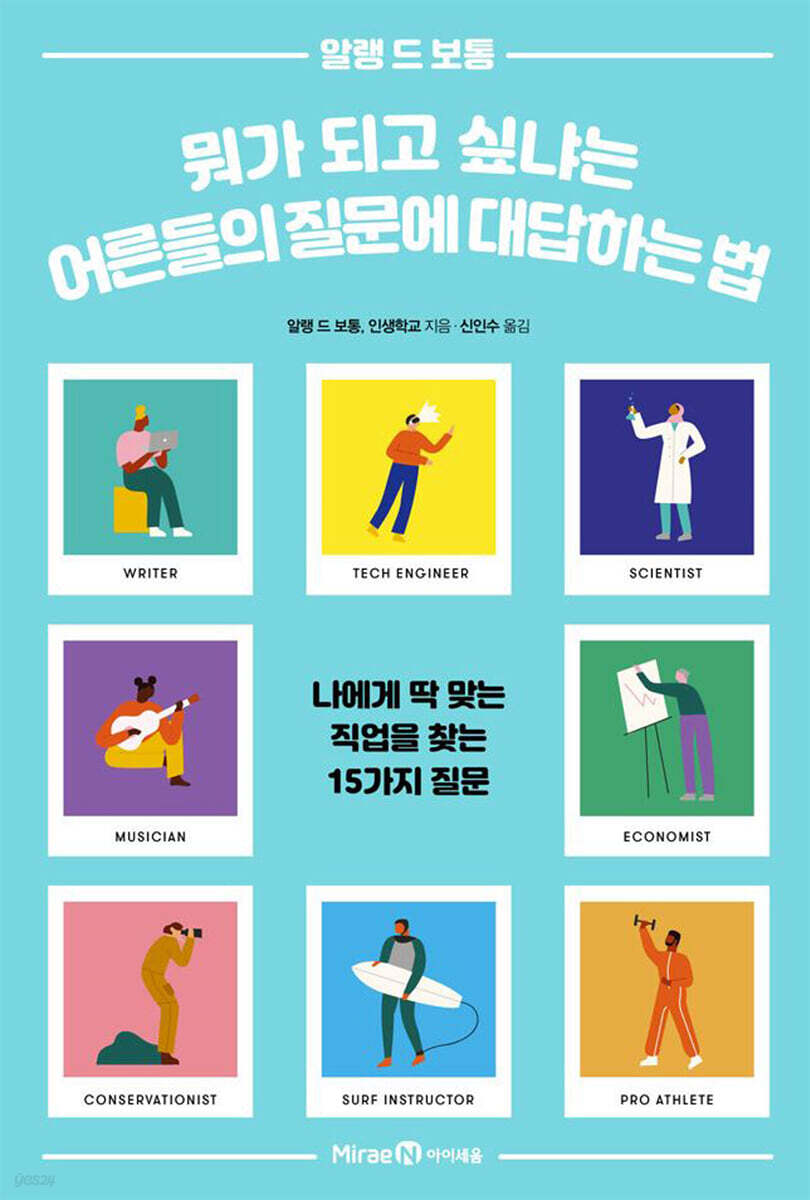
How to answer adults' questions about what you want to be
 |
Description
Book Introduction
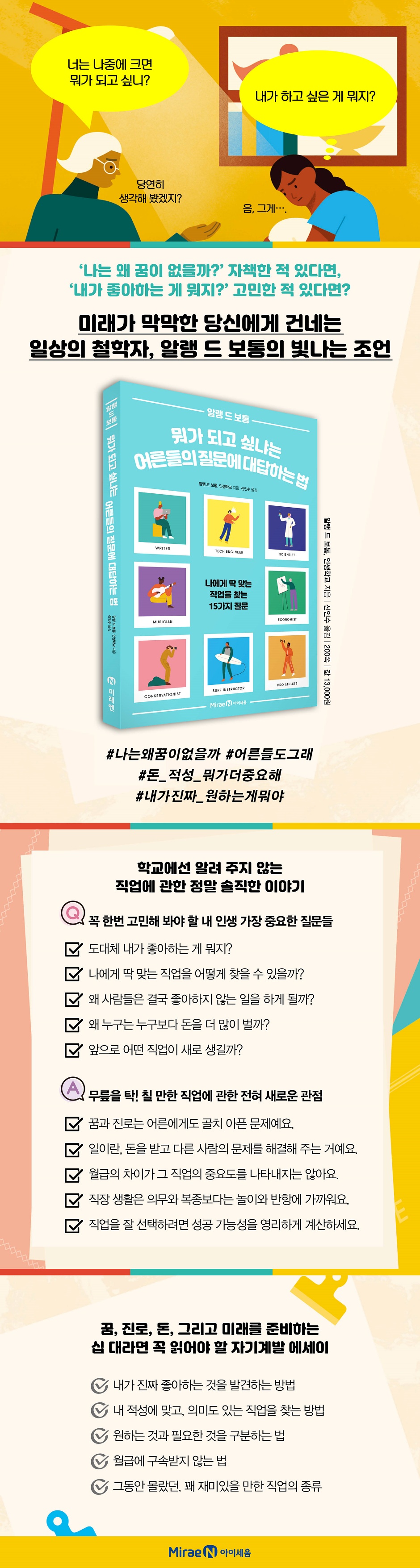
Alain de Botton, the philosopher of everyday life To those who are uncertain about their dreams, career path, and future Honest advice and brilliant insights Whenever I attend a relatives' gathering, this question always comes up and hits me. “What do you want to do after graduation?” “What is your dream?” And that night, I kick the blanket as I remember myself not being able to answer clearly. While I was blaming myself, asking myself, "What do I like?" and "Why don't I have a dream?", I was also starting to hate the older relative who had asked me such questions so calmly. Alain de Botton, a philosopher of everyday life who has been translated into over 20 languages and loved by people all over the world for his books, including “Why Do I Love You?”, “Anxiety”, and the School of Life series, offers comfort by saying that there is no need to worry about not having something you want to do or be right now, as this question is a difficult one even for adults who have been in society for a long time. In "How to Answer Adults' Questions About What You Want to Be," Alain de Botton criticizes adults who ask about your future aspirations as if it were the most ordinary question in the world, while also taking you on a journey to find the right job for you by twisting the concept of career and occupation from a new perspective. |
- You can preview some of the book's contents.
Preview
index
Introductory text.
What will I do when I grow up?
Chapter 1.
Why It's Hard to Know What I Want to Do
Chapter 2.
What is a job?
Chapter 3.
Why are there so many types of jobs?
Chapter 4.
Why are some jobs boring?
Chapter 5.
How did professions come into being?
Chapter 6.
Good jobs and bad jobs
Chapter 7.
Sweet advertising tricks
Chapter 8.
Visible and invisible jobs
Chapter 9.
Why do some people earn more money than others?
Chapter 10.
Is it better to earn more?
Chapter 11.
What kind of work should I do to have fun?
Chapter 12.
Things I enjoy
Chapter 13.
Similarities and Differences Between Work and School
Chapter 14.
Why do you end up doing something you don't like?
Chapter 15.
How to answer the question, "What do you want to be when you grow up?"
About the Author
What will I do when I grow up?
Chapter 1.
Why It's Hard to Know What I Want to Do
Chapter 2.
What is a job?
Chapter 3.
Why are there so many types of jobs?
Chapter 4.
Why are some jobs boring?
Chapter 5.
How did professions come into being?
Chapter 6.
Good jobs and bad jobs
Chapter 7.
Sweet advertising tricks
Chapter 8.
Visible and invisible jobs
Chapter 9.
Why do some people earn more money than others?
Chapter 10.
Is it better to earn more?
Chapter 11.
What kind of work should I do to have fun?
Chapter 12.
Things I enjoy
Chapter 13.
Similarities and Differences Between Work and School
Chapter 14.
Why do you end up doing something you don't like?
Chapter 15.
How to answer the question, "What do you want to be when you grow up?"
About the Author
Detailed image
Into the book
Adults who ask what they want to be when they grow up seem to expect answers like "calling," but in reality, very few people find their calling.
(.…) Not finding the right job for you doesn't mean you're destined for a boring and dull life.
Just try and figure out what you want to do next.
This is perfectly normal and something worth trying.
--- p.24
This is the real reason why you can get paid to work.
People pay because they have problems they can't solve on their own.
You need someone else to help you.
But since few people will help you just by asking, you end up paying for help with money instead of receiving it from others.
If the problem is urgent and urgent, people are more willing to pay, especially if there are few people who can help.
Isn't that a truly amazing idea? In other words, work is about solving other people's problems in exchange for money.
--- p.35
There's one way to figure out what business the world needs.
I usually take a good look to see if there are any issues that haven't been addressed yet.
The best way to figure out which problems are good for business is to ask yourself.
To know what millions of potential customers need, you must first understand what you need.
The smartest way to do 'market research' is to look inside yourself.
--- p.74
Wait, I need to make an important point here.
The difference in salary does not indicate the 'importance' of the job.
Salaries simply reflect how much customers want to solve a problem and how many people have the skills to solve that problem.
--- p.114
Think of money as food ingredients.
Money is an important material.
But having one essential ingredient doesn't guarantee you a good meal.
We need olive oil to make delicious food, but if all we had to eat was olive oil, our lives would be incredibly depressing.
--- p.129
I can't say that every day is fun when you're an adult and have a job, but overall it's pretty fun.
Making a living isn't always difficult.
Take pleasure seriously.
Fun is essential to a good work life.
As adults, our ability to work depends on our ability to identify what we enjoy and find a career that suits that.
--- p.147
On the broad highway of life, there are many times when we must break rules, defy precedents, overturn traditions, and make shocking or surprising choices.
That requires a lot of inner strength.
--- p.175
Finding a happy job also means you've intelligently assessed your chances of success.
It's wise to avoid races where there are already too many competitors and focus on races you can actually win.
(.…) Not finding the right job for you doesn't mean you're destined for a boring and dull life.
Just try and figure out what you want to do next.
This is perfectly normal and something worth trying.
--- p.24
This is the real reason why you can get paid to work.
People pay because they have problems they can't solve on their own.
You need someone else to help you.
But since few people will help you just by asking, you end up paying for help with money instead of receiving it from others.
If the problem is urgent and urgent, people are more willing to pay, especially if there are few people who can help.
Isn't that a truly amazing idea? In other words, work is about solving other people's problems in exchange for money.
--- p.35
There's one way to figure out what business the world needs.
I usually take a good look to see if there are any issues that haven't been addressed yet.
The best way to figure out which problems are good for business is to ask yourself.
To know what millions of potential customers need, you must first understand what you need.
The smartest way to do 'market research' is to look inside yourself.
--- p.74
Wait, I need to make an important point here.
The difference in salary does not indicate the 'importance' of the job.
Salaries simply reflect how much customers want to solve a problem and how many people have the skills to solve that problem.
--- p.114
Think of money as food ingredients.
Money is an important material.
But having one essential ingredient doesn't guarantee you a good meal.
We need olive oil to make delicious food, but if all we had to eat was olive oil, our lives would be incredibly depressing.
--- p.129
I can't say that every day is fun when you're an adult and have a job, but overall it's pretty fun.
Making a living isn't always difficult.
Take pleasure seriously.
Fun is essential to a good work life.
As adults, our ability to work depends on our ability to identify what we enjoy and find a career that suits that.
--- p.147
On the broad highway of life, there are many times when we must break rules, defy precedents, overturn traditions, and make shocking or surprising choices.
That requires a lot of inner strength.
--- p.175
Finding a happy job also means you've intelligently assessed your chances of success.
It's wise to avoid races where there are already too many competitors and focus on races you can actually win.
--- p.188
Publisher's Review
Alain de Botton, the philosopher of everyday life
To those who are uncertain about their dreams, career path, and future
Honest advice and brilliant insights
Whenever I attend a relatives' gathering, this question always comes up and hits me.
“What do you want to do after graduation?”
“What is your dream?”
And that night, I kick the blanket as I remember myself not being able to answer clearly.
While I was blaming myself, asking myself, "What do I like?" and "Why don't I have a dream?", I was also starting to hate the older relative who had asked me such questions so calmly.
Alain de Botton, a philosopher of everyday life who has been translated into over 20 languages and loved by people all over the world for his books, including “Why Do I Love You?”, “Anxiety”, and the School of Life series, offers comfort by saying that there is no need to worry about not having something you want to do or be right now, as this question is a difficult one even for adults who have been in society for a long time.
In "How to Answer Adults' Questions About What You Want to Be," Alain de Botton criticizes adults who ask about your future aspirations as if it were the most ordinary question in the world, while also taking you on a journey to find the right job for you by twisting the concept of career and occupation from a new perspective.
This book doesn't simply tell you what types of promising careers are out there or how to have a successful career.
Instead, we question things we take for granted, such as how to find the perfect job for you among the numerous types of jobs, why salaries vary for each job, why it is so hard to find your aptitude and talent, and how much money you should earn, and take a serious look into the real world of jobs that neither parents nor teachers taught you.
Rather than grappling with questions you haven't found answers to, pondering the incisive questions and loving advice that delve into the essence of your profession will allow you to find the work you want to do, the work that's right for you, with greater peace of mind.
Interspersed with text covering virtually every career-related question are activities that help you flesh out what you've read and reflect on it for yourself, perfect for reading discussions or follow-up activities.
A world that has completely changed, a present where we cannot see even an inch ahead.
A must-read for teenagers who are starting to think about their future.
The world has changed completely due to COVID-19.
While some occupations have been hit particularly hard by the ongoing social distancing measures, others have actually shined or even emerged from the crisis.
In a wave of change that is redefining the vitality and value of our profession, the ability to adapt flexibly to the currents, innovative thinking, and a resolute attitude have become more valuable virtues than ever.
In these times, the questions Alain de Botton poses resonate even more deeply with young people whose futures are uncertain.
What is a career? What do I like and am I good at? How do we distinguish between good and bad jobs? Why do some jobs pay more than others? Is it better to be a specialist, or a generalist who dabbles in a variety of fields? And the ultimate goal of all these questions is to address "me."
The book's penetrating, sharp questions, fresh yet balanced answers, vivid examples, and activities that encourage internalization of insights will encourage constant self-reflection while reading, fostering a healthy work ethic and values, and helping readers find clues to the puzzle that connects themselves, their work, and the world.
"The ability to work as an adult depends on figuring out what you enjoy and finding a job that matches it." "Work requires more play and rebellion than duty and obedience." Discover the secrets of work that even adults will be amazed by, but that no one has ever told you about.
For those of you who assumed earning money after graduating from school was a given, and who assumed that studying hard would lead to a good job, this will serve as a valuable compass to help you prepare for the new normal era that is fast approaching.
'What on earth do I like?'
'What career should I choose?'
A Guide to Finding the Right Career for You
▶ If you study the paths adults have taken, you will be surprised to find out how often those paths were determined by chance.
Here we can feel hope.
You too may wander and get lost, but in the end, everything will be okay.
It's okay if you don't decide on a career right after graduating from school.
Because you will eventually reach a destination of unexpected satisfaction that you didn't even know existed in the world for a long time.
(Page 26)
▶ When choosing a career, money is important, but the desire to contribute to people's happiness is also important.
It would be really depressing to go to work every day knowing that the job would have a negative impact on people's lives.
Adults sometimes say, “We need a change.”
When you come home from work, you want to feel like you've helped alleviate someone else's misfortune, even if just a little.
This is a very important part of the professional world.
(Page 86)
▶ No matter what career you choose, the first question you should ask yourself is not, "How much will it pay?" but, "How will it help others?"
It's not necessary for a mature adult to ask such questions.
Rather, it is the best way to focus on your own happiness.
It's a secret that all wise people know, but it feels really good to make other people happy.
(Page 138)
▶ Your career depends on how well your talents align with what the world needs.
So, what we need to do from now on is not to think about what a good job is 'in general', but to think about what a good job is 'for me'.
That means you need to figure out what your tastes, talents, and interests are.
(Page 141)
▶ However, when building a bridge between the present and the future, don't look for the 'adult version' of what you like now.
In other words, just because you like sweets doesn't mean you have to decide to run a sweets factory, or just because you like soccer doesn't mean you have to decide to become a soccer player.
(Page 153)
▶ A well-regarded job might be right for you, but what you're looking for isn't what other people think is good.
Be careful not to be blinded by fame, prestige, and power.
(Page 185)
To those who are uncertain about their dreams, career path, and future
Honest advice and brilliant insights
Whenever I attend a relatives' gathering, this question always comes up and hits me.
“What do you want to do after graduation?”
“What is your dream?”
And that night, I kick the blanket as I remember myself not being able to answer clearly.
While I was blaming myself, asking myself, "What do I like?" and "Why don't I have a dream?", I was also starting to hate the older relative who had asked me such questions so calmly.
Alain de Botton, a philosopher of everyday life who has been translated into over 20 languages and loved by people all over the world for his books, including “Why Do I Love You?”, “Anxiety”, and the School of Life series, offers comfort by saying that there is no need to worry about not having something you want to do or be right now, as this question is a difficult one even for adults who have been in society for a long time.
In "How to Answer Adults' Questions About What You Want to Be," Alain de Botton criticizes adults who ask about your future aspirations as if it were the most ordinary question in the world, while also taking you on a journey to find the right job for you by twisting the concept of career and occupation from a new perspective.
This book doesn't simply tell you what types of promising careers are out there or how to have a successful career.
Instead, we question things we take for granted, such as how to find the perfect job for you among the numerous types of jobs, why salaries vary for each job, why it is so hard to find your aptitude and talent, and how much money you should earn, and take a serious look into the real world of jobs that neither parents nor teachers taught you.
Rather than grappling with questions you haven't found answers to, pondering the incisive questions and loving advice that delve into the essence of your profession will allow you to find the work you want to do, the work that's right for you, with greater peace of mind.
Interspersed with text covering virtually every career-related question are activities that help you flesh out what you've read and reflect on it for yourself, perfect for reading discussions or follow-up activities.
A world that has completely changed, a present where we cannot see even an inch ahead.
A must-read for teenagers who are starting to think about their future.
The world has changed completely due to COVID-19.
While some occupations have been hit particularly hard by the ongoing social distancing measures, others have actually shined or even emerged from the crisis.
In a wave of change that is redefining the vitality and value of our profession, the ability to adapt flexibly to the currents, innovative thinking, and a resolute attitude have become more valuable virtues than ever.
In these times, the questions Alain de Botton poses resonate even more deeply with young people whose futures are uncertain.
What is a career? What do I like and am I good at? How do we distinguish between good and bad jobs? Why do some jobs pay more than others? Is it better to be a specialist, or a generalist who dabbles in a variety of fields? And the ultimate goal of all these questions is to address "me."
The book's penetrating, sharp questions, fresh yet balanced answers, vivid examples, and activities that encourage internalization of insights will encourage constant self-reflection while reading, fostering a healthy work ethic and values, and helping readers find clues to the puzzle that connects themselves, their work, and the world.
"The ability to work as an adult depends on figuring out what you enjoy and finding a job that matches it." "Work requires more play and rebellion than duty and obedience." Discover the secrets of work that even adults will be amazed by, but that no one has ever told you about.
For those of you who assumed earning money after graduating from school was a given, and who assumed that studying hard would lead to a good job, this will serve as a valuable compass to help you prepare for the new normal era that is fast approaching.
'What on earth do I like?'
'What career should I choose?'
A Guide to Finding the Right Career for You
▶ If you study the paths adults have taken, you will be surprised to find out how often those paths were determined by chance.
Here we can feel hope.
You too may wander and get lost, but in the end, everything will be okay.
It's okay if you don't decide on a career right after graduating from school.
Because you will eventually reach a destination of unexpected satisfaction that you didn't even know existed in the world for a long time.
(Page 26)
▶ When choosing a career, money is important, but the desire to contribute to people's happiness is also important.
It would be really depressing to go to work every day knowing that the job would have a negative impact on people's lives.
Adults sometimes say, “We need a change.”
When you come home from work, you want to feel like you've helped alleviate someone else's misfortune, even if just a little.
This is a very important part of the professional world.
(Page 86)
▶ No matter what career you choose, the first question you should ask yourself is not, "How much will it pay?" but, "How will it help others?"
It's not necessary for a mature adult to ask such questions.
Rather, it is the best way to focus on your own happiness.
It's a secret that all wise people know, but it feels really good to make other people happy.
(Page 138)
▶ Your career depends on how well your talents align with what the world needs.
So, what we need to do from now on is not to think about what a good job is 'in general', but to think about what a good job is 'for me'.
That means you need to figure out what your tastes, talents, and interests are.
(Page 141)
▶ However, when building a bridge between the present and the future, don't look for the 'adult version' of what you like now.
In other words, just because you like sweets doesn't mean you have to decide to run a sweets factory, or just because you like soccer doesn't mean you have to decide to become a soccer player.
(Page 153)
▶ A well-regarded job might be right for you, but what you're looking for isn't what other people think is good.
Be careful not to be blinded by fame, prestige, and power.
(Page 185)
GOODS SPECIFICS
- Date of issue: September 9, 2021
- Page count, weight, size: 200 pages | 392g | 152*225*13mm
- ISBN13: 9791164139088
- ISBN10: 1164139088
- KC Certification: Certification Type: Conformity Confirmation
You may also like
카테고리
korean


korean

![ELLE 엘르 스페셜 에디션 A형 : 12월 [2025]](http://librairie.coreenne.fr/cdn/shop/files/b8e27a3de6c9538896439686c6b0e8fb.jpg?v=1766436872&width=3840)


