

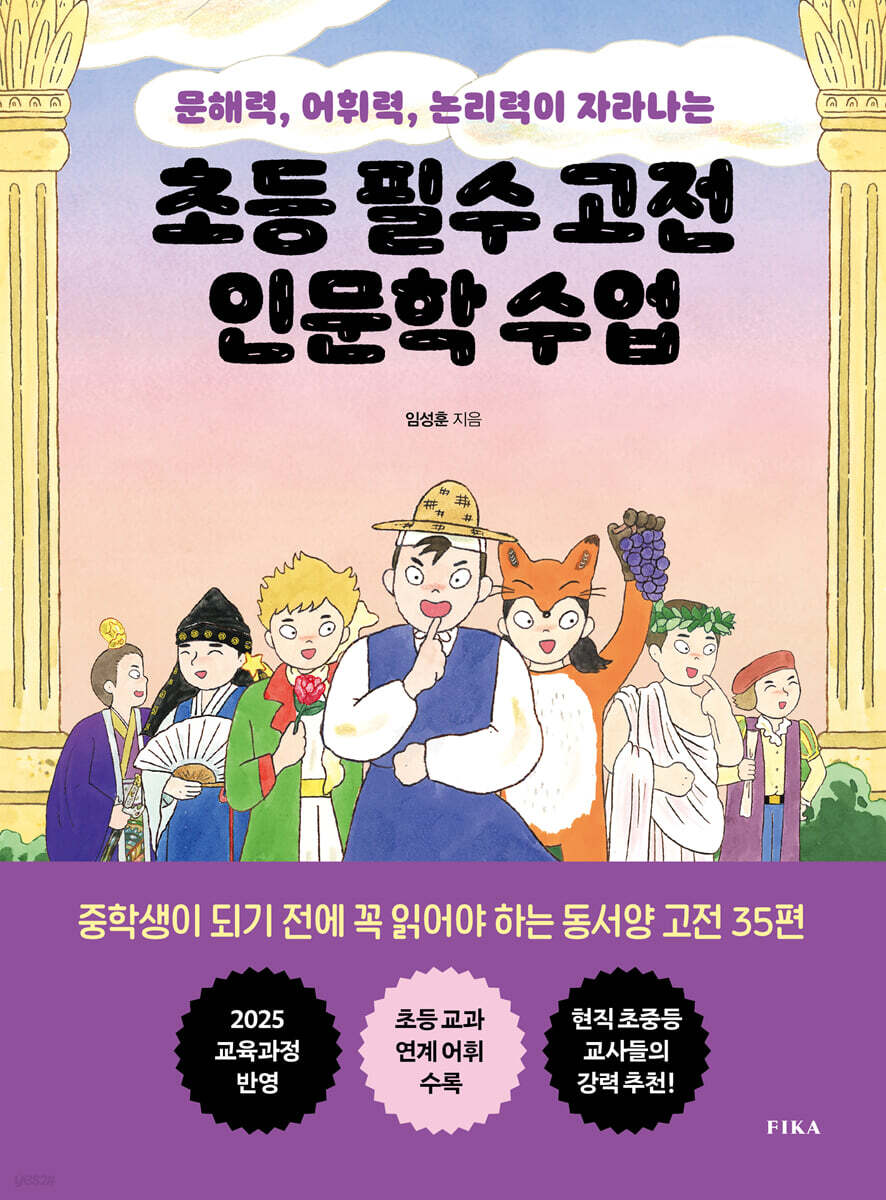
Elementary required classical humanities classes
 |
Description
Book Introduction
“Smart children read the classics!”
35 Essential Classics from the East and the West You Must Read Before Middle School
"Elementary Essential Classical Humanities Class" is an elementary humanities textbook designed to develop elementary school students' literacy, vocabulary, and critical thinking skills.
We have compiled a list of 35 essential classics that students must read before entering middle school, selected by current elementary and middle school teachers, including Eastern classics such as 『Memorabilia of the Three Kingdoms』, 『The Story of Hong Gildong』, 『Mencius』, and 『Zhuangzi』, as well as Western classics such as 『Aesop's Fables』, 『Gulliver's Travels』, 『The Little Prince』, and 『The Old Man and the Sea』.
Children can understand their cultural roots and identity through Eastern classics, and gain diverse cultural perspectives and a broader perspective through Western classics.
By reading a variety of classics that have been passed down across time and country, we can learn about the timeless, essential human concerns and wisdom, and through this, develop a broad perspective and sound values.
This book is not just about reading classics; it is designed to allow children to engage in a variety of activities, including vocabulary learning, background knowledge, questioning, writing, and transcription.
This is to foster critical and creative thinking and writing skills, which are emphasized in the newly revised 2025 elementary school curriculum.
The vocabulary in the book is a mix of vocabulary from elementary school textbooks in Korean, math, social studies, and science, to help with schoolwork.
Through the classic books "Elementary Essential Classical Humanities Class," which children can read while playing, they will gain confidence in Korean language subjects, become interested in reading, and improve their literacy, vocabulary, and comprehension skills.
35 Essential Classics from the East and the West You Must Read Before Middle School
"Elementary Essential Classical Humanities Class" is an elementary humanities textbook designed to develop elementary school students' literacy, vocabulary, and critical thinking skills.
We have compiled a list of 35 essential classics that students must read before entering middle school, selected by current elementary and middle school teachers, including Eastern classics such as 『Memorabilia of the Three Kingdoms』, 『The Story of Hong Gildong』, 『Mencius』, and 『Zhuangzi』, as well as Western classics such as 『Aesop's Fables』, 『Gulliver's Travels』, 『The Little Prince』, and 『The Old Man and the Sea』.
Children can understand their cultural roots and identity through Eastern classics, and gain diverse cultural perspectives and a broader perspective through Western classics.
By reading a variety of classics that have been passed down across time and country, we can learn about the timeless, essential human concerns and wisdom, and through this, develop a broad perspective and sound values.
This book is not just about reading classics; it is designed to allow children to engage in a variety of activities, including vocabulary learning, background knowledge, questioning, writing, and transcription.
This is to foster critical and creative thinking and writing skills, which are emphasized in the newly revised 2025 elementary school curriculum.
The vocabulary in the book is a mix of vocabulary from elementary school textbooks in Korean, math, social studies, and science, to help with schoolwork.
Through the classic books "Elementary Essential Classical Humanities Class," which children can read while playing, they will gain confidence in Korean language subjects, become interested in reading, and improve their literacy, vocabulary, and comprehension skills.
- You can preview some of the book's contents.
Preview
index
Before we begin, let's read some fun classics and improve our literacy skills!
Structure and features of this book
Part 1: Oriental Classics
The Birth of the Hero Who Founded Goguryeo (Samguk Yusa)
Dreaming of a world where people can live like humans: The Story of Hong Gildong
Prepare for War for Peace 《Jingbirok》 _ Early days of the war
The Hero Who Saved the Nation, Jingbirok_ Yi Sun-sin
Don't judge a book by its cover. (The Tale of Park)
Wealth and honor are like bubbles. (The Nine Cloud Dream)
Those who study must first set their sights on something big. (Gyeokmong Yogyeol)
If you can love freely, read "Chunhyangjeon"
A Criticism of the Absurd Northern Expedition Theory (The Story of Heo Saeng)
Don't Wish Misfortune, Even in Joke 《Lucky Day》
Those destined to meet will meet. 《When Buckwheat Flowers Bloom》
Human nature is good (Mencius)
Be free from everything 《Zhuangzi》 _ My side
Changing Your Perspective Allows You to See a Broader World (Zhuangzi) _ Extra
We must realize human nature. 《The Chronicles of the Four Great Historians》 _ Maeng Sang-gun
Victory is achieved by upholding principles. 《Biographies of the Four Great Masters》 _ Sun Tzu
Leadership begins with leading by example. Romance of the Three Kingdoms _ Cao Cao's strategy
Strategy is key to victory. Romance of the Three Kingdoms - The Battle of Red Cliffs
Pursue Justice (The Young Master)
Part 2 Western Classics
Pride has a price: The Odyssey
Live Wisely in the World (Aesop's Fables)
Admit that you don't know what you don't know. Apology of Socrates
Listen to the advice of those who have experience. 《Metamorphosis》 _ The Fall of Phaethon
Gain insight from experience 《The Metamorphosis Story》 _ The Foolish Midas
Stick to the right decision to the end. 《Plutarch's Lives》 _ Pericles
A hero is one who overcomes vanity and greed. Plutarch's Lives _ Alcibiades
Don't lose your humanity. The Merchant of Venice
Sometimes, look at the world differently. Gulliver's Travels
Learning is always important. 《The Last Lesson》
Wisdom comes at a price. (Norse Mythology)
Humans are precious in themselves. 《Metamorphosis》
Relationships Take Time: The Little Prince
Humanity is not defeated by The Old Man and the Sea
Civilization and order preserve humanity in "Lord of the Flies."
Don't Be Trapped by Self-Imposed Limitations (Jonathan Livingston Livingston)
Structure and features of this book
Part 1: Oriental Classics
The Birth of the Hero Who Founded Goguryeo (Samguk Yusa)
Dreaming of a world where people can live like humans: The Story of Hong Gildong
Prepare for War for Peace 《Jingbirok》 _ Early days of the war
The Hero Who Saved the Nation, Jingbirok_ Yi Sun-sin
Don't judge a book by its cover. (The Tale of Park)
Wealth and honor are like bubbles. (The Nine Cloud Dream)
Those who study must first set their sights on something big. (Gyeokmong Yogyeol)
If you can love freely, read "Chunhyangjeon"
A Criticism of the Absurd Northern Expedition Theory (The Story of Heo Saeng)
Don't Wish Misfortune, Even in Joke 《Lucky Day》
Those destined to meet will meet. 《When Buckwheat Flowers Bloom》
Human nature is good (Mencius)
Be free from everything 《Zhuangzi》 _ My side
Changing Your Perspective Allows You to See a Broader World (Zhuangzi) _ Extra
We must realize human nature. 《The Chronicles of the Four Great Historians》 _ Maeng Sang-gun
Victory is achieved by upholding principles. 《Biographies of the Four Great Masters》 _ Sun Tzu
Leadership begins with leading by example. Romance of the Three Kingdoms _ Cao Cao's strategy
Strategy is key to victory. Romance of the Three Kingdoms - The Battle of Red Cliffs
Pursue Justice (The Young Master)
Part 2 Western Classics
Pride has a price: The Odyssey
Live Wisely in the World (Aesop's Fables)
Admit that you don't know what you don't know. Apology of Socrates
Listen to the advice of those who have experience. 《Metamorphosis》 _ The Fall of Phaethon
Gain insight from experience 《The Metamorphosis Story》 _ The Foolish Midas
Stick to the right decision to the end. 《Plutarch's Lives》 _ Pericles
A hero is one who overcomes vanity and greed. Plutarch's Lives _ Alcibiades
Don't lose your humanity. The Merchant of Venice
Sometimes, look at the world differently. Gulliver's Travels
Learning is always important. 《The Last Lesson》
Wisdom comes at a price. (Norse Mythology)
Humans are precious in themselves. 《Metamorphosis》
Relationships Take Time: The Little Prince
Humanity is not defeated by The Old Man and the Sea
Civilization and order preserve humanity in "Lord of the Flies."
Don't Be Trapped by Self-Imposed Limitations (Jonathan Livingston Livingston)
Detailed image

Publisher's Review
“Children who read the classics think differently!”
Why Reading Classics Is Essential for Elementary School Students
What do current elementary and middle school Korean language teachers consider the most important thing in elementary education? It's reading.
This is especially important in times like today when literacy rates are so low.
Among books, reading classics is beneficial because it not only improves literacy but also allows one to understand history and culture, and acquire humanistic knowledge and wisdom.
Classics are works that have been read by many people for a long time, and contain a rich vocabulary and a variety of expressions.
You can also see the essential human concerns and wisdom that transcends time.
For example, in “The Story of Hong Gildong,” we can learn about the absurdity of the caste system and the desire for an equal society, and in “Memorabilia of the Three Kingdoms,” we can learn about the founding myth and national identity.
Reading classic literature containing these lessons and messages from a young age can foster a sense of humanity and social justice, and help develop sound values.
"The most important things in elementary school are literacy and vocabulary."
Reflecting the '2025 Curriculum', your learning and writing confidence will soar!
The newly revised elementary school curriculum, effective from 2025, emphasizes fostering critical and creative thinking and improving argumentative writing skills through reading and writing activities.
This book is designed to fit these educational trends and effectively complement and enrich school education.
The current serious problem of declining literacy is not simply a result of children spending less time reading, but also a lack of deep thinking and contextual understanding.
In these situations, reading classics is very effective in improving literacy.
Classics contain words and expressions that aren't commonly used in everyday life, allowing you to learn new vocabulary and develop the ability to understand the nuances and context of words.
Moreover, since classic texts often have long and complex sentence structures, literacy skills can be improved through the process of analyzing long sentences and understanding their meaning.
This book naturally incorporates key vocabulary from elementary school textbooks into classic works, allowing readers to learn textbook vocabulary while reading classics.
We have made it possible to learn vocabulary from not only Korean but also other subjects such as math, social studies, and science, and have included definitions and examples to help children understand easily.
In this way, the literacy and vocabulary gained through reading classics not only lay a solid foundation for elementary school learning, but also boost confidence in writing essays.
“As you read, write, and think, your thoughts grow and your heart expands!”
Improve your grades and develop your character with these 35 essential elementary classics!
This book contains a selection of 35 classic Eastern and Western literature pieces that elementary school students must read before entering middle school.
Sentences and vocabulary that may be difficult are adapted to be as easy and fun as possible so that children can read them on their own without getting bored.
It is important to have ‘my own thoughts’ about classics, not to read them once and be done with them.
Because you can develop the ability to think and judge for yourself through the characters, situations, and lessons in classics.
This process develops critical and creative thinking skills and helps you clarify and logically express your views.
The 'background knowledge' in 'Elementary Essential Classical Humanities Class' adds practical information to the classics, allowing for a broader understanding of the classics, while 'questions that enhance comprehension' and 'writing that fosters thinking' foster children's ability to think and judge for themselves.
By going beyond reading classics and engaging in various activities to consider various perspectives, you can also improve your logical thinking and problem-solving skills.
Furthermore, by encountering a variety of classic works from the East and the West, we can learn universal human values and wisdom that transcend time and culture. Exposure to works from diverse eras and cultures also helps us develop a broad perspective and a balanced worldview.
This will serve as a foundation for children to understand the wider world as they grow and become better members of society.
Why Reading Classics Is Essential for Elementary School Students
What do current elementary and middle school Korean language teachers consider the most important thing in elementary education? It's reading.
This is especially important in times like today when literacy rates are so low.
Among books, reading classics is beneficial because it not only improves literacy but also allows one to understand history and culture, and acquire humanistic knowledge and wisdom.
Classics are works that have been read by many people for a long time, and contain a rich vocabulary and a variety of expressions.
You can also see the essential human concerns and wisdom that transcends time.
For example, in “The Story of Hong Gildong,” we can learn about the absurdity of the caste system and the desire for an equal society, and in “Memorabilia of the Three Kingdoms,” we can learn about the founding myth and national identity.
Reading classic literature containing these lessons and messages from a young age can foster a sense of humanity and social justice, and help develop sound values.
"The most important things in elementary school are literacy and vocabulary."
Reflecting the '2025 Curriculum', your learning and writing confidence will soar!
The newly revised elementary school curriculum, effective from 2025, emphasizes fostering critical and creative thinking and improving argumentative writing skills through reading and writing activities.
This book is designed to fit these educational trends and effectively complement and enrich school education.
The current serious problem of declining literacy is not simply a result of children spending less time reading, but also a lack of deep thinking and contextual understanding.
In these situations, reading classics is very effective in improving literacy.
Classics contain words and expressions that aren't commonly used in everyday life, allowing you to learn new vocabulary and develop the ability to understand the nuances and context of words.
Moreover, since classic texts often have long and complex sentence structures, literacy skills can be improved through the process of analyzing long sentences and understanding their meaning.
This book naturally incorporates key vocabulary from elementary school textbooks into classic works, allowing readers to learn textbook vocabulary while reading classics.
We have made it possible to learn vocabulary from not only Korean but also other subjects such as math, social studies, and science, and have included definitions and examples to help children understand easily.
In this way, the literacy and vocabulary gained through reading classics not only lay a solid foundation for elementary school learning, but also boost confidence in writing essays.
“As you read, write, and think, your thoughts grow and your heart expands!”
Improve your grades and develop your character with these 35 essential elementary classics!
This book contains a selection of 35 classic Eastern and Western literature pieces that elementary school students must read before entering middle school.
Sentences and vocabulary that may be difficult are adapted to be as easy and fun as possible so that children can read them on their own without getting bored.
It is important to have ‘my own thoughts’ about classics, not to read them once and be done with them.
Because you can develop the ability to think and judge for yourself through the characters, situations, and lessons in classics.
This process develops critical and creative thinking skills and helps you clarify and logically express your views.
The 'background knowledge' in 'Elementary Essential Classical Humanities Class' adds practical information to the classics, allowing for a broader understanding of the classics, while 'questions that enhance comprehension' and 'writing that fosters thinking' foster children's ability to think and judge for themselves.
By going beyond reading classics and engaging in various activities to consider various perspectives, you can also improve your logical thinking and problem-solving skills.
Furthermore, by encountering a variety of classic works from the East and the West, we can learn universal human values and wisdom that transcend time and culture. Exposure to works from diverse eras and cultures also helps us develop a broad perspective and a balanced worldview.
This will serve as a foundation for children to understand the wider world as they grow and become better members of society.
GOODS SPECIFICS
- Date of issue: April 1, 2025
- Page count, weight, size: 368 pages | 632g | 170*230*22mm
- ISBN13: 9791193866283
- ISBN10: 1193866286
- KC Certification: Certification Type: Conformity Confirmation
You may also like
카테고리
korean


korean

![ELLE 엘르 스페셜 에디션 A형 : 12월 [2025]](http://librairie.coreenne.fr/cdn/shop/files/b8e27a3de6c9538896439686c6b0e8fb.jpg?v=1766436872&width=3840)


