

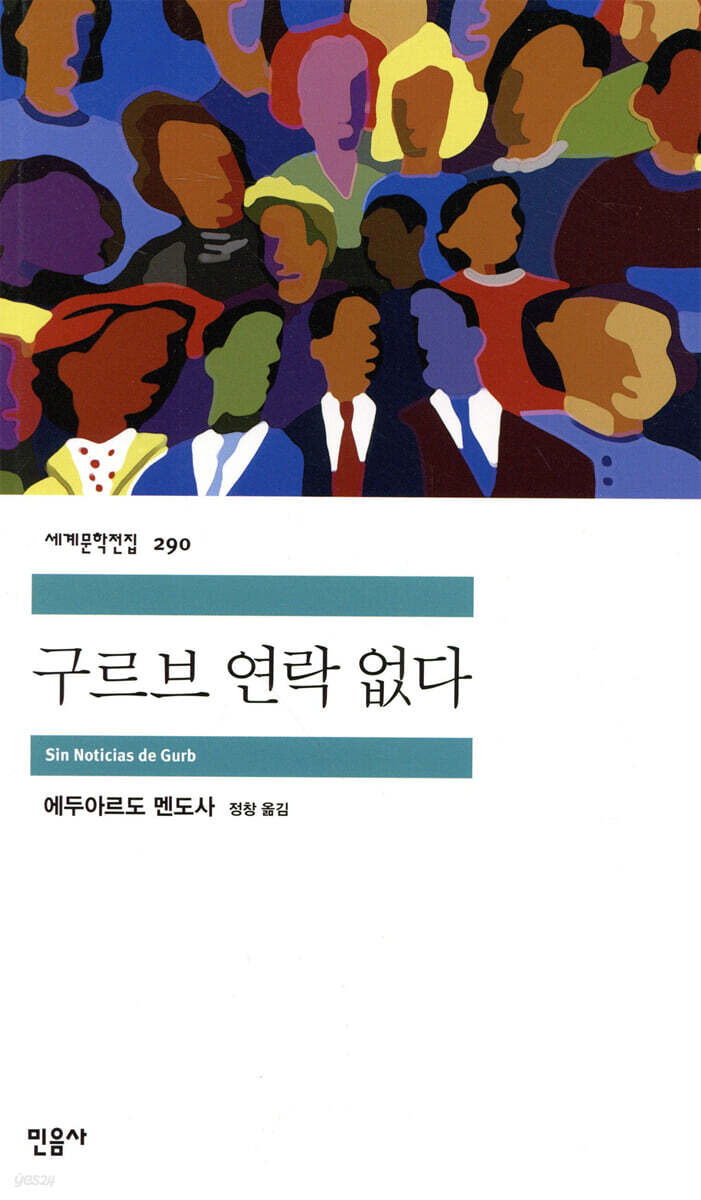
No contact from Gurub
 |
Description
Book Introduction
A work by Eduardo Mendoza, a world-renowned writer leading contemporary Spanish literature. "No Contact with Gurub" is a unique novel featuring an alien who visits Earth as its main character. By adding parody techniques and science fiction elements to the traditional narrative structure, it humorously depicts the chaos and disorder of the metropolis of Barcelona and the life of its urban dwellers. Throughout this work, Mendoza uses a light and cheerful tone to lightly mock the absurd and ridiculous aspects of his hometown Barcelona, which was preparing for the Olympics at the time, while also meticulously examining Barcelona's famous landmarks, famous people, and historical events through the eyes of an alien filled with wonder. |
- You can preview some of the book's contents.
Preview
index
No contact from Gurub
Commentary on the work
Author's chronology
Commentary on the work
Author's chronology
Publisher's Review
A delightful ode to Barcelona by Eduardo Mendoza, a master of Spanish literature.
The diary of an alien's exploration of Earth in search of his missing companion, Gurub.
A novel that humorously satirizes big city life by adding a whimsical imagination to the traditional Spanish narrative.
▶ Barcelona and I, we have been a very loving couple and have very strong and sturdy children.
Eduardo Mendoza
▶ Great book.
Literary antidepressant.
?《Cosmopolitan》
▶ Mendoza's flawless narrative technique is unparalleled.
André Kravel (film director)
≡≡≡≡≡≡≡≡≡≡≡≡≡≡≡≡≡≡≡≡≡≡≡≡≡≡≡≡≡≡≡≡≡≡≡≡≡≡≡≡≡≡≡≡≡≡≡≡≡≡≡≡
Eduardo Mendoza, a world-renowned writer leading contemporary Spanish literature, has published his book, “No Contact with Gurb,” in Minumsa’s World Literature Collection (290).
"No Contact with Gurub" is a unique novel featuring an alien who visits Earth as its main character.
By adding parody techniques and science fiction elements to the traditional narrative structure, it humorously depicts the chaos and disorder of the metropolis of Barcelona and the bizarre life of its urban dwellers.
Throughout this work, Mendoza uses a light and cheerful tone to lightly mock the absurd and ridiculous aspects of his hometown Barcelona, which was preparing for the Olympics at the time, while also meticulously examining Barcelona's famous landmarks, famous people, and historical events through the eyes of an alien filled with wonder.
It was first serialized in El País, Spain's largest daily newspaper, and received critical acclaim. It became a bestseller immediately after publication, selling over 500,000 copies to date.
Recognized for its literary value as well as its unique narrative techniques and rhetoric, it was included in Spanish textbooks and selected as a must-read for children 15 years of age and older.
■ Until the infinitely unfamiliar Earth becomes infinitely familiar, the strange alien's strange Earth exploration diary
Two aliens land in Spain a year or two before the 1992 Barcelona Olympics.
They seek to explore life on Earth by taking advantage of their ability to freely change their appearance.
'I' entrusts the exploration of the landing site area to my colleague Gurb, but after Gurb disguises himself as the famous Spanish singer Marta Sanchez and sets out on the exploration, contact is lost.
Left alone, 'I' wanders around Barcelona disguised as celebrities to find Gurub.
'I', who was wandering around the complex city looking for Gurub, gets into trouble with the spaceship he was using as his residence, so he manipulates his bank account to get money to buy an apartment and begins his life on Earth in earnest while waiting for Gurub's call.
He becomes friends with the owners of his regular restaurant and the apartment complex janitor, falls in love with the single mother next door and tries to find a way to date her, and gets drunk every day with people, causes trouble, and visits the police station.
After about twenty days of adjusting to this earthly life, a strange invitation flies in to me.
“No Contact with Gurub” is, as Mendoza himself says, a very “unique” novel.
The protagonist is an alien who can change his appearance at will, and he records everything he sees, hears, experiences, and feels on an unfamiliar Earth and in an unfamiliar city, every hour of every day (even when he's drunk), like a diary.
In addition to the fun of science fiction-like settings such as aliens transforming into movie stars, the Pope, or animals, shedding tears like Earthlings, shrinking bodies, or exploding heads that are sensitive to heat, the present tense sentences recorded every hour make you feel like you are traveling through Barcelona with aliens right now, with a sense of presence and speed.
Also, the alien's struggles to adapt to life on Earth, such as getting drunk and taken to the police station, sneaking into a neighbor's house to change a Tosa into a Pekingese, and taking over a restaurant for a sick couple and breaking all the machines, are consistently funny.
The reason why "Gurb No Contact" has become the best-selling novel of all time, surpassing Mendoza's other outstanding works, is probably because his unique humor and wit explode out of this short novel of just over 200 pages.
A delightful satirical novel that combines Spanish narrative tradition with whimsical imagination and humor.
"No Contact with Gurub" was serialized in El País in the summer of 1990 and published as a book the following year.
The setting of 'The Diary of an Alien' is quite groundbreaking and original for a novel published in the early 1990s.
But this alien speaker is not entirely unfamiliar or new.
Doesn't Cervantes' Don Quixote come to mind, the adventurer who loves alcohol and women and causes trouble wherever he goes?
In his previous works, Mendoza has consistently parodied the characters and plot of the picaresque novel, a traditional Spanish literary form.
Like Onoref in "The City of Wonders" and the nameless detective in the trilogy ("The Mystery of the Ossuary," "The Labyrinth of Olives," and "What Happened in the Hairdresser"), the narrator of "Gurb No Call" can be seen as a parody of the typical picaresque protagonist as an alien, adding the author's whimsical imagination to the Spanish literary tradition.
Just as traditional picaresque novels expose and satirize the absurdity and corruption of society through their protagonists, 『Gurub No Contact』 also touches on a wide range of social issues, such as the gap between the rich and the poor and racial issues, through the alien's difficult period of adaptation to Earth.
21:00 (omitted) It seems that Earthlings are divided into several categories, especially the rich and the poor.
I don't know why, but it's one of the issues they consider very important.
The basic difference I see between the rich and the poor is this.
The rich can get as much of what they want wherever they go or consume as much as they want without paying, while the poor pay with their sweat.
09:50 (omitted) Of all races, black people (literally people with dark skin) are born with special talents that are better than white people, namely the talents of being big, strong, and fast.
Of course, stupidity is the same for blacks and whites.
White people do not respect black people, perhaps because of painful memories in the collective subconscious of white people from a long time ago when black people were the ruling class and white people were the ruled class.
However, due to the nature of short and light works, rather than delving deeply into these issues, the focus is on the humorous fun of twisting the ridiculous and absurd aspects of everyday human affairs through the eyes of a thorough outsider.
This fun is further amplified by the exaggeration and humor appropriately used throughout the work.
01:30 I wake up startled by a terrible noise.
Millions of years ago (or perhaps even longer), the Earth was in the grip of a catastrophic tectonic shift: raging oceans swept across coastlines, swallowing up islands, massive mountain ranges sank, volcanoes spewed lava and erupted, forming new mountains, and devastating earthquakes shifted continents.
The city hall seems to be trying to impress upon its citizens the natural phenomenon by sending a garbage truck to the apartment complex every night, making a tremendous noise.
21:30 I eat a hamburger at a restaurant near the hotel.
A cursory analysis of the meat chunks revealed that they contained castrated cattle, donkeys, Arabian camels, elephants (both Asian and African), baboons, wildebeests, and Megatheriums, along with horseflies, dragonflies, badminton rackets, nuts, bottle caps, pebbles, and trace amounts of foreign matter.
03:41 No.
That's not it.
A waiter comes running at the sudden commotion.
This is the dinner table reserved by Princess Stephanie of Monaco and her fiancé.
The reservation date is April 9, 1978, but the reservation has not been cancelled yet, and it cannot be cancelled either.
Once a week, they wash tablecloths and napkins, clean the dinnerware, change the flower arrangements, get rid of bugs, and replace the bread (made from white wheat and beans) with freshly baked bread from the oven.
Come to think of it, there are five or six photographers draped in spiderwebs set up camp in one corner of the room.
"No Contact with Gurub" is a short and light novel, literally like a small piece of literature.
As Mendoza says, there is “no gloomy shadow in this work.
“Because the perspective is exceptional and it is a view of a wondrous world, there is no tragedy or criticism.” However, looking at it another way, instead of the overwhelming weight and sharpness of previous works such as “The Truth about the Savolta Affair,” “No Contact with Gurub” is a novel by a seasoned master who strips away the reader’s soul and defenseless daily life with sparkling imagination and humor at every moment.
■ Mendoza, the most Spanish writer, pays homage to Barcelona
The narrator of "No Contact with Gurub" does not simply satirize the dark side of society like the protagonists of traditional picaresque novels.
Through the adventure diary of the alien narrator 'I', full of delightful satire and humor, we are introduced to the bustling metropolis of Barcelona in preparation for the Olympics.
He visits all the famous landmarks of Barcelona, from a street under construction to art galleries and museums, a national park full of pigeons pooping, an award-winning interior design bar, and even a restaurant featured in a gourmet book. Through the characters he transforms into or converses with, he also meets the famous people of Barcelona at the time and the famous events surrounding them.
Furthermore, after encountering the songs, dances, food, TV programs, proverbs, and dialects of the Catalan region, this book begins to seem like a humorous travel essay about Barcelona.
04:20 What? Why, Gurub? You want to go back to our planet? Of course.
Don't you? Oh, I don't know, I don't know.
Actually, our star is too boring and dull.
Gurub, you still have some foolish thoughts left.
Yeah, actually I'd like to stay here.
(Omitted) This city is like a gold mine where you dig and dig, and every time you dig, you find gold.
The Earth and the lives of its inhabitants, as seen through the eyes of a foreigner, are complex, uncomfortable, messy, and full of contradictions.
But ironically, Gurub and 'I' end up staying on Earth.
This is a passage that shows Mendoza's true affection for Barcelona, where he says they have lived like a "golden couple."
Mendoza attempts to convey to readers the unique charm and value of Barcelona while mocking it through the mouth of an alien.
Translator Jeong Chang says this about this:
“Love and hate are relative and ironic.
Behind hatred, there is a sense of care.
In this sense, this book, “No Contact with Gurb,” is an homage paid by the author Eduardo Mendoza to his hometown of Catalonia, his city of Barcelona, and further to the 1992 Barcelona Olympics.”
The diary of an alien's exploration of Earth in search of his missing companion, Gurub.
A novel that humorously satirizes big city life by adding a whimsical imagination to the traditional Spanish narrative.
▶ Barcelona and I, we have been a very loving couple and have very strong and sturdy children.
Eduardo Mendoza
▶ Great book.
Literary antidepressant.
?《Cosmopolitan》
▶ Mendoza's flawless narrative technique is unparalleled.
André Kravel (film director)
≡≡≡≡≡≡≡≡≡≡≡≡≡≡≡≡≡≡≡≡≡≡≡≡≡≡≡≡≡≡≡≡≡≡≡≡≡≡≡≡≡≡≡≡≡≡≡≡≡≡≡≡
Eduardo Mendoza, a world-renowned writer leading contemporary Spanish literature, has published his book, “No Contact with Gurb,” in Minumsa’s World Literature Collection (290).
"No Contact with Gurub" is a unique novel featuring an alien who visits Earth as its main character.
By adding parody techniques and science fiction elements to the traditional narrative structure, it humorously depicts the chaos and disorder of the metropolis of Barcelona and the bizarre life of its urban dwellers.
Throughout this work, Mendoza uses a light and cheerful tone to lightly mock the absurd and ridiculous aspects of his hometown Barcelona, which was preparing for the Olympics at the time, while also meticulously examining Barcelona's famous landmarks, famous people, and historical events through the eyes of an alien filled with wonder.
It was first serialized in El País, Spain's largest daily newspaper, and received critical acclaim. It became a bestseller immediately after publication, selling over 500,000 copies to date.
Recognized for its literary value as well as its unique narrative techniques and rhetoric, it was included in Spanish textbooks and selected as a must-read for children 15 years of age and older.
■ Until the infinitely unfamiliar Earth becomes infinitely familiar, the strange alien's strange Earth exploration diary
Two aliens land in Spain a year or two before the 1992 Barcelona Olympics.
They seek to explore life on Earth by taking advantage of their ability to freely change their appearance.
'I' entrusts the exploration of the landing site area to my colleague Gurb, but after Gurb disguises himself as the famous Spanish singer Marta Sanchez and sets out on the exploration, contact is lost.
Left alone, 'I' wanders around Barcelona disguised as celebrities to find Gurub.
'I', who was wandering around the complex city looking for Gurub, gets into trouble with the spaceship he was using as his residence, so he manipulates his bank account to get money to buy an apartment and begins his life on Earth in earnest while waiting for Gurub's call.
He becomes friends with the owners of his regular restaurant and the apartment complex janitor, falls in love with the single mother next door and tries to find a way to date her, and gets drunk every day with people, causes trouble, and visits the police station.
After about twenty days of adjusting to this earthly life, a strange invitation flies in to me.
“No Contact with Gurub” is, as Mendoza himself says, a very “unique” novel.
The protagonist is an alien who can change his appearance at will, and he records everything he sees, hears, experiences, and feels on an unfamiliar Earth and in an unfamiliar city, every hour of every day (even when he's drunk), like a diary.
In addition to the fun of science fiction-like settings such as aliens transforming into movie stars, the Pope, or animals, shedding tears like Earthlings, shrinking bodies, or exploding heads that are sensitive to heat, the present tense sentences recorded every hour make you feel like you are traveling through Barcelona with aliens right now, with a sense of presence and speed.
Also, the alien's struggles to adapt to life on Earth, such as getting drunk and taken to the police station, sneaking into a neighbor's house to change a Tosa into a Pekingese, and taking over a restaurant for a sick couple and breaking all the machines, are consistently funny.
The reason why "Gurb No Contact" has become the best-selling novel of all time, surpassing Mendoza's other outstanding works, is probably because his unique humor and wit explode out of this short novel of just over 200 pages.
A delightful satirical novel that combines Spanish narrative tradition with whimsical imagination and humor.
"No Contact with Gurub" was serialized in El País in the summer of 1990 and published as a book the following year.
The setting of 'The Diary of an Alien' is quite groundbreaking and original for a novel published in the early 1990s.
But this alien speaker is not entirely unfamiliar or new.
Doesn't Cervantes' Don Quixote come to mind, the adventurer who loves alcohol and women and causes trouble wherever he goes?
In his previous works, Mendoza has consistently parodied the characters and plot of the picaresque novel, a traditional Spanish literary form.
Like Onoref in "The City of Wonders" and the nameless detective in the trilogy ("The Mystery of the Ossuary," "The Labyrinth of Olives," and "What Happened in the Hairdresser"), the narrator of "Gurb No Call" can be seen as a parody of the typical picaresque protagonist as an alien, adding the author's whimsical imagination to the Spanish literary tradition.
Just as traditional picaresque novels expose and satirize the absurdity and corruption of society through their protagonists, 『Gurub No Contact』 also touches on a wide range of social issues, such as the gap between the rich and the poor and racial issues, through the alien's difficult period of adaptation to Earth.
21:00 (omitted) It seems that Earthlings are divided into several categories, especially the rich and the poor.
I don't know why, but it's one of the issues they consider very important.
The basic difference I see between the rich and the poor is this.
The rich can get as much of what they want wherever they go or consume as much as they want without paying, while the poor pay with their sweat.
09:50 (omitted) Of all races, black people (literally people with dark skin) are born with special talents that are better than white people, namely the talents of being big, strong, and fast.
Of course, stupidity is the same for blacks and whites.
White people do not respect black people, perhaps because of painful memories in the collective subconscious of white people from a long time ago when black people were the ruling class and white people were the ruled class.
However, due to the nature of short and light works, rather than delving deeply into these issues, the focus is on the humorous fun of twisting the ridiculous and absurd aspects of everyday human affairs through the eyes of a thorough outsider.
This fun is further amplified by the exaggeration and humor appropriately used throughout the work.
01:30 I wake up startled by a terrible noise.
Millions of years ago (or perhaps even longer), the Earth was in the grip of a catastrophic tectonic shift: raging oceans swept across coastlines, swallowing up islands, massive mountain ranges sank, volcanoes spewed lava and erupted, forming new mountains, and devastating earthquakes shifted continents.
The city hall seems to be trying to impress upon its citizens the natural phenomenon by sending a garbage truck to the apartment complex every night, making a tremendous noise.
21:30 I eat a hamburger at a restaurant near the hotel.
A cursory analysis of the meat chunks revealed that they contained castrated cattle, donkeys, Arabian camels, elephants (both Asian and African), baboons, wildebeests, and Megatheriums, along with horseflies, dragonflies, badminton rackets, nuts, bottle caps, pebbles, and trace amounts of foreign matter.
03:41 No.
That's not it.
A waiter comes running at the sudden commotion.
This is the dinner table reserved by Princess Stephanie of Monaco and her fiancé.
The reservation date is April 9, 1978, but the reservation has not been cancelled yet, and it cannot be cancelled either.
Once a week, they wash tablecloths and napkins, clean the dinnerware, change the flower arrangements, get rid of bugs, and replace the bread (made from white wheat and beans) with freshly baked bread from the oven.
Come to think of it, there are five or six photographers draped in spiderwebs set up camp in one corner of the room.
"No Contact with Gurub" is a short and light novel, literally like a small piece of literature.
As Mendoza says, there is “no gloomy shadow in this work.
“Because the perspective is exceptional and it is a view of a wondrous world, there is no tragedy or criticism.” However, looking at it another way, instead of the overwhelming weight and sharpness of previous works such as “The Truth about the Savolta Affair,” “No Contact with Gurub” is a novel by a seasoned master who strips away the reader’s soul and defenseless daily life with sparkling imagination and humor at every moment.
■ Mendoza, the most Spanish writer, pays homage to Barcelona
The narrator of "No Contact with Gurub" does not simply satirize the dark side of society like the protagonists of traditional picaresque novels.
Through the adventure diary of the alien narrator 'I', full of delightful satire and humor, we are introduced to the bustling metropolis of Barcelona in preparation for the Olympics.
He visits all the famous landmarks of Barcelona, from a street under construction to art galleries and museums, a national park full of pigeons pooping, an award-winning interior design bar, and even a restaurant featured in a gourmet book. Through the characters he transforms into or converses with, he also meets the famous people of Barcelona at the time and the famous events surrounding them.
Furthermore, after encountering the songs, dances, food, TV programs, proverbs, and dialects of the Catalan region, this book begins to seem like a humorous travel essay about Barcelona.
04:20 What? Why, Gurub? You want to go back to our planet? Of course.
Don't you? Oh, I don't know, I don't know.
Actually, our star is too boring and dull.
Gurub, you still have some foolish thoughts left.
Yeah, actually I'd like to stay here.
(Omitted) This city is like a gold mine where you dig and dig, and every time you dig, you find gold.
The Earth and the lives of its inhabitants, as seen through the eyes of a foreigner, are complex, uncomfortable, messy, and full of contradictions.
But ironically, Gurub and 'I' end up staying on Earth.
This is a passage that shows Mendoza's true affection for Barcelona, where he says they have lived like a "golden couple."
Mendoza attempts to convey to readers the unique charm and value of Barcelona while mocking it through the mouth of an alien.
Translator Jeong Chang says this about this:
“Love and hate are relative and ironic.
Behind hatred, there is a sense of care.
In this sense, this book, “No Contact with Gurb,” is an homage paid by the author Eduardo Mendoza to his hometown of Catalonia, his city of Barcelona, and further to the 1992 Barcelona Olympics.”
GOODS SPECIFICS
- Date of publication: June 29, 2012
- Page count, weight, size: 196 pages | 278g | 132*225*20mm
- ISBN13: 9788937462900
- ISBN10: 8937462907
You may also like
카테고리
korean


korean

![ELLE 엘르 스페셜 에디션 A형 : 12월 [2025]](http://librairie.coreenne.fr/cdn/shop/files/b8e27a3de6c9538896439686c6b0e8fb.jpg?v=1766436872&width=3840)


