

Waiting for altitude
 |
Description
Book Introduction
|
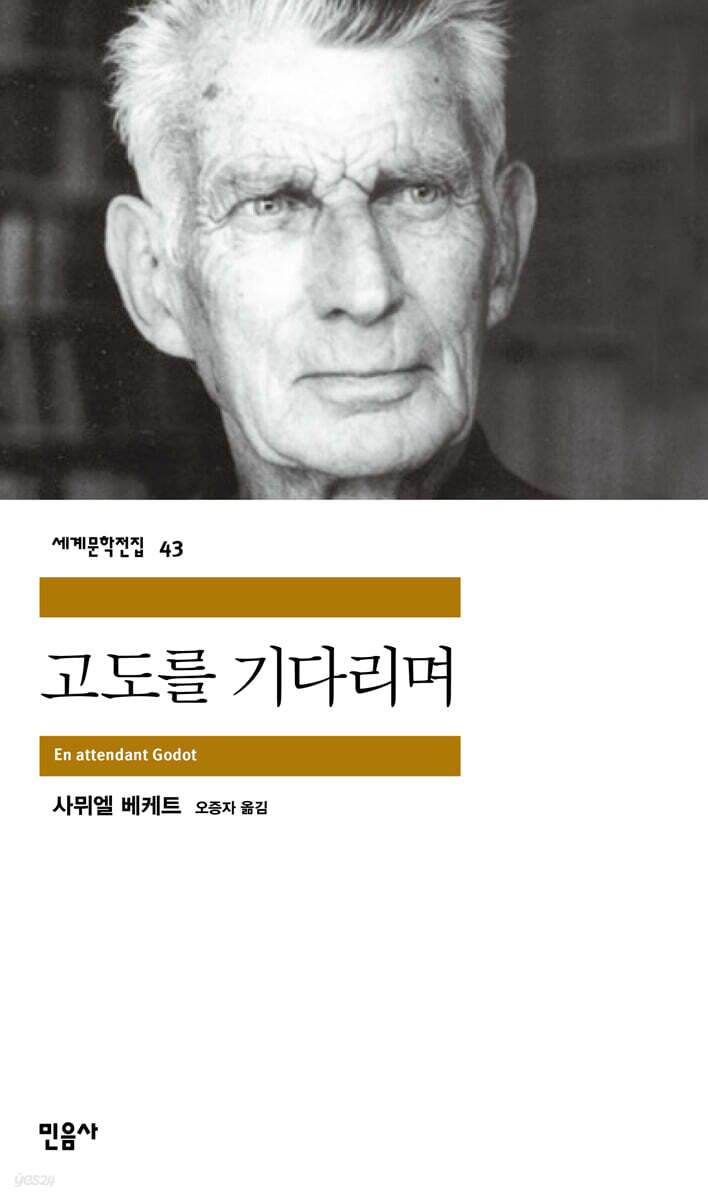
Samuel Beckett, the writer who changed the course of modern drama A classic of post-war absurdist theatre that rebelled against traditional realism 'Altitude' is salvation and freedom, bread and hope. “Godoh said he would definitely come tomorrow. (Sigh) Still don't you know? Samuel Beckett's masterpiece, Waiting for Godot (hereafter referred to as Godot), has been published by Minumsa under an official contract with French publisher Minu. Professor Oh Jeong-ja, who is renowned for her delicious Korean translations that are suitable for oral communication and is in charge of the scripts for the world-renowned theater company Sanulrim, has presented a new translation that has been meticulously polished. Published in 1952, "The Altitude" is a work that brought fame to Beckett, who was known only to a very small number of intellectuals, and is a representative work of the Theatre of the Absurd that changed the direction of Western theater in the latter half of the 20th century. It is also a bestseller that is performed as often in schools and prisons as in general theaters around the world, and in Ireland, a project called 'Beckett on film' is currently being promoted in which famous filmmakers such as Neil Jordan are making films of Beckett's plays, and it is a work that is still loved even 70 years after its publication. |
- You can preview some of the book's contents.
Preview
Into the book
Actually.....as you know.....
Of course not.
Of course not.
If I had made a promise to meet that guy, whether he was Godin or Gode or Godo or whatever, I would wait until it got completely dark before deciding whether to give up or not.
Should I help you? If you ask me to do something, perhaps? What? Tell me to sit down again.
Would that be a good idea? I think so! Okay.
Teacher, please sit down again.
No, no, there's no need for that.
Don't stand there like that. You'll catch a cold.
--- p.57
Pozo: You've stopped crying now.
So you've become that guy's substitute, and the amount of tears in this world hasn't changed.
When someone starts to cry, there is always someone who holds back their tears.
The same goes for laughter.
So let's not say that our society is bad.
Just because it's our time doesn't mean it's more unfortunate than the old days.
Needless to say, it's good.
There's no need to talk about that at all.
--- p.81
Vladimir: One thing is certain: in this situation, time is of the essence.
And during that long time, we have no choice but to fill the time by doing all kinds of things.
Well, at first glance it seems logical, but in reality it has become a habit.
You might say that's just an attempt to keep reason from falling asleep.
I understand what you mean.
But sometimes I think about this.
I wonder if reason is already wandering in an endlessly deep, eternal darkness.
Do you understand what I'm saying?
--- pp.134-135
Vladimir: Don't go yet.
Pozo: (Stopping) I'll go.
Vladimir: What if you fall down somewhere where no one can help you?
Pozo: I guess I'll have to wait until I can get up.
And then you leave again.
Vladimir: Before you leave, let the author sing a song.
Pozo: To whom are you speaking?
Vladimir: Lucky, you say.
Pozo: A song for Lucky?
Vladimir: Yes.
Or make them think.
You can also have them read it out loud.
Pozo: That guy is dumb.
Vladimir: Mute?
Pozo: That's right.
I can't even groan.
Vladimir: You're dumb! Since when?
Pozo: (suddenly angrily) Stop harassing people by bringing up that damn time! You keep asking "when" at the end of every sentence! Are you crazy? Just say "which day" and you're done.
One day, like any other day, he became mute and blind.
And one day we will become deaf.
One day we were born, and one day we will die.
At the same moment on the same day.
Shouldn't that be enough? (Becoming more calm) Women give birth while sitting on graves.
The sun shines for a moment, and then night comes again.
(He pulls the string) Forward!
--- pp.149-150
In a wire shape like Giacometti's sculpture...
. In the West, it is said that trees in the shape of a cross were mainly erected, and it is presumed that this originated from the interpretation of the director who was trying to find the meaning of religious salvation.
--- p.166
Vladimir: Women sit on graves, in terrible labor, and beneath the pits, laborers dig with pickaxes as if in a dream, and people slowly grow old, and the sky is filled with our cries.
(Listens in) But habits block our ears.
(Looking at Estragon) I'm probably looking at other people too.
And I will say.
That guy is asleep.
I don't know anything.
Let's just let him sleep.
Of course not.
Of course not.
If I had made a promise to meet that guy, whether he was Godin or Gode or Godo or whatever, I would wait until it got completely dark before deciding whether to give up or not.
Should I help you? If you ask me to do something, perhaps? What? Tell me to sit down again.
Would that be a good idea? I think so! Okay.
Teacher, please sit down again.
No, no, there's no need for that.
Don't stand there like that. You'll catch a cold.
--- p.57
Pozo: You've stopped crying now.
So you've become that guy's substitute, and the amount of tears in this world hasn't changed.
When someone starts to cry, there is always someone who holds back their tears.
The same goes for laughter.
So let's not say that our society is bad.
Just because it's our time doesn't mean it's more unfortunate than the old days.
Needless to say, it's good.
There's no need to talk about that at all.
--- p.81
Vladimir: One thing is certain: in this situation, time is of the essence.
And during that long time, we have no choice but to fill the time by doing all kinds of things.
Well, at first glance it seems logical, but in reality it has become a habit.
You might say that's just an attempt to keep reason from falling asleep.
I understand what you mean.
But sometimes I think about this.
I wonder if reason is already wandering in an endlessly deep, eternal darkness.
Do you understand what I'm saying?
--- pp.134-135
Vladimir: Don't go yet.
Pozo: (Stopping) I'll go.
Vladimir: What if you fall down somewhere where no one can help you?
Pozo: I guess I'll have to wait until I can get up.
And then you leave again.
Vladimir: Before you leave, let the author sing a song.
Pozo: To whom are you speaking?
Vladimir: Lucky, you say.
Pozo: A song for Lucky?
Vladimir: Yes.
Or make them think.
You can also have them read it out loud.
Pozo: That guy is dumb.
Vladimir: Mute?
Pozo: That's right.
I can't even groan.
Vladimir: You're dumb! Since when?
Pozo: (suddenly angrily) Stop harassing people by bringing up that damn time! You keep asking "when" at the end of every sentence! Are you crazy? Just say "which day" and you're done.
One day, like any other day, he became mute and blind.
And one day we will become deaf.
One day we were born, and one day we will die.
At the same moment on the same day.
Shouldn't that be enough? (Becoming more calm) Women give birth while sitting on graves.
The sun shines for a moment, and then night comes again.
(He pulls the string) Forward!
--- pp.149-150
In a wire shape like Giacometti's sculpture...
. In the West, it is said that trees in the shape of a cross were mainly erected, and it is presumed that this originated from the interpretation of the director who was trying to find the meaning of religious salvation.
--- p.166
Vladimir: Women sit on graves, in terrible labor, and beneath the pits, laborers dig with pickaxes as if in a dream, and people slowly grow old, and the sky is filled with our cries.
(Listens in) But habits block our ears.
(Looking at Estragon) I'm probably looking at other people too.
And I will say.
That guy is asleep.
I don't know anything.
Let's just let him sleep.
--- From the text
Publisher's Review
Waiting for the End of the War - The Creative Background of "Godoh"
The nihilistic and tragic worldview underlying "Altitude" shows that this work is part of the post-war existentialist literature that recognized the absurdity of life and sought to find meaning in it.
“Women sit on the graves, suffering terrible pains, and at the bottom of the pit, workers dig with pickaxes as if in a dream.
People are slowly growing old and the sky is filled with our cries.
Vladimir's line, "But habits deafen our ears," is a prime example.
In fact, the creative background of 『Altitude』 is deeply related to war.
Beckett, an Irishman, used his safe status as a neutral citizen to help his French friends in the resistance movement when World War II broke out in 1939.
Then, the group he was involved in was discovered by the Nazis, and he was forced to hide in Vaucluse (the name of this area appears in the work), a region in southern France that was not occupied by Germany at the time. There, all he could do was wait for the war to end.
Since no one could predict when the war would end, he spent his time talking with other refugees.
As soon as one topic of conversation was started, another had to be found, and this is the style of conversation in 『Godō』.
In this way, Beckett created his work by starting from realistic elements obtained from his own experiences and by extremely simplifying the composition.
The historic first performance: Pascal's Meditations performed by clowns
A desolate stage with only a single, bare tree standing, with no special plot or dramatic events.
That is why when the work was performed at the Babylon Little Theatre in Paris on January 5, 1953, no one expected it to be a success.
In fact, "Altitude" had already been rejected by several other directors, and it is said that the performance began without even the actors being able to give their opinion on the work.
However, when Le Figaro published a review titled “Pascal’s Meditations performed by clowns,” audiences began to flock to the play, and “Gottot,” which was scheduled to run for at most a month, was able to continue its run.
The audience was shocked by the new content and format that were far removed from existing realistic plays, and newspapers and broadcasters attempted to understand the specific meaning of the work through interviews with the writer.
But it was useless.
There is a famous anecdote that when director Alain Schneider asked Beckett at the American premiere who Godot was and what he meant, Beckett replied, “If I had known that, I would have written it in.”
Everyone awaits their own 'altitude'
Some people say that "Altitude" is a difficult work, but the situation of waiting that forms the basis of the work actually has universality because its meaning is not fixed.
When it was performed in San Quentin prison in the United States in 1957 because it had no female characters, the 1,400 inmates surprisingly responded enthusiastically.
They shouted that 'altitude' was "the outside world!" or "bread!" or "freedom!"
Meanwhile, those who saw the play in Poland in the 1960s believed that "Gott" represented liberation from Russia, and when it was performed in Algeria under French rule, landless peasants took it as a play about land reform that had been promised to them but never implemented.
There is also an interpretation that Godot is an abbreviation of the compound word God, which corresponds to the English word for God, and the French word Dieu.
But Beckett said, “Don’t look for God in this work,” and “Don’t even think about looking for philosophy or ideas here.
Just laugh and have fun while watching it.
But after laughing your heart out in the theater, it is your freedom to go home and think seriously about life.”
Ultimately, the meaning of 'altitude' can be seen as depending on each individual who appreciates the work.
Because the text's meaning is thus open, "Godo" continues to be studied and remains a widely loved work.
The nihilistic and tragic worldview underlying "Altitude" shows that this work is part of the post-war existentialist literature that recognized the absurdity of life and sought to find meaning in it.
“Women sit on the graves, suffering terrible pains, and at the bottom of the pit, workers dig with pickaxes as if in a dream.
People are slowly growing old and the sky is filled with our cries.
Vladimir's line, "But habits deafen our ears," is a prime example.
In fact, the creative background of 『Altitude』 is deeply related to war.
Beckett, an Irishman, used his safe status as a neutral citizen to help his French friends in the resistance movement when World War II broke out in 1939.
Then, the group he was involved in was discovered by the Nazis, and he was forced to hide in Vaucluse (the name of this area appears in the work), a region in southern France that was not occupied by Germany at the time. There, all he could do was wait for the war to end.
Since no one could predict when the war would end, he spent his time talking with other refugees.
As soon as one topic of conversation was started, another had to be found, and this is the style of conversation in 『Godō』.
In this way, Beckett created his work by starting from realistic elements obtained from his own experiences and by extremely simplifying the composition.
The historic first performance: Pascal's Meditations performed by clowns
A desolate stage with only a single, bare tree standing, with no special plot or dramatic events.
That is why when the work was performed at the Babylon Little Theatre in Paris on January 5, 1953, no one expected it to be a success.
In fact, "Altitude" had already been rejected by several other directors, and it is said that the performance began without even the actors being able to give their opinion on the work.
However, when Le Figaro published a review titled “Pascal’s Meditations performed by clowns,” audiences began to flock to the play, and “Gottot,” which was scheduled to run for at most a month, was able to continue its run.
The audience was shocked by the new content and format that were far removed from existing realistic plays, and newspapers and broadcasters attempted to understand the specific meaning of the work through interviews with the writer.
But it was useless.
There is a famous anecdote that when director Alain Schneider asked Beckett at the American premiere who Godot was and what he meant, Beckett replied, “If I had known that, I would have written it in.”
Everyone awaits their own 'altitude'
Some people say that "Altitude" is a difficult work, but the situation of waiting that forms the basis of the work actually has universality because its meaning is not fixed.
When it was performed in San Quentin prison in the United States in 1957 because it had no female characters, the 1,400 inmates surprisingly responded enthusiastically.
They shouted that 'altitude' was "the outside world!" or "bread!" or "freedom!"
Meanwhile, those who saw the play in Poland in the 1960s believed that "Gott" represented liberation from Russia, and when it was performed in Algeria under French rule, landless peasants took it as a play about land reform that had been promised to them but never implemented.
There is also an interpretation that Godot is an abbreviation of the compound word God, which corresponds to the English word for God, and the French word Dieu.
But Beckett said, “Don’t look for God in this work,” and “Don’t even think about looking for philosophy or ideas here.
Just laugh and have fun while watching it.
But after laughing your heart out in the theater, it is your freedom to go home and think seriously about life.”
Ultimately, the meaning of 'altitude' can be seen as depending on each individual who appreciates the work.
Because the text's meaning is thus open, "Godo" continues to be studied and remains a widely loved work.
GOODS SPECIFICS
- Date of issue: November 30, 2000
- Page count, weight, size: 175 pages | 309g | 132*225*20mm
- ISBN13: 9788937460432
- ISBN10: 8937460432
You may also like
카테고리
korean


korean

![ELLE 엘르 스페셜 에디션 A형 : 12월 [2025]](http://librairie.coreenne.fr/cdn/shop/files/b8e27a3de6c9538896439686c6b0e8fb.jpg?v=1766436872&width=3840)


