

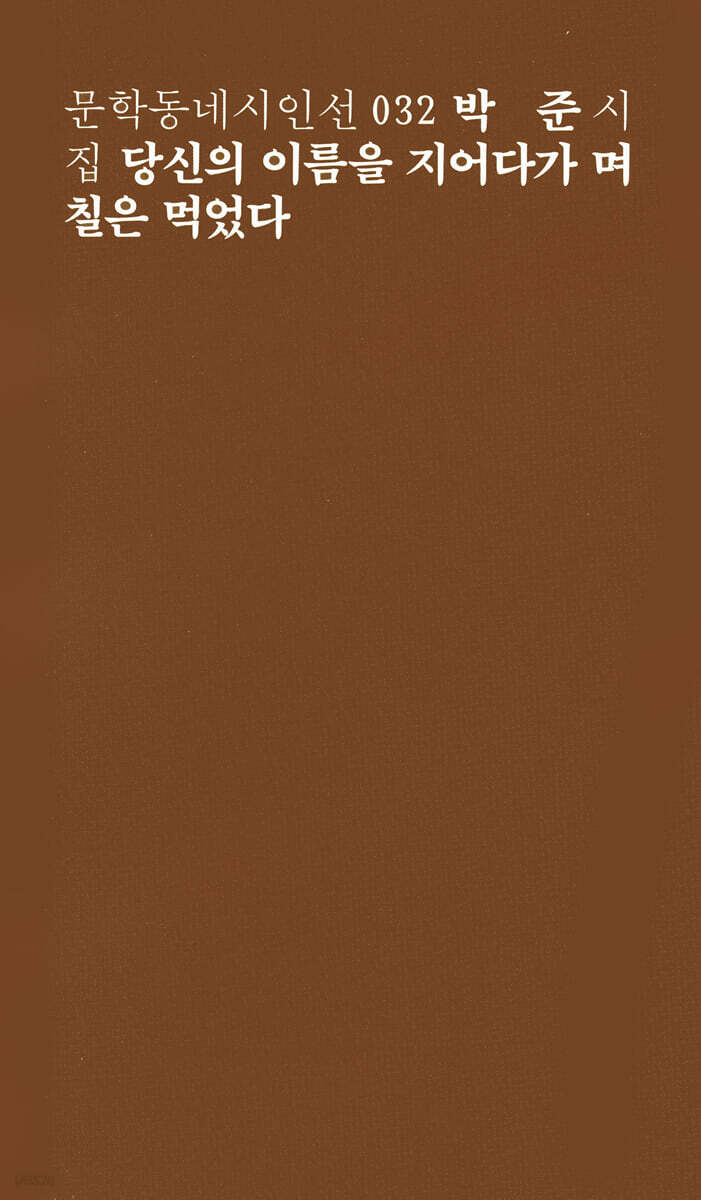
I named you and ate you for several days.
 |
Description
Book Introduction
In 2008, poet Park Jun, who debuted with 『Practical Literature』 and was praised for possessing both the linguistic sensibility of young poetry and the ability to spread reality, published his first poetry collection.
The poet said in an interview at the time, “Even if it’s rustic, I want to be a poet who talks about small and marginalized things.
“I believe that the possibilities of a generation liberated from solemnity are infinite, even in poetry,” he said.
I'm curious about the growth of this young poet, who has just entered his thirties, over the past four years, who has endlessly focused on and explored such "small and marginalized" things.
Growth is undoubtedly about realizing the fundamental sadness of life. The profound reflections in this collection on accepting and living in this world, and the moments of death encountered within it, are testament to poet Park Jun's deepening world.
The poet said in an interview at the time, “Even if it’s rustic, I want to be a poet who talks about small and marginalized things.
“I believe that the possibilities of a generation liberated from solemnity are infinite, even in poetry,” he said.
I'm curious about the growth of this young poet, who has just entered his thirties, over the past four years, who has endlessly focused on and explored such "small and marginalized" things.
Growth is undoubtedly about realizing the fundamental sadness of life. The profound reflections in this collection on accepting and living in this world, and the moments of death encountered within it, are testament to poet Park Jun's deepening world.
- You can preview some of the book's contents.
Preview
index
Poet's words
Part 1 I wish my cause of death was the same as yours.
Incheon Bandal
superstition
Your pronunciation
comrades
Sadness can become pride
A beautiful material called camellia
feigned illness
On the way to Yongsan - Cheongpa-dong 1
2:8-Cheongpa-dong 2
Guanyin-Cheongpa-dong 3
When the hill does not know the hill
light
I hope my cause of death is the same as yours.
Taebaek Central Hospital
Part 2: There were more nails than clothes
Now we
A spring day when I sleep like a beauty
Reading in June
Heavy rain advisory
Things to remember
Night self-study
Seasonal change
Fall
old amusement park
Paju
toenail
I named you and ate you for several days.
Crane
There were more nails than clothes.
A name to call in summer
I love the conversation here
Migration of Stars - Hwapocheon
square
Part 3: Burying Paper in the Soil
Shadow play in the sand
One season of mind
Plain of Stars
Blue Dragon Train
Cheonmachong Playground
Autumn to winter, summer to spring
doodle
Evening - Geumgang
Visit-Namhangang
Stairway of Flowers
Close your eyes
There are birds that cannot fly, but there are no birds that cannot cry.
runt
kite
Eyebrows - 1987
Part 4: The eyes are the first to swell
Lotus stone
2 nights and 3 days
The Forest That Never Sleeps
A day that falls into your mouth
suggested retail price
Beautiful feet
Letter to Haenam
Quilted attic
Family Holiday
Yuseong Gosiwon fire
Today's Menu - For Young
younger brother
The world called you
Lighthouse at the End of the World 1
Lighthouse at the End of the World 2
Preface│The poet writes poetry while holding a funeral in this life.
Heo Su-gyeong (poet)
Part 1 I wish my cause of death was the same as yours.
Incheon Bandal
superstition
Your pronunciation
comrades
Sadness can become pride
A beautiful material called camellia
feigned illness
On the way to Yongsan - Cheongpa-dong 1
2:8-Cheongpa-dong 2
Guanyin-Cheongpa-dong 3
When the hill does not know the hill
light
I hope my cause of death is the same as yours.
Taebaek Central Hospital
Part 2: There were more nails than clothes
Now we
A spring day when I sleep like a beauty
Reading in June
Heavy rain advisory
Things to remember
Night self-study
Seasonal change
Fall
old amusement park
Paju
toenail
I named you and ate you for several days.
Crane
There were more nails than clothes.
A name to call in summer
I love the conversation here
Migration of Stars - Hwapocheon
square
Part 3: Burying Paper in the Soil
Shadow play in the sand
One season of mind
Plain of Stars
Blue Dragon Train
Cheonmachong Playground
Autumn to winter, summer to spring
doodle
Evening - Geumgang
Visit-Namhangang
Stairway of Flowers
Close your eyes
There are birds that cannot fly, but there are no birds that cannot cry.
runt
kite
Eyebrows - 1987
Part 4: The eyes are the first to swell
Lotus stone
2 nights and 3 days
The Forest That Never Sleeps
A day that falls into your mouth
suggested retail price
Beautiful feet
Letter to Haenam
Quilted attic
Family Holiday
Yuseong Gosiwon fire
Today's Menu - For Young
younger brother
The world called you
Lighthouse at the End of the World 1
Lighthouse at the End of the World 2
Preface│The poet writes poetry while holding a funeral in this life.
Heo Su-gyeong (poet)
Into the book
My life, without any strange meaning, can be simple. I had to make new friends who told me that the wind would get colder starting tonight or that it would rain tomorrow.
It wasn't difficult to write the autobiography of someone I'd never met, but I couldn't help but feel the familiar sentences grab my wrist and pull me into my diary.
After writing in his autobiography, "The cold rain made the moss grow even bigger, and the color of the coat he was wearing stained my white underwear," I continued in my diary with the sentence, "I, who was sick, named you and ate it for several days."
We couldn't do that, but we always felt that every encounter between words should be beautiful.
--- From "I named you and ate it for several days"
Hanging on the horizontal bar for a long time
It's nothing to brag about anymore
My lungs hurt too
It's nothing to brag about anymore
Even the eyes are small
There are many things that make you cry
It's nothing to brag about
But in small eyes
I shed so many tears
Your sorrow can still be a source of pride
I am in a bad world
I think of your sorrow
In a bad world
Thinking of your sorrow
The land is losing its homes
It's like a house losing its people
Far away
I am now
Even if you don't hang from the horizontal bar
I have to grit my teeth
Gritting my teeth
When I think of you for a long time
As if it were raining
Frost gathers
The shape of your eyes
It was good too
It wasn't difficult to write the autobiography of someone I'd never met, but I couldn't help but feel the familiar sentences grab my wrist and pull me into my diary.
After writing in his autobiography, "The cold rain made the moss grow even bigger, and the color of the coat he was wearing stained my white underwear," I continued in my diary with the sentence, "I, who was sick, named you and ate it for several days."
We couldn't do that, but we always felt that every encounter between words should be beautiful.
--- From "I named you and ate it for several days"
Hanging on the horizontal bar for a long time
It's nothing to brag about anymore
My lungs hurt too
It's nothing to brag about anymore
Even the eyes are small
There are many things that make you cry
It's nothing to brag about
But in small eyes
I shed so many tears
Your sorrow can still be a source of pride
I am in a bad world
I think of your sorrow
In a bad world
Thinking of your sorrow
The land is losing its homes
It's like a house losing its people
Far away
I am now
Even if you don't hang from the horizontal bar
I have to grit my teeth
Gritting my teeth
When I think of you for a long time
As if it were raining
Frost gathers
The shape of your eyes
It was good too
--- From "Sadness Can Become Pride"
Publisher's Review
1.
One of the characteristics of Park Jun's poetry is 'narrative'.
Rather than the avant-garde or grotesque images that are popular among young poets these days, the series of narratives are armed with familiar lyricism, giving a fresh and comfortable feeling.
What is particularly notable among them is that there are many poems that are read as descriptions of specific incidents and accidents, and this is all the more striking because they seem to place significance on recording the events rather than focusing on what meaning they held for the poetic speaker.
I first saw a camel at Bandi Beauty Salon. The lady at the salon buried my head between the camel's hump-like chest and measured its crookedness, while I kept squinting my eyes (……) The lady was a staple snack at the neighborhood uncles' drinking parties and was stirred with sugar in the ladies' coffee cups (……) The day the camel left was the day my brother from the persimmon house drank a dozen bottles of soju. The building of Bandi Beauty Salon was blacker than my brother's chest, and the owner of the salon, who said that oil cans and cigarette butts flew in like fireflies, cried blackly like poppy dye (……) I don't know whether the camel went to the Sahara, the Gobi, or the Syrian Desert, but the footprints that walked my heart still remain, and even these days, I sometimes touch the white feet of the beauties I meet to those footprints.
―The "Beauty's Feet" section
The general affairs manager fell asleep while grading. He, who failed the second round every year, would probably have become a private by next year if he had escaped. By the way, do you know why there is always a red line drawn on the line of deficiency?
The women living on the third floor seemed to have returned from their second round. The smell of eggs being fried in the communal kitchen filled the entire room. That's when the light went out and the fire alarm rang.
―Excerpt from "The Story of the Fire at the Yooseong Gosiwon"
The poet wrote a poem about an incident that would have been briefly reported in the daily newspaper's accident and incident section as 'Fire at Bandi Beauty Salon, one female employee dead.'
Thanks to her, we can look into her life and mourn her.
By recording the story of an elderly woman with dementia who regained consciousness and spoke truthfully whenever a staff member came out of the district office, but was tricked by a soldier in plain clothes into revealing her husband's hiding place and thus became alone ("Remembering"), we can understand the elderly and their truthful speech.
When we read "The Story of the Fire at Yooseong Gosiwon," we can think about the people who lived there.
Although it is not yet known whether the fire was caused by an electrical leak or arson, the witness's vague statement that "I think all the tears I had been holding back for so long just came out in a dark cry" somehow feels like an obvious truth.
This too could be summarized as 'A fire broke out at Yooseong Gosiwon, causing considerable property damage and casualties.'
In this way, poet Park Jun changes ‘incident’ into ‘life.’
It is usually the life of people who are deprived.
People living in a “period of poverty.”
Poets restore their lives by recording and making visible the stories that could not be heard or seen.
Making it memorable, preserving it so that it is not dismissed as just another life—this is perhaps poet Park Jun's way of accepting this uncomfortable world and mourning the countless lives easily forgotten within it.
2.
The poetic speaker, who lives in an uncomfortable world, is often sick.
“I got sick every day, but it wasn’t deep enough to stain my forehead. If the fever lasted a long time, it would become desolate” (“On the Road to Yongsan”), “I was sick for two out of ten days and sick for eight days while being exposed to the light” (“2:8”), “When I closed my eyes and suffered, / the cold house I had lived in long ago // seemed to come into the blankets together / and shiver” (“Closing My Eyes”), “I was sick without even being able to write a will (……) I thought that being fine for a few days and then sick for three days straight was like holding a funeral in this life in advance” (“Making Sick”), etc. There are countless records of illness in the poetry collection.
Why is that?
“There was a time when we too gave everything to each other/ To the hearts that stayed for a season” (“A Season in the Heart”) is a past fact, a childhood memory when “the shade created by the tracks of the Cheongryong Train fell like the bars of a jade on the mat where the family sat,” and the realization that “in the end, burying something is creating time difference, and time difference is the painful waiting for one’s own gaze by being the one who got there first.”
In short, it can be said to be a kind of growing pain that comes from suddenly facing one's lonely self and opening one's eyes to the world while "running around like a deer" ("Eyebrows") in the midst of a mundane daily life.
Calling one's illness 'malingering' probably starts from the realization that the world is more sick than oneself.
3.
There is a hand that touches my sore forehead.
“What? I think I’m hotter,” she says with a smile.
The beauty who lies asleep next to me, “sick and unable to even write a will” (“Making Sick”), the beauty who “washes the scissors she used to cut kimchi / and begins to cut the stories that covered her ears” (“Heavy Rain Advisory”).
The beautiful women who appear throughout the poem serve as mediators who connect 'me' with the world and life and death.
Sometimes, it is an object of longing and affection, but it is not limited to the opposite sex.
The poet's yearning for beauty in this world and in the world of poetry can be sufficiently read as a 'beauty' as an ideal, and this functions as a point of orientation that supports the poetic speaker who is constantly suffering.
He is plagued by the premonition that this world will eventually become indigestible in his stomach.
The world that cannot be digested in the stomach will eventually burst out.
The agony of perhaps no longer being able to contain this world within one's stomach.
That suffering is the driving force that brings the undigested world out into the open.
The suffering proceeded in a state of trembling, “like a lover’s palm,/ Lying somewhere on the line of affection/ Like a whitish cradle” (“Superstition”).
The earnestness of that trembling was reduced to words.
We might call the result 'Park Jun's first poetry collection'.
―Heo Su-gyeong's preface, "The poet writes poetry while holding a funeral in this life"
The world will always be uncomfortable, and individual suffering will never disappear, but poet Park Jun's ethical awareness that none of it will be easily forgotten, and his "earnestness of trembling" will remain in sincere language, leaving gentle ripples in the hearts of readers.
From the author's words
It started with the intention of becoming beautiful like you, but it has come a long way.
You, whom I cannot meet while I am alive, live in that world.
Of course, there are a few of you in this world.
I want to say sorry over and over again whenever I meet you.
One of the characteristics of Park Jun's poetry is 'narrative'.
Rather than the avant-garde or grotesque images that are popular among young poets these days, the series of narratives are armed with familiar lyricism, giving a fresh and comfortable feeling.
What is particularly notable among them is that there are many poems that are read as descriptions of specific incidents and accidents, and this is all the more striking because they seem to place significance on recording the events rather than focusing on what meaning they held for the poetic speaker.
I first saw a camel at Bandi Beauty Salon. The lady at the salon buried my head between the camel's hump-like chest and measured its crookedness, while I kept squinting my eyes (……) The lady was a staple snack at the neighborhood uncles' drinking parties and was stirred with sugar in the ladies' coffee cups (……) The day the camel left was the day my brother from the persimmon house drank a dozen bottles of soju. The building of Bandi Beauty Salon was blacker than my brother's chest, and the owner of the salon, who said that oil cans and cigarette butts flew in like fireflies, cried blackly like poppy dye (……) I don't know whether the camel went to the Sahara, the Gobi, or the Syrian Desert, but the footprints that walked my heart still remain, and even these days, I sometimes touch the white feet of the beauties I meet to those footprints.
―The "Beauty's Feet" section
The general affairs manager fell asleep while grading. He, who failed the second round every year, would probably have become a private by next year if he had escaped. By the way, do you know why there is always a red line drawn on the line of deficiency?
The women living on the third floor seemed to have returned from their second round. The smell of eggs being fried in the communal kitchen filled the entire room. That's when the light went out and the fire alarm rang.
―Excerpt from "The Story of the Fire at the Yooseong Gosiwon"
The poet wrote a poem about an incident that would have been briefly reported in the daily newspaper's accident and incident section as 'Fire at Bandi Beauty Salon, one female employee dead.'
Thanks to her, we can look into her life and mourn her.
By recording the story of an elderly woman with dementia who regained consciousness and spoke truthfully whenever a staff member came out of the district office, but was tricked by a soldier in plain clothes into revealing her husband's hiding place and thus became alone ("Remembering"), we can understand the elderly and their truthful speech.
When we read "The Story of the Fire at Yooseong Gosiwon," we can think about the people who lived there.
Although it is not yet known whether the fire was caused by an electrical leak or arson, the witness's vague statement that "I think all the tears I had been holding back for so long just came out in a dark cry" somehow feels like an obvious truth.
This too could be summarized as 'A fire broke out at Yooseong Gosiwon, causing considerable property damage and casualties.'
In this way, poet Park Jun changes ‘incident’ into ‘life.’
It is usually the life of people who are deprived.
People living in a “period of poverty.”
Poets restore their lives by recording and making visible the stories that could not be heard or seen.
Making it memorable, preserving it so that it is not dismissed as just another life—this is perhaps poet Park Jun's way of accepting this uncomfortable world and mourning the countless lives easily forgotten within it.
2.
The poetic speaker, who lives in an uncomfortable world, is often sick.
“I got sick every day, but it wasn’t deep enough to stain my forehead. If the fever lasted a long time, it would become desolate” (“On the Road to Yongsan”), “I was sick for two out of ten days and sick for eight days while being exposed to the light” (“2:8”), “When I closed my eyes and suffered, / the cold house I had lived in long ago // seemed to come into the blankets together / and shiver” (“Closing My Eyes”), “I was sick without even being able to write a will (……) I thought that being fine for a few days and then sick for three days straight was like holding a funeral in this life in advance” (“Making Sick”), etc. There are countless records of illness in the poetry collection.
Why is that?
“There was a time when we too gave everything to each other/ To the hearts that stayed for a season” (“A Season in the Heart”) is a past fact, a childhood memory when “the shade created by the tracks of the Cheongryong Train fell like the bars of a jade on the mat where the family sat,” and the realization that “in the end, burying something is creating time difference, and time difference is the painful waiting for one’s own gaze by being the one who got there first.”
In short, it can be said to be a kind of growing pain that comes from suddenly facing one's lonely self and opening one's eyes to the world while "running around like a deer" ("Eyebrows") in the midst of a mundane daily life.
Calling one's illness 'malingering' probably starts from the realization that the world is more sick than oneself.
3.
There is a hand that touches my sore forehead.
“What? I think I’m hotter,” she says with a smile.
The beauty who lies asleep next to me, “sick and unable to even write a will” (“Making Sick”), the beauty who “washes the scissors she used to cut kimchi / and begins to cut the stories that covered her ears” (“Heavy Rain Advisory”).
The beautiful women who appear throughout the poem serve as mediators who connect 'me' with the world and life and death.
Sometimes, it is an object of longing and affection, but it is not limited to the opposite sex.
The poet's yearning for beauty in this world and in the world of poetry can be sufficiently read as a 'beauty' as an ideal, and this functions as a point of orientation that supports the poetic speaker who is constantly suffering.
He is plagued by the premonition that this world will eventually become indigestible in his stomach.
The world that cannot be digested in the stomach will eventually burst out.
The agony of perhaps no longer being able to contain this world within one's stomach.
That suffering is the driving force that brings the undigested world out into the open.
The suffering proceeded in a state of trembling, “like a lover’s palm,/ Lying somewhere on the line of affection/ Like a whitish cradle” (“Superstition”).
The earnestness of that trembling was reduced to words.
We might call the result 'Park Jun's first poetry collection'.
―Heo Su-gyeong's preface, "The poet writes poetry while holding a funeral in this life"
The world will always be uncomfortable, and individual suffering will never disappear, but poet Park Jun's ethical awareness that none of it will be easily forgotten, and his "earnestness of trembling" will remain in sincere language, leaving gentle ripples in the hearts of readers.
From the author's words
It started with the intention of becoming beautiful like you, but it has come a long way.
You, whom I cannot meet while I am alive, live in that world.
Of course, there are a few of you in this world.
I want to say sorry over and over again whenever I meet you.
GOODS SPECIFICS
- Date of publication: December 5, 2012
- Page count, weight, size: 144 pages | 208g | 130*224*20mm
- ISBN13: 9788954619578
- ISBN10: 8954619576
You may also like
카테고리
korean


korean

![ELLE 엘르 스페셜 에디션 A형 : 12월 [2025]](http://librairie.coreenne.fr/cdn/shop/files/b8e27a3de6c9538896439686c6b0e8fb.jpg?v=1766436872&width=3840)


