

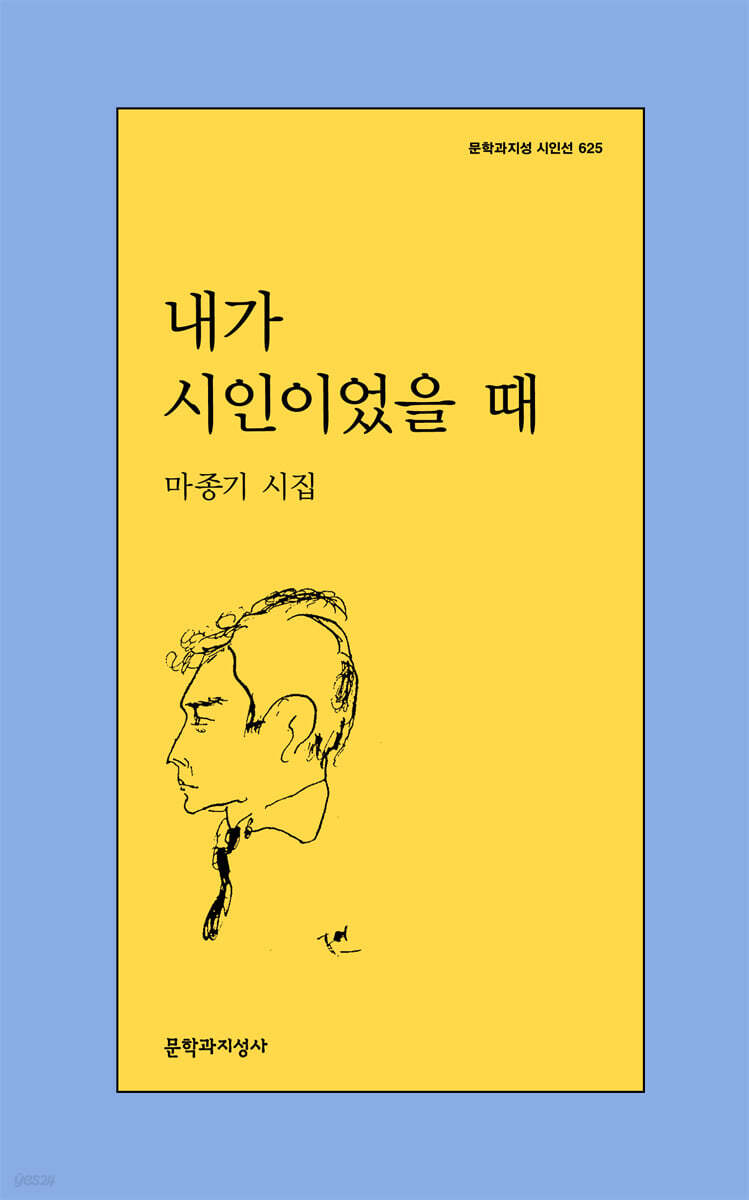
When I was a poet
 |
Description
Book Introduction
“The deep and beautiful days of my life”
When I was once a poet
When I was a poet who flew colorful balloons
So when I was a poet who overcame long suffering
Beautiful poet Ma Jong-gi's thirteenth poetry collection, "When I Was a Poet"
Poet Ma Jong-gi, who has been creating love poems with clear intellect and transparent language, has published a new poetry collection, “When I Was a Poet,” by Munhak-kwa-Jiseongsa.
All of the works included in this poetry collection, published five years after 『Angel's Lament』 (Munhak-kwa-Jiseongsa, 2020), were written as the poet passed through the path of longevity.
The poet, who said at the time of receiving the main prize at the 24th Korean Catholic Literature Award that “literature is what saved me,” has published works based on his utmost love for his mother tongue while traveling to over 60 countries over the years.
Ma Jong-gi, who shows boundless tolerance and does not make hasty judgments when it comes to matters related to people and life, has been a giant in the Korean literary world and has received the deep love of critics and readers alike.
This collection of poems, “When I Was a Poet,” which can be said to be the culmination of Ma Jong-gi’s world of poetry, is a condensed version of the poet’s pledge that “hoping for what is visible is not hope,” expressed with a pure heart.
The poet looks back on a friend he can no longer meet, a sister who passed away early, and even the small hope he saw in the yellow dandelions of his childhood, and looks back on a moment of love that could never be destroyed even in the midst of life's suffering.
The prose "Island Without a Hero," which contains the hardships of prison, the self-reproach for not being able to be there for his father Ma Hae-song at his deathbed, and the lonely moments that do not disappear even in the midst of an abundant life, will provide a glimpse into the life of poet Ma Jong-gi, who never once abandoned his sincerity toward people.
In 1980, the poet gave strength to us who were wandering in the emptiness of life, saying, “I live with a deep sense that what we desperately need now is love, understanding, and unconditional embrace, rather than the knowledge, accuracy, or strict judgment we believe in” (Poet’s note on the back cover of ‘The Invisible Country of Love’).
The 'love, understanding, and unconditional embrace' that the poet earnestly longed for may be what we need most in today's complex world, living without being able to see further or deeper.
This is why the beautiful poet Ma Jong-gi, who lived with unwavering love for invisible objects, should be with us now.
When I was once a poet
When I was a poet who flew colorful balloons
So when I was a poet who overcame long suffering
Beautiful poet Ma Jong-gi's thirteenth poetry collection, "When I Was a Poet"
Poet Ma Jong-gi, who has been creating love poems with clear intellect and transparent language, has published a new poetry collection, “When I Was a Poet,” by Munhak-kwa-Jiseongsa.
All of the works included in this poetry collection, published five years after 『Angel's Lament』 (Munhak-kwa-Jiseongsa, 2020), were written as the poet passed through the path of longevity.
The poet, who said at the time of receiving the main prize at the 24th Korean Catholic Literature Award that “literature is what saved me,” has published works based on his utmost love for his mother tongue while traveling to over 60 countries over the years.
Ma Jong-gi, who shows boundless tolerance and does not make hasty judgments when it comes to matters related to people and life, has been a giant in the Korean literary world and has received the deep love of critics and readers alike.
This collection of poems, “When I Was a Poet,” which can be said to be the culmination of Ma Jong-gi’s world of poetry, is a condensed version of the poet’s pledge that “hoping for what is visible is not hope,” expressed with a pure heart.
The poet looks back on a friend he can no longer meet, a sister who passed away early, and even the small hope he saw in the yellow dandelions of his childhood, and looks back on a moment of love that could never be destroyed even in the midst of life's suffering.
The prose "Island Without a Hero," which contains the hardships of prison, the self-reproach for not being able to be there for his father Ma Hae-song at his deathbed, and the lonely moments that do not disappear even in the midst of an abundant life, will provide a glimpse into the life of poet Ma Jong-gi, who never once abandoned his sincerity toward people.
In 1980, the poet gave strength to us who were wandering in the emptiness of life, saying, “I live with a deep sense that what we desperately need now is love, understanding, and unconditional embrace, rather than the knowledge, accuracy, or strict judgment we believe in” (Poet’s note on the back cover of ‘The Invisible Country of Love’).
The 'love, understanding, and unconditional embrace' that the poet earnestly longed for may be what we need most in today's complex world, living without being able to see further or deeper.
This is why the beautiful poet Ma Jong-gi, who lived with unwavering love for invisible objects, should be with us now.
- You can preview some of the book's contents.
Preview
index
Poet's words
Part 1
Diaspora on the Beach | Lent of That Year | The Road to Donghwasa Temple | A Pair of White-crowned Cranes | The Origin of Pain | Dizziness on Mount Baekdu | Mosquito Day | The Sunny Side of That Country | In the Name of the Wind | The Testimony of a White Butterfly | The Man Washing Feet | Leaving the Avatar | Winter's Response | My Brother's Memorial Day | Around the Time of Ipdong
Part 2
Late String Quartet | Like First Love | My Sister's Farewell | A Day in the Shadow | Late Autumn at Waon Beach | On a Big Journey | A Bird Living Alone | A Long Journey | A Secret Village | Thoughts on Snow | A Discovery in the Morning | A Crane | The King of Kings
Part 3
The Orchard of Perpetual Life | Using a Different Room | An Elegant Tree | Taming Chitchat 23 | Taming Chitchat 24 | Geulpina Geulpina | In the Gogunsan Archipelago | In the Gogunsan Archipelago 2 | Seeing Off a Friend | Sunset Family | Promise | The River of Myth | The Argentine Rainbow | A Single Wind | When I Was a Poet
prose
Island without heroes
commentary
The origin of deep and beautiful days?·?Jeong Geut-byeol
Part 1
Diaspora on the Beach | Lent of That Year | The Road to Donghwasa Temple | A Pair of White-crowned Cranes | The Origin of Pain | Dizziness on Mount Baekdu | Mosquito Day | The Sunny Side of That Country | In the Name of the Wind | The Testimony of a White Butterfly | The Man Washing Feet | Leaving the Avatar | Winter's Response | My Brother's Memorial Day | Around the Time of Ipdong
Part 2
Late String Quartet | Like First Love | My Sister's Farewell | A Day in the Shadow | Late Autumn at Waon Beach | On a Big Journey | A Bird Living Alone | A Long Journey | A Secret Village | Thoughts on Snow | A Discovery in the Morning | A Crane | The King of Kings
Part 3
The Orchard of Perpetual Life | Using a Different Room | An Elegant Tree | Taming Chitchat 23 | Taming Chitchat 24 | Geulpina Geulpina | In the Gogunsan Archipelago | In the Gogunsan Archipelago 2 | Seeing Off a Friend | Sunset Family | Promise | The River of Myth | The Argentine Rainbow | A Single Wind | When I Was a Poet
prose
Island without heroes
commentary
The origin of deep and beautiful days?·?Jeong Geut-byeol
Into the book
The dandelions that were blooming on the way to Dongwha Temple
I wonder if he still lives next to that big rock.
Well-raised chicks, with countless yellow faces
If I go, will you come and say you're happy to see me?
Even though I couldn't eat lunch during the chaos 70 years ago
In early summer, the flowers bloomed brightly along the road
Wildflowers, rocks, birds, and streams,
My young hopes growing up in it
Are they still living well?
1952, thirteen-year-old newspaper-selling refugee student,
My poem "The Road to Dongwhasa" was in that newspaper.
I still live in the fresh fields of Namdo.
Today is not a day to walk wearing rubber shoes
Check the shuttle bus schedule and sit leisurely
Or you can track them with your phone and drive away
A nearby paved road that is comfortable and refreshing.
The world has changed a lot over the years,
What's left for me is a wrinkled fairy tale.
I guess I'll have to go back and look for it.
Light green, heart-warming plans
Where exactly do you live now?
Is it because we don't live together holding hands?
Is it because I was running around acting like I was the only one who knew?
From sunrise to sunset
I have to bow my head and ask step by step.
--- From "On the Way to Dongwhasa"
In my younger days
I want to be a good poet again and again
He got drunk and collapsed on the ground.
I even went to prison for shouting out the right path.
In the end, only wounds accumulate all over the body
I left the country far away and became lonely
You came to me as a stranger.
Even though I struggle in the dark, they just ignore me
A road that did not allow even one companion,
If you wait for a cold answer in the shade
Only then did he send me a few glances
I lived in that thirst, in that shame.
Even at an age when the world is blurry
The path of slow steps is long
Flowers bloom only on naked bodies
I need to forget my age and my wounds.
My blood that was biting my lips to find poetry
Have you ever seen persistent insomnia?
They say only pain heals pain.
There is no sign of recovery anywhere.
Hiding the wandering soul of a disabled person
We will all set out again on the long journey we have already embarked on.
--- From "The Long Road"
It rained and then cleared up
The raindrops that remained in the air gathered together
It creates a refreshing rainbow.
In this land where rain is precious,
I need to get older
You can get wet all over your body.
Where the rainbow grew
The color still remains
Paint the sky and the earth brightly
Regretting my sinful life
Rain wasted on the five-colored paints
You said you would make a promise today
It washes even my body.
O land that raised rainbows,
Waking up a town in deep sleep
My singing summer backyard,
The temptation of the past seen at the end of the heavy rain.
--- From "Promise"
A few months after I sent the manuscript, a friend who was the president of a publishing company sent me a few copies of my poetry collection, saying that although it had finally been published, some poems had been deleted due to censorship by the military government. He apologized and sent me a few copies of my poetry collection.
When I looked through the poetry collection you sent me, I found that two poems that had no political overtones or particular flaws were deleted due to censorship.
I can't find the reason for the deletion, so I wonder if the list of people I was arrested with in 1960 still exists and could have been used as a clue for the censorship.
Suddenly, I got goosebumps all over my body.
A moment of regret flashed through my mind, wondering if I had published a poetry collection for no reason.
The poetry collection sold well, but it was a really strange collection of poetry.
The commentator of the poetry collection diligently mentioned the deleted poems that were not included in the poetry collection, and some of the deleted poems appeared in the commentary.
The poetry collection that began selling like that was reprinted over the next 40 years, but the publisher stubbornly published it in the same form as the first time, without changing the rough format and the abundance of Chinese characters that were similar to letterpress printing, and without reinserting poems that had been censored.
Then, finally, the trial was established last year.
So, after 40 years, Chinese characters were placed in parentheses and two deleted poems were finally reincarnated.
I think the story is getting too long, so I'll stop here.
--- From "Prose - An Island Without Heroes"
I recently counted the countries I've eaten and slept in for more than a day, and it was well over 60.
Each country has its own characteristics and there are many places that have impressed me, but if I had to pick one or two special memories, one would be twelve hours in the snow from Puerto Varas, Chile, in the Patagonia region of southern South America, crossing the high Andes into Argentina.
I remember being grateful for the good fortune of being able to live my entire life loving literature, with a smile like that of the pilot Guillaumet, a friend of Saint-Exupéry, who had been lost on the mountain while struggling to cross the mountain covered in thick snow.
Another was an afternoon spent walking along the path of suffering from the place where Jesus was tried in ancient Jerusalem, Israel, carrying his heavy cross, past the gentle rocky hill of Golgotha, to the cathedral built on the spot where he was crucified, in the oppressive heat of 43 degrees Celsius.
I can recall that desperate time, when I was torn to pieces with sweat and tears.
I can't forget the feeling of fulfillment I felt that day when I looked up to him and confessed that I would become the world's fool.
I wonder if he still lives next to that big rock.
Well-raised chicks, with countless yellow faces
If I go, will you come and say you're happy to see me?
Even though I couldn't eat lunch during the chaos 70 years ago
In early summer, the flowers bloomed brightly along the road
Wildflowers, rocks, birds, and streams,
My young hopes growing up in it
Are they still living well?
1952, thirteen-year-old newspaper-selling refugee student,
My poem "The Road to Dongwhasa" was in that newspaper.
I still live in the fresh fields of Namdo.
Today is not a day to walk wearing rubber shoes
Check the shuttle bus schedule and sit leisurely
Or you can track them with your phone and drive away
A nearby paved road that is comfortable and refreshing.
The world has changed a lot over the years,
What's left for me is a wrinkled fairy tale.
I guess I'll have to go back and look for it.
Light green, heart-warming plans
Where exactly do you live now?
Is it because we don't live together holding hands?
Is it because I was running around acting like I was the only one who knew?
From sunrise to sunset
I have to bow my head and ask step by step.
--- From "On the Way to Dongwhasa"
In my younger days
I want to be a good poet again and again
He got drunk and collapsed on the ground.
I even went to prison for shouting out the right path.
In the end, only wounds accumulate all over the body
I left the country far away and became lonely
You came to me as a stranger.
Even though I struggle in the dark, they just ignore me
A road that did not allow even one companion,
If you wait for a cold answer in the shade
Only then did he send me a few glances
I lived in that thirst, in that shame.
Even at an age when the world is blurry
The path of slow steps is long
Flowers bloom only on naked bodies
I need to forget my age and my wounds.
My blood that was biting my lips to find poetry
Have you ever seen persistent insomnia?
They say only pain heals pain.
There is no sign of recovery anywhere.
Hiding the wandering soul of a disabled person
We will all set out again on the long journey we have already embarked on.
--- From "The Long Road"
It rained and then cleared up
The raindrops that remained in the air gathered together
It creates a refreshing rainbow.
In this land where rain is precious,
I need to get older
You can get wet all over your body.
Where the rainbow grew
The color still remains
Paint the sky and the earth brightly
Regretting my sinful life
Rain wasted on the five-colored paints
You said you would make a promise today
It washes even my body.
O land that raised rainbows,
Waking up a town in deep sleep
My singing summer backyard,
The temptation of the past seen at the end of the heavy rain.
--- From "Promise"
A few months after I sent the manuscript, a friend who was the president of a publishing company sent me a few copies of my poetry collection, saying that although it had finally been published, some poems had been deleted due to censorship by the military government. He apologized and sent me a few copies of my poetry collection.
When I looked through the poetry collection you sent me, I found that two poems that had no political overtones or particular flaws were deleted due to censorship.
I can't find the reason for the deletion, so I wonder if the list of people I was arrested with in 1960 still exists and could have been used as a clue for the censorship.
Suddenly, I got goosebumps all over my body.
A moment of regret flashed through my mind, wondering if I had published a poetry collection for no reason.
The poetry collection sold well, but it was a really strange collection of poetry.
The commentator of the poetry collection diligently mentioned the deleted poems that were not included in the poetry collection, and some of the deleted poems appeared in the commentary.
The poetry collection that began selling like that was reprinted over the next 40 years, but the publisher stubbornly published it in the same form as the first time, without changing the rough format and the abundance of Chinese characters that were similar to letterpress printing, and without reinserting poems that had been censored.
Then, finally, the trial was established last year.
So, after 40 years, Chinese characters were placed in parentheses and two deleted poems were finally reincarnated.
I think the story is getting too long, so I'll stop here.
--- From "Prose - An Island Without Heroes"
I recently counted the countries I've eaten and slept in for more than a day, and it was well over 60.
Each country has its own characteristics and there are many places that have impressed me, but if I had to pick one or two special memories, one would be twelve hours in the snow from Puerto Varas, Chile, in the Patagonia region of southern South America, crossing the high Andes into Argentina.
I remember being grateful for the good fortune of being able to live my entire life loving literature, with a smile like that of the pilot Guillaumet, a friend of Saint-Exupéry, who had been lost on the mountain while struggling to cross the mountain covered in thick snow.
Another was an afternoon spent walking along the path of suffering from the place where Jesus was tried in ancient Jerusalem, Israel, carrying his heavy cross, past the gentle rocky hill of Golgotha, to the cathedral built on the spot where he was crucified, in the oppressive heat of 43 degrees Celsius.
I can recall that desperate time, when I was torn to pieces with sweat and tears.
I can't forget the feeling of fulfillment I felt that day when I looked up to him and confessed that I would become the world's fool.
--- From "Back Cover - The Poet's Writings"
Publisher's Review
Even if everything I miss falls apart
A young hope held in the palm of your hand
All the places I miss have changed.
The body in its old form that has not been able to shed its shell
I just now noticed that everyone has left.
Learn why all bottles are pale.
Mumbling that plants have memories too
Someone who listens to my monologue in secret
I feel like you're around me for some time now.
―Excerpt from “Lent of That Year”
The deep nostalgia that permeated Ma Jong-gi's poetry stemmed from the longing that had taken root within him.
He expands his unique experience of living as a "border person", wandering between the borders of his home country and a foreign country, without belonging anywhere, into the universal life of humanity, exploring human life and truth, not just individual experiences.
The “pale green, heart-warming plans” (“The Road to a Fairy Tale”) that grew up “in the midst of chaos 70 years ago” are a “young hope” and a belated letter that thirteen-year-old Ma Jong-gi sends to himself 70 years later.
“Even though I promise to live diligently/I leave behind the anxious days of the past” (“The Sunny Side of That Country”), “all the places I miss have changed” and familiar faces have left my side.
The poet, observing the people and places he believed would last forever crumble one by one, listens to the sound of winter, which “responds, little by little, with sleet” (“Winter’s Response”) to the words of “the philosopher who says that all humans are displaced people.”
Ma Jong-gi's poetry, which uses family, friends, neighbors, and nature as its material, asks after people we can no longer meet, irretrievable memories, and time that cannot be reached.
The poet who exhorted, “Don’t judge people with your eyes/Look at people with your ears” (“Opinions on the Eyes”) has now reached an age where he knows that “rivers flow more slowly as they get older” (“Taming Chitchat 24”).
His confession that he feels like someone has been listening to his monologue for some time is likely filled with his unwavering belief in living the life given to him and memories that will remain unforgettable no matter how much time passes.
We learn about life once again from this beautiful poet.
He compresses experiences, mediates memories, transforms perceptions, and condenses emotions into concise aphorisms.
It is an expression of a poetic desire to redefine invisible love, the responsibility and duty of love, the source of loneliness and longing resulting from it, and the pain and meaning of life in one's own words.
He has always questioned and sought answers about life and the world, understood life and the world, and examined and interpreted its memories.
It may also be a poetic reflection and a product of will on why some memories are unforgettable and how to live on without forgetting others.
―Jeong Gyeot-byeol, commentary from “The Origin of Deep and Beautiful Days”
Singing in search of the truth of the world
The gentle warmth of a beautiful poet
Then when I was still a poet
I sang while drunk as requested.
I suddenly looked around and there was no one there.
Even anxious tears cannot flow
I couldn't take my eyes off of him.
[······]
Yeah, open your eyes.
The hidden waterway inside me
The dawn flows with a sound,
To avoid becoming a lost patient
I ask the dew between the blades of grass to accompany me.
So when I was a poet who had overcome long suffering.
―Excerpt from “When I Was a Poet”
The poet, watching a pair of cranes mating, recalls the “precious sight of monks’ dances, the whirling salpuri dances, and the immaculate crane dances” he used to enjoy in his youth, “without excitement, without drooling, without amusement, but with a calm, ecstatic beauty.”
And then, when I encounter a moment like this, when life bears a splendid dew, I ask myself, “Can I now truly believe that I have become a poet?” (“A Pair of Cranes”).
The cranes walking gracefully with their heads together convey the meaning of life in the grass on which they stand, and the poet willingly shares that moment with us.
He writes poetry with the desire to look into the abyss of invisible objects and listen once more to the inaudible sounds. He holds a long-held belief that poetry “must become a tool for healing wounds in a bleak world” (the poet’s note on the back cover of “Angel’s Lament”).
“Justice is sold for a few pennies anywhere/Everyone learned it while touching their sore throats” (“The Origin of Pain”). For him, writing poetry is like a reckless attempt to not lose the beauty of life.
The poet glimpses the solemn attitude of a mosquito sitting at his desk, saying, “All the world is neither peaceful nor fair / Learned with one death” (“Mosquito Day”), but he responds to the call of poetry with concern, “I might kill someone with one mistake / I might hurt someone with one slip of the tongue.”
“In his younger days, he wanted to be a good poet, so many times he drank and got drunk and fell to the ground,” but only after he “left the country and became lonely” did he come to the painful realization that “only pain heals pain” (“The Long Road”).
The poet, who “wandered his whole life in search of good poetry without even knowing what it meant to be shaken,” confesses that “when I was shaken, poetry would bloom all over my body” (from “Gogunsan Islands”).
This may be a question about the survival dimension of a doctor and a question about the origin of existence, the purpose of a poet as a writer.
Even in the midst of the pain of a world where he cannot settle down, the poet faces himself as “a poet who has overcome long suffering” with “one day he was middle-aged and another day he was old” (“The River of Myth”).
The works of a poet who has achieved such moral maturity convey an innately beautiful nature and a purity that does not fade with time, and they resonate deeply with readers.
He said that amidst the hardships of life he had to endure as an immigrant after leaving his homeland, he was only able to discover his own identity when he wrote poetry. He still excavates the sadness embedded in all living things.
In this way, it elevates the aesthetics of poetry to a higher level and asks what is important in our lives.
I couldn't show that kind of sadness to my mother or my younger sibling.
Instead, I wrote several poems, and often cried alone while writing them.
Poems like “Words of the Wind” and “The Invisible Country of Love” were written at that time.
―From the prose, “The Island Without Heroes”
Poet's words
This collection of poems is a collection of poems written and published over the five years since 『The Angel's Lament』.
So all the poems here were written after I turned eighty.
I still find it amazing that I can write poetry.
Thank you for reading my poetry.
October 2025
Ma Jong-gi
A young hope held in the palm of your hand
All the places I miss have changed.
The body in its old form that has not been able to shed its shell
I just now noticed that everyone has left.
Learn why all bottles are pale.
Mumbling that plants have memories too
Someone who listens to my monologue in secret
I feel like you're around me for some time now.
―Excerpt from “Lent of That Year”
The deep nostalgia that permeated Ma Jong-gi's poetry stemmed from the longing that had taken root within him.
He expands his unique experience of living as a "border person", wandering between the borders of his home country and a foreign country, without belonging anywhere, into the universal life of humanity, exploring human life and truth, not just individual experiences.
The “pale green, heart-warming plans” (“The Road to a Fairy Tale”) that grew up “in the midst of chaos 70 years ago” are a “young hope” and a belated letter that thirteen-year-old Ma Jong-gi sends to himself 70 years later.
“Even though I promise to live diligently/I leave behind the anxious days of the past” (“The Sunny Side of That Country”), “all the places I miss have changed” and familiar faces have left my side.
The poet, observing the people and places he believed would last forever crumble one by one, listens to the sound of winter, which “responds, little by little, with sleet” (“Winter’s Response”) to the words of “the philosopher who says that all humans are displaced people.”
Ma Jong-gi's poetry, which uses family, friends, neighbors, and nature as its material, asks after people we can no longer meet, irretrievable memories, and time that cannot be reached.
The poet who exhorted, “Don’t judge people with your eyes/Look at people with your ears” (“Opinions on the Eyes”) has now reached an age where he knows that “rivers flow more slowly as they get older” (“Taming Chitchat 24”).
His confession that he feels like someone has been listening to his monologue for some time is likely filled with his unwavering belief in living the life given to him and memories that will remain unforgettable no matter how much time passes.
We learn about life once again from this beautiful poet.
He compresses experiences, mediates memories, transforms perceptions, and condenses emotions into concise aphorisms.
It is an expression of a poetic desire to redefine invisible love, the responsibility and duty of love, the source of loneliness and longing resulting from it, and the pain and meaning of life in one's own words.
He has always questioned and sought answers about life and the world, understood life and the world, and examined and interpreted its memories.
It may also be a poetic reflection and a product of will on why some memories are unforgettable and how to live on without forgetting others.
―Jeong Gyeot-byeol, commentary from “The Origin of Deep and Beautiful Days”
Singing in search of the truth of the world
The gentle warmth of a beautiful poet
Then when I was still a poet
I sang while drunk as requested.
I suddenly looked around and there was no one there.
Even anxious tears cannot flow
I couldn't take my eyes off of him.
[······]
Yeah, open your eyes.
The hidden waterway inside me
The dawn flows with a sound,
To avoid becoming a lost patient
I ask the dew between the blades of grass to accompany me.
So when I was a poet who had overcome long suffering.
―Excerpt from “When I Was a Poet”
The poet, watching a pair of cranes mating, recalls the “precious sight of monks’ dances, the whirling salpuri dances, and the immaculate crane dances” he used to enjoy in his youth, “without excitement, without drooling, without amusement, but with a calm, ecstatic beauty.”
And then, when I encounter a moment like this, when life bears a splendid dew, I ask myself, “Can I now truly believe that I have become a poet?” (“A Pair of Cranes”).
The cranes walking gracefully with their heads together convey the meaning of life in the grass on which they stand, and the poet willingly shares that moment with us.
He writes poetry with the desire to look into the abyss of invisible objects and listen once more to the inaudible sounds. He holds a long-held belief that poetry “must become a tool for healing wounds in a bleak world” (the poet’s note on the back cover of “Angel’s Lament”).
“Justice is sold for a few pennies anywhere/Everyone learned it while touching their sore throats” (“The Origin of Pain”). For him, writing poetry is like a reckless attempt to not lose the beauty of life.
The poet glimpses the solemn attitude of a mosquito sitting at his desk, saying, “All the world is neither peaceful nor fair / Learned with one death” (“Mosquito Day”), but he responds to the call of poetry with concern, “I might kill someone with one mistake / I might hurt someone with one slip of the tongue.”
“In his younger days, he wanted to be a good poet, so many times he drank and got drunk and fell to the ground,” but only after he “left the country and became lonely” did he come to the painful realization that “only pain heals pain” (“The Long Road”).
The poet, who “wandered his whole life in search of good poetry without even knowing what it meant to be shaken,” confesses that “when I was shaken, poetry would bloom all over my body” (from “Gogunsan Islands”).
This may be a question about the survival dimension of a doctor and a question about the origin of existence, the purpose of a poet as a writer.
Even in the midst of the pain of a world where he cannot settle down, the poet faces himself as “a poet who has overcome long suffering” with “one day he was middle-aged and another day he was old” (“The River of Myth”).
The works of a poet who has achieved such moral maturity convey an innately beautiful nature and a purity that does not fade with time, and they resonate deeply with readers.
He said that amidst the hardships of life he had to endure as an immigrant after leaving his homeland, he was only able to discover his own identity when he wrote poetry. He still excavates the sadness embedded in all living things.
In this way, it elevates the aesthetics of poetry to a higher level and asks what is important in our lives.
I couldn't show that kind of sadness to my mother or my younger sibling.
Instead, I wrote several poems, and often cried alone while writing them.
Poems like “Words of the Wind” and “The Invisible Country of Love” were written at that time.
―From the prose, “The Island Without Heroes”
Poet's words
This collection of poems is a collection of poems written and published over the five years since 『The Angel's Lament』.
So all the poems here were written after I turned eighty.
I still find it amazing that I can write poetry.
Thank you for reading my poetry.
October 2025
Ma Jong-gi
GOODS SPECIFICS
- Date of issue: October 10, 2025
- Page count, weight, size: 152 pages | 128*205*20mm
- ISBN13: 9788932044637
You may also like
카테고리
korean


korean

![ELLE 엘르 스페셜 에디션 A형 : 12월 [2025]](http://librairie.coreenne.fr/cdn/shop/files/b8e27a3de6c9538896439686c6b0e8fb.jpg?v=1766436872&width=3840)


