

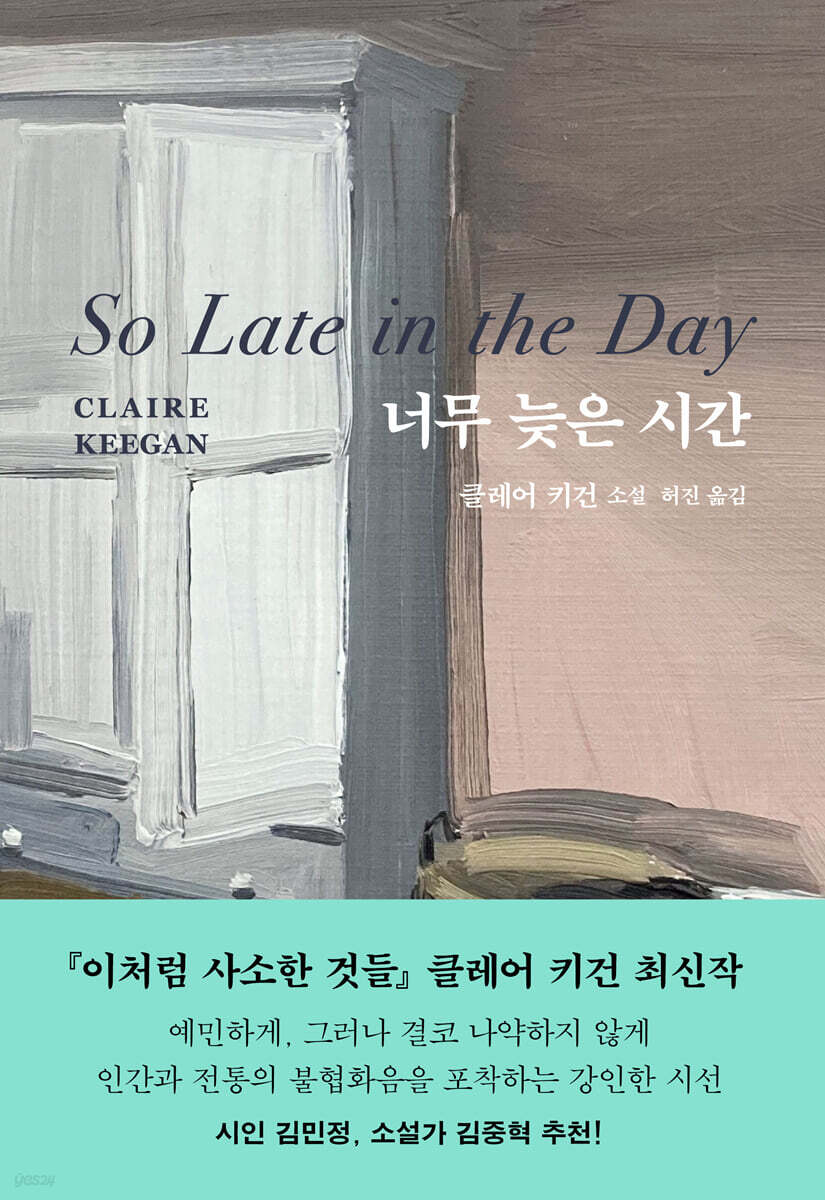
It's too late
 |
Description
Book Introduction
- A word from MD
-
The latest work by an author who aims at the world with sentencesThe latest work by Claire Keegan, author of last year's #1 book of the year, "Small Things Like This."
This collection of short stories contains three works spanning 25 years.
Although it is a short piece, it targets violence and distorted relationships with sentences that are concise and concise, as is typical of her.
A work that explores the roots of hatred that has persisted for generations.
July 8, 2025. Novel/Poetry PD Kim Yu-ri
Claire Keegan's latest work, "These Little Things"
* Recommended by poet Kim Min-jeong and novelist Kim Jung-hyuk *
Claire Keegan, author of 『Such Little Things』, the #1 Book of the Year in 2024 chosen by readers, has published a new book by Dasan Books.
Claire Keegan's work, "Too Late," which is being introduced in Korea for the fourth time, is her latest work, a collection of three short stories that showcases her most recent writings.
From his debut work 25 years ago to his most recent short stories, these are all being released for the first time in Korea, and they are bound together as a testimony to the distorted relationships between women and men.
In France, the translated version of this novel, which traces subtle or overt chauvinism, was given the title 'Misogyny' instead of the original title.
This novel, which appears calm on the surface but contains a tension that keeps the reader glued to the screen, has proven its literary value by being shortlisted for the 2023 Irish Book Award.
“Keegan’s writing style excels at allowing his thoughts to flow smoothly and without unnecessary embellishment.” _Kim Min-jeong (poet)
“On the surface, it seems like a sentence as cold as ice, but inside, all kinds of emotions are seething and surging.” _Kim Jung-hyuk (novelist)
* Recommended by poet Kim Min-jeong and novelist Kim Jung-hyuk *
Claire Keegan, author of 『Such Little Things』, the #1 Book of the Year in 2024 chosen by readers, has published a new book by Dasan Books.
Claire Keegan's work, "Too Late," which is being introduced in Korea for the fourth time, is her latest work, a collection of three short stories that showcases her most recent writings.
From his debut work 25 years ago to his most recent short stories, these are all being released for the first time in Korea, and they are bound together as a testimony to the distorted relationships between women and men.
In France, the translated version of this novel, which traces subtle or overt chauvinism, was given the title 'Misogyny' instead of the original title.
This novel, which appears calm on the surface but contains a tension that keeps the reader glued to the screen, has proven its literary value by being shortlisted for the 2023 Irish Book Award.
“Keegan’s writing style excels at allowing his thoughts to flow smoothly and without unnecessary embellishment.” _Kim Min-jeong (poet)
“On the surface, it seems like a sentence as cold as ice, but inside, all kinds of emotions are seething and surging.” _Kim Jung-hyuk (novelist)
- You can preview some of the book's contents.
Preview
index
It's too late
a long and painful death
Antarctica
Acknowledgements
Translator's Note
a long and painful death
Antarctica
Acknowledgements
Translator's Note
Detailed image

Into the book
Despite the tangled human struggles and knowing how everything would end, life went on mostly smoothly.
--- pp.12-13
“Tell me you still love me,” Sabine said after most of her things had found their places and she had moved several of his things.
She was sitting next to Kahl on the edge of the bed.
"of course."
“Then what’s the problem?”
“There is no problem.”
“Tell me,” Sabine insisted.
“I just wondered what it was all about, that’s all.”
“What? My stuff?”
“These.
All your stuff.
“That’s it.” Kahl looked around.
A blue blanket, two extra cushions, and several pairs of shoes and sandals sticking out from under Sabine's dresser, though she'd rarely seen them on.
All Kahl had was a pair of Nike sneakers and a pair of dress shoes.
--- pp.33-34
Then something from long ago came to mind.
My mother was standing in front of the stove, flipping buttermilk pancakes in a pan.
My father sat at the head of the table, and Kahl and my younger brother sat on either side of him.
Both were college students in their twenties, and had brought their laundry to spend the weekend at home.
When the mother brought the three plates to the table, the three of them began to eat.
My mother brought her plate and tried to sit down, but my brother reached out and pulled the chair away, causing me to fall to the floor.
My mother, who had married late, was nearly sixty at the time, but my father chuckled.
All three of them laughed heartily, even as their mother picked up the pancakes and broken plates that had fallen to the floor.
Kahl might have wondered in a corner of his heart what kind of person he would have become if his father had been a different man, if he hadn't laughed at that sight, but he didn't think about it for long.
--- p.44
High waves washed up on the beach, but all around her were layers of bleached stones, shining brightly.
I have never seen such a pretty stone.
Every time I moved, it rattled like Delft porcelain under my feet.
She wondered how long these stones had been here, and what kind they were, but what did it matter? Just as she was doing, they were here now.
--- p.60
“Ireland isn’t what it used to be,” he said.
“People here were poor, but they were all satisfied.”
“Do you think it is possible for a poor person to be content?”
He raised and lowered his shoulders, a childlike reaction.
He could neither lead nor answer the conversation, nor was he content with no conversation.
She figured this guy could at least make small talk, and it was her personal belief that all good conversations start with small talk.
--- p.72
A happily married woman wondered what it would be like to sleep with a different man every time she went away.
So I decided to find out next weekend.
It was December, and it felt like another year was coming to a close.
She wanted to do it before she got too old.
It was clear that it would be disappointing.
--- p.84
She filled the bath with as much hot water as she could stand.
He came into the bathroom, took off his shirt, and shaved in front of the sink with his back to her.
She closed her eyes and listened to the man lathering, tapping the razor against the sink, and shaving.
It felt like the two of us had been like this before.
The woman thought the man was the least threatening of all the men she had ever known.
--- pp.91-92
“When I was in school, the nuns told me that hell was eternal,” she said, peeling off the skin of a trout.
“When we asked how long eternity is, the nun said,
'Think of all the sand on Earth.
All the beaches, sand quarries, seabeds, deserts.
Imagine all that sand is in an hourglass.
It's like a giant cooking timer.
If one grain of sand falls in an hourglass every year, eternity is the time it takes for all the sand in the world to fall out of the hourglass.' Think about it! We were all terrified.
“I was very young.”
--- pp.12-13
“Tell me you still love me,” Sabine said after most of her things had found their places and she had moved several of his things.
She was sitting next to Kahl on the edge of the bed.
"of course."
“Then what’s the problem?”
“There is no problem.”
“Tell me,” Sabine insisted.
“I just wondered what it was all about, that’s all.”
“What? My stuff?”
“These.
All your stuff.
“That’s it.” Kahl looked around.
A blue blanket, two extra cushions, and several pairs of shoes and sandals sticking out from under Sabine's dresser, though she'd rarely seen them on.
All Kahl had was a pair of Nike sneakers and a pair of dress shoes.
--- pp.33-34
Then something from long ago came to mind.
My mother was standing in front of the stove, flipping buttermilk pancakes in a pan.
My father sat at the head of the table, and Kahl and my younger brother sat on either side of him.
Both were college students in their twenties, and had brought their laundry to spend the weekend at home.
When the mother brought the three plates to the table, the three of them began to eat.
My mother brought her plate and tried to sit down, but my brother reached out and pulled the chair away, causing me to fall to the floor.
My mother, who had married late, was nearly sixty at the time, but my father chuckled.
All three of them laughed heartily, even as their mother picked up the pancakes and broken plates that had fallen to the floor.
Kahl might have wondered in a corner of his heart what kind of person he would have become if his father had been a different man, if he hadn't laughed at that sight, but he didn't think about it for long.
--- p.44
High waves washed up on the beach, but all around her were layers of bleached stones, shining brightly.
I have never seen such a pretty stone.
Every time I moved, it rattled like Delft porcelain under my feet.
She wondered how long these stones had been here, and what kind they were, but what did it matter? Just as she was doing, they were here now.
--- p.60
“Ireland isn’t what it used to be,” he said.
“People here were poor, but they were all satisfied.”
“Do you think it is possible for a poor person to be content?”
He raised and lowered his shoulders, a childlike reaction.
He could neither lead nor answer the conversation, nor was he content with no conversation.
She figured this guy could at least make small talk, and it was her personal belief that all good conversations start with small talk.
--- p.72
A happily married woman wondered what it would be like to sleep with a different man every time she went away.
So I decided to find out next weekend.
It was December, and it felt like another year was coming to a close.
She wanted to do it before she got too old.
It was clear that it would be disappointing.
--- p.84
She filled the bath with as much hot water as she could stand.
He came into the bathroom, took off his shirt, and shaved in front of the sink with his back to her.
She closed her eyes and listened to the man lathering, tapping the razor against the sink, and shaving.
It felt like the two of us had been like this before.
The woman thought the man was the least threatening of all the men she had ever known.
--- pp.91-92
“When I was in school, the nuns told me that hell was eternal,” she said, peeling off the skin of a trout.
“When we asked how long eternity is, the nun said,
'Think of all the sand on Earth.
All the beaches, sand quarries, seabeds, deserts.
Imagine all that sand is in an hourglass.
It's like a giant cooking timer.
If one grain of sand falls in an hourglass every year, eternity is the time it takes for all the sand in the world to fall out of the hourglass.' Think about it! We were all terrified.
“I was very young.”
--- p.97
Publisher's Review
Claire Keegan completed it 25 years later.
Three Stories About Women and Men
Claire Keegan has established herself as a world-renowned writer, transcending Ireland, by sharply portraying the world and humanity with concise and suggestive sentences.
He left a strong impression on domestic readers with his first work, "The Girl Entrusted" and his representative work, "Such Trivial Things", and was subsequently called "the hottest novelist in bookstores today" with the introduction of his early work, "Walking in the Blue Fields".
In 2024, it simultaneously ranked first in the Book of the Year rankings of online bookstores Yes24, Aladdin, and Milli's Library, and swept the 'Book of the Year' awards from major media outlets, establishing itself as an unrivaled, unrivaled international author.
His new book, Too Late, is a collection of three quiet, devastating stories about twisted relationships.
Unlike the British version, which can be considered the original, the American version has a subtitle, which is unique for a novel.
'A story of women and men'.
As its subtitle suggests, this book traces the undercurrents of violence and supremacy that exist in relationships between men and women, from the subtle to the blatant.
The short stories contained within were published in 2022 ("Too Late"), 2007 ("The Long and Painful Death"), and 1999 ("Antarctica"), with a gap of approximately ten years between the three stories, allowing one to trace Claire Keegan's career as a writer through this one volume.
Among them, the title piece, "Too Late," attracts attention as it is Keegan's latest work, the first to be released after receiving worldwide attention with "Such Little Things."
This short story, known to be a work that the author has been refining for over ten years, began as a story that he, who also works as a creative writing instructor, wrote down on the blackboard in a class a long time ago while giving an example of a "novel that is not dramatic but full of suspense."
Completed over a period of about ten years, this work is a truly 'Keeganian' novel, capable of experiencing the same emotional turmoil as a full-length novel, despite being less than 50 pages long.
"Too Late" was first published in The New Yorker in 2023 and was later published as a book a year later, with some of the story altered. Comparing the two versions reveals the painstaking care Keegan put into the text.
In the New Yorker version, the protagonist, Cahl, receives a text message from his younger brother asking, “You OK?” after breaking up with his lover, but this was changed in the book version.
Asked if he felt comfortable using such explicit language as “Your better off without that French hoor,” Keegan adds that these words are more revealing and more accurate.
“It is the writer's job to translate the language we actually use into writing to describe the lives and world we live in.”
A story where one side must disappear for the other side to survive
The title piece, "Too Late," is set in Dublin on a sunny summer day and follows Cahull, a civil servant who goes to work at his company.
It's strange that the protagonist doesn't want to check his phone, but it's not immediately clear what the problem is.
Then, the fight with the woman he had promised to marry replays in his head.
The topic of the argument was what men want from women, and in the midst of it, he was overcome with a strange mixture of regret and hatred as he thought about his own mistakes and his father's legacy.
And as Kahl reminisces about his relationship with his fiancée, readers come to see, one by one, the character flaws that led to his downfall.
While "Too Late" delved into the story of a couple, "The Long and Painful Death" explores the subtle conflicts in an unfamiliar relationship.
The story begins with the female protagonist, who was trying to leisurely write at a writer's residence called 'Bell House', receiving a sudden phone call.
The man, who introduced himself as a German literature professor, immediately said that he would like to look around the house where the woman was staying.
The protagonist, who reluctantly complies with the man's request, prepares a cake for the guest during her precious time spent writing.
The guest who came that way was a man who “could neither lead a conversation, nor answer, nor be content with no conversation,” and after greedily eating the cake that had been served, he reprimanded him as follows:
“You’re a writer, but you’re making cakes at Heinrich Böll’s house.”
"Antarctica" is the last story in the collection, but it is the oldest published, and it begins with the following provocative sentence:
“A happily married woman wondered what it would be like to sleep with a different man every time she went away.
So she decided to find out next weekend.” She heads into the city for a few days to buy Christmas presents for her family, meets a man at a bar, and spends the night with him.
But an ominous aura surrounds this adventure, and she finally reaches a bone-chilling turning point.
When placed alongside Keegan's two other short stories, "Such Trivial Things" and "The Girl Left Behind," a striking feature of these novels is their exclusion of "warmth."
Unlike his short stories, which brought kind people into a harsh and cold world, this time Keegan presents the cold reality as it is, exquisitely depicting the frustrations and fears of lonely men, and the way they nurture desires and hunger in the darkness.
Each story exquisitely depicts the violent tensions and hatred hidden between seemingly quiet characters, and the resulting strained relationships.
And when we see how the horrific self-portrait of masculinity in that story has been passed down and firmly established from the father's generation, we can guess Keegan's intention in quoting Philip Larkin's poem at the beginning of the book.
“What we know, what we have always known, / What we cannot avoid, but cannot accept, / Is as plain as a wardrobe. / One side must disappear.” _Philip Larkin, “Aubade”
Deconstructing the male world with sharp, yet never weak, sentences
In "Too Late," there is a scene where the protagonist Kahl's younger brother knocks over his mother's chair by pulling it back as she tries to sit down at the table with her plate after preparing a meal.
Her husband and two sons laugh as they watch her lying on the floor.
“Unfortunately, this scene is very autobiographical,” Keegan said in an interview when the short story was published in The New Yorker.
“When I was little, my older brother did something like that to my mother, but everyone just took it lightly, like it was no big deal.
“That scene is forever etched in my memory.”
If we delve into the root causes of the distorted relationships featured in the book, we can understand why the French translation of the book was titled "Misogyny."
Keegan keenly captures how the imbalanced power relations that have persisted for generations manifest themselves in the modern era, how everyday hatred affects both men and women, and how vulnerable humans are to selfishness and impulsiveness.
This book, which contains questions that have long been explored in Keegan's work, feels like a kind of pronouncement that neither happiness nor love will be granted to those who retreat rather than move forward.
This new work, which stands out for the author's characteristically concise yet suggestive sentences, his skill in delivering a powerful impact in a quiet atmosphere, and his excellent writing style that allows his thoughts to flow smoothly, confronts the issues contained in his previous works with an even stronger perspective.
Translator Heo Jin, who translated Keegan's novels, once described Keegan as a very strong person, saying, "He is a writer who can feel and see the dissonance that occurs in life, but his perspective is never weak."
This new work, which seeks to dismantle the male world created by his father's generation, is one of Keegan's most striking works, particularly for its sharp and strong perspective.
Three Stories About Women and Men
Claire Keegan has established herself as a world-renowned writer, transcending Ireland, by sharply portraying the world and humanity with concise and suggestive sentences.
He left a strong impression on domestic readers with his first work, "The Girl Entrusted" and his representative work, "Such Trivial Things", and was subsequently called "the hottest novelist in bookstores today" with the introduction of his early work, "Walking in the Blue Fields".
In 2024, it simultaneously ranked first in the Book of the Year rankings of online bookstores Yes24, Aladdin, and Milli's Library, and swept the 'Book of the Year' awards from major media outlets, establishing itself as an unrivaled, unrivaled international author.
His new book, Too Late, is a collection of three quiet, devastating stories about twisted relationships.
Unlike the British version, which can be considered the original, the American version has a subtitle, which is unique for a novel.
'A story of women and men'.
As its subtitle suggests, this book traces the undercurrents of violence and supremacy that exist in relationships between men and women, from the subtle to the blatant.
The short stories contained within were published in 2022 ("Too Late"), 2007 ("The Long and Painful Death"), and 1999 ("Antarctica"), with a gap of approximately ten years between the three stories, allowing one to trace Claire Keegan's career as a writer through this one volume.
Among them, the title piece, "Too Late," attracts attention as it is Keegan's latest work, the first to be released after receiving worldwide attention with "Such Little Things."
This short story, known to be a work that the author has been refining for over ten years, began as a story that he, who also works as a creative writing instructor, wrote down on the blackboard in a class a long time ago while giving an example of a "novel that is not dramatic but full of suspense."
Completed over a period of about ten years, this work is a truly 'Keeganian' novel, capable of experiencing the same emotional turmoil as a full-length novel, despite being less than 50 pages long.
"Too Late" was first published in The New Yorker in 2023 and was later published as a book a year later, with some of the story altered. Comparing the two versions reveals the painstaking care Keegan put into the text.
In the New Yorker version, the protagonist, Cahl, receives a text message from his younger brother asking, “You OK?” after breaking up with his lover, but this was changed in the book version.
Asked if he felt comfortable using such explicit language as “Your better off without that French hoor,” Keegan adds that these words are more revealing and more accurate.
“It is the writer's job to translate the language we actually use into writing to describe the lives and world we live in.”
A story where one side must disappear for the other side to survive
The title piece, "Too Late," is set in Dublin on a sunny summer day and follows Cahull, a civil servant who goes to work at his company.
It's strange that the protagonist doesn't want to check his phone, but it's not immediately clear what the problem is.
Then, the fight with the woman he had promised to marry replays in his head.
The topic of the argument was what men want from women, and in the midst of it, he was overcome with a strange mixture of regret and hatred as he thought about his own mistakes and his father's legacy.
And as Kahl reminisces about his relationship with his fiancée, readers come to see, one by one, the character flaws that led to his downfall.
While "Too Late" delved into the story of a couple, "The Long and Painful Death" explores the subtle conflicts in an unfamiliar relationship.
The story begins with the female protagonist, who was trying to leisurely write at a writer's residence called 'Bell House', receiving a sudden phone call.
The man, who introduced himself as a German literature professor, immediately said that he would like to look around the house where the woman was staying.
The protagonist, who reluctantly complies with the man's request, prepares a cake for the guest during her precious time spent writing.
The guest who came that way was a man who “could neither lead a conversation, nor answer, nor be content with no conversation,” and after greedily eating the cake that had been served, he reprimanded him as follows:
“You’re a writer, but you’re making cakes at Heinrich Böll’s house.”
"Antarctica" is the last story in the collection, but it is the oldest published, and it begins with the following provocative sentence:
“A happily married woman wondered what it would be like to sleep with a different man every time she went away.
So she decided to find out next weekend.” She heads into the city for a few days to buy Christmas presents for her family, meets a man at a bar, and spends the night with him.
But an ominous aura surrounds this adventure, and she finally reaches a bone-chilling turning point.
When placed alongside Keegan's two other short stories, "Such Trivial Things" and "The Girl Left Behind," a striking feature of these novels is their exclusion of "warmth."
Unlike his short stories, which brought kind people into a harsh and cold world, this time Keegan presents the cold reality as it is, exquisitely depicting the frustrations and fears of lonely men, and the way they nurture desires and hunger in the darkness.
Each story exquisitely depicts the violent tensions and hatred hidden between seemingly quiet characters, and the resulting strained relationships.
And when we see how the horrific self-portrait of masculinity in that story has been passed down and firmly established from the father's generation, we can guess Keegan's intention in quoting Philip Larkin's poem at the beginning of the book.
“What we know, what we have always known, / What we cannot avoid, but cannot accept, / Is as plain as a wardrobe. / One side must disappear.” _Philip Larkin, “Aubade”
Deconstructing the male world with sharp, yet never weak, sentences
In "Too Late," there is a scene where the protagonist Kahl's younger brother knocks over his mother's chair by pulling it back as she tries to sit down at the table with her plate after preparing a meal.
Her husband and two sons laugh as they watch her lying on the floor.
“Unfortunately, this scene is very autobiographical,” Keegan said in an interview when the short story was published in The New Yorker.
“When I was little, my older brother did something like that to my mother, but everyone just took it lightly, like it was no big deal.
“That scene is forever etched in my memory.”
If we delve into the root causes of the distorted relationships featured in the book, we can understand why the French translation of the book was titled "Misogyny."
Keegan keenly captures how the imbalanced power relations that have persisted for generations manifest themselves in the modern era, how everyday hatred affects both men and women, and how vulnerable humans are to selfishness and impulsiveness.
This book, which contains questions that have long been explored in Keegan's work, feels like a kind of pronouncement that neither happiness nor love will be granted to those who retreat rather than move forward.
This new work, which stands out for the author's characteristically concise yet suggestive sentences, his skill in delivering a powerful impact in a quiet atmosphere, and his excellent writing style that allows his thoughts to flow smoothly, confronts the issues contained in his previous works with an even stronger perspective.
Translator Heo Jin, who translated Keegan's novels, once described Keegan as a very strong person, saying, "He is a writer who can feel and see the dissonance that occurs in life, but his perspective is never weak."
This new work, which seeks to dismantle the male world created by his father's generation, is one of Keegan's most striking works, particularly for its sharp and strong perspective.
GOODS SPECIFICS
- Date of issue: July 3, 2025
- Format: Hardcover book binding method guide
- Page count, weight, size: 120 pages | 272g | 132*192*15mm
- ISBN13: 9791130664903
- ISBN10: 1130664902
You may also like
카테고리
korean


korean

![ELLE 엘르 스페셜 에디션 A형 : 12월 [2025]](http://librairie.coreenne.fr/cdn/shop/files/b8e27a3de6c9538896439686c6b0e8fb.jpg?v=1766436872&width=3840)


