

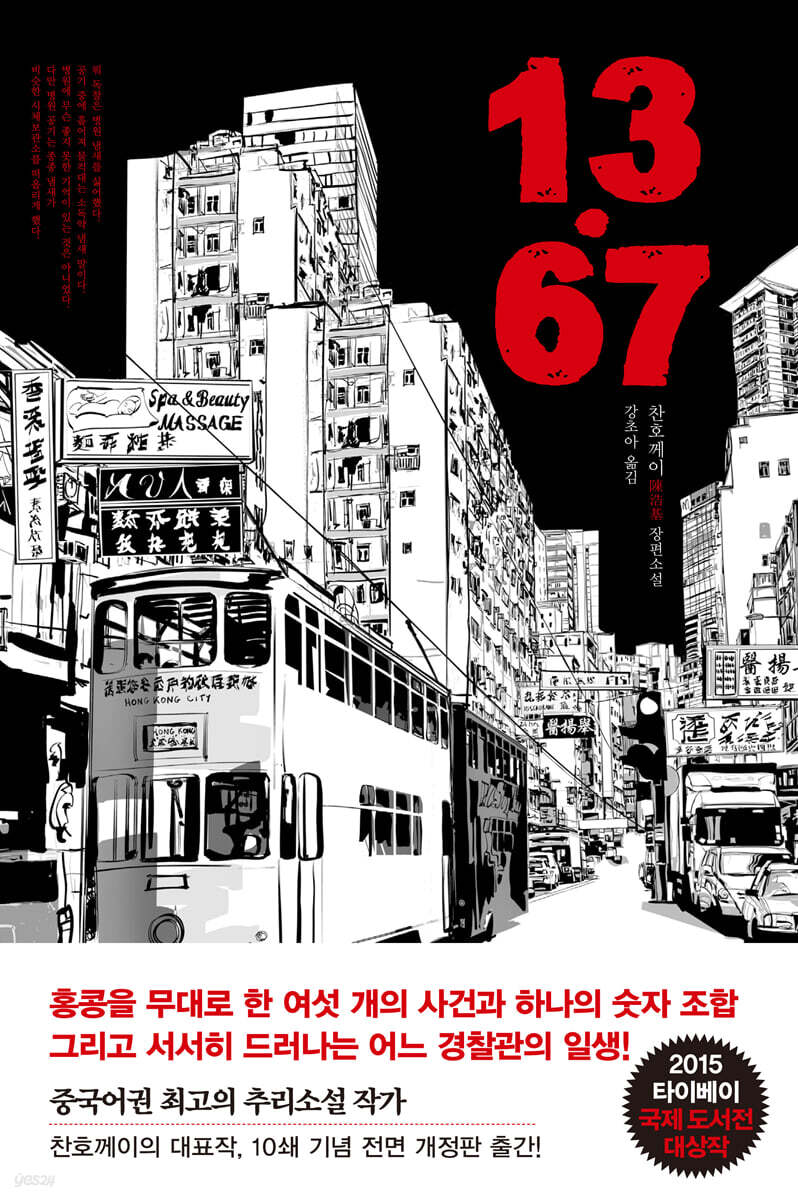
13.67
 |
Description
Book Introduction
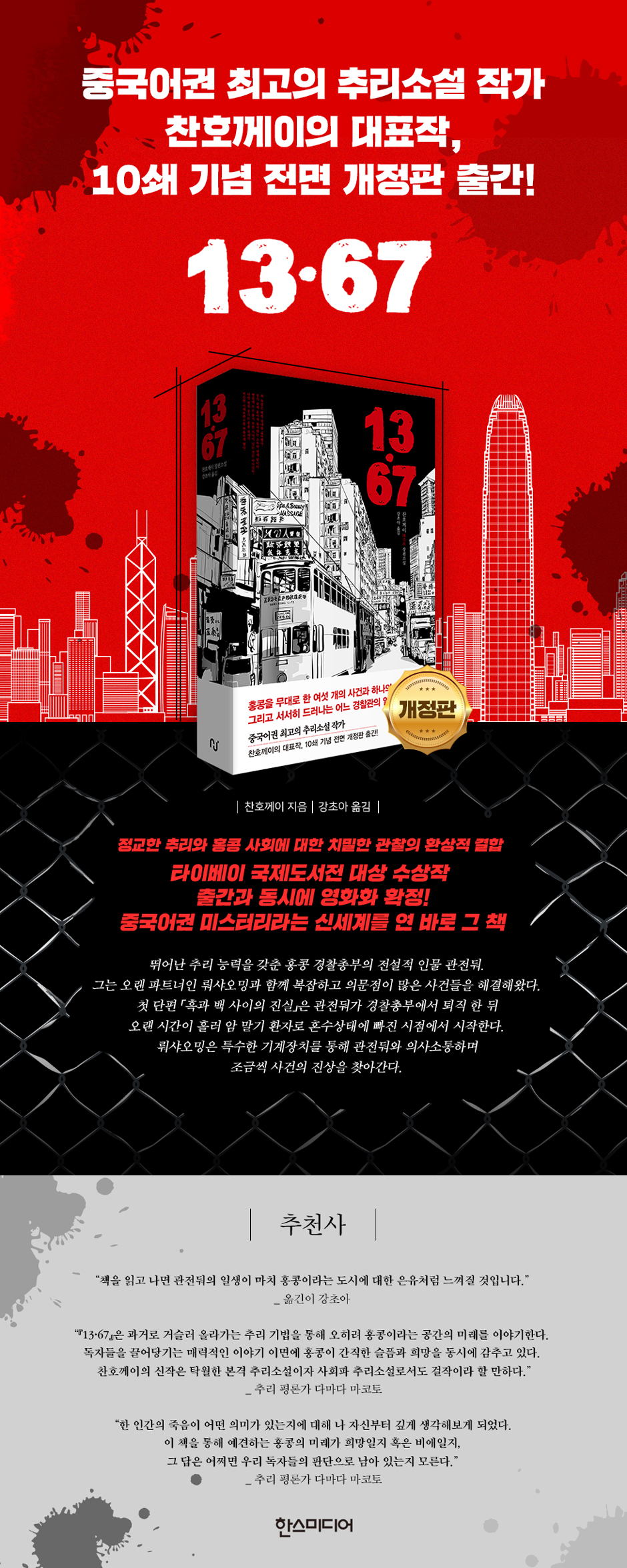
The best mystery novel writer in the Chinese-speaking world
Chan Ho-kei's masterpiece, "13·67"
A completely revised edition commemorating the 10th printing has been published!
This is a masterpiece mystery novel and Chan Ho-kei's representative work that surprised Korean readers by flying in from Hong Kong, China, which was considered a wasteland for mystery novels in 2015.
Chan Ho-kei is a Hong Kong writer who won the 2nd Shimada Soji Award for his novel, "The Detective Who Doesn't Remember" (published by Hans Media). In 2014, he published "13·67," which won the grand prize at the 2015 Taipei International Book Fair, establishing himself as a writer whose name transcends national boundaries and becomes known worldwide.
『13·67』 is a novel set in Hong Kong that unfolds in reverse chronological order over six events from 1967 to 2013.
Even in the 2020s, the novel structure of the story, along with the police advisor Guan Zhenduo's brilliant reasoning even while in a coma, strongly captures the reader's heart.
It also leaves a timeless resonance for readers by delving deeply into the police's duty to protect citizens first and foremost, even in turbulent times.
"13·67" is a work that exquisitely combines a full-fledged mystery novel and a social mystery novel, and is now considered a must-read and a classic in the mystery novel genre.
When it was first published in Korea in 2015, it became a bestseller thanks to word-of-mouth from readers, and to commemorate the 10th printing in 2023, a revised edition was published with several errors corrected and the entire text further refined.
Chan Ho-kei's masterpiece, "13·67"
A completely revised edition commemorating the 10th printing has been published!
This is a masterpiece mystery novel and Chan Ho-kei's representative work that surprised Korean readers by flying in from Hong Kong, China, which was considered a wasteland for mystery novels in 2015.
Chan Ho-kei is a Hong Kong writer who won the 2nd Shimada Soji Award for his novel, "The Detective Who Doesn't Remember" (published by Hans Media). In 2014, he published "13·67," which won the grand prize at the 2015 Taipei International Book Fair, establishing himself as a writer whose name transcends national boundaries and becomes known worldwide.
『13·67』 is a novel set in Hong Kong that unfolds in reverse chronological order over six events from 1967 to 2013.
Even in the 2020s, the novel structure of the story, along with the police advisor Guan Zhenduo's brilliant reasoning even while in a coma, strongly captures the reader's heart.
It also leaves a timeless resonance for readers by delving deeply into the police's duty to protect citizens first and foremost, even in turbulent times.
"13·67" is a work that exquisitely combines a full-fledged mystery novel and a social mystery novel, and is now considered a must-read and a classic in the mystery novel genre.
When it was first published in Korea in 2015, it became a bestseller thanks to word-of-mouth from readers, and to commemorate the 10th printing in 2023, a revised edition was published with several errors corrected and the entire text further refined.
- You can preview some of the book's contents.
Preview
index
Recommendation · 4
Chapter 1: The Truth Between Black and White · 9
Chapter 2: Prisoner's Morality · 113
Chapter 3: The Longest Day · 237
Chapter 4: The Libra of Themis · 355
Chapter 5: Borrowed Space · 473
Chapter 6: Borrowed Time · 581
Author's Note · 672
Translator's Note · 676
Chapter 1: The Truth Between Black and White · 9
Chapter 2: Prisoner's Morality · 113
Chapter 3: The Longest Day · 237
Chapter 4: The Libra of Themis · 355
Chapter 5: Borrowed Space · 473
Chapter 6: Borrowed Time · 581
Author's Note · 672
Translator's Note · 676
Detailed image
Into the book
“Your master, how great a person must you be?”
Wei Yonglian spoke with a sharp tone.
The police in front of him had an attitude of not caring at all.
“My name is Guan Quan Duo. I have served as the Commander of the Central Security Unit at the Hong Kong Island Police Headquarters and the Chief of Group B of the Criminal Intelligence Division of the General Headquarters. I am currently a Special Advisor to the Hong Kong Police Force.”
Luo Dokchal smiled faintly and continued speaking.
“There is no case he cannot solve.
“So far, the success rate of the investigation has been 100%.”
--- p.22
─You have to remember.
The true mission of the police is to protect citizens.
When a system harms innocent citizens or fails to deliver justice, we must challenge the rigid system with clear evidence.
When you become a police officer, you have to take an oath.
The oath's words have been repeatedly revised due to police reorganization and the return of Hong Kong sovereignty, but most end with the same or similar expressions.
“I will obey the lawful orders of my superiors without question and without fail.” Guan Zhenduo’s assertion is a clear violation of that sacred oath.
However, Luo Ducha understood his master's suffering.
In order to allow others to live in peace in the white world, Guan Zhenduo continued to wander the boundary between black and white.
Luo Dokchal knew.
Even if the police were to become a stale, bureaucratic, colluding organization that prioritized political missions, the Master would remain steadfast in his convictions.
And that he will devote all his strength to upholding the public justice that he recognizes.
The police's mission is to protect innocent citizens by uncovering the truth and arresting criminals.
But if the system fails to deal with the villains by law and tries to cover up the truth, Guan Zhenduo will deal with them in their own way, even if it means throwing himself into a dark swamp.
--- pp.111~112
“The police’s job is to protect citizens.
Even if that citizen isn't afraid of death at all, he can't just stand by and watch a girl be unjustly sacrificed.
“No matter what the laws or rules say, life is the most valuable thing and should never be wasted.”
--- p.232
“You risked your life to defuse the bomb in Car 1 for the sake of ‘police values.’
But yesterday, innocent children lost their lives because of you.
"Is it the police you need to protect, or the citizens? Is it the Hong Kong government you are loyal to, or the Hong Kong people?" I asked quietly.
“Why on earth did you become a police officer?”
Wei Yonglian spoke with a sharp tone.
The police in front of him had an attitude of not caring at all.
“My name is Guan Quan Duo. I have served as the Commander of the Central Security Unit at the Hong Kong Island Police Headquarters and the Chief of Group B of the Criminal Intelligence Division of the General Headquarters. I am currently a Special Advisor to the Hong Kong Police Force.”
Luo Dokchal smiled faintly and continued speaking.
“There is no case he cannot solve.
“So far, the success rate of the investigation has been 100%.”
--- p.22
─You have to remember.
The true mission of the police is to protect citizens.
When a system harms innocent citizens or fails to deliver justice, we must challenge the rigid system with clear evidence.
When you become a police officer, you have to take an oath.
The oath's words have been repeatedly revised due to police reorganization and the return of Hong Kong sovereignty, but most end with the same or similar expressions.
“I will obey the lawful orders of my superiors without question and without fail.” Guan Zhenduo’s assertion is a clear violation of that sacred oath.
However, Luo Ducha understood his master's suffering.
In order to allow others to live in peace in the white world, Guan Zhenduo continued to wander the boundary between black and white.
Luo Dokchal knew.
Even if the police were to become a stale, bureaucratic, colluding organization that prioritized political missions, the Master would remain steadfast in his convictions.
And that he will devote all his strength to upholding the public justice that he recognizes.
The police's mission is to protect innocent citizens by uncovering the truth and arresting criminals.
But if the system fails to deal with the villains by law and tries to cover up the truth, Guan Zhenduo will deal with them in their own way, even if it means throwing himself into a dark swamp.
--- pp.111~112
“The police’s job is to protect citizens.
Even if that citizen isn't afraid of death at all, he can't just stand by and watch a girl be unjustly sacrificed.
“No matter what the laws or rules say, life is the most valuable thing and should never be wasted.”
--- p.232
“You risked your life to defuse the bomb in Car 1 for the sake of ‘police values.’
But yesterday, innocent children lost their lives because of you.
"Is it the police you need to protect, or the citizens? Is it the Hong Kong government you are loyal to, or the Hong Kong people?" I asked quietly.
“Why on earth did you become a police officer?”
--- p.667
Publisher's Review
"A Police Officer's Life Revealed Through One Number and Six Incidents"
A sophisticated deduction and meticulous observation of the special space and time of Hong Kong.
The greatest masterpiece of Chinese-language police novels!
Guan Zhenduo, a legendary figure in the Hong Kong Police Force who boasts a 100% success rate in investigations thanks to his outstanding reasoning skills, has been solving complex and mysterious cases together with his junior officer and disciple Luo Xiaoming.
The first chapter, "The Truth Between Black and White," begins a long time after Guan Qianduo retired from the National Police Headquarters, when he is in a coma with terminal cancer.
Luo Xiaoming gradually discovers the truth of the incident by talking to Guan Zhenduo through a special machine.
The book's title, '13.67', refers to the years 2013 and 1967, and each chapter focuses on six crime incidents that occurred between 1967 and 2013.
Surprisingly, the story unfolds in reverse chronological order, starting with the most recent events in 2013 and ending with those in 1967, and each chapter is a complete short story that can be read independently, regardless of the actual order.
What makes this book stand out is that each chapter is a self-contained and entertaining mystery short story, and when these six chapters and short stories come together, they transform into a full-length social mystery novel that questions the values that police must truly uphold in a rapidly changing society.
In the story, which is arranged in reverse chronological order, the old Guan Qianduo, facing death, becomes a middle-aged Guan Qianduo who is at a major turning point in his police career, and then becomes a young Guan Qianduo who gains a great realization about what values he should pursue and live by in the future, making readers reinterpret the Guan Qianduo in chapter 1 over and over again.
In Chapter 1, "The Truth Between Black and White," after the incident, Luo Xiaoming recalls what he heard from Guan Qianduo.
“You have to remember.
The true mission of the police is to protect citizens.
“If a system harms innocent citizens or fails to deliver justice, we must challenge the rigid system with clear grounds.” (Page 111)
Hong Kong police officers undergo an oath ceremony when they become police officers.
The oath's words have been repeatedly revised due to police reorganization and the return of Hong Kong sovereignty, but most end with the same or similar expressions.
“I will obey the lawful orders of my superiors without question.” Although Guan Zhenduo’s teachings clearly violate the police oath, Luo Xiaoming vows to follow Guan Zhenduo.
Readers who complete the work will experience Guan Zhenduo's life journey as he arrives at the conclusion that "the true duty of the police is to protect the citizens" amidst the turbulent political climate of Hong Kong.
In the process, you can see how Luo Xiaoming, who impressed readers just as much as Guan Zhenduo in the first chapter, grew as a police officer, and in the last chapter, which throws out shocking facts, you return to the first chapter and realize several new facts, which will leave you greatly amazed.
A space where British and Chinese cultures collide
The original crime city of the Triads, where gunfights are rampant
A Hong Kong story that is universal because it is special
Chan Ho-kei, the author of this work, is a Hong Kong writer who was born and raised in Hong Kong.
He works in Hong Kong, a wasteland of mystery, and first became known in 2011 when he won the 2nd Shimada Soji Mystery Novel Award for his novel, "I Don't Remember, Detective."
He was praised as having “infinite talent” by Soji Shimada, who is called the god of Japanese mystery novels. Three years later, in 2014, his full-length mystery novel “13.67” was published, winning the grand prize at the 2015 Taipei International Book Fair, making his name known once again in the Chinese-speaking world.
This work was published in many countries, including Korea, the United States, the United Kingdom, France, Canada, Italy, and the Netherlands, and received great acclaim. This was because it successfully completed a universal story that everyone could relate to by dealing with various crime cases against the backdrop of the special space of Hong Kong.
Hong Kong is a region that has experienced political and social upheaval in a short period of time, just like Korea.
In particular, the emotions of a special time and space that underwent complex changes, from a 'colony' under British rule that advocated democracy to a return to the dictatorship of its own people, are fully revealed in '13.67', and the work itself can be read as a hymn to the city of Hong Kong, which holds both sadness and hope.
Readers who once fell in love with Hong Kong noir will find this book a glimpse into the crimes of the era when gunfights were rampant and triads were still rampant, and the author's insight into the police response to the 2019 Hong Kong protests, which occurred five years after the book's release, is also worth reading.
In this work, the life of the protagonist, Guan Zhenduo, feels like a metaphor for the city of Hong Kong.
For example, at the beginning of Chapter 4, “The Scales of Themis,” Guan Zhenduo, who had studied advanced investigative techniques in England and returned, shows the regional characteristics of a mixture of Eastern and Western cultures through his life as he solves cases amidst the chaos experienced by the police during the period of Hong Kong’s return to China.
Hong Kong's unique and complex history serves as a solid backdrop for six compelling crime scenes, making Guan Zhenduo's struggle to maintain balance amidst societal change and the formidable challenges faced by criminals all the more compelling and deeply moving.
Changing appearances like a kaleidoscope
A masterpiece that excels as both a full-fledged mystery and a social mystery.
A must-read and classic in the mystery genre.
"13.67" is a uniquely formatted full-length mystery novel that combines six consecutive short stories into an omnibus format.
Following the style of a true mystery novel, considerable effort has been put into the sophisticated tricks that catch readers off guard and their subversion, while the protagonist's life is well-exposed based on the regional background and changes in society and the times, making it an attractive story for readers in addition to providing a solid mystery.
It can be said to be an extraordinary work that is completed as a full-fledged mystery novel on a micro level and a complete social mystery novel on a macro level.
The first chapter and first short story of this work, "The Truth Between Black and White," shows the process of the elderly Guan Qianduo solving a mystery while in a coma due to cancer.
After several twists and turns thanks to the efforts of his disciple Luo Xiaoming, readers are suddenly faced with a tragedy that strikes them with little anticipation of the ending.
The second short story, "Prisoner's Morality," is based on the facts revealed in "The Truth Between Black and White," and rewinds time ten years to cover the events that occurred in 2003.
All the short stories in this book progress in this way, following clues revealed in the previous short stories and moving toward a series of past events.
In other words, the short story that follows the end of one is a story from before the previous short story, but it always has a link to the events of the previous chapter.
For example, if you look at the description of pedicures at the end of Chapter 2, “Prisoner’s Morality,” Chapter 1, “The Truth Between Black and White,” will inevitably be seen in a new light.
In Chapter 3, "The Longest Day," the main criminal is closely related to Chapter 4, "The Scales of Themis."
Readers reach the final chapter of the sixth short story, "Borrowed Time," the sixth chapter, on a journey led by the special pleasure of peeking into the past and the future. At that moment, they are forced to return to Chapter 1, "The Truth Between Black and White," and are shocked by another truth behind the tragic ending.
In an interview after receiving the grand prize at the Taipei International Book Fair, the author said this (Arts News, February 12, 2015).
“I think people are drawn to mystery novels because they are curious.
Because you are curious, you want to find out the truth.
“That is human instinct.” The trick of 『13.67』, which amplifies that curiosity to the fullest, subtly twists the perspective and surprises the readers.
Chan Ho-kei uses every means necessary to construct an elaborate mystery.
“I sometimes write novels from the perspective of the criminal or even the reader.
If I were a reader, what kind of stories would I want to read? Or what kind of stories would I not want to read? How can I transform a story I don't want to read into one I do? By putting myself in someone else's shoes, I can write the stories readers want to read.
“A story that readers will find satisfying, yet absolutely unpredictable.”
Ultimately, Chanho Kei pours all his energy into weaving the story and constructing the tricks in the hope that the readers will feel catharsis after reading the book.
This is also the reason why he writes novels.
“I believe that mystery novels should fundamentally be entertaining.
Tricks and twists in a novel should provide readers with catharsis and serve as enjoyable and entertaining elements.
However, pure literature does not necessarily have entertainment elements, and readers do not read books solely for that kind of satisfaction.
I think this is the difference between popular literature and pure literature.
I write mystery novels.
If you ask me if I write novels with social implications, I would have to say yes.
But the most important thing is entertainment.
“It’s the catharsis after reading a book.”
That's why his mystery novel, "13.67," has been loved for a long time, as it depicts the history of the city of Hong Kong, its social issues, and the role of the police, while also providing readers with the pleasure of solving the mystery and the fun of a twist by using characters and clues with a genuine detective technique.
Author's Note
Today's Hong Kong is just as bizarre as the Hong Kong of 1967 in the film.
We have come full circle and returned to the starting point.
But I don't know whether Hong Kong after 2013 will be able to move forward step by step and recover like Hong Kong after 1967.
It is also unclear whether the image of the police as strong, fair, just, courageous, and wholeheartedly dedicated to the people will be reestablished, and whether Hong Kong's children will come to think of the police as something to be proud of.
- Chan Ho-kei (author)
A sophisticated deduction and meticulous observation of the special space and time of Hong Kong.
The greatest masterpiece of Chinese-language police novels!
Guan Zhenduo, a legendary figure in the Hong Kong Police Force who boasts a 100% success rate in investigations thanks to his outstanding reasoning skills, has been solving complex and mysterious cases together with his junior officer and disciple Luo Xiaoming.
The first chapter, "The Truth Between Black and White," begins a long time after Guan Qianduo retired from the National Police Headquarters, when he is in a coma with terminal cancer.
Luo Xiaoming gradually discovers the truth of the incident by talking to Guan Zhenduo through a special machine.
The book's title, '13.67', refers to the years 2013 and 1967, and each chapter focuses on six crime incidents that occurred between 1967 and 2013.
Surprisingly, the story unfolds in reverse chronological order, starting with the most recent events in 2013 and ending with those in 1967, and each chapter is a complete short story that can be read independently, regardless of the actual order.
What makes this book stand out is that each chapter is a self-contained and entertaining mystery short story, and when these six chapters and short stories come together, they transform into a full-length social mystery novel that questions the values that police must truly uphold in a rapidly changing society.
In the story, which is arranged in reverse chronological order, the old Guan Qianduo, facing death, becomes a middle-aged Guan Qianduo who is at a major turning point in his police career, and then becomes a young Guan Qianduo who gains a great realization about what values he should pursue and live by in the future, making readers reinterpret the Guan Qianduo in chapter 1 over and over again.
In Chapter 1, "The Truth Between Black and White," after the incident, Luo Xiaoming recalls what he heard from Guan Qianduo.
“You have to remember.
The true mission of the police is to protect citizens.
“If a system harms innocent citizens or fails to deliver justice, we must challenge the rigid system with clear grounds.” (Page 111)
Hong Kong police officers undergo an oath ceremony when they become police officers.
The oath's words have been repeatedly revised due to police reorganization and the return of Hong Kong sovereignty, but most end with the same or similar expressions.
“I will obey the lawful orders of my superiors without question.” Although Guan Zhenduo’s teachings clearly violate the police oath, Luo Xiaoming vows to follow Guan Zhenduo.
Readers who complete the work will experience Guan Zhenduo's life journey as he arrives at the conclusion that "the true duty of the police is to protect the citizens" amidst the turbulent political climate of Hong Kong.
In the process, you can see how Luo Xiaoming, who impressed readers just as much as Guan Zhenduo in the first chapter, grew as a police officer, and in the last chapter, which throws out shocking facts, you return to the first chapter and realize several new facts, which will leave you greatly amazed.
A space where British and Chinese cultures collide
The original crime city of the Triads, where gunfights are rampant
A Hong Kong story that is universal because it is special
Chan Ho-kei, the author of this work, is a Hong Kong writer who was born and raised in Hong Kong.
He works in Hong Kong, a wasteland of mystery, and first became known in 2011 when he won the 2nd Shimada Soji Mystery Novel Award for his novel, "I Don't Remember, Detective."
He was praised as having “infinite talent” by Soji Shimada, who is called the god of Japanese mystery novels. Three years later, in 2014, his full-length mystery novel “13.67” was published, winning the grand prize at the 2015 Taipei International Book Fair, making his name known once again in the Chinese-speaking world.
This work was published in many countries, including Korea, the United States, the United Kingdom, France, Canada, Italy, and the Netherlands, and received great acclaim. This was because it successfully completed a universal story that everyone could relate to by dealing with various crime cases against the backdrop of the special space of Hong Kong.
Hong Kong is a region that has experienced political and social upheaval in a short period of time, just like Korea.
In particular, the emotions of a special time and space that underwent complex changes, from a 'colony' under British rule that advocated democracy to a return to the dictatorship of its own people, are fully revealed in '13.67', and the work itself can be read as a hymn to the city of Hong Kong, which holds both sadness and hope.
Readers who once fell in love with Hong Kong noir will find this book a glimpse into the crimes of the era when gunfights were rampant and triads were still rampant, and the author's insight into the police response to the 2019 Hong Kong protests, which occurred five years after the book's release, is also worth reading.
In this work, the life of the protagonist, Guan Zhenduo, feels like a metaphor for the city of Hong Kong.
For example, at the beginning of Chapter 4, “The Scales of Themis,” Guan Zhenduo, who had studied advanced investigative techniques in England and returned, shows the regional characteristics of a mixture of Eastern and Western cultures through his life as he solves cases amidst the chaos experienced by the police during the period of Hong Kong’s return to China.
Hong Kong's unique and complex history serves as a solid backdrop for six compelling crime scenes, making Guan Zhenduo's struggle to maintain balance amidst societal change and the formidable challenges faced by criminals all the more compelling and deeply moving.
Changing appearances like a kaleidoscope
A masterpiece that excels as both a full-fledged mystery and a social mystery.
A must-read and classic in the mystery genre.
"13.67" is a uniquely formatted full-length mystery novel that combines six consecutive short stories into an omnibus format.
Following the style of a true mystery novel, considerable effort has been put into the sophisticated tricks that catch readers off guard and their subversion, while the protagonist's life is well-exposed based on the regional background and changes in society and the times, making it an attractive story for readers in addition to providing a solid mystery.
It can be said to be an extraordinary work that is completed as a full-fledged mystery novel on a micro level and a complete social mystery novel on a macro level.
The first chapter and first short story of this work, "The Truth Between Black and White," shows the process of the elderly Guan Qianduo solving a mystery while in a coma due to cancer.
After several twists and turns thanks to the efforts of his disciple Luo Xiaoming, readers are suddenly faced with a tragedy that strikes them with little anticipation of the ending.
The second short story, "Prisoner's Morality," is based on the facts revealed in "The Truth Between Black and White," and rewinds time ten years to cover the events that occurred in 2003.
All the short stories in this book progress in this way, following clues revealed in the previous short stories and moving toward a series of past events.
In other words, the short story that follows the end of one is a story from before the previous short story, but it always has a link to the events of the previous chapter.
For example, if you look at the description of pedicures at the end of Chapter 2, “Prisoner’s Morality,” Chapter 1, “The Truth Between Black and White,” will inevitably be seen in a new light.
In Chapter 3, "The Longest Day," the main criminal is closely related to Chapter 4, "The Scales of Themis."
Readers reach the final chapter of the sixth short story, "Borrowed Time," the sixth chapter, on a journey led by the special pleasure of peeking into the past and the future. At that moment, they are forced to return to Chapter 1, "The Truth Between Black and White," and are shocked by another truth behind the tragic ending.
In an interview after receiving the grand prize at the Taipei International Book Fair, the author said this (Arts News, February 12, 2015).
“I think people are drawn to mystery novels because they are curious.
Because you are curious, you want to find out the truth.
“That is human instinct.” The trick of 『13.67』, which amplifies that curiosity to the fullest, subtly twists the perspective and surprises the readers.
Chan Ho-kei uses every means necessary to construct an elaborate mystery.
“I sometimes write novels from the perspective of the criminal or even the reader.
If I were a reader, what kind of stories would I want to read? Or what kind of stories would I not want to read? How can I transform a story I don't want to read into one I do? By putting myself in someone else's shoes, I can write the stories readers want to read.
“A story that readers will find satisfying, yet absolutely unpredictable.”
Ultimately, Chanho Kei pours all his energy into weaving the story and constructing the tricks in the hope that the readers will feel catharsis after reading the book.
This is also the reason why he writes novels.
“I believe that mystery novels should fundamentally be entertaining.
Tricks and twists in a novel should provide readers with catharsis and serve as enjoyable and entertaining elements.
However, pure literature does not necessarily have entertainment elements, and readers do not read books solely for that kind of satisfaction.
I think this is the difference between popular literature and pure literature.
I write mystery novels.
If you ask me if I write novels with social implications, I would have to say yes.
But the most important thing is entertainment.
“It’s the catharsis after reading a book.”
That's why his mystery novel, "13.67," has been loved for a long time, as it depicts the history of the city of Hong Kong, its social issues, and the role of the police, while also providing readers with the pleasure of solving the mystery and the fun of a twist by using characters and clues with a genuine detective technique.
Author's Note
Today's Hong Kong is just as bizarre as the Hong Kong of 1967 in the film.
We have come full circle and returned to the starting point.
But I don't know whether Hong Kong after 2013 will be able to move forward step by step and recover like Hong Kong after 1967.
It is also unclear whether the image of the police as strong, fair, just, courageous, and wholeheartedly dedicated to the people will be reestablished, and whether Hong Kong's children will come to think of the police as something to be proud of.
- Chan Ho-kei (author)
GOODS SPECIFICS
- Date of issue: January 11, 2023
- Page count, weight, size: 680 pages | 830g | 140*210*35mm
- ISBN13: 9791160078572
- ISBN10: 1160078572
You may also like
카테고리
korean


korean

![GQ KOREA Mark (Monthly): December [2025]](http://librairie.coreenne.fr/cdn/shop/files/8ef265dbbfbf186523ed75ba7319009d.jpg?v=1765340328&width=3840)


