

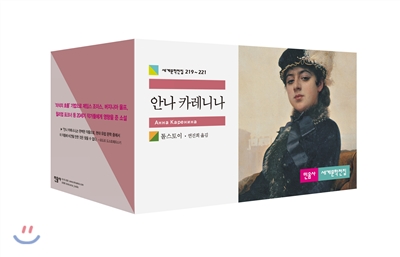
Anna Karenina set
 |
Description
Book Introduction
Tolstoy, the great artist born in 19th century Russia. The best realistic novel he left behind Anna Karenina (Анна Каренина), written by the great 19th-century Russian author Leo Tolstoy, has been published as part of Minumsa's World Literature Collection. This work received high praise from Dostoevsky, a contemporary writer, as a “perfect work of art,” and from Nabokov, another Russian novelist, as “the pinnacle of Tolstoy’s style.” In 2007, Time magazine selected it as “the greatest novel ever written” in a survey of 125 contemporary writers. Tolstoy himself is said to have considered Anna Karenina “my first true novel.” Anna Karenina, part of Minumsa's World Literature Collection, is translated by Yeon Jin-hee, a young translator who majored in Russian literature, in a new way that suits the sensibilities of the 21st century. When Duke Stepan's affair with his tutor causes discord between the couple, his sister Anna Karenina comes to Moscow to reconcile them. Anna, a beautiful woman living happily in St. Petersburg as the wife of a high-ranking official and mother of one child, becomes captivated by Count Vronsky, whom she meets here. Vronsky was courting Stepan's sister-in-law Kitty, but he too ended up falling for Anna... *This book is a set (3 volumes) Anna Karenina 1-3 |
index
Part 1
Part 2
Part 3
Part 4
Part 5
Part 6
Part 7
Part 8
Commentary on the work
Author's chronology
Part 2
Part 3
Part 4
Part 5
Part 6
Part 7
Part 8
Commentary on the work
Author's chronology
Publisher's Review
Newsweek's 100 Greatest Books | National Library of Korea's Recommended Books | Seoul National University's 100 Recommended Books
Tolstoy, the great artist born in 19th-century Russia, and his best realistic novel
A masterpiece that encapsulates all of Tolstoy's concerns about human emotions such as hypocrisy, jealousy, belief, desire, and love, as well as the social structures created by humans such as marriage, class, and religion.
▶ Anna Karenina is a perfect work, and there is no work in modern European literature that can compare to it.
―Fyodor Dostoevsky
▶ Anna Karenina is the greatest social novel in world literature.
-Thomas Mann
▶ The artist's job is not to solve problems, but to present them correctly.
Anna Karenina presents all the issues precisely.
—Anton Chekhov
▶ Tolstoy is the greatest Russian writer.
His work is powerful and dazzling, original and universal at the same time.
Anna Karenina is a perfect example of Tolstoy's magic.
―Nabokov
A masterpiece that condenses Tolstoy's thoughts and concerns
Anna Karenina's story unfolds around the events that happen to the main characters, Anna and Levin, and their thoughts.
Anna is the wife of Alexei Karenin, a capable high-ranking official, and they have a cute son.
As a virtuous lady, her world was limited to high society and family life. One day, she falls in love with a young count and is shunned by both high society and her family.
Meanwhile, Levin leaves behind his life in the big city and lives in the countryside, running a farm.
After proposing to the woman he loves and being rejected, he becomes more absorbed in rural life and ponders the realities of rural life and religion.
Through these two characters, who seem to be polar opposites in everything from their lifestyles and attitudes to their values, Tolstoy talks about the problems that Russia was facing at the time, such as war, peasants, and corruption, as well as the problems that he himself was struggling with, such as religion, beliefs, and the institution of marriage.
Tolstoy attempted to solve the philosophical and ideological problems given to humanity not in abstract thinking, but in the concrete world in which he lived.
That is, by creating a specific and empirical space and time and characters, I tried to obtain practical answers through various characters within it.
That is why the numerous characters in Anna Karenina live their lives with their own stories and thoughts, and through them, the author and the readers come to realize the truth of life.
Among the characters in Anna Karenina, there is one who is said to reflect Tolstoy himself particularly strongly: Levin.
Levin's estate is similar to Tolstoy's estate Yasnaya Polyana, and scenes such as his brother's death and the proposal to Kitty are said to be based on Tolstoy's own experiences.
More importantly, Levin's affection for the Russian peasantry and his attitude toward God seem to reflect Tolstoy's own thoughts on Levin.
Tolstoy reveals his thoughts and concerns through the characters in his works.
Anna Karenina contains countless internal links, and as each link is connected, there are an infinite number of themes that will take shape.
The "joy" of these countless discoveries will come when we read Anna Karenina, constantly linking our accumulated lives with the lives of the characters within our own time-space, a time-space made of the same materials as Anna and Levin's—a time-space imbued with continuity and relationality. (From "Commentary on the Work")
It delves into the truth of life, the essence of love, and the very nature of human existence, as revealed through the struggles and conflicts of humankind within the social systems and structures they have created.
“All happy families are alike; every unhappy family is unhappy in its own way.”
The affair between Prince Stepan Oblonsky and his tutor is discovered, leading to a crisis in their relationship.
Anna Karenina, Stepan's sister who lived in St. Petersburg, comes to Moscow to reconcile them.
Anna lived a quiet and elegant life as the wife of a capable official and the mother of one child.
Through Anna's efforts, the couple reconcile, but instead, Anna is immediately captivated by the young Count Vronsky.
Vronsky was courting Stepan's sister-in-law Kitty, but he too fell for Anna.
Kitty firmly believes that Vronsky will propose and rejects the proposal of the respectable nobleman Levin.
But Kitty despairs when she sees Anna and Vronsky together, oblivious to their surroundings.
Levin, too, is discouraged after being rejected by Kitty and returns to the countryside, where he spends his days immersed in the countryside and worrying about the problems of the countryside and peasants.
Meanwhile, Anna continues her affair with Vronsky, hiding it from her husband.
However, not only her husband but everyone in society notices what's going on between them.
Finally, Anna boldly confesses the truth to her husband and asks for a divorce.
However, Anna feels that the more her husband refuses to divorce and tries to maintain a superficial relationship, the more her hatred for him grows.
Eventually, Anna gives birth to Vronsky's daughter, causing a huge stir not only in the family but also in social circles.
The two leave for a foreign country, coldly shunned by society.
Kitty suffers from a mental illness and goes on a vacation abroad, but returns with a change of heart. Levin confirms that his feelings for her have not changed, and the two eventually get married.
Meanwhile, Anna and Vronsky live abroad with their daughter.
After being discharged from the army and his path to success blocked, Vronsky's mother hates Anna even more and opposes their relationship.
As divorce from her husband remains distant and her longing for her first child, a son, grows, Anna becomes increasingly obsessed with Vronsky.
Returning to Russia, but realizing that her relationship with Vronsky is not accepted anywhere, including in high society, Anna desperately yearns for Vronsky, and the more she does, the more Vronsky feels his feelings for her growing colder.
A novel that influenced 20th-century writers such as James Joyce, Virginia Woolf, and William Faulkner through its 'stream of consciousness' technique.
An eternal classic that has been reborn in various art genres such as movies, TV dramas, ballet, plays, musicals, and operas.
"Anna Karenina" unfolds through the perspectives of several characters, but it also uses an "omniscient authorial point of view" to thoroughly read the characters' actions and thoughts.
When each character vividly reveals their inner psychology, readers can sense the changes in thoughts and emotions that occur within them, and at the same time, the characters are reborn as more vibrant characters.
Additionally, in the process, the author's own values and awareness of issues are revealed.
This 'stream of consciousness' technique that Tolstoy demonstrated in 'Anna Karenina' was later inherited and developed by 20th-century writers such as James Joyce, Virginia Woolf, and William Faulkner.
'I think that guy thought he knew me.
Just as no one in this world knows me, that man doesn't know me either.
I don't even know myself.
As the French say, all I know is my own desires.
Those kids want to eat that dirty ice cream.
'I'm sure those kids know what they want,' she thought, looking at the two boys who had called out to the ice cream vendor.
The ice cream vendor put the wooden bucket down from his head and wiped his sweaty face with the end of a towel.
'We all want something sweet and delicious.
If there's no candy, even dirty ice cream will do.
Kitty is the same.
If I can't have Vronsky, I'll have Levin.
So you're jealous of me.
And hate me.
We all hate each other.
I like Kitty, Kitty likes me.
That is the truth.' (From the text)
Anna Karenina was first made into a Hollywood film in 1935 starring Greta Garbo, and has since been made into a series of films, including Vivien Leigh and Sophie Marceau, who played the lead role of Anna.
Since its first publication in 1878, this novel has been adapted into various artistic genres, including film, television drama, ballet, play, musical, and opera, continuously proving its value as an eternal classic.
Tolstoy, the great artist born in 19th-century Russia, and his best realistic novel
A masterpiece that encapsulates all of Tolstoy's concerns about human emotions such as hypocrisy, jealousy, belief, desire, and love, as well as the social structures created by humans such as marriage, class, and religion.
▶ Anna Karenina is a perfect work, and there is no work in modern European literature that can compare to it.
―Fyodor Dostoevsky
▶ Anna Karenina is the greatest social novel in world literature.
-Thomas Mann
▶ The artist's job is not to solve problems, but to present them correctly.
Anna Karenina presents all the issues precisely.
—Anton Chekhov
▶ Tolstoy is the greatest Russian writer.
His work is powerful and dazzling, original and universal at the same time.
Anna Karenina is a perfect example of Tolstoy's magic.
―Nabokov
A masterpiece that condenses Tolstoy's thoughts and concerns
Anna Karenina's story unfolds around the events that happen to the main characters, Anna and Levin, and their thoughts.
Anna is the wife of Alexei Karenin, a capable high-ranking official, and they have a cute son.
As a virtuous lady, her world was limited to high society and family life. One day, she falls in love with a young count and is shunned by both high society and her family.
Meanwhile, Levin leaves behind his life in the big city and lives in the countryside, running a farm.
After proposing to the woman he loves and being rejected, he becomes more absorbed in rural life and ponders the realities of rural life and religion.
Through these two characters, who seem to be polar opposites in everything from their lifestyles and attitudes to their values, Tolstoy talks about the problems that Russia was facing at the time, such as war, peasants, and corruption, as well as the problems that he himself was struggling with, such as religion, beliefs, and the institution of marriage.
Tolstoy attempted to solve the philosophical and ideological problems given to humanity not in abstract thinking, but in the concrete world in which he lived.
That is, by creating a specific and empirical space and time and characters, I tried to obtain practical answers through various characters within it.
That is why the numerous characters in Anna Karenina live their lives with their own stories and thoughts, and through them, the author and the readers come to realize the truth of life.
Among the characters in Anna Karenina, there is one who is said to reflect Tolstoy himself particularly strongly: Levin.
Levin's estate is similar to Tolstoy's estate Yasnaya Polyana, and scenes such as his brother's death and the proposal to Kitty are said to be based on Tolstoy's own experiences.
More importantly, Levin's affection for the Russian peasantry and his attitude toward God seem to reflect Tolstoy's own thoughts on Levin.
Tolstoy reveals his thoughts and concerns through the characters in his works.
Anna Karenina contains countless internal links, and as each link is connected, there are an infinite number of themes that will take shape.
The "joy" of these countless discoveries will come when we read Anna Karenina, constantly linking our accumulated lives with the lives of the characters within our own time-space, a time-space made of the same materials as Anna and Levin's—a time-space imbued with continuity and relationality. (From "Commentary on the Work")
It delves into the truth of life, the essence of love, and the very nature of human existence, as revealed through the struggles and conflicts of humankind within the social systems and structures they have created.
“All happy families are alike; every unhappy family is unhappy in its own way.”
The affair between Prince Stepan Oblonsky and his tutor is discovered, leading to a crisis in their relationship.
Anna Karenina, Stepan's sister who lived in St. Petersburg, comes to Moscow to reconcile them.
Anna lived a quiet and elegant life as the wife of a capable official and the mother of one child.
Through Anna's efforts, the couple reconcile, but instead, Anna is immediately captivated by the young Count Vronsky.
Vronsky was courting Stepan's sister-in-law Kitty, but he too fell for Anna.
Kitty firmly believes that Vronsky will propose and rejects the proposal of the respectable nobleman Levin.
But Kitty despairs when she sees Anna and Vronsky together, oblivious to their surroundings.
Levin, too, is discouraged after being rejected by Kitty and returns to the countryside, where he spends his days immersed in the countryside and worrying about the problems of the countryside and peasants.
Meanwhile, Anna continues her affair with Vronsky, hiding it from her husband.
However, not only her husband but everyone in society notices what's going on between them.
Finally, Anna boldly confesses the truth to her husband and asks for a divorce.
However, Anna feels that the more her husband refuses to divorce and tries to maintain a superficial relationship, the more her hatred for him grows.
Eventually, Anna gives birth to Vronsky's daughter, causing a huge stir not only in the family but also in social circles.
The two leave for a foreign country, coldly shunned by society.
Kitty suffers from a mental illness and goes on a vacation abroad, but returns with a change of heart. Levin confirms that his feelings for her have not changed, and the two eventually get married.
Meanwhile, Anna and Vronsky live abroad with their daughter.
After being discharged from the army and his path to success blocked, Vronsky's mother hates Anna even more and opposes their relationship.
As divorce from her husband remains distant and her longing for her first child, a son, grows, Anna becomes increasingly obsessed with Vronsky.
Returning to Russia, but realizing that her relationship with Vronsky is not accepted anywhere, including in high society, Anna desperately yearns for Vronsky, and the more she does, the more Vronsky feels his feelings for her growing colder.
A novel that influenced 20th-century writers such as James Joyce, Virginia Woolf, and William Faulkner through its 'stream of consciousness' technique.
An eternal classic that has been reborn in various art genres such as movies, TV dramas, ballet, plays, musicals, and operas.
"Anna Karenina" unfolds through the perspectives of several characters, but it also uses an "omniscient authorial point of view" to thoroughly read the characters' actions and thoughts.
When each character vividly reveals their inner psychology, readers can sense the changes in thoughts and emotions that occur within them, and at the same time, the characters are reborn as more vibrant characters.
Additionally, in the process, the author's own values and awareness of issues are revealed.
This 'stream of consciousness' technique that Tolstoy demonstrated in 'Anna Karenina' was later inherited and developed by 20th-century writers such as James Joyce, Virginia Woolf, and William Faulkner.
'I think that guy thought he knew me.
Just as no one in this world knows me, that man doesn't know me either.
I don't even know myself.
As the French say, all I know is my own desires.
Those kids want to eat that dirty ice cream.
'I'm sure those kids know what they want,' she thought, looking at the two boys who had called out to the ice cream vendor.
The ice cream vendor put the wooden bucket down from his head and wiped his sweaty face with the end of a towel.
'We all want something sweet and delicious.
If there's no candy, even dirty ice cream will do.
Kitty is the same.
If I can't have Vronsky, I'll have Levin.
So you're jealous of me.
And hate me.
We all hate each other.
I like Kitty, Kitty likes me.
That is the truth.' (From the text)
Anna Karenina was first made into a Hollywood film in 1935 starring Greta Garbo, and has since been made into a series of films, including Vivien Leigh and Sophie Marceau, who played the lead role of Anna.
Since its first publication in 1878, this novel has been adapted into various artistic genres, including film, television drama, ballet, play, musical, and opera, continuously proving its value as an eternal classic.
GOODS SPECIFICS
- Date of publication: November 6, 2012
- Page count, weight, size: 1,800 pages | 130*224*80mm
- ISBN13: 9788937486074
- ISBN10: 8937486075
You may also like
카테고리
korean


korean

![ELLE 엘르 스페셜 에디션 A형 : 12월 [2025]](http://librairie.coreenne.fr/cdn/shop/files/b8e27a3de6c9538896439686c6b0e8fb.jpg?v=1766436872&width=3840)


