

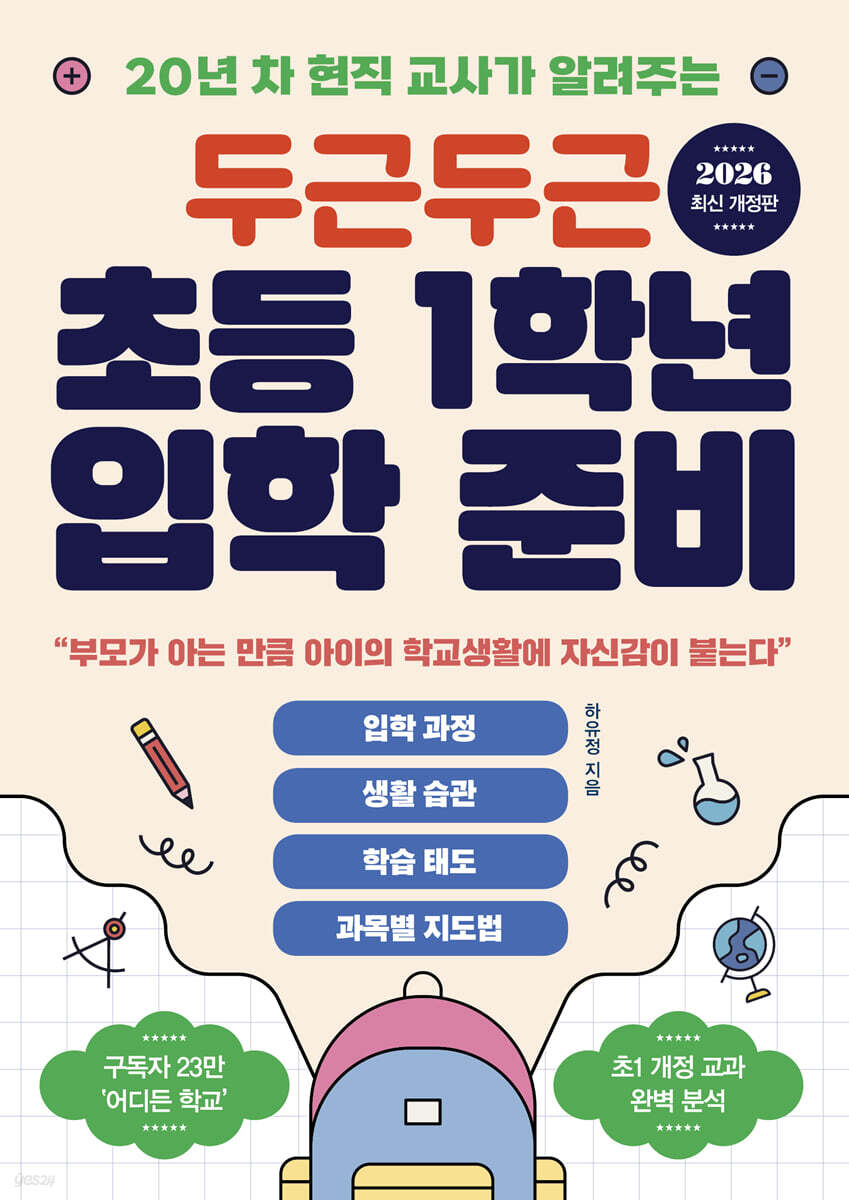
Excited preparation for first grade elementary school
 |
Description
Book Introduction
#1 in elementary school admissions
Complete Analysis of the Revised 1st Grade Curriculum
Anywhere School, with 230,000 subscribers
2026 Latest Revised Edition
Increases children's adaptability and reduces parents' anxiety
Everything about elementary school life
Elementary school life is very different from kindergarten life, which includes childcare.
They have to use the school bathroom alone, sit in one seat for 40 minutes, and fetch and clear their own lunch trays.
Parents of children about to enter school for the first time in their lives can't help but lose sleep over how to help their still-baby-like children adapt well to school life.
In addition, it is a major concern whether students will be able to keep up with classes after completing basic learning such as learning Korean, writing, and number concepts to a certain extent before entering the school.
The author, a teacher with 20 years of experience, provides detailed information on everything about elementary school life that first-time parents might be curious about, from the right lifestyle habits students should have to how to quickly and easily master the basics of learning.
In addition, we have carefully analyzed the parts that have changed as the curriculum has been revised, so that we can determine the direction on which parts to focus on when educating children.
The author, who taught first grade for four years and has two years of experience as a parent of first graders with her two daughters entering elementary school, provides up-to-date information that will serve as a solid guide to reduce anxiety and increase anticipation for parents and children about to enter school.
Complete Analysis of the Revised 1st Grade Curriculum
Anywhere School, with 230,000 subscribers
2026 Latest Revised Edition
Increases children's adaptability and reduces parents' anxiety
Everything about elementary school life
Elementary school life is very different from kindergarten life, which includes childcare.
They have to use the school bathroom alone, sit in one seat for 40 minutes, and fetch and clear their own lunch trays.
Parents of children about to enter school for the first time in their lives can't help but lose sleep over how to help their still-baby-like children adapt well to school life.
In addition, it is a major concern whether students will be able to keep up with classes after completing basic learning such as learning Korean, writing, and number concepts to a certain extent before entering the school.
The author, a teacher with 20 years of experience, provides detailed information on everything about elementary school life that first-time parents might be curious about, from the right lifestyle habits students should have to how to quickly and easily master the basics of learning.
In addition, we have carefully analyzed the parts that have changed as the curriculum has been revised, so that we can determine the direction on which parts to focus on when educating children.
The author, who taught first grade for four years and has two years of experience as a parent of first graders with her two daughters entering elementary school, provides up-to-date information that will serve as a solid guide to reduce anxiety and increase anticipation for parents and children about to enter school.
- You can preview some of the book's contents.
Preview
index
Prologue: Start Your Child's First Independence Safely
100-Day Checklist Before Admission
Chapter 1.
A closer look at the elementary school admissions process
1.
School admission notice and preliminary assembly date
How to Issue a School Enrollment Notice | Pre-Assembly Day Procedures | Documents to Receive on Pre-Assembly Day | What You Must Do on Pre-Assembly Day | Other Questions About Pre-Assembly Day
TIP.
Neulbom School (after-school program and care classroom)
2.
Elementary School Selection and Admissions Process
Types of Elementary Schools | Admissions Process by School
TIP.
Frequently Asked Questions About Admissions
3.
Class assignment and entrance ceremony
First-Year Class Assignment Criteria | The Exciting Entrance Ceremony | What You Need to Know on Entrance Ceremony Day
4.
Pack your admissions supplies wisely
Things to prepare before admission | Things to prepare after admission
Chapter 2.
A Closer Look at First Grade School Students
1.
A peek into the classroom
School start time | Morning activities | Class time | Break time | Lunch time | Lunch after school | Dismissal time
TIP.
Solving assignments and homework during class
2.
Preparing for Safe Self-Reliance
Practicing Safe School Commutes | How Long Should I Help My Child Get to and from School? | Is It Okay to Walk My Child to Class? | Developing Allowance Management Habits | Monitoring Your Child's Health
TIP.
To working moms considering quitting their jobs
3.
Review the 2022 Revised Curriculum
Collaborative communication skills are becoming increasingly important. Information and digital education is being strengthened. Early adjustment activities are being implemented. Korean language responsibility education is being implemented in first and second grades. Physical activity time has been increased by 64 hours. Class attitude and cooperation are also being evaluated.
TIP.
National textbooks, approved textbooks, and textbook recycling
4.
Preview of 1st grade textbooks
《Korean Language》《Korean Language Activities》 | 《Math》《Math Learning》 | Integrated Curriculum 《School》《Our Country》《People》《Exploration》 | Need an extra textbook?
TIP.
National textbooks, approved textbooks, and textbook recycling
Chapter 3.
Creating a lifestyle habit of doing small things on your own
1.
The first step to self-directed learning: fostering autonomy.
Doing chores together | Using a notepad | Going to bed early
2.
Developing good eating habits
Eat breakfast | Try to overcome picky eating | Try eating a variety of fruits | Eat on time | Practice using chopsticks | Practice opening milk cartons | Move plates
3.
Developing basic lifestyle habits
Go to the bathroom alone | Wear clothes that are easy to put on and take off | Choose your own clothes | Wear comfortable shoes
4.
Developing the habit of organizing
Cherish your belongings | Label your belongings | Teach your children to be organized | Get ready for school the day before | What if you forgot to pack your belongings?
Chapter 4.
Developing an Attitude to Becoming a Loved Child
1.
Kind Word Habit
The Basics of Social Skills: Greeting People | Using Respectful Speech | Avoiding Harsh Language
2.
Wise Speaking Habits
Asking for help | Saying no gently | Speaking in school situations | Reading emotions also takes practice | What if you struggle to make friends?
3.
A habit of speaking boldly
Speaking at an Appropriate Volume | Practicing Presentations at Home | When Pranks Turn into Violence | How to Deal with VIP Bullies | Wisely Dealing with School Violence | How Far Should You Intervene in Children's Fights?
4.
A Mom's Guide to Helping Kids Adjust to School
Things You Should Never Say | What if Your Child Has an Upsetting Event at School? | What if Your Child Plays Alone Instead of Hanging Out with Friends? | How Moms Ask Questions to Find Out About School Life | Give Objective Feedback Instead of Empty Praise
5.
Developing concentration
Do You Need 40-Minute Sitting Practice? | How to Build Focus in Distractable Children | Developing Listening Skills | Reducing Visual Stimuli
TIP.
Should I buy you a cell phone?
Chapter 5.
Building Study Habits ① Learning Korean and Reading
1.
The beginning of learning, learning Hangul
Should I learn Hangul before school? | The right time to start learning Hangul | How much Hangul should I learn before school? | Is it okay for my child to start school without any Hangul knowledge? | The level of Hangul needed depends on the child's temperament.
2.
Hangul study method
Learning Korean through play | Learning Korean through whole letters | Learning Korean through individual letters | Learning Korean by writing is the cornerstone of literacy | Reading disabilities and learning difficulties
3.
Reading habits that strengthen literacy
Reading Aloud | The Power of Listening | Vocabulary Builds Through Reading | Storybooks Included in First Grade Textbooks
Chapter 6.
Building Study Habits ② Strengthening Hands and Writing
1.
Developing hand strength to write freely
Drawing lines | Coloring | Cutting and pasting | Origami
2.
The Basics of Writing: Diary Writing
Starting a Picture Journal | Journaling Should Be Free | 10 Ways to Write Easier and Richer | 3 Tips for Enjoyable Writing
TIP.
Writing a reading log
3.
dictation
Dictation Study Method | Metacognitive Dictation Study Method | Dictation Rewards
TIP.
Creating study habits and a study environment
Chapter 7.
Building Study Habits ③ Math
1.
Learning counting and number concepts
Mastering Concepts with Concrete Objects | Strengthening Concepts with Math Materials | Understanding the Concept of Zero | Distinguishing Between Ordinal and Cardinal Numbers
2.
Start the operation like this
1 large number, 1 small number, 5 large numbers, 5 small numbers | Teaching and collecting | Playing with 10 | A workbook of calculations to solve before school | Things to keep in mind when learning calculations | Studying calculations every day
3.
Learn to read the clock and understand the concept of time.
Why Clock Reading is Difficult | Observe the Movement of the Hands | Recognize the Need to Read | Understand the Concepts of Hours, Half-Hour, and Five-Minute Time | Don't Make It Difficult
4.
Descriptive questions and geometric learning
Breaking things down into meaningful units | Explaining things verbally | Learning shapes with concrete objects | Checking your progress regularly
TIP.
[Smart! Math Exploration Team] How to Use
Chapter 8.
Building Study Habits ④ English Education and Private Education
1.
Should I study English in advance?
English Education in Elementary Schools | Exposure to English from a Young Age | English Exposure Methods Children Love | The Most Important Thing Is Their Native Language
TIP.
Should I study Chinese characters in advance?
2.
Private education for children
How much private tutoring is necessary for children from preschool to first grade? | Is music academy really necessary? | Distinguishing between genuine learning and parental greed | A strong study mindset is more important than private tutoring.
TIP.
Jump rope
Chapter 9.
Information I'm curious about as a first-time parent
1.
How to communicate with your school
Using the School Announcement and App | Reviewing the School Newsletter | How to Request an Absence
TIP.
Sample Off-campus Experiential Learning Application Form and Results Report
2.
First year of elementary school
Entrance Ceremony | Parents' Meeting | Science Month Event | Field Trip | Student Emotional and Behavioral Characteristics Test | Health Checkup | Childhood Obesity Prevention | Summer Vacation | School Festival | Closing Ceremony and Winter Vacation
3.
Parent Counseling
First Semester Counseling | Second Semester Counseling | What Not to Say in Counseling | What if you're dissatisfied with school life? | What if your homeroom teacher is older? | What if you can't find time for counseling? | How to Give Your Child Positive Feedback
4.
Curriculum Evaluation
Changes in Evaluation Direction | Evaluation Methods | Checking Evaluation Results with the Life Report
TIP.
How to prepare for performance evaluation
5.
Parent Participation Activities
Class Representative | Parents' Association | Green Mothers' Association | School Management Committee | Parent Librarian Assistant | Lunch Monitor
supplement.
Dictation grade table
100-Day Checklist Before Admission
Chapter 1.
A closer look at the elementary school admissions process
1.
School admission notice and preliminary assembly date
How to Issue a School Enrollment Notice | Pre-Assembly Day Procedures | Documents to Receive on Pre-Assembly Day | What You Must Do on Pre-Assembly Day | Other Questions About Pre-Assembly Day
TIP.
Neulbom School (after-school program and care classroom)
2.
Elementary School Selection and Admissions Process
Types of Elementary Schools | Admissions Process by School
TIP.
Frequently Asked Questions About Admissions
3.
Class assignment and entrance ceremony
First-Year Class Assignment Criteria | The Exciting Entrance Ceremony | What You Need to Know on Entrance Ceremony Day
4.
Pack your admissions supplies wisely
Things to prepare before admission | Things to prepare after admission
Chapter 2.
A Closer Look at First Grade School Students
1.
A peek into the classroom
School start time | Morning activities | Class time | Break time | Lunch time | Lunch after school | Dismissal time
TIP.
Solving assignments and homework during class
2.
Preparing for Safe Self-Reliance
Practicing Safe School Commutes | How Long Should I Help My Child Get to and from School? | Is It Okay to Walk My Child to Class? | Developing Allowance Management Habits | Monitoring Your Child's Health
TIP.
To working moms considering quitting their jobs
3.
Review the 2022 Revised Curriculum
Collaborative communication skills are becoming increasingly important. Information and digital education is being strengthened. Early adjustment activities are being implemented. Korean language responsibility education is being implemented in first and second grades. Physical activity time has been increased by 64 hours. Class attitude and cooperation are also being evaluated.
TIP.
National textbooks, approved textbooks, and textbook recycling
4.
Preview of 1st grade textbooks
《Korean Language》《Korean Language Activities》 | 《Math》《Math Learning》 | Integrated Curriculum 《School》《Our Country》《People》《Exploration》 | Need an extra textbook?
TIP.
National textbooks, approved textbooks, and textbook recycling
Chapter 3.
Creating a lifestyle habit of doing small things on your own
1.
The first step to self-directed learning: fostering autonomy.
Doing chores together | Using a notepad | Going to bed early
2.
Developing good eating habits
Eat breakfast | Try to overcome picky eating | Try eating a variety of fruits | Eat on time | Practice using chopsticks | Practice opening milk cartons | Move plates
3.
Developing basic lifestyle habits
Go to the bathroom alone | Wear clothes that are easy to put on and take off | Choose your own clothes | Wear comfortable shoes
4.
Developing the habit of organizing
Cherish your belongings | Label your belongings | Teach your children to be organized | Get ready for school the day before | What if you forgot to pack your belongings?
Chapter 4.
Developing an Attitude to Becoming a Loved Child
1.
Kind Word Habit
The Basics of Social Skills: Greeting People | Using Respectful Speech | Avoiding Harsh Language
2.
Wise Speaking Habits
Asking for help | Saying no gently | Speaking in school situations | Reading emotions also takes practice | What if you struggle to make friends?
3.
A habit of speaking boldly
Speaking at an Appropriate Volume | Practicing Presentations at Home | When Pranks Turn into Violence | How to Deal with VIP Bullies | Wisely Dealing with School Violence | How Far Should You Intervene in Children's Fights?
4.
A Mom's Guide to Helping Kids Adjust to School
Things You Should Never Say | What if Your Child Has an Upsetting Event at School? | What if Your Child Plays Alone Instead of Hanging Out with Friends? | How Moms Ask Questions to Find Out About School Life | Give Objective Feedback Instead of Empty Praise
5.
Developing concentration
Do You Need 40-Minute Sitting Practice? | How to Build Focus in Distractable Children | Developing Listening Skills | Reducing Visual Stimuli
TIP.
Should I buy you a cell phone?
Chapter 5.
Building Study Habits ① Learning Korean and Reading
1.
The beginning of learning, learning Hangul
Should I learn Hangul before school? | The right time to start learning Hangul | How much Hangul should I learn before school? | Is it okay for my child to start school without any Hangul knowledge? | The level of Hangul needed depends on the child's temperament.
2.
Hangul study method
Learning Korean through play | Learning Korean through whole letters | Learning Korean through individual letters | Learning Korean by writing is the cornerstone of literacy | Reading disabilities and learning difficulties
3.
Reading habits that strengthen literacy
Reading Aloud | The Power of Listening | Vocabulary Builds Through Reading | Storybooks Included in First Grade Textbooks
Chapter 6.
Building Study Habits ② Strengthening Hands and Writing
1.
Developing hand strength to write freely
Drawing lines | Coloring | Cutting and pasting | Origami
2.
The Basics of Writing: Diary Writing
Starting a Picture Journal | Journaling Should Be Free | 10 Ways to Write Easier and Richer | 3 Tips for Enjoyable Writing
TIP.
Writing a reading log
3.
dictation
Dictation Study Method | Metacognitive Dictation Study Method | Dictation Rewards
TIP.
Creating study habits and a study environment
Chapter 7.
Building Study Habits ③ Math
1.
Learning counting and number concepts
Mastering Concepts with Concrete Objects | Strengthening Concepts with Math Materials | Understanding the Concept of Zero | Distinguishing Between Ordinal and Cardinal Numbers
2.
Start the operation like this
1 large number, 1 small number, 5 large numbers, 5 small numbers | Teaching and collecting | Playing with 10 | A workbook of calculations to solve before school | Things to keep in mind when learning calculations | Studying calculations every day
3.
Learn to read the clock and understand the concept of time.
Why Clock Reading is Difficult | Observe the Movement of the Hands | Recognize the Need to Read | Understand the Concepts of Hours, Half-Hour, and Five-Minute Time | Don't Make It Difficult
4.
Descriptive questions and geometric learning
Breaking things down into meaningful units | Explaining things verbally | Learning shapes with concrete objects | Checking your progress regularly
TIP.
[Smart! Math Exploration Team] How to Use
Chapter 8.
Building Study Habits ④ English Education and Private Education
1.
Should I study English in advance?
English Education in Elementary Schools | Exposure to English from a Young Age | English Exposure Methods Children Love | The Most Important Thing Is Their Native Language
TIP.
Should I study Chinese characters in advance?
2.
Private education for children
How much private tutoring is necessary for children from preschool to first grade? | Is music academy really necessary? | Distinguishing between genuine learning and parental greed | A strong study mindset is more important than private tutoring.
TIP.
Jump rope
Chapter 9.
Information I'm curious about as a first-time parent
1.
How to communicate with your school
Using the School Announcement and App | Reviewing the School Newsletter | How to Request an Absence
TIP.
Sample Off-campus Experiential Learning Application Form and Results Report
2.
First year of elementary school
Entrance Ceremony | Parents' Meeting | Science Month Event | Field Trip | Student Emotional and Behavioral Characteristics Test | Health Checkup | Childhood Obesity Prevention | Summer Vacation | School Festival | Closing Ceremony and Winter Vacation
3.
Parent Counseling
First Semester Counseling | Second Semester Counseling | What Not to Say in Counseling | What if you're dissatisfied with school life? | What if your homeroom teacher is older? | What if you can't find time for counseling? | How to Give Your Child Positive Feedback
4.
Curriculum Evaluation
Changes in Evaluation Direction | Evaluation Methods | Checking Evaluation Results with the Life Report
TIP.
How to prepare for performance evaluation
5.
Parent Participation Activities
Class Representative | Parents' Association | Green Mothers' Association | School Management Committee | Parent Librarian Assistant | Lunch Monitor
supplement.
Dictation grade table
Detailed image

Into the book
If you have been doing a lot of the work for your child up until now, from now on, decide whose job it is and have your child write down what he or she needs to do.
Because you have to pass on the responsibility for your work to your children.
This is the first step to developing autonomy.
--- From "The First Step to Self-Directed Learning: Cultivating Autonomy"
Telling a child about to enter school, “What is this chopstick play?”, “If you spill your plate, you’ll be in trouble,” or “If you don’t eat the peel of the fruit, you’ll get in trouble with the teacher,” are just passing on the parent’s anxiety to the child.
Even if you're a little clumsy, it won't be a big problem.
More important than functionality is having a positive feeling about school.
--- From "Developing Good Eating Habits"
Let your child decide what is right and wrong in making choices.
The experience of making better choices and achieving better results is accumulated through repeated trial and error.
As children gain experience making their own decisions and taking responsibility for small things like choosing clothes, they will be able to do more things on their own.
Becoming proficient at something also depends on experience.
--- From "Developing Basic Lifestyle Habits"
Elementary school children are very talkative.
At the same time, you may not be able to say what you really need to say or convey your thoughts properly.
It's because they lack practice in expressing their own opinions.
Even before entering school, students need proper training to be able to communicate their thoughts effectively.
Communication skills are essential in group living.
You need to be able to speak up when you need help, and you also need to know how to politely decline awkward suggestions from friends.
--- From "The Habit of Wise Speaking"
Listening requires excellent concentration.
And if you can concentrate well, your attitude in class will also improve.
That is why listening skills, or attentive listening, must be developed before speaking skills.
The foundation of all communication, not just in school life, begins with listening.
--- From "Developing Concentration"
According to Professor Ryuta Kawashima of Tohoku University, reading aloud is the human activity that most activates the brain.
Because you use your mouth and abdominal muscles to make sounds and hear those sounds with your ears, you use multiple parts of your body, unlike when you read with just your eyes.
Reading aloud can also help children who lack confidence.
It is also good to have children who have difficulty speaking loudly practice reading first.
It also helps you practice speaking with a volume and pronunciation that is easy to understand before you can express your thoughts in an organized manner.
--- From "Reading Habits that Strengthen Literacy"
First, your fine motor skills must be strong so that you can hold a pencil firmly and write or draw as you intend.
To develop hand strength, it is more important to play with your hands than to practice writing.
The more hands-on play experiences you have, such as cutting, folding, drawing, coloring, and making things, the better.
In other words, before you give them a pencil, give them another tool they can use.
--- From "Developing Hand Strength to Write Freely"
If a child is good at counting, parents want to teach him or her arithmetic as well.
But that doesn't mean you should stop learning arithmetic in earnest by using operation symbols like addition (+) and subtraction (-).
Numbers and arithmetic symbols are abstract concepts for children at this age.
Ask questions like, “If I have five jellies and eat two, how many jellies will I have left?” to stimulate language and help them feel that math is closely related to real life.
Solving problems written as formulas, such as 5-2 = □, is a later problem.
Because you have to pass on the responsibility for your work to your children.
This is the first step to developing autonomy.
--- From "The First Step to Self-Directed Learning: Cultivating Autonomy"
Telling a child about to enter school, “What is this chopstick play?”, “If you spill your plate, you’ll be in trouble,” or “If you don’t eat the peel of the fruit, you’ll get in trouble with the teacher,” are just passing on the parent’s anxiety to the child.
Even if you're a little clumsy, it won't be a big problem.
More important than functionality is having a positive feeling about school.
--- From "Developing Good Eating Habits"
Let your child decide what is right and wrong in making choices.
The experience of making better choices and achieving better results is accumulated through repeated trial and error.
As children gain experience making their own decisions and taking responsibility for small things like choosing clothes, they will be able to do more things on their own.
Becoming proficient at something also depends on experience.
--- From "Developing Basic Lifestyle Habits"
Elementary school children are very talkative.
At the same time, you may not be able to say what you really need to say or convey your thoughts properly.
It's because they lack practice in expressing their own opinions.
Even before entering school, students need proper training to be able to communicate their thoughts effectively.
Communication skills are essential in group living.
You need to be able to speak up when you need help, and you also need to know how to politely decline awkward suggestions from friends.
--- From "The Habit of Wise Speaking"
Listening requires excellent concentration.
And if you can concentrate well, your attitude in class will also improve.
That is why listening skills, or attentive listening, must be developed before speaking skills.
The foundation of all communication, not just in school life, begins with listening.
--- From "Developing Concentration"
According to Professor Ryuta Kawashima of Tohoku University, reading aloud is the human activity that most activates the brain.
Because you use your mouth and abdominal muscles to make sounds and hear those sounds with your ears, you use multiple parts of your body, unlike when you read with just your eyes.
Reading aloud can also help children who lack confidence.
It is also good to have children who have difficulty speaking loudly practice reading first.
It also helps you practice speaking with a volume and pronunciation that is easy to understand before you can express your thoughts in an organized manner.
--- From "Reading Habits that Strengthen Literacy"
First, your fine motor skills must be strong so that you can hold a pencil firmly and write or draw as you intend.
To develop hand strength, it is more important to play with your hands than to practice writing.
The more hands-on play experiences you have, such as cutting, folding, drawing, coloring, and making things, the better.
In other words, before you give them a pencil, give them another tool they can use.
--- From "Developing Hand Strength to Write Freely"
If a child is good at counting, parents want to teach him or her arithmetic as well.
But that doesn't mean you should stop learning arithmetic in earnest by using operation symbols like addition (+) and subtraction (-).
Numbers and arithmetic symbols are abstract concepts for children at this age.
Ask questions like, “If I have five jellies and eat two, how many jellies will I have left?” to stimulate language and help them feel that math is closely related to real life.
Solving problems written as formulas, such as 5-2 = □, is a later problem.
--- From "Start the operation like this"
Publisher's Review
Admission process, lifestyle, learning attitude, subject-specific teaching methods…
The more parents know, the more confident their children will be in school.
There is a teacher who opened an online school so that children who are struggling to learn in educational blind spots can access it from anywhere.
Ms. Ha Yu-jeong, who was a first-grade vice-principal teacher, opened a YouTube channel called “Anywhere School,” and especially for first-grade students who had difficulty understanding text-based explanations, she created short videos of learning activities that required teacher explanations and shared them on her YouTube channel.
Thanks to this, children who are just starting school can easily understand the contents of their textbooks by watching friendly learning videos featuring dolls, and teachers who are teaching first grade elementary school students for the first time are also receiving great help in conducting their classes.
'Anywhere School', which started as learning content for first graders, has now grown into a leading elementary education channel trusted by 200,000 parents.
As a teacher with 20 years of experience and a mother of two daughters, the author generously shares all of her educational information and experience through this channel.
This book contains all the information about elementary school life, including the teaching methods for first graders that the author has shared through his YouTube channel, as well as the admission process and first grade school life that prospective parents are curious about, communication methods with the school that elementary school parents must know, parent counseling methods, and curriculum evaluation methods.
This is a must-read for parents of children aged 6-7, as well as for parents of elementary school students who are still learning how to navigate school life, if they want their children to have a smooth and stable school life.
This is because the more parents know, the more confident their children will be in their school life.
Learning to read and write Korean, developing hand strength, and learning the concept of numbers…
All the elementary school teacher's 'child-level' teaching know-how revealed!
How much Korean should I know before school? Will my child, who can barely write his own name, be able to write his own report card properly? He only knows numbers up to 50. Will he be able to find the right pages in his textbook?
When your child is about to enter school, you may be worried about how and to what extent you should teach them the basics of learning.
However, the biggest concern, Hangul separation, does not have to be perfect.
The author advises that the progress of learning Korean should be tailored to the child's temperament, as some children may find school boring because they consider what they have already learned trivial.
In addition, this book provides helpful tips for first graders on how to quickly and easily learn Korean, how to use dictation without stress, how to develop reading habits, and how to start writing by writing reading logs and diaries, so that children can acquire basic reading and writing skills.
In addition, we introduce games that help children easily learn number concepts, a good arithmetic workbook to solve before entering school, and methods to learn the concept of time, so that children can build a solid foundation in mathematics from the first grade.
Many prospective parents prepare their children for a grand study room before they even enter school.
But the author says that what is more important is the psychological study environment.
If you want to help your child develop daily study habits so they can enjoy school, open this book and learn from the teaching know-how of a current elementary school teacher.
Your worries and anxieties about elementary school life will turn into excitement.
Student-like speaking practice, admission preparation materials, care, parent consultation, student report card…
From questions too trivial to be asked,
Things parents and children must prepare before entering school
My sensitive child has a sensitive personality. Will friendships be okay? How should I teach them to speak like a student? Does my child really need a smartphone? Should I quit my job once my child enters school? With school starting earlier than kindergarten, what should I do about afternoon care? How much private education should I provide?
There are issues that may seem trivial to others, but are very serious to prospective parents.
Feeling frustrated and lost, I searched for mom cafes here and there, but they were not very helpful because everyone's methods were different depending on their personality and situation.
In times like these, we need the wisdom to make decisions that are right for us and our children, based on the advice of educational experts, rather than relying on hearsay.
The most important thing to get through school life smoothly is ‘speaking.’
To become a child who gets along well with friends, participates actively in class, and is loved by teachers, you must first develop the habit of speaking kindly, wisely, and courageously.
This book provides specific tips for students to effectively express their feelings and opinions, such as asking for help, saying no gently, and speaking at an appropriate volume.
It's also packed with valuable information you won't find anywhere else, including mothers' speaking tips to help their children adjust to school, how to create healthy habits, advice for working moms, what to pack before and after school, how to fill out off-campus experiential learning applications and report cards, how to utilize parent counseling, and how to understand the meaning of expressions on student life reports.
If you want to help your child successfully navigate the six years of elementary school, including their studies, relationships, and habits, keep this book, "Exciting First Grade Preparation," by your side and open it whenever necessary.
The more parents know, the more confident their children will be in school.
There is a teacher who opened an online school so that children who are struggling to learn in educational blind spots can access it from anywhere.
Ms. Ha Yu-jeong, who was a first-grade vice-principal teacher, opened a YouTube channel called “Anywhere School,” and especially for first-grade students who had difficulty understanding text-based explanations, she created short videos of learning activities that required teacher explanations and shared them on her YouTube channel.
Thanks to this, children who are just starting school can easily understand the contents of their textbooks by watching friendly learning videos featuring dolls, and teachers who are teaching first grade elementary school students for the first time are also receiving great help in conducting their classes.
'Anywhere School', which started as learning content for first graders, has now grown into a leading elementary education channel trusted by 200,000 parents.
As a teacher with 20 years of experience and a mother of two daughters, the author generously shares all of her educational information and experience through this channel.
This book contains all the information about elementary school life, including the teaching methods for first graders that the author has shared through his YouTube channel, as well as the admission process and first grade school life that prospective parents are curious about, communication methods with the school that elementary school parents must know, parent counseling methods, and curriculum evaluation methods.
This is a must-read for parents of children aged 6-7, as well as for parents of elementary school students who are still learning how to navigate school life, if they want their children to have a smooth and stable school life.
This is because the more parents know, the more confident their children will be in their school life.
Learning to read and write Korean, developing hand strength, and learning the concept of numbers…
All the elementary school teacher's 'child-level' teaching know-how revealed!
How much Korean should I know before school? Will my child, who can barely write his own name, be able to write his own report card properly? He only knows numbers up to 50. Will he be able to find the right pages in his textbook?
When your child is about to enter school, you may be worried about how and to what extent you should teach them the basics of learning.
However, the biggest concern, Hangul separation, does not have to be perfect.
The author advises that the progress of learning Korean should be tailored to the child's temperament, as some children may find school boring because they consider what they have already learned trivial.
In addition, this book provides helpful tips for first graders on how to quickly and easily learn Korean, how to use dictation without stress, how to develop reading habits, and how to start writing by writing reading logs and diaries, so that children can acquire basic reading and writing skills.
In addition, we introduce games that help children easily learn number concepts, a good arithmetic workbook to solve before entering school, and methods to learn the concept of time, so that children can build a solid foundation in mathematics from the first grade.
Many prospective parents prepare their children for a grand study room before they even enter school.
But the author says that what is more important is the psychological study environment.
If you want to help your child develop daily study habits so they can enjoy school, open this book and learn from the teaching know-how of a current elementary school teacher.
Your worries and anxieties about elementary school life will turn into excitement.
Student-like speaking practice, admission preparation materials, care, parent consultation, student report card…
From questions too trivial to be asked,
Things parents and children must prepare before entering school
My sensitive child has a sensitive personality. Will friendships be okay? How should I teach them to speak like a student? Does my child really need a smartphone? Should I quit my job once my child enters school? With school starting earlier than kindergarten, what should I do about afternoon care? How much private education should I provide?
There are issues that may seem trivial to others, but are very serious to prospective parents.
Feeling frustrated and lost, I searched for mom cafes here and there, but they were not very helpful because everyone's methods were different depending on their personality and situation.
In times like these, we need the wisdom to make decisions that are right for us and our children, based on the advice of educational experts, rather than relying on hearsay.
The most important thing to get through school life smoothly is ‘speaking.’
To become a child who gets along well with friends, participates actively in class, and is loved by teachers, you must first develop the habit of speaking kindly, wisely, and courageously.
This book provides specific tips for students to effectively express their feelings and opinions, such as asking for help, saying no gently, and speaking at an appropriate volume.
It's also packed with valuable information you won't find anywhere else, including mothers' speaking tips to help their children adjust to school, how to create healthy habits, advice for working moms, what to pack before and after school, how to fill out off-campus experiential learning applications and report cards, how to utilize parent counseling, and how to understand the meaning of expressions on student life reports.
If you want to help your child successfully navigate the six years of elementary school, including their studies, relationships, and habits, keep this book, "Exciting First Grade Preparation," by your side and open it whenever necessary.
GOODS SPECIFICS
- Date of issue: December 15, 2025
- Page count, weight, size: 388 pages | 626g | 148*210*22mm
- ISBN13: 9791199491724
- ISBN10: 1199491721
You may also like
카테고리
korean


korean

![GQ KOREA Mark (Monthly): December [2025]](http://librairie.coreenne.fr/cdn/shop/files/8ef265dbbfbf186523ed75ba7319009d.jpg?v=1765340328&width=3840)


