

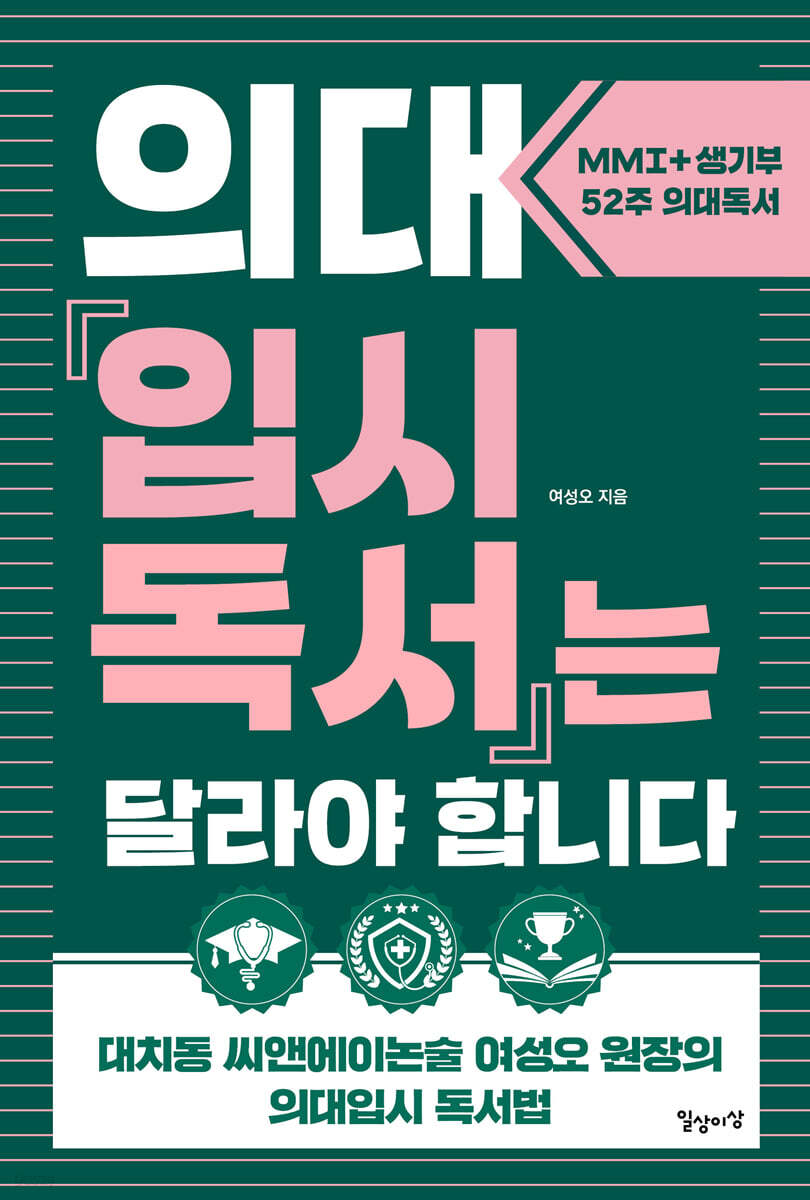
Medical school entrance exam reading must be different.
 |
Description
Book Introduction
The one and only book most needed by medical school applicants, their parents, and teachers!
Read 52 must-read books for medical school admissions and prepare perfectly for everything from writing your resume to the MMI!
“Starting in 2025, the 5-grade system will be implemented. What should I do to get into medical school?”
“They say I need to prepare differently for the medical school entrance exam. What should I do?”
This is something that the author of this book, Dr. Oh Yeo-seong of C&A Nonsul Daechi Branch, often hears from students preparing for medical school entrance exams and their parents.
The 5-grade system for internal grades will be applied to first-year high school students starting in 2025.
In the 9-grade system, only 4% received a 1st grade, but in the 5-grade system, 10% received a 1st grade.
Since only the top students apply to medical school, even if you get a grade 1, you may still be rejected.
Because it is difficult to determine whether applicants are accepted or rejected based solely on their academic records and college entrance exam scores in medical schools, the student record and multiple mini-interview (MMI) have emerged as the most important variables in determining medical school admissions.
Reading is essential for preparing for the Life Sciences and MMI.
Why is this? With the implementation of the high school credit system, students must pay attention not only to written exams and performance assessments, but also to the detailed ability and special skills section (so-called "special skills") in their student records.
To achieve good results not only in the performance evaluation but also in the life sciences special tax return, you need to include content that will connect your dreams with your career path, and reading is what you need to do that.
Reading is also necessary to prepare for the MMI.
The entrance exams for 40 medical schools nationwide, including Seoul National University, are known as a fierce battleground for top applicants. The MMI (Mediation Introductory Mathematics Interview) has become a crucial factor in determining acceptance to medical school. As its name suggests, the MMI is a "multiple-part interview."
While a typical interview is conducted in one interview room, MMI involves a series of small interviews held in multiple interview rooms.
The exam presents questions related to communication and dilemmas in human relationships, humans and systems, science and technology, ethics, labor, and social relations in various forms such as text, pictures, and diagrams. Questions are asked about these questions. In order to calmly answer the questions without being nervous, you must develop reading skills to quickly understand the questions.
This book is designed to help you prepare for both the CV and MMI at the same time.
This book contains a customized reading method for medical school entrance exams written by Dr. Oh, the director of C&A Essay Daechi Branch, who has produced many students who were accepted to major medical schools, including Seoul National University.
We have designed a system to prepare for the medical school entrance exam by reading 52 books in total, one per week, in line with the latest entrance exam trends, to help you prepare for the life sciences test and MMI.
We introduced the actual questions asked in the MMI for medical school admissions, as well as examples of questions and model answers asked during interviews.
In addition, we introduced how to read books related to the suggested text in the form of a one-on-one, friendly, customized reading class for medical schools, and even introduced examples of special features of the life science department.
This book will be the single most essential book for medical school applicants, their parents, and teachers.
Read 52 must-read books for medical school admissions and prepare perfectly for everything from writing your resume to the MMI!
“Starting in 2025, the 5-grade system will be implemented. What should I do to get into medical school?”
“They say I need to prepare differently for the medical school entrance exam. What should I do?”
This is something that the author of this book, Dr. Oh Yeo-seong of C&A Nonsul Daechi Branch, often hears from students preparing for medical school entrance exams and their parents.
The 5-grade system for internal grades will be applied to first-year high school students starting in 2025.
In the 9-grade system, only 4% received a 1st grade, but in the 5-grade system, 10% received a 1st grade.
Since only the top students apply to medical school, even if you get a grade 1, you may still be rejected.
Because it is difficult to determine whether applicants are accepted or rejected based solely on their academic records and college entrance exam scores in medical schools, the student record and multiple mini-interview (MMI) have emerged as the most important variables in determining medical school admissions.
Reading is essential for preparing for the Life Sciences and MMI.
Why is this? With the implementation of the high school credit system, students must pay attention not only to written exams and performance assessments, but also to the detailed ability and special skills section (so-called "special skills") in their student records.
To achieve good results not only in the performance evaluation but also in the life sciences special tax return, you need to include content that will connect your dreams with your career path, and reading is what you need to do that.
Reading is also necessary to prepare for the MMI.
The entrance exams for 40 medical schools nationwide, including Seoul National University, are known as a fierce battleground for top applicants. The MMI (Mediation Introductory Mathematics Interview) has become a crucial factor in determining acceptance to medical school. As its name suggests, the MMI is a "multiple-part interview."
While a typical interview is conducted in one interview room, MMI involves a series of small interviews held in multiple interview rooms.
The exam presents questions related to communication and dilemmas in human relationships, humans and systems, science and technology, ethics, labor, and social relations in various forms such as text, pictures, and diagrams. Questions are asked about these questions. In order to calmly answer the questions without being nervous, you must develop reading skills to quickly understand the questions.
This book is designed to help you prepare for both the CV and MMI at the same time.
This book contains a customized reading method for medical school entrance exams written by Dr. Oh, the director of C&A Essay Daechi Branch, who has produced many students who were accepted to major medical schools, including Seoul National University.
We have designed a system to prepare for the medical school entrance exam by reading 52 books in total, one per week, in line with the latest entrance exam trends, to help you prepare for the life sciences test and MMI.
We introduced the actual questions asked in the MMI for medical school admissions, as well as examples of questions and model answers asked during interviews.
In addition, we introduced how to read books related to the suggested text in the form of a one-on-one, friendly, customized reading class for medical schools, and even introduced examples of special features of the life science department.
This book will be the single most essential book for medical school applicants, their parents, and teachers.
- You can preview some of the book's contents.
Preview
index
Reading has emerged as the biggest variable in medical school admissions. How should we prepare for it?
Week 1: "Such a Kind Individualist"
Week 2 Nexus
Week 3: The Medical Scientist at the Art Museum
Week 4: Freakonomics
Week 5: Don't Think of an Elephant
Week 6: Logic is My Power
Week 7: "I Go to See a Dead Body Every Week"
Week 8 《1984》
Week 9: What Would Marx Do?
Week 10: Decision Making Lesson
Week 11: 1795, King Jeongjo's Happy Procession
Week 12: Noh Myung-woo's One-Line Sociology
Week 13: The Autobiography of Philip Zimbardo
Week 14: The King Asks Desperately, and His Servant Risks His Life to Answer
Week 15: Damien Hirst I Met
Week 16: The Argument Against Perfection
Week 17: Completely Equal and Extremely Discriminatory
Week 18: Noise Pollution
Week 19: Aesthetic Scandal
Week 20: AI Meets People with Disabilities
Week 21: The Benevolent Discriminationist
Week 22: If Our Body Were the World
Week 23: Why Nations Fail
Week 24: The Emergence of the Altruistic Human
Week 25: The 90s Generation is Coming
Week 26: "Will You Be There in Huntington Beach?"
Week 27: Factfulness
Week 28: The Hwang Woo-suk Case: A Look at It 10 Years Ago from the Present
Week 29: Reading Multicultural Society through Literature
Week 30: Helen Keller, My Story
Week 31: Tears of an Idol
Week 32: People Who Don't Think
Week 33: World History Through Fruit
Week 34: How Population Changes My Future
Week 35: Crisis Management Communication
Week 36: Biomedical Ethics
Week 37: Banksy, Wall and Peace
Week 38: Reading Literature at the Philosophy Cafe
Week 39: The Strange Normal Family
Week 40: Pale Blue Dot
Week 41: The Man Left with Nine Pairs of Shoes
Week 42 Rap Girl
Week 43: Misinformation and Fact-Checking Journalism
Week 44: Stick!
Week 45: Song of the Sword
Week 46: Landscapes of Modern Medicine
Week 47: Baridegi
Week 48: Human Work in the Robot Age
Week 49: "Statistics: A Bright Red Lie"
Week 50: How Stereotypes Threaten the World
Week 51: Brilliant Extinction
Week 52: Moral Economics
Week 1: "Such a Kind Individualist"
Week 2 Nexus
Week 3: The Medical Scientist at the Art Museum
Week 4: Freakonomics
Week 5: Don't Think of an Elephant
Week 6: Logic is My Power
Week 7: "I Go to See a Dead Body Every Week"
Week 8 《1984》
Week 9: What Would Marx Do?
Week 10: Decision Making Lesson
Week 11: 1795, King Jeongjo's Happy Procession
Week 12: Noh Myung-woo's One-Line Sociology
Week 13: The Autobiography of Philip Zimbardo
Week 14: The King Asks Desperately, and His Servant Risks His Life to Answer
Week 15: Damien Hirst I Met
Week 16: The Argument Against Perfection
Week 17: Completely Equal and Extremely Discriminatory
Week 18: Noise Pollution
Week 19: Aesthetic Scandal
Week 20: AI Meets People with Disabilities
Week 21: The Benevolent Discriminationist
Week 22: If Our Body Were the World
Week 23: Why Nations Fail
Week 24: The Emergence of the Altruistic Human
Week 25: The 90s Generation is Coming
Week 26: "Will You Be There in Huntington Beach?"
Week 27: Factfulness
Week 28: The Hwang Woo-suk Case: A Look at It 10 Years Ago from the Present
Week 29: Reading Multicultural Society through Literature
Week 30: Helen Keller, My Story
Week 31: Tears of an Idol
Week 32: People Who Don't Think
Week 33: World History Through Fruit
Week 34: How Population Changes My Future
Week 35: Crisis Management Communication
Week 36: Biomedical Ethics
Week 37: Banksy, Wall and Peace
Week 38: Reading Literature at the Philosophy Cafe
Week 39: The Strange Normal Family
Week 40: Pale Blue Dot
Week 41: The Man Left with Nine Pairs of Shoes
Week 42 Rap Girl
Week 43: Misinformation and Fact-Checking Journalism
Week 44: Stick!
Week 45: Song of the Sword
Week 46: Landscapes of Modern Medicine
Week 47: Baridegi
Week 48: Human Work in the Robot Age
Week 49: "Statistics: A Bright Red Lie"
Week 50: How Stereotypes Threaten the World
Week 51: Brilliant Extinction
Week 52: Moral Economics
Detailed image

Into the book
This book will introduce a total of 52 Seoul National University Medical School interview questions, one per week.
Seoul National University MMI is conducted in four interview rooms for the application process and one interview room for the student affairs department.
The presentation interview is 10 minutes long, with 2 minutes of preparation time per presentation and 8 minutes for Q&A, and the resume interview is 20 minutes long, with questions and answers about the applicant's resume. Therefore, a total of 60 minutes is given to one applicant.
--- p.17
Situational statements are a typical type of interview for most medical schools, including Seoul National University.
In medical school interviews, problem situations are presented.
We ask questions in turn about what problems arise in the situation, what a medical school applicant would do in that problematic situation, and what the characters' emotions are.
This book ('Medical School Entrance Exam Reading Must Be Different') will introduce various presentations related to medical and non-medical situations.
In particular, Seoul National University issues a question related to a dilemma in a non-medical situation every year.
A variety of situations are presented, such as club or group project situations, conflicts in peer relationships related to competitions or grades, and school violence.
It is often given outside of school settings.
Generally, scenes that can be encountered in society are given.
You might be the owner of a pizza shop, or you might meet an immigrant on the subway.
You will be assessed in a short interview on everything from making choices in ethical dilemmas to showing empathy and consideration for friends or acquaintances in distress.
--- p.23
This may seem unfamiliar as a medical school interview prompt, but it offers important insights into the meaning of language.
These days, the idea that language is not simply understood through dictionary definitions, but that its meaning is formed and changed based on how people actually use it, is very relatable.
I especially find the part where the word 'cook' is used as an example interesting.
Just as the act of making food is expressed as 'cooking', so too is the act of moving people according to one's will, making us realize that language is alive and moving.
(syncopation)
This article argues that language is not simply an act of naming things, but a tool necessary to perform specific roles in our lives.
As a physician, what do you think is the specific role language plays in a patient's life? These questions assess the depth of understanding and nuanced approach a candidate possesses in communicating with patients as a physician.
Please keep in mind that medical school interviews evaluate not only simple knowledge but also human empathy and communication skills.
--- pp.94~96
〈Example of special taxation of the Ministry of Health and Welfare〉
We examine how newly developed congenital disease prevention technologies offer great hope for humanity while simultaneously sparking complex ethical and social debates. We analyze the positive aspects of reducing potential fetal suffering, as well as the essential need for social consensus on issues such as cost, potential for misuse, and long-term safety.
Personally, some argue that the application of technology can be considered for a healthy life, but given the uncertainty and potential side effects of genetic modification and the existence of existing alternative treatments, caution is needed. Furthermore, even if the technology becomes cheaper, there are those who fundamentally oppose it due to the unpredictable future. Then, in the context of an international conference discussing the scope of application of the technology, the pros and cons are logically deduced.
The argument that congenital heart disease treatment is a 'treatment' rather than an 'enhancement of ability' because it restores the limitations of physical function caused by the disease is connected to the human desire and bioethical issues in the biotechnology era discussed in 'The Case for Perfection (Michael Sandel)'.
Reflecting on the nature of the moral discomfort brought about by technological advancement, we propose further case studies, summarizing it as a significant task that requires not only scientific benefits but also social responsibility, ethical reflection, and deep consideration for future generations.
--- p.186
In 'If Our Body Were the World', we use data to tell the social history of the body and disease.
We present data on the actual number of deaths from an infectious disease presumed to be typhus during the reign of King Jungjong of the Joseon Dynasty, as well as data on the number of outpatients using hospitals, the number of deaths from legal infectious diseases, and average height during the Japanese colonial period.
Speaking of the Black Death in the Middle Ages, he poses the question, "Did more women than men die from the Black Death in 14th-century Europe?" and introduces a 2017 Dutch study that analyzed the male-female mortality ratio during and without the Black Death epidemic.
Show data and ask questions at the same time.
It asks about the inequality of death: 'Who had to take greater risks in the face of a major disaster?'
It is a significant question in today's world, where large-scale disasters occur constantly.
If you are a medical school applicant, you should be able to answer this question, right?
--- p.248
To help you further, I'd like to share with you some real-life experiences from seniors who have taken the Seoul National University College of Medicine MMI interview.
This is an experience from a multiple mini-interview that took place over 70 minutes in 7 different rooms.
One student who prepared a variety of past exam questions in advance said he wasn't overly flustered by the multiple mini-interview format.
Because it was fully expected and did not deviate significantly from expectations.
I expected the situational interview and theatrical interview to some extent.
However, the format of summarizing the fingerprint content on an OHP film and presenting it on a screen in front of the interviewer, separated into two rooms, was completely unexpected.
It was also important where the first room was taken.
The group this student belongs to had a self-introduction interview room as the first room, and he said that it helped with psychological stability.
The biggest crisis occurred in room number 3.
A situation was presented where a passive girl was hurt emotionally by her friends and was in a state of anxiety.
One of the professors asked me, “Have you ever experienced a similar situation?” and I answered, “Yes.”
The professor kept asking about the experience until the very end.
Seoul National University MMI is conducted in four interview rooms for the application process and one interview room for the student affairs department.
The presentation interview is 10 minutes long, with 2 minutes of preparation time per presentation and 8 minutes for Q&A, and the resume interview is 20 minutes long, with questions and answers about the applicant's resume. Therefore, a total of 60 minutes is given to one applicant.
--- p.17
Situational statements are a typical type of interview for most medical schools, including Seoul National University.
In medical school interviews, problem situations are presented.
We ask questions in turn about what problems arise in the situation, what a medical school applicant would do in that problematic situation, and what the characters' emotions are.
This book ('Medical School Entrance Exam Reading Must Be Different') will introduce various presentations related to medical and non-medical situations.
In particular, Seoul National University issues a question related to a dilemma in a non-medical situation every year.
A variety of situations are presented, such as club or group project situations, conflicts in peer relationships related to competitions or grades, and school violence.
It is often given outside of school settings.
Generally, scenes that can be encountered in society are given.
You might be the owner of a pizza shop, or you might meet an immigrant on the subway.
You will be assessed in a short interview on everything from making choices in ethical dilemmas to showing empathy and consideration for friends or acquaintances in distress.
--- p.23
This may seem unfamiliar as a medical school interview prompt, but it offers important insights into the meaning of language.
These days, the idea that language is not simply understood through dictionary definitions, but that its meaning is formed and changed based on how people actually use it, is very relatable.
I especially find the part where the word 'cook' is used as an example interesting.
Just as the act of making food is expressed as 'cooking', so too is the act of moving people according to one's will, making us realize that language is alive and moving.
(syncopation)
This article argues that language is not simply an act of naming things, but a tool necessary to perform specific roles in our lives.
As a physician, what do you think is the specific role language plays in a patient's life? These questions assess the depth of understanding and nuanced approach a candidate possesses in communicating with patients as a physician.
Please keep in mind that medical school interviews evaluate not only simple knowledge but also human empathy and communication skills.
--- pp.94~96
〈Example of special taxation of the Ministry of Health and Welfare〉
We examine how newly developed congenital disease prevention technologies offer great hope for humanity while simultaneously sparking complex ethical and social debates. We analyze the positive aspects of reducing potential fetal suffering, as well as the essential need for social consensus on issues such as cost, potential for misuse, and long-term safety.
Personally, some argue that the application of technology can be considered for a healthy life, but given the uncertainty and potential side effects of genetic modification and the existence of existing alternative treatments, caution is needed. Furthermore, even if the technology becomes cheaper, there are those who fundamentally oppose it due to the unpredictable future. Then, in the context of an international conference discussing the scope of application of the technology, the pros and cons are logically deduced.
The argument that congenital heart disease treatment is a 'treatment' rather than an 'enhancement of ability' because it restores the limitations of physical function caused by the disease is connected to the human desire and bioethical issues in the biotechnology era discussed in 'The Case for Perfection (Michael Sandel)'.
Reflecting on the nature of the moral discomfort brought about by technological advancement, we propose further case studies, summarizing it as a significant task that requires not only scientific benefits but also social responsibility, ethical reflection, and deep consideration for future generations.
--- p.186
In 'If Our Body Were the World', we use data to tell the social history of the body and disease.
We present data on the actual number of deaths from an infectious disease presumed to be typhus during the reign of King Jungjong of the Joseon Dynasty, as well as data on the number of outpatients using hospitals, the number of deaths from legal infectious diseases, and average height during the Japanese colonial period.
Speaking of the Black Death in the Middle Ages, he poses the question, "Did more women than men die from the Black Death in 14th-century Europe?" and introduces a 2017 Dutch study that analyzed the male-female mortality ratio during and without the Black Death epidemic.
Show data and ask questions at the same time.
It asks about the inequality of death: 'Who had to take greater risks in the face of a major disaster?'
It is a significant question in today's world, where large-scale disasters occur constantly.
If you are a medical school applicant, you should be able to answer this question, right?
--- p.248
To help you further, I'd like to share with you some real-life experiences from seniors who have taken the Seoul National University College of Medicine MMI interview.
This is an experience from a multiple mini-interview that took place over 70 minutes in 7 different rooms.
One student who prepared a variety of past exam questions in advance said he wasn't overly flustered by the multiple mini-interview format.
Because it was fully expected and did not deviate significantly from expectations.
I expected the situational interview and theatrical interview to some extent.
However, the format of summarizing the fingerprint content on an OHP film and presenting it on a screen in front of the interviewer, separated into two rooms, was completely unexpected.
It was also important where the first room was taken.
The group this student belongs to had a self-introduction interview room as the first room, and he said that it helped with psychological stability.
The biggest crisis occurred in room number 3.
A situation was presented where a passive girl was hurt emotionally by her friends and was in a state of anxiety.
One of the professors asked me, “Have you ever experienced a similar situation?” and I answered, “Yes.”
The professor kept asking about the experience until the very end.
--- pp.482~483
Publisher's Review
Daechi-dong C&A Nonsul Women's University Director Oh's medical school entrance exam reading method!
A book recommended by medical school students, containing customized reading methods for medical school entrance exams!
In the 2025 Seoul National University College of Medicine MMI, two pictures were presented as questions.
(A) The interviewer explained that the picture is of Napoleon's coronation and (B) the picture is of Napoleon comforting a plague patient, and then asked what these pictures were trying to say.
Not only at Seoul National University, but also in the MMI for medical school entrance exams, text, pictures, and diagrams are presented as questions.
This book introduces various types of MMI problems and provides methods for preparing for them.
Students preparing for medical school entrance exams should also pay attention to medical ethics. The MMI primarily presents questions related to ethical dilemmas.
Because a doctor's life itself is filled with countless choices.
The test presents a situation involving a dilemma and assesses how the applicant responds.
Through this, we evaluate the empathy, communication, and teamwork skills required of medical professionals.
This book introduces reading methods to prepare for not only the MMI required for medical school admissions but also the life sciences specialization, and has the following characteristics.
First, we introduced actual MMI questions for medical school admissions and organized them into a one-on-one customized reading class for medical school admissions.
We have organized and introduced the previous year's presentations, which are released at the end of March every year, in chronological order, and organized the required readings for medical school entrance exams related to the presentations into a class format where students read 52 books, one per week.
I read the given passages for two minutes each, as if they were real exams, and answered the questions and additional questions that appeared on the MMI.
Second, we introduced recommended books that are in line with the latest medical school entrance exam trends.
Starting with the first year of high school in 2025, textbooks will be updated according to the revised curriculum. This book introduces 52 recommended books that are in line with the latest trends in college entrance exams and explains how to utilize them.
Third, the book's volume, difficulty, and usability are clearly indicated.
This book is marked with '★' for its length, difficulty, and usability.
For example, 'Book size ★★★★★' is a good book because it is short, around 200 pages.
The more burdensome the reading, the fewer stars it gets. Books that are thick and heavy like bricks are marked with 'volume ★★'.
Fourth, we introduced examples of special features of medical school admissions.
We have introduced examples that can be written in the special section of each subject of the life sciences department using 52 required reading books.
We kindly introduced a version that fits the maximum size of 1,500 bytes, as well as a version that fits 2/3 of the size and a version that fits 1/3 of the size.
A book recommended by medical school students, containing customized reading methods for medical school entrance exams!
In the 2025 Seoul National University College of Medicine MMI, two pictures were presented as questions.
(A) The interviewer explained that the picture is of Napoleon's coronation and (B) the picture is of Napoleon comforting a plague patient, and then asked what these pictures were trying to say.
Not only at Seoul National University, but also in the MMI for medical school entrance exams, text, pictures, and diagrams are presented as questions.
This book introduces various types of MMI problems and provides methods for preparing for them.
Students preparing for medical school entrance exams should also pay attention to medical ethics. The MMI primarily presents questions related to ethical dilemmas.
Because a doctor's life itself is filled with countless choices.
The test presents a situation involving a dilemma and assesses how the applicant responds.
Through this, we evaluate the empathy, communication, and teamwork skills required of medical professionals.
This book introduces reading methods to prepare for not only the MMI required for medical school admissions but also the life sciences specialization, and has the following characteristics.
First, we introduced actual MMI questions for medical school admissions and organized them into a one-on-one customized reading class for medical school admissions.
We have organized and introduced the previous year's presentations, which are released at the end of March every year, in chronological order, and organized the required readings for medical school entrance exams related to the presentations into a class format where students read 52 books, one per week.
I read the given passages for two minutes each, as if they were real exams, and answered the questions and additional questions that appeared on the MMI.
Second, we introduced recommended books that are in line with the latest medical school entrance exam trends.
Starting with the first year of high school in 2025, textbooks will be updated according to the revised curriculum. This book introduces 52 recommended books that are in line with the latest trends in college entrance exams and explains how to utilize them.
Third, the book's volume, difficulty, and usability are clearly indicated.
This book is marked with '★' for its length, difficulty, and usability.
For example, 'Book size ★★★★★' is a good book because it is short, around 200 pages.
The more burdensome the reading, the fewer stars it gets. Books that are thick and heavy like bricks are marked with 'volume ★★'.
Fourth, we introduced examples of special features of medical school admissions.
We have introduced examples that can be written in the special section of each subject of the life sciences department using 52 required reading books.
We kindly introduced a version that fits the maximum size of 1,500 bytes, as well as a version that fits 2/3 of the size and a version that fits 1/3 of the size.
GOODS SPECIFICS
- Date of issue: November 3, 2025
- Page count, weight, size: 564 pages | 808g | 152*225*26mm
- ISBN13: 9791194227076
- ISBN10: 1194227074
You may also like
카테고리
korean


korean

![GQ KOREA Mark (Monthly): December [2025]](http://librairie.coreenne.fr/cdn/shop/files/8ef265dbbfbf186523ed75ba7319009d.jpg?v=1765340328&width=3840)


