

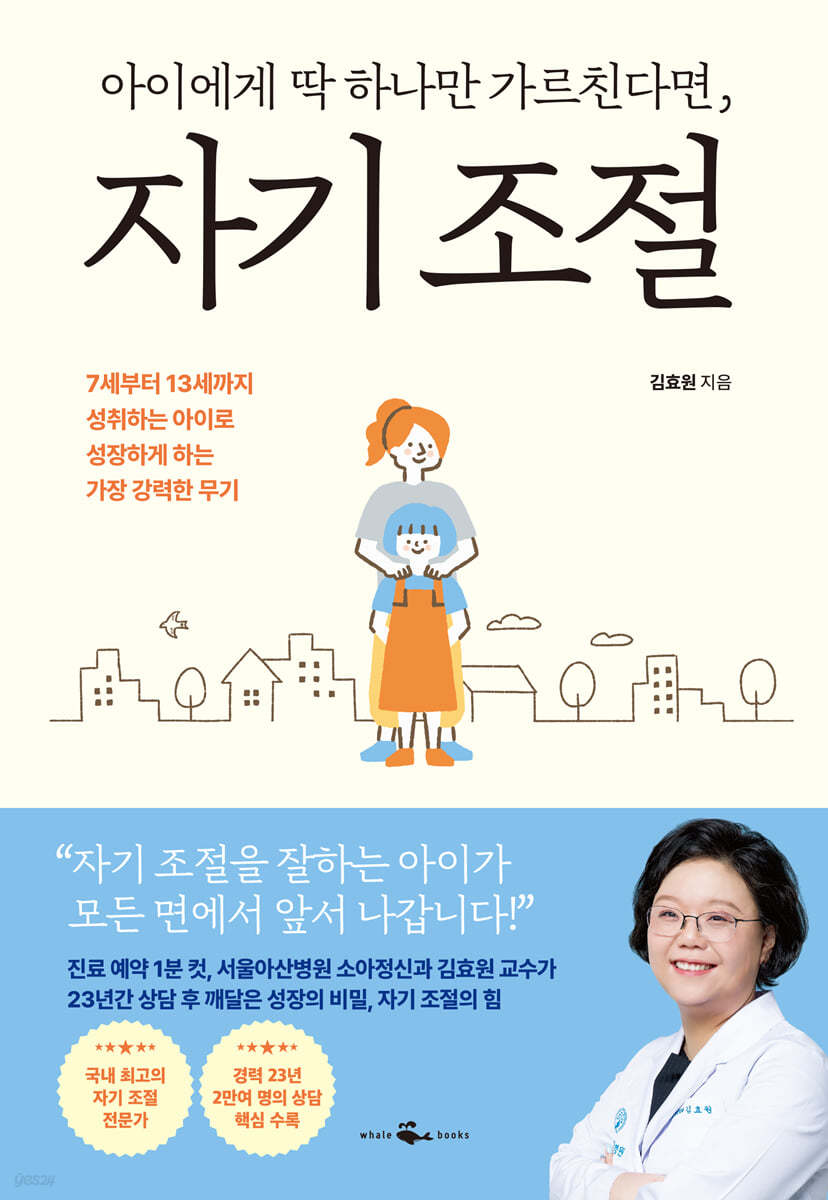
If you teach your child only one thing, it's self-control.
 |
Description
Book Introduction
“Teach your child self-control before Korean, English, or math.
“The kind of child that parents so desperately want begins with self-control.”
Endless competition, anxiety and stress, the proliferation of digital media, addiction and apathy…
The only solution for struggling parents and wavering children: self-regulation.
A book that sets a new standard for parenting with self-regulation know-how suited to the current era.
Self-regulation has always been an important factor in children's growth, but it has re-emerged as an especially important factor today.
This is because self-regulation is the key ability to overcome side effects such as anxiety and stress caused by overheated competition, and addiction and lethargy caused by excessive use of digital media.
Professor Kim Hyo-won of the Department of Pediatrics and Adolescent Psychiatry at Seoul Asan Medical Center, who has gained absolute trust from parents to the point that appointments are filled within a minute of opening, has confirmed through numerous consultations and treatments in recent years that children's self-regulation is a major concern for parents, and has published "If You Teach Your Child Only One Thing, It's Self-Regulation" by comprehensively covering the topic.
This book explains why self-regulation is especially essential for children today, and provides practical guidance for parents on how to understand and teach it.
Professor Kim Hyo-won, drawing on 23 years of clinical experience and cutting-edge research, has deeply analyzed the impact of self-regulation on children's daily lives, learning abilities, relationship formation, and overall mental health.
If parents, along with this book, first cultivate self-regulation and systematically teach their children, their children will gain the momentum to grow even in this rapidly changing era, and they will grow into children who excel in all aspects of their lives, academics, and relationships, children who achieve success, and ultimately, wonderful adults who can live independently.
“The kind of child that parents so desperately want begins with self-control.”
Endless competition, anxiety and stress, the proliferation of digital media, addiction and apathy…
The only solution for struggling parents and wavering children: self-regulation.
A book that sets a new standard for parenting with self-regulation know-how suited to the current era.
Self-regulation has always been an important factor in children's growth, but it has re-emerged as an especially important factor today.
This is because self-regulation is the key ability to overcome side effects such as anxiety and stress caused by overheated competition, and addiction and lethargy caused by excessive use of digital media.
Professor Kim Hyo-won of the Department of Pediatrics and Adolescent Psychiatry at Seoul Asan Medical Center, who has gained absolute trust from parents to the point that appointments are filled within a minute of opening, has confirmed through numerous consultations and treatments in recent years that children's self-regulation is a major concern for parents, and has published "If You Teach Your Child Only One Thing, It's Self-Regulation" by comprehensively covering the topic.
This book explains why self-regulation is especially essential for children today, and provides practical guidance for parents on how to understand and teach it.
Professor Kim Hyo-won, drawing on 23 years of clinical experience and cutting-edge research, has deeply analyzed the impact of self-regulation on children's daily lives, learning abilities, relationship formation, and overall mental health.
If parents, along with this book, first cultivate self-regulation and systematically teach their children, their children will gain the momentum to grow even in this rapidly changing era, and they will grow into children who excel in all aspects of their lives, academics, and relationships, children who achieve success, and ultimately, wonderful adults who can live independently.
- You can preview some of the book's contents.
Preview
index
Prologue | For parents who want to raise children with good self-control
Part 1: Self-Control: The Best Weapon in a Child's Life
Chapter 1: Examining Children's Self-Regulation
· What is self-regulation?
· Why self-regulation is important
· Five areas of self-regulation
· Three factors that influence a child's self-regulation development
Chapter 2: The Secret of a Child with Extraordinary Self-Control
· The secret of a child with exceptional self-control ① Emotional control
· The secret of a child with exceptional self-control ② Behavioral control
· The secret of a child with exceptional self-regulation ③ Cognitive control
· The secret of a child with exceptional self-regulation ④ Control in relationships
· The Secret of Children with Extraordinary Self-Regulation ⑤ Regulating Pleasure and Motivation
Chapter 3: Six Keys to Determining Your Child's Self-Regulation
Key ① Innate Temperament - Understanding the Soil in which a Child Grows
Key ② Parenting - What the Fence of Family Can Do
Key ③ Development of Conscience and Morality - Standards and Motivations for Self-Regulation
Key ④ Stress and Trauma - Examining the Obstacles to Self-Regulation
· Key ⑤ Self-esteem and resilience - a solid foundation for self-regulation
· Key ⑥ Digital Media and Social Media - New Obstacles to Self-Regulation Development
Part 2: How to Develop Self-Regulation in Your Child
Chapter 4: A Complex Brain Has Simple Solutions
· Step 01 Examining Your Child's Brain
· Step 02 Child's Brain and Self-Regulation
· Step 03 Understanding the Compensation Circuit
Chapter 5: How to Raise a Child with Exceptional Self-Regulation
Self-regulation begins in good relationships.
· Firm discipline is absolutely necessary.
Raising a child with exceptional self-control ① Emotional control
Raising a child with exceptional self-control ② Behavior control
· Raising a child with exceptional self-regulation ③ Cognitive control
· Raising a child with exceptional self-control ④ Control in relationships
· Raising a child with exceptional self-regulation ⑤ Regulating pleasure and motivation
· When you need a hospital
Chapter 6: Parents Who Control Raise Children Who Control
· Parental self-regulation is important.
· Look into your own feelings
· Parents look back on their own lives
· Set your life boundaries wisely (feat.
Parental Burnout)
Epilogue | A Child Growing Up with Parents
References
Part 1: Self-Control: The Best Weapon in a Child's Life
Chapter 1: Examining Children's Self-Regulation
· What is self-regulation?
· Why self-regulation is important
· Five areas of self-regulation
· Three factors that influence a child's self-regulation development
Chapter 2: The Secret of a Child with Extraordinary Self-Control
· The secret of a child with exceptional self-control ① Emotional control
· The secret of a child with exceptional self-control ② Behavioral control
· The secret of a child with exceptional self-regulation ③ Cognitive control
· The secret of a child with exceptional self-regulation ④ Control in relationships
· The Secret of Children with Extraordinary Self-Regulation ⑤ Regulating Pleasure and Motivation
Chapter 3: Six Keys to Determining Your Child's Self-Regulation
Key ① Innate Temperament - Understanding the Soil in which a Child Grows
Key ② Parenting - What the Fence of Family Can Do
Key ③ Development of Conscience and Morality - Standards and Motivations for Self-Regulation
Key ④ Stress and Trauma - Examining the Obstacles to Self-Regulation
· Key ⑤ Self-esteem and resilience - a solid foundation for self-regulation
· Key ⑥ Digital Media and Social Media - New Obstacles to Self-Regulation Development
Part 2: How to Develop Self-Regulation in Your Child
Chapter 4: A Complex Brain Has Simple Solutions
· Step 01 Examining Your Child's Brain
· Step 02 Child's Brain and Self-Regulation
· Step 03 Understanding the Compensation Circuit
Chapter 5: How to Raise a Child with Exceptional Self-Regulation
Self-regulation begins in good relationships.
· Firm discipline is absolutely necessary.
Raising a child with exceptional self-control ① Emotional control
Raising a child with exceptional self-control ② Behavior control
· Raising a child with exceptional self-regulation ③ Cognitive control
· Raising a child with exceptional self-control ④ Control in relationships
· Raising a child with exceptional self-regulation ⑤ Regulating pleasure and motivation
· When you need a hospital
Chapter 6: Parents Who Control Raise Children Who Control
· Parental self-regulation is important.
· Look into your own feelings
· Parents look back on their own lives
· Set your life boundaries wisely (feat.
Parental Burnout)
Epilogue | A Child Growing Up with Parents
References
Detailed image

Into the book
There is more stress and conflict in the reality that children live in than before.
Overheated academic competition and constant stress make children impatient and easily frustrated.
There is more to learn, but fewer opportunities to run around freely, develop social skills, and relieve stress.
In addition, excessive use of digital devices such as smartphones and tablet PCs, as well as various games, reels, and shorts, which are fun and exciting, hinder the development of children's self-regulation.
As families become more nuclear and society becomes more complex, it has become difficult for families and schools to adequately care for children's minds and teach them self-control.
As a result, it seems that children's self-regulation, which is necessary to maintain daily life and social relationships while enduring stress and conflict, is in crisis.
Parents are increasingly at a loss as to how to understand and help their children, who have difficulty self-regulating.
The role of parents is not only to care for and love their children so that they can grow up well, but also to guide them so that they can self-regulate well and live well with others in society.
In order to teach children to regulate themselves well, to act according to rules and norms without causing harm to others, parents must first consider what self-regulation means to their children.
---From "Prologue - For Parents Who Want to Raise Children with Good Self-Control"
Self-regulation is with us from the beginning of life.
Newborns cry when they are hungry, but when they are full, they feel satisfied and comfortable. They are startled by loud noises, but their anxiety decreases when their mother comforts them.
They also suck their thumbs to relieve boredom or anxiety.
This ability to regulate one's emotions, behavior, and thoughts exists from a very young age, and is what makes humans human.
Self-regulation begins to develop in infancy, continues to grow into adulthood, and influences a person throughout his or her life.
---From "Chapter 1 - Why Self-Control is Important"
A child's ability to regulate his or her emotions affects every aspect of his or her life.
Children who are good at regulating their emotions can temporarily separate emotions that interfere with achieving their goals, avoid losing their temper due to irritation or anxiety, tolerate frustration, and wait for problems to be resolved.
So, you can maintain good relationships with your family, teachers, and peers, and not only will you have an advantage in your long-term studies and career, but you will also grow up to be a healthier person both physically and mentally.
---From "Chapter 2 - The Secret of a Child with Extraordinary Self-Control ① Emotion Control"
As children grow and begin to walk and use a spoon on their own, parenting that respects their initiative while also clearly setting boundaries between what they can and cannot do will help them develop self-regulation.
However, if parents are overly controlling and insist on following instructions, it can hinder the development of self-regulation.
Especially during adolescence, allowing children to exercise an appropriate level of autonomy helps them develop more positive emotions and better emotional regulation.
“I thought I could finish the performance evaluation over the weekend, but it took longer than I thought and I couldn’t finish it all.
If you respect your child's study plan and verbally acknowledge their feelings of frustration when things don't go as planned, such as, "I have to study for the test, but I'm anxious and nervous because I can't finish the performance evaluation," your child will be able to calmly re-plan without getting irritated or exploding with anger.
Reading emotions plays an important role in developing emotional regulation and problem-solving skills.
If parents are unable to control their own emotions, their children will also have difficulty controlling their emotions.
High-conflict and unsupportive parent-child relationships impair children's self-regulation.
Things like excessively long and repetitive nagging, vague instructions and commands, harsh and inconsistent discipline, and a lack of warm care and supervision make emotional regulation more difficult.
Conversely, if parents are good at regulating their own emotions and treat their children in a stable and predictable manner, their children will not only grow up to be good at self-regulation, but will also gain confidence in their ability to regulate themselves.
---From "Chapter 3 - Key ② Parenting - What the Fence of Family Can Do"
The part of our brain that is responsible for regulatory functions is the frontal lobe.
Among them, the prefrontal cortex, which accounts for two-thirds of the frontal lobe, synthesizes various information to judge the situation, predicts the outcome, makes plans, and puts them into practice.
Understanding other people's feelings, emotions, and situations is also the job of the frontal lobe.
It is also the frontal lobe's job to regulate emotions such as anger and rage, as well as the desires, impulses, and behaviors hidden beneath these emotions.
In this way, the frontal lobe not only plans and executes daily tasks, but also controls physical movements, emotions, and behavior.
In other words, it acts as a conductor and CEO who controls various functions of the brain.
---From "Chapter 4 - Step 02: The Child's Brain and Self-Regulation"
There are things in life that you have to do even if you don't want to.
You must not engage in any behavior that harms yourself or others.
There are so many things that don't go my way, and failure and frustration are unavoidable, but I still have to live.
Appropriate frustration in childhood teaches us to regulate our desires and builds the strength to overcome future challenges.
The role of parents in a child's life is to teach and inform the boundaries of what should and should not be done, what can and cannot be done.
---From "Chapter 5 - Firm Discipline is Absolutely Necessary"
In fact, raising a child is a task that requires constant self-regulation on the part of the parents.
Self-regulation is the process of continually regulating your emotions, behaviors, and thoughts while anticipating the long-term consequences of your actions.
When raising a child, there are many moments when parents must control their emotions, actions, and thoughts.
This is especially true because parents are the ones who turn around and regret and blame themselves after yelling at or hitting their children.
Parents who are good at self-regulation are less angry with their children, more responsive to their children's needs, and better able to resolve problems when they arise.
Children learn to regulate their emotions, behaviors, and thoughts without even realizing it by observing how their parents regulate their emotions, behaviors, and thoughts.
So, parental self-regulation is directly related to the child's self-regulation.
Overheated academic competition and constant stress make children impatient and easily frustrated.
There is more to learn, but fewer opportunities to run around freely, develop social skills, and relieve stress.
In addition, excessive use of digital devices such as smartphones and tablet PCs, as well as various games, reels, and shorts, which are fun and exciting, hinder the development of children's self-regulation.
As families become more nuclear and society becomes more complex, it has become difficult for families and schools to adequately care for children's minds and teach them self-control.
As a result, it seems that children's self-regulation, which is necessary to maintain daily life and social relationships while enduring stress and conflict, is in crisis.
Parents are increasingly at a loss as to how to understand and help their children, who have difficulty self-regulating.
The role of parents is not only to care for and love their children so that they can grow up well, but also to guide them so that they can self-regulate well and live well with others in society.
In order to teach children to regulate themselves well, to act according to rules and norms without causing harm to others, parents must first consider what self-regulation means to their children.
---From "Prologue - For Parents Who Want to Raise Children with Good Self-Control"
Self-regulation is with us from the beginning of life.
Newborns cry when they are hungry, but when they are full, they feel satisfied and comfortable. They are startled by loud noises, but their anxiety decreases when their mother comforts them.
They also suck their thumbs to relieve boredom or anxiety.
This ability to regulate one's emotions, behavior, and thoughts exists from a very young age, and is what makes humans human.
Self-regulation begins to develop in infancy, continues to grow into adulthood, and influences a person throughout his or her life.
---From "Chapter 1 - Why Self-Control is Important"
A child's ability to regulate his or her emotions affects every aspect of his or her life.
Children who are good at regulating their emotions can temporarily separate emotions that interfere with achieving their goals, avoid losing their temper due to irritation or anxiety, tolerate frustration, and wait for problems to be resolved.
So, you can maintain good relationships with your family, teachers, and peers, and not only will you have an advantage in your long-term studies and career, but you will also grow up to be a healthier person both physically and mentally.
---From "Chapter 2 - The Secret of a Child with Extraordinary Self-Control ① Emotion Control"
As children grow and begin to walk and use a spoon on their own, parenting that respects their initiative while also clearly setting boundaries between what they can and cannot do will help them develop self-regulation.
However, if parents are overly controlling and insist on following instructions, it can hinder the development of self-regulation.
Especially during adolescence, allowing children to exercise an appropriate level of autonomy helps them develop more positive emotions and better emotional regulation.
“I thought I could finish the performance evaluation over the weekend, but it took longer than I thought and I couldn’t finish it all.
If you respect your child's study plan and verbally acknowledge their feelings of frustration when things don't go as planned, such as, "I have to study for the test, but I'm anxious and nervous because I can't finish the performance evaluation," your child will be able to calmly re-plan without getting irritated or exploding with anger.
Reading emotions plays an important role in developing emotional regulation and problem-solving skills.
If parents are unable to control their own emotions, their children will also have difficulty controlling their emotions.
High-conflict and unsupportive parent-child relationships impair children's self-regulation.
Things like excessively long and repetitive nagging, vague instructions and commands, harsh and inconsistent discipline, and a lack of warm care and supervision make emotional regulation more difficult.
Conversely, if parents are good at regulating their own emotions and treat their children in a stable and predictable manner, their children will not only grow up to be good at self-regulation, but will also gain confidence in their ability to regulate themselves.
---From "Chapter 3 - Key ② Parenting - What the Fence of Family Can Do"
The part of our brain that is responsible for regulatory functions is the frontal lobe.
Among them, the prefrontal cortex, which accounts for two-thirds of the frontal lobe, synthesizes various information to judge the situation, predicts the outcome, makes plans, and puts them into practice.
Understanding other people's feelings, emotions, and situations is also the job of the frontal lobe.
It is also the frontal lobe's job to regulate emotions such as anger and rage, as well as the desires, impulses, and behaviors hidden beneath these emotions.
In this way, the frontal lobe not only plans and executes daily tasks, but also controls physical movements, emotions, and behavior.
In other words, it acts as a conductor and CEO who controls various functions of the brain.
---From "Chapter 4 - Step 02: The Child's Brain and Self-Regulation"
There are things in life that you have to do even if you don't want to.
You must not engage in any behavior that harms yourself or others.
There are so many things that don't go my way, and failure and frustration are unavoidable, but I still have to live.
Appropriate frustration in childhood teaches us to regulate our desires and builds the strength to overcome future challenges.
The role of parents in a child's life is to teach and inform the boundaries of what should and should not be done, what can and cannot be done.
---From "Chapter 5 - Firm Discipline is Absolutely Necessary"
In fact, raising a child is a task that requires constant self-regulation on the part of the parents.
Self-regulation is the process of continually regulating your emotions, behaviors, and thoughts while anticipating the long-term consequences of your actions.
When raising a child, there are many moments when parents must control their emotions, actions, and thoughts.
This is especially true because parents are the ones who turn around and regret and blame themselves after yelling at or hitting their children.
Parents who are good at self-regulation are less angry with their children, more responsive to their children's needs, and better able to resolve problems when they arise.
Children learn to regulate their emotions, behaviors, and thoughts without even realizing it by observing how their parents regulate their emotions, behaviors, and thoughts.
So, parental self-regulation is directly related to the child's self-regulation.
---From "Chapter 6: Parental Self-Regulation is Important"
Publisher's Review
“From emotional regulation to behavioral, cognitive, and relationship issues to addiction and apathy,
“All the problems a child experiences can be solved by learning self-regulation.”
A life weapon that parents should put in their children's hands from ages 7 to 13.
Professor Kim Hyo-won of the Department of Pediatrics and Adolescent Psychiatry at Seoul Asan Medical Center explains
All About Self-Regulation for My Child
A child who can't wait for their food to arrive at a restaurant, a child who cries and throws a tantrum at the supermarket because they aren't buying what they want, a child who insists on playing only the games they want when playing with friends, a child who doesn't answer no matter how many times you call them and just looks at their smartphone, a child who just doesn't want to do anything and doesn't want to do anything... These are common behaviors of children who lack self-control.
When faced with this situation, most parents tend to react in extreme ways, either unconditionally comforting their children or indiscriminately scolding them, without knowing what to do.
This all happens because parents don't know their children's self-regulation well.
To help parents understand and effectively utilize their children's self-regulation in parenting, this book divides self-regulation into five areas: emotion, behavior, cognition, relationships, and pleasure and motivation. It also details problems frequently encountered by children in each area, real-life examples, and methods for resolving them.
For example, Byeol-i (a first grader, female) often gets irritated and cannot sit down whenever class time changes from break time to class time, disrupting the class.
On the other hand, Dongyoon (3rd grade, male) is playing with several friends when another friend suddenly suggests a new game. Instead of reacting immediately, he calms down by taking deep breaths and clearly expressing his thoughts to resolve the situation smoothly.
Through contrasting case studies like these, the book vividly illustrates how children with and without self-regulation react and behave differently in everyday life, helping parents compare their child's current situation to find the best solutions for themselves.
Additionally, six keys to determining self-regulation were separately mentioned, allowing parents to take a deeper look into their child's self-regulation.
Knowing how innate temperament, upbringing, conscience and moral development, stress and trauma, self-esteem and resilience, and digital media and social media influence self-regulation can help parents effectively guide their children to achieve their goals.
“The practice of very small self-control in daily life
“It leads the child to holistic growth.”
A child with strong mental muscles, a child who follows rules well,
A child who studies on his own, a child who gets along well with friends,
The most practical parenting solution for raising a child who is motivated and energetic in everything.
Professor Kim Hyo-won also provides a helpful explanation of the connection between brain development and self-regulation to help parents gain a fundamental understanding of their children's self-regulation.
By going through the basic brain development sequence from brainstem to limbic system to frontal lobe, as well as brain development related to emotional and cognitive control, addiction, and apathy, parents can discover clues to self-regulation development through their child's brain.
And, the highlight of this book is that it provides specific practical methods to foster self-regulation in children.
From how to build a good parent-child relationship to how to manage enjoyment and motivation, it's full of practical advice you can apply right now in your parenting practice.
· How to build a good relationship between parents and children: 5 ways to play with your child, 5 ways to read your child's mind, etc.
· How to Discipline Firmly: 9 Ways to Get Your Child to Follow Instructions, Time-Out Discipline, and More
· How to develop emotional regulation: 4 ways to regulate emotions, 4 easy meditations to do with children, etc.
· How to develop behavioral control: The 4-step Turtle Method, how to use a life planner, etc.
· How to develop cognitive control: How to establish a routine, 8 ways to become a self-directed learner, and more.
· How to develop relationship control: social-emotional learning methods, peer communication methods, etc.
· How to cultivate enjoyment and motivation: How to watch videos properly, how to use smartphones without conflict, etc.
A child's self-regulation development is greatly influenced by the parents' parenting attitude and growth environment.
The author emphasizes that parents should first practice self-control and become role models for their children.
In fact, Jiyoon (6 years old, female) visited the hospital because of hitting a friend at kindergarten. During the consultation, she said, “Even my dad hits me when he gets angry, so why can’t I hit my friend?”
These cases clearly show how much influence parents' emotions and actions have on their children's self-regulation.
Therefore, this book presents a process and method for parents to examine their own self-regulation so that they can empathize with their child's self-regulation and help their child's development.
It's about how parents can calmly examine and honestly express their feelings, how parents can reflect on their lives and accept even the imperfections, and how parents can wisely set boundaries in their lives to avoid reaching the extreme of parental burnout.
Parents are a child's first teachers.
This means that parents are the ones who have the greatest influence on a child's learning and growth in the world.
Parents play a very important role in helping their children develop self-regulation.
I am confident that this book will provide the most realistic and practical help to parents who wish for their children to grow up to be self-regulating—that is, children who can effectively manage their emotions, behaviors, and thoughts, set goals and work towards them consistently, and manage their relationships with others.
“All the problems a child experiences can be solved by learning self-regulation.”
A life weapon that parents should put in their children's hands from ages 7 to 13.
Professor Kim Hyo-won of the Department of Pediatrics and Adolescent Psychiatry at Seoul Asan Medical Center explains
All About Self-Regulation for My Child
A child who can't wait for their food to arrive at a restaurant, a child who cries and throws a tantrum at the supermarket because they aren't buying what they want, a child who insists on playing only the games they want when playing with friends, a child who doesn't answer no matter how many times you call them and just looks at their smartphone, a child who just doesn't want to do anything and doesn't want to do anything... These are common behaviors of children who lack self-control.
When faced with this situation, most parents tend to react in extreme ways, either unconditionally comforting their children or indiscriminately scolding them, without knowing what to do.
This all happens because parents don't know their children's self-regulation well.
To help parents understand and effectively utilize their children's self-regulation in parenting, this book divides self-regulation into five areas: emotion, behavior, cognition, relationships, and pleasure and motivation. It also details problems frequently encountered by children in each area, real-life examples, and methods for resolving them.
For example, Byeol-i (a first grader, female) often gets irritated and cannot sit down whenever class time changes from break time to class time, disrupting the class.
On the other hand, Dongyoon (3rd grade, male) is playing with several friends when another friend suddenly suggests a new game. Instead of reacting immediately, he calms down by taking deep breaths and clearly expressing his thoughts to resolve the situation smoothly.
Through contrasting case studies like these, the book vividly illustrates how children with and without self-regulation react and behave differently in everyday life, helping parents compare their child's current situation to find the best solutions for themselves.
Additionally, six keys to determining self-regulation were separately mentioned, allowing parents to take a deeper look into their child's self-regulation.
Knowing how innate temperament, upbringing, conscience and moral development, stress and trauma, self-esteem and resilience, and digital media and social media influence self-regulation can help parents effectively guide their children to achieve their goals.
“The practice of very small self-control in daily life
“It leads the child to holistic growth.”
A child with strong mental muscles, a child who follows rules well,
A child who studies on his own, a child who gets along well with friends,
The most practical parenting solution for raising a child who is motivated and energetic in everything.
Professor Kim Hyo-won also provides a helpful explanation of the connection between brain development and self-regulation to help parents gain a fundamental understanding of their children's self-regulation.
By going through the basic brain development sequence from brainstem to limbic system to frontal lobe, as well as brain development related to emotional and cognitive control, addiction, and apathy, parents can discover clues to self-regulation development through their child's brain.
And, the highlight of this book is that it provides specific practical methods to foster self-regulation in children.
From how to build a good parent-child relationship to how to manage enjoyment and motivation, it's full of practical advice you can apply right now in your parenting practice.
· How to build a good relationship between parents and children: 5 ways to play with your child, 5 ways to read your child's mind, etc.
· How to Discipline Firmly: 9 Ways to Get Your Child to Follow Instructions, Time-Out Discipline, and More
· How to develop emotional regulation: 4 ways to regulate emotions, 4 easy meditations to do with children, etc.
· How to develop behavioral control: The 4-step Turtle Method, how to use a life planner, etc.
· How to develop cognitive control: How to establish a routine, 8 ways to become a self-directed learner, and more.
· How to develop relationship control: social-emotional learning methods, peer communication methods, etc.
· How to cultivate enjoyment and motivation: How to watch videos properly, how to use smartphones without conflict, etc.
A child's self-regulation development is greatly influenced by the parents' parenting attitude and growth environment.
The author emphasizes that parents should first practice self-control and become role models for their children.
In fact, Jiyoon (6 years old, female) visited the hospital because of hitting a friend at kindergarten. During the consultation, she said, “Even my dad hits me when he gets angry, so why can’t I hit my friend?”
These cases clearly show how much influence parents' emotions and actions have on their children's self-regulation.
Therefore, this book presents a process and method for parents to examine their own self-regulation so that they can empathize with their child's self-regulation and help their child's development.
It's about how parents can calmly examine and honestly express their feelings, how parents can reflect on their lives and accept even the imperfections, and how parents can wisely set boundaries in their lives to avoid reaching the extreme of parental burnout.
Parents are a child's first teachers.
This means that parents are the ones who have the greatest influence on a child's learning and growth in the world.
Parents play a very important role in helping their children develop self-regulation.
I am confident that this book will provide the most realistic and practical help to parents who wish for their children to grow up to be self-regulating—that is, children who can effectively manage their emotions, behaviors, and thoughts, set goals and work towards them consistently, and manage their relationships with others.
GOODS SPECIFICS
- Date of issue: January 20, 2025
- Page count, weight, size: 320 pages | 436g | 145*210*30mm
- ISBN13: 9791192097954
- ISBN10: 1192097955
You may also like
카테고리
korean


korean

![GQ KOREA Mark (Monthly): December [2025]](http://librairie.coreenne.fr/cdn/shop/files/8ef265dbbfbf186523ed75ba7319009d.jpg?v=1765340328&width=3840)


