

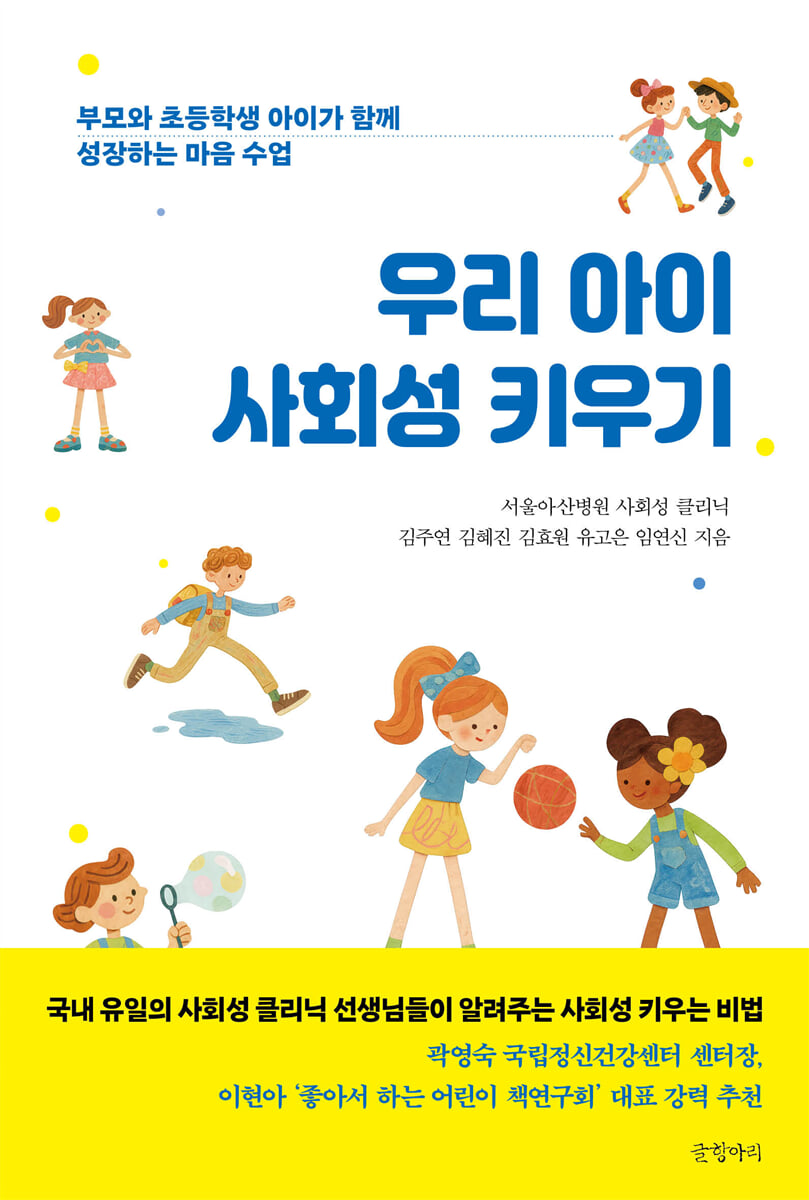
Raising our children's social skills
 |
Description
Book Introduction
Social skills are not innate.
It's a technology that gets better little by little every day.
The secrets to developing social skills, taught by instructors at Korea's only social skills clinic.
First social life of elementary school students
How can I help?
Parents of children who have entered or are planning to enter elementary school are plagued by all sorts of worries.
What if my child can't make friends? What if he or she gets into conflicts with the teacher? What if he or she can't adapt? ... If you gather all your worries, they all boil down to one thing.
"What if my child lacks social skills?" Just imagining a child without friends, fighting frequently with friends, or being bullied can be a source of anxiety.
How can we foster social skills in children? What can parents do to help their children navigate their first social journey?
The authors are experts who have been exploring this question for a long time.
While working with parents to find ways to help their children develop friendships, we also opened the 'Seoul Asan Medical Center Social Skills Clinic' to meet children directly and help them develop social skills, and have helped over 300 children.
Professors Kim Hyo-won and Lim Yeon-shin have been leading the Social Sexuality Clinic for 15 years.
Teachers Kim Hye-jin and Yoo Go-eun, as clinical psychologists, have been conducting group and individual social skills training programs, while Teacher Kim Joo-yeon, a former elementary school teacher turned doctor, is meeting children with her unique background.
This book, which is based on many years of experience, is very practical and concrete.
Any concept is explained with play activities or examples, and the method of carrying out the activity and even sample dialogues are included.
This book also does not miss the sociality of parents.
When parents worry about their child's social skills, they tend to neglect their own social skills.
However, parents also need to demonstrate social skills in parent-teacher meetings, open classes, etc., and these relationships also affect their children's peer relationships.
Let's take a look at the advice of doctors, special education teachers, and clinical psychologists who have worked at Korea's only social skills clinic.
It's a technology that gets better little by little every day.
The secrets to developing social skills, taught by instructors at Korea's only social skills clinic.
First social life of elementary school students
How can I help?
Parents of children who have entered or are planning to enter elementary school are plagued by all sorts of worries.
What if my child can't make friends? What if he or she gets into conflicts with the teacher? What if he or she can't adapt? ... If you gather all your worries, they all boil down to one thing.
"What if my child lacks social skills?" Just imagining a child without friends, fighting frequently with friends, or being bullied can be a source of anxiety.
How can we foster social skills in children? What can parents do to help their children navigate their first social journey?
The authors are experts who have been exploring this question for a long time.
While working with parents to find ways to help their children develop friendships, we also opened the 'Seoul Asan Medical Center Social Skills Clinic' to meet children directly and help them develop social skills, and have helped over 300 children.
Professors Kim Hyo-won and Lim Yeon-shin have been leading the Social Sexuality Clinic for 15 years.
Teachers Kim Hye-jin and Yoo Go-eun, as clinical psychologists, have been conducting group and individual social skills training programs, while Teacher Kim Joo-yeon, a former elementary school teacher turned doctor, is meeting children with her unique background.
This book, which is based on many years of experience, is very practical and concrete.
Any concept is explained with play activities or examples, and the method of carrying out the activity and even sample dialogues are included.
This book also does not miss the sociality of parents.
When parents worry about their child's social skills, they tend to neglect their own social skills.
However, parents also need to demonstrate social skills in parent-teacher meetings, open classes, etc., and these relationships also affect their children's peer relationships.
Let's take a look at the advice of doctors, special education teachers, and clinical psychologists who have worked at Korea's only social skills clinic.
- You can preview some of the book's contents.
Preview
index
preface
Chapter 1: Five Competencies That Form the Foundation of Sociality_Im Yeon-shin
1.
Social skills, a skill that improves little by little every day
2.
Five fundamental elements
3.
Raising Social Skills in Our Children
4.
Self-help skills in children are as important as social skills.
Chapter 2: Preparing Your Child to Be a Good Friend: Play Date_Yoo Go-eun
1.
Playdates, do you really need them?
2.
Preparing to become a good friend
3.
Planning a play date
4.
Start a play date
5.
Bringing Playdates to Life
Chapter 3: Children Dealing with Anger, Teasing, and Bullying: Growing Up with Conflict_Hyejin Kim
1.
Basic Principles of Conflict Resolution That Parents Should Know
2.
How to Deal with Conflict Through Case Studies
Chapter 4: How to Do a Good Mothers' Gathering_Kim Hyo-won
1.
Do I really have to go to the parent-teacher meeting?
2.
How should I interact with moms at parent-teacher meetings?
3.
Things to watch out for in your relationship with your mother
4.
What Parents Should Do When Their Children Fight
5.
Things to remember at moms' gatherings
6.
How Dads Survive Parents' Meetings
7.
If your child's development is slow or disabled
Chapter 5: Teachers, Children's Best Helpers_Kim Joo-yeon
1.
Teacher, Co-Parent
2.
How can parents get along well with their children's teachers?
3.
Parent Counseling
4.
Open classes
5.
Parent Participation Activities
6.
School life
Chapter 1: Five Competencies That Form the Foundation of Sociality_Im Yeon-shin
1.
Social skills, a skill that improves little by little every day
2.
Five fundamental elements
3.
Raising Social Skills in Our Children
4.
Self-help skills in children are as important as social skills.
Chapter 2: Preparing Your Child to Be a Good Friend: Play Date_Yoo Go-eun
1.
Playdates, do you really need them?
2.
Preparing to become a good friend
3.
Planning a play date
4.
Start a play date
5.
Bringing Playdates to Life
Chapter 3: Children Dealing with Anger, Teasing, and Bullying: Growing Up with Conflict_Hyejin Kim
1.
Basic Principles of Conflict Resolution That Parents Should Know
2.
How to Deal with Conflict Through Case Studies
Chapter 4: How to Do a Good Mothers' Gathering_Kim Hyo-won
1.
Do I really have to go to the parent-teacher meeting?
2.
How should I interact with moms at parent-teacher meetings?
3.
Things to watch out for in your relationship with your mother
4.
What Parents Should Do When Their Children Fight
5.
Things to remember at moms' gatherings
6.
How Dads Survive Parents' Meetings
7.
If your child's development is slow or disabled
Chapter 5: Teachers, Children's Best Helpers_Kim Joo-yeon
1.
Teacher, Co-Parent
2.
How can parents get along well with their children's teachers?
3.
Parent Counseling
4.
Open classes
5.
Parent Participation Activities
6.
School life
Detailed image

Into the book
When we talk about social skills, we often think of getting along well with friends, not fighting, and just getting along well with everyone.
So, just by seeing them playing well with their friends, we can conclude that they have good social skills.
But does being easy to make friends with and having fun mean you have good social skills? Does not fighting with friends really mean you have good social skills? Let's debunk some misconceptions about social skills.
--- p.16
“Kids are all like that.
As you grow up, you will naturally have more friends and play better.
"Don't worry, just leave it alone." Is that really true? It's a common misconception that social skills will improve over time.
But this ability is not developed without effort.
--- p.19
How does sociality relate to learning? While it may seem unrelated at first glance, sociality actually has a profound impact on learning.
According to research by Megan McClelland, children who are socially developed are more likely to perform better in school.
--- p.21
Social skills are invisible, unlike physical development like crawling, walking, and running.
However, it is not something that can be achieved overnight, nor can it be completed in a short period of time by reading a few books.
(…) The key to sociality is that it is not something you are born with, but rather a skill that can be developed through learning and practice.
Because sociality is not an abstract concept, but rather consists of concrete behaviors and skills such as communication, emotion regulation, conflict resolution, and cooperation.
--- p.23~24
The early elementary school years are a time when children develop the ability to understand and empathize with other people's emotions and behaviors.
(…) However, since they are not yet completely free from egocentric thinking, they may not be able to fully understand more complex and subtle emotions or other people’s positions.
(…) However, it is not advisable to leave it alone, thinking that it will get better on its own.
Parents should help their children develop empathy and social skills by talking about emotions with them, discussing how to act in different situations, and helping them better understand the emotions of others and accurately grasp the intentions behind words and actions.
--- p.32
To foster social skills, it is more effective to explain to children why they should do something than to tell them to do it this way. This will foster their inner motivation.
This plays a vital role in helping you understand the situation and choose the right course of action.
--- p.46
By the time children reach the early elementary school years, playdates have become even more essential to peer relationships than the benefits described above.
(…) These skills are not learned through one or two experiences, but are naturally developed through repeated play and interaction.
That's why it's increasingly important to develop the ability to express your opinions, understand the feelings of others, and resolve conflicts without adult intervention.
Playdates provide a safe environment to practice and develop these social skills, helping children become more independent within their peer relationships.
--- p.113
'To meet a good person, you must first become a good person.' This saying is a truth that applies to all relationships.
This is no exception for our young children.
(…) So the starting point is to first prepare our children to be good friends to others.
If you are well prepared, the subsequent relationship building and play process will be much easier.
--- p.115~116
Elementary school students in the lower grades are not yet fully developed in their emotional regulation and problem-solving skills, so they are bound to be awkward in conflict situations.
Therefore, the role of parents in helping their children resolve conflicts is important.
At this time, it is not advisable for parents to intervene excessively and solve everything, nor is it advisable for them to just stand by and watch indifferently.
A parent's job is to give their children the opportunity to successfully resolve conflicts on their own when they become adults.
--- p.179
There is no set answer to whether or not to participate in parent-teacher conferences, as each child's personality and values are different.
Still, when people around me or in the clinic ask me whether I should attend parent-teacher meetings, I tell them that regardless of my personality, inclinations, or values, it is good to participate in formal kindergarten or school events and that at least some level of connection is necessary.
So, just by seeing them playing well with their friends, we can conclude that they have good social skills.
But does being easy to make friends with and having fun mean you have good social skills? Does not fighting with friends really mean you have good social skills? Let's debunk some misconceptions about social skills.
--- p.16
“Kids are all like that.
As you grow up, you will naturally have more friends and play better.
"Don't worry, just leave it alone." Is that really true? It's a common misconception that social skills will improve over time.
But this ability is not developed without effort.
--- p.19
How does sociality relate to learning? While it may seem unrelated at first glance, sociality actually has a profound impact on learning.
According to research by Megan McClelland, children who are socially developed are more likely to perform better in school.
--- p.21
Social skills are invisible, unlike physical development like crawling, walking, and running.
However, it is not something that can be achieved overnight, nor can it be completed in a short period of time by reading a few books.
(…) The key to sociality is that it is not something you are born with, but rather a skill that can be developed through learning and practice.
Because sociality is not an abstract concept, but rather consists of concrete behaviors and skills such as communication, emotion regulation, conflict resolution, and cooperation.
--- p.23~24
The early elementary school years are a time when children develop the ability to understand and empathize with other people's emotions and behaviors.
(…) However, since they are not yet completely free from egocentric thinking, they may not be able to fully understand more complex and subtle emotions or other people’s positions.
(…) However, it is not advisable to leave it alone, thinking that it will get better on its own.
Parents should help their children develop empathy and social skills by talking about emotions with them, discussing how to act in different situations, and helping them better understand the emotions of others and accurately grasp the intentions behind words and actions.
--- p.32
To foster social skills, it is more effective to explain to children why they should do something than to tell them to do it this way. This will foster their inner motivation.
This plays a vital role in helping you understand the situation and choose the right course of action.
--- p.46
By the time children reach the early elementary school years, playdates have become even more essential to peer relationships than the benefits described above.
(…) These skills are not learned through one or two experiences, but are naturally developed through repeated play and interaction.
That's why it's increasingly important to develop the ability to express your opinions, understand the feelings of others, and resolve conflicts without adult intervention.
Playdates provide a safe environment to practice and develop these social skills, helping children become more independent within their peer relationships.
--- p.113
'To meet a good person, you must first become a good person.' This saying is a truth that applies to all relationships.
This is no exception for our young children.
(…) So the starting point is to first prepare our children to be good friends to others.
If you are well prepared, the subsequent relationship building and play process will be much easier.
--- p.115~116
Elementary school students in the lower grades are not yet fully developed in their emotional regulation and problem-solving skills, so they are bound to be awkward in conflict situations.
Therefore, the role of parents in helping their children resolve conflicts is important.
At this time, it is not advisable for parents to intervene excessively and solve everything, nor is it advisable for them to just stand by and watch indifferently.
A parent's job is to give their children the opportunity to successfully resolve conflicts on their own when they become adults.
--- p.179
There is no set answer to whether or not to participate in parent-teacher conferences, as each child's personality and values are different.
Still, when people around me or in the clinic ask me whether I should attend parent-teacher meetings, I tell them that regardless of my personality, inclinations, or values, it is good to participate in formal kindergarten or school events and that at least some level of connection is necessary.
--- p.244
Publisher's Review
What are the elements that make up sociality?
Playdate Secrets and Conflict Management Tips
One of the common misconceptions about social skills is that they will just get better with time.
However, social skills are not innate abilities and cannot be properly developed without effort.
In other words, sociality is also a ‘technology’.
As with any skill, it improves little by little with practice.
Just as parents can help develop language and physical skills, they can also help develop social skills.
Unlike other skills, social development is invisible.
It can feel vague because there are no clear indicators like in physical development.
However, sociality is not an abstract concept, but a concrete skill consisting of five elements: ‘social cognition and empathy,’ ‘communication,’ ‘emotion regulation,’ ‘cooperation,’ and ‘conflict resolution.’
In addition to explaining each component, the author also presents activities to develop it.
For example, 'emotional thermometers' and 'butterfly poses' can help children regulate their emotions, and playing games with their parents can help them develop social cooperation.
Each activity is described in detail, so you can try it right away.
Now that you've mastered the basic elements of social skills, it's time to put them to use in real-world interactions with friends.
Even at this time, the role of parents is important.
Unlike in the past when children could meet and play with their neighborhood friends just by stepping out the front door, it is difficult for children these days to meet and play naturally.
For this reason, it has become more common these days for parents to take the initiative in making play dates with their children rather than expecting them to become friends on their own.
It's called 'play date'.
The book covers every step of the playdate process, from planning to conducting and providing feedback afterwards.
What's notable is that it covers not only the playdate itself but also the preparatory steps leading up to it.
Before thinking about who would be a good playmate for your child, consider whether your child would be a good playmate for another child, which increases the success rate.
The full-scale progress plan is more detailed.
It covers who to play with, when, where, how to play, and finally how to apply the social skills learned through playdates to real life.
It is more useful to focus on the social development that comes from it rather than simply 'playing'.
On the other hand, conflicts can arise when hanging out with friends.
Elementary school children have difficulty dealing with conflicts because they are immature in emotional regulation and lack experience.
If parents support their children in times like these, they will not be hurt by the conflict and will instead learn a lot.
To make the process of dealing with conflict more vivid, the author uses real-life examples.
Eunbi, who expresses her anger violently, Jiho, who is hated for constantly pointing out her friends…
It is effective because it covers in detail situations that are commonly found in lower elementary school grades.
However, not all conflicts can be resolved by parents.
If the conflict leads to bullying and this escalates into violence, outside help is needed.
To prepare for such situations, the author also included a manual for responding to school violence.
Keep in mind that in situations where ongoing violence is suspected, there are ways to recognize the danger signs your child is sending you.
Do I really have to go to the moms' meeting?
How to work well with your teacher
After their children enter elementary school, parents also form numerous human relationships.
Unlike previous human relationships, it is not easy to deal with people who are connected only through 'children'.
What's more difficult is that parents' relationships also affect their children's relationships.
If parents have a good relationship, children will stick together, and if parents and teachers have a good relationship, children will be treated more kindly.
The most important and most difficult people to connect with through a child are the parents of the child's friends.
Many parents complain, saying, "Do I really have to go to parent-teacher meetings?" or "I'm already introverted, so I don't know if I really have to meet my child's friends' parents."
The author speaks decisively.
It is essential to have one or two close, trustworthy mothers.
Playdates are becoming increasingly important, and can be helpful when your child isn't open about what happened at school.
Of course, it is not an easy relationship.
Since these are people you wouldn't have met if you weren't a child, there's a high chance that you won't get along well, and you'll have no good topics to talk about, and you might even experience unpleasant things.
Some parents gossip about their spouse or in-laws, brag about their children, or ask about their family's personal history or prior learning information.
Parents' meetings can be a struggle if you encounter people gossiping about other children or parents.
But on the other hand, this also means that you can get along well with other parents without doing these things.
The author, a working mom, covers the secrets to getting along well with her parents, how to resolve conflicts between them, and even how dads can survive parent-teacher conferences.
Dealing with your child's school teacher is also not easy.
Many parents say that dealing with teachers is the most difficult.
During the week, the person who sees the child longer than the parents and has an influence on the child's knowledge and personality formation becomes cautious about even saying a single word to the child.
All parents are nervous about their child's every action, worried that the teacher might hate them.
In the book, the author, who worked as an elementary school teacher and then became a doctor, reveals the secrets to building relationships with teachers.
Based on my own experiences as a teacher, I answer the questions of first-time parents.
What time is best to contact them? If you've been diagnosed with ADHD or autism spectrum disorder, should you disclose this? If your child is an executive, does he or she have to participate in volunteer activities?
It provides detailed advice, especially on parent-child counseling.
During counseling, many parents ask questions such as, “Is your child doing well at school?”
But such a general question won't elicit the information you want to know.
So, let's write down specific questions about the areas you've been worried about.
*
Parents are the first society a child encounters.
It is also the parents' responsibility to send their children out into the wider society.
From personally nurturing the five stages of social skills to planning playdates and properly handling conflicts your child experiences.
The same goes for maintaining good relationships with your child's friends' parents and getting along well with teachers.
With the help of expert advice, you won't be lost anymore.
Let's move forward into a broader society in step with our children.
With the help of parents, the child will meet good friends.
Playdate Secrets and Conflict Management Tips
One of the common misconceptions about social skills is that they will just get better with time.
However, social skills are not innate abilities and cannot be properly developed without effort.
In other words, sociality is also a ‘technology’.
As with any skill, it improves little by little with practice.
Just as parents can help develop language and physical skills, they can also help develop social skills.
Unlike other skills, social development is invisible.
It can feel vague because there are no clear indicators like in physical development.
However, sociality is not an abstract concept, but a concrete skill consisting of five elements: ‘social cognition and empathy,’ ‘communication,’ ‘emotion regulation,’ ‘cooperation,’ and ‘conflict resolution.’
In addition to explaining each component, the author also presents activities to develop it.
For example, 'emotional thermometers' and 'butterfly poses' can help children regulate their emotions, and playing games with their parents can help them develop social cooperation.
Each activity is described in detail, so you can try it right away.
Now that you've mastered the basic elements of social skills, it's time to put them to use in real-world interactions with friends.
Even at this time, the role of parents is important.
Unlike in the past when children could meet and play with their neighborhood friends just by stepping out the front door, it is difficult for children these days to meet and play naturally.
For this reason, it has become more common these days for parents to take the initiative in making play dates with their children rather than expecting them to become friends on their own.
It's called 'play date'.
The book covers every step of the playdate process, from planning to conducting and providing feedback afterwards.
What's notable is that it covers not only the playdate itself but also the preparatory steps leading up to it.
Before thinking about who would be a good playmate for your child, consider whether your child would be a good playmate for another child, which increases the success rate.
The full-scale progress plan is more detailed.
It covers who to play with, when, where, how to play, and finally how to apply the social skills learned through playdates to real life.
It is more useful to focus on the social development that comes from it rather than simply 'playing'.
On the other hand, conflicts can arise when hanging out with friends.
Elementary school children have difficulty dealing with conflicts because they are immature in emotional regulation and lack experience.
If parents support their children in times like these, they will not be hurt by the conflict and will instead learn a lot.
To make the process of dealing with conflict more vivid, the author uses real-life examples.
Eunbi, who expresses her anger violently, Jiho, who is hated for constantly pointing out her friends…
It is effective because it covers in detail situations that are commonly found in lower elementary school grades.
However, not all conflicts can be resolved by parents.
If the conflict leads to bullying and this escalates into violence, outside help is needed.
To prepare for such situations, the author also included a manual for responding to school violence.
Keep in mind that in situations where ongoing violence is suspected, there are ways to recognize the danger signs your child is sending you.
Do I really have to go to the moms' meeting?
How to work well with your teacher
After their children enter elementary school, parents also form numerous human relationships.
Unlike previous human relationships, it is not easy to deal with people who are connected only through 'children'.
What's more difficult is that parents' relationships also affect their children's relationships.
If parents have a good relationship, children will stick together, and if parents and teachers have a good relationship, children will be treated more kindly.
The most important and most difficult people to connect with through a child are the parents of the child's friends.
Many parents complain, saying, "Do I really have to go to parent-teacher meetings?" or "I'm already introverted, so I don't know if I really have to meet my child's friends' parents."
The author speaks decisively.
It is essential to have one or two close, trustworthy mothers.
Playdates are becoming increasingly important, and can be helpful when your child isn't open about what happened at school.
Of course, it is not an easy relationship.
Since these are people you wouldn't have met if you weren't a child, there's a high chance that you won't get along well, and you'll have no good topics to talk about, and you might even experience unpleasant things.
Some parents gossip about their spouse or in-laws, brag about their children, or ask about their family's personal history or prior learning information.
Parents' meetings can be a struggle if you encounter people gossiping about other children or parents.
But on the other hand, this also means that you can get along well with other parents without doing these things.
The author, a working mom, covers the secrets to getting along well with her parents, how to resolve conflicts between them, and even how dads can survive parent-teacher conferences.
Dealing with your child's school teacher is also not easy.
Many parents say that dealing with teachers is the most difficult.
During the week, the person who sees the child longer than the parents and has an influence on the child's knowledge and personality formation becomes cautious about even saying a single word to the child.
All parents are nervous about their child's every action, worried that the teacher might hate them.
In the book, the author, who worked as an elementary school teacher and then became a doctor, reveals the secrets to building relationships with teachers.
Based on my own experiences as a teacher, I answer the questions of first-time parents.
What time is best to contact them? If you've been diagnosed with ADHD or autism spectrum disorder, should you disclose this? If your child is an executive, does he or she have to participate in volunteer activities?
It provides detailed advice, especially on parent-child counseling.
During counseling, many parents ask questions such as, “Is your child doing well at school?”
But such a general question won't elicit the information you want to know.
So, let's write down specific questions about the areas you've been worried about.
*
Parents are the first society a child encounters.
It is also the parents' responsibility to send their children out into the wider society.
From personally nurturing the five stages of social skills to planning playdates and properly handling conflicts your child experiences.
The same goes for maintaining good relationships with your child's friends' parents and getting along well with teachers.
With the help of expert advice, you won't be lost anymore.
Let's move forward into a broader society in step with our children.
With the help of parents, the child will meet good friends.
GOODS SPECIFICS
- Date of issue: August 25, 2025
- Page count, weight, size: 364 pages | 135*200*25mm
- ISBN13: 9791169094023
You may also like
카테고리
korean


korean

![GQ KOREA Mark (Monthly): December [2025]](http://librairie.coreenne.fr/cdn/shop/files/8ef265dbbfbf186523ed75ba7319009d.jpg?v=1765340328&width=3840)


