

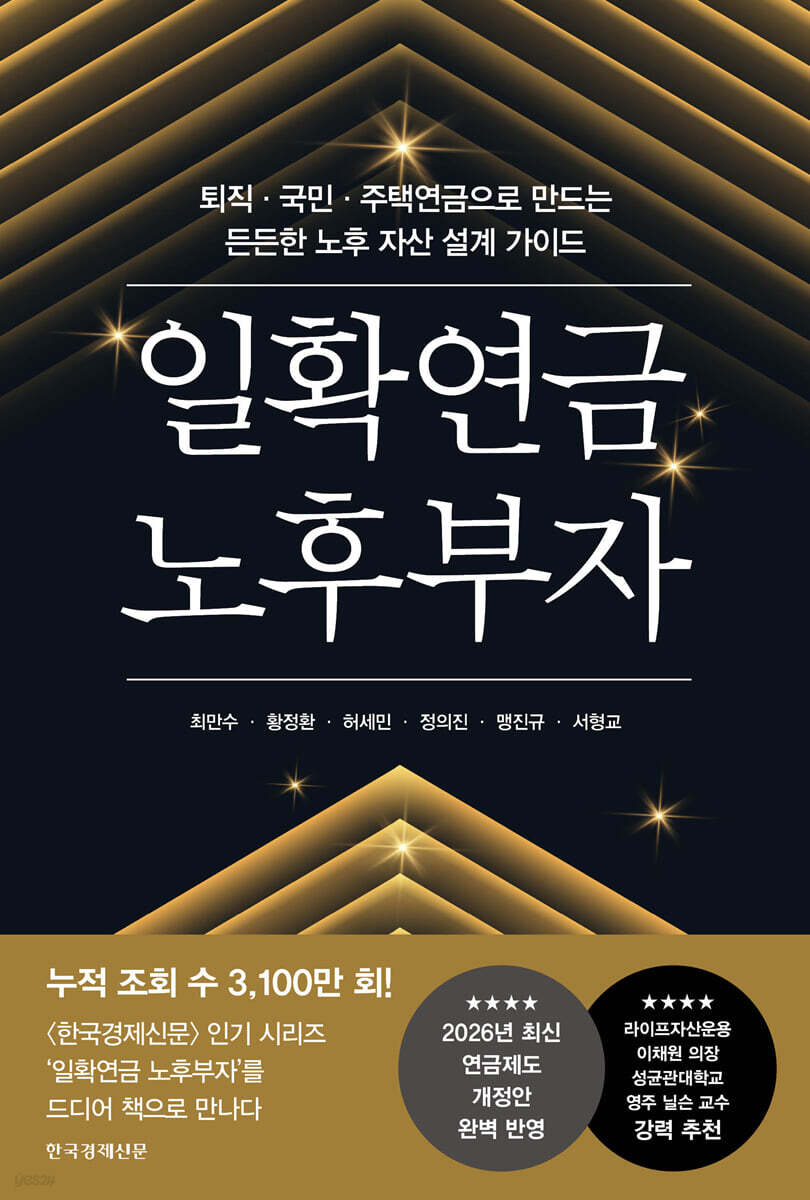
Ilhwak Pension for the Wealthy in Retirement
 |
Description
Book Introduction
If you rely solely on your retirement benefits, your retirement will be ruined within 10 years.
Wake up your dormant pension and let money flow like a salary even after retirement.
The three-tier structure of retirement, national, and housing pension
The Complete Edition of the "Lifetime Salary System" with Alternative Investments
The majority of South Korean workers in their 30s and 50s still live with all their assets tied up in a single property.
The average retirement age is only 51.2 years, but life expectancy is approaching 100.
In an era where housing prices are stagnant and the national pension fund is expected to be depleted, what is more important than 'how to increase assets' is 'how to ensure that money continues to come in even after retirement.'
“The One-Stop Pension Retirement Rich” is a book that started from this awareness of the problem.
Based on the popular online series "Get Rich in Retirement with a One-Time Pension," which reporters at the Korea Economic Daily have been publishing since 2024, this book systematically covers how to design an uninterrupted cash flow even after retirement by adding alternative investments to retirement, national, and housing pensions.
This book presents specific methods for creating a life where your monthly salary doesn't stop even after retirement, focusing on three pillars: retirement pension, national pension, and housing pension.
In the retirement pension section, we show how many workers can turn their neglected DC and IRP accounts into "post-retirement salary accounts."
We've outlined the process of maximizing tax benefits and creating long-term compounding structures through ETFs and TDFs (default options), with practical examples.
The National Pension section provides a quick overview of useful systems, including extension of subscription period, arrears, installment and survivor pensions, and childbirth credits. The Housing Pension section explains the specific procedures for receiving money like a salary without having to sell your home.
We also cover alternative investment strategies that generate steady cash flow, such as REITs, covered call ETFs, foreign bonds, and tax-saving insurance products.
The core of this book is not simply asset allocation, but rather a proposal for a "four-tier pension portfolio" structure that extends economic life by restructuring the tax, investment, and profit structures.
We've simplified the complex financial system so that even beginners can understand and implement it.
The six reporters from the Korea Economic Daily who wrote this book are all experts with extensive experience covering pensions, finance, ETFs, welfare, and policy.
Under the awareness that "assets are meaningless once the salary stops after retirement," we combined our respective fields of expertise to write a "post-retirement survival strategy book" that is essential for Korean workers today.
Throughout the book, they end the era of 'real estate speculation' and present a blueprint for a new retirement asset that adds alternative investments to retirement pensions, national pensions, and housing pensions.
"One-Stop Pension Retirement Wealth" is not just a simple introduction to financial management.
This book contains the most realistic and concrete solutions for sustaining life in old age in Korea, which has entered a super-aging society.
We make it possible to live a life where money comes in even after retirement through practical strategies that save on taxes, grow your pension account, and turn real estate into cash flow.
This book contains the method of completing a 'sudden pension' rather than a 'get-rich-quick' by combining welfare, time, system, and strategy.
Wake up your dormant pension and let money flow like a salary even after retirement.
The three-tier structure of retirement, national, and housing pension
The Complete Edition of the "Lifetime Salary System" with Alternative Investments
The majority of South Korean workers in their 30s and 50s still live with all their assets tied up in a single property.
The average retirement age is only 51.2 years, but life expectancy is approaching 100.
In an era where housing prices are stagnant and the national pension fund is expected to be depleted, what is more important than 'how to increase assets' is 'how to ensure that money continues to come in even after retirement.'
“The One-Stop Pension Retirement Rich” is a book that started from this awareness of the problem.
Based on the popular online series "Get Rich in Retirement with a One-Time Pension," which reporters at the Korea Economic Daily have been publishing since 2024, this book systematically covers how to design an uninterrupted cash flow even after retirement by adding alternative investments to retirement, national, and housing pensions.
This book presents specific methods for creating a life where your monthly salary doesn't stop even after retirement, focusing on three pillars: retirement pension, national pension, and housing pension.
In the retirement pension section, we show how many workers can turn their neglected DC and IRP accounts into "post-retirement salary accounts."
We've outlined the process of maximizing tax benefits and creating long-term compounding structures through ETFs and TDFs (default options), with practical examples.
The National Pension section provides a quick overview of useful systems, including extension of subscription period, arrears, installment and survivor pensions, and childbirth credits. The Housing Pension section explains the specific procedures for receiving money like a salary without having to sell your home.
We also cover alternative investment strategies that generate steady cash flow, such as REITs, covered call ETFs, foreign bonds, and tax-saving insurance products.
The core of this book is not simply asset allocation, but rather a proposal for a "four-tier pension portfolio" structure that extends economic life by restructuring the tax, investment, and profit structures.
We've simplified the complex financial system so that even beginners can understand and implement it.
The six reporters from the Korea Economic Daily who wrote this book are all experts with extensive experience covering pensions, finance, ETFs, welfare, and policy.
Under the awareness that "assets are meaningless once the salary stops after retirement," we combined our respective fields of expertise to write a "post-retirement survival strategy book" that is essential for Korean workers today.
Throughout the book, they end the era of 'real estate speculation' and present a blueprint for a new retirement asset that adds alternative investments to retirement pensions, national pensions, and housing pensions.
"One-Stop Pension Retirement Wealth" is not just a simple introduction to financial management.
This book contains the most realistic and concrete solutions for sustaining life in old age in Korea, which has entered a super-aging society.
We make it possible to live a life where money comes in even after retirement through practical strategies that save on taxes, grow your pension account, and turn real estate into cash flow.
This book contains the method of completing a 'sudden pension' rather than a 'get-rich-quick' by combining welfare, time, system, and strategy.
- You can preview some of the book's contents.
Preview
index
introduction
PART 1.
A secure start to your retirement: a retirement pension account
01.
Wake up your dormant retirement account
02.
The Magic of Compound Interest: Creating a Billion Won in Retirement Savings
03.
Will you become a real estate beggar or a cash rich man?
04.
Become a millionaire by investing in pension stocks
05.
TDF: A pension investment that takes care of everything for you, without the worry of management.
06.
Pension account investments also start with US stocks.
07.
Diversify long-term investment risk with asset allocation.
08.
Enjoy the benefits of receiving a monthly salary with US dividend stocks.
09.
Retirement Tax Saving Strategies to Avoid the Tax Bomb
10.
Easy retirement pension transfer
11.
How do large institutional investors, including the National Pension Service, invest?
12.
Retirement pension managed by smart AI
13.
When investing long-term, check even small fees carefully.
14.
Increase the stock allocation in your pension account to maximize compounding benefits.
15.
The "magic of gifting" through long-term savings investments
PART 2.
National Pension, a retirement account that provides a lifetime of benefits
01.
Why the National Pension Service's subscription period is so "thuggish."
02.
Does the National Pension also pay taxes?
03.
If you work more than 60 hours a month, you must sign up.
04.
People who want to receive their pension early even if it is reduced
05.
A survivor's pension that's as good as a billion-dollar inheritance.
06.
What is 'National Pension Investment'?
07.
The pension program that today's 65-year-olds need
08.
How to claim national pension in the military
09.
A split pension system that eliminates pension concerns even after divorce.
10.
Maternity Credit: A Hope for Women on Career Breaks
11.
Lump sum refund system that extends the pension subscription period
12.
People who voluntarily join the National Pension Service
13.
Pension is good, but what if you don't have money to pay insurance premiums?
14.
I closed my business. Do I still have to pay insurance premiums?
15.
If you try to get more money and get hit with a health insurance premium bomb
16.
When you suddenly need a large sum of money, Silver Loan
17.
A second life, but what if the national pension is cut?
PART 3.
Another retirement investment: alternative investments
01.
From Risky Asset to Essential Investment: Bitcoin
02.
Brazilian bonds resurface
03.
Gold investment surpasses US stocks and becomes a gold-like asset.
04.
If you want to earn living expenses every month, covered call ETF
05.
Real estate investment starting with a small amount: REITs
06.
Between Stocks and Bonds: New Capital Securities
07.
Mandatory for those under 34 years of age: Youth Leap Account
08.
Savings Insurance: A Stable Tax-Saving Strategy Rather Than High-Rate
09.
Complete your retirement planning with private pension insurance.
10.
Life insurance death benefits received in advance when needed
PART 4.
Housing pension: An essential option for a stable retirement
01.
Get cash without working through housing pension
02.
Is it a loss to determine the 'house price' based on the publicly announced price?
03.
Will housing pensions also be hit by health insurance premiums?
04.
Set a withdrawal limit for emergencies.
05.
Can I sign up for a housing pension even if I have debt?
06.
Short and concise 'fixed-term' housing pension
07.
How to Get More Pension with Low-Cost Housing
08.
How to use your housing pension to receive less at first and more later
09.
What Happens to Your Housing Pension After Death?
10.
If I move, will my housing pension increase or decrease?
PART 1.
A secure start to your retirement: a retirement pension account
01.
Wake up your dormant retirement account
02.
The Magic of Compound Interest: Creating a Billion Won in Retirement Savings
03.
Will you become a real estate beggar or a cash rich man?
04.
Become a millionaire by investing in pension stocks
05.
TDF: A pension investment that takes care of everything for you, without the worry of management.
06.
Pension account investments also start with US stocks.
07.
Diversify long-term investment risk with asset allocation.
08.
Enjoy the benefits of receiving a monthly salary with US dividend stocks.
09.
Retirement Tax Saving Strategies to Avoid the Tax Bomb
10.
Easy retirement pension transfer
11.
How do large institutional investors, including the National Pension Service, invest?
12.
Retirement pension managed by smart AI
13.
When investing long-term, check even small fees carefully.
14.
Increase the stock allocation in your pension account to maximize compounding benefits.
15.
The "magic of gifting" through long-term savings investments
PART 2.
National Pension, a retirement account that provides a lifetime of benefits
01.
Why the National Pension Service's subscription period is so "thuggish."
02.
Does the National Pension also pay taxes?
03.
If you work more than 60 hours a month, you must sign up.
04.
People who want to receive their pension early even if it is reduced
05.
A survivor's pension that's as good as a billion-dollar inheritance.
06.
What is 'National Pension Investment'?
07.
The pension program that today's 65-year-olds need
08.
How to claim national pension in the military
09.
A split pension system that eliminates pension concerns even after divorce.
10.
Maternity Credit: A Hope for Women on Career Breaks
11.
Lump sum refund system that extends the pension subscription period
12.
People who voluntarily join the National Pension Service
13.
Pension is good, but what if you don't have money to pay insurance premiums?
14.
I closed my business. Do I still have to pay insurance premiums?
15.
If you try to get more money and get hit with a health insurance premium bomb
16.
When you suddenly need a large sum of money, Silver Loan
17.
A second life, but what if the national pension is cut?
PART 3.
Another retirement investment: alternative investments
01.
From Risky Asset to Essential Investment: Bitcoin
02.
Brazilian bonds resurface
03.
Gold investment surpasses US stocks and becomes a gold-like asset.
04.
If you want to earn living expenses every month, covered call ETF
05.
Real estate investment starting with a small amount: REITs
06.
Between Stocks and Bonds: New Capital Securities
07.
Mandatory for those under 34 years of age: Youth Leap Account
08.
Savings Insurance: A Stable Tax-Saving Strategy Rather Than High-Rate
09.
Complete your retirement planning with private pension insurance.
10.
Life insurance death benefits received in advance when needed
PART 4.
Housing pension: An essential option for a stable retirement
01.
Get cash without working through housing pension
02.
Is it a loss to determine the 'house price' based on the publicly announced price?
03.
Will housing pensions also be hit by health insurance premiums?
04.
Set a withdrawal limit for emergencies.
05.
Can I sign up for a housing pension even if I have debt?
06.
Short and concise 'fixed-term' housing pension
07.
How to Get More Pension with Low-Cost Housing
08.
How to use your housing pension to receive less at first and more later
09.
What Happens to Your Housing Pension After Death?
10.
If I move, will my housing pension increase or decrease?
Detailed image

Into the book
To ensure a happy retirement, you need a thorough financial plan starting now.
Even if you leave your job, you need to create cash flow that will cover your living expenses after retirement.
When the real estate market fluctuates, we need to escape the "house poor" situation where everything falls apart and plan for a solid retirement based on diverse assets.
We must not leave our retirement pension account, which is gradually accumulating every month, unattended.
Starting in April 2024, the Korea Economic Daily will publish a weekly online premium content series titled "One-Stop Pension Retirement Wealth," which will cover asset management strategies using various financial products, including stocks, bonds, deposits, derivatives, and real estate.
Among them are various financial strategies, such as how to increase the return on retirement accounts with exchange-traded funds (ETFs), how to generate cash flow like a salary with monthly dividend funds, how to utilize various tax-saving measures to avoid the tax bomb, how to maximize national pension benefits, and how to utilize housing pensions.
--- From the "Preface"
Experts unanimously agree that to boost pension account returns, we need to move beyond a management approach focused solely on principal and interest protection. ETFs have lower fees and are easier to trade than traditional funds.
For those in their 20s and 30s, it is recommended to maintain a pension account with 70% of the assets in risky assets such as stock ETFs and 30% in principal-guaranteed products such as savings, deposits, and bonds.
A good strategy is to divide your investments into three categories: an ETF that invests in the U.S. Nasdaq index, which has been steadily rising over the past 10 years; an ETF that invests in emerging markets with high growth expectations, such as Vietnam and India; and an ETF that invests in the domestic stock market.
Pension accounts cannot invest in highly volatile products using derivatives such as inverse and leveraged products.
From your 40s to 50s, it is important to increase the proportion of safe assets and create a structure that can generate cash flow through a balanced portfolio.
In your 50s, we recommend a strategy of lowering the proportion of risky assets to 30% and increasing the proportion of safe assets to 60%.
--- 「Part 1, Chapter 1.
From "Wake Up Your Sleeping Retirement Pension Account"
Just because they're called "products for lazy investors" doesn't mean TDFs have low returns. TDFs pursue both stability and high returns by diversifying investments across global stocks and funds.
According to the Korea Financial Investment Association, the two-year average return (as of the end of May 2025) of 265 TDF products launched in Korea was 19.81%, 19.33 percentage points higher than that of domestic equity funds (0.48%). Since their launch in Korea in April 2016, TDFs have consistently delivered significantly higher returns than principal-and-interest-protected products every year, except for 2022 (-14.8%).
The average annual return from 2018 to 2024 is 8.1%.
--- 「Part 1, Chapter 5.
From “TDF, a pension investment that takes care of everything for you without worrying about management”
To summarize, the retirement income tax rate is 70% for the 1st to 10th year of pension receipt, and the retirement income tax rate is 60% for the 11th year and thereafter.
This means that to maximize tax savings, you should set the pension amount as low as possible before the 10th year of receiving the pension, and increase the pension amount from the 11th year onwards.
The pension receipt year is determined not by the date of receipt, but by whether or not the pension was actually received.
This means that if you receive a pension, even if it is a small amount, after 1 to 10 years, you are considered to have passed the pension payment period.
--- 「Part 1, Chapter 9.
From "Retirement Tax Saving Strategies to Avoid the Tax Bomb"
So, how can we maximize the subscription period for this cost-effective national pension?
The first thing to consider is ‘random sign-up’.
The National Pension Voluntary Subscription is a system that allows people who are 18 years of age or older and under 60 years of age residing in Korea but cannot become subscribers due to lack of income to subscribe at their own discretion.
(Omitted) As of June 2025, the pension insurance premium through voluntary subscription to the National Pension Service can be paid from a minimum of 90,000 won per month to a maximum of 555,300 won per month.
According to the 2025 projected monthly pension table published by the National Pension Service, if you pay 90,000 won per year for the minimum subscription period of 10 years, you can receive 205,980 won per month after starting to receive pension.
On the other hand, even if you pay the maximum amount of 555,300 won for 10 years, the monthly amount received will only be 466,420 won.
Insurance premiums have increased by more than six times, but pension payments have only increased by about two times.
If you only look at the cost-effectiveness, it seems like paying 90,000 won is a good deal.
However, as mentioned earlier, even if you pay the maximum national pension premium, the amount you will receive is 1.6 times more than the amount you paid, making the national pension a high-yield retirement preparation tool.
Considering that the return on private pensions, such as individual pensions, is 1x, this is a much more generous benefit. If your circumstances allow, increasing the contribution amount as much as possible to secure the maximum pension income can lead to a stable retirement.
--- 「Part 2, Chapter 1.
From “National Pension, Why the Subscription Period is ‘Rogue’”
Thanks to the military service arrears, this worker's monthly pension will increase from 286,680 won to 346,920 won starting at age 65.
Assuming you receive national pension for 20 years, you will receive 14,457,600 won more than if you did not pay military service arrears.
This is equivalent to receiving 2.2 times the amount of insurance premium (6.48 million won) paid in arrears for a two-year service period.
In addition to the deferred payment, you can extend the subscription period by more than two years by adding credit, so the old-age security effect of military service is quite significant.
--- 「Part 2, Chapter 8.
From "How to Call National Pension in the Military"
Covered call ETFs are ideal for retirees who need monthly living expenses rather than capital gains.
This is because the structure is such that you give up future stock price increases and receive a high level of dividends now.
Recently, covered call strategies have evolved to allow investors to enjoy some of the stock price increases.
However, experts advise that the product structure should be carefully examined, as covered call ETFs themselves are not principal-guaranteed products, and excessively high distribution rates can ultimately lead to a risk of reducing the principal and reducing the distribution.
--- 「Part 3, Chapter 4.
From "If you want to earn living expenses every month, covered call ETF"
To complement these limitations of the national pension, the government established a ‘three-tier pension structure.’
In addition to the National Pension (1st tier) that guarantees basic living, you can prepare for a stable and comfortable retirement life through the Retirement Pension (2nd tier) and Private Pension (3rd tier).
Unlike retirement pensions, which are mandatory for all employees, individual pensions can be subscribed to at one's own discretion.
--- 「Part 3, Chapter 9.
From “Complete your retirement preparation with private pension insurance”
The reason why the amount of housing pension benefits does not affect health insurance premiums, unlike the national pension, is because the national pension is ‘income’, whereas the housing pension is a type of ‘loan’.
There may be quite a few readers who are confused here. Although the word “pension” is included in the name of the system, the housing pension is actually a loan secured by a house.
However, it is expressed as a pension because the subscriber does not have to pay it back during his or her lifetime, and as long as he or she continues to live in the house, he or she can receive cash of several hundred thousand to several million won every month until both the subscriber and spouse pass away.
--- 「Part 4, Chapter 3.
From “Will Housing Pension Also Be Hit by the Health Insurance Premium Bomb?”
The monthly benefit amount received by subscribing to the housing pension is fixed at the time of subscription.
Even if house prices rise later, the amount of housing pension received will not increase.
Therefore, the more the housing pension price rises, the more disadvantageous it becomes.
If we compare domestic prices 20 years ago with current prices, everyone would agree that there is a significant difference.
Likewise, it is highly likely that prices will be higher in 20 years than they are now, although there may be some difference in degree.
This means that even if the amount of housing pension you will receive in 20 years is the same as the amount of housing pension you will receive next month, the actual value taking into account inflation will be lower.
So, should I not sign up for a housing pension? Of course not.
Depending on the subscriber's choice, the housing pension can be paid in large amounts at the beginning and in small amounts later, or it can be paid in small amounts at the beginning but with an increasing monthly amount over time to prepare for the decline in the value of money due to inflation.
Even if you leave your job, you need to create cash flow that will cover your living expenses after retirement.
When the real estate market fluctuates, we need to escape the "house poor" situation where everything falls apart and plan for a solid retirement based on diverse assets.
We must not leave our retirement pension account, which is gradually accumulating every month, unattended.
Starting in April 2024, the Korea Economic Daily will publish a weekly online premium content series titled "One-Stop Pension Retirement Wealth," which will cover asset management strategies using various financial products, including stocks, bonds, deposits, derivatives, and real estate.
Among them are various financial strategies, such as how to increase the return on retirement accounts with exchange-traded funds (ETFs), how to generate cash flow like a salary with monthly dividend funds, how to utilize various tax-saving measures to avoid the tax bomb, how to maximize national pension benefits, and how to utilize housing pensions.
--- From the "Preface"
Experts unanimously agree that to boost pension account returns, we need to move beyond a management approach focused solely on principal and interest protection. ETFs have lower fees and are easier to trade than traditional funds.
For those in their 20s and 30s, it is recommended to maintain a pension account with 70% of the assets in risky assets such as stock ETFs and 30% in principal-guaranteed products such as savings, deposits, and bonds.
A good strategy is to divide your investments into three categories: an ETF that invests in the U.S. Nasdaq index, which has been steadily rising over the past 10 years; an ETF that invests in emerging markets with high growth expectations, such as Vietnam and India; and an ETF that invests in the domestic stock market.
Pension accounts cannot invest in highly volatile products using derivatives such as inverse and leveraged products.
From your 40s to 50s, it is important to increase the proportion of safe assets and create a structure that can generate cash flow through a balanced portfolio.
In your 50s, we recommend a strategy of lowering the proportion of risky assets to 30% and increasing the proportion of safe assets to 60%.
--- 「Part 1, Chapter 1.
From "Wake Up Your Sleeping Retirement Pension Account"
Just because they're called "products for lazy investors" doesn't mean TDFs have low returns. TDFs pursue both stability and high returns by diversifying investments across global stocks and funds.
According to the Korea Financial Investment Association, the two-year average return (as of the end of May 2025) of 265 TDF products launched in Korea was 19.81%, 19.33 percentage points higher than that of domestic equity funds (0.48%). Since their launch in Korea in April 2016, TDFs have consistently delivered significantly higher returns than principal-and-interest-protected products every year, except for 2022 (-14.8%).
The average annual return from 2018 to 2024 is 8.1%.
--- 「Part 1, Chapter 5.
From “TDF, a pension investment that takes care of everything for you without worrying about management”
To summarize, the retirement income tax rate is 70% for the 1st to 10th year of pension receipt, and the retirement income tax rate is 60% for the 11th year and thereafter.
This means that to maximize tax savings, you should set the pension amount as low as possible before the 10th year of receiving the pension, and increase the pension amount from the 11th year onwards.
The pension receipt year is determined not by the date of receipt, but by whether or not the pension was actually received.
This means that if you receive a pension, even if it is a small amount, after 1 to 10 years, you are considered to have passed the pension payment period.
--- 「Part 1, Chapter 9.
From "Retirement Tax Saving Strategies to Avoid the Tax Bomb"
So, how can we maximize the subscription period for this cost-effective national pension?
The first thing to consider is ‘random sign-up’.
The National Pension Voluntary Subscription is a system that allows people who are 18 years of age or older and under 60 years of age residing in Korea but cannot become subscribers due to lack of income to subscribe at their own discretion.
(Omitted) As of June 2025, the pension insurance premium through voluntary subscription to the National Pension Service can be paid from a minimum of 90,000 won per month to a maximum of 555,300 won per month.
According to the 2025 projected monthly pension table published by the National Pension Service, if you pay 90,000 won per year for the minimum subscription period of 10 years, you can receive 205,980 won per month after starting to receive pension.
On the other hand, even if you pay the maximum amount of 555,300 won for 10 years, the monthly amount received will only be 466,420 won.
Insurance premiums have increased by more than six times, but pension payments have only increased by about two times.
If you only look at the cost-effectiveness, it seems like paying 90,000 won is a good deal.
However, as mentioned earlier, even if you pay the maximum national pension premium, the amount you will receive is 1.6 times more than the amount you paid, making the national pension a high-yield retirement preparation tool.
Considering that the return on private pensions, such as individual pensions, is 1x, this is a much more generous benefit. If your circumstances allow, increasing the contribution amount as much as possible to secure the maximum pension income can lead to a stable retirement.
--- 「Part 2, Chapter 1.
From “National Pension, Why the Subscription Period is ‘Rogue’”
Thanks to the military service arrears, this worker's monthly pension will increase from 286,680 won to 346,920 won starting at age 65.
Assuming you receive national pension for 20 years, you will receive 14,457,600 won more than if you did not pay military service arrears.
This is equivalent to receiving 2.2 times the amount of insurance premium (6.48 million won) paid in arrears for a two-year service period.
In addition to the deferred payment, you can extend the subscription period by more than two years by adding credit, so the old-age security effect of military service is quite significant.
--- 「Part 2, Chapter 8.
From "How to Call National Pension in the Military"
Covered call ETFs are ideal for retirees who need monthly living expenses rather than capital gains.
This is because the structure is such that you give up future stock price increases and receive a high level of dividends now.
Recently, covered call strategies have evolved to allow investors to enjoy some of the stock price increases.
However, experts advise that the product structure should be carefully examined, as covered call ETFs themselves are not principal-guaranteed products, and excessively high distribution rates can ultimately lead to a risk of reducing the principal and reducing the distribution.
--- 「Part 3, Chapter 4.
From "If you want to earn living expenses every month, covered call ETF"
To complement these limitations of the national pension, the government established a ‘three-tier pension structure.’
In addition to the National Pension (1st tier) that guarantees basic living, you can prepare for a stable and comfortable retirement life through the Retirement Pension (2nd tier) and Private Pension (3rd tier).
Unlike retirement pensions, which are mandatory for all employees, individual pensions can be subscribed to at one's own discretion.
--- 「Part 3, Chapter 9.
From “Complete your retirement preparation with private pension insurance”
The reason why the amount of housing pension benefits does not affect health insurance premiums, unlike the national pension, is because the national pension is ‘income’, whereas the housing pension is a type of ‘loan’.
There may be quite a few readers who are confused here. Although the word “pension” is included in the name of the system, the housing pension is actually a loan secured by a house.
However, it is expressed as a pension because the subscriber does not have to pay it back during his or her lifetime, and as long as he or she continues to live in the house, he or she can receive cash of several hundred thousand to several million won every month until both the subscriber and spouse pass away.
--- 「Part 4, Chapter 3.
From “Will Housing Pension Also Be Hit by the Health Insurance Premium Bomb?”
The monthly benefit amount received by subscribing to the housing pension is fixed at the time of subscription.
Even if house prices rise later, the amount of housing pension received will not increase.
Therefore, the more the housing pension price rises, the more disadvantageous it becomes.
If we compare domestic prices 20 years ago with current prices, everyone would agree that there is a significant difference.
Likewise, it is highly likely that prices will be higher in 20 years than they are now, although there may be some difference in degree.
This means that even if the amount of housing pension you will receive in 20 years is the same as the amount of housing pension you will receive next month, the actual value taking into account inflation will be lower.
So, should I not sign up for a housing pension? Of course not.
Depending on the subscriber's choice, the housing pension can be paid in large amounts at the beginning and in small amounts later, or it can be paid in small amounts at the beginning but with an increasing monthly amount over time to prepare for the decline in the value of money due to inflation.
--- 「Part 4, Chapter 8.
From “How to Use Housing Pension to Get Less at First, More Later”
From “How to Use Housing Pension to Get Less at First, More Later”
Publisher's Review
A system that keeps money flowing even after retirement
Presenting solutions for retirement survival
The biggest anxiety for Korean office workers is the disappearance of their 'post-retirement salary.'
Real estate is not easy to sell, national pensions are woefully inadequate, and retirement funds are difficult to sustain for even a few years.
"One-Stop Pension Retirement Riches" presents concrete methods for creating "continuous cash flow even after retirement" for office workers facing such a realistic crisis.
We've developed a practical strategy to awaken dormant retirement pension accounts, fill in the blind spots of the National Pension Service, and provide a steady stream of cash like a salary through a housing pension that allows you to receive money without having to sell your home.
This book is not simply an introductory guide to the pension system.
The Korea Economic Daily's reporters present "A Retirement Asset Design Method That Can Be Implemented Right Now," based on data accumulated through numerous real-life cases and direct observation of changes in systems and markets.
It not only provides pension management techniques but also shows you the flow of taxes, investments, and profits at a glance, helping you plan your life after retirement.
By reconstructing complex systems and financial products from a realistic perspective, we provide practical solutions that anyone, from beginners in financial management to those preparing to retire, can follow.
In particular, the authors of this book are reporters who have specialized in reporting on retirement pensions, national pensions, asset management, policy, welfare, and finance at the Korea Economic Daily.
By combining the insights and experiences accumulated in their respective fields of expertise, they were able to demystify the complexities of numbers and systems in a way that readers can understand.
In an era where "old-age anxiety" is unavoidable, they ask, "What should we prepare for now?" using data and the language of the field.
Thanks to these efforts, "One-Stop Pension Retirement Wealth" is not just a simple financial management book, but a "realistic survival manual" essential for office workers who will be living for the next 30 years.
Designing Your Second Economy with a Four-Tier Pension Structure
"The One-Stop Pension Retirement Rich" addresses the realistic problems faced by office workers after retirement through four streams.
This book does not simply introduce pension products or list investment methods; it guides readers to redesign the structure of how money comes in and goes out in their daily lives.
By following the four pillars of retirement pension, national pension, alternative investments, and housing pension, you will naturally realize how unstable your current financial habits are and what changes you need to make to create a stable cash flow.
The first part of the book deals with the first reality that one faces immediately after retirement: the 'discontinuation of one's salary.'
Most retirement accounts that companies once funded on your behalf are now left untouched.
The authors show you how to turn this account from a "sleeping asset" to a "second paycheck."
Automated investment strategies utilizing default options and ETFs, combined with tax deductions and compound interest structures, offer a realistic way to make your money work for you after retirement.
In the following chapter, we take a fresh look at the National Pension, the representative public pension.
Rather than dwelling on pension depletion controversies or distrust, we explain how to utilize the system to increase actual benefits.
Although specific systems such as retroactive payments, installment and survivor pensions, childbirth credits, and lump-sum refund systems may seem difficult, the book helps readers review their own pension financial plans by explaining complex regulations in an easy-to-understand manner through case studies.
The second half introduces alternative investment strategies that go beyond the limitations of pensions.
The process of including assets that generate steady cash flow, such as REITs, covered call ETFs, foreign bonds, and tax-saving insurance products, in your portfolio is also the process of establishing the "fourth pillar of pension."
This section presents a "pension + alternative investment combination simulation," a method rarely seen in existing investment books, and presents specific measures to simultaneously secure long-term returns and stability.
The final part deals with 'home', which accounts for the largest portion of assets in retirement.
The authors provide a multifaceted approach to transforming real estate into a cash-flow asset through housing pensions.
Rather than simply explaining the system, it covers in detail the questions that actual subscribers face, such as joint ownership by spouses, inheritance, early withdrawal, and health insurance premium issues, and concretely depicts the 'technology of turning a house into a salary.'
"One-Stop Pension Retirement Wealth" simplifies the complex world of finance and institutions into a single sentence: "A structure that brings in cash."
This book views retirement as a new starting point and connects taxes, investments, pensions, and real estate into a single flow to help you complete a "lifetime salary system."
This book, "The One-Stop Pension Retirement Wealth," discusses not the anxiety of old age but the planning of old age. This is the second economic strategy for life presented in this book.
Retirement isn't a time to wait; it's a future to be planned now.
"One-Stop Pension Retirement Rich" is not simply a financial guide that organizes the pension system.
The authors diagnose that Korea is currently facing an 'all-out war on old age anxiety.'
With the national pension depletion debate, stagnant real estate prices, and a rapidly aging population all at once, pensions are no longer an option but a matter of survival.
This book is an actionable guide that shows people lost in the complexities of systems and products how to design their own steady, monthly cash flow.
The purpose of this book is to help ordinary working people, not just a few financially literate professionals, understand and manage their pensions.
Moreover, the value of this book lies in its ability to move beyond warnings to actual action.
This guide presents specific procedures and figures to awaken dormant retirement pension accounts, generate compound interest with ETFs, fill blind spots in the National Pension Service to increase your benefits, and turn your home into a "paycheck account" with a housing pension.
It also includes a plan to supplement the existing pension system with realistic alternative investment vehicles such as REITs, covered call ETFs, insurance, and bonds.
This book doesn't simply teach you 'how to make money', but rather 'how to create a structure that keeps money flowing in'.
《One-Stop Pension Retirement Rich》 completely changes your perspective on retirement preparation.
If investing up until now was all about 'building assets,' now it should be about 'making cash flow.'
A gap in salary comes to everyone, from office workers nearing retirement to those just starting out in the workforce, the self-employed, and even those preparing to retire.
Building a cash flow foundation for that time is the beginning of economic independence.
"The One-Stop Pension: Achieving Wealth in Retirement" is the most realistic starting point, guiding readers to redesign their economic structure starting today, rather than vaguely fearing an uncertain future.
Presenting solutions for retirement survival
The biggest anxiety for Korean office workers is the disappearance of their 'post-retirement salary.'
Real estate is not easy to sell, national pensions are woefully inadequate, and retirement funds are difficult to sustain for even a few years.
"One-Stop Pension Retirement Riches" presents concrete methods for creating "continuous cash flow even after retirement" for office workers facing such a realistic crisis.
We've developed a practical strategy to awaken dormant retirement pension accounts, fill in the blind spots of the National Pension Service, and provide a steady stream of cash like a salary through a housing pension that allows you to receive money without having to sell your home.
This book is not simply an introductory guide to the pension system.
The Korea Economic Daily's reporters present "A Retirement Asset Design Method That Can Be Implemented Right Now," based on data accumulated through numerous real-life cases and direct observation of changes in systems and markets.
It not only provides pension management techniques but also shows you the flow of taxes, investments, and profits at a glance, helping you plan your life after retirement.
By reconstructing complex systems and financial products from a realistic perspective, we provide practical solutions that anyone, from beginners in financial management to those preparing to retire, can follow.
In particular, the authors of this book are reporters who have specialized in reporting on retirement pensions, national pensions, asset management, policy, welfare, and finance at the Korea Economic Daily.
By combining the insights and experiences accumulated in their respective fields of expertise, they were able to demystify the complexities of numbers and systems in a way that readers can understand.
In an era where "old-age anxiety" is unavoidable, they ask, "What should we prepare for now?" using data and the language of the field.
Thanks to these efforts, "One-Stop Pension Retirement Wealth" is not just a simple financial management book, but a "realistic survival manual" essential for office workers who will be living for the next 30 years.
Designing Your Second Economy with a Four-Tier Pension Structure
"The One-Stop Pension Retirement Rich" addresses the realistic problems faced by office workers after retirement through four streams.
This book does not simply introduce pension products or list investment methods; it guides readers to redesign the structure of how money comes in and goes out in their daily lives.
By following the four pillars of retirement pension, national pension, alternative investments, and housing pension, you will naturally realize how unstable your current financial habits are and what changes you need to make to create a stable cash flow.
The first part of the book deals with the first reality that one faces immediately after retirement: the 'discontinuation of one's salary.'
Most retirement accounts that companies once funded on your behalf are now left untouched.
The authors show you how to turn this account from a "sleeping asset" to a "second paycheck."
Automated investment strategies utilizing default options and ETFs, combined with tax deductions and compound interest structures, offer a realistic way to make your money work for you after retirement.
In the following chapter, we take a fresh look at the National Pension, the representative public pension.
Rather than dwelling on pension depletion controversies or distrust, we explain how to utilize the system to increase actual benefits.
Although specific systems such as retroactive payments, installment and survivor pensions, childbirth credits, and lump-sum refund systems may seem difficult, the book helps readers review their own pension financial plans by explaining complex regulations in an easy-to-understand manner through case studies.
The second half introduces alternative investment strategies that go beyond the limitations of pensions.
The process of including assets that generate steady cash flow, such as REITs, covered call ETFs, foreign bonds, and tax-saving insurance products, in your portfolio is also the process of establishing the "fourth pillar of pension."
This section presents a "pension + alternative investment combination simulation," a method rarely seen in existing investment books, and presents specific measures to simultaneously secure long-term returns and stability.
The final part deals with 'home', which accounts for the largest portion of assets in retirement.
The authors provide a multifaceted approach to transforming real estate into a cash-flow asset through housing pensions.
Rather than simply explaining the system, it covers in detail the questions that actual subscribers face, such as joint ownership by spouses, inheritance, early withdrawal, and health insurance premium issues, and concretely depicts the 'technology of turning a house into a salary.'
"One-Stop Pension Retirement Wealth" simplifies the complex world of finance and institutions into a single sentence: "A structure that brings in cash."
This book views retirement as a new starting point and connects taxes, investments, pensions, and real estate into a single flow to help you complete a "lifetime salary system."
This book, "The One-Stop Pension Retirement Wealth," discusses not the anxiety of old age but the planning of old age. This is the second economic strategy for life presented in this book.
Retirement isn't a time to wait; it's a future to be planned now.
"One-Stop Pension Retirement Rich" is not simply a financial guide that organizes the pension system.
The authors diagnose that Korea is currently facing an 'all-out war on old age anxiety.'
With the national pension depletion debate, stagnant real estate prices, and a rapidly aging population all at once, pensions are no longer an option but a matter of survival.
This book is an actionable guide that shows people lost in the complexities of systems and products how to design their own steady, monthly cash flow.
The purpose of this book is to help ordinary working people, not just a few financially literate professionals, understand and manage their pensions.
Moreover, the value of this book lies in its ability to move beyond warnings to actual action.
This guide presents specific procedures and figures to awaken dormant retirement pension accounts, generate compound interest with ETFs, fill blind spots in the National Pension Service to increase your benefits, and turn your home into a "paycheck account" with a housing pension.
It also includes a plan to supplement the existing pension system with realistic alternative investment vehicles such as REITs, covered call ETFs, insurance, and bonds.
This book doesn't simply teach you 'how to make money', but rather 'how to create a structure that keeps money flowing in'.
《One-Stop Pension Retirement Rich》 completely changes your perspective on retirement preparation.
If investing up until now was all about 'building assets,' now it should be about 'making cash flow.'
A gap in salary comes to everyone, from office workers nearing retirement to those just starting out in the workforce, the self-employed, and even those preparing to retire.
Building a cash flow foundation for that time is the beginning of economic independence.
"The One-Stop Pension: Achieving Wealth in Retirement" is the most realistic starting point, guiding readers to redesign their economic structure starting today, rather than vaguely fearing an uncertain future.
GOODS SPECIFICS
- Date of issue: November 14, 2025
- Page count, weight, size: 320 pages | 152*225*30mm
- ISBN13: 9788947502122
- ISBN10: 894750212X
You may also like
카테고리
korean


korean

![GQ KOREA Mark (Monthly): December [2025]](http://librairie.coreenne.fr/cdn/shop/files/8ef265dbbfbf186523ed75ba7319009d.jpg?v=1765340328&width=3840)


