

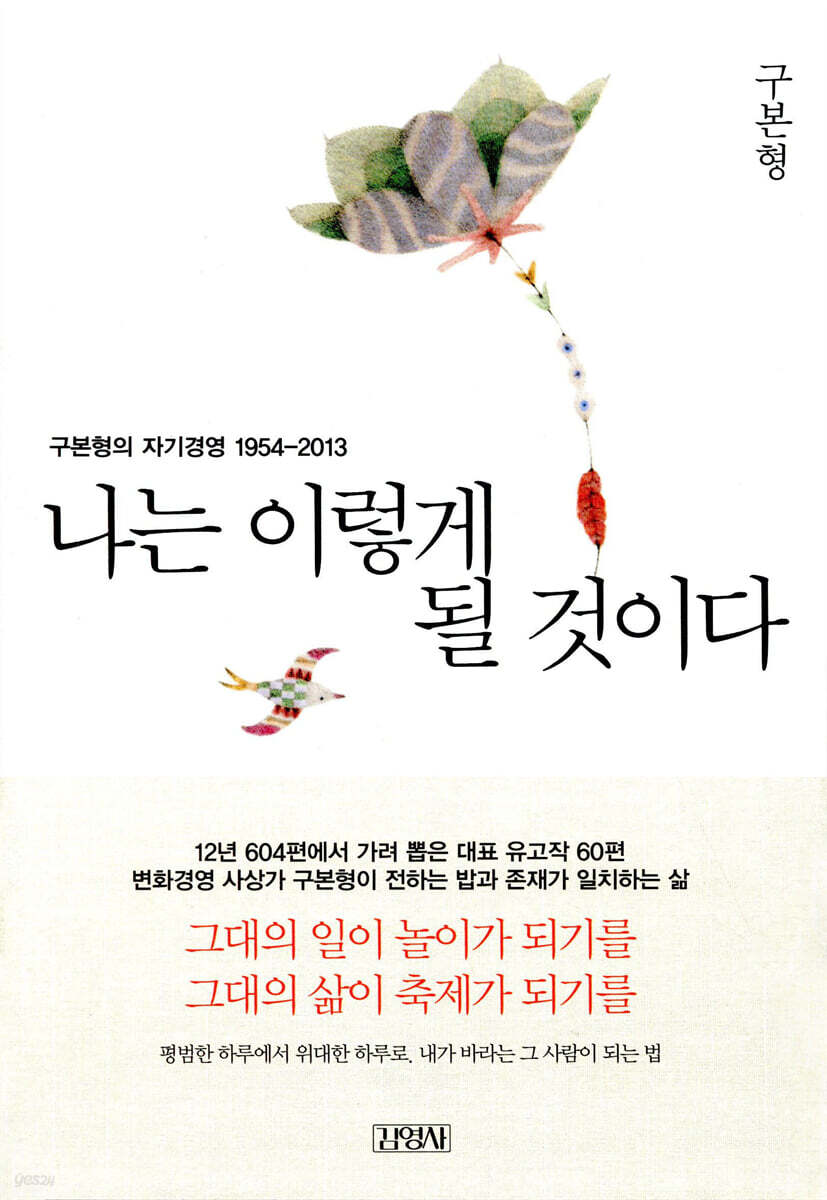
I will be like this
 |
Description
Book Introduction
How to become the person you want to be
This is Koo Bon-hyung's final autobiography of self-revolution, containing the spectrum of life skills and philosophy, thoughts and reading, research and experimentation that he dreamed and designed.
This book contains his representative works on change management, written from 2002, when he was most active in writing, lecturing, and teaching, until his death in 2013.
Survival-of-the-fittest changes forced by the environment are only half the process of change and are not pleasant.
The other half of change is the ‘expression of existence.’
To us, who are always hesitating, standing between these 'two changes', Koo Bon-hyung presents a true signpost of change.
"I Will Become Like This" is a collection of 60 selected from the 604 articles he left behind under the title "Koo Bon-hyung's Column."
From how to find self-confidence, the wisdom to elevate life to art, to how to use the textbook called "I," to how to align work and life, to the techniques to elevate life to the level of art, this book is packed with lessons in change management for those seeking a new path in life.
He was fascinated by the greatness that resided in ordinary people, and he was fascinated by the potential of ordinary people to live great lives by drawing out that greatness in their own lives.
He was a symbol of self-revolution for those who dreamed of change, showing them how to live a life that was truly their own by discovering the talent hidden deep within them by God.
Through this book, you will be able to hear a profound message for those who dream of change.
This is Koo Bon-hyung's final autobiography of self-revolution, containing the spectrum of life skills and philosophy, thoughts and reading, research and experimentation that he dreamed and designed.
This book contains his representative works on change management, written from 2002, when he was most active in writing, lecturing, and teaching, until his death in 2013.
Survival-of-the-fittest changes forced by the environment are only half the process of change and are not pleasant.
The other half of change is the ‘expression of existence.’
To us, who are always hesitating, standing between these 'two changes', Koo Bon-hyung presents a true signpost of change.
"I Will Become Like This" is a collection of 60 selected from the 604 articles he left behind under the title "Koo Bon-hyung's Column."
From how to find self-confidence, the wisdom to elevate life to art, to how to use the textbook called "I," to how to align work and life, to the techniques to elevate life to the level of art, this book is packed with lessons in change management for those seeking a new path in life.
He was fascinated by the greatness that resided in ordinary people, and he was fascinated by the potential of ordinary people to live great lives by drawing out that greatness in their own lives.
He was a symbol of self-revolution for those who dreamed of change, showing them how to live a life that was truly their own by discovering the talent hidden deep within them by God.
Through this book, you will be able to hear a profound message for those who dream of change.
- You can preview some of the book's contents.
Preview
index
This is what will happen to me
1.
Spring - Where the Heart Flows
Manage the brightness
Pleasure leads to pleasure
Always think about one or two things
The person I want
One way to read a book
Business card with a dream
Live as if you're going to die tomorrow
On the fear of change
Koo Bon-hyung's Thought Exploration 1: A Person I've Never Been
When we jump
2.
Summer - Beautiful Definition
Self-employed person
Was your vacation beautiful?
Forty, still the peak of the hot summer
If there is no margin
Wisdom to live well in your 40s
The miracle of boredom
The most beautiful business in the world
Koo Bon-hyung's Thought Exploration 2: You Can't Find It Without Leaving
Being born again
3.
Autumn - Where the Roads Split
Try as if you've never failed
A tiger living like a goat
Can a ship that has never left port be called a ship?
Go where I can be confident
I need to raise a tiger
The dimension where work becomes art
Target my problem deeply now
Gu Bon-hyung's Thought Exploration 3: Life is in Danger
Koo Bon-hyung's Thought Exploration 4: Amor Fati: Love Your Fate
We must serve people
4.
Winter - A person with a center
He was there
There is no better textbook than mine
Three Stories to Get a Good Man
Nevertheless, meet the Master
He who benefits widely will win.
Life reversal
marriage
Bless the present
Writers also wake up in the morning and go to work with their writing.
Koo Bon-hyung's Thought Exploration 5: A Dangerous Exploration
Koo Bon-hyung's Thought Exploration 6: How to Deal with Her
Father, I did a great job.
5.
Spring again, and poetry
I want to start again
Suddenly I stretched my back and looked at the stars
My flower will bloom once too
Love is
How to Market Me
The project that gave birth to me
The unity of food and existence
The path I take is 'my path'
Gu Bon-hyung's Thought Exploration 7ㆍLet's go to Africa, the pure humanity
Back to Boyhood
I don't have any
Compiling the writings left behind by the teacher
Remembering Koo Bon-hyung
1.
Spring - Where the Heart Flows
Manage the brightness
Pleasure leads to pleasure
Always think about one or two things
The person I want
One way to read a book
Business card with a dream
Live as if you're going to die tomorrow
On the fear of change
Koo Bon-hyung's Thought Exploration 1: A Person I've Never Been
When we jump
2.
Summer - Beautiful Definition
Self-employed person
Was your vacation beautiful?
Forty, still the peak of the hot summer
If there is no margin
Wisdom to live well in your 40s
The miracle of boredom
The most beautiful business in the world
Koo Bon-hyung's Thought Exploration 2: You Can't Find It Without Leaving
Being born again
3.
Autumn - Where the Roads Split
Try as if you've never failed
A tiger living like a goat
Can a ship that has never left port be called a ship?
Go where I can be confident
I need to raise a tiger
The dimension where work becomes art
Target my problem deeply now
Gu Bon-hyung's Thought Exploration 3: Life is in Danger
Koo Bon-hyung's Thought Exploration 4: Amor Fati: Love Your Fate
We must serve people
4.
Winter - A person with a center
He was there
There is no better textbook than mine
Three Stories to Get a Good Man
Nevertheless, meet the Master
He who benefits widely will win.
Life reversal
marriage
Bless the present
Writers also wake up in the morning and go to work with their writing.
Koo Bon-hyung's Thought Exploration 5: A Dangerous Exploration
Koo Bon-hyung's Thought Exploration 6: How to Deal with Her
Father, I did a great job.
5.
Spring again, and poetry
I want to start again
Suddenly I stretched my back and looked at the stars
My flower will bloom once too
Love is
How to Market Me
The project that gave birth to me
The unity of food and existence
The path I take is 'my path'
Gu Bon-hyung's Thought Exploration 7ㆍLet's go to Africa, the pure humanity
Back to Boyhood
I don't have any
Compiling the writings left behind by the teacher
Remembering Koo Bon-hyung
Into the book
I am a planet navigating this universe.
Countless other stars are the people I meet.
Man resembles the universe.
I too follow the laws of the universe.
There is light and darkness in the universe.
Darkness is my weakness, my problem, my mistake and my wound.
Brightness is my strength, my success, my admiration and my joy in life.
I am the brightness that embraces darkness.
The first thing I need to do is spread my light.
Instead of erasing darkness, we must first increase brightness.
This is my strategy.
---pp.28~29
When you find an open door, a place where you can best use what you have, you have to fall into that task.
It's not just for fame or money.
Because it is a calling.
One day, when something resonates with you and you feel a trembling sensation, enter that door and that path.
You must not doubt.
You have to abandon everything and go that way.
That is self-revolution.
I shout.
“When you dream, dream impossible dreams as if you would live forever.
But when you put that dream into practice, live as if there is no tomorrow, as if you will die today.” ---p.51
Enjoy the physical limitations of 'here and now'.
The way to enjoy the short lifespan of the body is to live in the present moment.
The short lifespan of this body, the very fact that we can only live for a short time, makes us all the more beautiful.
Did you enjoy your summer vacation? Did you feel the aliveness of the "here and now" that was given to you? ---p.83
Compete with your past.
Competition with others always makes us uncomfortable.
But competing with your past is a way to improve yourself without making enemies.
If you win, you can rejoice in yourself, hurt no one, and receive praise from everyone.
The hardest battle is with yourself, and the most worthwhile progress is becoming better than you were yesterday.
There is no such thing as a lucky victory as having no enemies and many followers.
---p.117
Focus on one thing.
This is the foundation of management: ‘selection and concentration.’
Whatever you choose at this time, it must pursue artistic realm.
Art is making things better.
Art transcends necessity.
We must strive for perfection, the ultimate goal.
Then, whatever it is, that person becomes an artist in that field.
Art is the most splendid experience of transformation.
Countless other stars are the people I meet.
Man resembles the universe.
I too follow the laws of the universe.
There is light and darkness in the universe.
Darkness is my weakness, my problem, my mistake and my wound.
Brightness is my strength, my success, my admiration and my joy in life.
I am the brightness that embraces darkness.
The first thing I need to do is spread my light.
Instead of erasing darkness, we must first increase brightness.
This is my strategy.
---pp.28~29
When you find an open door, a place where you can best use what you have, you have to fall into that task.
It's not just for fame or money.
Because it is a calling.
One day, when something resonates with you and you feel a trembling sensation, enter that door and that path.
You must not doubt.
You have to abandon everything and go that way.
That is self-revolution.
I shout.
“When you dream, dream impossible dreams as if you would live forever.
But when you put that dream into practice, live as if there is no tomorrow, as if you will die today.” ---p.51
Enjoy the physical limitations of 'here and now'.
The way to enjoy the short lifespan of the body is to live in the present moment.
The short lifespan of this body, the very fact that we can only live for a short time, makes us all the more beautiful.
Did you enjoy your summer vacation? Did you feel the aliveness of the "here and now" that was given to you? ---p.83
Compete with your past.
Competition with others always makes us uncomfortable.
But competing with your past is a way to improve yourself without making enemies.
If you win, you can rejoice in yourself, hurt no one, and receive praise from everyone.
The hardest battle is with yourself, and the most worthwhile progress is becoming better than you were yesterday.
There is no such thing as a lucky victory as having no enemies and many followers.
---p.117
Focus on one thing.
This is the foundation of management: ‘selection and concentration.’
Whatever you choose at this time, it must pursue artistic realm.
Art is making things better.
Art transcends necessity.
We must strive for perfection, the ultimate goal.
Then, whatever it is, that person becomes an artist in that field.
Art is the most splendid experience of transformation.
---p.163
Publisher's Review
A representative posthumous work that shows the entire life and thoughts of change management thinker Koo Bon-hyung.
60 selected from 604 episodes in 12 years.
The art of living that matches the food and existence he preaches
One day, an email arrived to a man who had applied for a research fellowship at the Koo Bon-hyung Change Management Research Institute but was rejected.
The person who contacted me to meet was Koo Bon-hyung.
Gu Bon-hyung bought a bowl of maesaengi-guk for the man who went to the meeting place wondering, "Why would he ask to see the person who fell?"
After seeing the part in the application that said, "I've been struggling my whole life and haven't had a bowl of maesaengi soup in the winter," I asked to meet up with him so I could buy him a bowl of soup.
This little thing left a deep impression on him.
"'When have I ever spent time and money on someone who has nothing to do with me? I live in this world with people who possess such warmth.' With a bowl of maesaengiguk, my somewhat cynical self began to view the world with a warmer perspective." (From the 'Memorial Bulletin Board on the Change Management Research Institute' website, pp. 2-3)
Koo Bon-hyung's business card reads, "Change Management Expert."
It's the name of his self-proclaimed profession that supported him when he left his job at age 46 and needed his own identity.
In his mid-fifties, he called himself a "change management thinker."
The goal is to evolve from a literal technical expert to a thinker who incorporates the philosophy and thoughts on change into his daily life.
He wrote about his later appearance:
“It may be possible, but I want to die with the name ‘poet of change management.’
Poetry requires the sparkle and leap of youth, so perhaps it would be difficult to keep up with its brilliant glide and creativity.
But you can live like a poet.
Can't we live beautifully like poetry?
“It will be possible to interact more with nature, laugh and chat more with young people, and walk freely without attachment to possessions.” (pp. 256-257)
He learned from all things in life, wrote, and spread beautiful influences, and passed away in April 2013 at the age of 59.
This book is a collection of 60 selected from among the 604 articles he wrote under the title “Gu Bon-hyung Column.”
This book contains his representative works that best capture the spectrum of his reading, research, thoughts, and philosophy spanning approximately 12 years from 2002 to 2013, when he was actively writing, lecturing, and teaching.
From how to find self-confidence, the wisdom to elevate life to art, to how to use the textbook called "I," to how to align work and life, to the techniques to elevate life to the level of art, this book is packed with lessons in change management for those seeking a new path in life.
He was a symbol of self-revolution for those who dreamed of change, showing them how to live a life that was truly their own by discovering the talent hidden deep within them by God.
This book is a collection of representative thoughts from the author's long journey.
Discover your own temperament and talents.
In times of uncertainty and anxiety, there is no one else to trust and rely on but yourself.
Therefore, nothing is more important than information about yourself.
You need to figure out what you aspire to and what you are good at.
You must solve the mystery and puzzle that is yourself.
You cannot specialize without leveraging this inner asset.
(Pages 119-120)
What kind of work do you want to create with the material called ‘me’?
For those who dream of work as play and life as a festival
A declaration of self-revolution and a concrete guide to implementation
When planning your life, approach it with a long-term perspective as if you will live forever, and when putting it into practice, cling to it fiercely as if today were your last day.
And cast the spell in your own language with conviction.
My favorite spell for the average person is this one.
“My flower will bloom someday.” It could be now, or it could be a few years later.
Everyone will be able to stand in the middle of that podium at least once before they die.
(Pages 264-265)
Koo Bon-hyung says, 'Change is the subject of unhappy people.'
Because change begins with the unfortunate awareness of the gap between ‘who I am now’ and ‘who I want to be.’
Only desperate people who cannot stand the gap between their 'real self' and their 'dream self' choose this path.
This work of change, which requires a lot of energy, is fueled by creative hatred of oneself.
The reason change is attractive is because it is a journey towards becoming ‘the person I want to be.’
Survival-of-the-fittest changes forced by the environment are only half the process of change and are not pleasant.
The other half of change is the ‘expression of existence.’
Living your true self according to your potential, this voluntary change is a pleasant process.
To us, who are always hesitating between these two changes in our daily lives, Koo Bon-hyung presents a true signpost for change.
There are difficult times in life.
Enjoy the darkness.
Have a dream of becoming a star someday.
Draw yourself shining brighter in the darkness someday.
Find your light where there is no vision.
Solve the puzzle of yourself.
Find your strengths and focus on them.
Always ask yourself questions, remembering that finding yourself is the greatest project of your life.
'What kind of work would you like to create using me as a material?'
Experiment with yourself in your daily life.
Test your strengths through hardships.
Find a moment in your life when you can live without doing the thing you hate the most.
There are many things that you have to try to realize your own strength.
Things that just linger in your head often become clearer when you confront them.
Just like picking out rice from a mixed grain of rice and stones, don't be discouraged by the difficult task and sit down.
And then face them one by one and pick them out.
One by one, another of your strengths.......
And create your own way through your strengths.
In difficult times, just living becomes a great struggle.
Let the darkness shine through you.
(From Koo Bon-hyung's "Star")
Koo Bon-hyung is fascinated by the greatness that lives among ordinary people.
We are immersed in the potential of ordinary people to live extraordinary lives by unleashing the greatness within their own lives.
He was a man who existed to witness the great moment when ordinary, humble people one day rise to their feet.
And I wanted to be one of them.
He said that being there when those insignificant things bloomed into flowers was the most beautiful scenery his job could give him.
"What keeps us trapped in the tedious routine and repetitive lethargy? Why can't we live our lives like poetry?" Self-management is leadership, where ordinary individuals lead themselves to extraordinary, great heights.
Leadership is about leading yourself first before it becomes leadership for others.
Only those who can give birth to themselves can become themselves and shine on their own.
(Page 278)
From an ordinary day to a great day.
How to become the person you want to be
“There is a path to excellence, no matter which way you go.”
I want everyone to have their own story, a myth in which they are the main character.
Every morning I train myself.
You wake up in the morning and start dreaming of something impossible.
Sometimes it's an extension of a dream I had yesterday, and sometimes it's another dream that suddenly pops into my head.
Anyway, I train myself to believe in something unreal rather than reality.
I practice creating a world where I can do whatever I want. (p. 155)
The starting point for everything for Koo Bon-hyung was ‘himself.’
Whenever a new idea came to me, I first experimented with it on myself.
And if it's useful, we added versatility so that others can apply it too.
'Put the brakes on your mindless daily routine by stopping the food supply, invest two hours in yourself no matter what, compete with your yesterday's self rather than others, be recognized for your expertise by writing a book, the life of an office worker is a fatal flaw, live a life like poetry... ' Methodologies like this were born from experimenting with oneself as a tool.
The experiment continued.
He has been focusing on 'myth management' for the past three years and opened 'Creative Salon 9', an offline cafe where research activities can be concentrated.
But then suddenly the road ended.
But when we look at what happened after he passed away, we can see that it was by no means the end.
Although the teacher's departure was a shock, each of the students at the Change Management Research Institute was reborn as a 'Little Gu Bon-hyung.'
He is carrying the seeds sown by his teacher and voluntarily contributing to the vision of the institute.
By becoming more beautiful than yesterday, a journey has begun to help others become more beautiful than yesterday.
Koo Bon-hyung said that this is one of his favorite sayings.
“A dancer must dance every day, a painter must draw every day, and a writer must write every day.
“Just as a swordsman must train every day or his life will be in danger if he does not train every day, he must train every day.” (p. 121)
His life and books are told to readers.
To laugh a lot and admire a lot.
“A life that is somehow managed is bound to be sticky.
Worrying doesn't make the future brighter.
If it rains, you can get wet, and if it's sunny, you can walk in the sunlight.
Such trips are full of fun and enjoyable stories.
The more different stories you create with other people, the more special that love becomes.
Don't let things that aren't love kill love.
“The things that once baffled us will one day turn out to be the pillars that supported our lives.”
He says.
There are many paths in life.
Explore for yourself, put everything on the line, but don't be disappointed if it doesn't work out.
If a different path appears in front of you, don't be sad, just take the new path.
No matter which way you go, there is a path to excellence.
I imagine my last days very cheerfully.
I hope that day will be a celebration.
I think of a festival that is the most joyful, the most poetic, the most musical, and the most carefree about tomorrow.
The most dazzlingly beautiful things are fleeting.
That must be why flowers are beautiful.
The immersion that burns everything out in an instant, and the regret that quickly disappears, the one-time nature of life is what makes us shine.
Someday I plan to write 'Poet of Change Management' on my business card.
I don't know when.
Maybe that name will be my tombstone.
I hope my life is a poem with countless resonances and echoes.
60 selected from 604 episodes in 12 years.
The art of living that matches the food and existence he preaches
One day, an email arrived to a man who had applied for a research fellowship at the Koo Bon-hyung Change Management Research Institute but was rejected.
The person who contacted me to meet was Koo Bon-hyung.
Gu Bon-hyung bought a bowl of maesaengi-guk for the man who went to the meeting place wondering, "Why would he ask to see the person who fell?"
After seeing the part in the application that said, "I've been struggling my whole life and haven't had a bowl of maesaengi soup in the winter," I asked to meet up with him so I could buy him a bowl of soup.
This little thing left a deep impression on him.
"'When have I ever spent time and money on someone who has nothing to do with me? I live in this world with people who possess such warmth.' With a bowl of maesaengiguk, my somewhat cynical self began to view the world with a warmer perspective." (From the 'Memorial Bulletin Board on the Change Management Research Institute' website, pp. 2-3)
Koo Bon-hyung's business card reads, "Change Management Expert."
It's the name of his self-proclaimed profession that supported him when he left his job at age 46 and needed his own identity.
In his mid-fifties, he called himself a "change management thinker."
The goal is to evolve from a literal technical expert to a thinker who incorporates the philosophy and thoughts on change into his daily life.
He wrote about his later appearance:
“It may be possible, but I want to die with the name ‘poet of change management.’
Poetry requires the sparkle and leap of youth, so perhaps it would be difficult to keep up with its brilliant glide and creativity.
But you can live like a poet.
Can't we live beautifully like poetry?
“It will be possible to interact more with nature, laugh and chat more with young people, and walk freely without attachment to possessions.” (pp. 256-257)
He learned from all things in life, wrote, and spread beautiful influences, and passed away in April 2013 at the age of 59.
This book is a collection of 60 selected from among the 604 articles he wrote under the title “Gu Bon-hyung Column.”
This book contains his representative works that best capture the spectrum of his reading, research, thoughts, and philosophy spanning approximately 12 years from 2002 to 2013, when he was actively writing, lecturing, and teaching.
From how to find self-confidence, the wisdom to elevate life to art, to how to use the textbook called "I," to how to align work and life, to the techniques to elevate life to the level of art, this book is packed with lessons in change management for those seeking a new path in life.
He was a symbol of self-revolution for those who dreamed of change, showing them how to live a life that was truly their own by discovering the talent hidden deep within them by God.
This book is a collection of representative thoughts from the author's long journey.
Discover your own temperament and talents.
In times of uncertainty and anxiety, there is no one else to trust and rely on but yourself.
Therefore, nothing is more important than information about yourself.
You need to figure out what you aspire to and what you are good at.
You must solve the mystery and puzzle that is yourself.
You cannot specialize without leveraging this inner asset.
(Pages 119-120)
What kind of work do you want to create with the material called ‘me’?
For those who dream of work as play and life as a festival
A declaration of self-revolution and a concrete guide to implementation
When planning your life, approach it with a long-term perspective as if you will live forever, and when putting it into practice, cling to it fiercely as if today were your last day.
And cast the spell in your own language with conviction.
My favorite spell for the average person is this one.
“My flower will bloom someday.” It could be now, or it could be a few years later.
Everyone will be able to stand in the middle of that podium at least once before they die.
(Pages 264-265)
Koo Bon-hyung says, 'Change is the subject of unhappy people.'
Because change begins with the unfortunate awareness of the gap between ‘who I am now’ and ‘who I want to be.’
Only desperate people who cannot stand the gap between their 'real self' and their 'dream self' choose this path.
This work of change, which requires a lot of energy, is fueled by creative hatred of oneself.
The reason change is attractive is because it is a journey towards becoming ‘the person I want to be.’
Survival-of-the-fittest changes forced by the environment are only half the process of change and are not pleasant.
The other half of change is the ‘expression of existence.’
Living your true self according to your potential, this voluntary change is a pleasant process.
To us, who are always hesitating between these two changes in our daily lives, Koo Bon-hyung presents a true signpost for change.
There are difficult times in life.
Enjoy the darkness.
Have a dream of becoming a star someday.
Draw yourself shining brighter in the darkness someday.
Find your light where there is no vision.
Solve the puzzle of yourself.
Find your strengths and focus on them.
Always ask yourself questions, remembering that finding yourself is the greatest project of your life.
'What kind of work would you like to create using me as a material?'
Experiment with yourself in your daily life.
Test your strengths through hardships.
Find a moment in your life when you can live without doing the thing you hate the most.
There are many things that you have to try to realize your own strength.
Things that just linger in your head often become clearer when you confront them.
Just like picking out rice from a mixed grain of rice and stones, don't be discouraged by the difficult task and sit down.
And then face them one by one and pick them out.
One by one, another of your strengths.......
And create your own way through your strengths.
In difficult times, just living becomes a great struggle.
Let the darkness shine through you.
(From Koo Bon-hyung's "Star")
Koo Bon-hyung is fascinated by the greatness that lives among ordinary people.
We are immersed in the potential of ordinary people to live extraordinary lives by unleashing the greatness within their own lives.
He was a man who existed to witness the great moment when ordinary, humble people one day rise to their feet.
And I wanted to be one of them.
He said that being there when those insignificant things bloomed into flowers was the most beautiful scenery his job could give him.
"What keeps us trapped in the tedious routine and repetitive lethargy? Why can't we live our lives like poetry?" Self-management is leadership, where ordinary individuals lead themselves to extraordinary, great heights.
Leadership is about leading yourself first before it becomes leadership for others.
Only those who can give birth to themselves can become themselves and shine on their own.
(Page 278)
From an ordinary day to a great day.
How to become the person you want to be
“There is a path to excellence, no matter which way you go.”
I want everyone to have their own story, a myth in which they are the main character.
Every morning I train myself.
You wake up in the morning and start dreaming of something impossible.
Sometimes it's an extension of a dream I had yesterday, and sometimes it's another dream that suddenly pops into my head.
Anyway, I train myself to believe in something unreal rather than reality.
I practice creating a world where I can do whatever I want. (p. 155)
The starting point for everything for Koo Bon-hyung was ‘himself.’
Whenever a new idea came to me, I first experimented with it on myself.
And if it's useful, we added versatility so that others can apply it too.
'Put the brakes on your mindless daily routine by stopping the food supply, invest two hours in yourself no matter what, compete with your yesterday's self rather than others, be recognized for your expertise by writing a book, the life of an office worker is a fatal flaw, live a life like poetry... ' Methodologies like this were born from experimenting with oneself as a tool.
The experiment continued.
He has been focusing on 'myth management' for the past three years and opened 'Creative Salon 9', an offline cafe where research activities can be concentrated.
But then suddenly the road ended.
But when we look at what happened after he passed away, we can see that it was by no means the end.
Although the teacher's departure was a shock, each of the students at the Change Management Research Institute was reborn as a 'Little Gu Bon-hyung.'
He is carrying the seeds sown by his teacher and voluntarily contributing to the vision of the institute.
By becoming more beautiful than yesterday, a journey has begun to help others become more beautiful than yesterday.
Koo Bon-hyung said that this is one of his favorite sayings.
“A dancer must dance every day, a painter must draw every day, and a writer must write every day.
“Just as a swordsman must train every day or his life will be in danger if he does not train every day, he must train every day.” (p. 121)
His life and books are told to readers.
To laugh a lot and admire a lot.
“A life that is somehow managed is bound to be sticky.
Worrying doesn't make the future brighter.
If it rains, you can get wet, and if it's sunny, you can walk in the sunlight.
Such trips are full of fun and enjoyable stories.
The more different stories you create with other people, the more special that love becomes.
Don't let things that aren't love kill love.
“The things that once baffled us will one day turn out to be the pillars that supported our lives.”
He says.
There are many paths in life.
Explore for yourself, put everything on the line, but don't be disappointed if it doesn't work out.
If a different path appears in front of you, don't be sad, just take the new path.
No matter which way you go, there is a path to excellence.
I imagine my last days very cheerfully.
I hope that day will be a celebration.
I think of a festival that is the most joyful, the most poetic, the most musical, and the most carefree about tomorrow.
The most dazzlingly beautiful things are fleeting.
That must be why flowers are beautiful.
The immersion that burns everything out in an instant, and the regret that quickly disappears, the one-time nature of life is what makes us shine.
Someday I plan to write 'Poet of Change Management' on my business card.
I don't know when.
Maybe that name will be my tombstone.
I hope my life is a poem with countless resonances and echoes.
GOODS SPECIFICS
- Date of issue: September 5, 2013
- Page count, weight, size: 304 pages | 436g | 138*200*30mm
- ISBN13: 9788934964315
- ISBN10: 8934964316
You may also like
카테고리
korean


korean

![GQ KOREA Mark (Monthly): December [2025]](http://librairie.coreenne.fr/cdn/shop/files/8ef265dbbfbf186523ed75ba7319009d.jpg?v=1765340328&width=3840)


