

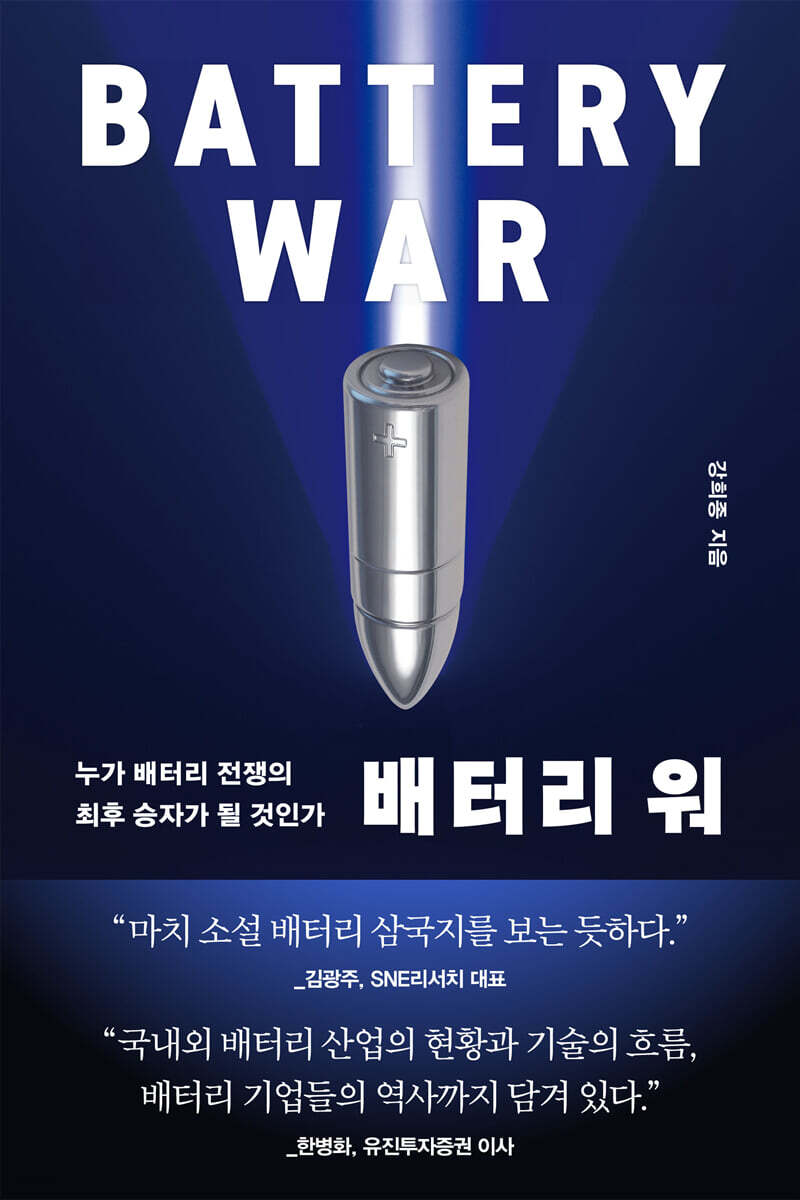
Battery War
 |
Description
Book Introduction
Everything about the battery industry, technology, and investment at the heart of the Fourth Industrial Revolution!
Who will ultimately emerge victorious in the future war for wealth and security hegemony?
Batteries have become essential not only for various devices such as smartphones, but also for electric vehicles, unmanned aerial vehicles (drones), humanoid robots, AI data centers, and spacecraft, making them essential in everyday life and cutting-edge industries.
If semiconductors are the brain of the Fourth Industrial Revolution and displays are its eyes, then batteries are the strategic industry that corresponds to its heart.
Additionally, batteries are an essential cutting-edge technology in the era of climate crisis and energy transition.
Therefore, falling behind in this area could have fatal consequences for the national economy and security.
Accordingly, each country is staking its life on strengthening its battery industry and technological capabilities.
This book provides almost everything about the industry, technology, history, and investment in batteries, which are considered one of the core technologies of the Fourth Industrial Revolution.
It provides an exciting look at the fierce global battery market competition, led by Korea, China, and Japan, with the US and Europe joining in.
Who will ultimately win the battery war over future wealth and security hegemony?
This book will serve as a clear guide to finding that direction.
Who will ultimately emerge victorious in the future war for wealth and security hegemony?
Batteries have become essential not only for various devices such as smartphones, but also for electric vehicles, unmanned aerial vehicles (drones), humanoid robots, AI data centers, and spacecraft, making them essential in everyday life and cutting-edge industries.
If semiconductors are the brain of the Fourth Industrial Revolution and displays are its eyes, then batteries are the strategic industry that corresponds to its heart.
Additionally, batteries are an essential cutting-edge technology in the era of climate crisis and energy transition.
Therefore, falling behind in this area could have fatal consequences for the national economy and security.
Accordingly, each country is staking its life on strengthening its battery industry and technological capabilities.
This book provides almost everything about the industry, technology, history, and investment in batteries, which are considered one of the core technologies of the Fourth Industrial Revolution.
It provides an exciting look at the fierce global battery market competition, led by Korea, China, and Japan, with the US and Europe joining in.
Who will ultimately win the battery war over future wealth and security hegemony?
This book will serve as a clear guide to finding that direction.
- You can preview some of the book's contents.
Preview
index
Recommendation
Song Ho-jun (CEO of Ecopro), Park Tae-seong (Executive Vice Chairman of the Korea Battery Industry Association), Kim Gwang-ju (CEO of SNE Research), Kim Je-young (CTO of LG Energy Solution), Kim Yoon-chang (Director of Samsung SDI Research), Park Ki-soo (Director of SK On Future Technology Institute), Lee Sang-young (Professor of Chemical and Biological Engineering, Yonsei University), Jang Jeong-hoon (Senior Research Fellow, Samsung Securities), and Han Byeong-hwa (Director, Eugene Investment & Securities)
preface
Part 1: The Battery War: The Front Lines Widen
Chapter 1: Battery is not included
China's Electric Vehicle Flood | From Climate Villain to Green Beneficiary | Batteries Expanding, From Robots to Spaceships
Chapter 2: On the surface, "Let's control prices," but the real intention is "Let's control China."
The IRA's Appearance | Historic Legislation | "Chinese Companies Are Overseas Concerns" | Operation to Encircle China's Key Minerals
Chapter 3: Europe to put tags on batteries
Even Batteries Need Passports | Lessons from the COVID-19 Pandemic and the Russo-Ukrainian War | Xinjiang Uyghur Autonomous Region, Solar Energy, and Secondary Batteries
Chapter 4: Trump Risk
The Clock Runs Backward | The IRA Goes, the OBBBA Comes | Fossil Fuel's Old Friend Becomes Energy Czar | The Fall of "First Buddy" Elon Musk
Chapter 5: Opportunities and Crises
K-Batteries: A Key to the De-Chinese Supply Chain | Revisiting Europe | Batteries, Now a Service: From BaaS to EaaS | Eco-Friendly Cars? Now, Autonomous Vehicles!
Part 2: K-Batteries Rise Above the US and Japan
Chapter 6: The Beginning of Lithium Secondary Batteries
The Butterfly Effect of the Oil Shock | Ford Inspires Giants | Young Scientist Solves the Final Puzzle
Chapter 7: The Rise and Fall of Japan's Secondary Battery Industry
The world's first lithium-metal secondary battery | Sony, the first to commercialize, failed to win a Nobel Prize | Establishing itself as a trend | The fall of Sanyo Electric | Thank you! Tesla! Panasonic's comeback | Sony and EcoPro's relationship | Japanese battery technology transferred to China
Chapter 8: The Birth of K-Batteries
Korean Companies Surpassing Japan | Chairman Koo Bon-moo and Samcheon Education Corps: LG Chem | From Vacuum Tubes to Batteries, a Master of Transformation: Samsung SDI | "I'll Run with You": SK | The Secrets of K-Battery Growth: Exchange Rates, Smartphones, and Electric Vehicles
Chapter 9: The Chinese Called "Battery Kings"
The Rise of China's Battery Industry | The Emergence of China's "Battery King": BYD | China's New Energy Vehicle Policy and Whitelist | The Man Known as the "King of Ningde": CATL | Xi Jinping's Political Hometown and the Thousand Talents Plan | CALB's "Sudden Appearance"
Chapter 10 Battery Three Kingdoms
The 896 Workweek and 100 Days of Struggle | K-Battery Expands Globally | No. 1, and a Turnaround | Now Performance Matters, Price Matters | Japan's Counterattack: Will It Recapture Past Glory?
Chapter 11: The US and Europe Chasing
Northvolt, Europe's shaky hope | Germany and France dream of becoming battery powerhouses | Poland and Hungary are locked in a fierce battle between Korea and China | The US: Memories of A123 Systems | From Gigafactory to StarPlus | How Chinese company Goshen entered the US market
Part 3: The Biggest Threat: China
Chapter 12: Where the World's Key Minerals Gather
We Can't Make It Without China | What Happened to Lithium, the "White Oil"? | China Dominates the Lithium Supply Chain | Nickel: A Different Class | China's Shadow Looms Over Indonesia | "Clean Nickel" or "Dirty Nickel?" | Korean Companies Investing in Nickel Mines | Graphite Needed Twice as Much as Lithium | The Difference Between Natural Graphite and Artificial Graphite | China's Dominance of the Graphite Industry | Conditions for Graphite Self-Sufficiency
Chapter 13: Chinese materials, no longer usable?
A precursor lies ahead of the cathode material | Where are precursors made? | The relationship between salt and water: electrolyte | Can we catch up with Chinese electrolytes? | Battery safety guardian: separators | Separator companies in the spotlight | The fate of separators in the all-solid-state era?
Chapter 14: The World of the Whole House
Why Aluminum is Used for the Anode and Copper for the Cathode | Fierce Competition Between Korea and China in Copper Foil | A Transformation of Cigarette Packaging | Aluminum Foil Is an Oligopoly
Chapter 15: Next-generation materials are our first
The dream of a "5-minute recharge" is just around the corner | Who's ahead in silicon anode materials? | Active material helpers, challengers | Carbon nanotubes: One layer is better than two | Batteries need adhesives too | Binders, the core technology of dry electrodes | Fluorine and EU environmental regulations
Chapter 16: Batteries, just recycle them!
The US and Europe Dream of De-China through Recycling | 3 Ways to Recycle Batteries | Recycling in the Warring States Period | The Challenges of Battery Recycling
Part 4: The Battle for Technological Hegemony
Chapter 17: Ternary or LFP?
Painful Miscalculations | The Roots of NCM | Korea, a High-Nickel Powerhouse | Why LFP Batteries Are Safer | How China Became an LFP Powerhouse | Overcoming LFP's Limitations | Korea's LFP Catch-Up
Chapter 18: Single Crystal, High Voltage, and Mid-Nickel: Will They Become the Saviors?
3 Key Words to Compete Against LFP | Reduce Nickel | Mid-Nickel: Innovation, Not Regression | Why Single-Crystal Matters | Can Mid-Nickel Compete Against LFP?
Chapter 19: Will Fire-Resistant All-Solid Materials Be a Game-Changer?
Dream Battery | Technological Challenges | Sulfide vs. Oxide | Who Will Commercialize First?
Chapter 20: Making a battery out of seawater?
Sodium-ion batteries withstand extreme cold | Weight is their biggest weakness | China leads, the West trails | Conflicting outlook
Chapter 21: A Battery-Powered Plane Appears
Lithium Metal, the Ultimate Cathode Material | 'High Wall' Dendrites and 'Bridge' Technology | Lithium Sulfur: Half-Price Batteries | What's the Shuttle Effect?
Chapter 22: The Form Factor War Is Not Over
Cylindrical vs. Square vs. Pouch | Disappearing Partitions | The Rise of the New Standard 46 Series | The 46 Series Also Represents the Three Kingdoms of Korea, China, and Japan
Chapter 23: Leading with Dry Electrodes
A Battle of Pride | A Jack of All Trades | Even Tesla Has an Unfinished Business | Dry Electrodes: Which One Has the Edge?
Chapter 24: Will Tesla Unify Charging Standards?
The biggest complaint is charging. Are electric vehicle charging stations the geese that lay the golden eggs? Charging standards vary by car and country. "300km of driving on a 5-minute charge."
Chapter 25: Breaking Through the Stagnation of Electric Vehicle Growth with ESS
A New Breakthrough: ESS | Duck Curve Solver | Countries Mandating ESS | K-Batteries: A New Trend
Part 5: The End of the Tunnel is in View
Chapter 26: The Sudden Approach of Chasm
What's Happening to Electric Vehicles? | The Tribulation Awaiting K-Batteries | Why the Electric Vehicle Chasm Has Occurred | A Korean-Only Phrase | Adding insult to injury
Chapter 27: Spring Comes Yet
Trump's tariff war and the lengthening floor | “small yard.
The Opportunity of the "High Fence" Strategy | Price Parity: The $100 Battery Price Wall | No More LFP Phobia
Chapter 28: Separating the Wise from the Wise in Battery Companies
Companies that are only floating mirages | Understanding pilots, samples, and mass production | Which batteries are used in which electric vehicles? | Where K-Batteries are born: LG Energy Solution, Samsung SDI, SK On | Exploring the battery supply chain: EcoPro, POSCO Future M, L&F
Appendix 1: How Batteries Are Made
Step 1 electrode process
90% Domestically Produced K-Battery Equipment | Like Spreading Strawberry Jam on Bread: Mixing and Coating | Baking, Pressing, and Cutting: Roll Pressing, Slitting, and Notching | Domestic and International Electrode Equipment Companies
2-step assembly process
Roll it up and fit it in a can: Winding | Z-folding/Z-stacking techniques have become the norm | Can or Pocket?
3-stage Mars process
Batteries Need Aging Too | How to Weed Out Bad Batteries | Solid-State Batteries: A Different Process
4-step pack process
Adding Value to Batteries | From Cell-to-Pack to Cell-to-Chassis
Appendix 2: The Story of Primary and Secondary Batteries: From Volta's Cell to Edison's Cell
Are cells and batteries the same thing? | Why are electron movement and current opposites? | How is voltage created? | The emergence of the 'dry cell' | "A powerful, long-lasting battery" | The first secondary battery | Edison also created a secondary battery.
Acknowledgements
main
Song Ho-jun (CEO of Ecopro), Park Tae-seong (Executive Vice Chairman of the Korea Battery Industry Association), Kim Gwang-ju (CEO of SNE Research), Kim Je-young (CTO of LG Energy Solution), Kim Yoon-chang (Director of Samsung SDI Research), Park Ki-soo (Director of SK On Future Technology Institute), Lee Sang-young (Professor of Chemical and Biological Engineering, Yonsei University), Jang Jeong-hoon (Senior Research Fellow, Samsung Securities), and Han Byeong-hwa (Director, Eugene Investment & Securities)
preface
Part 1: The Battery War: The Front Lines Widen
Chapter 1: Battery is not included
China's Electric Vehicle Flood | From Climate Villain to Green Beneficiary | Batteries Expanding, From Robots to Spaceships
Chapter 2: On the surface, "Let's control prices," but the real intention is "Let's control China."
The IRA's Appearance | Historic Legislation | "Chinese Companies Are Overseas Concerns" | Operation to Encircle China's Key Minerals
Chapter 3: Europe to put tags on batteries
Even Batteries Need Passports | Lessons from the COVID-19 Pandemic and the Russo-Ukrainian War | Xinjiang Uyghur Autonomous Region, Solar Energy, and Secondary Batteries
Chapter 4: Trump Risk
The Clock Runs Backward | The IRA Goes, the OBBBA Comes | Fossil Fuel's Old Friend Becomes Energy Czar | The Fall of "First Buddy" Elon Musk
Chapter 5: Opportunities and Crises
K-Batteries: A Key to the De-Chinese Supply Chain | Revisiting Europe | Batteries, Now a Service: From BaaS to EaaS | Eco-Friendly Cars? Now, Autonomous Vehicles!
Part 2: K-Batteries Rise Above the US and Japan
Chapter 6: The Beginning of Lithium Secondary Batteries
The Butterfly Effect of the Oil Shock | Ford Inspires Giants | Young Scientist Solves the Final Puzzle
Chapter 7: The Rise and Fall of Japan's Secondary Battery Industry
The world's first lithium-metal secondary battery | Sony, the first to commercialize, failed to win a Nobel Prize | Establishing itself as a trend | The fall of Sanyo Electric | Thank you! Tesla! Panasonic's comeback | Sony and EcoPro's relationship | Japanese battery technology transferred to China
Chapter 8: The Birth of K-Batteries
Korean Companies Surpassing Japan | Chairman Koo Bon-moo and Samcheon Education Corps: LG Chem | From Vacuum Tubes to Batteries, a Master of Transformation: Samsung SDI | "I'll Run with You": SK | The Secrets of K-Battery Growth: Exchange Rates, Smartphones, and Electric Vehicles
Chapter 9: The Chinese Called "Battery Kings"
The Rise of China's Battery Industry | The Emergence of China's "Battery King": BYD | China's New Energy Vehicle Policy and Whitelist | The Man Known as the "King of Ningde": CATL | Xi Jinping's Political Hometown and the Thousand Talents Plan | CALB's "Sudden Appearance"
Chapter 10 Battery Three Kingdoms
The 896 Workweek and 100 Days of Struggle | K-Battery Expands Globally | No. 1, and a Turnaround | Now Performance Matters, Price Matters | Japan's Counterattack: Will It Recapture Past Glory?
Chapter 11: The US and Europe Chasing
Northvolt, Europe's shaky hope | Germany and France dream of becoming battery powerhouses | Poland and Hungary are locked in a fierce battle between Korea and China | The US: Memories of A123 Systems | From Gigafactory to StarPlus | How Chinese company Goshen entered the US market
Part 3: The Biggest Threat: China
Chapter 12: Where the World's Key Minerals Gather
We Can't Make It Without China | What Happened to Lithium, the "White Oil"? | China Dominates the Lithium Supply Chain | Nickel: A Different Class | China's Shadow Looms Over Indonesia | "Clean Nickel" or "Dirty Nickel?" | Korean Companies Investing in Nickel Mines | Graphite Needed Twice as Much as Lithium | The Difference Between Natural Graphite and Artificial Graphite | China's Dominance of the Graphite Industry | Conditions for Graphite Self-Sufficiency
Chapter 13: Chinese materials, no longer usable?
A precursor lies ahead of the cathode material | Where are precursors made? | The relationship between salt and water: electrolyte | Can we catch up with Chinese electrolytes? | Battery safety guardian: separators | Separator companies in the spotlight | The fate of separators in the all-solid-state era?
Chapter 14: The World of the Whole House
Why Aluminum is Used for the Anode and Copper for the Cathode | Fierce Competition Between Korea and China in Copper Foil | A Transformation of Cigarette Packaging | Aluminum Foil Is an Oligopoly
Chapter 15: Next-generation materials are our first
The dream of a "5-minute recharge" is just around the corner | Who's ahead in silicon anode materials? | Active material helpers, challengers | Carbon nanotubes: One layer is better than two | Batteries need adhesives too | Binders, the core technology of dry electrodes | Fluorine and EU environmental regulations
Chapter 16: Batteries, just recycle them!
The US and Europe Dream of De-China through Recycling | 3 Ways to Recycle Batteries | Recycling in the Warring States Period | The Challenges of Battery Recycling
Part 4: The Battle for Technological Hegemony
Chapter 17: Ternary or LFP?
Painful Miscalculations | The Roots of NCM | Korea, a High-Nickel Powerhouse | Why LFP Batteries Are Safer | How China Became an LFP Powerhouse | Overcoming LFP's Limitations | Korea's LFP Catch-Up
Chapter 18: Single Crystal, High Voltage, and Mid-Nickel: Will They Become the Saviors?
3 Key Words to Compete Against LFP | Reduce Nickel | Mid-Nickel: Innovation, Not Regression | Why Single-Crystal Matters | Can Mid-Nickel Compete Against LFP?
Chapter 19: Will Fire-Resistant All-Solid Materials Be a Game-Changer?
Dream Battery | Technological Challenges | Sulfide vs. Oxide | Who Will Commercialize First?
Chapter 20: Making a battery out of seawater?
Sodium-ion batteries withstand extreme cold | Weight is their biggest weakness | China leads, the West trails | Conflicting outlook
Chapter 21: A Battery-Powered Plane Appears
Lithium Metal, the Ultimate Cathode Material | 'High Wall' Dendrites and 'Bridge' Technology | Lithium Sulfur: Half-Price Batteries | What's the Shuttle Effect?
Chapter 22: The Form Factor War Is Not Over
Cylindrical vs. Square vs. Pouch | Disappearing Partitions | The Rise of the New Standard 46 Series | The 46 Series Also Represents the Three Kingdoms of Korea, China, and Japan
Chapter 23: Leading with Dry Electrodes
A Battle of Pride | A Jack of All Trades | Even Tesla Has an Unfinished Business | Dry Electrodes: Which One Has the Edge?
Chapter 24: Will Tesla Unify Charging Standards?
The biggest complaint is charging. Are electric vehicle charging stations the geese that lay the golden eggs? Charging standards vary by car and country. "300km of driving on a 5-minute charge."
Chapter 25: Breaking Through the Stagnation of Electric Vehicle Growth with ESS
A New Breakthrough: ESS | Duck Curve Solver | Countries Mandating ESS | K-Batteries: A New Trend
Part 5: The End of the Tunnel is in View
Chapter 26: The Sudden Approach of Chasm
What's Happening to Electric Vehicles? | The Tribulation Awaiting K-Batteries | Why the Electric Vehicle Chasm Has Occurred | A Korean-Only Phrase | Adding insult to injury
Chapter 27: Spring Comes Yet
Trump's tariff war and the lengthening floor | “small yard.
The Opportunity of the "High Fence" Strategy | Price Parity: The $100 Battery Price Wall | No More LFP Phobia
Chapter 28: Separating the Wise from the Wise in Battery Companies
Companies that are only floating mirages | Understanding pilots, samples, and mass production | Which batteries are used in which electric vehicles? | Where K-Batteries are born: LG Energy Solution, Samsung SDI, SK On | Exploring the battery supply chain: EcoPro, POSCO Future M, L&F
Appendix 1: How Batteries Are Made
Step 1 electrode process
90% Domestically Produced K-Battery Equipment | Like Spreading Strawberry Jam on Bread: Mixing and Coating | Baking, Pressing, and Cutting: Roll Pressing, Slitting, and Notching | Domestic and International Electrode Equipment Companies
2-step assembly process
Roll it up and fit it in a can: Winding | Z-folding/Z-stacking techniques have become the norm | Can or Pocket?
3-stage Mars process
Batteries Need Aging Too | How to Weed Out Bad Batteries | Solid-State Batteries: A Different Process
4-step pack process
Adding Value to Batteries | From Cell-to-Pack to Cell-to-Chassis
Appendix 2: The Story of Primary and Secondary Batteries: From Volta's Cell to Edison's Cell
Are cells and batteries the same thing? | Why are electron movement and current opposites? | How is voltage created? | The emergence of the 'dry cell' | "A powerful, long-lasting battery" | The first secondary battery | Edison also created a secondary battery.
Acknowledgements
main
Detailed image

Into the book
On the international stage, the gap between countries with battery technology and those without will be vast.
Just as major countries are competing for dominance in semiconductor technology, the world is also beginning to wage war over battery supremacy.
China is pouring hundreds of trillions of won into its battery industry, seeking to monopolize the ecosystem.
In the free world, only South Korea and Japan have the capacity and technology to stand up to China.
By winning the battery war, Korea will be able to prove its worth to the world, just as it did in the semiconductor war.
--- p.25, from the “Preface”
At some point, countries around the world began to recognize batteries as directly linked to national security.
This is because we realized that batteries are absolutely necessary to achieve carbon neutrality, whether through electric vehicles or ESS, and that securing a stable supply of batteries is an urgent task.
The United States, which has accelerated the adoption of electric vehicles since the inauguration of the Joe Biden administration, recognized its lack of raw materials and manufacturing capabilities, and enacted the IRA. In a February 2022 article titled "How a Battery Shortage Could Threaten US National Security," CNN warned of the vulnerability of the US in the electric vehicle industry and the threat posed by China. Bob Galyen, who led battery development at GM and CATL, told the outlet, "We don't have the raw materials or the manufacturing capabilities. We don't have enough batteries to support a bad country in a war."
Several scholars have raised the possibility that China could weaponize the batteries needed for electric vehicles and the key minerals needed to manufacture them.
--- p.46, from “Chapter 1: Don’t Look at the Battery”
The U.S. government, which had been delaying issuing guidelines for overseas organizations of concern, finally released the relevant information in December 2023.
The guidelines announced by the U.S. were more stringent than the industry had expected.
The United States has made clear its intention to contain China in the electric vehicle supply chain through its guidelines for overseas concern organizations.
First, the U.S. government designated foreign companies as entities of foreign concern if they were established, located, or had their principal place of business in the jurisdiction of a country of concern.
The countries of concern here refer to China, Russia, Iran, and North Korea.
Since Russia, Iran, and North Korea have a small share of the electric vehicle battery supply chain, the country of concern was effectively China.
--- p.59-60, from Chapter 2, “Let’s control prices” on the surface, but the real intention is “Let’s control China”
The elimination of the electric vehicle subsidy under the IRA was subsequently passed into law in Congress.
Republicans have developed the "One Big Beautiful Bill Act," or OBBBA, a package of tax cuts, border security enhancements, and energy-related measures.
This bill, which contained large-scale tax cuts, also included provisions to reduce various benefits of IRAs.
--- p.86, from “Chapter 4 Trump Risk”
In particular, the introduction of the Prohibited Foreign Entity (PFE) regulation for advanced manufacturing production tax credits under the OBBBA has been advantageous for Korean companies.
If you receive support exceeding a certain percentage from a prohibited foreign organization, you will not be eligible for the advanced manufacturing production tax credit starting in 2027.
The prohibited foreign entities, which are complexly defined in the law, actually meant Chinese companies.
--- p.88, from “Chapter 4 Trump Risk”
What will happen if the Trump administration strengthens its policy of de-China supply chains in its second term? Korean battery companies, which rely heavily on Chinese minerals and materials, could also be affected in the short term.
However, if Korean battery companies diversify their supply chains in the long term, this could be a significant opportunity.
Korea is considered to be virtually the only country capable of replacing China across the entire value chain, including battery mineral processing, materials, battery manufacturing, and electric vehicles.
If Korea can establish itself as a reliable, core partner in the U.S. electric vehicle supply chain, it can overcome the crisis.
--- p.101, from “Chapter 5: Crisis and Opportunity”
It may seem difficult at first glance to understand why ExxonMobil, an oil company, would invest so quickly and boldly in batteries, a competing technology to fossil fuels.
There were two major factors at play here.
The first was the oil depletion theory that was widely spread in the scientific community in the 1960s, and the second was the oil crisis.
What these two have in common is the fear of the absence of oil.
--- p.122, from “Chapter 6: The Beginning of Lithium Secondary Batteries”
Sony's first lithium-ion battery was first installed in an 8mm camcorder called the CCD-TR1.
When lithium-ion batteries, boasting higher energy density, stability, and durability than existing secondary batteries, appeared, the world quickly recognized the value of this new product.
It began to be adopted not only in camcorders but also in portable electronic devices such as CD players.
Lithium-ion batteries began to spread rapidly in the 1990s with the advent of mobile phones.
Japanese electronics companies such as Sanyo Electric, Toshiba, and Panasonic entered the secondary battery business one after another, leading to its heyday.
--- p.140, from “Chapter 7: The Rise and Fall of Japan’s Secondary Batteries”
In September of the same year, Japanese market research firm Techno System Research announced that Korea had taken first place in the global lithium-ion battery market with a 42.6% share as of the second quarter, beating Japan (33.7%).
This is the first time that Korea has surpassed Japan in quarterly statistics.
Even when the market share of Japan's top five companies, Sanyo Electric, Sony, Panasonic, Hitachi, and NEC, is combined, it is significantly lower than the combined market share of Korea's Samsung SDI and LG Chem.
In the second quarter of 2008, before the global financial crisis, Japan was more than 20 percentage points ahead of Korea at 50.5%.
In just three years, the status of the battery industries in Korea and Japan has been reversed.
Since Sony commercialized the world's first lithium secondary battery, the secondary battery market has been dominated by Japanese companies like Sanyo Electric and Sony. LG Chem entered the market in earnest in 1998, followed by Samsung SDI in 2000.
Although it was much later than Japan, the combination of continuous technological development, rapid response to changes in the international environment, and bold investment by management enabled Korea to break down Japan's stronghold.
--- p.152-153, from “Chapter 8: The Birth of K-Batteries”
Until the early to mid-2010s, the global battery market was dominated by Korea and Japan.
Until then, the presence of Chinese companies was weak.
China entered the battery market in earnest in 1995.
This year marks the founding of BYD, now competing with Tesla in the global electric vehicle market. CATL was founded another 16 years later.
The two companies, once overshadowed by their Korean and Japanese counterparts, have experienced rapid growth since the mid-2010s and now supply half of the global electric vehicle battery market.
According to market research firm SNE Research, CATL's share of the global electric vehicle battery market was 37.0% in 2022, while BYD's was 13.6%.
The two companies combined accounted for 50.6% of the market share.
In addition, six Chinese companies are ranked in the world's top 10, including CALB (Zhongchuan New Port) with 3.9%, Gotion High-Tech with 2.7%, Sunwoda with 1.8%, and Farasis with 1.4%.
Among these, CALB was founded in 2015 and has been in business for only about 10 years.
Local media outlets emphasize the innovative mindset of Chinese battery companies as the reason they were able to achieve such rapid growth in such a short period of time.
Some compare them to Tesla founder Elon Musk.
However, it cannot be denied that this remarkable growth would not have been possible without the Chinese government's electric vehicle promotion strategy, its protectionist policies for domestic companies, and its massive domestic market.
--- p.173, from Chapter 9, “The Chinese Called ‘Battery Kings’”
According to a New York Times analysis of data from the raw materials consulting firm CRU Group, China will account for 67% of global lithium refining and 63% of global nickel refining by 2022.
Indonesia's nickel mines also raise international concerns about poor working conditions and environmental destruction caused by indiscriminate deforestation, but the close relationship between Indonesia and China remains unchanged.
--- p.229, from “Chapter 12: Where the World’s Key Minerals Gather”
Electrolytes were also cited as a key beneficiary of the US Inflation Reduction Act (IRA). Under the IRA, electrolytes and separators were classified as "battery components." According to IRA regulations, by 2024, at least 60% of battery components had to be manufactured or assembled in North America to qualify for electric vehicle subsidies.
In December 2023, the U.S. government classified China, Russia, North Korea, and Iran as countries of concern.
Additionally, companies located in countries of concern or owned, controlled, or directed by the governments of countries of concern were designated as overseas entities of concern.
In fact, this applies to almost all Chinese companies.
Starting in 2024, companies sourcing battery components from overseas organizations will no longer be eligible for the eco-friendly vehicle tax credit.
Accordingly, demand for Korean electrolyte has increased significantly among battery companies and electric vehicle manufacturers that have recently advanced into the U.S. market.
--- p.272, from “Chapter 13: Chinese Materials, No Longer Useful?”
Currently, there is fierce competition over which technology will lead the market between ternary batteries and LFP batteries.
And at the center of it all are Korea and China.
Korean battery companies have focused on developing ternary batteries with increased nickel content in the cathode to improve the driving performance of electric vehicles. Ternary batteries such as NCM and NCA have high energy densities, allowing for longer driving ranges on a single charge, but they are also somewhat expensive.
In contrast, Chinese companies like BYD and CATL have primarily focused on LFP batteries, which use phosphoric acid and iron as cathode materials, from the beginning. While LFP batteries are cheaper and more stable than ternary batteries, their low energy density has limited their use in low-cost electric vehicles.
Until a few years ago, improving the performance of electric vehicles was the top concern of both automakers and consumers.
In order to popularize electric vehicles, the first challenge was to secure a driving distance comparable to that of internal combustion engine vehicles on a single charge.
This is why global automobile companies have been looking to Korea for ternary batteries.
Ternary batteries soon became the mainstream market, and LFP batteries seemed poised to be pushed out.
Many predicted that ternary batteries would dominate the lithium-ion battery market.
But the mood changed as Chinese companies began to introduce LFP batteries with improved performance.
Moreover, as each country reduced subsidies for electric vehicles, automakers began looking for cheaper LFP batteries to lower vehicle prices.
Tesla has opened the door to expanding LFP batteries by installing CATL's LFP batteries in the Model Y, which will be released in 2023, following the Model 3.
--- p.334, from “Chapter 17: Ternary System or LFP”
An all-solid-state battery is a battery made entirely of solid materials.
Structurally, it is a form in which the liquid electrolyte among the four major materials (anode, cathode, separator, and electrolyte) of the existing lithium-ion battery is changed to a solid and the separator is eliminated.
All-solid-state batteries were developed to prevent fire and thermal runaway, which are vulnerabilities of lithium-ion batteries.
In lithium-ion batteries, the electrolyte acts as a connecting passage for lithium ions to travel between the positive and negative electrodes.
The electrolyte consists of a lithium salt, an organic solvent, and a small amount of additives.
Since the electrolyte is mainly composed of organic substances, it is vulnerable to heat and poses a fire risk.
Replacing this liquid electrolyte with a solid could create a non-flammable battery.
--- p.366, from “Chapter 19: Will Fire-Resistant Solids Become a Game Changer?”
ESS was previously used as an uninterruptible power supply (UPS).
Its role is to supply power for emergency purposes when power cannot be supplied to buildings, etc. due to temporary power outages, etc.
Recently, with the spread of renewable energy sources such as solar and wind power, ESS is being widely used to improve the quality of renewable energy.
Renewable energy production is unstable, resulting in unstable voltage and frequency, which puts a strain on the power grid.
If the frequency changes rapidly, power equipment may fail.
At this time, using ESS can control frequency and voltage to ensure stable operation of the power grid.
ESS also plays a role in distributing power demand.
By supplying the power stored in ESS during peak hours when power demand is high, less power can be produced and energy costs can be reduced.
--- p.447, from “Chapter 25 Breaking Through the Stagnation of Electric Vehicle Growth with ESS”
Battery companies' stock prices also slid.
Investors suffered significant losses as the stock prices of domestic battery companies, which had been soaring to new heights, plummeted.
LG Energy Solution's stock price, which rose to 624,000 won in November 2022, fell to 322,000 won in August 2024.
In less than two years, it has shrunk to 48.3%.
The stock price of EcoPro BM, which once sparked a national battery investment boom, soared to 407,500 won in July 2023, but fell to the 80,000 won range as of April 2025.
As stock prices plummeted, companies' market capitalizations also melted away.
The market capitalization of nine battery-related companies, including POSCO Holdings, LG Chem, LG Energy Solution, EcoPro BM, POSCO Future M, Samsung SDI, EcoPro, EcoPro Materials, and SK IE Technology, evaporated by 130 trillion won in 2024 alone.
--- p.466, from “Chapter 26: The Chasm That Suddenly Appeared”
“We have started operating a pilot line and are preparing for mass production.” “We have provided samples to customers.” These are common phrases you hear when reading articles about batteries.
Just hearing this makes me feel like it will lead to increased sales and results.
However, there are not many cases where a contract is actually signed with a customer just because a pilot line has been operated or samples have been provided.
There are countless cases where contracts are canceled because samples do not provide the performance the client wants.
If you rashly invest after only hearing about pilot lines and sample availability, you are likely to suffer a loss.
From product development to delivery to actual customers, numerous hurdles must be overcome.
Secondary battery development, like any other cutting-edge technology, begins in the laboratory.
Once researchers have conducted research and development in the laboratory and proven to have a certain degree of commercial viability, they move on to actual production testing on a pilot line.
A pilot line can be said to be a demonstration production line that produces small quantities of new technologies.
The scale varies greatly from company to company.
Start small and gradually increase production.
A pilot line doesn't mean mass production.
Just as major countries are competing for dominance in semiconductor technology, the world is also beginning to wage war over battery supremacy.
China is pouring hundreds of trillions of won into its battery industry, seeking to monopolize the ecosystem.
In the free world, only South Korea and Japan have the capacity and technology to stand up to China.
By winning the battery war, Korea will be able to prove its worth to the world, just as it did in the semiconductor war.
--- p.25, from the “Preface”
At some point, countries around the world began to recognize batteries as directly linked to national security.
This is because we realized that batteries are absolutely necessary to achieve carbon neutrality, whether through electric vehicles or ESS, and that securing a stable supply of batteries is an urgent task.
The United States, which has accelerated the adoption of electric vehicles since the inauguration of the Joe Biden administration, recognized its lack of raw materials and manufacturing capabilities, and enacted the IRA. In a February 2022 article titled "How a Battery Shortage Could Threaten US National Security," CNN warned of the vulnerability of the US in the electric vehicle industry and the threat posed by China. Bob Galyen, who led battery development at GM and CATL, told the outlet, "We don't have the raw materials or the manufacturing capabilities. We don't have enough batteries to support a bad country in a war."
Several scholars have raised the possibility that China could weaponize the batteries needed for electric vehicles and the key minerals needed to manufacture them.
--- p.46, from “Chapter 1: Don’t Look at the Battery”
The U.S. government, which had been delaying issuing guidelines for overseas organizations of concern, finally released the relevant information in December 2023.
The guidelines announced by the U.S. were more stringent than the industry had expected.
The United States has made clear its intention to contain China in the electric vehicle supply chain through its guidelines for overseas concern organizations.
First, the U.S. government designated foreign companies as entities of foreign concern if they were established, located, or had their principal place of business in the jurisdiction of a country of concern.
The countries of concern here refer to China, Russia, Iran, and North Korea.
Since Russia, Iran, and North Korea have a small share of the electric vehicle battery supply chain, the country of concern was effectively China.
--- p.59-60, from Chapter 2, “Let’s control prices” on the surface, but the real intention is “Let’s control China”
The elimination of the electric vehicle subsidy under the IRA was subsequently passed into law in Congress.
Republicans have developed the "One Big Beautiful Bill Act," or OBBBA, a package of tax cuts, border security enhancements, and energy-related measures.
This bill, which contained large-scale tax cuts, also included provisions to reduce various benefits of IRAs.
--- p.86, from “Chapter 4 Trump Risk”
In particular, the introduction of the Prohibited Foreign Entity (PFE) regulation for advanced manufacturing production tax credits under the OBBBA has been advantageous for Korean companies.
If you receive support exceeding a certain percentage from a prohibited foreign organization, you will not be eligible for the advanced manufacturing production tax credit starting in 2027.
The prohibited foreign entities, which are complexly defined in the law, actually meant Chinese companies.
--- p.88, from “Chapter 4 Trump Risk”
What will happen if the Trump administration strengthens its policy of de-China supply chains in its second term? Korean battery companies, which rely heavily on Chinese minerals and materials, could also be affected in the short term.
However, if Korean battery companies diversify their supply chains in the long term, this could be a significant opportunity.
Korea is considered to be virtually the only country capable of replacing China across the entire value chain, including battery mineral processing, materials, battery manufacturing, and electric vehicles.
If Korea can establish itself as a reliable, core partner in the U.S. electric vehicle supply chain, it can overcome the crisis.
--- p.101, from “Chapter 5: Crisis and Opportunity”
It may seem difficult at first glance to understand why ExxonMobil, an oil company, would invest so quickly and boldly in batteries, a competing technology to fossil fuels.
There were two major factors at play here.
The first was the oil depletion theory that was widely spread in the scientific community in the 1960s, and the second was the oil crisis.
What these two have in common is the fear of the absence of oil.
--- p.122, from “Chapter 6: The Beginning of Lithium Secondary Batteries”
Sony's first lithium-ion battery was first installed in an 8mm camcorder called the CCD-TR1.
When lithium-ion batteries, boasting higher energy density, stability, and durability than existing secondary batteries, appeared, the world quickly recognized the value of this new product.
It began to be adopted not only in camcorders but also in portable electronic devices such as CD players.
Lithium-ion batteries began to spread rapidly in the 1990s with the advent of mobile phones.
Japanese electronics companies such as Sanyo Electric, Toshiba, and Panasonic entered the secondary battery business one after another, leading to its heyday.
--- p.140, from “Chapter 7: The Rise and Fall of Japan’s Secondary Batteries”
In September of the same year, Japanese market research firm Techno System Research announced that Korea had taken first place in the global lithium-ion battery market with a 42.6% share as of the second quarter, beating Japan (33.7%).
This is the first time that Korea has surpassed Japan in quarterly statistics.
Even when the market share of Japan's top five companies, Sanyo Electric, Sony, Panasonic, Hitachi, and NEC, is combined, it is significantly lower than the combined market share of Korea's Samsung SDI and LG Chem.
In the second quarter of 2008, before the global financial crisis, Japan was more than 20 percentage points ahead of Korea at 50.5%.
In just three years, the status of the battery industries in Korea and Japan has been reversed.
Since Sony commercialized the world's first lithium secondary battery, the secondary battery market has been dominated by Japanese companies like Sanyo Electric and Sony. LG Chem entered the market in earnest in 1998, followed by Samsung SDI in 2000.
Although it was much later than Japan, the combination of continuous technological development, rapid response to changes in the international environment, and bold investment by management enabled Korea to break down Japan's stronghold.
--- p.152-153, from “Chapter 8: The Birth of K-Batteries”
Until the early to mid-2010s, the global battery market was dominated by Korea and Japan.
Until then, the presence of Chinese companies was weak.
China entered the battery market in earnest in 1995.
This year marks the founding of BYD, now competing with Tesla in the global electric vehicle market. CATL was founded another 16 years later.
The two companies, once overshadowed by their Korean and Japanese counterparts, have experienced rapid growth since the mid-2010s and now supply half of the global electric vehicle battery market.
According to market research firm SNE Research, CATL's share of the global electric vehicle battery market was 37.0% in 2022, while BYD's was 13.6%.
The two companies combined accounted for 50.6% of the market share.
In addition, six Chinese companies are ranked in the world's top 10, including CALB (Zhongchuan New Port) with 3.9%, Gotion High-Tech with 2.7%, Sunwoda with 1.8%, and Farasis with 1.4%.
Among these, CALB was founded in 2015 and has been in business for only about 10 years.
Local media outlets emphasize the innovative mindset of Chinese battery companies as the reason they were able to achieve such rapid growth in such a short period of time.
Some compare them to Tesla founder Elon Musk.
However, it cannot be denied that this remarkable growth would not have been possible without the Chinese government's electric vehicle promotion strategy, its protectionist policies for domestic companies, and its massive domestic market.
--- p.173, from Chapter 9, “The Chinese Called ‘Battery Kings’”
According to a New York Times analysis of data from the raw materials consulting firm CRU Group, China will account for 67% of global lithium refining and 63% of global nickel refining by 2022.
Indonesia's nickel mines also raise international concerns about poor working conditions and environmental destruction caused by indiscriminate deforestation, but the close relationship between Indonesia and China remains unchanged.
--- p.229, from “Chapter 12: Where the World’s Key Minerals Gather”
Electrolytes were also cited as a key beneficiary of the US Inflation Reduction Act (IRA). Under the IRA, electrolytes and separators were classified as "battery components." According to IRA regulations, by 2024, at least 60% of battery components had to be manufactured or assembled in North America to qualify for electric vehicle subsidies.
In December 2023, the U.S. government classified China, Russia, North Korea, and Iran as countries of concern.
Additionally, companies located in countries of concern or owned, controlled, or directed by the governments of countries of concern were designated as overseas entities of concern.
In fact, this applies to almost all Chinese companies.
Starting in 2024, companies sourcing battery components from overseas organizations will no longer be eligible for the eco-friendly vehicle tax credit.
Accordingly, demand for Korean electrolyte has increased significantly among battery companies and electric vehicle manufacturers that have recently advanced into the U.S. market.
--- p.272, from “Chapter 13: Chinese Materials, No Longer Useful?”
Currently, there is fierce competition over which technology will lead the market between ternary batteries and LFP batteries.
And at the center of it all are Korea and China.
Korean battery companies have focused on developing ternary batteries with increased nickel content in the cathode to improve the driving performance of electric vehicles. Ternary batteries such as NCM and NCA have high energy densities, allowing for longer driving ranges on a single charge, but they are also somewhat expensive.
In contrast, Chinese companies like BYD and CATL have primarily focused on LFP batteries, which use phosphoric acid and iron as cathode materials, from the beginning. While LFP batteries are cheaper and more stable than ternary batteries, their low energy density has limited their use in low-cost electric vehicles.
Until a few years ago, improving the performance of electric vehicles was the top concern of both automakers and consumers.
In order to popularize electric vehicles, the first challenge was to secure a driving distance comparable to that of internal combustion engine vehicles on a single charge.
This is why global automobile companies have been looking to Korea for ternary batteries.
Ternary batteries soon became the mainstream market, and LFP batteries seemed poised to be pushed out.
Many predicted that ternary batteries would dominate the lithium-ion battery market.
But the mood changed as Chinese companies began to introduce LFP batteries with improved performance.
Moreover, as each country reduced subsidies for electric vehicles, automakers began looking for cheaper LFP batteries to lower vehicle prices.
Tesla has opened the door to expanding LFP batteries by installing CATL's LFP batteries in the Model Y, which will be released in 2023, following the Model 3.
--- p.334, from “Chapter 17: Ternary System or LFP”
An all-solid-state battery is a battery made entirely of solid materials.
Structurally, it is a form in which the liquid electrolyte among the four major materials (anode, cathode, separator, and electrolyte) of the existing lithium-ion battery is changed to a solid and the separator is eliminated.
All-solid-state batteries were developed to prevent fire and thermal runaway, which are vulnerabilities of lithium-ion batteries.
In lithium-ion batteries, the electrolyte acts as a connecting passage for lithium ions to travel between the positive and negative electrodes.
The electrolyte consists of a lithium salt, an organic solvent, and a small amount of additives.
Since the electrolyte is mainly composed of organic substances, it is vulnerable to heat and poses a fire risk.
Replacing this liquid electrolyte with a solid could create a non-flammable battery.
--- p.366, from “Chapter 19: Will Fire-Resistant Solids Become a Game Changer?”
ESS was previously used as an uninterruptible power supply (UPS).
Its role is to supply power for emergency purposes when power cannot be supplied to buildings, etc. due to temporary power outages, etc.
Recently, with the spread of renewable energy sources such as solar and wind power, ESS is being widely used to improve the quality of renewable energy.
Renewable energy production is unstable, resulting in unstable voltage and frequency, which puts a strain on the power grid.
If the frequency changes rapidly, power equipment may fail.
At this time, using ESS can control frequency and voltage to ensure stable operation of the power grid.
ESS also plays a role in distributing power demand.
By supplying the power stored in ESS during peak hours when power demand is high, less power can be produced and energy costs can be reduced.
--- p.447, from “Chapter 25 Breaking Through the Stagnation of Electric Vehicle Growth with ESS”
Battery companies' stock prices also slid.
Investors suffered significant losses as the stock prices of domestic battery companies, which had been soaring to new heights, plummeted.
LG Energy Solution's stock price, which rose to 624,000 won in November 2022, fell to 322,000 won in August 2024.
In less than two years, it has shrunk to 48.3%.
The stock price of EcoPro BM, which once sparked a national battery investment boom, soared to 407,500 won in July 2023, but fell to the 80,000 won range as of April 2025.
As stock prices plummeted, companies' market capitalizations also melted away.
The market capitalization of nine battery-related companies, including POSCO Holdings, LG Chem, LG Energy Solution, EcoPro BM, POSCO Future M, Samsung SDI, EcoPro, EcoPro Materials, and SK IE Technology, evaporated by 130 trillion won in 2024 alone.
--- p.466, from “Chapter 26: The Chasm That Suddenly Appeared”
“We have started operating a pilot line and are preparing for mass production.” “We have provided samples to customers.” These are common phrases you hear when reading articles about batteries.
Just hearing this makes me feel like it will lead to increased sales and results.
However, there are not many cases where a contract is actually signed with a customer just because a pilot line has been operated or samples have been provided.
There are countless cases where contracts are canceled because samples do not provide the performance the client wants.
If you rashly invest after only hearing about pilot lines and sample availability, you are likely to suffer a loss.
From product development to delivery to actual customers, numerous hurdles must be overcome.
Secondary battery development, like any other cutting-edge technology, begins in the laboratory.
Once researchers have conducted research and development in the laboratory and proven to have a certain degree of commercial viability, they move on to actual production testing on a pilot line.
A pilot line can be said to be a demonstration production line that produces small quantities of new technologies.
The scale varies greatly from company to company.
Start small and gradually increase production.
A pilot line doesn't mean mass production.
--- p.504~505, from “Chapter 28: Separating the Wise from the Wise in Battery Companies”
Publisher's Review
★★★ Strongly recommended by EcoPro CEO, Executive Vice Chairman of the Korea Battery Industry Association, and CEO of SNE Research
★★★ Highly recommended by LG Energy Solution CTO, Samsung SDI Research Center Director, and SK On Future Technology Institute Director
★★★ Highly recommended by Senior Research Fellow at Samsung Securities, Director at Eugene Investment & Securities, and Professor at Yonsei University.
“It’s like watching the Battery Three Kingdoms.”
Korea, China, and Japan led the war, with the US and Europe participating.
Asking about the future direction of the wealth and security hegemony war.
On September 4, 2025, a shocking incident occurred at the construction site of a joint Hyundai Motor Company and LG Energy Solution plant in Georgia, USA, in which 475 people, including 317 Koreans, were arrested by U.S. Immigration and Customs Enforcement.
The sight of helicopters being mobilized and workers being dragged away with chains and cable ties shocked everyone.
Ten days after the incident, President Trump posted this on social media.
“We do not want to scare off foreign countries and companies investing in the United States, and we welcome foreign investment and employees, and we are willing to learn technology from them.” The place that Korea was investing in and building in the United States was a ‘battery factory,’ and the technology that Trump wanted to learn was ‘battery technology.’
On July 15, 2010, President Barack Obama made a surprise appearance at the groundbreaking ceremony for LG Chem's (now LG Energy Solution) electric vehicle battery plant in Holland, Michigan.
In May 2021, the South Korean president, who was in the United States for the Korea-U.S. summit, visited the construction site of SK Innovation (now SK On)'s electric vehicle battery plant in Georgia.
On October 13, 2024, the Starship Mars exploration spacecraft of SpaceX, founded by Elon Musk, was launched from the Space Launch Complex in Texas, USA.
Starship is equipped with cylindrical lithium-ion batteries made by LG Energy Solution.
On the international stage, the gap between countries with battery technology and those without will be vast.
Just as major countries are competing for dominance in semiconductor technology, the world is also beginning to wage war over battery supremacy.
China is pouring hundreds of trillions of won into its battery industry, seeking to monopolize the ecosystem.
In the free world, only South Korea and Japan have the capacity and technology to stand up to China.
By winning the battery war, Korea will be able to prove its worth to the world, just as it did in the semiconductor war.
Part 1, 'The Battery War Expands', covers the topic of 'Batteries are not for sale'.
Batteries are becoming a strategically important industry in countries around the world.
Batteries are increasingly being used in a wider range of applications, including not only electric vehicles but also drones, humanoid robots, AI (artificial intelligence) data centers, and spacecraft.
However, as China has taken control of the battery supply chain, countries are belatedly beginning to take steps to contain China.
Part 2, "K-Batteries that Overcame the US and Japan," examines the past and present of the secondary battery industry and provides insight into how Korea can maintain its leadership.
We examine the current state of the battery three kingdoms between Korea, China, and Japan, as well as the efforts of the U.S. and European countries to develop their domestic battery industries from various perspectives.
Part 3, "China: The Biggest Threat," examines China's role in the global battery ecosystem, how it poses a threat to Korea, and how to overcome it.
China dominates the supply chain not only of finished battery products but also of key minerals that make up lithium-ion batteries, such as lithium, nickel, cobalt, and manganese.
There are even statements that say, “Without China, we cannot make batteries.”
Part 4, "The Unleashed Battle for Technological Hegemony," covers the key technological characteristics of ternary batteries and LFP (lithium iron phosphate) batteries, as well as the recent battle for dominance.
The lithium-ion battery market is being competed against ternary batteries such as NCM (nickel, cobalt, manganese) and NCA (nickel, cobalt, aluminum), which are led by Korea, and LFP batteries, which China has a strong position in, based on technology.
At one time, in our country, ternary batteries, which have high energy density and are advantageous for extending driving range, were expected to dominate the market, and the potential of LFP batteries was underestimated.
However, China has recently been dominating the market with LFP batteries that boast fire safety and low prices.
Accordingly, Korean battery companies are also rushing to develop LFP batteries.
Part 5, "Seeing the End of the Tunnel," analyzes the causes of the slowdown in electric vehicle demand and why Korean battery companies have been hit particularly hard.
Korean battery companies are bearing the brunt of the global electric vehicle market slowdown around 2024.
Due to the so-called 'chasm', the performance of domestic battery companies plummeted and investors suffered losses.
A cold wind is blowing through the secondary battery industry, which seemed destined for endless growth starting in 2023.
Demand for electric vehicles has slowed in North America and Europe, key markets for Korean companies.
The performance of K-battery companies has slipped and their stock prices have also been on the decline.
In the market, it was called a “chasm,” meaning a deep canyon.
It is true that the public's interest in secondary battery companies is not as strong as it used to be.
Does this mean we should abandon our interest in batteries? Now more than ever, we need to focus national attention and foster the secondary battery industry.
In an era where all energy is being electrified to address the climate crisis, the role of batteries, especially secondary batteries, is sure to expand further.
★★★ Highly recommended by LG Energy Solution CTO, Samsung SDI Research Center Director, and SK On Future Technology Institute Director
★★★ Highly recommended by Senior Research Fellow at Samsung Securities, Director at Eugene Investment & Securities, and Professor at Yonsei University.
“It’s like watching the Battery Three Kingdoms.”
Korea, China, and Japan led the war, with the US and Europe participating.
Asking about the future direction of the wealth and security hegemony war.
On September 4, 2025, a shocking incident occurred at the construction site of a joint Hyundai Motor Company and LG Energy Solution plant in Georgia, USA, in which 475 people, including 317 Koreans, were arrested by U.S. Immigration and Customs Enforcement.
The sight of helicopters being mobilized and workers being dragged away with chains and cable ties shocked everyone.
Ten days after the incident, President Trump posted this on social media.
“We do not want to scare off foreign countries and companies investing in the United States, and we welcome foreign investment and employees, and we are willing to learn technology from them.” The place that Korea was investing in and building in the United States was a ‘battery factory,’ and the technology that Trump wanted to learn was ‘battery technology.’
On July 15, 2010, President Barack Obama made a surprise appearance at the groundbreaking ceremony for LG Chem's (now LG Energy Solution) electric vehicle battery plant in Holland, Michigan.
In May 2021, the South Korean president, who was in the United States for the Korea-U.S. summit, visited the construction site of SK Innovation (now SK On)'s electric vehicle battery plant in Georgia.
On October 13, 2024, the Starship Mars exploration spacecraft of SpaceX, founded by Elon Musk, was launched from the Space Launch Complex in Texas, USA.
Starship is equipped with cylindrical lithium-ion batteries made by LG Energy Solution.
On the international stage, the gap between countries with battery technology and those without will be vast.
Just as major countries are competing for dominance in semiconductor technology, the world is also beginning to wage war over battery supremacy.
China is pouring hundreds of trillions of won into its battery industry, seeking to monopolize the ecosystem.
In the free world, only South Korea and Japan have the capacity and technology to stand up to China.
By winning the battery war, Korea will be able to prove its worth to the world, just as it did in the semiconductor war.
Part 1, 'The Battery War Expands', covers the topic of 'Batteries are not for sale'.
Batteries are becoming a strategically important industry in countries around the world.
Batteries are increasingly being used in a wider range of applications, including not only electric vehicles but also drones, humanoid robots, AI (artificial intelligence) data centers, and spacecraft.
However, as China has taken control of the battery supply chain, countries are belatedly beginning to take steps to contain China.
Part 2, "K-Batteries that Overcame the US and Japan," examines the past and present of the secondary battery industry and provides insight into how Korea can maintain its leadership.
We examine the current state of the battery three kingdoms between Korea, China, and Japan, as well as the efforts of the U.S. and European countries to develop their domestic battery industries from various perspectives.
Part 3, "China: The Biggest Threat," examines China's role in the global battery ecosystem, how it poses a threat to Korea, and how to overcome it.
China dominates the supply chain not only of finished battery products but also of key minerals that make up lithium-ion batteries, such as lithium, nickel, cobalt, and manganese.
There are even statements that say, “Without China, we cannot make batteries.”
Part 4, "The Unleashed Battle for Technological Hegemony," covers the key technological characteristics of ternary batteries and LFP (lithium iron phosphate) batteries, as well as the recent battle for dominance.
The lithium-ion battery market is being competed against ternary batteries such as NCM (nickel, cobalt, manganese) and NCA (nickel, cobalt, aluminum), which are led by Korea, and LFP batteries, which China has a strong position in, based on technology.
At one time, in our country, ternary batteries, which have high energy density and are advantageous for extending driving range, were expected to dominate the market, and the potential of LFP batteries was underestimated.
However, China has recently been dominating the market with LFP batteries that boast fire safety and low prices.
Accordingly, Korean battery companies are also rushing to develop LFP batteries.
Part 5, "Seeing the End of the Tunnel," analyzes the causes of the slowdown in electric vehicle demand and why Korean battery companies have been hit particularly hard.
Korean battery companies are bearing the brunt of the global electric vehicle market slowdown around 2024.
Due to the so-called 'chasm', the performance of domestic battery companies plummeted and investors suffered losses.
A cold wind is blowing through the secondary battery industry, which seemed destined for endless growth starting in 2023.
Demand for electric vehicles has slowed in North America and Europe, key markets for Korean companies.
The performance of K-battery companies has slipped and their stock prices have also been on the decline.
In the market, it was called a “chasm,” meaning a deep canyon.
It is true that the public's interest in secondary battery companies is not as strong as it used to be.
Does this mean we should abandon our interest in batteries? Now more than ever, we need to focus national attention and foster the secondary battery industry.
In an era where all energy is being electrified to address the climate crisis, the role of batteries, especially secondary batteries, is sure to expand further.
GOODS SPECIFICS
- Date of issue: November 17, 2025
- Page count, weight, size: 608 pages | 858g | 150*225*29mm
- ISBN13: 9791193528969
You may also like
카테고리
korean


korean

![GQ KOREA Mark (Monthly): December [2025]](http://librairie.coreenne.fr/cdn/shop/files/8ef265dbbfbf186523ed75ba7319009d.jpg?v=1765340328&width=3840)


