

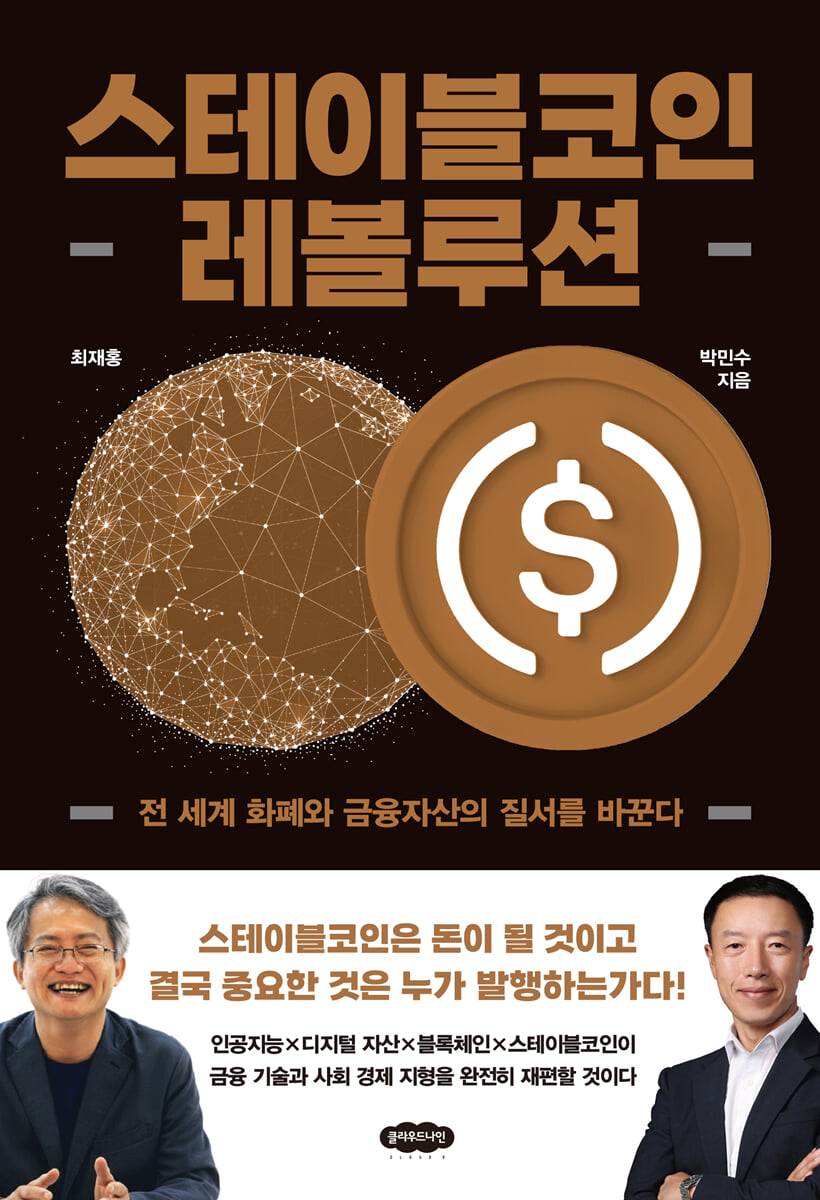
Stablecoin Revolution
 |
Description
Book Introduction
A must-read for finance, publishers, and policymakers!
The first strategy document to present a concrete roadmap for stablecoin issuance.
A fundamental shift in the financial paradigm has begun.
Stablecoins will reshape not only the future of finance but also the future of society.
★★★★★
“This may be the greatest revolution in financial technology since the advent of the Internet,” Trump said after the passage of the US GENIUS Act.
As each country's response strategy rapidly unfolds, the global monetary order is in turmoil.
Ultimately, stablecoins will become not just a technology or speculative asset, but a new financial infrastructure that digitally embodies trust.
Furthermore, it will reorganize the socio-economic landscape.
The authors, Professor Choi Jae-hong of Gachon University and Vice President Park Min-soo of Finger, are experts who have worked in academia and the field at the forefront of fintech, digital assets, and the platform industry for over 20 years.
They explain how stablecoins are transforming the financial landscape and what Korea needs to prepare for, covering policy, market, technology, and practice.
The first thing this book addresses is 'how is the order of money actually changing?'
From the US Genius Act, Europe's MiCA, Japan's revised Payment Services Act, and China's digital yuan, countries are incorporating stablecoins into their institutional frameworks, creating digital versions of their own currencies.
The authors call this trend the "stablecoin revolution."
It is not a simple fad, but an irreversible structural change that fundamentally alters the existing payment structure and financial market paradigm.
The first strategy document to present a concrete roadmap for stablecoin issuance.
A fundamental shift in the financial paradigm has begun.
Stablecoins will reshape not only the future of finance but also the future of society.
★★★★★
“This may be the greatest revolution in financial technology since the advent of the Internet,” Trump said after the passage of the US GENIUS Act.
As each country's response strategy rapidly unfolds, the global monetary order is in turmoil.
Ultimately, stablecoins will become not just a technology or speculative asset, but a new financial infrastructure that digitally embodies trust.
Furthermore, it will reorganize the socio-economic landscape.
The authors, Professor Choi Jae-hong of Gachon University and Vice President Park Min-soo of Finger, are experts who have worked in academia and the field at the forefront of fintech, digital assets, and the platform industry for over 20 years.
They explain how stablecoins are transforming the financial landscape and what Korea needs to prepare for, covering policy, market, technology, and practice.
The first thing this book addresses is 'how is the order of money actually changing?'
From the US Genius Act, Europe's MiCA, Japan's revised Payment Services Act, and China's digital yuan, countries are incorporating stablecoins into their institutional frameworks, creating digital versions of their own currencies.
The authors call this trend the "stablecoin revolution."
It is not a simple fad, but an irreversible structural change that fundamentally alters the existing payment structure and financial market paradigm.
- You can preview some of the book's contents.
Preview
index
Recommendation
Gain insight into the massive financial changes of the digital asset era!
(Cho Hwa-jun, Chairman of the Board of Directors of KB Financial Group)
Easily unravel the new paradigm brought about by stablecoins!
(Kim Seong-tae, President of IBK Industrial Bank of Korea)
Prologue: The Stablecoin Revolution: A Changing Order of Money
Before we dive in, let's seize the opportunity in the stablecoin wave.
Chapter 1: Stablecoins and the Era of Financial Revolution
1.
How will Korea's financial system change in 10 years?
South Korea's digital finance stands at a major inflection point. The success or failure of won-denominated stablecoins will determine the future of South Korea's finances.
2.
The explosive growth of the virtual asset market is an opportunity, not a crisis.
We must prepare a new financial structure, including stablecoins, and become the driving force behind a new financial paradigm.
3.
The Terra and Luna incidents demonstrated the need for institutionalization.
Institutionalizing stablecoins expands the role of issuers. They must become trusted participants in the stablecoin ecosystem.
4.
Virtual assets are connected to the entire global financial system.
Virtual assets and the existing financial system are already closely linked. A crisis response strategy must be developed when entering the stablecoin market.
5.
The approval of a Bitcoin ETF marks a turning point for virtual assets.
The role of stablecoins has gained traction following the approval of the Bitcoin ETF. The entire digital asset market ecosystem is being redesigned.
6.
The US started a financial war with the Genius Act.
The Genius Act opens the way for safe market entry. European and Asian countries are also reviewing their regulatory environments.
7.
China is accelerating its digital yuan strategy.
The US-China financial hegemony war intensifies with the legalization of stablecoins / The Genius Act has begun a restructuring of the global financial order.
8.
Financial institutions and fintech companies must participate.
Stablecoins are emerging as comprehensive financial platforms, becoming a focal point of policy and economic strategy, beyond financial technology innovation.
9.
The dawn of financial innovation and the restructuring of the global order has begun.
An era is dawning where anyone can instantly transfer money, make payments, and invest. / Financial services will be automated and operated globally in real time. / Discussion and preparation are needed to determine where the leadership in finance will take place.
10.
Digital asset innovation has begun in the Korean financial market.
The Digital Asset Basic Act will present a new challenge for Korean finance. The Korean Won stablecoin opens a new chapter in Korean finance.
Chapter 2: The Financial World Reshaped by Stablecoins
1.
Stablecoins provide stable value and efficiency.
Stablecoins are assets with built-in safety features. Stablecoins are categorized into four types, each with different uses.
2.
Stablecoins have become a key pillar of the global ecosystem.
Beyond digital assets, it is a core part of the global payment infrastructure. As global adoption expands, the market size is growing.
3.
What's the Difference Between Cryptocurrencies and Stablecoins?
Stablecoins address the volatility of cryptocurrencies. Stablecoins enable payments and remittances with price stability.
4.
Stablecoins have a wide range of practical applications, from trading to ESG.
It is being used in a variety of real-world applications, from trading to asset tokenization. It is expanding into diverse fields, from Web3 to carbon markets.
5.
How will traditional financial players participate?
Traditional finance can also gain competitiveness through network effects. A consortium model is advantageous for stablecoin issuance.
Chapter 3: The Stablecoin Ecosystem and Key Players
1.
Who does what and how in the stablecoin ecosystem?
The core of a stablecoin is the issuer who creates and guarantees it. The map of the stablecoin ecosystem is organically connected.
2.
Stablecoin issuers are becoming leaders in supply chains.
How Tether, Circle, Ripple, PayPal, and Stripe were issued / How JPMorgan, Visa, Mastercard, and Alibaba were issued
3.
How do countries secure trust and stability?
How do the EU, Japan, and Singapore regulate? / South Korea plans to have all reserves held and managed by the Bank of Korea.
4.
Exchanges and payment platforms serve as core hubs.
Exchanges and payment platforms are strengthening their practical usability. Exchanges and payment platforms are also pursuing digital finance experiments.
5.
Each user directly manages their own financial assets.
Financial services become automated when combined with smart contracts, expanding users' financial decision-making power.
6.
The potential and risks of stablecoins must be managed.
Regulators must safeguard financial stability and monetary sovereignty. Regulators must harmonize international standards with domestic laws.
7.
Stablecoins are reshaping global finance itself.
The race to secure the lead in new financial infrastructure is on. Stablecoins are expanding beyond investment assets into the real economy.
8.
We need to analyze global regulatory trends and develop a roadmap.
The United States is strengthening regulations to achieve both innovation and stability, and is developing a regulatory model that promotes stability and monetary sovereignty.
9.
Who are the technology providers and what role do they play?
Technology providers provide solutions in the form of operational and financial infrastructure. Technology providers build and manage financial networks.
10.
Financial institutions and fintechs are preparing for the future financial system.
From large banks to fintech and big tech, it's being used. Strategic investment in stablecoin-based services is needed.
11.
Preparing for financial service innovation and payment system reform
The Bank of Korea and fintech companies are also exploring issuance models and designing a new financial order based on trust and stability.
Chapter 4: Financial Stablecoin Master Plan
1.
How Banks Will Build Digital Financial Infrastructure
Why Banks Are Introducing Stablecoins / Banks Need to Develop Comprehensive Infrastructure Strategies Beyond Issuance
2.
How Banks Will Innovate in the Digital Finance Era
Stablecoins must be redesigned to fit their operational needs. / Design and operation through organizational division of labor are crucial. / Financial stablecoins are a core infrastructure for future finance.
3.
The key to the success of banking stablecoins is a task force.
What are the goals and roles of the Stablecoin Task Force? / Brainstorming, market analysis, and roadmaps should be conducted early.
4.
Develop a publishing strategy through market research and case studies.
Domestic and international market research and case studies are essential for designing a publishing strategy.
5.
Stablecoin design and issuance structure must be properly implemented.
How to blueprint a stablecoin issuance strategy / Establishing a complete issuance structure and regulatory approval strategy is also necessary.
6.
How to build and operate a stablecoin system
How to design and build a stablecoin system / How to operate a stablecoin system after it is built
7.
After building the stablecoin, we will connect it with the global financial ecosystem.
To achieve global expansion, we must analyze regulatory differences across countries. A global expansion strategy encompassing technology, regulations, and standards is needed.
8.
After stablecoin issuance, operational capabilities determine its success or failure.
How to Ensure Operational Stability and Global Trust / Stablecoin Operations and Systems Need to Be Updated
Chapter 5: Stablecoins and Blockchain: A Trust-Based Currency Innovation
1.
Trust in Blockchain and Smart Contracts
The distributed ledger, the core of blockchain, ensures reliability. Smart contracts are a key tool for ensuring trust.
2.
Blockchain is a mechanism that guarantees stable value.
Blockchain's public key encryption supports stable operation. Blockchain is collateral- and algorithm-based, making it a regulatory-friendly structure.
3.
Trust in the digital environment is about transparency and identity verification.
Leveraging blockchain's transparency to secure trust / Decentralized identity verification to verify identity and protect personal information
4.
Stablecoins are a catalyst for financial innovation.
It is applied to fintech services, driving various innovations and enhancing the efficiency and transparency of public and ESG management.
5.
The stage has been set for a decentralized financial innovation platform.
Decentralized finance is an experiment reimagined with code and networks. From Lido to Uniswap, it's a laboratory for decentralized finance.
6.
Stablecoins' challenges today seize tomorrow's opportunities.
What are the differences between coins and tokens? They can serve as payment infrastructure in the metaverse and Web3 ecosystems.
Chapter 6: Stablecoins, Banks, and Digital Assets in the AI Era
1.
Stablecoin banks are creating a new financial ecosystem.
We need to design a target operating model and revise the overall roadmap. This is the beginning of a fundamental change in the financial experience and trust system.
2.
Stablecoin innovation in traditional finance is a gradual transition.
Establish and operate a digital asset banking platform separate from existing channels / JPMorgan becomes the first major US bank to issue JPM Coin.
3.
The combination of digital assets and artificial intelligence will reshape society.
The autonomous economy is dawning with AI and blockchain, redefining the role of the financial sector and how it creates social value.
4.
Autonomous machine economy and blockchain create new contracts.
Blockchain and AI are creating an autonomous machine economy, creating new economic and social values.
5.
AI and digital assets are facing a test of trust and norms.
We need laws and regulations governing autonomous economic systems. The autonomous economy is becoming a social problem, not a technological one.
Epilogue: The Stablecoin Revolution Has Begun
Gain insight into the massive financial changes of the digital asset era!
(Cho Hwa-jun, Chairman of the Board of Directors of KB Financial Group)
Easily unravel the new paradigm brought about by stablecoins!
(Kim Seong-tae, President of IBK Industrial Bank of Korea)
Prologue: The Stablecoin Revolution: A Changing Order of Money
Before we dive in, let's seize the opportunity in the stablecoin wave.
Chapter 1: Stablecoins and the Era of Financial Revolution
1.
How will Korea's financial system change in 10 years?
South Korea's digital finance stands at a major inflection point. The success or failure of won-denominated stablecoins will determine the future of South Korea's finances.
2.
The explosive growth of the virtual asset market is an opportunity, not a crisis.
We must prepare a new financial structure, including stablecoins, and become the driving force behind a new financial paradigm.
3.
The Terra and Luna incidents demonstrated the need for institutionalization.
Institutionalizing stablecoins expands the role of issuers. They must become trusted participants in the stablecoin ecosystem.
4.
Virtual assets are connected to the entire global financial system.
Virtual assets and the existing financial system are already closely linked. A crisis response strategy must be developed when entering the stablecoin market.
5.
The approval of a Bitcoin ETF marks a turning point for virtual assets.
The role of stablecoins has gained traction following the approval of the Bitcoin ETF. The entire digital asset market ecosystem is being redesigned.
6.
The US started a financial war with the Genius Act.
The Genius Act opens the way for safe market entry. European and Asian countries are also reviewing their regulatory environments.
7.
China is accelerating its digital yuan strategy.
The US-China financial hegemony war intensifies with the legalization of stablecoins / The Genius Act has begun a restructuring of the global financial order.
8.
Financial institutions and fintech companies must participate.
Stablecoins are emerging as comprehensive financial platforms, becoming a focal point of policy and economic strategy, beyond financial technology innovation.
9.
The dawn of financial innovation and the restructuring of the global order has begun.
An era is dawning where anyone can instantly transfer money, make payments, and invest. / Financial services will be automated and operated globally in real time. / Discussion and preparation are needed to determine where the leadership in finance will take place.
10.
Digital asset innovation has begun in the Korean financial market.
The Digital Asset Basic Act will present a new challenge for Korean finance. The Korean Won stablecoin opens a new chapter in Korean finance.
Chapter 2: The Financial World Reshaped by Stablecoins
1.
Stablecoins provide stable value and efficiency.
Stablecoins are assets with built-in safety features. Stablecoins are categorized into four types, each with different uses.
2.
Stablecoins have become a key pillar of the global ecosystem.
Beyond digital assets, it is a core part of the global payment infrastructure. As global adoption expands, the market size is growing.
3.
What's the Difference Between Cryptocurrencies and Stablecoins?
Stablecoins address the volatility of cryptocurrencies. Stablecoins enable payments and remittances with price stability.
4.
Stablecoins have a wide range of practical applications, from trading to ESG.
It is being used in a variety of real-world applications, from trading to asset tokenization. It is expanding into diverse fields, from Web3 to carbon markets.
5.
How will traditional financial players participate?
Traditional finance can also gain competitiveness through network effects. A consortium model is advantageous for stablecoin issuance.
Chapter 3: The Stablecoin Ecosystem and Key Players
1.
Who does what and how in the stablecoin ecosystem?
The core of a stablecoin is the issuer who creates and guarantees it. The map of the stablecoin ecosystem is organically connected.
2.
Stablecoin issuers are becoming leaders in supply chains.
How Tether, Circle, Ripple, PayPal, and Stripe were issued / How JPMorgan, Visa, Mastercard, and Alibaba were issued
3.
How do countries secure trust and stability?
How do the EU, Japan, and Singapore regulate? / South Korea plans to have all reserves held and managed by the Bank of Korea.
4.
Exchanges and payment platforms serve as core hubs.
Exchanges and payment platforms are strengthening their practical usability. Exchanges and payment platforms are also pursuing digital finance experiments.
5.
Each user directly manages their own financial assets.
Financial services become automated when combined with smart contracts, expanding users' financial decision-making power.
6.
The potential and risks of stablecoins must be managed.
Regulators must safeguard financial stability and monetary sovereignty. Regulators must harmonize international standards with domestic laws.
7.
Stablecoins are reshaping global finance itself.
The race to secure the lead in new financial infrastructure is on. Stablecoins are expanding beyond investment assets into the real economy.
8.
We need to analyze global regulatory trends and develop a roadmap.
The United States is strengthening regulations to achieve both innovation and stability, and is developing a regulatory model that promotes stability and monetary sovereignty.
9.
Who are the technology providers and what role do they play?
Technology providers provide solutions in the form of operational and financial infrastructure. Technology providers build and manage financial networks.
10.
Financial institutions and fintechs are preparing for the future financial system.
From large banks to fintech and big tech, it's being used. Strategic investment in stablecoin-based services is needed.
11.
Preparing for financial service innovation and payment system reform
The Bank of Korea and fintech companies are also exploring issuance models and designing a new financial order based on trust and stability.
Chapter 4: Financial Stablecoin Master Plan
1.
How Banks Will Build Digital Financial Infrastructure
Why Banks Are Introducing Stablecoins / Banks Need to Develop Comprehensive Infrastructure Strategies Beyond Issuance
2.
How Banks Will Innovate in the Digital Finance Era
Stablecoins must be redesigned to fit their operational needs. / Design and operation through organizational division of labor are crucial. / Financial stablecoins are a core infrastructure for future finance.
3.
The key to the success of banking stablecoins is a task force.
What are the goals and roles of the Stablecoin Task Force? / Brainstorming, market analysis, and roadmaps should be conducted early.
4.
Develop a publishing strategy through market research and case studies.
Domestic and international market research and case studies are essential for designing a publishing strategy.
5.
Stablecoin design and issuance structure must be properly implemented.
How to blueprint a stablecoin issuance strategy / Establishing a complete issuance structure and regulatory approval strategy is also necessary.
6.
How to build and operate a stablecoin system
How to design and build a stablecoin system / How to operate a stablecoin system after it is built
7.
After building the stablecoin, we will connect it with the global financial ecosystem.
To achieve global expansion, we must analyze regulatory differences across countries. A global expansion strategy encompassing technology, regulations, and standards is needed.
8.
After stablecoin issuance, operational capabilities determine its success or failure.
How to Ensure Operational Stability and Global Trust / Stablecoin Operations and Systems Need to Be Updated
Chapter 5: Stablecoins and Blockchain: A Trust-Based Currency Innovation
1.
Trust in Blockchain and Smart Contracts
The distributed ledger, the core of blockchain, ensures reliability. Smart contracts are a key tool for ensuring trust.
2.
Blockchain is a mechanism that guarantees stable value.
Blockchain's public key encryption supports stable operation. Blockchain is collateral- and algorithm-based, making it a regulatory-friendly structure.
3.
Trust in the digital environment is about transparency and identity verification.
Leveraging blockchain's transparency to secure trust / Decentralized identity verification to verify identity and protect personal information
4.
Stablecoins are a catalyst for financial innovation.
It is applied to fintech services, driving various innovations and enhancing the efficiency and transparency of public and ESG management.
5.
The stage has been set for a decentralized financial innovation platform.
Decentralized finance is an experiment reimagined with code and networks. From Lido to Uniswap, it's a laboratory for decentralized finance.
6.
Stablecoins' challenges today seize tomorrow's opportunities.
What are the differences between coins and tokens? They can serve as payment infrastructure in the metaverse and Web3 ecosystems.
Chapter 6: Stablecoins, Banks, and Digital Assets in the AI Era
1.
Stablecoin banks are creating a new financial ecosystem.
We need to design a target operating model and revise the overall roadmap. This is the beginning of a fundamental change in the financial experience and trust system.
2.
Stablecoin innovation in traditional finance is a gradual transition.
Establish and operate a digital asset banking platform separate from existing channels / JPMorgan becomes the first major US bank to issue JPM Coin.
3.
The combination of digital assets and artificial intelligence will reshape society.
The autonomous economy is dawning with AI and blockchain, redefining the role of the financial sector and how it creates social value.
4.
Autonomous machine economy and blockchain create new contracts.
Blockchain and AI are creating an autonomous machine economy, creating new economic and social values.
5.
AI and digital assets are facing a test of trust and norms.
We need laws and regulations governing autonomous economic systems. The autonomous economy is becoming a social problem, not a technological one.
Epilogue: The Stablecoin Revolution Has Begun
Detailed image

Into the book
The stablecoin revolution is not simply a technological event, but a socio-economic paradigm shift.
AI, digital assets, machine-to-machine (M2M) blockchain monitoring, and new financial systems centered on stablecoins are opening new horizons across the economy and society, connecting humans and machines and centralization and decentralization.
Companies and countries that understand this moment and respond proactively will secure leadership in the future economy.
This book is written to chronicle the stablecoin revolution, helping readers understand the flow of change and develop strategies for innovation and adaptation.
We will explore how digital assets, artificial intelligence, blockchain, and stablecoins interconnect and impact businesses, local governments, governments, and society as a whole, and how this will transform future finance and the economy.
I hope that through this book, readers will become agents of innovation and adaptation, rather than mere observers.
--- p.8
At the signing ceremony that day, President Trump said, “The GENIUS Act solidifies the tremendous potential of dollar-backed stablecoins.
“This may be the greatest revolution in financial technology since the advent of the Internet,” he said.
This means that a new chapter has opened in financial history.
Stablecoins have been criticized for lacking an institutional framework compared to their rapid growth.
As virtual assets rapidly spread globally, the importance of stablecoins has increased. However, banks and investors face the reality that active market participation is difficult without legal stability.
The signing of the Genius Act is an opportunity to fill this gap.
The bill would establish federal regulation of dollar-backed stablecoins, ensuring both investor protection and market stability.
--- p.59~60
Trump's Genius Act in the US goes beyond mere domestic regulation and has become the starting point for a restructuring of the global financial order and a digital currency competition.
All movements—including the responses of China and other countries, the strategic restructuring of global corporations, and the regulatory discussions of international organizations—have been triggered by the reference point of US legislation.
Stablecoins are no longer experimental assets, but have become a core element of national strategy and global financial competition.
This change will have profound implications for the financial system and economic structure for years to come.
The financial markets of the future will no longer be simply a battleground of intra-border competition, but rather a complex arena of competition and cooperation centered around global digital currencies and stablecoins.
The moves by the United States, China, and other major countries signal the beginning of this competitive landscape, demanding strategic decisions from global financial institutions, fintech companies, and investors that simultaneously consider the three pillars of trust, regulation, and innovation.
--- p.65~66
Almost all transactions in the decentralized finance ecosystem are based on stablecoins.
Stablecoins are essential as a means of settlement for on-chain financial services such as deposits, lending, insurance, and derivatives.
Leading decentralized finance platforms like MakerDAO and Aave leverage stablecoins as collateral for loans and place them at the heart of liquidity pools.
This enables users to conduct stable financial activities while minimizing volatility risks.
As decentralized finance grows, stablecoins will gain a stronger position as the "base currency" of blockchain finance.
Stablecoins play a crucial role as a medium connecting asset transfers between blockchains.
For example, when moving assets issued on Ethereum to the Solana network, price fluctuation risk can be minimized by using stablecoins.
Stablecoins also serve as a reliable medium of exchange in the on-off ramp connecting the offline real economy and the blockchain world.
Stablecoins ensure stability when users convert fiat currency to blockchain networks or, conversely, liquidate assets.
This strengthens the connection between blockchain and the real economy.
As we enter the era of carbon neutrality, the carbon emissions trading market is growing rapidly.
However, the existing transaction structure is inefficient due to issues with transparency and reliability, as well as settlement delays.
Stablecoins could revolutionize this.
Projects like the US-based Toucan Protocol and KlimaDAO allow carbon credits to be tokenized on-chain and traded as stablecoins.
This will allow for immediate settlement of cross-border emissions trading, increasing the efficiency of ESG investment and sustainable finance.
If South Korea were to utilize won-based stablecoins as a means of carbon emissions settlement, domestic companies could more efficiently achieve global carbon neutrality goals.
This demonstrates that stablecoins can go beyond mere financial infrastructure and become tools for sustainability.
--- p.110~111
The stablecoin ecosystem goes beyond currency issuance to form a financial network where various players are organically connected.
First, the issuer and reserve management institution play the most crucial roles in stablecoins.
They provide a trustworthy environment for market participants by backing value and maintaining stability based on real assets.
Exchanges and payment platforms are the conduits that connect this stability to real economic activity.
Users utilize stablecoins to conduct a variety of financial activities, including payments, remittances, and investments, experiencing the platform's accessibility and liquidity firsthand.
Technology providers implement blockchain and smart contract-based automation systems to ensure stable and efficient operation of the platform.
Finally, regulators ensure the entire process is conducted safely, ensuring trust and transparency, and serve as a bridge connecting stablecoins to the institutional landscape.
The ecosystem created by the interaction of issuers, technology providers, exchanges, users, and regulators goes beyond simple digital assets and becomes a driving force for global financial innovation.
Stablecoins present a new financial paradigm, transcending the boundaries of traditional finance, including payments, investments, and remittances.
AI, digital assets, machine-to-machine (M2M) blockchain monitoring, and new financial systems centered on stablecoins are opening new horizons across the economy and society, connecting humans and machines and centralization and decentralization.
Companies and countries that understand this moment and respond proactively will secure leadership in the future economy.
This book is written to chronicle the stablecoin revolution, helping readers understand the flow of change and develop strategies for innovation and adaptation.
We will explore how digital assets, artificial intelligence, blockchain, and stablecoins interconnect and impact businesses, local governments, governments, and society as a whole, and how this will transform future finance and the economy.
I hope that through this book, readers will become agents of innovation and adaptation, rather than mere observers.
--- p.8
At the signing ceremony that day, President Trump said, “The GENIUS Act solidifies the tremendous potential of dollar-backed stablecoins.
“This may be the greatest revolution in financial technology since the advent of the Internet,” he said.
This means that a new chapter has opened in financial history.
Stablecoins have been criticized for lacking an institutional framework compared to their rapid growth.
As virtual assets rapidly spread globally, the importance of stablecoins has increased. However, banks and investors face the reality that active market participation is difficult without legal stability.
The signing of the Genius Act is an opportunity to fill this gap.
The bill would establish federal regulation of dollar-backed stablecoins, ensuring both investor protection and market stability.
--- p.59~60
Trump's Genius Act in the US goes beyond mere domestic regulation and has become the starting point for a restructuring of the global financial order and a digital currency competition.
All movements—including the responses of China and other countries, the strategic restructuring of global corporations, and the regulatory discussions of international organizations—have been triggered by the reference point of US legislation.
Stablecoins are no longer experimental assets, but have become a core element of national strategy and global financial competition.
This change will have profound implications for the financial system and economic structure for years to come.
The financial markets of the future will no longer be simply a battleground of intra-border competition, but rather a complex arena of competition and cooperation centered around global digital currencies and stablecoins.
The moves by the United States, China, and other major countries signal the beginning of this competitive landscape, demanding strategic decisions from global financial institutions, fintech companies, and investors that simultaneously consider the three pillars of trust, regulation, and innovation.
--- p.65~66
Almost all transactions in the decentralized finance ecosystem are based on stablecoins.
Stablecoins are essential as a means of settlement for on-chain financial services such as deposits, lending, insurance, and derivatives.
Leading decentralized finance platforms like MakerDAO and Aave leverage stablecoins as collateral for loans and place them at the heart of liquidity pools.
This enables users to conduct stable financial activities while minimizing volatility risks.
As decentralized finance grows, stablecoins will gain a stronger position as the "base currency" of blockchain finance.
Stablecoins play a crucial role as a medium connecting asset transfers between blockchains.
For example, when moving assets issued on Ethereum to the Solana network, price fluctuation risk can be minimized by using stablecoins.
Stablecoins also serve as a reliable medium of exchange in the on-off ramp connecting the offline real economy and the blockchain world.
Stablecoins ensure stability when users convert fiat currency to blockchain networks or, conversely, liquidate assets.
This strengthens the connection between blockchain and the real economy.
As we enter the era of carbon neutrality, the carbon emissions trading market is growing rapidly.
However, the existing transaction structure is inefficient due to issues with transparency and reliability, as well as settlement delays.
Stablecoins could revolutionize this.
Projects like the US-based Toucan Protocol and KlimaDAO allow carbon credits to be tokenized on-chain and traded as stablecoins.
This will allow for immediate settlement of cross-border emissions trading, increasing the efficiency of ESG investment and sustainable finance.
If South Korea were to utilize won-based stablecoins as a means of carbon emissions settlement, domestic companies could more efficiently achieve global carbon neutrality goals.
This demonstrates that stablecoins can go beyond mere financial infrastructure and become tools for sustainability.
--- p.110~111
The stablecoin ecosystem goes beyond currency issuance to form a financial network where various players are organically connected.
First, the issuer and reserve management institution play the most crucial roles in stablecoins.
They provide a trustworthy environment for market participants by backing value and maintaining stability based on real assets.
Exchanges and payment platforms are the conduits that connect this stability to real economic activity.
Users utilize stablecoins to conduct a variety of financial activities, including payments, remittances, and investments, experiencing the platform's accessibility and liquidity firsthand.
Technology providers implement blockchain and smart contract-based automation systems to ensure stable and efficient operation of the platform.
Finally, regulators ensure the entire process is conducted safely, ensuring trust and transparency, and serve as a bridge connecting stablecoins to the institutional landscape.
The ecosystem created by the interaction of issuers, technology providers, exchanges, users, and regulators goes beyond simple digital assets and becomes a driving force for global financial innovation.
Stablecoins present a new financial paradigm, transcending the boundaries of traditional finance, including payments, investments, and remittances.
--- p.129
Publisher's Review
In the digital money era, the question is who will design trust!
The new blueprint for Korean finance is here.
The moment the dollar becomes digital, the map of financial power is being redrawn.
The Genius Act, passed by the U.S. Congress with the inauguration of the second Trump administration, incorporated the issuance of dollar stablecoins into the institutional framework.
The digitization of the dollar is not simply a technological innovation; it signifies a restructuring of financial hegemony.
This book poses the fundamental question, “Who will design the trust in currency?” amidst this wave of enormous change.
Authors Professor Choi Jae-hong and Vice Chairman Park Min-soo, both experts in the field who have researched and implemented fintech, digital assets, and platform industries, do not simply view stablecoins as a technological evolution, but rather define them as “a tool to digitally institutionalize trust” and a political and economic weapon that allows countries to re-establish financial leadership.
The authors see “the future of money as a question of power, not technology,” and offer a “guide to action” for financiers, issuers, and policymakers.
The world is already moving.
The United States is establishing a hybrid model of "private sector leadership + regulatory supplementation" by linking private issuers (PayPal, Circle, etc.) with institutional banks through the Genius Act.
The European Union absorbed risks into the system by separating issuance and distribution through the MiCA law.
Japan, emphasizing trust as a core value, revised its Payment Services Act to allow banks and large corporations to issue stablecoins.
China is already commercializing the digital yuan, strengthening its model of state control over finance.
The authors analyze these four models and conclude that “the center of the monetary order is shifting from paper to code.”
The problem is Korea.
Although the country's technological prowess is world-class, its systems and policies are still at the discussion stage.
Discussions about stablecoins in Korea are tied to the sub-concept of virtual assets, and regulations are ambiguous.
The authors warn that “if South Korea does not respond, the won will be relegated to a local currency used only within the country.”
So what should Korea do? This book presents solutions through three key words.
Institutional reform, private sector innovation, and global expansion are all necessary at the same time.
First, it is a battle for speed in institutionalization.
The enactment of the Basic Digital Asset Act and the establishment of the Bank of Korea's reserve management system must come first.
Stablecoins are an operating system and payment network that integrates the financial system.
Therefore, without a legal framework in place, the market will drift towards a monopoly structure of private platforms.
Second, it is a private sector-led governance model.
Big tech companies such as Naver, Kakao, Toss, and Dunamu, as well as major commercial banks, must participate in the form of a consortium.
We need a structure where the public sector is responsible for discipline and the private sector is responsible for innovation.
Third, it is a global expansion strategy.
We need to export models that directly use won stablecoins in real economic sectors such as K-content, K-games, and trade payments.
The authors emphasize that stablecoins are not just a topic for the financial industry, but a new payment infrastructure for export industries.
In addition to explaining the concept and structure of stablecoins,
This is an implementation manual that covers everything from how to issue and operate!
This book is not a technical guide explaining the structure of stablecoins.
In reality, it is closer to an implementation manual that deals with 'how to issue and how to operate'.
The authors offer a concrete roadmap for banks and issuers to consider immediately.
We have compiled practical information on reserve management, trust structure, accounting, regulatory response, and risk scenarios for each issuance model.
For example, “For the issuance type, capital requirements and transparency are key, while for the payment type, remittance infrastructure and accounting standards are important.”
What's interesting is that the book emphasizes the speed of institutions and governance over technology.
The essence of stablecoins lies not in blockchain technology, but in how quickly and safely they can be institutionalized.
“Nowadays, the timing of the system is more important than technology,” he says.
While the financial authorities, the National Assembly, and the Bank of Korea are belatedly taking action, the United States and Japan have already established a model that integrates systems, markets, and platforms.
The second half of the book provides specific guidance to financial institutions and issuers.
Banks should view stablecoins as an opportunity, not a crisis.
Redesigning credit creation functions based on blockchain technology offers new competitive advantages in transparency, speed, and cost.
Issuers must learn viable financial models, including capital requirements, reserve management, compliance, and global expansion strategies.
The book warns that "if you view stablecoins as mere investment products, it's already too late," and that "this is a fight to design a new financial infrastructure."
The second half of the book deals with stablecoins in the age of artificial intelligence.
In the "Agent Economy A2A," where artificial intelligence (AI) replaces users' financial actions, stablecoins become a common currency language used by both humans and machines.
Behind the algorithms that automatically insure, rebalance investments, and optimize international payments lies the question: "Which digital currency will be used as the default?"
The authors believe that stablecoins are the heart of digital finance in the AI era, and that the choices we make today will determine our competitiveness for the next 10 to 20 years.
This book is essential for financial professionals, policymakers, and publishers alike.
From a financier's perspective, it offers opportunities for new revenue models; from a policymaker's perspective, it offers institutional speed and governance design; and from an issuer's perspective, it offers a practical business roadmap.
This book goes beyond the chaotic market post-Bitcoin and provides a concrete demonstration of the practical changes that the institutionalization of digital currency will bring.
A practical guide that details the five-step roadmap for publishing and operating!
The most distinctive and practical aspect of this book compared to existing stablecoin books is its roadmap for issuance and operation.
The authors state that financial institutions and companies preparing to issue stablecoins must take at least the following steps:
Step 1 is strategy formulation.
We will specify the goals our organization seeks to achieve through stablecoins (domestic payment innovation, international remittances, corporate settlements, new revenue models, etc.) and design links with existing businesses.
Step 2 is governance and organizational design.
We will establish a dedicated task force within the company and create a structure in which IT and business units participate together in risk and compliance monitoring.
In this process, a clear decision-making structure and responsibilities for the board of directors and management must be established.
Step 3 is to design the reserve assets and issuance structure.
It specifically determines the ratio of reserves (fiat currency deposits, government bonds, short-term high-quality bonds, cash equivalents, etc.), whether to establish a separate trust account, what kind of contract to enter into with the bank, and how to design the repayment and redemption conditions.
Step 4 is regulatory and supervisory communication.
Financial authorities will coordinate with the Bank of Korea in advance to determine the legal framework within which the bonds will be issued and how reporting, disclosure, and auditing systems will be aligned.
Step 5 is pilot and gradual expansion.
Initially, we will test with a limited number of users and transaction volumes, gradually expanding the scope once the technical stability, reserve management, and risk management are verified.
This book doesn't simply list the roadmap for publication; it explains it with examples.
For example, trade-offs are explained by saying that in some structures, reserve transparency is high but profitability is low, while in other structures, operating profits are high but it is difficult to gain market trust.
Through this book, publishers will gain a standard by which they can determine for themselves “what structure is right for us.”
From the financial institution's perspective, it is closer to a 'survival strategy book'.
The authors state, “Financial professionals who do not understand stablecoins will struggle to make key decisions in the future of digital finance.”
This is because stablecoins can become the standard layer for digital payments and settlements that binds all of these activities, including deposits, loans, payments, remittances, and asset management, as they increasingly move on-chain (e.g., on-chain settlements, token securities, and central bank digital currencies (CBDCs).
It also details how options and strategies differ depending on whether banks issue stablecoins directly or play a role in the infrastructure and service layers.
It is also useful for policymakers and regulators.
The authors point out that stablecoin regulation is complex, intertwined with financial stability, foreign exchange management, the separation of banking and commerce, and capital market regulation, but point out that "the most dangerous situation is when excessive uncertainty stifles innovation."
Therefore, we suggest that a strategy of limited introduction centered on banks and then gradual expansion, assuming a certain level of safety measures, is realistic.
Citing real-world examples, including remarks by the Bank of Korea governor, the growing share of dollar stablecoin trading on domestic exchanges, and the debate over won-denominated stablecoins, the book explains the choices facing Korea.
The authors state that “the stablecoin revolution is not simply a financial trend, but an irreversible global shift.”
He emphasizes that this change is not solely the responsibility of large financial institutions and big tech companies, but rather a joint task that must be achieved by practitioners and leaders, issuers and regulators, technology providers and startups.
“It’s difficult to do it alone.
The passage that "consortium networks reduce adoption risk and accelerate learning" clearly suggests the direction in which the stablecoin ecosystem should be structured going forward.
The new blueprint for Korean finance is here.
The moment the dollar becomes digital, the map of financial power is being redrawn.
The Genius Act, passed by the U.S. Congress with the inauguration of the second Trump administration, incorporated the issuance of dollar stablecoins into the institutional framework.
The digitization of the dollar is not simply a technological innovation; it signifies a restructuring of financial hegemony.
This book poses the fundamental question, “Who will design the trust in currency?” amidst this wave of enormous change.
Authors Professor Choi Jae-hong and Vice Chairman Park Min-soo, both experts in the field who have researched and implemented fintech, digital assets, and platform industries, do not simply view stablecoins as a technological evolution, but rather define them as “a tool to digitally institutionalize trust” and a political and economic weapon that allows countries to re-establish financial leadership.
The authors see “the future of money as a question of power, not technology,” and offer a “guide to action” for financiers, issuers, and policymakers.
The world is already moving.
The United States is establishing a hybrid model of "private sector leadership + regulatory supplementation" by linking private issuers (PayPal, Circle, etc.) with institutional banks through the Genius Act.
The European Union absorbed risks into the system by separating issuance and distribution through the MiCA law.
Japan, emphasizing trust as a core value, revised its Payment Services Act to allow banks and large corporations to issue stablecoins.
China is already commercializing the digital yuan, strengthening its model of state control over finance.
The authors analyze these four models and conclude that “the center of the monetary order is shifting from paper to code.”
The problem is Korea.
Although the country's technological prowess is world-class, its systems and policies are still at the discussion stage.
Discussions about stablecoins in Korea are tied to the sub-concept of virtual assets, and regulations are ambiguous.
The authors warn that “if South Korea does not respond, the won will be relegated to a local currency used only within the country.”
So what should Korea do? This book presents solutions through three key words.
Institutional reform, private sector innovation, and global expansion are all necessary at the same time.
First, it is a battle for speed in institutionalization.
The enactment of the Basic Digital Asset Act and the establishment of the Bank of Korea's reserve management system must come first.
Stablecoins are an operating system and payment network that integrates the financial system.
Therefore, without a legal framework in place, the market will drift towards a monopoly structure of private platforms.
Second, it is a private sector-led governance model.
Big tech companies such as Naver, Kakao, Toss, and Dunamu, as well as major commercial banks, must participate in the form of a consortium.
We need a structure where the public sector is responsible for discipline and the private sector is responsible for innovation.
Third, it is a global expansion strategy.
We need to export models that directly use won stablecoins in real economic sectors such as K-content, K-games, and trade payments.
The authors emphasize that stablecoins are not just a topic for the financial industry, but a new payment infrastructure for export industries.
In addition to explaining the concept and structure of stablecoins,
This is an implementation manual that covers everything from how to issue and operate!
This book is not a technical guide explaining the structure of stablecoins.
In reality, it is closer to an implementation manual that deals with 'how to issue and how to operate'.
The authors offer a concrete roadmap for banks and issuers to consider immediately.
We have compiled practical information on reserve management, trust structure, accounting, regulatory response, and risk scenarios for each issuance model.
For example, “For the issuance type, capital requirements and transparency are key, while for the payment type, remittance infrastructure and accounting standards are important.”
What's interesting is that the book emphasizes the speed of institutions and governance over technology.
The essence of stablecoins lies not in blockchain technology, but in how quickly and safely they can be institutionalized.
“Nowadays, the timing of the system is more important than technology,” he says.
While the financial authorities, the National Assembly, and the Bank of Korea are belatedly taking action, the United States and Japan have already established a model that integrates systems, markets, and platforms.
The second half of the book provides specific guidance to financial institutions and issuers.
Banks should view stablecoins as an opportunity, not a crisis.
Redesigning credit creation functions based on blockchain technology offers new competitive advantages in transparency, speed, and cost.
Issuers must learn viable financial models, including capital requirements, reserve management, compliance, and global expansion strategies.
The book warns that "if you view stablecoins as mere investment products, it's already too late," and that "this is a fight to design a new financial infrastructure."
The second half of the book deals with stablecoins in the age of artificial intelligence.
In the "Agent Economy A2A," where artificial intelligence (AI) replaces users' financial actions, stablecoins become a common currency language used by both humans and machines.
Behind the algorithms that automatically insure, rebalance investments, and optimize international payments lies the question: "Which digital currency will be used as the default?"
The authors believe that stablecoins are the heart of digital finance in the AI era, and that the choices we make today will determine our competitiveness for the next 10 to 20 years.
This book is essential for financial professionals, policymakers, and publishers alike.
From a financier's perspective, it offers opportunities for new revenue models; from a policymaker's perspective, it offers institutional speed and governance design; and from an issuer's perspective, it offers a practical business roadmap.
This book goes beyond the chaotic market post-Bitcoin and provides a concrete demonstration of the practical changes that the institutionalization of digital currency will bring.
A practical guide that details the five-step roadmap for publishing and operating!
The most distinctive and practical aspect of this book compared to existing stablecoin books is its roadmap for issuance and operation.
The authors state that financial institutions and companies preparing to issue stablecoins must take at least the following steps:
Step 1 is strategy formulation.
We will specify the goals our organization seeks to achieve through stablecoins (domestic payment innovation, international remittances, corporate settlements, new revenue models, etc.) and design links with existing businesses.
Step 2 is governance and organizational design.
We will establish a dedicated task force within the company and create a structure in which IT and business units participate together in risk and compliance monitoring.
In this process, a clear decision-making structure and responsibilities for the board of directors and management must be established.
Step 3 is to design the reserve assets and issuance structure.
It specifically determines the ratio of reserves (fiat currency deposits, government bonds, short-term high-quality bonds, cash equivalents, etc.), whether to establish a separate trust account, what kind of contract to enter into with the bank, and how to design the repayment and redemption conditions.
Step 4 is regulatory and supervisory communication.
Financial authorities will coordinate with the Bank of Korea in advance to determine the legal framework within which the bonds will be issued and how reporting, disclosure, and auditing systems will be aligned.
Step 5 is pilot and gradual expansion.
Initially, we will test with a limited number of users and transaction volumes, gradually expanding the scope once the technical stability, reserve management, and risk management are verified.
This book doesn't simply list the roadmap for publication; it explains it with examples.
For example, trade-offs are explained by saying that in some structures, reserve transparency is high but profitability is low, while in other structures, operating profits are high but it is difficult to gain market trust.
Through this book, publishers will gain a standard by which they can determine for themselves “what structure is right for us.”
From the financial institution's perspective, it is closer to a 'survival strategy book'.
The authors state, “Financial professionals who do not understand stablecoins will struggle to make key decisions in the future of digital finance.”
This is because stablecoins can become the standard layer for digital payments and settlements that binds all of these activities, including deposits, loans, payments, remittances, and asset management, as they increasingly move on-chain (e.g., on-chain settlements, token securities, and central bank digital currencies (CBDCs).
It also details how options and strategies differ depending on whether banks issue stablecoins directly or play a role in the infrastructure and service layers.
It is also useful for policymakers and regulators.
The authors point out that stablecoin regulation is complex, intertwined with financial stability, foreign exchange management, the separation of banking and commerce, and capital market regulation, but point out that "the most dangerous situation is when excessive uncertainty stifles innovation."
Therefore, we suggest that a strategy of limited introduction centered on banks and then gradual expansion, assuming a certain level of safety measures, is realistic.
Citing real-world examples, including remarks by the Bank of Korea governor, the growing share of dollar stablecoin trading on domestic exchanges, and the debate over won-denominated stablecoins, the book explains the choices facing Korea.
The authors state that “the stablecoin revolution is not simply a financial trend, but an irreversible global shift.”
He emphasizes that this change is not solely the responsibility of large financial institutions and big tech companies, but rather a joint task that must be achieved by practitioners and leaders, issuers and regulators, technology providers and startups.
“It’s difficult to do it alone.
The passage that "consortium networks reduce adoption risk and accelerate learning" clearly suggests the direction in which the stablecoin ecosystem should be structured going forward.
GOODS SPECIFICS
- Date of issue: November 11, 2025
- Page count, weight, size: 332 pages | 152*225*30mm
- ISBN13: 9791194534464
- ISBN10: 1194534465
You may also like
카테고리
korean


korean

![GQ KOREA Mark (Monthly): December [2025]](http://librairie.coreenne.fr/cdn/shop/files/8ef265dbbfbf186523ed75ba7319009d.jpg?v=1765340328&width=3840)


