

Klaus Schwab's Fourth Industrial Revolution THE NEXT
 |
Description
Book Introduction
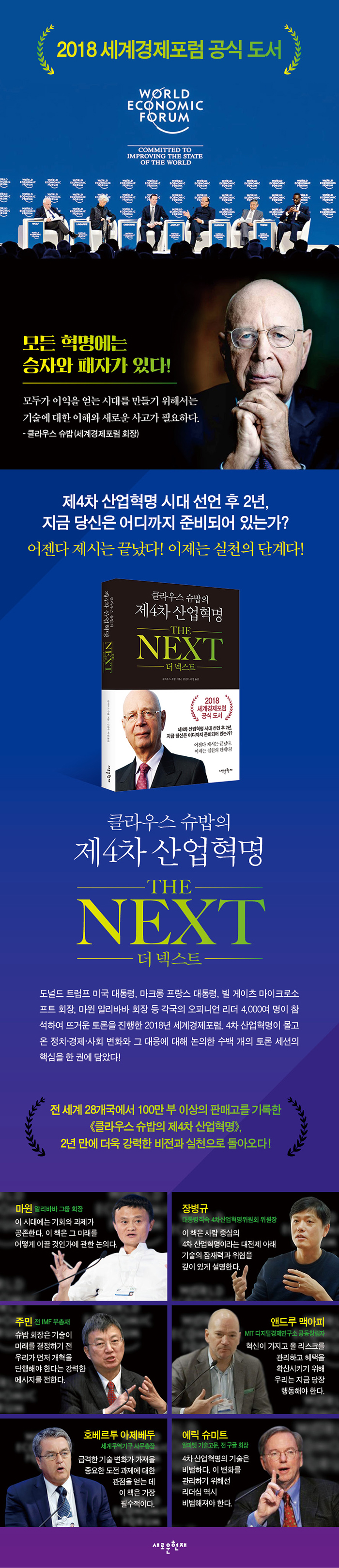
The agenda is over! Now it's time to put it into action! A second conversation at the intersection of innovation and opportunity facing humanity. A book that offers both a powerful vision and a practical approach to the Fourth Industrial Revolution. Klaus Schwab's The Fourth Industrial Revolution, published in 2016 by Klaus Schwab, founder and executive chairman of the World Economic Forum (aka the Davos Forum), talks about the definition of the Fourth Industrial Revolution, its pros and cons, and the discovery of new global growth engines, and urges us all to take shared responsibility for "a future where innovation and technology work for the common good of humanity." Two years later, thanks to extensive research and development, cutting-edge technologies are changing at an even faster pace, and companies are beginning to adopt new approaches. The book's argument becomes even more compelling as empirical evidence emerges that new technologies and business models can disrupt labor markets, social relations, and even political systems. This book, a sequel to Klaus Schwab's The Fourth Industrial Revolution, complements its predecessor in two ways. First, it provides guidelines to help all readers, from global leaders to ordinary citizens, develop a systems perspective on innovation and see the big picture by examining the relationships between new technologies, global challenges, and our actions. Second, it selects 12 core technologies of the Fourth Industrial Revolution, including blockchain, the Internet of Things, artificial intelligence, advanced materials, additive manufacturing, biotechnology, virtual and augmented reality, and space technology. By compiling the most recent cases and perspectives from global experts, it provides practical guidance that allows readers to delve deeper into the core of these technologies and their management systems. |
- You can preview some of the book's contents.
Preview
index
Recommendation 1_ Dreaming of a people-centered 4th industrial revolution era
(Jang Byung-gyu, Chairman of the Presidential Committee on the Fourth Industrial Revolution)
Recommendation 2: Escaping the Zero-Sum Mentality
(Satya Nadella, Microsoft CEO)
Preface: Humanity's Choice for a Sustainable and Peaceful Future
SECTION 01 The Fourth Industrial Revolution
CHAPTER 01 Leading the Fourth Industrial Revolution
CHAPTER 02 Connecting the Dots
CHAPTER 03 Instilling Value in Technology
SPECIAL INSERT International Human Rights Framework
CHAPTER 04 Empowering All Stakeholders
SECTION 02 Technology, Opportunities, and Disruptive Innovation
PART 1: Expanding Digital Technologies
CHAPTER 05 New Computing Technologies
CHAPTER 06 Blockchain and Distributed Ledger Technology
CHAPTER 07 Internet of Things
SPECIAL INSERT INFORMATION ETHICS
SPECIAL INSERT Cyber Risk
PART 2 The Shifting Physical World
CHAPTER 08 Artificial Intelligence and Robotics
CHAPTER 09 Advanced Materials
CHAPTER 10 Additive Manufacturing and 3D Printing
SPECIAL INSERT The Light and Darkness of Drones
PART 3 Another Beginning for Humanity
CHAPTER 11 Biotechnology
CHAPTER 12 Neurotechnology
CHAPTER 13 Virtual Reality and Augmented Reality
SPECIAL INSERT: Artistic and Cultural Perspectives on the Fourth Industrial Revolution
PART 4 The Front Line of the Environment to Be Pioneered
CHAPTER 14 Energy Acquisition, Storage, and Transmission
CHAPTER 15 Geoengineering
CHAPTER 16 Space Technology
CONCLUSION
Systems Leadership: What You Can Do to Lead the Fourth Industrial Revolution
(Jang Byung-gyu, Chairman of the Presidential Committee on the Fourth Industrial Revolution)
Recommendation 2: Escaping the Zero-Sum Mentality
(Satya Nadella, Microsoft CEO)
Preface: Humanity's Choice for a Sustainable and Peaceful Future
SECTION 01 The Fourth Industrial Revolution
CHAPTER 01 Leading the Fourth Industrial Revolution
CHAPTER 02 Connecting the Dots
CHAPTER 03 Instilling Value in Technology
SPECIAL INSERT International Human Rights Framework
CHAPTER 04 Empowering All Stakeholders
SECTION 02 Technology, Opportunities, and Disruptive Innovation
PART 1: Expanding Digital Technologies
CHAPTER 05 New Computing Technologies
CHAPTER 06 Blockchain and Distributed Ledger Technology
CHAPTER 07 Internet of Things
SPECIAL INSERT INFORMATION ETHICS
SPECIAL INSERT Cyber Risk
PART 2 The Shifting Physical World
CHAPTER 08 Artificial Intelligence and Robotics
CHAPTER 09 Advanced Materials
CHAPTER 10 Additive Manufacturing and 3D Printing
SPECIAL INSERT The Light and Darkness of Drones
PART 3 Another Beginning for Humanity
CHAPTER 11 Biotechnology
CHAPTER 12 Neurotechnology
CHAPTER 13 Virtual Reality and Augmented Reality
SPECIAL INSERT: Artistic and Cultural Perspectives on the Fourth Industrial Revolution
PART 4 The Front Line of the Environment to Be Pioneered
CHAPTER 14 Energy Acquisition, Storage, and Transmission
CHAPTER 15 Geoengineering
CHAPTER 16 Space Technology
CONCLUSION
Systems Leadership: What You Can Do to Lead the Fourth Industrial Revolution
Detailed image
Into the book
With so many disruptive technologies emerging from laboratories, garages, and R&D centers around the world, and regulations constantly being created and revised, citizens and leaders across various sectors have countless opportunities to shape the systems of the Fourth Industrial Revolution.
We must seize this opportunity.
If successful, our wealth will be distributed more fairly, inequality will be reduced, and social trust will be rebuilt to ease social conflict and political polarization.
Chapter 1.
Leading the Fourth Industrial Revolution
When studying the technological changes of the Fourth Industrial Revolution, leaders who focus on "systems, not technology" will have an advantage over those who don't.
Without a deep understanding of the technology itself, we cannot truly understand how it transforms institutions closely related to us, such as business, government, and social systems.
This is the challenge many people face.
This problem can be overcome with a two-pronged approach.
The first method is to understand and study each technology 'only to the minimum level necessary'.
This approach will enable you to engage in intelligent conversations with experts, experiment with new ideas, and explore where value can be created.
Section 2 of this book is designed to provide just that level of understanding by concisely introducing twelve new technologies driving the Fourth Industrial Revolution.
Chapter 2.
Connecting the dots
As the chart shows, it took 75 years to reach 100 million telephone users, while it took less than 10 years to reach 100 million Internet users.
As the Fourth Industrial Revolution technologies accelerate their diffusion, their impact on investment, productivity, organizational strategy, industrial structure, and individual behavior will grow.
Chapter 2.
Connecting the dots
Perhaps the most important challenge facing blockchain is the absence of a central authority.
The absence of a central authority is more than an institutional problem.
It is a psychological problem and is also related to the human-created order.
Distributing trust by relying on complex algorithms is as radical as replacing human reasoning with modern scientific machines as the source of knowledge.
While economic incentives can foster human reasoning, it is also important to remember that it took centuries for human society to adapt to the scientific machine.
Ultimately, with the advancement of blockchain technology, trust will no longer reside with politicians, individuals, or credible institutions, but with mathematicians and digital infrastructure.
This is a significant task that must be addressed alongside political and technical issues.
Chapter 6.
Blockchain and Distributed Ledger Technology
Peter Smith, CEO of US blockchain company, said:
“By leveraging collaboration, blockchain creates and delivers value more safely, benefiting people.
But if blockchain were to be applied across a wide range of industries, millions of jobs could be lost as the institutions and people who mediate transactions today would become unnecessary.” But for the economy as a whole, blockchain would generate net benefits over time.
Because blockchain can create a world where small transactions and value creation are possible at a level that sufficiently outweighs the losses incurred by middlemen and intermediaries.
Chapter 6.
Blockchain and Distributed Ledger Technology
Like other emerging technologies such as artificial intelligence, robotics, and blockchain, the Internet of Things will impact employment and the labor market.
Organizations and industries will change, especially due to the disruptive potential of the Internet of Things.
When combined with artificial intelligence and robotics, the Internet of Things will reduce the demand for repetitive and physical labor, putting pressure on workers.
On the other hand, the demand for creative and problem-solving skills related to programming, design, and maintenance will actually increase.
Chapter 7.
Internet of Things
The potential of robotics has grown over the past decade as artificial intelligence begins to be applied to new physical systems.
Humans and machines will work together, increasingly replacing and reducing the roles of educated and skilled people like doctors, lawyers, pilots, and truck drivers.
It raises concerns about the role of human expertise and how much human intelligence and judgment will be needed for many tasks that could be automated.
Chapter 8.
Artificial Intelligence and Robotics
Advanced materials science will impact most, if not all, aspects of the Fourth Industrial Revolution.
Materials science is used in a variety of applications, from energy generation, transmission, and storage to water purification and electronics.
Although it may not always be visible, advanced materials science will literally create a whole new world of materials.
Materials science will transform consumption by reshaping supply chains and changing the environment.
Many industries require new materials to meet the growing demand for improved performance.
Chapter 9.
Advanced materials
Small-batch production and design freedom encourage the production of customized products.
Personalized fashion items are becoming increasingly common, and custom 3D printing is being used in medicine to create custom dental prosthetics, hearing aids, and orthopedic implants.
Indeed, 3D printing technology appears poised to revolutionize the healthcare industry.
As our population ages and technology becomes more widespread, the day may come when we can make our own medicine at home.
We have already reached the stage where we can produce drugs using various active ingredients in appropriate dosages.
Governments and pharmaceutical companies must consider new regulations and business models.
Chapter 10.
Additive manufacturing and 3D printing
The Fourth Industrial Revolution, characterized by complexity, transformation, and decentralization, demands a new form of leadership.
We would like to call this 'system leadership'.
Systems leadership fosters a shared vision for change, collaborates with all stakeholders in the global community, and drives change in how and with whom the benefits of systems are shared.
Ultimately, systems leadership is an interconnected effort to drive change in our social and economic systems to avoid repeating the failures of the previous industrial revolution and to provide sustainable benefits to all citizens, including future generations.
Systems Leadership: What You Can Do to Lead the Fourth Industrial Revolution
We must seize this opportunity.
If successful, our wealth will be distributed more fairly, inequality will be reduced, and social trust will be rebuilt to ease social conflict and political polarization.
Chapter 1.
Leading the Fourth Industrial Revolution
When studying the technological changes of the Fourth Industrial Revolution, leaders who focus on "systems, not technology" will have an advantage over those who don't.
Without a deep understanding of the technology itself, we cannot truly understand how it transforms institutions closely related to us, such as business, government, and social systems.
This is the challenge many people face.
This problem can be overcome with a two-pronged approach.
The first method is to understand and study each technology 'only to the minimum level necessary'.
This approach will enable you to engage in intelligent conversations with experts, experiment with new ideas, and explore where value can be created.
Section 2 of this book is designed to provide just that level of understanding by concisely introducing twelve new technologies driving the Fourth Industrial Revolution.
Chapter 2.
Connecting the dots
As the chart shows, it took 75 years to reach 100 million telephone users, while it took less than 10 years to reach 100 million Internet users.
As the Fourth Industrial Revolution technologies accelerate their diffusion, their impact on investment, productivity, organizational strategy, industrial structure, and individual behavior will grow.
Chapter 2.
Connecting the dots
Perhaps the most important challenge facing blockchain is the absence of a central authority.
The absence of a central authority is more than an institutional problem.
It is a psychological problem and is also related to the human-created order.
Distributing trust by relying on complex algorithms is as radical as replacing human reasoning with modern scientific machines as the source of knowledge.
While economic incentives can foster human reasoning, it is also important to remember that it took centuries for human society to adapt to the scientific machine.
Ultimately, with the advancement of blockchain technology, trust will no longer reside with politicians, individuals, or credible institutions, but with mathematicians and digital infrastructure.
This is a significant task that must be addressed alongside political and technical issues.
Chapter 6.
Blockchain and Distributed Ledger Technology
Peter Smith, CEO of US blockchain company, said:
“By leveraging collaboration, blockchain creates and delivers value more safely, benefiting people.
But if blockchain were to be applied across a wide range of industries, millions of jobs could be lost as the institutions and people who mediate transactions today would become unnecessary.” But for the economy as a whole, blockchain would generate net benefits over time.
Because blockchain can create a world where small transactions and value creation are possible at a level that sufficiently outweighs the losses incurred by middlemen and intermediaries.
Chapter 6.
Blockchain and Distributed Ledger Technology
Like other emerging technologies such as artificial intelligence, robotics, and blockchain, the Internet of Things will impact employment and the labor market.
Organizations and industries will change, especially due to the disruptive potential of the Internet of Things.
When combined with artificial intelligence and robotics, the Internet of Things will reduce the demand for repetitive and physical labor, putting pressure on workers.
On the other hand, the demand for creative and problem-solving skills related to programming, design, and maintenance will actually increase.
Chapter 7.
Internet of Things
The potential of robotics has grown over the past decade as artificial intelligence begins to be applied to new physical systems.
Humans and machines will work together, increasingly replacing and reducing the roles of educated and skilled people like doctors, lawyers, pilots, and truck drivers.
It raises concerns about the role of human expertise and how much human intelligence and judgment will be needed for many tasks that could be automated.
Chapter 8.
Artificial Intelligence and Robotics
Advanced materials science will impact most, if not all, aspects of the Fourth Industrial Revolution.
Materials science is used in a variety of applications, from energy generation, transmission, and storage to water purification and electronics.
Although it may not always be visible, advanced materials science will literally create a whole new world of materials.
Materials science will transform consumption by reshaping supply chains and changing the environment.
Many industries require new materials to meet the growing demand for improved performance.
Chapter 9.
Advanced materials
Small-batch production and design freedom encourage the production of customized products.
Personalized fashion items are becoming increasingly common, and custom 3D printing is being used in medicine to create custom dental prosthetics, hearing aids, and orthopedic implants.
Indeed, 3D printing technology appears poised to revolutionize the healthcare industry.
As our population ages and technology becomes more widespread, the day may come when we can make our own medicine at home.
We have already reached the stage where we can produce drugs using various active ingredients in appropriate dosages.
Governments and pharmaceutical companies must consider new regulations and business models.
Chapter 10.
Additive manufacturing and 3D printing
The Fourth Industrial Revolution, characterized by complexity, transformation, and decentralization, demands a new form of leadership.
We would like to call this 'system leadership'.
Systems leadership fosters a shared vision for change, collaborates with all stakeholders in the global community, and drives change in how and with whom the benefits of systems are shared.
Ultimately, systems leadership is an interconnected effort to drive change in our social and economic systems to avoid repeating the failures of the previous industrial revolution and to provide sustainable benefits to all citizens, including future generations.
Systems Leadership: What You Can Do to Lead the Fourth Industrial Revolution
---From the text
Publisher's Review
★ Official Book of the World Economic Forum 2018
★ A sequel to Klaus Schwab's The Fourth Industrial Revolution, which was published in 28 countries around the world in 2016 and sold over 1 million copies (300,000 copies sold in Korea, No. 1 in portal searches, bestseller rankings at major bookstores, and number of public library loans among books related to the Fourth Industrial Revolution, economics and management book of the year in 2016, and recommended book for university freshmen in 2017).
★ Following the first part that covered the overview and basic agenda of the 4th Industrial Revolution, this book selects 12 technology fields that will lead the 4th Industrial Revolution, introduces the most recent cases, predicts future development prospects, and presents the role of humans in controlling them.
The agenda is over! Now it's time to put it into action!
A second conversation at the intersection of innovation and opportunity facing humanity.
A book that offers both a powerful vision and a practical approach to the Fourth Industrial Revolution.
Klaus Schwab, founder and executive chairman of the World Economic Forum (aka the Davos Forum), published his book, The Fourth Industrial Revolution, in 2016. He talked about the definition of the Fourth Industrial Revolution, its pros and cons, and the discovery of new global growth engines, and urged us all to take shared responsibility for “a future where innovation and technology work for the common good of humanity.”
Two years later, thanks to extensive research and development, cutting-edge technologies are changing at an even faster pace, and companies are beginning to adopt new approaches.
The book's argument becomes even more compelling as empirical evidence emerges that new technologies and business models can disrupt labor markets, social relations, and even political systems.
At the 2018 World Economic Forum, held under the theme of “Creating a Shared Future in a Fractured World,” approximately 4,000 political and business figures from around the world, including U.S. President Donald Trump, French President Emmanuel Macron, Indian Prime Minister Narendra Modi, Microsoft Chairman Bill Gates, and Alibaba Chairman Jack Ma, participated in a heated discussion on how the world should respond to the political, economic, and social changes brought about by the Fourth Industrial Revolution.
This book, "Klaus Schwab's Fourth Industrial Revolution - The Next," summarizes the core elements of the Fourth Industrial Revolution from hundreds of discussion sessions and related research materials on topics such as promoting sustainable economic development, moving toward a multipolar and multiconceptual world, overcoming social divisions, and establishing governance for technology.
This book, a sequel to Klaus Schwab's The Fourth Industrial Revolution, complements its predecessor in two ways.
First, it provides guidelines that will help all readers, from global leaders to ordinary citizens, develop a systems perspective on innovation and see the big picture by examining the relationships between new technologies, global challenges, and our actions.
Second, it selects 12 core technologies of the Fourth Industrial Revolution, including blockchain, the Internet of Things, artificial intelligence, advanced materials, additive manufacturing, biotechnology, virtual and augmented reality, and space technology. By compiling the most recent cases and perspectives from global experts, it provides practical guidance that allows readers to delve deeper into the core of these technologies and their management systems.
This book is largely divided into two sections.
The four chapters in 'Section 1' present the key challenges and principles for creating a human-centered future and explain how Fourth Industrial Revolution technologies are interconnected.
Through it, it provides a framework for easy understanding of the role of values and the principles of new technological systems.
And I wrote about the stakeholders who should be more involved in the Fourth Industrial Revolution and the application of technology.
Written in collaboration with experts from the World Economic Forum's Global Future Council, Section 2 consists of 12 chapters, each introducing the potential of a specific technology and why it is important.
It shows how new technologies interact and co-evolve as our relationship with data shifts, the physical world transforms, human capabilities are enhanced, and new systems of immense power surround us.
Section 2, divided into sub-sections titled “Expanding Digital Technologies,” “The Disruptive Physical World,” “Another Beginning for Humanity,” and “The Frontiers of the Environment We Must Cultivate,” discusses relevant technologies around key themes and examines how these technologies are impacting the world and heralding the beginning of a new era.
Finally, the book concludes with a look at systemic leadership.
It presents critical governance challenges that leaders across all sectors and the general public must address to create a more inclusive, sustainable, and prosperous future.
Klaus Schwab, the proponent of the 'Fourth Industrial Revolution', says:
How Humanity Can Survive in the Chaos of Destructive Technology
Innovative technology companies like Google and Amazon have proven to be drivers of change in our world today.
But as these tech giants race to develop AI, innovation risks putting millions, even billions, of people out of work.
Klaus Schwab offers clear guidance on how leaders and regulators should act to ensure that Fourth Industrial Revolution technologies create more jobs rather than displace millions.
In this book, Schwab argues that given the unprecedented pace of technological advancement, governments, regulators, and businesses managing the impact of technology must transform more rapidly and innovatively than ever before.
That means leaders must understand the agility of technology and adopt a "systems leadership" approach that ensures technological advancements occur under agile governance that collaborates with other disciplines to continuously update and rethink rules.
The authors warn that unless technological advancements are built within an inclusive and sustainable governance system, the Fourth Industrial Revolution will exacerbate income inequality, disenfranchise billions of people, and miss opportunities to leverage technology to address crises.
“It has taken more than a decade to develop a shared response to climate change,” said Schwab.
If we wait this long to respond to the Fourth Industrial Revolution, we will miss the opportunity to influence the development of technologies that will shape the way we work, live, and behave.
“If we act now, we will have the opportunity to improve the lives and futures of as many people as possible in a sustainable and meaningful way,” he said, urging everyone living in the present to take action.
A compilation of research findings and insights from global leaders and experts.
The One and Only Must-Read Book on the Fourth Industrial Revolution
This book, which fully utilizes the World Economic Forum's core keywords of 'innovation, agenda leadership, and network formation,' is based on 18 months of research, interviews, workshops, briefings, and conferences with thousands of experts, senior business executives, and policymakers, as well as in-depth interviews and exchanges of opinions with over 240 thought leaders.
Packed with extensive information, the most up-to-date case studies, and insights from global opinion and technology leaders, this work will serve as an invaluable guide for technology, economics, and social experts, business leaders, and policymakers.
As Klaus Schwab says in the introduction to his book, the world is now at a critical crossroads.
Whether we go on the right path or not will depend on the 'values' we choose.
Technology is neither an absolute being that will drive humanity in a direction we cannot control, nor is it a mere tool that is merely a means to an end.
Depending on what values we place on it and in what direction we develop it, technology will bring about a completely different future.
Chairman Schwab carefully examines both the opportunities and risks of these technologies, emphasizing that, rather than being unconditionally optimistic or pessimistic, shared institutions and responsibilities must operate for the common good of humanity.
★ A sequel to Klaus Schwab's The Fourth Industrial Revolution, which was published in 28 countries around the world in 2016 and sold over 1 million copies (300,000 copies sold in Korea, No. 1 in portal searches, bestseller rankings at major bookstores, and number of public library loans among books related to the Fourth Industrial Revolution, economics and management book of the year in 2016, and recommended book for university freshmen in 2017).
★ Following the first part that covered the overview and basic agenda of the 4th Industrial Revolution, this book selects 12 technology fields that will lead the 4th Industrial Revolution, introduces the most recent cases, predicts future development prospects, and presents the role of humans in controlling them.
The agenda is over! Now it's time to put it into action!
A second conversation at the intersection of innovation and opportunity facing humanity.
A book that offers both a powerful vision and a practical approach to the Fourth Industrial Revolution.
Klaus Schwab, founder and executive chairman of the World Economic Forum (aka the Davos Forum), published his book, The Fourth Industrial Revolution, in 2016. He talked about the definition of the Fourth Industrial Revolution, its pros and cons, and the discovery of new global growth engines, and urged us all to take shared responsibility for “a future where innovation and technology work for the common good of humanity.”
Two years later, thanks to extensive research and development, cutting-edge technologies are changing at an even faster pace, and companies are beginning to adopt new approaches.
The book's argument becomes even more compelling as empirical evidence emerges that new technologies and business models can disrupt labor markets, social relations, and even political systems.
At the 2018 World Economic Forum, held under the theme of “Creating a Shared Future in a Fractured World,” approximately 4,000 political and business figures from around the world, including U.S. President Donald Trump, French President Emmanuel Macron, Indian Prime Minister Narendra Modi, Microsoft Chairman Bill Gates, and Alibaba Chairman Jack Ma, participated in a heated discussion on how the world should respond to the political, economic, and social changes brought about by the Fourth Industrial Revolution.
This book, "Klaus Schwab's Fourth Industrial Revolution - The Next," summarizes the core elements of the Fourth Industrial Revolution from hundreds of discussion sessions and related research materials on topics such as promoting sustainable economic development, moving toward a multipolar and multiconceptual world, overcoming social divisions, and establishing governance for technology.
This book, a sequel to Klaus Schwab's The Fourth Industrial Revolution, complements its predecessor in two ways.
First, it provides guidelines that will help all readers, from global leaders to ordinary citizens, develop a systems perspective on innovation and see the big picture by examining the relationships between new technologies, global challenges, and our actions.
Second, it selects 12 core technologies of the Fourth Industrial Revolution, including blockchain, the Internet of Things, artificial intelligence, advanced materials, additive manufacturing, biotechnology, virtual and augmented reality, and space technology. By compiling the most recent cases and perspectives from global experts, it provides practical guidance that allows readers to delve deeper into the core of these technologies and their management systems.
This book is largely divided into two sections.
The four chapters in 'Section 1' present the key challenges and principles for creating a human-centered future and explain how Fourth Industrial Revolution technologies are interconnected.
Through it, it provides a framework for easy understanding of the role of values and the principles of new technological systems.
And I wrote about the stakeholders who should be more involved in the Fourth Industrial Revolution and the application of technology.
Written in collaboration with experts from the World Economic Forum's Global Future Council, Section 2 consists of 12 chapters, each introducing the potential of a specific technology and why it is important.
It shows how new technologies interact and co-evolve as our relationship with data shifts, the physical world transforms, human capabilities are enhanced, and new systems of immense power surround us.
Section 2, divided into sub-sections titled “Expanding Digital Technologies,” “The Disruptive Physical World,” “Another Beginning for Humanity,” and “The Frontiers of the Environment We Must Cultivate,” discusses relevant technologies around key themes and examines how these technologies are impacting the world and heralding the beginning of a new era.
Finally, the book concludes with a look at systemic leadership.
It presents critical governance challenges that leaders across all sectors and the general public must address to create a more inclusive, sustainable, and prosperous future.
Klaus Schwab, the proponent of the 'Fourth Industrial Revolution', says:
How Humanity Can Survive in the Chaos of Destructive Technology
Innovative technology companies like Google and Amazon have proven to be drivers of change in our world today.
But as these tech giants race to develop AI, innovation risks putting millions, even billions, of people out of work.
Klaus Schwab offers clear guidance on how leaders and regulators should act to ensure that Fourth Industrial Revolution technologies create more jobs rather than displace millions.
In this book, Schwab argues that given the unprecedented pace of technological advancement, governments, regulators, and businesses managing the impact of technology must transform more rapidly and innovatively than ever before.
That means leaders must understand the agility of technology and adopt a "systems leadership" approach that ensures technological advancements occur under agile governance that collaborates with other disciplines to continuously update and rethink rules.
The authors warn that unless technological advancements are built within an inclusive and sustainable governance system, the Fourth Industrial Revolution will exacerbate income inequality, disenfranchise billions of people, and miss opportunities to leverage technology to address crises.
“It has taken more than a decade to develop a shared response to climate change,” said Schwab.
If we wait this long to respond to the Fourth Industrial Revolution, we will miss the opportunity to influence the development of technologies that will shape the way we work, live, and behave.
“If we act now, we will have the opportunity to improve the lives and futures of as many people as possible in a sustainable and meaningful way,” he said, urging everyone living in the present to take action.
A compilation of research findings and insights from global leaders and experts.
The One and Only Must-Read Book on the Fourth Industrial Revolution
This book, which fully utilizes the World Economic Forum's core keywords of 'innovation, agenda leadership, and network formation,' is based on 18 months of research, interviews, workshops, briefings, and conferences with thousands of experts, senior business executives, and policymakers, as well as in-depth interviews and exchanges of opinions with over 240 thought leaders.
Packed with extensive information, the most up-to-date case studies, and insights from global opinion and technology leaders, this work will serve as an invaluable guide for technology, economics, and social experts, business leaders, and policymakers.
As Klaus Schwab says in the introduction to his book, the world is now at a critical crossroads.
Whether we go on the right path or not will depend on the 'values' we choose.
Technology is neither an absolute being that will drive humanity in a direction we cannot control, nor is it a mere tool that is merely a means to an end.
Depending on what values we place on it and in what direction we develop it, technology will bring about a completely different future.
Chairman Schwab carefully examines both the opportunities and risks of these technologies, emphasizing that, rather than being unconditionally optimistic or pessimistic, shared institutions and responsibilities must operate for the common good of humanity.
GOODS SPECIFICS
- Date of issue: April 5, 2018
- Page count, weight, size: 351 pages | 657g | 152*225*22mm
- ISBN13: 9791129701701
- ISBN10: 1129701700
You may also like
카테고리
korean


korean

![GQ KOREA Mark (Monthly): December [2025]](http://librairie.coreenne.fr/cdn/shop/files/8ef265dbbfbf186523ed75ba7319009d.jpg?v=1765340328&width=3840)


