

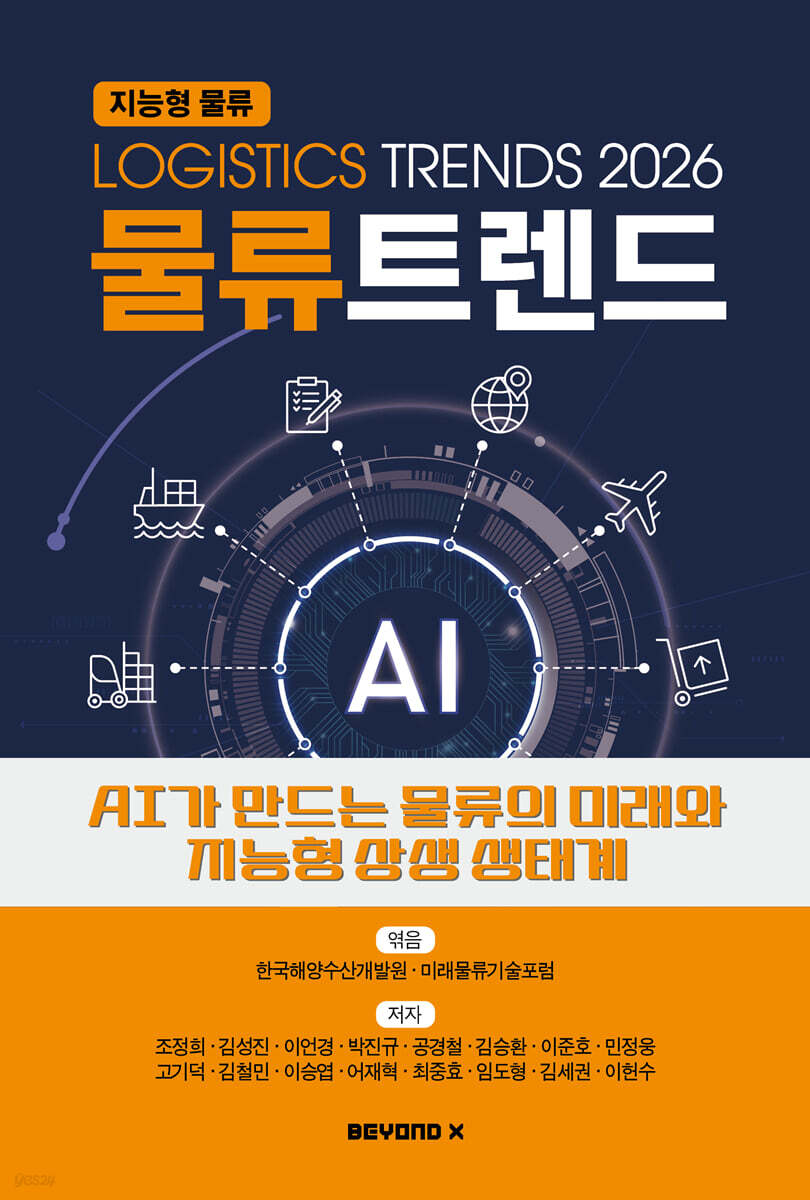
Logistics Trends 2026
 |
Description
Book Introduction
From technological innovation to industrial transformation, everything about logistics in 2026.
In 2026, the logistics industry is undergoing fundamental change due to the convergence of AI and automation technologies.
Humanoid robots equipped with physical AI collaborate with humans in logistics centers, while agentic AI autonomously manages the entire process, from demand forecasting to delivery optimization. AGVs, AMRs, autonomous trucks, and drones are organically connected to automate the entire logistics process into a single, intelligent flow. Wearable robots are reducing workers' physical burden by 30%, ushering in a new era of human augmentation.
The proliferation of urban micro-fulfillment centers is making one-hour delivery commonplace, and big data and AI are enabling predictive delivery, where products are pre-ordered.
An intelligent, symbiotic ecosystem encompassing even small and medium-sized enterprises (SMEs) is being built through supply chain diversification and API-based platform integration to address geopolitical risks.
This book comprehensively covers technological innovation, market changes, global issues, and sustainability in the logistics industry, with the participation of 16 top experts from academia and industry, including KAIST, Coupang, LG CNS, LX Pantos, Hanwha Ocean, and HD Hyundai.
Technology is reshaping industries, ushering in a new era of transformation where people and machines collaborate.
In 2026, the logistics industry is undergoing fundamental change due to the convergence of AI and automation technologies.
Humanoid robots equipped with physical AI collaborate with humans in logistics centers, while agentic AI autonomously manages the entire process, from demand forecasting to delivery optimization. AGVs, AMRs, autonomous trucks, and drones are organically connected to automate the entire logistics process into a single, intelligent flow. Wearable robots are reducing workers' physical burden by 30%, ushering in a new era of human augmentation.
The proliferation of urban micro-fulfillment centers is making one-hour delivery commonplace, and big data and AI are enabling predictive delivery, where products are pre-ordered.
An intelligent, symbiotic ecosystem encompassing even small and medium-sized enterprises (SMEs) is being built through supply chain diversification and API-based platform integration to address geopolitical risks.
This book comprehensively covers technological innovation, market changes, global issues, and sustainability in the logistics industry, with the participation of 16 top experts from academia and industry, including KAIST, Coupang, LG CNS, LX Pantos, Hanwha Ocean, and HD Hyundai.
Technology is reshaping industries, ushering in a new era of transformation where people and machines collaborate.
- You can preview some of the book's contents.
Preview
index
Published articles
The Blue Economy Era: A Logistics Revolution Unleashed by the Sea _ Cho Jeong-hee, President of the Korea Maritime Institute
From Connectivity to Convergence, the Evolution of Logistics Begins _ Kim Seong-jin, Chairman of the Future Logistics Technology Forum
General
A Great Transformation of the Logistics Ecosystem: Turning Uncertainty into Opportunity _ Lee Eun-kyung
Part 1: Technology Innovation
· Agentic AI is changing the logistics landscape _ Jin-gyu Park
Beyond the Limits of Automation: The Era of Human Augmentation _ Gong Kyung-chul and Kim Seung-hwan
· Humanoid robots appearing in logistics centers _ Lee Jun-ho
Part 2: Market Transformation
· Supply Chain Management Evolved by AI _ Min Jeong-ung
· The ultra-high-speed logistics revolution is changing the world _ Go Gi-deok
Last Mile Big Bang: How Platforms Changed Our Neighborhoods _ Kim Chul-min
Part 3: Global Dynamics
· Game Changer in Supply Chain Finance _ Seung-Yeop Lee
· Geopolitical Risk and Logistics Response Strategy _ Jaehyuk Eo
· Opportunities and Challenges in the Shipbuilding Industry _ Choi Jung-hyo
Part 4: Sustainability
· The autonomous driving revolution at sea _ Lim Do-hyung
· 5-Minute Charging Changes the Delivery Ecosystem _ Kim Se-kwon
· Coloring the Sky Eco-Friendly _ Lee Hyun-soo
The Blue Economy Era: A Logistics Revolution Unleashed by the Sea _ Cho Jeong-hee, President of the Korea Maritime Institute
From Connectivity to Convergence, the Evolution of Logistics Begins _ Kim Seong-jin, Chairman of the Future Logistics Technology Forum
General
A Great Transformation of the Logistics Ecosystem: Turning Uncertainty into Opportunity _ Lee Eun-kyung
Part 1: Technology Innovation
· Agentic AI is changing the logistics landscape _ Jin-gyu Park
Beyond the Limits of Automation: The Era of Human Augmentation _ Gong Kyung-chul and Kim Seung-hwan
· Humanoid robots appearing in logistics centers _ Lee Jun-ho
Part 2: Market Transformation
· Supply Chain Management Evolved by AI _ Min Jeong-ung
· The ultra-high-speed logistics revolution is changing the world _ Go Gi-deok
Last Mile Big Bang: How Platforms Changed Our Neighborhoods _ Kim Chul-min
Part 3: Global Dynamics
· Game Changer in Supply Chain Finance _ Seung-Yeop Lee
· Geopolitical Risk and Logistics Response Strategy _ Jaehyuk Eo
· Opportunities and Challenges in the Shipbuilding Industry _ Choi Jung-hyo
Part 4: Sustainability
· The autonomous driving revolution at sea _ Lim Do-hyung
· 5-Minute Charging Changes the Delivery Ecosystem _ Kim Se-kwon
· Coloring the Sky Eco-Friendly _ Lee Hyun-soo
Into the book
Agentic AI goes beyond simply performing given tasks; it sets its own goals, perceives its environment, and makes optimal decisions.
In logistics centers, agentic AI autonomously manages the entire process, from demand forecasting and inventory management to picking route optimization and delivery scheduling.
This means that we have entered an era of 'intelligent autonomy' that goes beyond simple automation.
As of 2026, major domestic logistics companies have improved operational efficiency by more than 40% through the introduction of agentic AI, freeing human managers to focus on handling exceptions and making strategic decisions.
- From 'Agentic AI, Changing the Logistics Landscape', Supply Chain Finance (SCF) is not just a financial product, but a game changer that upgrades the entire logistics ecosystem.
99.9% of domestic shipping companies are small and medium-sized enterprises (SMEs), and the average payment collection period is 67 days. SCF addresses this issue by leveraging the credit ratings of shippers.
The structure is such that the financial institution first pays 97% of the payment to the transport company within 3 days of the completion of the transport service, and the shipper company repays the principal to the financial institution 60 days later.
Instead of the high interest rates of 8.7% per annum, carriers can secure immediate cash at a reasonable financing cost of 3.5%.
As of 2025, 15 major domestic logistics companies have adopted the SCF program, and approximately 8,000 small and medium-sized transportation companies are benefiting from it.
In logistics centers, agentic AI autonomously manages the entire process, from demand forecasting and inventory management to picking route optimization and delivery scheduling.
This means that we have entered an era of 'intelligent autonomy' that goes beyond simple automation.
As of 2026, major domestic logistics companies have improved operational efficiency by more than 40% through the introduction of agentic AI, freeing human managers to focus on handling exceptions and making strategic decisions.
- From 'Agentic AI, Changing the Logistics Landscape', Supply Chain Finance (SCF) is not just a financial product, but a game changer that upgrades the entire logistics ecosystem.
99.9% of domestic shipping companies are small and medium-sized enterprises (SMEs), and the average payment collection period is 67 days. SCF addresses this issue by leveraging the credit ratings of shippers.
The structure is such that the financial institution first pays 97% of the payment to the transport company within 3 days of the completion of the transport service, and the shipper company repays the principal to the financial institution 60 days later.
Instead of the high interest rates of 8.7% per annum, carriers can secure immediate cash at a reasonable financing cost of 3.5%.
As of 2025, 15 major domestic logistics companies have adopted the SCF program, and approximately 8,000 small and medium-sized transportation companies are benefiting from it.
--- From "Game Changers in Supply Chain Finance"
Publisher's Review
From agentic AI to the autonomous driving revolution, everything logistics will look like in 2026.
In the wake of COVID-19, digital transformation, combined with AI and robotics technologies, is reshaping the entire logistics industry.
This book systematically analyzes the key technologies and trends that will drive the logistics industry in 2026, divided into four chapters.
Part 1, Technology Innovation, features leading researchers from KAIST and other leading domestic institutions exploring cutting-edge technologies that are revolutionizing logistics, including agentic AI, humanoid robots, and wearable robots, offering an in-depth look at the present and future of technology.
In Part 2, Market Transformation, experts from major logistics companies, including Coupang, analyze new business models and market changes, such as AI-based supply chain management, the ultra-high-speed logistics revolution, and last-mile platforms, and report vivid changes on the ground.
Part 3, Global Dynamics, addresses the changing global logistics environment, including supply chain finance (SCF), geopolitical risk responses, and opportunities for the shipbuilding industry, and presents strategies for responding to the era of geopolitical risk.
Part 4, Sustainability, examines the responsibilities of the logistics industry in the ESG era, including the maritime autonomous driving revolution, 5-minute charging technology, and eco-friendly aviation, and presents specific measures for building a sustainable logistics ecosystem.
The most striking feature of this book is its vision of an "intelligent, symbiotic ecosystem." It envisions a future where AI and automation technologies are integrated into platforms and shared with data, enabling not only large corporations but also small and medium-sized logistics companies to leverage them, creating a truly symbiotic ecosystem.
In the wake of COVID-19, digital transformation, combined with AI and robotics technologies, is reshaping the entire logistics industry.
This book systematically analyzes the key technologies and trends that will drive the logistics industry in 2026, divided into four chapters.
Part 1, Technology Innovation, features leading researchers from KAIST and other leading domestic institutions exploring cutting-edge technologies that are revolutionizing logistics, including agentic AI, humanoid robots, and wearable robots, offering an in-depth look at the present and future of technology.
In Part 2, Market Transformation, experts from major logistics companies, including Coupang, analyze new business models and market changes, such as AI-based supply chain management, the ultra-high-speed logistics revolution, and last-mile platforms, and report vivid changes on the ground.
Part 3, Global Dynamics, addresses the changing global logistics environment, including supply chain finance (SCF), geopolitical risk responses, and opportunities for the shipbuilding industry, and presents strategies for responding to the era of geopolitical risk.
Part 4, Sustainability, examines the responsibilities of the logistics industry in the ESG era, including the maritime autonomous driving revolution, 5-minute charging technology, and eco-friendly aviation, and presents specific measures for building a sustainable logistics ecosystem.
The most striking feature of this book is its vision of an "intelligent, symbiotic ecosystem." It envisions a future where AI and automation technologies are integrated into platforms and shared with data, enabling not only large corporations but also small and medium-sized logistics companies to leverage them, creating a truly symbiotic ecosystem.
GOODS SPECIFICS
- Date of issue: November 1, 2025
- Page count, weight, size: 386 pages | 152*223*30mm
- ISBN13: 9791197679070
- ISBN10: 1197679073
You may also like
카테고리
korean


korean

![GQ KOREA Mark (Monthly): December [2025]](http://librairie.coreenne.fr/cdn/shop/files/8ef265dbbfbf186523ed75ba7319009d.jpg?v=1765340328&width=3840)


