

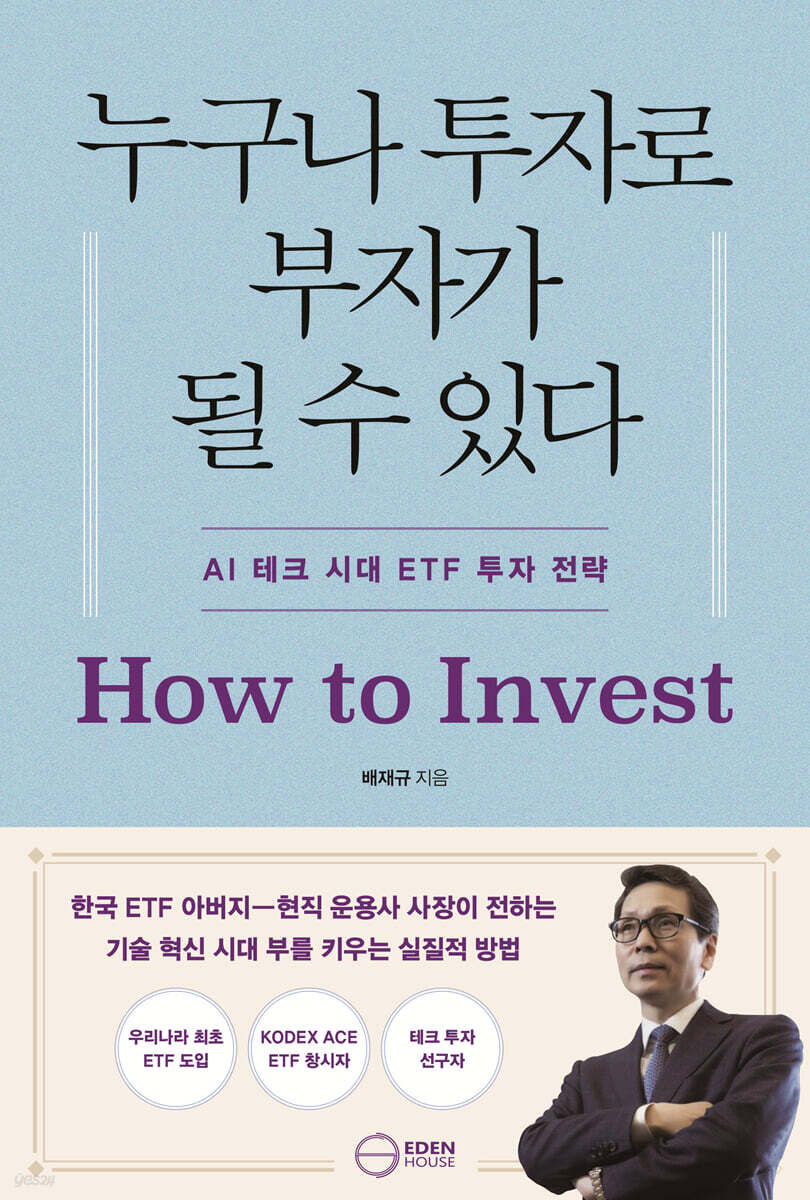
Anyone can become rich through investing.
 |
Description
Book Introduction
The father of Korean ETFs, the current head of an asset management company, shares his thoughts.
Practical Ways to Grow Wealth in the Age of Technological Innovation
“Invest in long-term future growth!”
● Fail-safe investments from the founder of South Korea's ETF and a pioneer in tech investment.
How to become rich through two basic principles: direction and time.
● Change the investment paradigm, stand on the shoulders of the giant called 'ETF' and see a wider world!
Everyone wants to be rich.
But the reality is not easy.
People try various investment methods, but only a very small number of people manage to find wealth.
But here is someone who shouts, “Anyone can become rich.”
This is CEO Bae Jae-gyu, known as the 'father of Korean ETFs.'
Having worked in the asset management industry for over 25 years and acquired numerous investment methods and know-how, he says that the reason people fail at investing is not because of a lack of effort or will, but because of a wrong investment 'method'.
His investment philosophy, which states that anyone can succeed in investing if they correctly understand direction and timing, can be summarized in one word: "Invest for the long term in future growth."
"Anyone Can Get Rich Through Investment" teaches you how to become truly rich through investment, not how to make money with a single investment.
This book covers everything from the investment principles of legendary investment gurus to how the market reacted, recovered, and changed during major crises like the financial crisis, COVID-19, and the dot-com bubble, and, most importantly, how the investment market will operate during the current transformational period, when AI is once again shifting the world's paradigm.
It's the investment bible of our time, offering a path to success that can be implemented without being an expert or having to look at the markets every day.
Practical Ways to Grow Wealth in the Age of Technological Innovation
“Invest in long-term future growth!”
● Fail-safe investments from the founder of South Korea's ETF and a pioneer in tech investment.
How to become rich through two basic principles: direction and time.
● Change the investment paradigm, stand on the shoulders of the giant called 'ETF' and see a wider world!
Everyone wants to be rich.
But the reality is not easy.
People try various investment methods, but only a very small number of people manage to find wealth.
But here is someone who shouts, “Anyone can become rich.”
This is CEO Bae Jae-gyu, known as the 'father of Korean ETFs.'
Having worked in the asset management industry for over 25 years and acquired numerous investment methods and know-how, he says that the reason people fail at investing is not because of a lack of effort or will, but because of a wrong investment 'method'.
His investment philosophy, which states that anyone can succeed in investing if they correctly understand direction and timing, can be summarized in one word: "Invest for the long term in future growth."
"Anyone Can Get Rich Through Investment" teaches you how to become truly rich through investment, not how to make money with a single investment.
This book covers everything from the investment principles of legendary investment gurus to how the market reacted, recovered, and changed during major crises like the financial crisis, COVID-19, and the dot-com bubble, and, most importantly, how the investment market will operate during the current transformational period, when AI is once again shifting the world's paradigm.
It's the investment bible of our time, offering a path to success that can be implemented without being an expert or having to look at the markets every day.
- You can preview some of the book's contents.
Preview
index
Prologue - Wishing for a world where everyone can become rich?
Chapter 1: Three Questions That Open the Door to Wealth
Chapter 2 What Should I Invest in (Choosing an Investment Target)?
Chapter 3: Analysis of Major Global Markets
Chapter 4: Seven Traps That Block Successful Investing
Chapter 5: Invest in Technology Stocks
Chapter 6: The Beginning of Passive Investing (The Fall of Active Investing)
Chapter 7: ETFs as the Crystal of Financial Innovation
Chapter 8: Asset Allocation and Life Cycle Funds (TDFs)
Chapter 9: Asset Management in a Transitional Period
Chapter 10: The Formula for Wealth
Epilogue: Investing is about long-term commitment to future growth.
Chapter 1: Three Questions That Open the Door to Wealth
Chapter 2 What Should I Invest in (Choosing an Investment Target)?
Chapter 3: Analysis of Major Global Markets
Chapter 4: Seven Traps That Block Successful Investing
Chapter 5: Invest in Technology Stocks
Chapter 6: The Beginning of Passive Investing (The Fall of Active Investing)
Chapter 7: ETFs as the Crystal of Financial Innovation
Chapter 8: Asset Allocation and Life Cycle Funds (TDFs)
Chapter 9: Asset Management in a Transitional Period
Chapter 10: The Formula for Wealth
Epilogue: Investing is about long-term commitment to future growth.
Prologue - Wishing for a world where everyone can become rich?
Chapter 1: Three Questions That Open the Door to Wealth
01 Why isn't investing just a stock-picking game?
02 How can I increase my chances of success in long-term investing?
03 Am I investing in the past or the future?
Chapter 2 What Should I Invest in (Choosing an Investment Target)?
01 Stocks: Investing in ownership of a company
02 Real Estate
03 Alternative Investment
04 Cryptocurrency: The Potential of a New Financial Order and Investment Strategies
Chapter 3: Analysis of Major Global Markets
01 The United States: A Market with Structural Competitiveness and Resilience
02 China: Partial Capitalism
03 Japan, Europe, India and Taiwan
04 Korea: Opportunities and Risks for a Manufacturing Powerhouse
05 Conclusion of Global Market Analysis
Chapter 4: Seven Traps That Block Successful Investing
01 Investment based on outlook and prediction
02 Trading by Information
03 Mean Reversion
04 Short-term investment
05 Market Timing
06 Investment by incitement
07 Circular Investment and Value Stock Investment
Chapter 5: Invest in Technology Stocks
01 My Investment Philosophy Shift: Invest Long-Term for Future Growth
02 Human History and Technological Progress
03 The Digital Age and Tech Companies
04 The Digital Age and Semiconductors
05 The AI Era and Semiconductors
06 Investment and Valuation of Tech Companies (Tech Stocks)
07 Risks of Investing in Technology Stocks
Chapter 6: The Beginning of Passive Investing (The Fall of Active Investing)
01 Passive Investment
02 Active Investment
03 Paradigm Shift in the Asset Management Market
04 Changes in Asset Management and Manufacturing Business Models
05 What is the competitiveness of asset managers in the era of passive management?
Chapter 7: ETFs as the Crystal of Financial Innovation
01 The Birth of ETFs
02 ETF's Core Philosophy
03 Mainstream of the global financial market
04 ETFs as 'tools' rather than commodities
05 Things to Consider When Investing in ETFs
06 Korean ETFs
Chapter 8: Asset Allocation and Life Cycle Funds (TDFs)
01 Basic Concepts of Asset Allocation
02 Real-world examples of asset allocation
03 TDF
04 Korea Investment Trust Management TDF: Korea Investment TDF ETF Focus
Chapter 9: Asset Management in a Transitional Period
01 History of Capitalist Development
02 The Vision of Asset Management Companies that Must Move from Stage 2 to Stage 3 of Capitalism
03 'Make KIM Great', a great operator built on customer trust.
Chapter 10: The Formula for Wealth
01 Investment principal (P)
02 The power of sustainable investment returns (r)
03 The Magic of Long-Term Investment Compounding
Epilogue - Investing is about long-term participation in future growth. Prologue - Hoping for a world where everyone can become rich.
Chapter 1: Three Questions That Open the Door to Wealth
01 Why isn't investing just a stock-picking game?
02 How can I increase my chances of success in long-term investing?
03 Am I investing in the past or the future?
Chapter 2 What Should I Invest in (Choosing an Investment Target)?
01 Stocks: Investing in ownership of a company
02 Real Estate
03 Alternative Investment
04 Cryptocurrency: The Potential of a New Financial Order and Investment Strategies
Chapter 3: Analysis of Major Global Markets
01 The United States: A Market with Structural Competitiveness and Resilience
02 China: Partial Capitalism
03 Japan, Europe, India and Taiwan
04 Korea: Opportunities and Risks for a Manufacturing Powerhouse
05 Conclusion of Global Market Analysis
Chapter 4: Seven Traps That Block Successful Investing
01 Investment based on outlook and prediction
02 Trading by Information
03 Mean Reversion
04 Short-term investment
05 Market Timing
06 Investment by incitement
07 Circular Investment and Value Stock Investment
Chapter 5: Invest in Technology Stocks
01 My Investment Philosophy Shift: Invest Long-Term for Future Growth
02 Human History and Technological Progress
03 The Digital Age and Tech Companies
04 The Digital Age and Semiconductors
05 The AI Era and Semiconductors
06 Investment and Valuation of Tech Companies (Tech Stocks)
07 Risks of Investing in Technology Stocks
Chapter 6: The Beginning of Passive Investing (The Fall of Active Investing)
01 Passive Investment
02 Active Investment
03 Paradigm Shift in the Asset Management Market
04 Changes in Asset Management and Manufacturing Business Models
05 What is the competitiveness of asset managers in the era of passive management?
Chapter 7: ETFs as the Crystal of Financial Innovation
01 The Birth of ETFs
02 ETF's Core Philosophy
03 Mainstream of the global financial market
04 ETFs as 'tools' rather than commodities
05 Things to Consider When Investing in ETFs
06 Korean ETFs
Chapter 8: Asset Allocation and Life Cycle Funds (TDFs)
01 Basic Concepts of Asset Allocation
02 Real-world examples of asset allocation
03 TDF
04 Korea Investment Trust Management TDF: Korea Investment TDF ETF Focus
Chapter 9: Asset Management in a Transitional Period
01 History of Capitalist Development
02 The Vision of Asset Management Companies that Must Move from Stage 2 to Stage 3 of Capitalism
03 'Make KIM Great', a great operator built on customer trust.
Chapter 10: The Formula for Wealth
01 Investment principal (P)
02 The power of sustainable investment returns (r)
03 The Magic of Long-Term Investment Compounding
Epilogue: Investing is about long-term commitment to future growth.
Chapter 1: Three Questions That Open the Door to Wealth
01 Why isn't investing just a stock-picking game?
02 How can I increase my chances of success in long-term investing?
03 Am I investing in the past or the future?
Chapter 2 What Should I Invest in (Choosing an Investment Target)?
01 Stocks: Investing in ownership of a company
02 Real Estate
03 Alternative Investment
04 Cryptocurrency: The Potential of a New Financial Order and Investment Strategies
Chapter 3: Analysis of Major Global Markets
01 The United States: A Market with Structural Competitiveness and Resilience
02 China: Partial Capitalism
03 Japan, Europe, India and Taiwan
04 Korea: Opportunities and Risks for a Manufacturing Powerhouse
05 Conclusion of Global Market Analysis
Chapter 4: Seven Traps That Block Successful Investing
01 Investment based on outlook and prediction
02 Trading by Information
03 Mean Reversion
04 Short-term investment
05 Market Timing
06 Investment by incitement
07 Circular Investment and Value Stock Investment
Chapter 5: Invest in Technology Stocks
01 My Investment Philosophy Shift: Invest Long-Term for Future Growth
02 Human History and Technological Progress
03 The Digital Age and Tech Companies
04 The Digital Age and Semiconductors
05 The AI Era and Semiconductors
06 Investment and Valuation of Tech Companies (Tech Stocks)
07 Risks of Investing in Technology Stocks
Chapter 6: The Beginning of Passive Investing (The Fall of Active Investing)
01 Passive Investment
02 Active Investment
03 Paradigm Shift in the Asset Management Market
04 Changes in Asset Management and Manufacturing Business Models
05 What is the competitiveness of asset managers in the era of passive management?
Chapter 7: ETFs as the Crystal of Financial Innovation
01 The Birth of ETFs
02 ETF's Core Philosophy
03 Mainstream of the global financial market
04 ETFs as 'tools' rather than commodities
05 Things to Consider When Investing in ETFs
06 Korean ETFs
Chapter 8: Asset Allocation and Life Cycle Funds (TDFs)
01 Basic Concepts of Asset Allocation
02 Real-world examples of asset allocation
03 TDF
04 Korea Investment Trust Management TDF: Korea Investment TDF ETF Focus
Chapter 9: Asset Management in a Transitional Period
01 History of Capitalist Development
02 The Vision of Asset Management Companies that Must Move from Stage 2 to Stage 3 of Capitalism
03 'Make KIM Great', a great operator built on customer trust.
Chapter 10: The Formula for Wealth
01 Investment principal (P)
02 The power of sustainable investment returns (r)
03 The Magic of Long-Term Investment Compounding
Epilogue - Investing is about long-term participation in future growth. Prologue - Hoping for a world where everyone can become rich.
Chapter 1: Three Questions That Open the Door to Wealth
01 Why isn't investing just a stock-picking game?
02 How can I increase my chances of success in long-term investing?
03 Am I investing in the past or the future?
Chapter 2 What Should I Invest in (Choosing an Investment Target)?
01 Stocks: Investing in ownership of a company
02 Real Estate
03 Alternative Investment
04 Cryptocurrency: The Potential of a New Financial Order and Investment Strategies
Chapter 3: Analysis of Major Global Markets
01 The United States: A Market with Structural Competitiveness and Resilience
02 China: Partial Capitalism
03 Japan, Europe, India and Taiwan
04 Korea: Opportunities and Risks for a Manufacturing Powerhouse
05 Conclusion of Global Market Analysis
Chapter 4: Seven Traps That Block Successful Investing
01 Investment based on outlook and prediction
02 Trading by Information
03 Mean Reversion
04 Short-term investment
05 Market Timing
06 Investment by incitement
07 Circular Investment and Value Stock Investment
Chapter 5: Invest in Technology Stocks
01 My Investment Philosophy Shift: Invest Long-Term for Future Growth
02 Human History and Technological Progress
03 The Digital Age and Tech Companies
04 The Digital Age and Semiconductors
05 The AI Era and Semiconductors
06 Investment and Valuation of Tech Companies (Tech Stocks)
07 Risks of Investing in Technology Stocks
Chapter 6: The Beginning of Passive Investing (The Fall of Active Investing)
01 Passive Investment
02 Active Investment
03 Paradigm Shift in the Asset Management Market
04 Changes in Asset Management and Manufacturing Business Models
05 What is the competitiveness of asset managers in the era of passive management?
Chapter 7: ETFs as the Crystal of Financial Innovation
01 The Birth of ETFs
02 ETF's Core Philosophy
03 Mainstream of the global financial market
04 ETFs as 'tools' rather than commodities
05 Things to Consider When Investing in ETFs
06 Korean ETFs
Chapter 8: Asset Allocation and Life Cycle Funds (TDFs)
01 Basic Concepts of Asset Allocation
02 Real-world examples of asset allocation
03 TDF
04 Korea Investment Trust Management TDF: Korea Investment TDF ETF Focus
Chapter 9: Asset Management in a Transitional Period
01 History of Capitalist Development
02 The Vision of Asset Management Companies that Must Move from Stage 2 to Stage 3 of Capitalism
03 'Make KIM Great', a great operator built on customer trust.
Chapter 10: The Formula for Wealth
01 Investment principal (P)
02 The power of sustainable investment returns (r)
03 The Magic of Long-Term Investment Compounding
Epilogue: Investing is about long-term commitment to future growth.
Into the book
"Anyone Can Become Rich Through Investment" will have different meanings for different readers.
For the average investor, it presents a simple yet powerful strategy that anyone can consistently implement.
For professional investors, it provides an opportunity to reflect on the continuities and disconnects between value investing and tech-focused growth investing.
For those in the asset management industry, this will serve as a reminder of the fundamental shift in the industry, moving from the "art of stock selection" to the "science of product planning and marketing."
--- From the prologue, “Anyone Can Become Rich Through Investment”
I propose the following four new investment principles for the tech age:
First, read the trends of the times and allocate capital to the tech industry, which is at the center of structural growth.
We are moving beyond the manufacturing-centric era and are at a turning point where platforms, AI, semiconductors, cloud computing, and bio are redrawing the map of wealth.
AI, in particular, is a key driver of reshaping the economy and society in the coming decades.
Second, create a structure that overcomes short-term volatility.
By utilizing ETFs that encompass entire industries, sectors, and themes rather than individual stocks, you can reduce individual company risk and gain the psychological stability of a portfolio that won't fail.
Third, don't be swayed by the noise of the market, but invest your time and capital in industries that will create the future and enjoy the benefits of compound interest.
Fourth, save time on investing and invest in yourself.
Investing in knowledge, health, and networks leads to ultimate success in life.
--- From Chapter 1, “Three Questions to Open the Door to Wealth”
While the Korean market may have the potential for a short-term rebound through institutional reform, it must also be considered that structural limitations to institutional reform remain.
Unless the complex weaknesses of slowing growth, backward systems, profit monopoly structure, and non-expert-centered management are resolved, its long-term appeal will be limited.
The days when 'patriotic investment' was taken for granted, as in the past, are long gone.
Individual investors, known as "Seohak Ants," are entering the world's most powerful capital market.
This trend is not a fad, but a structural shift toward a better investment ecosystem.
--- From Chapter 3, "World? Major? Market? Analysis"
In reality, many investors suffer investment failures due to emotional failures, where they are swayed by market volatility and end up missing out on investment performance.
But in reality, most mistakes made repeatedly in investing stem from choosing the wrong target in the first place.
In other words, it is an error in logical judgment.
In other words, ‘failure to choose’ is more common than ‘failure to wait.’
From now on, I would like to organize the mistakes that investors are likely to make in the process of making logical decisions, namely, 'Things not to do when investing.'
This is the most important topic that must be addressed to improve investment performance.
--- From Chapter 4, "Seven Traps That Block Successful Investment"
We are currently standing on the threshold of the AI era.
Artificial intelligence is emerging as a new paradigm that will reshape all industries and society, transcending a single technology.
However, this massive transformation was ultimately made possible by semiconductors. High-performance semiconductors underpin every process by which AI learns, infers, and communicates with humans.
AI is permeating human civilization in a wide range of fields, from autonomous driving and robotics to healthcare and life sciences, and even the AI+X (Physical AI) era.
It is not just a continuation of digital expansion, but a paradigm shift where the very operating principles of human civilization are being changed by the addition of intelligence called AI.
--- From Chapter 5, "Invest in Technology Stocks"
Passive management has now become the dominant approach in the global asset management market.
This is because the advantage of active management has virtually disappeared as the academic verification of active management strategies, which had been shrouded in secrecy for a long time, and the information asymmetry was resolved with the implementation of the FD (Fair Disclosure) system in the United States in 2000.
Here, active funds are increasingly failing to keep up with market returns despite their high fees.
On the other hand, passive strategies have led to fund inflows by providing stable performance at low costs.
--- From Chapter 6, "The Beginning of Passive Investment (The Fall of Active Investment)"
The Korean asset management market has now entered a clear turning point.
The future of some asset managers who remain centered on active funds is difficult to be optimistic about. Asset managers not currently engaged in ETF operations should either expedite a strategic shift toward ETFs or actively explore expansion into alternative assets.
(Omitted) The Korean ETF market has achieved remarkable quantitative growth so far.
Now is the time to move towards qualitative evolution.
If changes like reforming the retirement pension system, strengthening platform-based distribution, expanding investor education, and engaging in sensible competition among ETF operators are implemented together, ETFs will go beyond simple investment products and become a key tool for Korean investors to accumulate wealth over the long term.
--- From Chapter 7, "ETFs as a Crystal of Finance? Innovation?"
I believe that a flywheel structure centered on customer value is essential for the sustainable growth of asset management companies.
The flywheel is a virtuous cycle where customers are first helped to succeed, that success breeds trust, and based on that trust, long-term relationships are formed, which in turn naturally attracts more customers.
--- From Chapter 9, "Asset Management in a Transitional Period"
Wealth in the future (abbreviated as 'Wf') can be expressed by the simple formula below.
It's a simple formula, but it holds a surprising truth within it.
That's the power of compound interest.
The effects of compounding work exponentially over time.
Anyone, even an ordinary person, can accumulate wealth if they deeply understand this formula and apply it to their own lives.
The key is how quickly you start, how long you stick with it, and what kind of consistent returns you can achieve.
For the average investor, it presents a simple yet powerful strategy that anyone can consistently implement.
For professional investors, it provides an opportunity to reflect on the continuities and disconnects between value investing and tech-focused growth investing.
For those in the asset management industry, this will serve as a reminder of the fundamental shift in the industry, moving from the "art of stock selection" to the "science of product planning and marketing."
--- From the prologue, “Anyone Can Become Rich Through Investment”
I propose the following four new investment principles for the tech age:
First, read the trends of the times and allocate capital to the tech industry, which is at the center of structural growth.
We are moving beyond the manufacturing-centric era and are at a turning point where platforms, AI, semiconductors, cloud computing, and bio are redrawing the map of wealth.
AI, in particular, is a key driver of reshaping the economy and society in the coming decades.
Second, create a structure that overcomes short-term volatility.
By utilizing ETFs that encompass entire industries, sectors, and themes rather than individual stocks, you can reduce individual company risk and gain the psychological stability of a portfolio that won't fail.
Third, don't be swayed by the noise of the market, but invest your time and capital in industries that will create the future and enjoy the benefits of compound interest.
Fourth, save time on investing and invest in yourself.
Investing in knowledge, health, and networks leads to ultimate success in life.
--- From Chapter 1, “Three Questions to Open the Door to Wealth”
While the Korean market may have the potential for a short-term rebound through institutional reform, it must also be considered that structural limitations to institutional reform remain.
Unless the complex weaknesses of slowing growth, backward systems, profit monopoly structure, and non-expert-centered management are resolved, its long-term appeal will be limited.
The days when 'patriotic investment' was taken for granted, as in the past, are long gone.
Individual investors, known as "Seohak Ants," are entering the world's most powerful capital market.
This trend is not a fad, but a structural shift toward a better investment ecosystem.
--- From Chapter 3, "World? Major? Market? Analysis"
In reality, many investors suffer investment failures due to emotional failures, where they are swayed by market volatility and end up missing out on investment performance.
But in reality, most mistakes made repeatedly in investing stem from choosing the wrong target in the first place.
In other words, it is an error in logical judgment.
In other words, ‘failure to choose’ is more common than ‘failure to wait.’
From now on, I would like to organize the mistakes that investors are likely to make in the process of making logical decisions, namely, 'Things not to do when investing.'
This is the most important topic that must be addressed to improve investment performance.
--- From Chapter 4, "Seven Traps That Block Successful Investment"
We are currently standing on the threshold of the AI era.
Artificial intelligence is emerging as a new paradigm that will reshape all industries and society, transcending a single technology.
However, this massive transformation was ultimately made possible by semiconductors. High-performance semiconductors underpin every process by which AI learns, infers, and communicates with humans.
AI is permeating human civilization in a wide range of fields, from autonomous driving and robotics to healthcare and life sciences, and even the AI+X (Physical AI) era.
It is not just a continuation of digital expansion, but a paradigm shift where the very operating principles of human civilization are being changed by the addition of intelligence called AI.
--- From Chapter 5, "Invest in Technology Stocks"
Passive management has now become the dominant approach in the global asset management market.
This is because the advantage of active management has virtually disappeared as the academic verification of active management strategies, which had been shrouded in secrecy for a long time, and the information asymmetry was resolved with the implementation of the FD (Fair Disclosure) system in the United States in 2000.
Here, active funds are increasingly failing to keep up with market returns despite their high fees.
On the other hand, passive strategies have led to fund inflows by providing stable performance at low costs.
--- From Chapter 6, "The Beginning of Passive Investment (The Fall of Active Investment)"
The Korean asset management market has now entered a clear turning point.
The future of some asset managers who remain centered on active funds is difficult to be optimistic about. Asset managers not currently engaged in ETF operations should either expedite a strategic shift toward ETFs or actively explore expansion into alternative assets.
(Omitted) The Korean ETF market has achieved remarkable quantitative growth so far.
Now is the time to move towards qualitative evolution.
If changes like reforming the retirement pension system, strengthening platform-based distribution, expanding investor education, and engaging in sensible competition among ETF operators are implemented together, ETFs will go beyond simple investment products and become a key tool for Korean investors to accumulate wealth over the long term.
--- From Chapter 7, "ETFs as a Crystal of Finance? Innovation?"
I believe that a flywheel structure centered on customer value is essential for the sustainable growth of asset management companies.
The flywheel is a virtuous cycle where customers are first helped to succeed, that success breeds trust, and based on that trust, long-term relationships are formed, which in turn naturally attracts more customers.
--- From Chapter 9, "Asset Management in a Transitional Period"
Wealth in the future (abbreviated as 'Wf') can be expressed by the simple formula below.
It's a simple formula, but it holds a surprising truth within it.
That's the power of compound interest.
The effects of compounding work exponentially over time.
Anyone, even an ordinary person, can accumulate wealth if they deeply understand this formula and apply it to their own lives.
The key is how quickly you start, how long you stick with it, and what kind of consistent returns you can achieve.
--- From "Chapter 10 'The Formula of Wealth'"
Publisher's Review
Two Conditions for Successful Investment
Bae Jae-gyu, CEO of Korea Investment Trust Management, says there are only two conditions necessary for successful investing, and understanding them will enable anyone to achieve investment success.
It's just direction and time.
First, direction is the logical realm of choosing the right investment target.
Next, time is an emotional realm, a matter of understanding and overcoming market volatility.
It seems simple at first, but is it really? People believe they can become rich simply by picking the right stocks.
I think if I had bought Nvidia, Tesla, or Bitcoin 10 years ago, I would be rich by now.
Reality is different.
Because I would have sold it even if I made a small profit, being swayed by the volatility over the past 10 years.
It goes without saying that selecting good stocks requires an excellent eye for reading the times.
That's why we need this book.
"Anyone Can Become Rich Through Investment" is a book that compiles the direction and timing of investment, that is, how to view, invest in, and overcome the logical and emotional realms of investment.
First, it provides the right investment direction by explaining the major events in history that changed the wealth paradigm, how the direction of wealth changed at that time, and where we stand now.
It also predicts how cutting-edge technologies, such as AI, will change the future world and how this will change the world and our lives.
Next, we'll provide a clear overview of seven common pitfalls investors face when investing to weather market volatility, analyze major global markets, and transition from active to passive investing.
The author argues that successful investing requires a structural framework that ensures logic and overcoming emotions, and this book provides a solid foundation for this.
Invest long-term in future growth
Most of the methods used in today's investment world rely on short-term forecasts and predictions.
Of course, if you're lucky, you can make a profit this way.
But can this really be called investing? Despite the significant risk involved—a single failure could wipe out all previous gains—countless investors are making these flawed investments.
Jae-gyu Bae, author of “Anyone Can Become Rich Through Investment,” said, “Investing is not a game that relies on luck or intuition.
“You can’t get rich through short-term trading,” he asserts.
In other words, investing is a long-term battle, not a short-term one.
He says that through the realization that "investment is not a bet based on prospects and predictions, but rather the efficient acquisition of the fruits of corporate growth," he concluded that successful investment is "a function of direction and time."
It is a philosophy that is central to asset management around the world today.
Investing is essentially the act of postponing current consumption in order to realize a profit at a specific point in the future.
No investor would object to this.
But while we say we are preparing for the ‘future’, aren’t we actually focusing on what looks good in the ‘present’?
With decades of experience in the asset management industry, the author draws on his own successful experiences and expertise to offer sound investment advice, one that truly connects to the essence of investment and ensures its success. At a time of structural transformation, where AI and tech are reshaping the economy and power, he explains how individuals can systematically invest in future industries amidst this massive paradigm shift.
The way he conveys his message is very realistic and clear.
A vision for the future and small individual actions are enough.
In addition, it provides wisdom to live a successful life.
Bae Jae-gyu, CEO of Korea Investment Trust Management, says there are only two conditions necessary for successful investing, and understanding them will enable anyone to achieve investment success.
It's just direction and time.
First, direction is the logical realm of choosing the right investment target.
Next, time is an emotional realm, a matter of understanding and overcoming market volatility.
It seems simple at first, but is it really? People believe they can become rich simply by picking the right stocks.
I think if I had bought Nvidia, Tesla, or Bitcoin 10 years ago, I would be rich by now.
Reality is different.
Because I would have sold it even if I made a small profit, being swayed by the volatility over the past 10 years.
It goes without saying that selecting good stocks requires an excellent eye for reading the times.
That's why we need this book.
"Anyone Can Become Rich Through Investment" is a book that compiles the direction and timing of investment, that is, how to view, invest in, and overcome the logical and emotional realms of investment.
First, it provides the right investment direction by explaining the major events in history that changed the wealth paradigm, how the direction of wealth changed at that time, and where we stand now.
It also predicts how cutting-edge technologies, such as AI, will change the future world and how this will change the world and our lives.
Next, we'll provide a clear overview of seven common pitfalls investors face when investing to weather market volatility, analyze major global markets, and transition from active to passive investing.
The author argues that successful investing requires a structural framework that ensures logic and overcoming emotions, and this book provides a solid foundation for this.
Invest long-term in future growth
Most of the methods used in today's investment world rely on short-term forecasts and predictions.
Of course, if you're lucky, you can make a profit this way.
But can this really be called investing? Despite the significant risk involved—a single failure could wipe out all previous gains—countless investors are making these flawed investments.
Jae-gyu Bae, author of “Anyone Can Become Rich Through Investment,” said, “Investing is not a game that relies on luck or intuition.
“You can’t get rich through short-term trading,” he asserts.
In other words, investing is a long-term battle, not a short-term one.
He says that through the realization that "investment is not a bet based on prospects and predictions, but rather the efficient acquisition of the fruits of corporate growth," he concluded that successful investment is "a function of direction and time."
It is a philosophy that is central to asset management around the world today.
Investing is essentially the act of postponing current consumption in order to realize a profit at a specific point in the future.
No investor would object to this.
But while we say we are preparing for the ‘future’, aren’t we actually focusing on what looks good in the ‘present’?
With decades of experience in the asset management industry, the author draws on his own successful experiences and expertise to offer sound investment advice, one that truly connects to the essence of investment and ensures its success. At a time of structural transformation, where AI and tech are reshaping the economy and power, he explains how individuals can systematically invest in future industries amidst this massive paradigm shift.
The way he conveys his message is very realistic and clear.
A vision for the future and small individual actions are enough.
In addition, it provides wisdom to live a successful life.
GOODS SPECIFICS
- Date of issue: November 30, 2025
- Page count, weight, size: 328 pages | 598g | 152*225*20mm
- ISBN13: 9791194353379
- ISBN10: 1194353371
You may also like
카테고리
korean


korean

![GQ KOREA Mark (Monthly): December [2025]](http://librairie.coreenne.fr/cdn/shop/files/8ef265dbbfbf186523ed75ba7319009d.jpg?v=1765340328&width=3840)


