

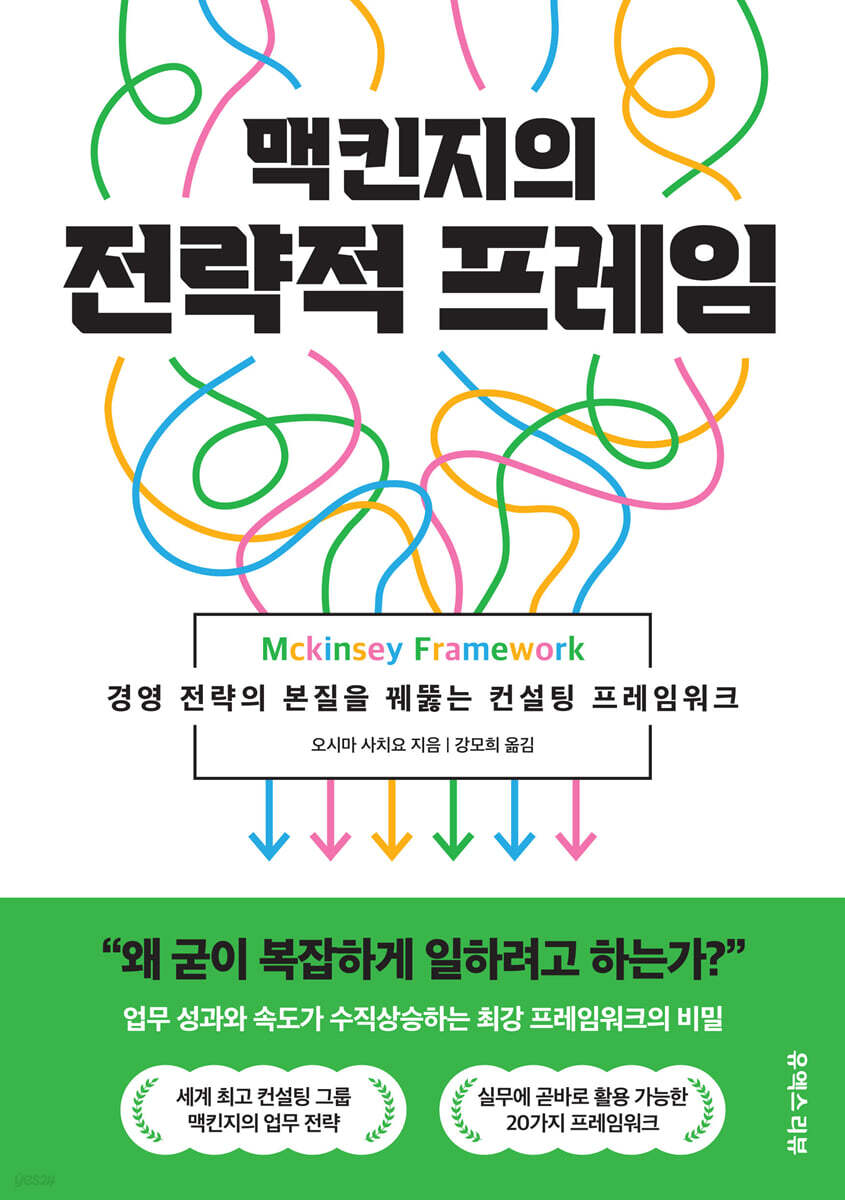
McKinsey's Strategic Framework
 |
Description
Book Introduction
McKinsey, the world's leading management consulting firm
Revealing the strategic framework used by consultants!
The more you use it, the more your speed and logic will improve.
Implement 20 Management Frameworks into Your Work!
A book that reveals the work framework actually used by consultants at McKinsey, considered the world's leading management consulting firm.
This framework, which McKinsey has used as the basis for strategic planning while providing management consulting services to numerous global companies, including the U.S. government, Coca-Cola, IBM, and Johnson & Johnson, helps quickly grasp the essence of any complex problem, analyze information, and derive accurate solutions.
McKinsey's Strategic Framework details techniques for simplifying complex problems and identifying their core, utilizing 20 management frameworks utilized by top-tier consultants, including MECE, logic trees, 3C analysis, the PDCA cycle, and SWOT analysis.
This will enable readers to develop faster and more efficient information analysis skills, more accurate decision-making skills, and stronger problem-solving abilities.
The framework covered in this book can be a particularly practical and powerful tool for planners, management consultants, and others who need to achieve maximum results within limited time.
A framework that penetrates the essence of management strategy maximizes individual and organizational productivity by structuring problems and approaching them logically.
The author details 20 framework techniques tailored to three objectives: "element analysis," "flow analysis," and "comparison and contrast," and suggests ways to utilize them to achieve tangible results.
The 20 techniques include a two-axis matrix that can efficiently execute everything from target setting to prioritization, and the “So What?” and “Why So?” questioning techniques that quickly identify the essence of a problem.
As this method has been proven effective by management consultants who must provide solutions to problems in various fields, it is useful for readers seeking to improve work efficiency by staying competitive in an ever-changing business environment.
Revealing the strategic framework used by consultants!
The more you use it, the more your speed and logic will improve.
Implement 20 Management Frameworks into Your Work!
A book that reveals the work framework actually used by consultants at McKinsey, considered the world's leading management consulting firm.
This framework, which McKinsey has used as the basis for strategic planning while providing management consulting services to numerous global companies, including the U.S. government, Coca-Cola, IBM, and Johnson & Johnson, helps quickly grasp the essence of any complex problem, analyze information, and derive accurate solutions.
McKinsey's Strategic Framework details techniques for simplifying complex problems and identifying their core, utilizing 20 management frameworks utilized by top-tier consultants, including MECE, logic trees, 3C analysis, the PDCA cycle, and SWOT analysis.
This will enable readers to develop faster and more efficient information analysis skills, more accurate decision-making skills, and stronger problem-solving abilities.
The framework covered in this book can be a particularly practical and powerful tool for planners, management consultants, and others who need to achieve maximum results within limited time.
A framework that penetrates the essence of management strategy maximizes individual and organizational productivity by structuring problems and approaching them logically.
The author details 20 framework techniques tailored to three objectives: "element analysis," "flow analysis," and "comparison and contrast," and suggests ways to utilize them to achieve tangible results.
The 20 techniques include a two-axis matrix that can efficiently execute everything from target setting to prioritization, and the “So What?” and “Why So?” questioning techniques that quickly identify the essence of a problem.
As this method has been proven effective by management consultants who must provide solutions to problems in various fields, it is useful for readers seeking to improve work efficiency by staying competitive in an ever-changing business environment.
- You can preview some of the book's contents.
Preview
index
Introduction: McKinsey's spleen-trained framework technology
McKinsey's Framework for Maximizing Work Capacity
3 Benefits of Framework Thinking
The important thing is the MECE sense
Three major framework types
Part 1: Problem-Solving Framework
Chapter 1: "Sky, Rain, and Umbrellas": Preventing Problems in Advance
Fact + Interpretation + Solution
How to predict and prevent problems from occurring
A crooked chimney foretells a fire.
Why You Should Be Wary of Internet and Newspaper Articles
Hints for improvement are right there on the ground.
A reasonable hypothesis determines whether a problem can be solved successfully.
How to collect high-quality information
5W1H that penetrates the essence of work
Chapter 2: 'So What?' and 'Why So?': Uncovering the Real Problem
The difference between causation and correlation
When you clarify cause and effect, you see the solution.
The 'why' of finding the essence of work
Solving workplace interpersonal relationship problems
If you find the issue, you can solve the problem.
The real question is finding the essence of the phenomenon.
If you want to solve a problem, focus on the phenomenon.
Keep asking questions until a concrete solution comes to mind.
Broaden your horizons and review everything thoroughly.
Chapter 3: Logic Trees: Systematically Reviewing Problem Solutions
To solve a problem, you need to know two things.
Break down big problems into smaller components
Using logic trees prevents accidental failures.
Note 1: Disassemble without omission or duplication.
Note 2: Analyze based on facts.
Note 3: If the importance is low, don't delve too deeply.
Prioritize from three perspectives
Digging deep into a problem reveals the whole picture.
What are the most fundamental and impactful challenges to address?
Part 2 Marketing Framework
Chapter 4: "3C Analysis": Understanding the Business Environment from Three Perspectives
Understand the market and competitive landscape to develop your own strategy.
Don't miss out on changes in the market and competitors.
Example of 3C Analysis: The Kimono Market
SWOT Analysis: The Pluses and Minuses
Analyze the external and internal environments.
Analysis reveals marketing strategy
It can be applied to life too
PEST analysis examines four aspects: politics, economy, society, and technology.
5Force Analysis: Exploring Five Competitive Factors
Example of 5Force Analysis: The Hamburger Industry
Chapter 5: The Effective Two-Axis Matrix for Differentiation Strategies
Organize and classify by horizontal and vertical axes
Priorities become clear
When determining the priority of sales locations
The Birth of the Two-Axis Matrix
Example of a two-axis matrix: Moisturizing academy
Chapter 6: "4Ps," from product development to sales strategy
You can know the current status of your product.
What are the measures to support a declining product?
How to Find Promising Segments in a Declining Market
4P Strategy: A Business-Consumer Perspective
Product: Differentiate yourself by responding to customer needs.
Price: The appropriate price is determined by three factors: 'demand,' 'cost,' and 'competition.'
How to Determine Market Share, Profit, and Top Direction
Place: The task of finalizing the overall marketing strategy.
Three Approaches to Designing Sales Channels
Promotion: Activities that encourage purchases
Part 3 Goal Achievement Framework
Chapter 7: The Business System That Creates Value
An era that requires people who create value
Only the value created is evaluated
'Value Chain' that analyzes the value provided
A 'business system' that views necessary elements as a continuous flow.
Create a product design by understanding the overall flow.
A 3-Step Decomposition Method for Easily Capturing Value
Establish the investigation work process and secondary values.
Example of a business system: a large hospital
Sell services, not things.
Find out what customer conveniences your company can provide.
Chapter 8: The PREP Method: A Persuasive Communication Method
When your boss doesn't give you time
3 Reasons Your Boss Rejected You
Communicate the purpose and time required at the same time
The 'Elevator Test': Conveying a Brief Message
Report in the following order: fact report → situation assessment → proposal
The PREP method: stating the conclusion first
3 reasons to support your claim
The basis is stratified in multiples of 3.
Remember the number 3
When delivering, use the 'power of 3'
The 'pyramid structure' that stacks logic like a pyramid
Chapter 9: The Experiential Learning Model: Achieving Goals Through Action and Improvement
Two methods used to solve problems
Symptomatic treatment is not a true solution to the problem.
We examine not only the perspectives of 'competitors' but also those of 'customers' and 'our own company'.
A practical framework: the experiential learning model
When generating good hypotheses and ideas
The PDCA cycle improves work efficiency.
A constant learning attitude
Actively embrace the wisdom of the experienced.
Conclusion
References
McKinsey's Framework for Maximizing Work Capacity
3 Benefits of Framework Thinking
The important thing is the MECE sense
Three major framework types
Part 1: Problem-Solving Framework
Chapter 1: "Sky, Rain, and Umbrellas": Preventing Problems in Advance
Fact + Interpretation + Solution
How to predict and prevent problems from occurring
A crooked chimney foretells a fire.
Why You Should Be Wary of Internet and Newspaper Articles
Hints for improvement are right there on the ground.
A reasonable hypothesis determines whether a problem can be solved successfully.
How to collect high-quality information
5W1H that penetrates the essence of work
Chapter 2: 'So What?' and 'Why So?': Uncovering the Real Problem
The difference between causation and correlation
When you clarify cause and effect, you see the solution.
The 'why' of finding the essence of work
Solving workplace interpersonal relationship problems
If you find the issue, you can solve the problem.
The real question is finding the essence of the phenomenon.
If you want to solve a problem, focus on the phenomenon.
Keep asking questions until a concrete solution comes to mind.
Broaden your horizons and review everything thoroughly.
Chapter 3: Logic Trees: Systematically Reviewing Problem Solutions
To solve a problem, you need to know two things.
Break down big problems into smaller components
Using logic trees prevents accidental failures.
Note 1: Disassemble without omission or duplication.
Note 2: Analyze based on facts.
Note 3: If the importance is low, don't delve too deeply.
Prioritize from three perspectives
Digging deep into a problem reveals the whole picture.
What are the most fundamental and impactful challenges to address?
Part 2 Marketing Framework
Chapter 4: "3C Analysis": Understanding the Business Environment from Three Perspectives
Understand the market and competitive landscape to develop your own strategy.
Don't miss out on changes in the market and competitors.
Example of 3C Analysis: The Kimono Market
SWOT Analysis: The Pluses and Minuses
Analyze the external and internal environments.
Analysis reveals marketing strategy
It can be applied to life too
PEST analysis examines four aspects: politics, economy, society, and technology.
5Force Analysis: Exploring Five Competitive Factors
Example of 5Force Analysis: The Hamburger Industry
Chapter 5: The Effective Two-Axis Matrix for Differentiation Strategies
Organize and classify by horizontal and vertical axes
Priorities become clear
When determining the priority of sales locations
The Birth of the Two-Axis Matrix
Example of a two-axis matrix: Moisturizing academy
Chapter 6: "4Ps," from product development to sales strategy
You can know the current status of your product.
What are the measures to support a declining product?
How to Find Promising Segments in a Declining Market
4P Strategy: A Business-Consumer Perspective
Product: Differentiate yourself by responding to customer needs.
Price: The appropriate price is determined by three factors: 'demand,' 'cost,' and 'competition.'
How to Determine Market Share, Profit, and Top Direction
Place: The task of finalizing the overall marketing strategy.
Three Approaches to Designing Sales Channels
Promotion: Activities that encourage purchases
Part 3 Goal Achievement Framework
Chapter 7: The Business System That Creates Value
An era that requires people who create value
Only the value created is evaluated
'Value Chain' that analyzes the value provided
A 'business system' that views necessary elements as a continuous flow.
Create a product design by understanding the overall flow.
A 3-Step Decomposition Method for Easily Capturing Value
Establish the investigation work process and secondary values.
Example of a business system: a large hospital
Sell services, not things.
Find out what customer conveniences your company can provide.
Chapter 8: The PREP Method: A Persuasive Communication Method
When your boss doesn't give you time
3 Reasons Your Boss Rejected You
Communicate the purpose and time required at the same time
The 'Elevator Test': Conveying a Brief Message
Report in the following order: fact report → situation assessment → proposal
The PREP method: stating the conclusion first
3 reasons to support your claim
The basis is stratified in multiples of 3.
Remember the number 3
When delivering, use the 'power of 3'
The 'pyramid structure' that stacks logic like a pyramid
Chapter 9: The Experiential Learning Model: Achieving Goals Through Action and Improvement
Two methods used to solve problems
Symptomatic treatment is not a true solution to the problem.
We examine not only the perspectives of 'competitors' but also those of 'customers' and 'our own company'.
A practical framework: the experiential learning model
When generating good hypotheses and ideas
The PDCA cycle improves work efficiency.
A constant learning attitude
Actively embrace the wisdom of the experienced.
Conclusion
References
Detailed image

Into the book
If you develop the habit of using frameworks to carry out your work, you will naturally develop "framework thinking," which is organizing information by setting a frame.
This will allow you to see things clearly, easily understand phenomena, and predict outcomes, while also noticeably improving your decision-making and communication skills.
--- p.8, from “The Secret Framework Skills forged at McKinsey”
Looking at a cloudy sky and saying 'it will rain', or seeing flames and firewood and guessing 'there will be a fire' are relatively accurate hypotheses.
However, in actual business situations, it is often very difficult to establish a hypothesis with high accuracy.
Conversely, if we can establish a hypothesis with high accuracy, we can say that we have reached the finish line of solving the problem.
--- p.31, from “Chapter 1: ‘Sky, Rain, and Umbrellas’ to Prevent Problems in Advance”
As we continue to break down the problem, we discover that there are several factors contributing to the problem of 'sales not increasing.'
The real problem may be that 'we're not spending time on acquiring new customers first,' or 'our usage per customer isn't increasing.'
Breaking down and analyzing a problem into a logic tree is the process of understanding the problem as a whole and clarifying its essence.
If you find a problem during this process, you can see if it can be solved, and further, you can 'crush' the problem by developing a new logic tree by asking a question about the problem.
--- p.75, from “Chapter 3: ‘Logic Tree’ for Systematically Reviewing Problem Solutions”
A framework is 'information x idea'.
This world is overflowing with vast amounts of information.
In this chaotic information landscape, how do we organize it? Depending on this, perspectives and interpretations will change, and ultimately, the actions we take will also change.
A framework is a tool that guides the process.
Everything I introduce in this book is a practical and versatile framework that I have used in my consulting practice.
This will dramatically increase the reliability and speed of decision-making, as it will help increase the accuracy of root cause identification and help in deriving solutions.
This will allow you to see things clearly, easily understand phenomena, and predict outcomes, while also noticeably improving your decision-making and communication skills.
--- p.8, from “The Secret Framework Skills forged at McKinsey”
Looking at a cloudy sky and saying 'it will rain', or seeing flames and firewood and guessing 'there will be a fire' are relatively accurate hypotheses.
However, in actual business situations, it is often very difficult to establish a hypothesis with high accuracy.
Conversely, if we can establish a hypothesis with high accuracy, we can say that we have reached the finish line of solving the problem.
--- p.31, from “Chapter 1: ‘Sky, Rain, and Umbrellas’ to Prevent Problems in Advance”
As we continue to break down the problem, we discover that there are several factors contributing to the problem of 'sales not increasing.'
The real problem may be that 'we're not spending time on acquiring new customers first,' or 'our usage per customer isn't increasing.'
Breaking down and analyzing a problem into a logic tree is the process of understanding the problem as a whole and clarifying its essence.
If you find a problem during this process, you can see if it can be solved, and further, you can 'crush' the problem by developing a new logic tree by asking a question about the problem.
--- p.75, from “Chapter 3: ‘Logic Tree’ for Systematically Reviewing Problem Solutions”
A framework is 'information x idea'.
This world is overflowing with vast amounts of information.
In this chaotic information landscape, how do we organize it? Depending on this, perspectives and interpretations will change, and ultimately, the actions we take will also change.
A framework is a tool that guides the process.
Everything I introduce in this book is a practical and versatile framework that I have used in my consulting practice.
This will dramatically increase the reliability and speed of decision-making, as it will help increase the accuracy of root cause identification and help in deriving solutions.
--- p.198, from the “Conclusion”
Publisher's Review
How do top management consultants plan and strategize?
McKinsey, one of the world's top three management consulting firms, reveals its most powerful business strategies!
Any working person wants to have the ability to achieve maximum results in a short period of time and the ability to persuade logically.
What distinguishes those who demonstrate these skills and thrive in the workplace? What these highly effective individuals have in common is their ability to utilize frameworks to simplify complex tasks.
Even seemingly complex problems can be thought of more simply and clearly if you delve deeper into them and break them down into detailed categories.
This will enable faster and more accurate decision-making, more efficient problem-solving, and increased productivity.
For example, if you think of the instruction, “Come up with a plan related to alcohol,” within the context of the condition (frame), “Come up with a plan related to Japanese alcohol targeting women in their 30s,” it becomes much easier to come up with specific ideas.
"McKinsey's Strategic Framework" covers the actual work of McKinsey, a world-class management consulting firm that diagnoses problems faced by global companies and proposes solutions.
The author, who has provided strategic consulting to leading global organizations, has found that, through a framework, companies can quickly and efficiently analyze their internal capabilities and establish strategic visions, thereby achieving rapid growth.
This book summarizes the author's experience and career as a professional consultant into 20 core frameworks.
McKinsey's framework, which quickly grasps the essence and logically communicates opinions to solve problems, can be widely utilized across all industries.
It will be a powerful key in company practice, including planning and strategy formulation, data analysis and verification, decision-making, and communication.
Have you ever heard of a management technique but found it difficult to actually implement?
A frame of mind to help you identify real problems and set priorities!
This book introduces a core framework and 20 techniques that enable you to derive optimal solutions.
When trying to improve a problem, it is difficult to achieve the desired results if you jump in blindly while various factors are complexly intertwined.
What is needed in this situation is a framework for systematically reviewing all the information.
The 'MECE framework' emphasized in this book is a method of finding a strategy by breaking down the individual elements that make up the target and then checking for overlaps and omissions.
The 'MECE framework', which is most widely used in global companies, is largely divided into three types.
The first is the 'element-by-element' framework, which breaks down the problems and challenges we face into individual elements and explores their structure.
The second is a 'flow-seeing' framework, which divides the order of work and phenomena into four processes - planning, execution, evaluation, and improvement - and analyzes them to come up with solutions.
The third and final framework is a 'comparative' framework, which analyzes based on axes such as quantity and quality, importance and urgency.
In the book, the author introduces the 'Sky, Rain, and Umbrella' framework, which he frequently uses in business settings as well as in everyday life.
[Sky, Rain, and Umbrella Framework]
Sky: What are the facts?
Rain: What interpretation can we draw from that fact?
Umbrella: Which solution will you choose to solve the problem?
This is a thought process that involves looking at the sky and figuring out that there are rain clouds, interpreting it as, "If I go out, I might get rained on," and choosing the solution of "taking an umbrella."
Applying this to a real case, it is as follows.
[Example: Devising a plan to improve a car dealer's declining sales]
Sky (actually, current situation): Customers do not welcome regular visits from sales representatives.
Rain (Interpretation): Isn't it that the guest doesn't seek an intimate relationship?
Umbrella (solution): Stop regular visits and set up a customer service center with professional consultants managing the customers.
The Sky-Rain-Umbrella Framework is a method for deriving meaningful hypotheses by simplifying complex business problems into three steps.
These hypotheses serve as good starting points and clues that lead to solving actual problems.
The 20 frameworks introduced in this book closely link theory and practical examples, helping you easily apply even difficult concepts to your work.
For office workers who have a lot of tasks to solve every day, this will be an important cheat key that will help them quickly come up with the best solution.
A comprehensive overview of management's "framework" to understand the essence of planning and strategy!
Now all that's left is to upgrade your work skills to fit the frame!
At McKinsey, ‘value’ means maximizing the client’s benefit.
The consultant who leaves the greatest value is respected.
The author, who received significant recognition for his value creation at McKinsey, presents the techniques he personally utilized in consulting projects, such as establishing company-wide strategies and sales strategies, for readers who want to understand the main lines and core of management strategy.
To help you answer all your questions in the field, McKinsey has outlined a framework approach to creating value.
We introduce the definition of the 'value chain' framework, which analyzes the value provided, and the 'business system' framework, which views necessary elements as a continuous flow.
This book provides clear answers, explaining how to utilize and using examples to differentiate your company's system from competitors' in terms of functions and processes.
Mastering this framework will allow you to clearly see the flow and value of processes in the field, and you'll be able to clearly judge each step of the process, achieving a high level of accomplishment in any task.
This book provides the most reasonable insights, containing vivid information obtained directly from the field by the author.
It provides useful guidance, covering everything from how to collect high-quality information to how to develop sound hypotheses and how to ask meaningful questions.
The frameworks in this book can be applied to a wide range of problems, from everyday tasks to large-scale corporate ones. It will serve as a valuable guide for professionals preparing presentations, reports, and presentations, consultants tasked with delivering optimal solutions to multiple companies in a short period of time, and anyone seeking to improve their logical, persuasive, and analytical skills.
McKinsey, one of the world's top three management consulting firms, reveals its most powerful business strategies!
Any working person wants to have the ability to achieve maximum results in a short period of time and the ability to persuade logically.
What distinguishes those who demonstrate these skills and thrive in the workplace? What these highly effective individuals have in common is their ability to utilize frameworks to simplify complex tasks.
Even seemingly complex problems can be thought of more simply and clearly if you delve deeper into them and break them down into detailed categories.
This will enable faster and more accurate decision-making, more efficient problem-solving, and increased productivity.
For example, if you think of the instruction, “Come up with a plan related to alcohol,” within the context of the condition (frame), “Come up with a plan related to Japanese alcohol targeting women in their 30s,” it becomes much easier to come up with specific ideas.
"McKinsey's Strategic Framework" covers the actual work of McKinsey, a world-class management consulting firm that diagnoses problems faced by global companies and proposes solutions.
The author, who has provided strategic consulting to leading global organizations, has found that, through a framework, companies can quickly and efficiently analyze their internal capabilities and establish strategic visions, thereby achieving rapid growth.
This book summarizes the author's experience and career as a professional consultant into 20 core frameworks.
McKinsey's framework, which quickly grasps the essence and logically communicates opinions to solve problems, can be widely utilized across all industries.
It will be a powerful key in company practice, including planning and strategy formulation, data analysis and verification, decision-making, and communication.
Have you ever heard of a management technique but found it difficult to actually implement?
A frame of mind to help you identify real problems and set priorities!
This book introduces a core framework and 20 techniques that enable you to derive optimal solutions.
When trying to improve a problem, it is difficult to achieve the desired results if you jump in blindly while various factors are complexly intertwined.
What is needed in this situation is a framework for systematically reviewing all the information.
The 'MECE framework' emphasized in this book is a method of finding a strategy by breaking down the individual elements that make up the target and then checking for overlaps and omissions.
The 'MECE framework', which is most widely used in global companies, is largely divided into three types.
The first is the 'element-by-element' framework, which breaks down the problems and challenges we face into individual elements and explores their structure.
The second is a 'flow-seeing' framework, which divides the order of work and phenomena into four processes - planning, execution, evaluation, and improvement - and analyzes them to come up with solutions.
The third and final framework is a 'comparative' framework, which analyzes based on axes such as quantity and quality, importance and urgency.
In the book, the author introduces the 'Sky, Rain, and Umbrella' framework, which he frequently uses in business settings as well as in everyday life.
[Sky, Rain, and Umbrella Framework]
Sky: What are the facts?
Rain: What interpretation can we draw from that fact?
Umbrella: Which solution will you choose to solve the problem?
This is a thought process that involves looking at the sky and figuring out that there are rain clouds, interpreting it as, "If I go out, I might get rained on," and choosing the solution of "taking an umbrella."
Applying this to a real case, it is as follows.
[Example: Devising a plan to improve a car dealer's declining sales]
Sky (actually, current situation): Customers do not welcome regular visits from sales representatives.
Rain (Interpretation): Isn't it that the guest doesn't seek an intimate relationship?
Umbrella (solution): Stop regular visits and set up a customer service center with professional consultants managing the customers.
The Sky-Rain-Umbrella Framework is a method for deriving meaningful hypotheses by simplifying complex business problems into three steps.
These hypotheses serve as good starting points and clues that lead to solving actual problems.
The 20 frameworks introduced in this book closely link theory and practical examples, helping you easily apply even difficult concepts to your work.
For office workers who have a lot of tasks to solve every day, this will be an important cheat key that will help them quickly come up with the best solution.
A comprehensive overview of management's "framework" to understand the essence of planning and strategy!
Now all that's left is to upgrade your work skills to fit the frame!
At McKinsey, ‘value’ means maximizing the client’s benefit.
The consultant who leaves the greatest value is respected.
The author, who received significant recognition for his value creation at McKinsey, presents the techniques he personally utilized in consulting projects, such as establishing company-wide strategies and sales strategies, for readers who want to understand the main lines and core of management strategy.
To help you answer all your questions in the field, McKinsey has outlined a framework approach to creating value.
We introduce the definition of the 'value chain' framework, which analyzes the value provided, and the 'business system' framework, which views necessary elements as a continuous flow.
This book provides clear answers, explaining how to utilize and using examples to differentiate your company's system from competitors' in terms of functions and processes.
Mastering this framework will allow you to clearly see the flow and value of processes in the field, and you'll be able to clearly judge each step of the process, achieving a high level of accomplishment in any task.
This book provides the most reasonable insights, containing vivid information obtained directly from the field by the author.
It provides useful guidance, covering everything from how to collect high-quality information to how to develop sound hypotheses and how to ask meaningful questions.
The frameworks in this book can be applied to a wide range of problems, from everyday tasks to large-scale corporate ones. It will serve as a valuable guide for professionals preparing presentations, reports, and presentations, consultants tasked with delivering optimal solutions to multiple companies in a short period of time, and anyone seeking to improve their logical, persuasive, and analytical skills.
GOODS SPECIFICS
- Date of issue: December 16, 2024
- Page count, weight, size: 200 pages | 148*210*20mm
- ISBN13: 9791193217788
- ISBN10: 1193217784
You may also like
카테고리
korean


korean

![GQ KOREA Mark (Monthly): December [2025]](http://librairie.coreenne.fr/cdn/shop/files/8ef265dbbfbf186523ed75ba7319009d.jpg?v=1765340328&width=3840)


