

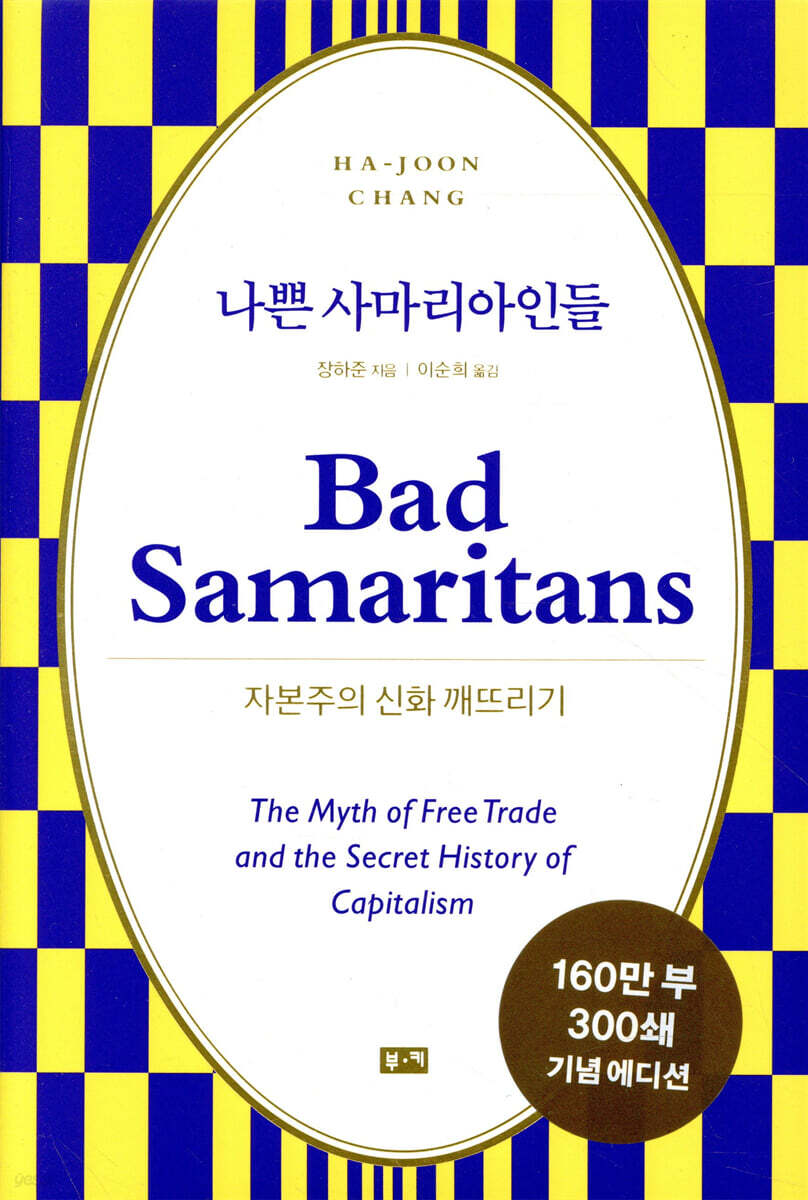
Bad Samaritans
 |
Description
Book Introduction
A masterpiece of practical economics that sharply and lucidly delves into the dark side of capitalism and the myth of the free market!
This is the first full-fledged economics textbook written by world-renowned economist Professor Ha-Joon Chang with the average person in mind.
This book provides humorous yet poignant answers to important economic questions, using widely known books and movies as material, such as whether free trade truly helps developing countries, whether opening up the economy really increases foreign investment, whether the problems of public enterprises can be solved through privatization, whether intellectual property rights actually promote technological innovation, whether there is a special relationship between democracy and economic development, and whether there are cultures or ethnicities suitable for economic development.
This book is different in style and structure from Professor Jang Ha-jin's previous books.
According to Noam Chomsky, "America's conscience," the book is "so vivid, rich and clear that it will astonish readers." Others, like Larry Elliott, economics editor of the Guardian, said, "It's a superb book.
This book, beautifully written and based on solid research, is praised as a “virtual panorama of economics.”
The American editors say the book aims to “expose the traps lurking in the doctrines of liberal economists,” and that Professor Ha-Joon Chang uses his weapons to do so: “a barrage of anecdotes, a wit bordering on sarcastic, and a charming writing style.”
This is the first full-fledged economics textbook written by world-renowned economist Professor Ha-Joon Chang with the average person in mind.
This book provides humorous yet poignant answers to important economic questions, using widely known books and movies as material, such as whether free trade truly helps developing countries, whether opening up the economy really increases foreign investment, whether the problems of public enterprises can be solved through privatization, whether intellectual property rights actually promote technological innovation, whether there is a special relationship between democracy and economic development, and whether there are cultures or ethnicities suitable for economic development.
This book is different in style and structure from Professor Jang Ha-jin's previous books.
According to Noam Chomsky, "America's conscience," the book is "so vivid, rich and clear that it will astonish readers." Others, like Larry Elliott, economics editor of the Guardian, said, "It's a superb book.
This book, beautifully written and based on solid research, is praised as a “virtual panorama of economics.”
The American editors say the book aims to “expose the traps lurking in the doctrines of liberal economists,” and that Professor Ha-Joon Chang uses his weapons to do so: “a barrage of anecdotes, a wit bordering on sarcastic, and a charming writing style.”
- You can preview some of the book's contents.
Preview
index
introduction
Recommendation
Acknowledgements
Prologue: For a country to become rich
Chapter 1: Rereading Lexus and the Olive Tree: Myths and Truths about Globalization
The True History of Globalization | The Truth About Globalization | Neoliberals or Neo-Idiots? | Who Runs the Global Economy? | Will the Bad Samaritans Win?
Chapter 2 The Double Life of Daniel Defoe: How Rich Countries Got Rich
Britain Challenges the World | The Double Life of the British Economy | America Enters the Fray | Lincoln, Tariffs, and the Civil War | Other Nations: Embarrassing Secrets | Lessons Learned from History
Chapter 3 My Six-Year-Old Son Needs a Job!: Is Free Trade Always the Answer?
Free trade doesn't work! | Bad theory leads to bad results | The international trade system and its discontents | Sacrificing industry for agriculture? | Increase trade, reduce ideology
Chapter 4: Finns and Elephants: Should Foreign Investment Be Regulated?
Is foreign capital really necessary? | Foreign capital like Mother Teresa? | 'More dangerous than military power' | Has a borderless world arrived? | 'The only thing worse than being exploited by capital is...'
Chapter 5: Humans Exploit Humans: Are Private Enterprises Good, Public Enterprises Bad?
State-Owned Property on the Court | State vs. Private | Success Stories of State-Owned Enterprises | Why Nationalization Matters | The Pitfalls of Privatization | Black Cat or White Cat
Chapter 6: Windows 98 in 1997: Is 'borrowing' ideas wrong?
"Genius is fire, profit is fuel" | John Law and the first technological "arms race" | Lawyers begin to intervene | Long live Mickey Mouse | The dog-eared sandwich and turmeric | The tyranny of interlocking patents | Harsh regulations and developing countries | Finding a balance
Chapter 7: Mission Impossible?: The Limits of Fiscal Soundness
Highway robbers, armed robbers, and contract killers | Inflation is just another form of inflation | The price of price stability | When fiscal soundness policies are unsound | Keynesianism in rich countries, monetarism in poor countries
Chapter 8 Zaire vs. Indonesia: Should We Turn Our Backs on Corrupt and Undemocratic Countries?
Does Corruption Hinder Economic Development? | Prosperity and Honesty | The Overextended Market is a Problem | Democracy and the Free Market | When Democracy Undermines Democracy | Democracy and Economic Development | Politics and Economic Development
Chapter 9: Lazy Japanese and Stealthy Germans: Are There National Traits Advantageous to Economic Development?
Does Culture Affect Economic Development? | What is Culture? | Dr. Jekyll and Mr. Hyde | The Lazy Japanese and the Thief Germans | How Culture Changes? | The Reinvention of Culture
Epilogue: Can the world get better?
São Paulo 2037 | Fight the Market | Why Manufacturing Matters | Don't Try It at Home! | We Need a Leveled Playing Field | Doing the Right Thing and Doing the Easy Thing
main
Recommendation
Acknowledgements
Prologue: For a country to become rich
Chapter 1: Rereading Lexus and the Olive Tree: Myths and Truths about Globalization
The True History of Globalization | The Truth About Globalization | Neoliberals or Neo-Idiots? | Who Runs the Global Economy? | Will the Bad Samaritans Win?
Chapter 2 The Double Life of Daniel Defoe: How Rich Countries Got Rich
Britain Challenges the World | The Double Life of the British Economy | America Enters the Fray | Lincoln, Tariffs, and the Civil War | Other Nations: Embarrassing Secrets | Lessons Learned from History
Chapter 3 My Six-Year-Old Son Needs a Job!: Is Free Trade Always the Answer?
Free trade doesn't work! | Bad theory leads to bad results | The international trade system and its discontents | Sacrificing industry for agriculture? | Increase trade, reduce ideology
Chapter 4: Finns and Elephants: Should Foreign Investment Be Regulated?
Is foreign capital really necessary? | Foreign capital like Mother Teresa? | 'More dangerous than military power' | Has a borderless world arrived? | 'The only thing worse than being exploited by capital is...'
Chapter 5: Humans Exploit Humans: Are Private Enterprises Good, Public Enterprises Bad?
State-Owned Property on the Court | State vs. Private | Success Stories of State-Owned Enterprises | Why Nationalization Matters | The Pitfalls of Privatization | Black Cat or White Cat
Chapter 6: Windows 98 in 1997: Is 'borrowing' ideas wrong?
"Genius is fire, profit is fuel" | John Law and the first technological "arms race" | Lawyers begin to intervene | Long live Mickey Mouse | The dog-eared sandwich and turmeric | The tyranny of interlocking patents | Harsh regulations and developing countries | Finding a balance
Chapter 7: Mission Impossible?: The Limits of Fiscal Soundness
Highway robbers, armed robbers, and contract killers | Inflation is just another form of inflation | The price of price stability | When fiscal soundness policies are unsound | Keynesianism in rich countries, monetarism in poor countries
Chapter 8 Zaire vs. Indonesia: Should We Turn Our Backs on Corrupt and Undemocratic Countries?
Does Corruption Hinder Economic Development? | Prosperity and Honesty | The Overextended Market is a Problem | Democracy and the Free Market | When Democracy Undermines Democracy | Democracy and Economic Development | Politics and Economic Development
Chapter 9: Lazy Japanese and Stealthy Germans: Are There National Traits Advantageous to Economic Development?
Does Culture Affect Economic Development? | What is Culture? | Dr. Jekyll and Mr. Hyde | The Lazy Japanese and the Thief Germans | How Culture Changes? | The Reinvention of Culture
Epilogue: Can the world get better?
São Paulo 2037 | Fight the Market | Why Manufacturing Matters | Don't Try It at Home! | We Need a Leveled Playing Field | Doing the Right Thing and Doing the Easy Thing
main
Detailed image

Into the book
After the 1997 foreign exchange crisis, our country also became a victim of neoliberalism.
The 1997 foreign exchange crisis was in fact the result of the excessive and overly rapid financial liberalization carried out under the Kim Young-sam administration, but neoliberals at home and abroad pursued active openness, privatization, and deregulation, claiming that it was due to the 'faulty' state-led economic model of the past.
As a result, the economy's vitality declined sharply.
The economic growth rate, which was over 6% in terms of per capita income during the past period of high growth, has fallen to 2-3%.
It is natural for the growth rate to decline as the economy matures, but it is not natural for that rate to suddenly drop by half or a third.
The most important reason for this is the decline in corporate investment.
As capital markets opened after the foreign exchange crisis, shareholders seeking short-term profits, especially foreign shareholders, gained influence. Their continued demands for high dividends and stock buybacks made it difficult for large corporations to make long-term investments.
Moreover, as the domestic financial market liberalized after the foreign exchange crisis and government regulations on bank lending were lifted, banks began to focus on 'sit-and-make' home mortgage loans and consumer finance instead of high-risk corporate finance.
The proportion of corporate loans among bank loans fell from around 90% in the early 1990s to around 30-40%, making it difficult for small and medium-sized enterprises (SMEs) that depend on bank loans to invest.
Ultimately, the investment rate fell from 35% of national income to 30%, and facility investment, which is most crucial for economic competitiveness, fell even more sharply, halving its share of national income from 14-16% before the foreign exchange crisis to 7-8%.
It is natural that economic growth will decline as investment decreases.
---From the "Preface"
The general perception that the Korean economy is a free trade system was formed because of Korea's export success.
However, as can be seen in the cases of Japan and China, export success does not presuppose free trade.
Early Korean exports (such as simple clothing and cheap electronics) were the only way to obtain the foreign currency needed to purchase the advanced technology and expensive equipment essential for new and more sophisticated industries.
The Korean government protected these newly introduced industries with tariffs and subsidies, not to permanently shield them from international competition, but to buy time for them to absorb new technologies, organize themselves, and compete effectively in the global market.
South Korea's economic miracle is the result of a clever and pragmatic combination of market incentives and state management.
The South Korean government did not destroy the market as communist countries did, but that does not mean it has blind faith in the free market.
South Korea's economic development strategy took markets seriously, but recognized that markets often needed to be regulated through policy intervention.
If only South Korea had become wealthy through such "heretical" policies, free-market advocates might conclude that South Korea's case was merely an exception.
But Korea is no exception.
As we will discuss later, today's advanced economies have become rich largely on the basis of policy prescriptions that run counter to neoliberal economics.
Even the UK and the US, considered the home of free markets and free trade, are no exception.
---From the "Prologue"
Chapter 1: Rereading Lexus and the Olive Tree
The poor 'growth' record of neoliberal globalization since the 1980s is disconcerting.
Accelerated growth—even if at the cost of increased inequality and a slight increase in poverty—was the stated goal of neoliberal reforms.
We have been told time and time again that if we want to share wealth more widely, we must first create more wealth, and that neoliberalism is the way to achieve this goal.
However, as a result of neoliberal policies, income inequality has increased in most countries, while growth has actually slowed significantly.
Moreover, during the period when neoliberalism was in vogue, economic instability also increased rapidly.
The world, and particularly the developing world, has experienced larger-scale financial crises more frequently and more frequently, especially since the 1980s.
In other words, neoliberal globalization has failed on all fronts of economic life: growth, equality, and stability.
Yet, we constantly hear that neoliberal globalization has brought unprecedented abundance.
Even at the level of individual countries, it is clear that distortion of facts is taking place in political affairs.
Although orthodox neoliberal economists would have us believe this history, almost all developing countries that achieved economic development after World War II did so through nationalistic policies utilizing various forms of government intervention, including protective tariffs and subsidies.
---p.69~70
Since the Third World debt crisis of 1982, the roles of the IMF and the World Bank have changed significantly.
They began to exert significant influence over the policies of developing countries through joint operations called structural adjustment programs (SAPs).
These programs expanded far beyond the original mission of the Bretton Woods institutions to encompass virtually every aspect of economic policy in developing countries, including government budgets, industrial regulation, agricultural prices, labor market regulation, and privatization.
Starting in the 1990s, when they began attaching so-called governance conditionalities to loans, their "expansion of mission" progressed further, and they began interfering in previously unthinkable areas such as democracy, government decentralization, central bank independence, and even corporate governance.
But this expansion of mandates presents a serious problem. The IMF and the World Bank were launched with relatively limited mandates.
However, these organizations have expanded their scope by arguing that the countries that borrow money from them are failing to manage their economies, and that if this affects economic performance, they should intervene even in new areas that go beyond their original mission.
---p.75
Chapter 2: The Double Life of Daniel Defoe
These policies are very similar to those used successfully by East Asian "miracle" economies like Japan, South Korea, and Taiwan after World War II.
What many, myself included, believed was devised by Japanese policymakers in the 1950s was actually invented long before in Britain.
Walpole's protectionist policies remained firmly in place for the next century, enabling British manufacturing to not only catch up with, but eventually surpass, those of continental Europe.
Britain was a highly protectionist country until the mid-19th century.
In 1820, the average tariff rate on imported manufactured goods in Britain was 45-55%, in the Low Countries it was 6-8%, in Germany and Switzerland it was 8-12%, and in France it was around 20%.
Tariffs were not the only weapon Britain used in its trade policy.
Britain imposed an unconditional ban on advanced manufacturing activities in its colonies.
By prohibiting the construction of new steel mills producing high-grade steel in the United States, Walpole forced Americans to produce low-value-added pig iron and bar instead of high-value-added steel.
Britain also prohibited its colonies from exporting to Britain or abroad any products that might compete with its own products.
England banned the import of Indian cotton (calico), which was superior to English cotton at the time, and in 1699 (through the Wool Act) prohibited the colonies from exporting wool to other countries, destroying the wool industry in Ireland and preventing the emergence of a wool industry in America.
Ultimately, Britain pursued a policy of encouraging the production of primary goods in its colonies.
---p.93
The United States was the world's most powerful protectionist nation throughout the 19th century and well into the 1920s.
Despite this, the U.S. economy grew rapidly.
Paul Bearock, a renowned Swiss economic historian, points out that the significant reduction in protectionism in the U.S. economy (between 1846 and 1861) did not have a noticeable positive effect on U.S. economic growth.
Some free-trade economists argue that the United States grew rapidly during this period despite protectionism because it had many favorable conditions for growth, including abundant natural resources, a large domestic market, and a low illiteracy rate.
However, as we will see later, this argument becomes less persuasive when we consider that many countries that lacked these conditions also grew rapidly behind protectionist trade barriers.
Simply put, consider the cases of Germany, Sweden, France, Finland, Austria, Japan, Taiwan, and Korea.
After World War II, the United States (which had achieved an unchallenged industrial dominance) liberalized trade and began to advocate for free trade on a grand scale.
But the United States has never practiced free trade as vigorously as Britain did during its free-trade era (1860-1932).
The United States has never pursued a zero-tariff policy like Britain.
Moreover, the United States has not hesitated to use protectionist policies other than tariffs whenever necessary.
Is that all?
Even after strengthening free trade (though not absolute free trade), the U.S. government encouraged key industries through other means, such as research and development support.
From the 1950s to the mid-1990s, U.S. federal government support accounted for 50 to 70 percent of total R&D spending, significantly exceeding the 20 percent or so seen in "government-led" countries like Japan and South Korea.
---p.106~107
Chapter 3 My six-year-old son needs to find a job!
The essence of the problem is this.
Producers in developing countries entering new industries must be (partially) insulated from international competition (through various means, including protectionist policies and subsidies) until they are able to compete with superior foreign producers.
Of course, once the infant industry 'grows up' and can compete with other overseas producers, the quarantine measures should disappear.
However, this process must be done gradually.
If exposed to fierce international competition too quickly, these producers will soon disappear.
This is the essence of the argument about infant industries that I presented at the beginning of this chapter, mentioning my son Jin-gyu.
The rich countries, the bad Samaritans, encourage free trade to developing countries, emphasizing that they are close to, if not entirely free, trade.
But this is like telling a parent raising a six-year-old child to send that child to work, arguing that successful adults are successful because they don't rely on their parents and are independent.
Successful adults are independent because they are successful, not because they are independent.
But they don't realize this fact.
In reality, most successful people are those who received strong financial and emotional support from their parents during their childhood.
As discussed in Chapter 2, rich countries liberalized trade only when their producers were ready, and usually only gradually.
In short, historically speaking, trade liberalization is not a cause of economic development, but a consequence of it.
---p.134~135
Chapter 4: Finnish People and Elephants
Although the United States was the largest recipient of foreign investment in the 19th and early 20th centuries, it maintained strict controls on foreign investment in various ways, similar to the recent case of China.
Despite China's strict regulation of multinational corporations in recent decades, a huge amount of foreign direct investment is pouring into the country.
Bad Samaritans argue that restricting foreign investment will reduce the flow of investment, while easing foreign investment regulations will increase the flow of foreign investment, but the reality is the opposite.
Despite—and in part because of—the world's highest tariff rates and strict restrictions on foreign investment, the United States was the world's fastest-growing economy from the 19th century through the 1920s.
This undermines the prevailing view that foreign investment restrictions negatively impact an economy's prospects for success.
Japan has been much more stringent than the United States in terms of foreign investment regulations.
In particular, in Japan before 1963, foreign ownership was limited to 49%, and foreign direct investment in "key industries" was completely banned.
Although foreign investment has been steadily opened since then, its scope has been limited to industries that domestic companies judge to be ready for.
Ultimately, foreign direct investment flowing into Japan is at the lowest level compared to overall domestic investment, excluding communist countries.
However, Japan recently stated in a document submitted to the WTO that “restrictions on (foreign direct) investment cannot be considered an appropriate decision from the perspective of development policy,” which, considering Japan’s past actions, is a classic example of selective amnesia about history, double standards, and “kicking away the ladder.”
---p.164~165
So, regardless of the necessity of foreign investment regulations, how should we interpret the argument that practical regulation of foreign investment is impossible? According to the Bad Samaritans, multinational corporations are now in a position where they can "go wherever they want," and thus, they can set an example for countries that regulate foreign investment by "getting out if they don't like it."
One might immediately ask this question in response to such a claim:
Why do Bad Samaritans insist that increased corporate mobility has rendered national regulations ineffective, yet they strive to force developing countries to sign international agreements that limit their ability to regulate foreign investment? Neoliberal orthodoxies favor market logic, so why not leave it up to developing countries to decide which approach to take? If foreign investors were to make investment decisions only in friendly countries, wouldn't that itself be punishing or rewarding those developing countries? The very fact that rich countries rely on international agreements to impose these restrictions on developing countries underscores the untruthfulness of the Bad Samaritans' claim that foreign direct investment regulations are ineffective.
---p.170
Chapter 5: Humans Exploit Humans
One foreign banker even told the Wall Street Journal in the mid-1980s, during the height of the Third World debt crisis, “We foreign bankers support free markets when we think we’re going to make money, and we believe in the state when we think we’re going to lose money.”
There are many instances where governments that profess free markets have actually implemented national financial support for large private companies.
Sweden's shipbuilding industry went bankrupt in the late 1970s, only to be saved by nationalisation measures by the right-wing government that had taken power for the first time in 44 years.
However, this right-wing government came to power with a promise to reduce the size of the country.
American automaker Chrysler faced a crisis in the early 1980s, but was rescued by the Republican administration of Ronald Reagan, which was at the forefront of neoliberal market reforms at the time.
Chile implemented poorly planned, premature financial liberalization, which led to a financial crisis in 1982 that required public funds to bail out the entire banking sector.
By the Pinochet government, which seized power through a bloody coup in the name of defending free markets and private property.
The neoliberal view against state-owned enterprises is made all the more unfounded by the numerous examples of successfully operating state-owned enterprises.
Among them are many world-class companies.
---p.185~186
As previously pointed out, the principal-agent problem, free-riding problem, and soft budget constraints, which are cited as major causes of inefficiency in state-owned enterprises, are all real, but that does not mean that they exist only in state-owned enterprises.
Large, decentralized private enterprises also suffer from principal-agent problems and free-riding problems.
Therefore, in these two problems, the form of ownership is not important.
The important distinction here is not between state and private ownership, but between concentrated and dispersed ownership.
In the case of soft budget constraints, the distinction between public and private is much clearer, but it is not absolute.
As we have seen, private enterprises may receive government financial support for politically important projects, while state-owned enterprises may, and indeed do, be subject to strict budget constraints, such as management turnover and final approval for debt restructuring.
If state ownership itself is not the sole or prominent root cause of the various problems of state-owned enterprises, then changing the ownership status, i.e. privatization, will not solve these problems.
Rather, privatization has many pitfalls.
---p.196
Chapter 6: Windows 98 in 1997
The inefficiencies caused by the monopolies of patents and other similar intellectual property protection systems and the waste created by competition in a "winner-takes-all" structure are neither the only nor the most important problems with the system.
The most damaging impact of the intellectual property protection system is that it has the potential to block the flow of knowledge to technologically underdeveloped countries that need advanced technologies for economic development.
The key to economic development is the absorption of advanced foreign technology.
Simply put, whether it's a patent system or a ban on exporting advanced technologies, anything that makes it difficult to absorb advanced technologies makes economic development difficult.
Rich countries in the past understood this point well and did everything they could to prevent such a situation from occurring.
---p.213~214
The historical facts are clear.
Counterfeiting or replicating products was not a new invention in modern Asia.
Today's advanced countries, when they were backward in terms of knowledge, indiscriminately infringed on the patents, trademarks, and copyrights of other countries.
Switzerland 'borrowed' German chemical inventions, Germany 'borrowed' British trademarks, and the United States 'borrowed' British copyrights.
Of course, none of them paid what would be considered 'fair' compensation by today's standards.
Despite this history, wealthy countries, often called bad Samaritans, are demanding historically unprecedented levels of strong intellectual property protection from developing countries through trade-related intellectual property agreements and bilateral free trade agreements.
They argue that strengthening intellectual property rights protection would stimulate the production of new knowledge, benefiting all countries, including developing countries.
Is this really true?
---p.222~223
Chapter 7 Mission Impossible?
Paul Volcker, then chairman of the Federal Reserve (the central bank of the United States) under Ronald Reagan, said, “Inflation is a cruel tax, perhaps the cruelest tax of all.
“Because inflation not only hurts in many different ways across many sectors, it hurts people on fixed incomes the most,” he argued.
But this is only half the truth.
While lower inflation may better protect workers' existing earnings, the policies needed to achieve this result could reduce workers' future earning potential.
Why is this so? The stringent monetary and fiscal policies necessary to keep inflation low, even extremely low, can reduce the level of economic activity, ultimately leading to reduced labor demand, increased unemployment, and lower wages.
Therefore, strict price controls are a double-edged sword for workers.
A low inflation rate better protects workers' existing incomes, but conversely reduces their future incomes.
Those who benefit from a decline in inflation are limited to pensioners and economic entities (including the financial industry) that derive income from financial assets at fixed rates.
Because they exist outside the labor market, strict macroeconomic policies aimed at reducing inflation cannot negatively impact future employment opportunities or wages, while their existing incomes are better protected.
As Volcker's argument quoted above shows, neoliberals are blaming inflation for the harm it causes to the general public.
But this public rhetoric obscures the fact that the policies needed to maintain low inflation will reduce the future incomes of the vast majority of workers by lowering their job prospects and wage levels.
---p.249~250
When South Korea signed the agreement with the IMF in December 1997, amid the foreign exchange crisis, it was required to maintain a budget surplus of 1% of GDP.
Given the circumstances at the time, when the economy was in a deep recession due to a massive outflow of foreign capital, the IMF had to allow the Korean government to increase its budget deficit.
Korea was in a position to implement such a policy.
At the time, Korea had one of the lowest government debt-to-GDP ratios in the world, including among wealthy nations.
Nevertheless, the IMF prevented Korea from engaging in deficit spending.
The economy, of course, crashed.
In the first few months of 1998, more than 100 companies failed every day, and unemployment nearly tripled.
At the time, Koreans nicknamed the IMF 'I'M Fired', which was not at all strange.
Only when this uncontrollable economic downturn showed signs of continuing did the IMF finally ease policy, allowing the Korean government to run a deficit budget, but only on a very small scale, less than 0.8% of GDP.
A more extreme example is Indonesia, which, in the same year it faced a financial crisis, cut government spending, particularly food subsidies, under IMF direction.
Indonesia's interest rates soared to 80%, leading to widespread corporate bankruptcies, mass unemployment, and urban riots, ultimately causing a 16% drop in output in 1998.
If the rich countries, the bad Samaritans, were in the same situation, they would not do what they told the poor countries to do.
Instead, they will lower interest rates and increase government deficit spending to increase demand.
No finance minister in a rich country would do something foolish like raise interest rates or run a budget surplus during an economic downturn.
In the early 21st century, as the American economy reeled from the aftermath of the dot-com bubble burst and the September 11 bombings of the World Trade Center, the solution adopted by the anti-Keynesian Republican administration of President George W. Bush, which promised "responsible fiscal policy," was (as you might have guessed) deficit spending and unprecedentedly loose monetary policy.
As a result, the U.S. budget deficit in 2003 and 2004 reached 4% of GDP.
---p.256~257
Chapter 8 Zaire vs. Indonesia
If morally wrong things like corruption had an equally obvious negative impact on the economy, things would be simpler.
But the reality is much more complicated.
Looking back over the past half century, there are countries whose economies have collapsed due to rampant corruption, such as Zaire under Mobutu and Haiti under Duvalier.
And at the other extreme are countries like Finland, Sweden, and Singapore that are renowned for their integrity while also performing well economically.
But there are countries like Indonesia that have achieved relatively good economic performance despite being highly corrupt.
Many other countries (including Italy, Japan, South Korea, Taiwan, and China) have fared much better than Indonesia during this period, despite having widespread, massive, and deeply entrenched corruption (though not as severe as Indonesia).
Corruption is not a 20th century phenomenon.
Most of today's rich countries have succeeded in industrializing despite the high level of corruption among their public officials.
In England and France, public buying and selling of public offices was common practice until the 18th century.
---p.267~268
One important question here is whether the dirty money remains in the country.
If the money received as bribes is deposited in Swiss banks, it cannot contribute to creating more income and more jobs through investment (the only way dirty money can atone for its crimes).
This is one of the main reasons why Zaire and Indonesia differ.
In Indonesia, most of the money related to corruption remained domestically, creating jobs and income.
In Zaire's case, most of the corrupt money flowed out of the country.
If you have a corrupt leader, you should at least hope that the dirty money stays in the country.
---p.270~271
It is particularly important to emphasize that the Bad Samaritans' call for the depoliticization of the economy is in fact an undermining of democracy.
Depoliticizing policy decisions within a democracy is (to put it bluntly) weakening democracy.
If all important decisions are taken from the hands of democratically elected governments and placed in the hands of unelected technocrats within "politically independent" institutions, what is the purpose of democracy? In other words, neoliberals recognize democracy only to the extent that it does not contradict the free market.
That is why some neoliberals do not see any contradiction between supporting the Pinochet dictatorship and praising democracy.
---p.286
Chapter 9: The Lazy Japanese and the Stealing Germans
Okay, let's think about this.
The Japanese of a century ago were lazy rather than industrious, overly independent rather than faithful "worker ants," emotional rather than reserved, simplistic rather than serious, and (unlike today, where high savings rates are a hallmark) living for today without a thought for the future.
And the Germans of half a century earlier were not efficient but lazy, not cooperative but individualistic, more emotional than rational, more stupid than intelligent, more dishonest and thieving than law-abiding, and more easygoing than self-controlled.
There are two reasons why we are puzzled when we read these characterizations of the Japanese and Germans.
First, how did the Japanese and Germans, with such a "bad" culture, become wealthy? Second, why are the Japanese and Germans of that time so different from those of today? In other words, how were they able to completely change their "ancestral national customs"?
---p.301
Epilogue
As we have repeatedly emphasized, the market has a strong tendency to reinforce the current situation.
The free market dictates that countries stick to what they already do well.
This is, to put it bluntly, telling poor countries to continue with their current low-productivity activities.
But it is precisely these low-productivity activities that are the cause of these countries' poverty.
If these countries want to escape poverty, they will have to do the harder work of competing with the market to achieve higher incomes.
There is no other way out of poverty.
The phrase “go against the market” may sound radical.
Aren't there many countries that have tried to compete with the market and failed miserably?
But going against the market is something entrepreneurs always do.
Of course, entrepreneurs are ultimately judged by the market.
But entrepreneurs, especially successful ones, don't blindly accept market forces.
They make long-term plans for their companies.
In some cases, plans may need to be made that go against the market trend for a significant period of time.
They look after the growth of subsidiaries they establish in new sectors they wish to enter.
This is done by making up for the loss with profits from existing companies.
---p.334~335
Bad Samaritans argue that additional policies of protection, subsidies, and regulation used by developing countries should not be allowed to develop because they create unfair competition.
If such things are allowed, the developing countries will become like a soccer team that runs from the high side to the low side of the uneven playing field while the rich countries on the other side struggle to climb up the hill to the high side.
Remove all barriers to entry and allow everyone to compete on equal footing.
No matter what, we can only reap the benefits of the market when competition is fundamentally fair.
If someone were to invoke a concept that anyone would agree with, such as "the playing field needs to be leveled," who would dare to object? Nevertheless, I do.
This is because it is a competition between players of different levels.
Therefore, if we want to build an international system that promotes economic development, we must all raise objections.
If the level of the players is not the same and the playing field is level, the game will ultimately be unfair.
Imagine a soccer match where one team is the Brazilian national team and the other team is made up of my eleven-year-old daughter Yuna's friends.
If so, then it would be fair to allow the girls to run downwards and attack.
In such a situation, tilting the playing field rather than leveling it can ensure fair competition.
The 1997 foreign exchange crisis was in fact the result of the excessive and overly rapid financial liberalization carried out under the Kim Young-sam administration, but neoliberals at home and abroad pursued active openness, privatization, and deregulation, claiming that it was due to the 'faulty' state-led economic model of the past.
As a result, the economy's vitality declined sharply.
The economic growth rate, which was over 6% in terms of per capita income during the past period of high growth, has fallen to 2-3%.
It is natural for the growth rate to decline as the economy matures, but it is not natural for that rate to suddenly drop by half or a third.
The most important reason for this is the decline in corporate investment.
As capital markets opened after the foreign exchange crisis, shareholders seeking short-term profits, especially foreign shareholders, gained influence. Their continued demands for high dividends and stock buybacks made it difficult for large corporations to make long-term investments.
Moreover, as the domestic financial market liberalized after the foreign exchange crisis and government regulations on bank lending were lifted, banks began to focus on 'sit-and-make' home mortgage loans and consumer finance instead of high-risk corporate finance.
The proportion of corporate loans among bank loans fell from around 90% in the early 1990s to around 30-40%, making it difficult for small and medium-sized enterprises (SMEs) that depend on bank loans to invest.
Ultimately, the investment rate fell from 35% of national income to 30%, and facility investment, which is most crucial for economic competitiveness, fell even more sharply, halving its share of national income from 14-16% before the foreign exchange crisis to 7-8%.
It is natural that economic growth will decline as investment decreases.
---From the "Preface"
The general perception that the Korean economy is a free trade system was formed because of Korea's export success.
However, as can be seen in the cases of Japan and China, export success does not presuppose free trade.
Early Korean exports (such as simple clothing and cheap electronics) were the only way to obtain the foreign currency needed to purchase the advanced technology and expensive equipment essential for new and more sophisticated industries.
The Korean government protected these newly introduced industries with tariffs and subsidies, not to permanently shield them from international competition, but to buy time for them to absorb new technologies, organize themselves, and compete effectively in the global market.
South Korea's economic miracle is the result of a clever and pragmatic combination of market incentives and state management.
The South Korean government did not destroy the market as communist countries did, but that does not mean it has blind faith in the free market.
South Korea's economic development strategy took markets seriously, but recognized that markets often needed to be regulated through policy intervention.
If only South Korea had become wealthy through such "heretical" policies, free-market advocates might conclude that South Korea's case was merely an exception.
But Korea is no exception.
As we will discuss later, today's advanced economies have become rich largely on the basis of policy prescriptions that run counter to neoliberal economics.
Even the UK and the US, considered the home of free markets and free trade, are no exception.
---From the "Prologue"
Chapter 1: Rereading Lexus and the Olive Tree
The poor 'growth' record of neoliberal globalization since the 1980s is disconcerting.
Accelerated growth—even if at the cost of increased inequality and a slight increase in poverty—was the stated goal of neoliberal reforms.
We have been told time and time again that if we want to share wealth more widely, we must first create more wealth, and that neoliberalism is the way to achieve this goal.
However, as a result of neoliberal policies, income inequality has increased in most countries, while growth has actually slowed significantly.
Moreover, during the period when neoliberalism was in vogue, economic instability also increased rapidly.
The world, and particularly the developing world, has experienced larger-scale financial crises more frequently and more frequently, especially since the 1980s.
In other words, neoliberal globalization has failed on all fronts of economic life: growth, equality, and stability.
Yet, we constantly hear that neoliberal globalization has brought unprecedented abundance.
Even at the level of individual countries, it is clear that distortion of facts is taking place in political affairs.
Although orthodox neoliberal economists would have us believe this history, almost all developing countries that achieved economic development after World War II did so through nationalistic policies utilizing various forms of government intervention, including protective tariffs and subsidies.
---p.69~70
Since the Third World debt crisis of 1982, the roles of the IMF and the World Bank have changed significantly.
They began to exert significant influence over the policies of developing countries through joint operations called structural adjustment programs (SAPs).
These programs expanded far beyond the original mission of the Bretton Woods institutions to encompass virtually every aspect of economic policy in developing countries, including government budgets, industrial regulation, agricultural prices, labor market regulation, and privatization.
Starting in the 1990s, when they began attaching so-called governance conditionalities to loans, their "expansion of mission" progressed further, and they began interfering in previously unthinkable areas such as democracy, government decentralization, central bank independence, and even corporate governance.
But this expansion of mandates presents a serious problem. The IMF and the World Bank were launched with relatively limited mandates.
However, these organizations have expanded their scope by arguing that the countries that borrow money from them are failing to manage their economies, and that if this affects economic performance, they should intervene even in new areas that go beyond their original mission.
---p.75
Chapter 2: The Double Life of Daniel Defoe
These policies are very similar to those used successfully by East Asian "miracle" economies like Japan, South Korea, and Taiwan after World War II.
What many, myself included, believed was devised by Japanese policymakers in the 1950s was actually invented long before in Britain.
Walpole's protectionist policies remained firmly in place for the next century, enabling British manufacturing to not only catch up with, but eventually surpass, those of continental Europe.
Britain was a highly protectionist country until the mid-19th century.
In 1820, the average tariff rate on imported manufactured goods in Britain was 45-55%, in the Low Countries it was 6-8%, in Germany and Switzerland it was 8-12%, and in France it was around 20%.
Tariffs were not the only weapon Britain used in its trade policy.
Britain imposed an unconditional ban on advanced manufacturing activities in its colonies.
By prohibiting the construction of new steel mills producing high-grade steel in the United States, Walpole forced Americans to produce low-value-added pig iron and bar instead of high-value-added steel.
Britain also prohibited its colonies from exporting to Britain or abroad any products that might compete with its own products.
England banned the import of Indian cotton (calico), which was superior to English cotton at the time, and in 1699 (through the Wool Act) prohibited the colonies from exporting wool to other countries, destroying the wool industry in Ireland and preventing the emergence of a wool industry in America.
Ultimately, Britain pursued a policy of encouraging the production of primary goods in its colonies.
---p.93
The United States was the world's most powerful protectionist nation throughout the 19th century and well into the 1920s.
Despite this, the U.S. economy grew rapidly.
Paul Bearock, a renowned Swiss economic historian, points out that the significant reduction in protectionism in the U.S. economy (between 1846 and 1861) did not have a noticeable positive effect on U.S. economic growth.
Some free-trade economists argue that the United States grew rapidly during this period despite protectionism because it had many favorable conditions for growth, including abundant natural resources, a large domestic market, and a low illiteracy rate.
However, as we will see later, this argument becomes less persuasive when we consider that many countries that lacked these conditions also grew rapidly behind protectionist trade barriers.
Simply put, consider the cases of Germany, Sweden, France, Finland, Austria, Japan, Taiwan, and Korea.
After World War II, the United States (which had achieved an unchallenged industrial dominance) liberalized trade and began to advocate for free trade on a grand scale.
But the United States has never practiced free trade as vigorously as Britain did during its free-trade era (1860-1932).
The United States has never pursued a zero-tariff policy like Britain.
Moreover, the United States has not hesitated to use protectionist policies other than tariffs whenever necessary.
Is that all?
Even after strengthening free trade (though not absolute free trade), the U.S. government encouraged key industries through other means, such as research and development support.
From the 1950s to the mid-1990s, U.S. federal government support accounted for 50 to 70 percent of total R&D spending, significantly exceeding the 20 percent or so seen in "government-led" countries like Japan and South Korea.
---p.106~107
Chapter 3 My six-year-old son needs to find a job!
The essence of the problem is this.
Producers in developing countries entering new industries must be (partially) insulated from international competition (through various means, including protectionist policies and subsidies) until they are able to compete with superior foreign producers.
Of course, once the infant industry 'grows up' and can compete with other overseas producers, the quarantine measures should disappear.
However, this process must be done gradually.
If exposed to fierce international competition too quickly, these producers will soon disappear.
This is the essence of the argument about infant industries that I presented at the beginning of this chapter, mentioning my son Jin-gyu.
The rich countries, the bad Samaritans, encourage free trade to developing countries, emphasizing that they are close to, if not entirely free, trade.
But this is like telling a parent raising a six-year-old child to send that child to work, arguing that successful adults are successful because they don't rely on their parents and are independent.
Successful adults are independent because they are successful, not because they are independent.
But they don't realize this fact.
In reality, most successful people are those who received strong financial and emotional support from their parents during their childhood.
As discussed in Chapter 2, rich countries liberalized trade only when their producers were ready, and usually only gradually.
In short, historically speaking, trade liberalization is not a cause of economic development, but a consequence of it.
---p.134~135
Chapter 4: Finnish People and Elephants
Although the United States was the largest recipient of foreign investment in the 19th and early 20th centuries, it maintained strict controls on foreign investment in various ways, similar to the recent case of China.
Despite China's strict regulation of multinational corporations in recent decades, a huge amount of foreign direct investment is pouring into the country.
Bad Samaritans argue that restricting foreign investment will reduce the flow of investment, while easing foreign investment regulations will increase the flow of foreign investment, but the reality is the opposite.
Despite—and in part because of—the world's highest tariff rates and strict restrictions on foreign investment, the United States was the world's fastest-growing economy from the 19th century through the 1920s.
This undermines the prevailing view that foreign investment restrictions negatively impact an economy's prospects for success.
Japan has been much more stringent than the United States in terms of foreign investment regulations.
In particular, in Japan before 1963, foreign ownership was limited to 49%, and foreign direct investment in "key industries" was completely banned.
Although foreign investment has been steadily opened since then, its scope has been limited to industries that domestic companies judge to be ready for.
Ultimately, foreign direct investment flowing into Japan is at the lowest level compared to overall domestic investment, excluding communist countries.
However, Japan recently stated in a document submitted to the WTO that “restrictions on (foreign direct) investment cannot be considered an appropriate decision from the perspective of development policy,” which, considering Japan’s past actions, is a classic example of selective amnesia about history, double standards, and “kicking away the ladder.”
---p.164~165
So, regardless of the necessity of foreign investment regulations, how should we interpret the argument that practical regulation of foreign investment is impossible? According to the Bad Samaritans, multinational corporations are now in a position where they can "go wherever they want," and thus, they can set an example for countries that regulate foreign investment by "getting out if they don't like it."
One might immediately ask this question in response to such a claim:
Why do Bad Samaritans insist that increased corporate mobility has rendered national regulations ineffective, yet they strive to force developing countries to sign international agreements that limit their ability to regulate foreign investment? Neoliberal orthodoxies favor market logic, so why not leave it up to developing countries to decide which approach to take? If foreign investors were to make investment decisions only in friendly countries, wouldn't that itself be punishing or rewarding those developing countries? The very fact that rich countries rely on international agreements to impose these restrictions on developing countries underscores the untruthfulness of the Bad Samaritans' claim that foreign direct investment regulations are ineffective.
---p.170
Chapter 5: Humans Exploit Humans
One foreign banker even told the Wall Street Journal in the mid-1980s, during the height of the Third World debt crisis, “We foreign bankers support free markets when we think we’re going to make money, and we believe in the state when we think we’re going to lose money.”
There are many instances where governments that profess free markets have actually implemented national financial support for large private companies.
Sweden's shipbuilding industry went bankrupt in the late 1970s, only to be saved by nationalisation measures by the right-wing government that had taken power for the first time in 44 years.
However, this right-wing government came to power with a promise to reduce the size of the country.
American automaker Chrysler faced a crisis in the early 1980s, but was rescued by the Republican administration of Ronald Reagan, which was at the forefront of neoliberal market reforms at the time.
Chile implemented poorly planned, premature financial liberalization, which led to a financial crisis in 1982 that required public funds to bail out the entire banking sector.
By the Pinochet government, which seized power through a bloody coup in the name of defending free markets and private property.
The neoliberal view against state-owned enterprises is made all the more unfounded by the numerous examples of successfully operating state-owned enterprises.
Among them are many world-class companies.
---p.185~186
As previously pointed out, the principal-agent problem, free-riding problem, and soft budget constraints, which are cited as major causes of inefficiency in state-owned enterprises, are all real, but that does not mean that they exist only in state-owned enterprises.
Large, decentralized private enterprises also suffer from principal-agent problems and free-riding problems.
Therefore, in these two problems, the form of ownership is not important.
The important distinction here is not between state and private ownership, but between concentrated and dispersed ownership.
In the case of soft budget constraints, the distinction between public and private is much clearer, but it is not absolute.
As we have seen, private enterprises may receive government financial support for politically important projects, while state-owned enterprises may, and indeed do, be subject to strict budget constraints, such as management turnover and final approval for debt restructuring.
If state ownership itself is not the sole or prominent root cause of the various problems of state-owned enterprises, then changing the ownership status, i.e. privatization, will not solve these problems.
Rather, privatization has many pitfalls.
---p.196
Chapter 6: Windows 98 in 1997
The inefficiencies caused by the monopolies of patents and other similar intellectual property protection systems and the waste created by competition in a "winner-takes-all" structure are neither the only nor the most important problems with the system.
The most damaging impact of the intellectual property protection system is that it has the potential to block the flow of knowledge to technologically underdeveloped countries that need advanced technologies for economic development.
The key to economic development is the absorption of advanced foreign technology.
Simply put, whether it's a patent system or a ban on exporting advanced technologies, anything that makes it difficult to absorb advanced technologies makes economic development difficult.
Rich countries in the past understood this point well and did everything they could to prevent such a situation from occurring.
---p.213~214
The historical facts are clear.
Counterfeiting or replicating products was not a new invention in modern Asia.
Today's advanced countries, when they were backward in terms of knowledge, indiscriminately infringed on the patents, trademarks, and copyrights of other countries.
Switzerland 'borrowed' German chemical inventions, Germany 'borrowed' British trademarks, and the United States 'borrowed' British copyrights.
Of course, none of them paid what would be considered 'fair' compensation by today's standards.
Despite this history, wealthy countries, often called bad Samaritans, are demanding historically unprecedented levels of strong intellectual property protection from developing countries through trade-related intellectual property agreements and bilateral free trade agreements.
They argue that strengthening intellectual property rights protection would stimulate the production of new knowledge, benefiting all countries, including developing countries.
Is this really true?
---p.222~223
Chapter 7 Mission Impossible?
Paul Volcker, then chairman of the Federal Reserve (the central bank of the United States) under Ronald Reagan, said, “Inflation is a cruel tax, perhaps the cruelest tax of all.
“Because inflation not only hurts in many different ways across many sectors, it hurts people on fixed incomes the most,” he argued.
But this is only half the truth.
While lower inflation may better protect workers' existing earnings, the policies needed to achieve this result could reduce workers' future earning potential.
Why is this so? The stringent monetary and fiscal policies necessary to keep inflation low, even extremely low, can reduce the level of economic activity, ultimately leading to reduced labor demand, increased unemployment, and lower wages.
Therefore, strict price controls are a double-edged sword for workers.
A low inflation rate better protects workers' existing incomes, but conversely reduces their future incomes.
Those who benefit from a decline in inflation are limited to pensioners and economic entities (including the financial industry) that derive income from financial assets at fixed rates.
Because they exist outside the labor market, strict macroeconomic policies aimed at reducing inflation cannot negatively impact future employment opportunities or wages, while their existing incomes are better protected.
As Volcker's argument quoted above shows, neoliberals are blaming inflation for the harm it causes to the general public.
But this public rhetoric obscures the fact that the policies needed to maintain low inflation will reduce the future incomes of the vast majority of workers by lowering their job prospects and wage levels.
---p.249~250
When South Korea signed the agreement with the IMF in December 1997, amid the foreign exchange crisis, it was required to maintain a budget surplus of 1% of GDP.
Given the circumstances at the time, when the economy was in a deep recession due to a massive outflow of foreign capital, the IMF had to allow the Korean government to increase its budget deficit.
Korea was in a position to implement such a policy.
At the time, Korea had one of the lowest government debt-to-GDP ratios in the world, including among wealthy nations.
Nevertheless, the IMF prevented Korea from engaging in deficit spending.
The economy, of course, crashed.
In the first few months of 1998, more than 100 companies failed every day, and unemployment nearly tripled.
At the time, Koreans nicknamed the IMF 'I'M Fired', which was not at all strange.
Only when this uncontrollable economic downturn showed signs of continuing did the IMF finally ease policy, allowing the Korean government to run a deficit budget, but only on a very small scale, less than 0.8% of GDP.
A more extreme example is Indonesia, which, in the same year it faced a financial crisis, cut government spending, particularly food subsidies, under IMF direction.
Indonesia's interest rates soared to 80%, leading to widespread corporate bankruptcies, mass unemployment, and urban riots, ultimately causing a 16% drop in output in 1998.
If the rich countries, the bad Samaritans, were in the same situation, they would not do what they told the poor countries to do.
Instead, they will lower interest rates and increase government deficit spending to increase demand.
No finance minister in a rich country would do something foolish like raise interest rates or run a budget surplus during an economic downturn.
In the early 21st century, as the American economy reeled from the aftermath of the dot-com bubble burst and the September 11 bombings of the World Trade Center, the solution adopted by the anti-Keynesian Republican administration of President George W. Bush, which promised "responsible fiscal policy," was (as you might have guessed) deficit spending and unprecedentedly loose monetary policy.
As a result, the U.S. budget deficit in 2003 and 2004 reached 4% of GDP.
---p.256~257
Chapter 8 Zaire vs. Indonesia
If morally wrong things like corruption had an equally obvious negative impact on the economy, things would be simpler.
But the reality is much more complicated.
Looking back over the past half century, there are countries whose economies have collapsed due to rampant corruption, such as Zaire under Mobutu and Haiti under Duvalier.
And at the other extreme are countries like Finland, Sweden, and Singapore that are renowned for their integrity while also performing well economically.
But there are countries like Indonesia that have achieved relatively good economic performance despite being highly corrupt.
Many other countries (including Italy, Japan, South Korea, Taiwan, and China) have fared much better than Indonesia during this period, despite having widespread, massive, and deeply entrenched corruption (though not as severe as Indonesia).
Corruption is not a 20th century phenomenon.
Most of today's rich countries have succeeded in industrializing despite the high level of corruption among their public officials.
In England and France, public buying and selling of public offices was common practice until the 18th century.
---p.267~268
One important question here is whether the dirty money remains in the country.
If the money received as bribes is deposited in Swiss banks, it cannot contribute to creating more income and more jobs through investment (the only way dirty money can atone for its crimes).
This is one of the main reasons why Zaire and Indonesia differ.
In Indonesia, most of the money related to corruption remained domestically, creating jobs and income.
In Zaire's case, most of the corrupt money flowed out of the country.
If you have a corrupt leader, you should at least hope that the dirty money stays in the country.
---p.270~271
It is particularly important to emphasize that the Bad Samaritans' call for the depoliticization of the economy is in fact an undermining of democracy.
Depoliticizing policy decisions within a democracy is (to put it bluntly) weakening democracy.
If all important decisions are taken from the hands of democratically elected governments and placed in the hands of unelected technocrats within "politically independent" institutions, what is the purpose of democracy? In other words, neoliberals recognize democracy only to the extent that it does not contradict the free market.
That is why some neoliberals do not see any contradiction between supporting the Pinochet dictatorship and praising democracy.
---p.286
Chapter 9: The Lazy Japanese and the Stealing Germans
Okay, let's think about this.
The Japanese of a century ago were lazy rather than industrious, overly independent rather than faithful "worker ants," emotional rather than reserved, simplistic rather than serious, and (unlike today, where high savings rates are a hallmark) living for today without a thought for the future.
And the Germans of half a century earlier were not efficient but lazy, not cooperative but individualistic, more emotional than rational, more stupid than intelligent, more dishonest and thieving than law-abiding, and more easygoing than self-controlled.
There are two reasons why we are puzzled when we read these characterizations of the Japanese and Germans.
First, how did the Japanese and Germans, with such a "bad" culture, become wealthy? Second, why are the Japanese and Germans of that time so different from those of today? In other words, how were they able to completely change their "ancestral national customs"?
---p.301
Epilogue
As we have repeatedly emphasized, the market has a strong tendency to reinforce the current situation.
The free market dictates that countries stick to what they already do well.
This is, to put it bluntly, telling poor countries to continue with their current low-productivity activities.
But it is precisely these low-productivity activities that are the cause of these countries' poverty.
If these countries want to escape poverty, they will have to do the harder work of competing with the market to achieve higher incomes.
There is no other way out of poverty.
The phrase “go against the market” may sound radical.
Aren't there many countries that have tried to compete with the market and failed miserably?
But going against the market is something entrepreneurs always do.
Of course, entrepreneurs are ultimately judged by the market.
But entrepreneurs, especially successful ones, don't blindly accept market forces.
They make long-term plans for their companies.
In some cases, plans may need to be made that go against the market trend for a significant period of time.
They look after the growth of subsidiaries they establish in new sectors they wish to enter.
This is done by making up for the loss with profits from existing companies.
---p.334~335
Bad Samaritans argue that additional policies of protection, subsidies, and regulation used by developing countries should not be allowed to develop because they create unfair competition.
If such things are allowed, the developing countries will become like a soccer team that runs from the high side to the low side of the uneven playing field while the rich countries on the other side struggle to climb up the hill to the high side.
Remove all barriers to entry and allow everyone to compete on equal footing.
No matter what, we can only reap the benefits of the market when competition is fundamentally fair.
If someone were to invoke a concept that anyone would agree with, such as "the playing field needs to be leveled," who would dare to object? Nevertheless, I do.
This is because it is a competition between players of different levels.
Therefore, if we want to build an international system that promotes economic development, we must all raise objections.
If the level of the players is not the same and the playing field is level, the game will ultimately be unfair.
Imagine a soccer match where one team is the Brazilian national team and the other team is made up of my eleven-year-old daughter Yuna's friends.
If so, then it would be fair to allow the girls to run downwards and attack.
In such a situation, tilting the playing field rather than leveling it can ensure fair competition.
---p.345~346
Publisher's Review
* 2007 TV Book Talk Book of the Year
* 2007 Donga Chosun JoongAng Hankyoreh Book of the Year
* 2007 Korean Publishers Association Book of the Month
* Winner of the 48th Korean Publishing Culture Award in the Humanities and Liberal Arts category
* 2008 Academy of Sciences Outstanding Academic Book
* 2008 Kyobo Aladdin Yes24 Interpark Book of the Year
* 2008 Ministry of National Defense Subversive Books
* Bestseller in the economics category for 160 consecutive weeks
Ha-Joon Chang's first liberal arts economics book for ordinary people
This is a masterpiece of general economics written for the first time by Professor Ha-Joon Chang, an economist who is receiving worldwide attention, with ordinary people in mind.
This book remained a bestseller in the economics category for 160 consecutive weeks after its publication, and was selected as the Book of the Year and Excellent Book by various media outlets, bookstores, and institutions, receiving praise as an outstanding economics book.
Meanwhile, it also suffered the stigma of being designated as a subversive book by the Ministry of National Defense, labeled as anti-American, anti-government, and anti-capitalist.
Perhaps readers who really read this book will never make this kind of ideological foundation or ask the question, “What on earth is identity?”
Furthermore, we will no longer be asking the question, “So what do we do?” which is reminiscent of British Prime Minister Margaret Thatcher’s statement in the 1980s when she launched a large-scale privatization of public enterprises: “There is no other alternative.”
This book is Professor Ha-Joon Chang's first book on economics as a whole, written with ordinary people, not just economists, in mind.
Therefore, this book is neither an academic book like 『Kicking Away the Ladder』(2004) or 『The Role of the State』(2006), nor is it a book that focuses only on Korea like 『The Korean Economy: A Quick Look』(2005).
This book is a collection of nine sharp and lucid stories about real-world economics, presented by Professor Ha-Joon Chang, for all those who are perplexed by the neoliberal trend that insists there is "no alternative" to "openness" and "globalization," despite the seeming flaws, yet are unable to find a compelling argument to refute it.
Rich examples, engaging writing style, and even wit.
So, this book is different in style and structure from Professor Ha-Joon Chang's previous books.
Linguist Noam Chomsky, known as “America’s conscience,” praised the book, saying, “It is vivid, rich, and clear enough to astonish readers.”
Larry Elliott, economics editor of the British daily newspaper The Guardian, also praised it as follows:
“It’s the best book.
“This book, beautifully written and based on solid research, is a veritable panorama of economics,” he says, adding that it is “a devastating blow to those who believe there is a single right answer for every country when it comes to growth and globalization.”
The American editors say the book aims to “expose the traps lurking in the doctrines of liberal economists,” and that Professor Ha-Joon Chang uses his weapons to do so: “a barrage of anecdotes, a wit bordering on sarcastic, and a charming writing style.”
Many of these examples can be found in Professor Ha-Joon Chang's previous works.
Again, whether a writing style is attractive is something that can be left to the individual reader's judgment.
However, the head that was tilted in confusion, thinking that it was a wit bordering on sarcasm, naturally nods when it comes to the following passage.
"Regardless of the necessity of foreign investment regulations, how should we interpret the argument that practical regulation of foreign investment is impossible? According to the Bad Samaritans, multinational corporations are now in a position where they can "go wherever they want," and thus can serve as an example to countries that regulate foreign investment by "getting out if they don't like it."
One might immediately ask this question in response to such a claim:
Why do Bad Samaritans insist that increased corporate mobility has rendered national regulations ineffective, yet they insist on forcing developing countries to sign international agreements that limit their ability to regulate foreign investment? Neoliberal orthodoxies favor market logic, so why not leave it up to developing countries to decide which approach to take? If foreign investors were to make investment decisions only in friendly countries, wouldn't that itself be punishing or rewarding those developing countries? The fact that rich countries rely on international agreements to impose these restrictions on developing countries reveals the falsity of the Bad Samaritans' claim that foreign direct investment regulations are ineffective.
Professor Ha-Joon Chang also presents various other stage devices to reach out directly to readers.
In relation to the fiction of globalization, the contemporary bestseller, “The Lexus and the Olive Tree,” is included.
By uncovering the secrets of Toyota's growth myth and dismantling the "Lexus myth," this book delivers a blow to Richard Friedman, the author of a book inspired by Lexus.
The book also features the author's six-year-old son.
To confirm whether free trade is always the answer.
There are other supporting actors that Professor Ha-Joon Chang has brought in.
From Daniel Defoe, who is considered the first economist and wrote Robinson Crusoe, to the self-conscious Finnish people's staunch rejection of foreigners, Hong Kong's counterfeit industry, the role of the IMF in the movie Mission: Impossible, the light and dark sides of corrupt Zaire and Indonesia, lazy Japanese and thieving Germans, all kinds of characters jump onto the stage one after another to tell their stories.
Still, someone might ask:
“Do you think the alternatives presented here are realistically feasible?”
Let each person make that judgment.
But let's remember the following words at the end of this book:
“The fact that rich countries have not acted like bad Samaritans in the past gives us hope.
That historical period also produced great economic results.
The developing world has achieved the highest economic performance of any time before or since.
“It is our moral duty to learn from that experience.”
* 2007 Donga Chosun JoongAng Hankyoreh Book of the Year
* 2007 Korean Publishers Association Book of the Month
* Winner of the 48th Korean Publishing Culture Award in the Humanities and Liberal Arts category
* 2008 Academy of Sciences Outstanding Academic Book
* 2008 Kyobo Aladdin Yes24 Interpark Book of the Year
* 2008 Ministry of National Defense Subversive Books
* Bestseller in the economics category for 160 consecutive weeks
Ha-Joon Chang's first liberal arts economics book for ordinary people
This is a masterpiece of general economics written for the first time by Professor Ha-Joon Chang, an economist who is receiving worldwide attention, with ordinary people in mind.
This book remained a bestseller in the economics category for 160 consecutive weeks after its publication, and was selected as the Book of the Year and Excellent Book by various media outlets, bookstores, and institutions, receiving praise as an outstanding economics book.
Meanwhile, it also suffered the stigma of being designated as a subversive book by the Ministry of National Defense, labeled as anti-American, anti-government, and anti-capitalist.
Perhaps readers who really read this book will never make this kind of ideological foundation or ask the question, “What on earth is identity?”
Furthermore, we will no longer be asking the question, “So what do we do?” which is reminiscent of British Prime Minister Margaret Thatcher’s statement in the 1980s when she launched a large-scale privatization of public enterprises: “There is no other alternative.”
This book is Professor Ha-Joon Chang's first book on economics as a whole, written with ordinary people, not just economists, in mind.
Therefore, this book is neither an academic book like 『Kicking Away the Ladder』(2004) or 『The Role of the State』(2006), nor is it a book that focuses only on Korea like 『The Korean Economy: A Quick Look』(2005).
This book is a collection of nine sharp and lucid stories about real-world economics, presented by Professor Ha-Joon Chang, for all those who are perplexed by the neoliberal trend that insists there is "no alternative" to "openness" and "globalization," despite the seeming flaws, yet are unable to find a compelling argument to refute it.
Rich examples, engaging writing style, and even wit.
So, this book is different in style and structure from Professor Ha-Joon Chang's previous books.
Linguist Noam Chomsky, known as “America’s conscience,” praised the book, saying, “It is vivid, rich, and clear enough to astonish readers.”
Larry Elliott, economics editor of the British daily newspaper The Guardian, also praised it as follows:
“It’s the best book.
“This book, beautifully written and based on solid research, is a veritable panorama of economics,” he says, adding that it is “a devastating blow to those who believe there is a single right answer for every country when it comes to growth and globalization.”
The American editors say the book aims to “expose the traps lurking in the doctrines of liberal economists,” and that Professor Ha-Joon Chang uses his weapons to do so: “a barrage of anecdotes, a wit bordering on sarcastic, and a charming writing style.”
Many of these examples can be found in Professor Ha-Joon Chang's previous works.
Again, whether a writing style is attractive is something that can be left to the individual reader's judgment.
However, the head that was tilted in confusion, thinking that it was a wit bordering on sarcasm, naturally nods when it comes to the following passage.
"Regardless of the necessity of foreign investment regulations, how should we interpret the argument that practical regulation of foreign investment is impossible? According to the Bad Samaritans, multinational corporations are now in a position where they can "go wherever they want," and thus can serve as an example to countries that regulate foreign investment by "getting out if they don't like it."
One might immediately ask this question in response to such a claim:
Why do Bad Samaritans insist that increased corporate mobility has rendered national regulations ineffective, yet they insist on forcing developing countries to sign international agreements that limit their ability to regulate foreign investment? Neoliberal orthodoxies favor market logic, so why not leave it up to developing countries to decide which approach to take? If foreign investors were to make investment decisions only in friendly countries, wouldn't that itself be punishing or rewarding those developing countries? The fact that rich countries rely on international agreements to impose these restrictions on developing countries reveals the falsity of the Bad Samaritans' claim that foreign direct investment regulations are ineffective.
Professor Ha-Joon Chang also presents various other stage devices to reach out directly to readers.
In relation to the fiction of globalization, the contemporary bestseller, “The Lexus and the Olive Tree,” is included.
By uncovering the secrets of Toyota's growth myth and dismantling the "Lexus myth," this book delivers a blow to Richard Friedman, the author of a book inspired by Lexus.
The book also features the author's six-year-old son.
To confirm whether free trade is always the answer.
There are other supporting actors that Professor Ha-Joon Chang has brought in.
From Daniel Defoe, who is considered the first economist and wrote Robinson Crusoe, to the self-conscious Finnish people's staunch rejection of foreigners, Hong Kong's counterfeit industry, the role of the IMF in the movie Mission: Impossible, the light and dark sides of corrupt Zaire and Indonesia, lazy Japanese and thieving Germans, all kinds of characters jump onto the stage one after another to tell their stories.
Still, someone might ask:
“Do you think the alternatives presented here are realistically feasible?”
Let each person make that judgment.
But let's remember the following words at the end of this book:
“The fact that rich countries have not acted like bad Samaritans in the past gives us hope.
That historical period also produced great economic results.
The developing world has achieved the highest economic performance of any time before or since.
“It is our moral duty to learn from that experience.”
GOODS SPECIFICS
- Date of issue: March 30, 2023
- Page count, weight, size: 400 pages | 594g | 152*225*19mm
- ISBN13: 9788960519732
- ISBN10: 8960519731
You may also like
카테고리
korean


korean

![GQ KOREA Mark (Monthly): December [2025]](http://librairie.coreenne.fr/cdn/shop/files/8ef265dbbfbf186523ed75ba7319009d.jpg?v=1765340328&width=3840)


