

Jesse Livermore's Memoirs
 |
Description
Book Introduction
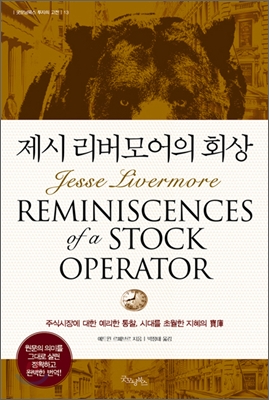
The Memoirs of Jesse Livermore is a first-person novel set on Wall Street from the 1890s to the 1920s.
The book's protagonist, Jesse Livermore, confesses that human nature is the most fearsome enemy, as he introduces countless examples of mistakes and failures he has made.
Author Edwin Lefevre concludes through Livermore's words that no one can consistently beat the stock market.
In particular, the recent publication of "Jesse Livermore's Memoirs" by Good Morning Books is the first Korean translation that faithfully translates the original book published in the United States in 1923 without any abbreviations or omissions, and its significance lies in the fact that it is an accurate and perfect translation that preserves the original meaning.
The book's protagonist, Jesse Livermore, confesses that human nature is the most fearsome enemy, as he introduces countless examples of mistakes and failures he has made.
Author Edwin Lefevre concludes through Livermore's words that no one can consistently beat the stock market.
In particular, the recent publication of "Jesse Livermore's Memoirs" by Good Morning Books is the first Korean translation that faithfully translates the original book published in the United States in 1923 without any abbreviations or omissions, and its significance lies in the fact that it is an accurate and perfect translation that preserves the original meaning.
- You can preview some of the book's contents.
Preview
index
Translator's Preface
1.
Messages conveyed by stock prices
2.
Open your eyes to the game of stock speculation
3.
I don't even know what's wrong
4.
Scammer vs.
fraud
5.
How to Make Big Money in the Stock Market
6.
Advancing to the next level in the ruthless school of speculation
7.
The Basics of Stock Trading
8.
Qualities of a Smart Speculator
9.
The best day of my life
10.
Least Resistance Line and Psychological Timing
11.
When opportunity is lurking at your doorstep
12.
Why People Lose Money on Wall Street
13.
Wasting precious years
14.
There comes a time when no one can avoid a windfall.
15.
You can never be 100% sure about anything.
16.
Investigate thoroughly and be constantly suspicious.
17.
An impulse born of conviction
18.
Belief in yourself
19.
Vision without money, vision with money
20.
The art of price manipulation
21.
Leading price manipulation
22.
If you only care about your own interests, you will not be treated well anywhere.
23.
A friendly explanation from an anonymous insider.
24.
Beware of Greeks who bring gifts.
1.
Messages conveyed by stock prices
2.
Open your eyes to the game of stock speculation
3.
I don't even know what's wrong
4.
Scammer vs.
fraud
5.
How to Make Big Money in the Stock Market
6.
Advancing to the next level in the ruthless school of speculation
7.
The Basics of Stock Trading
8.
Qualities of a Smart Speculator
9.
The best day of my life
10.
Least Resistance Line and Psychological Timing
11.
When opportunity is lurking at your doorstep
12.
Why People Lose Money on Wall Street
13.
Wasting precious years
14.
There comes a time when no one can avoid a windfall.
15.
You can never be 100% sure about anything.
16.
Investigate thoroughly and be constantly suspicious.
17.
An impulse born of conviction
18.
Belief in yourself
19.
Vision without money, vision with money
20.
The art of price manipulation
21.
Leading price manipulation
22.
If you only care about your own interests, you will not be treated well anywhere.
23.
A friendly explanation from an anonymous insider.
24.
Beware of Greeks who bring gifts.
Into the book
There's nothing new on Wall Street.
Whatever happens in the stock market today has happened before and will happen again in the future.
I have never forgotten this fact for even a moment.
I try to remember exactly when and how it happened in the past.
Remembering the past is my way of using my past experiences in my own way.
---p.17
It was never my brain that made me a lot of money.
It was thanks to sitting down.
He said he made a lot of money by sitting still! It's rare to find someone who makes sound decisions while also sitting still.
I've found this to be one of the hardest things to learn.
However, stock speculators can make a lot of money only after they clearly understand this.
It is easier to make millions of dollars after learning how to trade properly than to make hundreds of dollars without knowing anything.
---p.104
A speculator's greatest enemy always comes from within himself.
Hope and fear are inseparable parts of human nature.
Any successful trader must fight these two deep-seated instincts.
We need to completely change what we call natural human responses.
When you try to hope, you have to be afraid.
When you are afraid, you must have hope.
---p.199
Observation, experience, memory, and mathematical thinking are the four essential elements that successful traders must rely on.
Successful traders not only observe accurately, but they also always remember what they observe.
No matter how strong my personal conviction about human irrationality, I never bet irrationally, and no matter how often I feel that unpredictable events will occur, I never bet on such unpredictable events.
Successful traders always bet based on probability.
Always try to predict the probability.
Whatever happens in the stock market today has happened before and will happen again in the future.
I have never forgotten this fact for even a moment.
I try to remember exactly when and how it happened in the past.
Remembering the past is my way of using my past experiences in my own way.
---p.17
It was never my brain that made me a lot of money.
It was thanks to sitting down.
He said he made a lot of money by sitting still! It's rare to find someone who makes sound decisions while also sitting still.
I've found this to be one of the hardest things to learn.
However, stock speculators can make a lot of money only after they clearly understand this.
It is easier to make millions of dollars after learning how to trade properly than to make hundreds of dollars without knowing anything.
---p.104
A speculator's greatest enemy always comes from within himself.
Hope and fear are inseparable parts of human nature.
Any successful trader must fight these two deep-seated instincts.
We need to completely change what we call natural human responses.
When you try to hope, you have to be afraid.
When you are afraid, you must have hope.
---p.199
Observation, experience, memory, and mathematical thinking are the four essential elements that successful traders must rely on.
Successful traders not only observe accurately, but they also always remember what they observe.
No matter how strong my personal conviction about human irrationality, I never bet irrationally, and no matter how often I feel that unpredictable events will occur, I never bet on such unpredictable events.
Successful traders always bet based on probability.
Always try to predict the probability.
---p.324
Publisher's Review
Books about stock investing can be this exciting.
This book is probably the most entertaining and educational investment book in the world.
This book is full of factual and instructive content, so much so that it is not at all out of place to call it a "textbook of investment."
The Memoirs of Jesse Livermore is a first-person novel set on Wall Street from the 1890s to the 1920s.
The story of how a fourteen-year-old boy from the countryside grew into the greatest trader of his time is told through the memoirs of the narrator, Larry Livingston.
Unlike other investment books, this book doesn't explain the secrets or formulas for successful investing, but instead tells the lessons you need to remember in a story format.
The book's protagonist, Jesse Livermore, confesses that human nature is the most fearsome enemy, as he introduces countless examples of mistakes and failures he has made.
Author Edwin Lefevre concludes through Livermore's words that no one can consistently beat the stock market.
Wall Street's countless proverbs and sayings that stab the heart
This book is an investment classic that clearly explains what speculation is, a vivid history of Wall Street's past, a psychological analysis that keenly observes the psychology of market participants, and a biography of Jesse Livermore, the tragic speculator who dominated his time.
Also, the highlight of this book are the humane, honest, and sharp aphorisms you encounter with each page:
There's nothing new on Wall Street.
Whatever happens in the stock market today has happened before and will happen again in the future. (Chapter 1) There is only one perspective in the stock market.
It is a perspective that accurately views the market, neither bullish nor bearish. (Chapter 3) It is rare to find someone who makes the right judgment while also sitting quietly.
It's easier to make millions of dollars after learning how to trade properly than to make hundreds of dollars without knowing anything (Chapter 5). Those who make the right decisions at the right time are always rewarded (Chapter 10).
The life of a tragic speculator who dominated an era
The main character of this book, Jesse Livermore, was the greatest speculator of his time, dominating Wall Street in the early 20th century.
He was called the "Big Bear" of Wall Street because he made a lot of money through a large-scale short selling offensive at a crucial moment.
Through the Panic of 1907, World War I, the historic bull market of the 1920s, the stock market crash of 1929, and the Great Depression of the 1930s, the company created numerous success stories and also endured numerous bankruptcies.
Born in 1877 in South Acton, Massachusetts, the son of a poor farmer, Livermore went to Boston with $5 saved by his mother as soon as he graduated from elementary school and started working as a clerk at a stock company at the age of 14.
From this time on, he opened his eyes to stock speculation, and made his first $1,000 around the age of 15. After that, he devoted himself to speculation, making astronomical profits of $3 million during the Panic of 1907 and $100 million during the stock market crash of 1929.
However, he officially went bankrupt four times due to excessive leveraged investments and extravagant lifestyle.
He rose again three times like a rock and paid off all the principal and interest on the debt that he had previously been declared bankrupt.
However, he never recovered after his fourth and final bankruptcy on March 7, 1934, leaving Livermore with assets of $184,900 and liabilities of $2,259,212.
Livermore suffered from three failed marriages, excessive drinking, and depression in his later years, and ultimately committed suicide with a pistol in a New York hotel on November 28, 1940.
"Don't invest your hard-earned money until you read this book!"
"Jesse Livermore's Memoirs" is considered the "bible of investing" by renowned traders, and is often cited as "the one book" that inspired them to enter the world of investing.
Kenneth Fisher, who writes a regular column called "Portfolio Strategy" for Forbes, said:
"This is my favorite book I've ever read, and I don't think anyone should invest their hard-earned money in it before reading it first."
The author, Edwin Lefevre, was a writer and journalist who best depicted the human side of Wall Street.
His novels, set on Wall Street, vividly illustrate how human greed, ignorance, fear, and hope operate in the stock market.
Throughout the 1920s, when the U.S. stock market was booming, he explained to the public the reality of speculation and its risks.
From 1922 to 1923, he serialized "Reminiscences of Jesse Livermore" in the Saturday Evening Post, the most popular magazine in the United States at the time, and it created a great stir among readers, earning him the reputation of having portrayed the human nature that drives Wall Street more accurately than anyone else.
This time, Good Morning Books' "Jesse Livermore's Memoirs" is the first Korean translation to faithfully translate the original book published in the United States in 1923 without any abbreviations or omissions. It is particularly significant in that it is an accurate and perfect translation that preserves the original meaning.
This book is probably the most entertaining and educational investment book in the world.
This book is full of factual and instructive content, so much so that it is not at all out of place to call it a "textbook of investment."
The Memoirs of Jesse Livermore is a first-person novel set on Wall Street from the 1890s to the 1920s.
The story of how a fourteen-year-old boy from the countryside grew into the greatest trader of his time is told through the memoirs of the narrator, Larry Livingston.
Unlike other investment books, this book doesn't explain the secrets or formulas for successful investing, but instead tells the lessons you need to remember in a story format.
The book's protagonist, Jesse Livermore, confesses that human nature is the most fearsome enemy, as he introduces countless examples of mistakes and failures he has made.
Author Edwin Lefevre concludes through Livermore's words that no one can consistently beat the stock market.
Wall Street's countless proverbs and sayings that stab the heart
This book is an investment classic that clearly explains what speculation is, a vivid history of Wall Street's past, a psychological analysis that keenly observes the psychology of market participants, and a biography of Jesse Livermore, the tragic speculator who dominated his time.
Also, the highlight of this book are the humane, honest, and sharp aphorisms you encounter with each page:
There's nothing new on Wall Street.
Whatever happens in the stock market today has happened before and will happen again in the future. (Chapter 1) There is only one perspective in the stock market.
It is a perspective that accurately views the market, neither bullish nor bearish. (Chapter 3) It is rare to find someone who makes the right judgment while also sitting quietly.
It's easier to make millions of dollars after learning how to trade properly than to make hundreds of dollars without knowing anything (Chapter 5). Those who make the right decisions at the right time are always rewarded (Chapter 10).
The life of a tragic speculator who dominated an era
The main character of this book, Jesse Livermore, was the greatest speculator of his time, dominating Wall Street in the early 20th century.
He was called the "Big Bear" of Wall Street because he made a lot of money through a large-scale short selling offensive at a crucial moment.
Through the Panic of 1907, World War I, the historic bull market of the 1920s, the stock market crash of 1929, and the Great Depression of the 1930s, the company created numerous success stories and also endured numerous bankruptcies.
Born in 1877 in South Acton, Massachusetts, the son of a poor farmer, Livermore went to Boston with $5 saved by his mother as soon as he graduated from elementary school and started working as a clerk at a stock company at the age of 14.
From this time on, he opened his eyes to stock speculation, and made his first $1,000 around the age of 15. After that, he devoted himself to speculation, making astronomical profits of $3 million during the Panic of 1907 and $100 million during the stock market crash of 1929.
However, he officially went bankrupt four times due to excessive leveraged investments and extravagant lifestyle.
He rose again three times like a rock and paid off all the principal and interest on the debt that he had previously been declared bankrupt.
However, he never recovered after his fourth and final bankruptcy on March 7, 1934, leaving Livermore with assets of $184,900 and liabilities of $2,259,212.
Livermore suffered from three failed marriages, excessive drinking, and depression in his later years, and ultimately committed suicide with a pistol in a New York hotel on November 28, 1940.
"Don't invest your hard-earned money until you read this book!"
"Jesse Livermore's Memoirs" is considered the "bible of investing" by renowned traders, and is often cited as "the one book" that inspired them to enter the world of investing.
Kenneth Fisher, who writes a regular column called "Portfolio Strategy" for Forbes, said:
"This is my favorite book I've ever read, and I don't think anyone should invest their hard-earned money in it before reading it first."
The author, Edwin Lefevre, was a writer and journalist who best depicted the human side of Wall Street.
His novels, set on Wall Street, vividly illustrate how human greed, ignorance, fear, and hope operate in the stock market.
Throughout the 1920s, when the U.S. stock market was booming, he explained to the public the reality of speculation and its risks.
From 1922 to 1923, he serialized "Reminiscences of Jesse Livermore" in the Saturday Evening Post, the most popular magazine in the United States at the time, and it created a great stir among readers, earning him the reputation of having portrayed the human nature that drives Wall Street more accurately than anyone else.
This time, Good Morning Books' "Jesse Livermore's Memoirs" is the first Korean translation to faithfully translate the original book published in the United States in 1923 without any abbreviations or omissions. It is particularly significant in that it is an accurate and perfect translation that preserves the original meaning.
GOODS SPECIFICS
- Date of publication: July 26, 2010
- Page count, weight, size: 445 pages | 659g | 153*224*30mm
- ISBN13: 9788991378216
- ISBN10: 8991378218
You may also like
카테고리
korean


korean

![GQ KOREA Mark (Monthly): December [2025]](http://librairie.coreenne.fr/cdn/shop/files/8ef265dbbfbf186523ed75ba7319009d.jpg?v=1765340328&width=3840)


