

Tariff story
 |
Description
Book Introduction
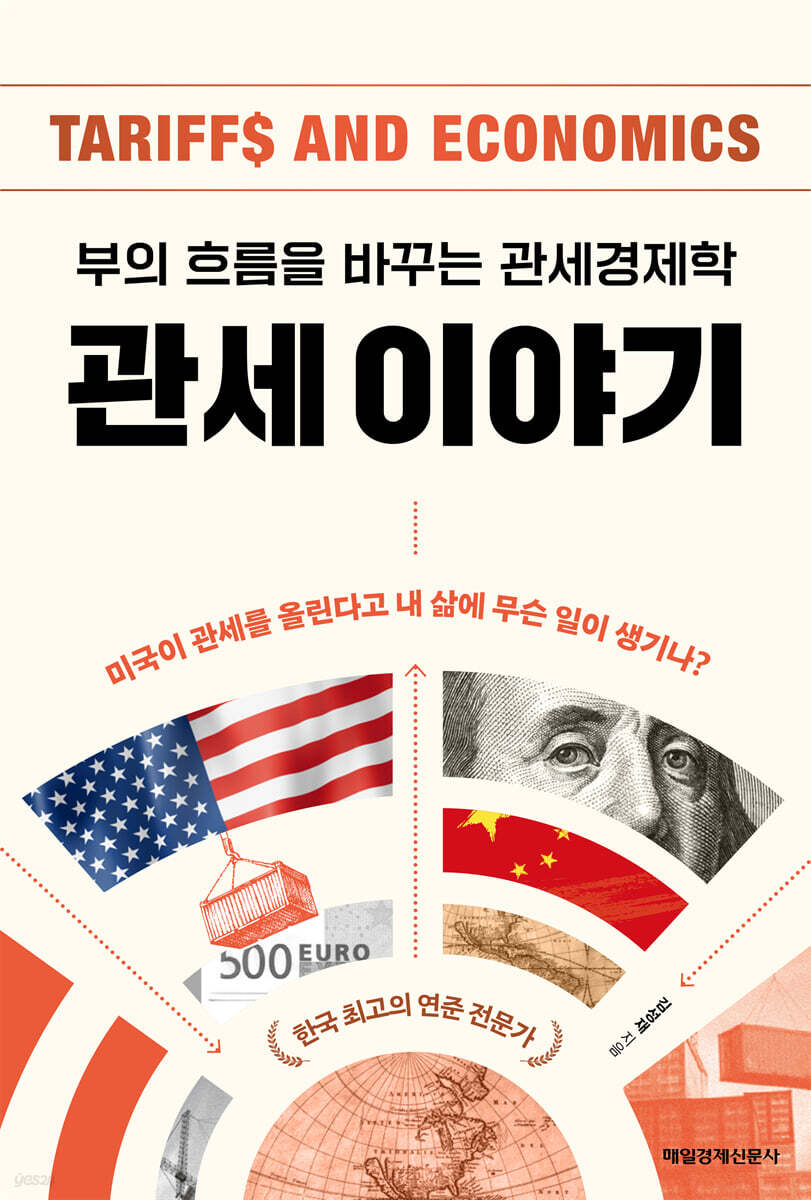
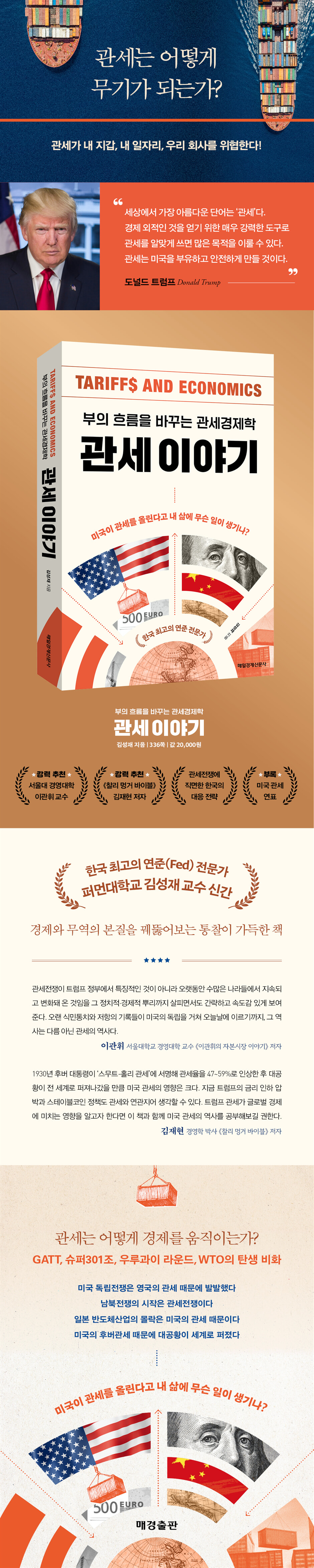
“What will happen to my life if the US raises tariffs?”
Tariffs threaten my wallet, my job, and my company.
★ A new book by Professor Kim Seong-jae of Furman University, Korea's top Federal Reserve expert.
★ Recommended by Professor Lee Gwan-hui of Seoul National University and Dr. Kim Jae-hyun
A book titled "Tariff Story" explores the long history of the tariff war the United States is currently waging against the world and prepares for the impact it will have on our economy.
Tariffs are not simply taxes; they are crucial variables that change a country's economic structure, the lives of its citizens, and even the flow of the global economy.
In this book, Professor Kim Seong-jae of the Department of Business Administration at Furman University answers questions we often have about tariffs in our daily lives, such as, “How long will we have to suffer from US tariffs?”, “Why does the government impose tariffs?”, and “Why does my shopping cart get lighter when tariffs rise?”
It also systematically explains the roles of markets and governments, economic growth and prices, unemployment and monetary policy, and even the principles of international trade and the economic effects of tariffs.
Although tariffs serve the function of protecting domestic industries, they also have a significant negative impact on the overall economy through price distortions, reduced trade efficiency, inflation, and reduced consumer benefits.
The author explains the historical examples of tariff policies implemented by the United States and the United Kingdom, the principles of supply and demand, and changes in financial markets according to interest rates and money supply. Based on the economic theories of David Ricardo and John Stuart Mill, the author emphasizes that free trade is more effective in economic growth and stability, and suggests the direction of desirable economic policy.
It also advises on strategies for our economy to prepare for and overcome the complex and urgent economic crisis triggered by the tariff war.
Tariffs threaten my wallet, my job, and my company.
★ A new book by Professor Kim Seong-jae of Furman University, Korea's top Federal Reserve expert.
★ Recommended by Professor Lee Gwan-hui of Seoul National University and Dr. Kim Jae-hyun
A book titled "Tariff Story" explores the long history of the tariff war the United States is currently waging against the world and prepares for the impact it will have on our economy.
Tariffs are not simply taxes; they are crucial variables that change a country's economic structure, the lives of its citizens, and even the flow of the global economy.
In this book, Professor Kim Seong-jae of the Department of Business Administration at Furman University answers questions we often have about tariffs in our daily lives, such as, “How long will we have to suffer from US tariffs?”, “Why does the government impose tariffs?”, and “Why does my shopping cart get lighter when tariffs rise?”
It also systematically explains the roles of markets and governments, economic growth and prices, unemployment and monetary policy, and even the principles of international trade and the economic effects of tariffs.
Although tariffs serve the function of protecting domestic industries, they also have a significant negative impact on the overall economy through price distortions, reduced trade efficiency, inflation, and reduced consumer benefits.
The author explains the historical examples of tariff policies implemented by the United States and the United Kingdom, the principles of supply and demand, and changes in financial markets according to interest rates and money supply. Based on the economic theories of David Ricardo and John Stuart Mill, the author emphasizes that free trade is more effective in economic growth and stability, and suggests the direction of desirable economic policy.
It also advises on strategies for our economy to prepare for and overcome the complex and urgent economic crisis triggered by the tariff war.
- You can preview some of the book's contents.
Preview
index
Introduction_ A Special Way to Understand the Economy
Chapter 1: How Tariffs Drive the Economy
What is a good economy?
Fisher's quantity theory of money and Keynesian economics
Monetary Economy and Central Banks
Principles of Inflation and Economic Growth
A win-win system for the international economy
Is the theory of comparative advantage beneficial to everyone?
Chapter 2: The Present and Future of the Tariff War
Can we find the optimal tariff rate?
Unfair practices and trade imbalances
Nixon used tariffs as a negotiating weapon
The Plaza Accord: Japan's Semiconductor Industry Ruined by Tariffs
The Rise of Young Trump and Clinton's WTO Creation
Trump's first US-China tariff war
The Biden administration maintained Trump's tariff policies.
The superpower tariff man who threatens the world
Trump's Tariff Guidelines, Stephen Myron's Thesis
The aftermath of the Mar-a-Lago agreement
Second US-China tariff war
The Future of the Trade War and the Bubble Burst
Chapter 3: The American Revolutionary War Caused by Tariffs
Two streams of British immigration
Southeastern Plantation Economy and Free Trade
Northeastern self-reliant economy and independent spirit
The Sugar Tax's Whirlwind: The First US-UK Tariff War
Britain's failed tariff attempts to exploit colonial America
Tariffs that Crossed the Red Line and the Boston Tea Party
The trade war sparked a gunfight, the beginning of the war of independence.
Paine's Common Sense and the Declaration of Independence
The Battle of the Chesapeake, a fateful battle
Chapter 4: Great America or Abominable Tariffs?
The conflict between industrialism and physiocracy
The Purpose of Early Tariffs and the Seeds of Division
Tariffs, the core of the American system
Heinous Tariffs Are Ripping America Apart
Financial crisis and black tariffs
The temperature gap between the North and South created by free trade
Tariff hikes are unbearable
The tariff war that became the Civil War
Chapter 5: Recurring Economic Crises and Trade Wars
The gold standard, financial crises, and tariffs
High tariffs and the rise of monopoly capitalists
The Hoover Tariffs that choked the global economy
The era of hegemony in the United States and free trade
The return of the strong dollar policy and protectionism
The world economy is in serious crisis
Chapter 6: The 21st Century Tariff War Surrounding America
Who will win the US-China tariff war?
How much will Japan concede?
Future Directions for Europe and Canada
Chapter 7: How Should We Prepare?
Exports are the foundation of Korea's economic growth and prosperity.
The United States has absolute influence over Korea
A popular car becomes a target for Trump.
Survival strategies for the Korean economy
Coming out
Appendix_ U.S. Tariff Chronology
Search
Chapter 1: How Tariffs Drive the Economy
What is a good economy?
Fisher's quantity theory of money and Keynesian economics
Monetary Economy and Central Banks
Principles of Inflation and Economic Growth
A win-win system for the international economy
Is the theory of comparative advantage beneficial to everyone?
Chapter 2: The Present and Future of the Tariff War
Can we find the optimal tariff rate?
Unfair practices and trade imbalances
Nixon used tariffs as a negotiating weapon
The Plaza Accord: Japan's Semiconductor Industry Ruined by Tariffs
The Rise of Young Trump and Clinton's WTO Creation
Trump's first US-China tariff war
The Biden administration maintained Trump's tariff policies.
The superpower tariff man who threatens the world
Trump's Tariff Guidelines, Stephen Myron's Thesis
The aftermath of the Mar-a-Lago agreement
Second US-China tariff war
The Future of the Trade War and the Bubble Burst
Chapter 3: The American Revolutionary War Caused by Tariffs
Two streams of British immigration
Southeastern Plantation Economy and Free Trade
Northeastern self-reliant economy and independent spirit
The Sugar Tax's Whirlwind: The First US-UK Tariff War
Britain's failed tariff attempts to exploit colonial America
Tariffs that Crossed the Red Line and the Boston Tea Party
The trade war sparked a gunfight, the beginning of the war of independence.
Paine's Common Sense and the Declaration of Independence
The Battle of the Chesapeake, a fateful battle
Chapter 4: Great America or Abominable Tariffs?
The conflict between industrialism and physiocracy
The Purpose of Early Tariffs and the Seeds of Division
Tariffs, the core of the American system
Heinous Tariffs Are Ripping America Apart
Financial crisis and black tariffs
The temperature gap between the North and South created by free trade
Tariff hikes are unbearable
The tariff war that became the Civil War
Chapter 5: Recurring Economic Crises and Trade Wars
The gold standard, financial crises, and tariffs
High tariffs and the rise of monopoly capitalists
The Hoover Tariffs that choked the global economy
The era of hegemony in the United States and free trade
The return of the strong dollar policy and protectionism
The world economy is in serious crisis
Chapter 6: The 21st Century Tariff War Surrounding America
Who will win the US-China tariff war?
How much will Japan concede?
Future Directions for Europe and Canada
Chapter 7: How Should We Prepare?
Exports are the foundation of Korea's economic growth and prosperity.
The United States has absolute influence over Korea
A popular car becomes a target for Trump.
Survival strategies for the Korean economy
Coming out
Appendix_ U.S. Tariff Chronology
Search
Detailed image
Into the book
Imposing tariffs also increases government revenue.
It is expected that increased direct investment by foreign companies seeking to avoid paying tariffs will also contribute to economic growth.
However, the effectiveness of economic policy is like a 'double-edged sword'.
When a hegemonic country like the United States imposes tariffs, the effect is not limited to that of a simple tax.
Tariffs shake up a country's economic structure, the lives of its people, and even the world order.
Tariffs raise prices in some way.
As prices rise, interest rates also rise.
The possibility of countries being hit with tariffs retaliating also increases.
Tariffs reduce the volume of international trade itself.
Then, companies that lose the market reduce production and lay off employees.
Unemployment and recession are coming.
---From "Introduction - A Special Way to Understand the Economy"
The benefits of free trade based on Ricardo's theory of comparative advantage are mostly enjoyed by powerful countries that have a competitive edge in manufacturing productivity.
It is very difficult for developing countries specializing in agriculture and primary industries to achieve economic growth.
It often falls to the level of a raw material base for a manufacturing powerhouse.
Even if you work hard, it is difficult to escape poverty.
The only way for them to share in the fruits of economic growth is to grow manufacturing.
However, building a manufacturing ecosystem does not happen overnight.
It takes a long time to learn complex production processes and manufacturing techniques and to acquire sales know-how.
As the example above shows, if the United States opens its cotton textile market to free trade, cheap, high-quality British products will flood the market.
Appealing to patriotism to encourage the use of domestic products inevitably has its limits.
---From "Chapter 1 - How Tariffs Drive the Economy"
Issuers of dollar stablecoins, such as Tether (USDT) or USDC, must purchase and hold short-term government bonds equal to the value of the stablecoin.
While the bill appears to be aimed at curbing cryptocurrencies, it actually seeks to strengthen the dollar's status as a reserve currency by boosting demand for U.S. Treasury securities through the promotion of stablecoins.
Above all, as stablecoins become more active and their use explodes, the velocity (V) of the dollar currency increases, increasing the total circulation (MV) of the currency.
This compensates for the decrease in the money supply (M) due to the imposition of tariffs.
Because the potential of stablecoins is so great, the power struggle between traditional financial institutions and big tech is fierce.
Wall Street wants to limit stablecoin issuance to institutions similar to banks.
Big tech wants to get into the stablecoin market too.
---From "Chapter 2 - The Present and Future of the Tariff War"
With Lincoln's election and his opposition to slavery and tariff increases clear, in December 1860 the South Carolina legislature unanimously voted to secede from the Union.
Mississippi, Florida, Alabama, Georgia, Louisiana, and Texas followed suit by February 1861.
These seven southern states formed the new Confederate States.
A new nation, called the Confederacy, emerged to confront the United States of America, led by Lincoln.
When the Confederacy seceded from the Union, the Republican Party gained a majority in the Senate.
Based on this, the Senate passed the Morrill Tariff in March of that year.
The Morrill tariff has been revised and raised several times.
Initially, the average tariff was around 26-30%.
The northern industrial zone imposed tariffs of over 40% on some manufactured goods, such as steel, that competed with foreign countries.
The same was true for textiles and wool.
In July of that year, as the Civil War intensified, tariffs were raised to 30-40%, and by 1862 the average tariff rate had risen to 37%.
---From "Chapter 4 - Great America or Abominable Tariffs"
As a Korean company, we need to respond to the US and non-US markets separately.
The U.S. market needs to be addressed by localizing production, while the investment plan needs to be readjusted to accommodate non-U.S. markets by manufacturing in other production bases, including Korea.
It is expected that increased direct investment by foreign companies seeking to avoid paying tariffs will also contribute to economic growth.
However, the effectiveness of economic policy is like a 'double-edged sword'.
When a hegemonic country like the United States imposes tariffs, the effect is not limited to that of a simple tax.
Tariffs shake up a country's economic structure, the lives of its people, and even the world order.
Tariffs raise prices in some way.
As prices rise, interest rates also rise.
The possibility of countries being hit with tariffs retaliating also increases.
Tariffs reduce the volume of international trade itself.
Then, companies that lose the market reduce production and lay off employees.
Unemployment and recession are coming.
---From "Introduction - A Special Way to Understand the Economy"
The benefits of free trade based on Ricardo's theory of comparative advantage are mostly enjoyed by powerful countries that have a competitive edge in manufacturing productivity.
It is very difficult for developing countries specializing in agriculture and primary industries to achieve economic growth.
It often falls to the level of a raw material base for a manufacturing powerhouse.
Even if you work hard, it is difficult to escape poverty.
The only way for them to share in the fruits of economic growth is to grow manufacturing.
However, building a manufacturing ecosystem does not happen overnight.
It takes a long time to learn complex production processes and manufacturing techniques and to acquire sales know-how.
As the example above shows, if the United States opens its cotton textile market to free trade, cheap, high-quality British products will flood the market.
Appealing to patriotism to encourage the use of domestic products inevitably has its limits.
---From "Chapter 1 - How Tariffs Drive the Economy"
Issuers of dollar stablecoins, such as Tether (USDT) or USDC, must purchase and hold short-term government bonds equal to the value of the stablecoin.
While the bill appears to be aimed at curbing cryptocurrencies, it actually seeks to strengthen the dollar's status as a reserve currency by boosting demand for U.S. Treasury securities through the promotion of stablecoins.
Above all, as stablecoins become more active and their use explodes, the velocity (V) of the dollar currency increases, increasing the total circulation (MV) of the currency.
This compensates for the decrease in the money supply (M) due to the imposition of tariffs.
Because the potential of stablecoins is so great, the power struggle between traditional financial institutions and big tech is fierce.
Wall Street wants to limit stablecoin issuance to institutions similar to banks.
Big tech wants to get into the stablecoin market too.
---From "Chapter 2 - The Present and Future of the Tariff War"
With Lincoln's election and his opposition to slavery and tariff increases clear, in December 1860 the South Carolina legislature unanimously voted to secede from the Union.
Mississippi, Florida, Alabama, Georgia, Louisiana, and Texas followed suit by February 1861.
These seven southern states formed the new Confederate States.
A new nation, called the Confederacy, emerged to confront the United States of America, led by Lincoln.
When the Confederacy seceded from the Union, the Republican Party gained a majority in the Senate.
Based on this, the Senate passed the Morrill Tariff in March of that year.
The Morrill tariff has been revised and raised several times.
Initially, the average tariff was around 26-30%.
The northern industrial zone imposed tariffs of over 40% on some manufactured goods, such as steel, that competed with foreign countries.
The same was true for textiles and wool.
In July of that year, as the Civil War intensified, tariffs were raised to 30-40%, and by 1862 the average tariff rate had risen to 37%.
---From "Chapter 4 - Great America or Abominable Tariffs"
As a Korean company, we need to respond to the US and non-US markets separately.
The U.S. market needs to be addressed by localizing production, while the investment plan needs to be readjusted to accommodate non-U.S. markets by manufacturing in other production bases, including Korea.
---From Chapter 7 - How Should We Prepare?
Publisher's Review
“How do tariffs drive the economy?”
A book full of insight into the essence of economics and trade.
-How do tariffs become weapons?
Although tariffs have the effect of protecting domestic manufacturers and increasing tax revenues by raising the prices of cheap imported goods, they also cause inflation, increasing the purchasing costs of domestic consumers and increasing the burden on households.
The price increases caused by tariffs are causing relatively greater losses to ordinary citizens, who spend a high proportion of their income on consumption.
Furthermore, on a macro level, it ultimately weakens the export competitiveness of companies.
Tariffs are used to protect domestic industries and to pressure foreign companies to gain an advantageous position in negotiations.
When a country with a large economic power like the United States utilizes tariffs, it can be used not just as a simple tax, but as a strategic weapon to subdue other countries.
Tariffs can have a ripple effect of 'price increases → consumption decreases → production decreases → unemployment increases', and if retaliatory tariffs continue between the two countries, the scale of global trade will shrink, dealing a blow to the global economy as a whole.
A representative historical example is the Great Depression of 1929.
The history of tariff wars is the history of the world economy.
This book swiftly traces the emergence and decisive role of tariffs at key historical junctures, from the American Revolutionary War, the Civil War, the Great Depression, and the 21st-century U.S.-China trade war.
It is full of interesting historical facts, such as 'The American Revolutionary War broke out because of British tariffs', 'The Civil War started because of excessive tariffs', 'The Great Depression spread around the world because of the Hoover Tariff in the US', and 'The Japanese semiconductor industry collapsed because of US tariffs'.
While President Donald Trump is currently hell-bent on imposing tariffs on countries around the world, the United States has long been trying to eliminate tariffs.
George H.
President W. Bush promoted the North American Free Trade Agreement (NAFTA), and President Bill Clinton implemented it.
Clinton also spearheaded the creation of the World Trade Organization (WTO), which replaced the General Agreement on Tariffs and Trade (GATT), and encouraged countries to lower not only tariffs but also various non-tariff trade barriers.
The reason the United States, which had been preaching free trade by expanding tariff-free zones through free trade agreements (FTAs) with many countries, is now imposing enormous tariffs is because of its trade deficit.
The US-China tariff war that is putting the global economy at risk
The U.S. trade deficit, which exceeded $550 billion in 2017, jumped to $622.7 billion in 2018.
What most irritated Trump was the trade deficit with China, which had reached nearly $420 billion.
Two-thirds of the total trade deficit came from public trade.
Finally, on July 6, 2018, Trump imposed a 25% import tariff on $34 billion worth of Chinese goods.
The first US-China tariff war began when China imposed the same tariffs on the US.
The U.S. trade deficit hit a record high of $945.3 billion in 2022.
The trade deficit is projected to reach $918.4 billion in 2024.
The trade deficit with the public has steadily declined, reaching $295.4 billion in 2024, but remains high.
Upon his re-election, Trump immediately announced a 10% tariff on all Chinese goods, adding to existing tariffs on China, starting February 1, 2025, initiating a second tariff war.
-The keyword for understanding the future of the global economy: 'tariffs.'
Currently, the United States is imposing high tariffs on major trading partners, including China and the EU, to foster key strategic industries such as electric vehicles, semiconductors, and AI components domestically. This is not simply protectionism, but a sophisticated economic strategy aimed at securing industrial leadership.
The United States is pressuring not only China but also the EU, South Korea, and Japan to renegotiate trade agreements by mentioning tariff increases.
To avoid tariff burdens, companies around the world are relocating their production bases from China to Southeast Asia, Mexico, and other regions, accelerating the de-Chinaization and reshoring of global supply chains.
-The tariff war is a war for hegemony!
The United States, which has achieved 'financial hegemony' with the dollar and 'security hegemony' with military power, now wants to achieve 'trade hegemony' with tariffs.
It is literally an attempt to seize all world hegemony.
So where did Trump get the confidence to start the current tariff war?
Professor Kim Seong-jae of Furman University in the United States focuses on Stephen Myron's paper, "A User's Guide to Restructuring the Global Trading System."
It is analyzed that, similar to the 1985 Plaza Accord that triggered Japan's "Lost 30 Years," they are planning to invite trading partners to the Mar-a-Lago resort and force them to buy ultra-long-term U.S. Treasury bonds and sign the so-called "Mar-a-Lago Agreement."
The US is pressuring that only countries that have entered the "economic umbrella" imposed by the US will be able to trade smoothly with the US, and only those countries that have entered this economic umbrella will be eligible to receive the "liquidity umbrella" that will allow them to easily obtain the US dollar, the key currency, as well as the "security umbrella."
Through "Tariff Story," researched and compiled by Professor Kim Seong-jae, Korea's leading Federal Reserve expert, let's take the opportunity to understand the architects of the tariff war that threatens the world and destabilizes economies around the world, and to predict America's future scenarios.
A book full of insight into the essence of economics and trade.
-How do tariffs become weapons?
Although tariffs have the effect of protecting domestic manufacturers and increasing tax revenues by raising the prices of cheap imported goods, they also cause inflation, increasing the purchasing costs of domestic consumers and increasing the burden on households.
The price increases caused by tariffs are causing relatively greater losses to ordinary citizens, who spend a high proportion of their income on consumption.
Furthermore, on a macro level, it ultimately weakens the export competitiveness of companies.
Tariffs are used to protect domestic industries and to pressure foreign companies to gain an advantageous position in negotiations.
When a country with a large economic power like the United States utilizes tariffs, it can be used not just as a simple tax, but as a strategic weapon to subdue other countries.
Tariffs can have a ripple effect of 'price increases → consumption decreases → production decreases → unemployment increases', and if retaliatory tariffs continue between the two countries, the scale of global trade will shrink, dealing a blow to the global economy as a whole.
A representative historical example is the Great Depression of 1929.
The history of tariff wars is the history of the world economy.
This book swiftly traces the emergence and decisive role of tariffs at key historical junctures, from the American Revolutionary War, the Civil War, the Great Depression, and the 21st-century U.S.-China trade war.
It is full of interesting historical facts, such as 'The American Revolutionary War broke out because of British tariffs', 'The Civil War started because of excessive tariffs', 'The Great Depression spread around the world because of the Hoover Tariff in the US', and 'The Japanese semiconductor industry collapsed because of US tariffs'.
While President Donald Trump is currently hell-bent on imposing tariffs on countries around the world, the United States has long been trying to eliminate tariffs.
George H.
President W. Bush promoted the North American Free Trade Agreement (NAFTA), and President Bill Clinton implemented it.
Clinton also spearheaded the creation of the World Trade Organization (WTO), which replaced the General Agreement on Tariffs and Trade (GATT), and encouraged countries to lower not only tariffs but also various non-tariff trade barriers.
The reason the United States, which had been preaching free trade by expanding tariff-free zones through free trade agreements (FTAs) with many countries, is now imposing enormous tariffs is because of its trade deficit.
The US-China tariff war that is putting the global economy at risk
The U.S. trade deficit, which exceeded $550 billion in 2017, jumped to $622.7 billion in 2018.
What most irritated Trump was the trade deficit with China, which had reached nearly $420 billion.
Two-thirds of the total trade deficit came from public trade.
Finally, on July 6, 2018, Trump imposed a 25% import tariff on $34 billion worth of Chinese goods.
The first US-China tariff war began when China imposed the same tariffs on the US.
The U.S. trade deficit hit a record high of $945.3 billion in 2022.
The trade deficit is projected to reach $918.4 billion in 2024.
The trade deficit with the public has steadily declined, reaching $295.4 billion in 2024, but remains high.
Upon his re-election, Trump immediately announced a 10% tariff on all Chinese goods, adding to existing tariffs on China, starting February 1, 2025, initiating a second tariff war.
-The keyword for understanding the future of the global economy: 'tariffs.'
Currently, the United States is imposing high tariffs on major trading partners, including China and the EU, to foster key strategic industries such as electric vehicles, semiconductors, and AI components domestically. This is not simply protectionism, but a sophisticated economic strategy aimed at securing industrial leadership.
The United States is pressuring not only China but also the EU, South Korea, and Japan to renegotiate trade agreements by mentioning tariff increases.
To avoid tariff burdens, companies around the world are relocating their production bases from China to Southeast Asia, Mexico, and other regions, accelerating the de-Chinaization and reshoring of global supply chains.
-The tariff war is a war for hegemony!
The United States, which has achieved 'financial hegemony' with the dollar and 'security hegemony' with military power, now wants to achieve 'trade hegemony' with tariffs.
It is literally an attempt to seize all world hegemony.
So where did Trump get the confidence to start the current tariff war?
Professor Kim Seong-jae of Furman University in the United States focuses on Stephen Myron's paper, "A User's Guide to Restructuring the Global Trading System."
It is analyzed that, similar to the 1985 Plaza Accord that triggered Japan's "Lost 30 Years," they are planning to invite trading partners to the Mar-a-Lago resort and force them to buy ultra-long-term U.S. Treasury bonds and sign the so-called "Mar-a-Lago Agreement."
The US is pressuring that only countries that have entered the "economic umbrella" imposed by the US will be able to trade smoothly with the US, and only those countries that have entered this economic umbrella will be eligible to receive the "liquidity umbrella" that will allow them to easily obtain the US dollar, the key currency, as well as the "security umbrella."
Through "Tariff Story," researched and compiled by Professor Kim Seong-jae, Korea's leading Federal Reserve expert, let's take the opportunity to understand the architects of the tariff war that threatens the world and destabilizes economies around the world, and to predict America's future scenarios.
GOODS SPECIFICS
- Date of issue: July 17, 2025
- Page count, weight, size: 336 pages | 622g | 152*225*22mm
- ISBN13: 9791164847938
You may also like
카테고리
korean


korean

![GQ KOREA Mark (Monthly): December [2025]](http://librairie.coreenne.fr/cdn/shop/files/8ef265dbbfbf186523ed75ba7319009d.jpg?v=1765340328&width=3840)


