

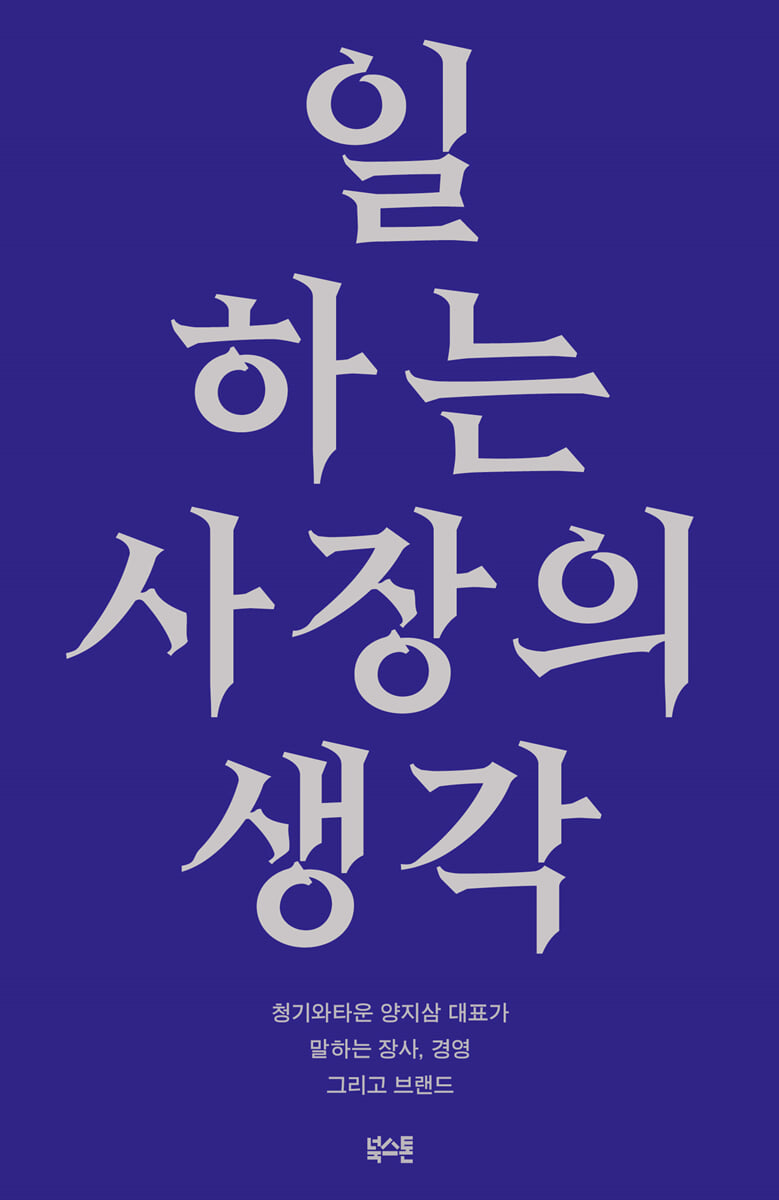
Thoughts of a working boss
 |
Description
Book Introduction
From a restaurant employee to the CEO of a company with annual sales of 40 billion won,
Yang Ji-sam, CEO of Cheonggiwa Town, talks about business, management, and branding.
"Thoughts of a Working CEO" is a survival strategy shared by Yang Ji-sam, CEO of Cheonggiwa Town, who started out as a restaurant employee and created a brand with annual sales of 40 billion won.
This is not a simple business guide, but rather a vivid process of solving problems encountered in real business and creating a sustainable brand based on one's own experience.
The author shares "real-world advice" gleaned from countless moments of choice, including how to overcome the first crisis after starting a business, the process of finding your own customers, and the secret to building core employees.
Above all, it contains 'advice for survival' rather than 'advice for success', and is full of raw, real-life experiences that are hard to hear anywhere else.
This is a must-have business bible for anyone preparing to start a business, a current store owner, or anyone who wants to build a brand.
Yang Ji-sam, CEO of Cheonggiwa Town, talks about business, management, and branding.
"Thoughts of a Working CEO" is a survival strategy shared by Yang Ji-sam, CEO of Cheonggiwa Town, who started out as a restaurant employee and created a brand with annual sales of 40 billion won.
This is not a simple business guide, but rather a vivid process of solving problems encountered in real business and creating a sustainable brand based on one's own experience.
The author shares "real-world advice" gleaned from countless moments of choice, including how to overcome the first crisis after starting a business, the process of finding your own customers, and the secret to building core employees.
Above all, it contains 'advice for survival' rather than 'advice for success', and is full of raw, real-life experiences that are hard to hear anywhere else.
This is a must-have business bible for anyone preparing to start a business, a current store owner, or anyone who wants to build a brand.
- You can preview some of the book's contents.
Preview
index
At the beginning of the book
Prologue | For a Successful Business, Not a Startup
Chapter 1.
The Battle of Experiences: Creating Your Own Brand
Being good at business
Something no one can do for you
A brand is not something you create, but something you 'meet'.
Who is the brand for?
The choice to find just one person
My own content creates my own market.
A Working CEO's Thought Note: Turning Experience into Habit, Habit into Performance
Chapter 2.
Business in Practice: Creating a Structure That Drives Sales
The concept of a successful restaurant comes from the "language of the customer."
A 'good' position that both items and competitors can win
A commercial district that suits me is better than a good commercial district.
If you want to increase the stamina of your store
3 Ways to Keep Guests Coming Back
Find the right online marketing strategy for you today
Promotion is communicated and virality spreads.
If you want to capture sales, manage traffic.
6 Practical Tips for Business Owners Considering Closure
Things I've learned from buying and selling business, real estate, and stores.
A Working Boss's Thoughts: Where, What, and How to Sell
Chapter 3.
The World of Management: From Individuals to Organizations, From Businesses to Entrepreneurship
The problem isn't hiring, it's quitting.
How to hire good employees
Create an environment that motivates instead of motivating.
Without a manual, there are no rules or culture.
Employee management and compensation based on numbers, not intuition
Welfare is about keeping promises to employees.
An operating system that turns business into a business
How to Start and Survive a Franchise Business
A Working CEO's Thoughts: Creating a Structure That Promotes Growth for Employees, the CEO, and the Company
Chapter 4.
The Working Boss's Thoughts: What to Lose and What to Gain
I didn't know then, but I know now
What will you 'lose'?
If you want to grow your company
If you're too smart, you can't take on the challenge.
The law of accumulation and divergence
Setting goals
When the slump comes
Anxiety is something to be managed, not eliminated.
Conditions of Happiness
My own pleasure is my strength
The boss's time
Why do you want to go there?
How to overcome loneliness
If you don't know what to do
What to do when sales drop
The person I have to protect
How to grow a country
5 Things to Do During the Long Holidays
Something that comforts me
Ending a relationship
A Working Boss' Thoughts: What I Want to Say to My Juniors
Epilogue | Remembering the Guests of That Day
Prologue | For a Successful Business, Not a Startup
Chapter 1.
The Battle of Experiences: Creating Your Own Brand
Being good at business
Something no one can do for you
A brand is not something you create, but something you 'meet'.
Who is the brand for?
The choice to find just one person
My own content creates my own market.
A Working CEO's Thought Note: Turning Experience into Habit, Habit into Performance
Chapter 2.
Business in Practice: Creating a Structure That Drives Sales
The concept of a successful restaurant comes from the "language of the customer."
A 'good' position that both items and competitors can win
A commercial district that suits me is better than a good commercial district.
If you want to increase the stamina of your store
3 Ways to Keep Guests Coming Back
Find the right online marketing strategy for you today
Promotion is communicated and virality spreads.
If you want to capture sales, manage traffic.
6 Practical Tips for Business Owners Considering Closure
Things I've learned from buying and selling business, real estate, and stores.
A Working Boss's Thoughts: Where, What, and How to Sell
Chapter 3.
The World of Management: From Individuals to Organizations, From Businesses to Entrepreneurship
The problem isn't hiring, it's quitting.
How to hire good employees
Create an environment that motivates instead of motivating.
Without a manual, there are no rules or culture.
Employee management and compensation based on numbers, not intuition
Welfare is about keeping promises to employees.
An operating system that turns business into a business
How to Start and Survive a Franchise Business
A Working CEO's Thoughts: Creating a Structure That Promotes Growth for Employees, the CEO, and the Company
Chapter 4.
The Working Boss's Thoughts: What to Lose and What to Gain
I didn't know then, but I know now
What will you 'lose'?
If you want to grow your company
If you're too smart, you can't take on the challenge.
The law of accumulation and divergence
Setting goals
When the slump comes
Anxiety is something to be managed, not eliminated.
Conditions of Happiness
My own pleasure is my strength
The boss's time
Why do you want to go there?
How to overcome loneliness
If you don't know what to do
What to do when sales drop
The person I have to protect
How to grow a country
5 Things to Do During the Long Holidays
Something that comforts me
Ending a relationship
A Working Boss' Thoughts: What I Want to Say to My Juniors
Epilogue | Remembering the Guests of That Day
Into the book
I met many people who asked for advice on business and management, and thanks to that, I even wrote a book, but in fact, I am a prospective entrepreneur.
The words don't sound all that welcoming.
The reason is simple.
It may be an over-prediction, but the goal is to start a business.
Because I meet so many of you.
Our goal is to become a successful business, not to start a business.
When I see people who think, “Should I try my hand at business?” and boldly jump into business after registering a business, I honestly get a lot of mixed feelings.
If you view business as a difficult endeavor, would you dare to jump into it without gaining any experience? Just look at today's job seekers.
Isn't a job something you get after completing more than 10 years of schooling and putting in personal effort?
If you think of business as a professional qualification exam to become a doctor or lawyer, you wouldn't be able to think and jump into it as easily as you do now.
--- From the "Prologue"
“What kind of product would be good to start a business with?” This is a question I often get asked in lectures and private settings.
Simply put, it is advantageous to do what you are good at or know well.
However, I, who am saying this, have actually worked in a clam grill restaurant for 5 years and run several stores, but I did not choose clam grill as my first business item.
Because he knew more about clams than anyone else.
Clams are a type of seafood that will die if kept in an aquarium.
Immediately, the meaning of cost accounting disappears.
Moreover, the freshness of the clams
It is very important.
I can tell if a clam is dead or alive just by touching it.
Just by smelling it, you can tell the condition of the clams intuitively, but it is obviously difficult for those who lack experience to do so.
In the end, I figured that in order to run a clam restaurant, I, as the owner, had to stay in my position, which meant that it would be impossible to run two or three stores.
This is why I chose a meat restaurant as my first business venture, as it is the most common food and has a slightly more comprehensive commercial area.
I just wanted to use what I learned (seafood) somehow, so I mixed meat and seafood.
--- From "Things No One Can Do for You"
A brand is not something I create alone, but something that 'meets' the needs of customers.
Above all, there is a time that is right for each person.
While some people may sketch out the outline of their brand and decide on a concept from the beginning, when they start a business, it is more likely that it will be a livelihood-oriented venture.
So, they either target franchises of famous brands or high-margin items, or start a simple business in a residential area.
Only when you have gained experience and entered a stable orbit can you begin to draw up your own brand.
At this time, you need to exchange thoughts with yourself, not with the customer.
What do I want now? What do I feel I lack? What kind of brand do I want to create? Do I have the business stamina to achieve it? Only you can answer these questions.
If you can answer the question, my brand
The time has come to meet you.
In both mountaineering and business, the most important thing is your own pace.
If you follow the footsteps of others, you will be tired and exhausted, making it difficult to climb the mountain.
When you have to be fast, you have to be fast, and when you have to be slow, you have to be slow.
In the meantime, I have to find my own pace by keeping up with people.
You can only set your direction when you have the confidence to know and control your own pace.
--- From "A brand is not something you create, but something you 'meet'"
“What’s the benefit of creating a brand?” This is another question I get asked frequently.
As mentioned earlier, the advantage of a brand is that it can be in business for a long time.
If we expand on that story, it means that even if you raise prices, you won't lose customers.
Prices are rising, but you can't raise them? If you raise prices, customers stop coming? Then you haven't yet established a brand, or in other words, you haven't established a structure that generates consistent sales.
Looking at the long line of customers in front of the first Cheonggiwa Town store, I thought to myself, 'Who among them will continue to come to our store in the future?'
Who is the one customer who will love our brand? After much deliberation, I decided to find the answer. Ultimately, I concluded, "It's my choice."
--- From "The Choice to Find Just One Person"
It was when I was twenty-five.
I kept working, but no money was saved in my bank account.
I felt like I would be living the same life in 5 years or 10 years.
So I wrote down every single thing I spent my money on.
Money for cigarettes, money for an ice cream or snack picked up while going to buy cigarettes, money for clothes, money for buying meals for people around me even though I didn't have any money... As I gradually reduced these things, only then did I start to have money left in my pocket.
First I need to have money, then I can make more money.
You can't make 100 million or 200 million won overnight.
Let's turn money into 'luck'.
Very small things accumulate to create luck, and thanks to that luck, business can go well.
Only when you accumulate luck and skills can you catch the luck that comes to you.
What if I feel like I'm unlucky? Small
Let's start building up our luck little by little.
--- From "Practice of Accumulating Small Luck"
While trends are a matter of immediate survival, traffic determines long-term, sustainable sales.
Therefore, we need to constantly look at data from Naver Data Lab and Google Trends to see who had a lot of traffic in the past, who has it now, and how we can increase traffic, and create our own.
Traffic also changes from time to time, like a trend, with the channels that explode.
If you do what you were doing and it doesn't explode at some point, then the key has changed.
It is the boss's job to find that key.
Let's check ourselves from time to time by asking ourselves the following questions:
'Are you willing to continue driving traffic?'
'Are my items healthy enough to pour water into a broken jar?'
Are you confident enough to maintain traffic?
--- From "If you want to increase sales, manage traffic"
The biggest mistake people make in interviews is confusing "good employees" with "good people."
If you base your decisions on people, it's difficult to hire good employees.
Interviews aren't about finding people who have lived cool, remarkable lives.
Rather than thinking about who to hire, it is better to first decide what kind of work to give them and then decide whether they are the right person for the job.
For example, when looking for a store manager, someone with experience directly managing employees, developing someone, or running a small organization is a good fit.
People who have only worked in large organizations are accustomed to division of labor and may be good at their own roles, but it takes some time for them to learn the rest.
--- From "How to Select Good Employees"
Although raw fish restaurants and meat restaurants are the same business, they operate under completely different systems.
The cost ratio is different, the working method is different, and the number of people required is different.
But it's not like there's no distance to measure.
For example, no matter what food you sell, you can use how cleanly it is cleaned as a standard for measurement.
How much inventory to keep in a store can also be a metric.
The measurement criteria also extend to the task of managing the store.
For example, are labor costs a manageable item? How much were today's sales?
Is it possible to accurately predict when a situation will arise and manage labor costs accordingly? One area of labor costs that managers can manage is the ratio of part-time workers to full-time employees.
What about the cost? When it rains heavily, vegetable prices can rise by as much as three times.
Climate change is something we cannot control, and we cannot simply raise costs as prices continue to rise.
There are only two things an administrator can do in this regard:
It's about checking whether this price is appropriate or not and determining whether this level of sales can be maintained.
Breaking down the work like this reveals measurable units.
--- From "Operating Systems that Turn Business into a Business"
There are many people who are good at business.
However, there are very few people who create long-lasting brands or make every project they touch a success.
It's rare.
Restaurant business owners are people who have a naturally developed sense for marketing and a keen eye for the market.
He likes to move around and has the ability to quickly figure out what people want.
So, if you have a good item, you keep turning it into a business, whether it's a raw fish restaurant or a meat restaurant.
The problem is that no one is good at everything they do, even if they might succeed at 4 or 5.
Rather than relying solely on your own intuition and the formula for success, you need to figure out what your core competencies are and then create a business that fits those.
A single failure can have a huge financial and psychological impact, and the more stores you run, the more risk you face.
People who have been in business for a long time, especially those who have been in the same place for decades, are great not because they make a lot of money, but because they have maintained their position through perseverance and trust.
The true meaning of a 'working boss' is not simply someone who works a lot, but someone who constantly thinks, learns, and accumulates his or her own value.
The words don't sound all that welcoming.
The reason is simple.
It may be an over-prediction, but the goal is to start a business.
Because I meet so many of you.
Our goal is to become a successful business, not to start a business.
When I see people who think, “Should I try my hand at business?” and boldly jump into business after registering a business, I honestly get a lot of mixed feelings.
If you view business as a difficult endeavor, would you dare to jump into it without gaining any experience? Just look at today's job seekers.
Isn't a job something you get after completing more than 10 years of schooling and putting in personal effort?
If you think of business as a professional qualification exam to become a doctor or lawyer, you wouldn't be able to think and jump into it as easily as you do now.
--- From the "Prologue"
“What kind of product would be good to start a business with?” This is a question I often get asked in lectures and private settings.
Simply put, it is advantageous to do what you are good at or know well.
However, I, who am saying this, have actually worked in a clam grill restaurant for 5 years and run several stores, but I did not choose clam grill as my first business item.
Because he knew more about clams than anyone else.
Clams are a type of seafood that will die if kept in an aquarium.
Immediately, the meaning of cost accounting disappears.
Moreover, the freshness of the clams
It is very important.
I can tell if a clam is dead or alive just by touching it.
Just by smelling it, you can tell the condition of the clams intuitively, but it is obviously difficult for those who lack experience to do so.
In the end, I figured that in order to run a clam restaurant, I, as the owner, had to stay in my position, which meant that it would be impossible to run two or three stores.
This is why I chose a meat restaurant as my first business venture, as it is the most common food and has a slightly more comprehensive commercial area.
I just wanted to use what I learned (seafood) somehow, so I mixed meat and seafood.
--- From "Things No One Can Do for You"
A brand is not something I create alone, but something that 'meets' the needs of customers.
Above all, there is a time that is right for each person.
While some people may sketch out the outline of their brand and decide on a concept from the beginning, when they start a business, it is more likely that it will be a livelihood-oriented venture.
So, they either target franchises of famous brands or high-margin items, or start a simple business in a residential area.
Only when you have gained experience and entered a stable orbit can you begin to draw up your own brand.
At this time, you need to exchange thoughts with yourself, not with the customer.
What do I want now? What do I feel I lack? What kind of brand do I want to create? Do I have the business stamina to achieve it? Only you can answer these questions.
If you can answer the question, my brand
The time has come to meet you.
In both mountaineering and business, the most important thing is your own pace.
If you follow the footsteps of others, you will be tired and exhausted, making it difficult to climb the mountain.
When you have to be fast, you have to be fast, and when you have to be slow, you have to be slow.
In the meantime, I have to find my own pace by keeping up with people.
You can only set your direction when you have the confidence to know and control your own pace.
--- From "A brand is not something you create, but something you 'meet'"
“What’s the benefit of creating a brand?” This is another question I get asked frequently.
As mentioned earlier, the advantage of a brand is that it can be in business for a long time.
If we expand on that story, it means that even if you raise prices, you won't lose customers.
Prices are rising, but you can't raise them? If you raise prices, customers stop coming? Then you haven't yet established a brand, or in other words, you haven't established a structure that generates consistent sales.
Looking at the long line of customers in front of the first Cheonggiwa Town store, I thought to myself, 'Who among them will continue to come to our store in the future?'
Who is the one customer who will love our brand? After much deliberation, I decided to find the answer. Ultimately, I concluded, "It's my choice."
--- From "The Choice to Find Just One Person"
It was when I was twenty-five.
I kept working, but no money was saved in my bank account.
I felt like I would be living the same life in 5 years or 10 years.
So I wrote down every single thing I spent my money on.
Money for cigarettes, money for an ice cream or snack picked up while going to buy cigarettes, money for clothes, money for buying meals for people around me even though I didn't have any money... As I gradually reduced these things, only then did I start to have money left in my pocket.
First I need to have money, then I can make more money.
You can't make 100 million or 200 million won overnight.
Let's turn money into 'luck'.
Very small things accumulate to create luck, and thanks to that luck, business can go well.
Only when you accumulate luck and skills can you catch the luck that comes to you.
What if I feel like I'm unlucky? Small
Let's start building up our luck little by little.
--- From "Practice of Accumulating Small Luck"
While trends are a matter of immediate survival, traffic determines long-term, sustainable sales.
Therefore, we need to constantly look at data from Naver Data Lab and Google Trends to see who had a lot of traffic in the past, who has it now, and how we can increase traffic, and create our own.
Traffic also changes from time to time, like a trend, with the channels that explode.
If you do what you were doing and it doesn't explode at some point, then the key has changed.
It is the boss's job to find that key.
Let's check ourselves from time to time by asking ourselves the following questions:
'Are you willing to continue driving traffic?'
'Are my items healthy enough to pour water into a broken jar?'
Are you confident enough to maintain traffic?
--- From "If you want to increase sales, manage traffic"
The biggest mistake people make in interviews is confusing "good employees" with "good people."
If you base your decisions on people, it's difficult to hire good employees.
Interviews aren't about finding people who have lived cool, remarkable lives.
Rather than thinking about who to hire, it is better to first decide what kind of work to give them and then decide whether they are the right person for the job.
For example, when looking for a store manager, someone with experience directly managing employees, developing someone, or running a small organization is a good fit.
People who have only worked in large organizations are accustomed to division of labor and may be good at their own roles, but it takes some time for them to learn the rest.
--- From "How to Select Good Employees"
Although raw fish restaurants and meat restaurants are the same business, they operate under completely different systems.
The cost ratio is different, the working method is different, and the number of people required is different.
But it's not like there's no distance to measure.
For example, no matter what food you sell, you can use how cleanly it is cleaned as a standard for measurement.
How much inventory to keep in a store can also be a metric.
The measurement criteria also extend to the task of managing the store.
For example, are labor costs a manageable item? How much were today's sales?
Is it possible to accurately predict when a situation will arise and manage labor costs accordingly? One area of labor costs that managers can manage is the ratio of part-time workers to full-time employees.
What about the cost? When it rains heavily, vegetable prices can rise by as much as three times.
Climate change is something we cannot control, and we cannot simply raise costs as prices continue to rise.
There are only two things an administrator can do in this regard:
It's about checking whether this price is appropriate or not and determining whether this level of sales can be maintained.
Breaking down the work like this reveals measurable units.
--- From "Operating Systems that Turn Business into a Business"
There are many people who are good at business.
However, there are very few people who create long-lasting brands or make every project they touch a success.
It's rare.
Restaurant business owners are people who have a naturally developed sense for marketing and a keen eye for the market.
He likes to move around and has the ability to quickly figure out what people want.
So, if you have a good item, you keep turning it into a business, whether it's a raw fish restaurant or a meat restaurant.
The problem is that no one is good at everything they do, even if they might succeed at 4 or 5.
Rather than relying solely on your own intuition and the formula for success, you need to figure out what your core competencies are and then create a business that fits those.
A single failure can have a huge financial and psychological impact, and the more stores you run, the more risk you face.
People who have been in business for a long time, especially those who have been in the same place for decades, are great not because they make a lot of money, but because they have maintained their position through perseverance and trust.
The true meaning of a 'working boss' is not simply someone who works a lot, but someone who constantly thinks, learns, and accumulates his or her own value.
--- From "What I Didn't Know Then, What I Know Now"
Publisher's Review
Business is not about surviving, it's about improving every day!
The author says, "Business is not just about starting a business, it's about learning how to survive."
The author's entrepreneurship began from a reality that everyone can relate to.
CEO Yang Ji-sam did not become the CEO overnight. He started out as a restaurant employee and prepared to start his own business by saving up funds every day, as if accumulating small amounts of luck.
He started his business based solely on his own experience, and he reinvested the profits he made from running the store back into the business to build his brand.
However, just because the start of a business is realistic, it does not mean that anyone can easily follow it.
As the saying goes, success doesn't come to those who rush, so he didn't rush into starting his business.
Rather, before becoming the CEO, I worked harder than the CEO and gained all the experience I could as an employee.
He not only ran the stores of the president he was serving, but also contributed to expanding them to seven stores. Only after he had built up enough business stamina to run the stores without any problems did he decide to start his own business.
Even before he started his business, he already had a realistic answer to the question, 'How should I run it to succeed?'
But even if you are thoroughly prepared, you cannot avoid all crises.
The author received a notice from the building owner terminating his contract immediately after opening his first store, and Cheonggiwa Town is a brand that was born at the beginning of the COVID-19 pandemic.
How did he survive such a crisis? This book is the answer, a record of a working CEO who confronted and struggled daily in the real world, forging his own path.
This book will inspire and motivate business owners who pursue steady growth rather than a huge hit, entrepreneurs who want to build a long-lasting store rather than a trendy one, business owners who believe that only those who study and experience will survive, and above all, those who steadily move forward at their own pace even in difficult situations.
This book is not a startup bible.
It is the Bible of success.
A book for those who want to create a lasting brand.
The author emphasizes the importance of a 'long-lasting brand' from beginning to end.
Anyone can start a business.
But can that startup survive one, five, or ten years from now? What should a successful CEO consider, and what attitude should he or she adopt? This book provides answers to these questions.
The book consists of four parts.
The author first emphasizes the 'business stamina' that is cultivated through experience rather than special senses.
A business cannot last long without physical strength.
Fundamentals come first.
It is in this context that it is said that a brand is not something you ‘make’ but something you ‘meet’.
While a clear concept is important, it also means that the brand's identity must be consistently discovered through contact with customers.
If you have the basics down, the next step is practice.
It's not difficult to get a guest to come once.
But making them come back is a whole other matter.
This section covers the essentials of business, from customer service skills and trust with customers to marketing and traffic management that boost sales, and even practical advice for business owners considering closing their doors.
The key is that business should not be approached as a simple matter of making a living from day to day, but as a sustainable operation.
Once you have some experience in business, the next step is the world of management.
No CEO succeeds alone.
Ultimately, you have to work with your employees.
Because employees soon become brands.
The author talks about what needs to be prepared to move from a 'solo business' to a 'business done together'.
How to recruit and retain good employees, and how to run an organization.
This is something that must be considered in order for an individual business to establish itself as a brand.
The last part is the CEO's thoughts written down in his spare time during his daily life.
The most important thing in business is not short-term success, but sustainable operation.
There are times when sales go up, and times when they go down.
What attitude should a CEO adopt to maintain focus and move forward even in times of crisis? From goal setting and crisis management to self-management and business philosophy, this book contains the essential knowledge needed to become a long-lasting CEO, reflecting on countless choices and reflections.
“If the boss is shaken, the store is shaken too.
“I need to stay focused so that both my employees and customers will trust and come to me.” If you want to create a long-lasting brand, a long-lasting organization, and a wise leader, “Thoughts of a Working CEO” will be the most realistic collection of advice.
The author says, "Business is not just about starting a business, it's about learning how to survive."
The author's entrepreneurship began from a reality that everyone can relate to.
CEO Yang Ji-sam did not become the CEO overnight. He started out as a restaurant employee and prepared to start his own business by saving up funds every day, as if accumulating small amounts of luck.
He started his business based solely on his own experience, and he reinvested the profits he made from running the store back into the business to build his brand.
However, just because the start of a business is realistic, it does not mean that anyone can easily follow it.
As the saying goes, success doesn't come to those who rush, so he didn't rush into starting his business.
Rather, before becoming the CEO, I worked harder than the CEO and gained all the experience I could as an employee.
He not only ran the stores of the president he was serving, but also contributed to expanding them to seven stores. Only after he had built up enough business stamina to run the stores without any problems did he decide to start his own business.
Even before he started his business, he already had a realistic answer to the question, 'How should I run it to succeed?'
But even if you are thoroughly prepared, you cannot avoid all crises.
The author received a notice from the building owner terminating his contract immediately after opening his first store, and Cheonggiwa Town is a brand that was born at the beginning of the COVID-19 pandemic.
How did he survive such a crisis? This book is the answer, a record of a working CEO who confronted and struggled daily in the real world, forging his own path.
This book will inspire and motivate business owners who pursue steady growth rather than a huge hit, entrepreneurs who want to build a long-lasting store rather than a trendy one, business owners who believe that only those who study and experience will survive, and above all, those who steadily move forward at their own pace even in difficult situations.
This book is not a startup bible.
It is the Bible of success.
A book for those who want to create a lasting brand.
The author emphasizes the importance of a 'long-lasting brand' from beginning to end.
Anyone can start a business.
But can that startup survive one, five, or ten years from now? What should a successful CEO consider, and what attitude should he or she adopt? This book provides answers to these questions.
The book consists of four parts.
The author first emphasizes the 'business stamina' that is cultivated through experience rather than special senses.
A business cannot last long without physical strength.
Fundamentals come first.
It is in this context that it is said that a brand is not something you ‘make’ but something you ‘meet’.
While a clear concept is important, it also means that the brand's identity must be consistently discovered through contact with customers.
If you have the basics down, the next step is practice.
It's not difficult to get a guest to come once.
But making them come back is a whole other matter.
This section covers the essentials of business, from customer service skills and trust with customers to marketing and traffic management that boost sales, and even practical advice for business owners considering closing their doors.
The key is that business should not be approached as a simple matter of making a living from day to day, but as a sustainable operation.
Once you have some experience in business, the next step is the world of management.
No CEO succeeds alone.
Ultimately, you have to work with your employees.
Because employees soon become brands.
The author talks about what needs to be prepared to move from a 'solo business' to a 'business done together'.
How to recruit and retain good employees, and how to run an organization.
This is something that must be considered in order for an individual business to establish itself as a brand.
The last part is the CEO's thoughts written down in his spare time during his daily life.
The most important thing in business is not short-term success, but sustainable operation.
There are times when sales go up, and times when they go down.
What attitude should a CEO adopt to maintain focus and move forward even in times of crisis? From goal setting and crisis management to self-management and business philosophy, this book contains the essential knowledge needed to become a long-lasting CEO, reflecting on countless choices and reflections.
“If the boss is shaken, the store is shaken too.
“I need to stay focused so that both my employees and customers will trust and come to me.” If you want to create a long-lasting brand, a long-lasting organization, and a wise leader, “Thoughts of a Working CEO” will be the most realistic collection of advice.
GOODS SPECIFICS
- Date of issue: March 8, 2025
- Page count, weight, size: 272 pages | 320g | 130*200*17mm
- ISBN13: 9791193063866
- ISBN10: 1193063868
You may also like
카테고리
korean


korean

![GQ KOREA Mark (Monthly): December [2025]](http://librairie.coreenne.fr/cdn/shop/files/8ef265dbbfbf186523ed75ba7319009d.jpg?v=1765340328&width=3840)


