

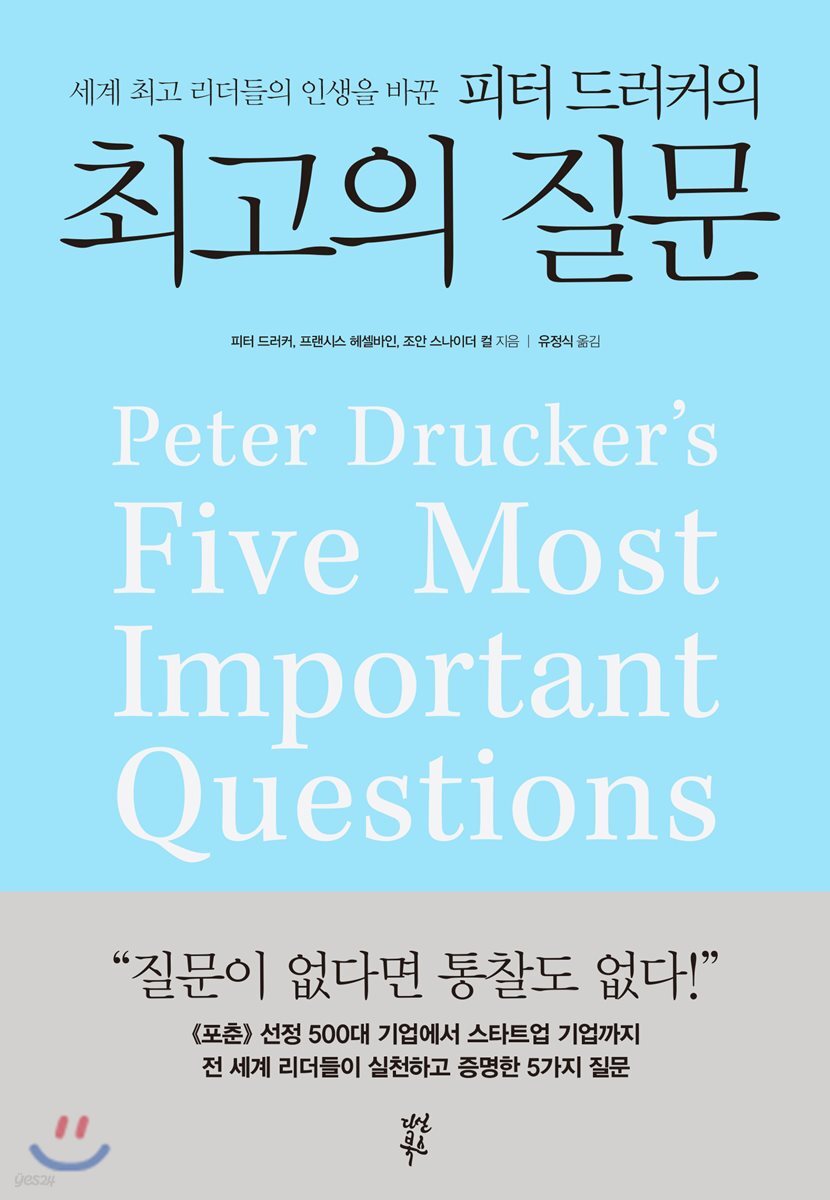
Peter Drucker's Best Questions
 |
Description
Book Introduction
“No questions, no insight!”
From Fortune 500 companies to emerging startups.
5 Questions Practiced and Proven by Leaders Around the World
★★★★★
If you want to change the world and become part of the future,
Be sure to ask the questions in this book!
_ Alan Mulally (Google director, former Ford CEO)
Elegantly simple, yet powerful in its focus!
_ Thomas Colditz (Professor, Yale School of Management)
Presenting to the rapidly evolving business world,
Insights that don't change with time!
Beth Comstock (Vice President, Business Innovation, GE)
A person whom Bill Gates openly said was “the greatest management scholar who had the greatest influence on me.”
The one person that global CEOs and business school students all say they respect the most.
Peter Drucker is a management pioneer who has truly changed the lives of countless leaders and businessmen around the world.
He established many concepts and theories regarding management, but among them, the core that overwhelmingly condenses his management philosophy is undoubtedly the 'Five Questions for Management'.
"Peter Drucker's Greatest Questions" is a book that contains all the insights regarding those "five questions."
From Fortune 500 companies to emerging startups.
5 Questions Practiced and Proven by Leaders Around the World
★★★★★
If you want to change the world and become part of the future,
Be sure to ask the questions in this book!
_ Alan Mulally (Google director, former Ford CEO)
Elegantly simple, yet powerful in its focus!
_ Thomas Colditz (Professor, Yale School of Management)
Presenting to the rapidly evolving business world,
Insights that don't change with time!
Beth Comstock (Vice President, Business Innovation, GE)
A person whom Bill Gates openly said was “the greatest management scholar who had the greatest influence on me.”
The one person that global CEOs and business school students all say they respect the most.
Peter Drucker is a management pioneer who has truly changed the lives of countless leaders and businessmen around the world.
He established many concepts and theories regarding management, but among them, the core that overwhelmingly condenses his management philosophy is undoubtedly the 'Five Questions for Management'.
"Peter Drucker's Greatest Questions" is a book that contains all the insights regarding those "five questions."
- You can preview some of the book's contents.
Preview
index
Praise poured in for this book
About Peter Drucker
About the Francis Hesselbein Leadership Institute
A bold journey that provides energy and courage for growth.
Recommended Reading: Timeless Wisdom for Leaders Around the World
Prologue _ Why should you self-diagnose?
Five Most Important Questions ┃ Planning is not a one-time event ┃ Encourage constructive dissent ┃ Things to do starting tomorrow morning, not next year
Question Ⅰ _ [Mission] Why and for what purpose do we exist?
The reason for existence is the force that creates change. ┃ The mission should be as easy as putting on a T-shirt. ┃ Make decisions based on principles. ┃ Small steps cannot lead to eternity.
[Insight 1] Jim Collins: What Shouldn't Change and What Should Be Open to Change
[Insight 2] Marshall & Kelly Goldsmith: Drucker's Great Questions, Crucial for Personal Success
[Case 1] Michael Radparvar: 'It's always with us as our journey takes unexpected turns.
Question Ⅱ _ [Customer] Who is the target that must be satisfied?
People who recognize, want, and feel important about the value you provide ┃ Define your primary customers, the benchmark for important decisions ┃ Satisfy and attract your support customers ┃ Customers are never fixed targets
[Insight 3] Philip Kotler: The best companies don't create customers, they create fans.
[Insight 4] Raghu Krishnamurti: Put the Customer at the Center of All Decisions
[Case 2] Luke Owings: Consider the needs and motivations of the people you work with.
Question Ⅲ _ [Customer Value] What do they value?
There are no irrational customers. ┃ What is the basis for your judgment? ┃ Think carefully about what you need to know from your customers.
[Insight 5] James Kouzes: Creating Extraordinary Value for Customers' Better Lives
[Insight 6] Michael & Cass Lagerow: How to Join the Era of the Customer Revolution
[Case 3] Nadira Hira: Never stop asking questions to your customers. That's innovation.
?
Question IV _ [Result] What result is needed and what does it mean?
Monitor short-term performance and long-term change ┃ Quantitative and qualitative indicators ┃ Decide what to strengthen or discard ┃ Leaders are responsible for creating meaningful results
[Insight 7] Judith Rodin: How have we been able to change people over time?
[Insight 8] Bernard Banks: The Core of the "Results Review Method": The Filter of "Values" and the Prism of "Belief"
[Case 4] Adam Brown: The Story of the "Promise Pencil" That Produced Amazing Results
Question V _ [Plan] What will we do in the future?
Planning is not a skill, it's a responsibility ┃ Setting a fundamental and long-term direction ┃ Five elements of effective planning ┃ Define roles and responsibilities ┃ Never be satisfied
[Insight 9] Casterly Langan: 4 Specific Questions to Turn Good Ideas into Reality
[Insight 10] Juana Bordas: Leverage Six Lessons to Plan for Sustainability
[Case 5] Carolyn Gosson: Plans aren't just dead paperwork that sits there.
Epilogue: Eight Milestones for Transformational Leadership
Explore the environment ┃ Reexamine the mission ┃ Abandon the hierarchy ┃ Challenge the truth ┃ Use the 'power of language' ┃ Distribute leadership throughout the organization ┃ Lead from the front, not push from behind ┃ Evaluate performance
[Case 6] Lauren Mailian Bias: Exercise leadership by considering your own characteristics.
[Appendix] Self-Diagnosis Process
Acknowledgements
Translator's Note
About Peter Drucker
About the Francis Hesselbein Leadership Institute
A bold journey that provides energy and courage for growth.
Recommended Reading: Timeless Wisdom for Leaders Around the World
Prologue _ Why should you self-diagnose?
Five Most Important Questions ┃ Planning is not a one-time event ┃ Encourage constructive dissent ┃ Things to do starting tomorrow morning, not next year
Question Ⅰ _ [Mission] Why and for what purpose do we exist?
The reason for existence is the force that creates change. ┃ The mission should be as easy as putting on a T-shirt. ┃ Make decisions based on principles. ┃ Small steps cannot lead to eternity.
[Insight 1] Jim Collins: What Shouldn't Change and What Should Be Open to Change
[Insight 2] Marshall & Kelly Goldsmith: Drucker's Great Questions, Crucial for Personal Success
[Case 1] Michael Radparvar: 'It's always with us as our journey takes unexpected turns.
Question Ⅱ _ [Customer] Who is the target that must be satisfied?
People who recognize, want, and feel important about the value you provide ┃ Define your primary customers, the benchmark for important decisions ┃ Satisfy and attract your support customers ┃ Customers are never fixed targets
[Insight 3] Philip Kotler: The best companies don't create customers, they create fans.
[Insight 4] Raghu Krishnamurti: Put the Customer at the Center of All Decisions
[Case 2] Luke Owings: Consider the needs and motivations of the people you work with.
Question Ⅲ _ [Customer Value] What do they value?
There are no irrational customers. ┃ What is the basis for your judgment? ┃ Think carefully about what you need to know from your customers.
[Insight 5] James Kouzes: Creating Extraordinary Value for Customers' Better Lives
[Insight 6] Michael & Cass Lagerow: How to Join the Era of the Customer Revolution
[Case 3] Nadira Hira: Never stop asking questions to your customers. That's innovation.
?
Question IV _ [Result] What result is needed and what does it mean?
Monitor short-term performance and long-term change ┃ Quantitative and qualitative indicators ┃ Decide what to strengthen or discard ┃ Leaders are responsible for creating meaningful results
[Insight 7] Judith Rodin: How have we been able to change people over time?
[Insight 8] Bernard Banks: The Core of the "Results Review Method": The Filter of "Values" and the Prism of "Belief"
[Case 4] Adam Brown: The Story of the "Promise Pencil" That Produced Amazing Results
Question V _ [Plan] What will we do in the future?
Planning is not a skill, it's a responsibility ┃ Setting a fundamental and long-term direction ┃ Five elements of effective planning ┃ Define roles and responsibilities ┃ Never be satisfied
[Insight 9] Casterly Langan: 4 Specific Questions to Turn Good Ideas into Reality
[Insight 10] Juana Bordas: Leverage Six Lessons to Plan for Sustainability
[Case 5] Carolyn Gosson: Plans aren't just dead paperwork that sits there.
Epilogue: Eight Milestones for Transformational Leadership
Explore the environment ┃ Reexamine the mission ┃ Abandon the hierarchy ┃ Challenge the truth ┃ Use the 'power of language' ┃ Distribute leadership throughout the organization ┃ Lead from the front, not push from behind ┃ Evaluate performance
[Case 6] Lauren Mailian Bias: Exercise leadership by considering your own characteristics.
[Appendix] Self-Diagnosis Process
Acknowledgements
Translator's Note
Detailed image

Into the book
The 'Peter Drucker's Questions' presented in this book are flexible and fully adjustable.
It is something that can be used in any organization or CEO's office.
It can be used in all fields.
It doesn't matter whether you're a Fortune 500 company or a fledgling startup, a massive government agency or a small town, a billion-dollar nonprofit or a homeless shelter with just $100,000 in assets.
What matters is commitment to the mission, dedication to the customer, commitment to the future, and focus on innovation.
Self-discovery through Peter Drucker's Questions is a reflective and bold journey that provides organizations and leaders with the energy and courage to grow.
--- p.21
In the business world, customers are the ones who must be satisfied.
If you don't satisfy them, you won't get any results.
If there are no results, there is no business.
No matter who you consider your customers, you need to focus on the value they demand.
This means that we must focus on satisfying their needs, wants, and aspirations.
There is danger in believing that 'this is how you can satisfy customers.'
Such beliefs inevitably lead to misjudgment of the environment.
It is also a leader's job to not just guess the answer to customer satisfaction in their head.
To find answers, you must always approach the customer and explore systematically.
--- p.38
GE has always evolved by pursuing Drucker's advice of "planned obsolescence."
Drucker said, “Planning is not about controlling the future.
“Planning is about defining ‘where you want to be’ and ‘how you plan to get there,’ despite the uncertainty,” he emphasized.
These words are guidelines for setting the organization's strategy and direction.
The concept of customers and related content that Drucker emphasized is timeless and wise advice that is being discussed more and more in today's world.
What has changed is the 'method of getting there' based on the transitions and changes that have occurred in the present era.
--- p.99
When the best products and services are about to be launched, the practitioners in charge should constantly remind themselves to seek the simplest and most useful answers before others, and never stop asking questions until they have those answers.
I think that's what innovation is.
Practitioners must continually delve into their customers, create frames, and continually refine them.
--- p.144
Giving up something is always met with strong resistance.
In any organization, members tend to cling to things that are now obsolete—things that were once expected to be effective but haven't, things that were once productive but no longer are.
But it takes courage to throw it away.
Nothing gets accomplished unless it is discarded.
When people debate what to discard, they can become caught up in a whirlwind of emotions.
It is difficult to discard something like that.
But it's only difficult for a little while.
The dead must be buried in the ground before the resurrection can begin.
After about six months, everyone will be wondering, “What took so long?”
--- p.154
The reason for making plans, despite the uncertainty of the future, is to identify a specific point you 'want' to reach and how to get there.
Having a plan doesn't mean facts replace judgment, and scientific management doesn't mean leadership.
When making plans, we must accept that analysis is not the only thing that matters, but also courage, experience, intuition, and even gut instinct.
Because planning is more of a 'responsibility' than a skill.
--- p.182
We know that management is a tool, not an end in itself, so we practice “management for the mission” rather than “management for management’s sake.”
Moreover, our mission is not to define how we operate, but to clarify why we exist.
The mission must be clear, powerful, and compelling.
It is something that can be used in any organization or CEO's office.
It can be used in all fields.
It doesn't matter whether you're a Fortune 500 company or a fledgling startup, a massive government agency or a small town, a billion-dollar nonprofit or a homeless shelter with just $100,000 in assets.
What matters is commitment to the mission, dedication to the customer, commitment to the future, and focus on innovation.
Self-discovery through Peter Drucker's Questions is a reflective and bold journey that provides organizations and leaders with the energy and courage to grow.
--- p.21
In the business world, customers are the ones who must be satisfied.
If you don't satisfy them, you won't get any results.
If there are no results, there is no business.
No matter who you consider your customers, you need to focus on the value they demand.
This means that we must focus on satisfying their needs, wants, and aspirations.
There is danger in believing that 'this is how you can satisfy customers.'
Such beliefs inevitably lead to misjudgment of the environment.
It is also a leader's job to not just guess the answer to customer satisfaction in their head.
To find answers, you must always approach the customer and explore systematically.
--- p.38
GE has always evolved by pursuing Drucker's advice of "planned obsolescence."
Drucker said, “Planning is not about controlling the future.
“Planning is about defining ‘where you want to be’ and ‘how you plan to get there,’ despite the uncertainty,” he emphasized.
These words are guidelines for setting the organization's strategy and direction.
The concept of customers and related content that Drucker emphasized is timeless and wise advice that is being discussed more and more in today's world.
What has changed is the 'method of getting there' based on the transitions and changes that have occurred in the present era.
--- p.99
When the best products and services are about to be launched, the practitioners in charge should constantly remind themselves to seek the simplest and most useful answers before others, and never stop asking questions until they have those answers.
I think that's what innovation is.
Practitioners must continually delve into their customers, create frames, and continually refine them.
--- p.144
Giving up something is always met with strong resistance.
In any organization, members tend to cling to things that are now obsolete—things that were once expected to be effective but haven't, things that were once productive but no longer are.
But it takes courage to throw it away.
Nothing gets accomplished unless it is discarded.
When people debate what to discard, they can become caught up in a whirlwind of emotions.
It is difficult to discard something like that.
But it's only difficult for a little while.
The dead must be buried in the ground before the resurrection can begin.
After about six months, everyone will be wondering, “What took so long?”
--- p.154
The reason for making plans, despite the uncertainty of the future, is to identify a specific point you 'want' to reach and how to get there.
Having a plan doesn't mean facts replace judgment, and scientific management doesn't mean leadership.
When making plans, we must accept that analysis is not the only thing that matters, but also courage, experience, intuition, and even gut instinct.
Because planning is more of a 'responsibility' than a skill.
--- p.182
We know that management is a tool, not an end in itself, so we practice “management for the mission” rather than “management for management’s sake.”
Moreover, our mission is not to define how we operate, but to clarify why we exist.
The mission must be clear, powerful, and compelling.
--- p.227
Publisher's Review
Why should we ask 'Peter Drucker's question' now?
A milestone for those struggling with new jobs, ventures, and projects.
Peter Drucker always emphasized the importance of ‘questions’ above all else.
“Serious errors do not arise from wrong answers.
“The real danger is asking the wrong questions.” If a business is in turmoil, if an organization is lost and wandering, the most urgent thing to correct is ‘questions.’
Are you asking the right questions right now? In this unpredictable business environment, are you asking the right questions for your work, your business, and your organization?
An uncertain future is a topic of conversation for everyone in this era.
The world is rapidly changing and evolving, and situations where we get lost in the middle of a harsh desert unfold every moment.
But even in the hazy fog, there are always milestones that offer a glimmer of hope.
A milestone that stands firm and unchanging, no matter how much the world changes.
Peter Drucker's 5 Questions is like that milestone.
In moments of agonizing over 'how to survive, how to make a way', each question Peter Drucker poses leads us to a path that allows us to move forward without wavering.
It can be applied to any existing organization.
It provides powerful insights to those struggling with new jobs, businesses, and projects.
Peter Drucker's five questions are:
'[Mission] Why and for what purpose do we exist?' '[Customer] Who must be satisfied?' '[Customer Value] What do they value?' '[Outcome] What outcome is needed, and what does it mean?' '[Plan] What will we do going forward, and how?'
These five core questions then lead to more detailed questions.
And all of those questions contain the answers to the philosophy and essence that a leader must possess.
The profound questions Drucker poses offer us timeless insights and profound resonance.
The pages are filled with inspiring stories that will stir your heart.
“All new and meaningful changes come from ‘questions’!”
Vivid insights from 20 of the world's greatest leaders who changed their lives with five questions.
“The most surprising paradox about change is that the organizations that adapt best to a changing world are the ones that know best what must not change.
They anchor themselves firmly in the fundamental principles from which everything can be more easily transformed.
They truly understand the difference between what is sacred and what is not, between what must remain constant and what must always be open to change, and between what they say they do and how they actually do it.”
_ From 'Jim Collins: What Shouldn't Change and What Should Be Open to Change'
“Drucker said over 40 years ago, ‘The purpose of a company is to create customers.
He emphasized that 'customers are our only source of revenue.'
If he were alive, wouldn't he have revised his words to say: 'The best companies don't create customers.
They create fans!' He would probably say that it's more important to check how much you're occupying the minds and hearts of your customers than to check whether your profits have improved this year."
_ 'Philip Kotler: The best companies don't create customers.
In 'They Create Fans'
“These five questions are great questions that are important not only for the success of an organization but also for the success of an individual.
No one can tell you what makes you happy, and no one can tell you what is meaningful to you.
“The answer must come from within each person’s heart.”
_ From 'Marshall Goldsmith: Drucker's Great Questions That Are Also Important for Personal Success'
This book also contains fascinating insights from 20 world leaders who practice and demonstrate the '5 Questions' approach.
With the addition of thoughtful interpretations from world-renowned management gurus such as Philip Kotler, Marshall Goldsmith, and Jim Collins, you will be able to delve deeper into the depth of the 'Five Questions' from a deeper and more diverse perspective.
You can also vividly learn about the practices of global innovative companies like GE and Google, as well as the cases of rising young leaders who achieved success with groundbreaking ideas like Uber, Holsty, and Promise Pencil.
You will be able to follow how they have strongly promoted their ideas with 'Peter Drucker's questions' and how they are changing themselves, changing their organizations, changing their lives, and changing the world.
Why should your work and business exist?
Peter Drucker's 5 Questions You Should Never Miss, No Matter What New Challenges Arise
“You are faced with a life-or-death decision.
You must decide whether to shift your mission, whether to abandon programs that are no longer useful and refocus your resources, what competencies and immersion you need to seize opportunities, and how to build organizational community and transform people's lives.
The process of self-diagnosis, asking and answering 'questions', is the first action requirement of leadership.
Through this self-diagnosis, we must continually reset our direction and constantly readjust our focus.
You shouldn't be satisfied with 'this is enough'.
A good time to do a self-diagnosis is when you are having success.
If you wait until things get worse, self-diagnosis becomes very difficult.” _ From 'Prologue: Why Self-Diagnose?'
Every organization faces new challenges and opportunities at every moment.
“When you rise to a leadership position, you have to anticipate the future and respond immediately to changes.
“Even if you are lucky enough to ride the wave, you may still end up crashing down with it,” says Drucker.
The five questions this book guides you through are the ultimate management tools for leaders facing challenges and opportunities.
Consider this journey of self-diagnosis as the most important process you must never miss, no matter what new challenges arise.
Apply it not only to determining the direction of the entire organization, but also to individual businesses and projects.
Always check that you can answer these five questions and have consistent answers from the top to the bottom of your organization.
The best leaders are those who ask the best questions.
Why does your job, business, or project exist now? Don't stop and ask yourself this question.
No questions, no insights.
No business can succeed without insight!
A milestone for those struggling with new jobs, ventures, and projects.
Peter Drucker always emphasized the importance of ‘questions’ above all else.
“Serious errors do not arise from wrong answers.
“The real danger is asking the wrong questions.” If a business is in turmoil, if an organization is lost and wandering, the most urgent thing to correct is ‘questions.’
Are you asking the right questions right now? In this unpredictable business environment, are you asking the right questions for your work, your business, and your organization?
An uncertain future is a topic of conversation for everyone in this era.
The world is rapidly changing and evolving, and situations where we get lost in the middle of a harsh desert unfold every moment.
But even in the hazy fog, there are always milestones that offer a glimmer of hope.
A milestone that stands firm and unchanging, no matter how much the world changes.
Peter Drucker's 5 Questions is like that milestone.
In moments of agonizing over 'how to survive, how to make a way', each question Peter Drucker poses leads us to a path that allows us to move forward without wavering.
It can be applied to any existing organization.
It provides powerful insights to those struggling with new jobs, businesses, and projects.
Peter Drucker's five questions are:
'[Mission] Why and for what purpose do we exist?' '[Customer] Who must be satisfied?' '[Customer Value] What do they value?' '[Outcome] What outcome is needed, and what does it mean?' '[Plan] What will we do going forward, and how?'
These five core questions then lead to more detailed questions.
And all of those questions contain the answers to the philosophy and essence that a leader must possess.
The profound questions Drucker poses offer us timeless insights and profound resonance.
The pages are filled with inspiring stories that will stir your heart.
“All new and meaningful changes come from ‘questions’!”
Vivid insights from 20 of the world's greatest leaders who changed their lives with five questions.
“The most surprising paradox about change is that the organizations that adapt best to a changing world are the ones that know best what must not change.
They anchor themselves firmly in the fundamental principles from which everything can be more easily transformed.
They truly understand the difference between what is sacred and what is not, between what must remain constant and what must always be open to change, and between what they say they do and how they actually do it.”
_ From 'Jim Collins: What Shouldn't Change and What Should Be Open to Change'
“Drucker said over 40 years ago, ‘The purpose of a company is to create customers.
He emphasized that 'customers are our only source of revenue.'
If he were alive, wouldn't he have revised his words to say: 'The best companies don't create customers.
They create fans!' He would probably say that it's more important to check how much you're occupying the minds and hearts of your customers than to check whether your profits have improved this year."
_ 'Philip Kotler: The best companies don't create customers.
In 'They Create Fans'
“These five questions are great questions that are important not only for the success of an organization but also for the success of an individual.
No one can tell you what makes you happy, and no one can tell you what is meaningful to you.
“The answer must come from within each person’s heart.”
_ From 'Marshall Goldsmith: Drucker's Great Questions That Are Also Important for Personal Success'
This book also contains fascinating insights from 20 world leaders who practice and demonstrate the '5 Questions' approach.
With the addition of thoughtful interpretations from world-renowned management gurus such as Philip Kotler, Marshall Goldsmith, and Jim Collins, you will be able to delve deeper into the depth of the 'Five Questions' from a deeper and more diverse perspective.
You can also vividly learn about the practices of global innovative companies like GE and Google, as well as the cases of rising young leaders who achieved success with groundbreaking ideas like Uber, Holsty, and Promise Pencil.
You will be able to follow how they have strongly promoted their ideas with 'Peter Drucker's questions' and how they are changing themselves, changing their organizations, changing their lives, and changing the world.
Why should your work and business exist?
Peter Drucker's 5 Questions You Should Never Miss, No Matter What New Challenges Arise
“You are faced with a life-or-death decision.
You must decide whether to shift your mission, whether to abandon programs that are no longer useful and refocus your resources, what competencies and immersion you need to seize opportunities, and how to build organizational community and transform people's lives.
The process of self-diagnosis, asking and answering 'questions', is the first action requirement of leadership.
Through this self-diagnosis, we must continually reset our direction and constantly readjust our focus.
You shouldn't be satisfied with 'this is enough'.
A good time to do a self-diagnosis is when you are having success.
If you wait until things get worse, self-diagnosis becomes very difficult.” _ From 'Prologue: Why Self-Diagnose?'
Every organization faces new challenges and opportunities at every moment.
“When you rise to a leadership position, you have to anticipate the future and respond immediately to changes.
“Even if you are lucky enough to ride the wave, you may still end up crashing down with it,” says Drucker.
The five questions this book guides you through are the ultimate management tools for leaders facing challenges and opportunities.
Consider this journey of self-diagnosis as the most important process you must never miss, no matter what new challenges arise.
Apply it not only to determining the direction of the entire organization, but also to individual businesses and projects.
Always check that you can answer these five questions and have consistent answers from the top to the bottom of your organization.
The best leaders are those who ask the best questions.
Why does your job, business, or project exist now? Don't stop and ask yourself this question.
No questions, no insights.
No business can succeed without insight!
GOODS SPECIFICS
- Date of issue: April 21, 2017
- Format: Hardcover book binding method guide
- Page count, weight, size: 284 pages | 447g | 134*200*20mm
- ISBN13: 9791130612157
- ISBN10: 1130612155
You may also like
카테고리
korean


korean

![GQ KOREA Mark (Monthly): December [2025]](http://librairie.coreenne.fr/cdn/shop/files/8ef265dbbfbf186523ed75ba7319009d.jpg?v=1765340328&width=3840)


