

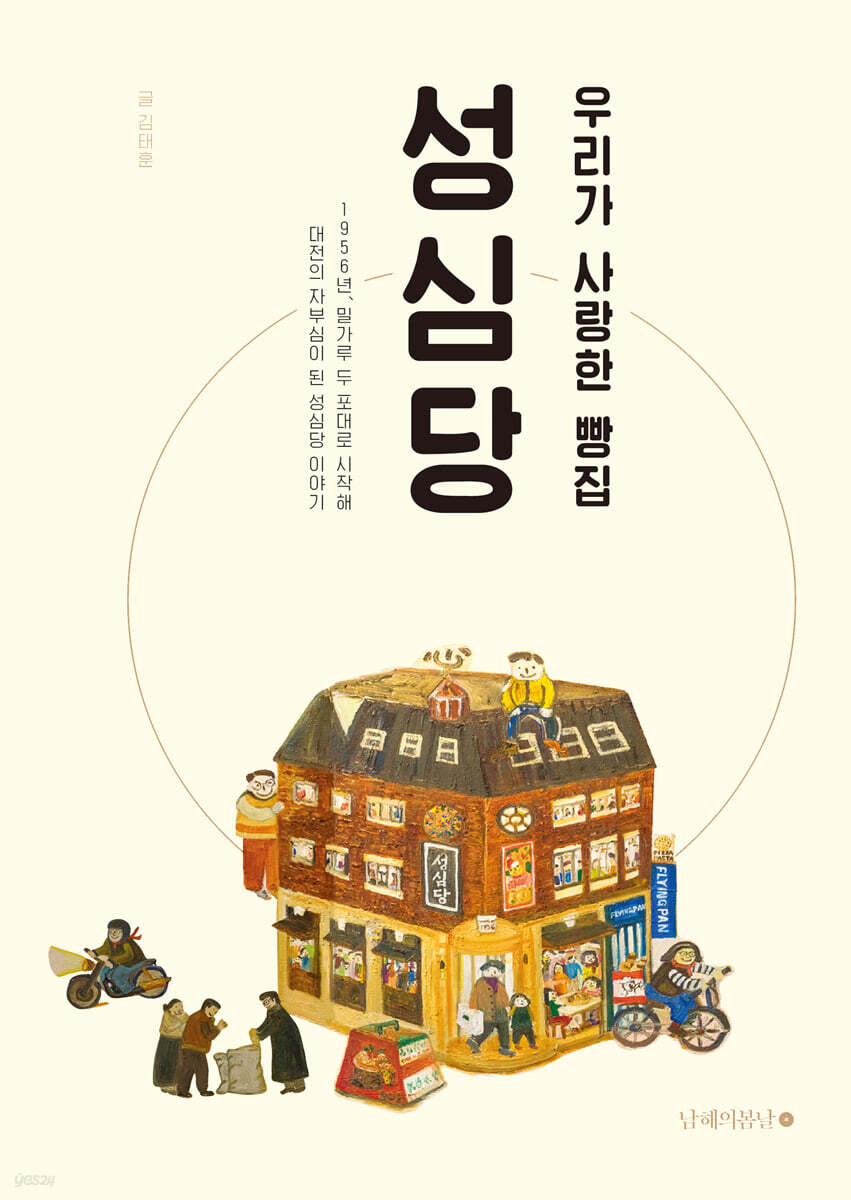
Seongsimdang, the bakery we loved
 |
Description
Book Introduction
Daejeon's leading company that calls for open runs for every new product
The bakery that loved Daejeon, Seongsimdang, has added a richer story over the past 8 years.
Revised and expanded edition published!
Seongsimdang, one of the top three bakeries in the country and the number one course for bread pilgrimage, is not just a famous bakery.
It is called the richest house in Daejeon, and it has been sharing bread with the needy for a long time, to the point that it is said that thanks to Seongsimdang, there is no one starving in Daejeon.
Seongsimdang, which donates over 70 million won in bread every month, started out as a steamed bun shop on the street near Daejeon Station in 1956 and has grown into a company with over 1,000 employees.
Professor Luigino Bruni, a world-renowned economist, praised Seongsimdang, saying, "If Seongsimdang's philosophy and management style spreads to other regions and creates 100 small and medium-sized enterprises, the very structure of the Korean economy, which is currently dominated by large corporations, will change." How did Seongsimdang become a source of pride for Daejeon citizens and a key alternative for the Korean economy? Let's delve into the history of Korean bakeries and the miraculous story of this local neighborhood bakery.
The bakery that loved Daejeon, Seongsimdang, has added a richer story over the past 8 years.
Revised and expanded edition published!
Seongsimdang, one of the top three bakeries in the country and the number one course for bread pilgrimage, is not just a famous bakery.
It is called the richest house in Daejeon, and it has been sharing bread with the needy for a long time, to the point that it is said that thanks to Seongsimdang, there is no one starving in Daejeon.
Seongsimdang, which donates over 70 million won in bread every month, started out as a steamed bun shop on the street near Daejeon Station in 1956 and has grown into a company with over 1,000 employees.
Professor Luigino Bruni, a world-renowned economist, praised Seongsimdang, saying, "If Seongsimdang's philosophy and management style spreads to other regions and creates 100 small and medium-sized enterprises, the very structure of the Korean economy, which is currently dominated by large corporations, will change." How did Seongsimdang become a source of pride for Daejeon citizens and a key alternative for the Korean economy? Let's delve into the history of Korean bakeries and the miraculous story of this local neighborhood bakery.
- You can preview some of the book's contents.
Preview
index
Preface to the Revised Edition
A slightly long prologue
1.
Windy Heungnam Pier
2.
A train stopped in Daejeon
3.
The Birth of Fried Soboro
4.
Burning Sacred Heart Church
5.
New vision
6.
Daejeon's pride
7.
Labor as a relationship
Author's Epilogue
Epilogue of Seongsimdang
A slightly long prologue
1.
Windy Heungnam Pier
2.
A train stopped in Daejeon
3.
The Birth of Fried Soboro
4.
Burning Sacred Heart Church
5.
New vision
6.
Daejeon's pride
7.
Labor as a relationship
Author's Epilogue
Epilogue of Seongsimdang
Detailed image

Into the book
Im Gil-sun met Father Oh Gi-seon and explained the whole story of how he escaped from Heungnam Port and arrived at Daejeon Station via Geoje and Jinhae.
As soon as he heard the story, the priest readily gave two bags of flour from the aid he had received from the United States to the Im Gil-sun family.
The couple who received two sacks of flour decided to start a steamed bun business instead of using it to feed their family.
It was the first departure of Daejeon Seongsim Church.
--- p.53, from “Two Sacks of Flour”
Because it was a time when food was scarce, business was relatively good.
Because we shared leftover bread with our neighbors every day, Seongsimdang's steamed buns were always made fresh that day.
Rumors spread and the number of regular customers gradually increased.
However, Im Gil-sun's attention was entirely focused on sharing bread.
If I could save even a little money, I would buy more flour and make more bread to share with the needy.
--- p.54, from “Daejeon Station Tent Street Vendor Seongsim Church”
Fried soboro has created all sorts of syndromes.
Before we knew it, Daejeon citizens were divided into those who had tried fried soboro and those who had not.
The fact that even bread could form a fandom made everyone happy.
As the fried soboro became incredibly popular, Seongsimdang began to create its own unique style.
It began to overtake other bakeries in both reputation and size.
It easily overcame its disadvantageous location, located at 153 Eunhaeng-dong, two blocks from Jungang-ro.
--- p.84, from "Fried Soboro, the Never Ending Story"
While everyone was going through the most difficult time, a large fire broke out at Seongsim Church on the evening of Saturday, January 22, 2005, just a few days before Lunar New Year.
The fire that had burned the building next door spread to the Seongsimdang Church, completely burning down the three-story factory.
All functions of the Seongsimdang Church were temporarily suspended.
It was a decisive blow.
It was as if the challenger, who had barely managed to hold on against the unbeatable world champion, was knocked out in a spectacular manner in the final round.
--- p.142, from “A Couple Standing Before a Pile of Ashes”
Everyone literally means everyone, but that doesn't mean they are a single, jumbled mass of people.
If you look closely, you can finally see each person's distinct color.
Among 'everyone', there are those who visit the Sacred Heart Church and those who do not visit the Sacred Heart Church.
There are women and men.
There are both elderly and children.
There are internal employees and there are also business partner employees.
There are poor people and rich people.
Everyone is a being with a different self-identity.
We need to think about the things they like and the spaces they like.
--- p.154, "The Discovery of 'Everyone'
Youngjin has strived to apply the EoC perspective not only to management but also to all processes of bread making.
Not only the internal staff at Seongsimdang, but also the external customers they worked with had to be happy.
We try to use ingredients grown using eco-friendly farming methods from the Daejeon area whenever possible, and we have also significantly reduced excessive packaging to address environmental concerns.
The packaging of shaved ice, which was an icon of innovation at Seongsimdang, was also changed from the Styrofoam packaging that had been used for a long time to eco-friendly paper packaging.
--- p.174, from “Practicing a New Vision”
At Daejeon Station, it's now common to miss the train after waiting in line for fried sobokki, and there are quite a few people who go to Daejeon Station from Seoul specifically to buy Seongsimdang bread.
Passengers whose destination is not Daejeon also use Daejeon as a transfer station, stop at Seongsimdang, and then head back to their destination.
Many of the lockers placed throughout the station are filled with bread from the Seongsimdang store purchased by passengers.
There are various anecdotes being told, from the story of a husband who ran during a transfer time to buy fried soboro and cheered for his wife with both hands full of fried soboro, receiving applause from the passengers, to the anecdote of passengers sleeping in the train waking up to the delicious smell of fried soboro and realizing they had arrived at Daejeon Station.
--- p.217, from “The Home of Seongsim Church, Opening at Daejeon Station”
Youngjin and Mijin believe that establishing themselves as a valuable presence in Daejeon while adhering to the principle of being a bakery representing the region is still the goal that Seongsimdang must pursue.
People from all over the country come to Daejeon to visit Seongsim Church, and Seongsim Church believes that contributing even a little to Daejeon's economy is its duty to the citizens of Daejeon.
So, as a company, the couple hopes that Seongsim Church will fulfill its social responsibility in its city and ultimately become a source of pride for Daejeon.
--- p.224, from “The Presence of Local Enterprise Seongsimdang”
“See you tomorrow!”
Employees who have closed the entrance stand in front of the remaining bread holding empty boxes, carefully checking how much of each type of bread is left and putting them into boxes.
This box will be sorted into sponsored bread boxes along with other boxes packed every four hours during the workday and delivered to neighbors tomorrow morning.
This sponsorship bread is the essence of Seongsim Church, which has continued without fail every day for 68 years.
--- p.272, from “A Day in the Life of the Holy Spirit”
There are many voices praising Seongsimdang.
The practice of sharing that began with the company's founding, its dedication to the local community, and its remarkable innovation and crisis-overcoming efforts have made it the best bakery not only in Daejeon but in Korea. It is beyond praise.
In early 2024, news broke that Sungsim Church's operating profit for the previous year had surpassed that of large corporations.
But this information we know is not all there is to know about the Sacred Heart Church.
A company is not a simple organization where everything runs smoothly as long as the manager is good.
The organizational culture that binds members together must be healthy and strong.
At the center of Seongsimdang is ‘labor.’
From the CEO to the lowest-ranking employees, everyone at Seongsimdang works with honesty.
I value that labor.
In the Church of the Holy Spirit, labor is not a means of exploitation or alienation.
When more work is needed, superiors step up and take on the responsibility instead of deferring it to lower-level employees.
The fact that 'love' accounts for 40% of employee performance evaluations also stems from Seongsim Church's labor-centered management.
A workplace where love is practiced allows people to experience a new dimension of life.
--- p.276, from “Labor and Love”
In the philosophy of 'Economy of Communion (EoC)' followed by the Catholic Church of Korea, the English word 'communion' means 'fellowship and sharing.'
Its roots lie in the ritual of Jesus sharing bread and wine with his disciples at the Last Supper before his crucifixion, to remind them of his death.
Just as Jesus became one with his disciples by sharing his flesh and blood, the economic philosophy that businesses should not only pursue their own profits but also share with society, build fellowship, and become one is the 'economy for all'.
This philosophy was taken a step further with the inauguration of Pope Francis, under the name of the “Economy of Francesco.”
Francis's economics criticizes the capitalist economic system that currently dominates most of the world's markets as destructive and unsustainable.
He emphasizes that we need to breathe life into the current system.
He argues that we must become a much more just, inclusive, and sustainable economy than we are today, one that cares for life and the Earth's environment, God's creation, rather than exploiting them, and that we must especially draw wisdom and inspiration from plants.
As soon as he heard the story, the priest readily gave two bags of flour from the aid he had received from the United States to the Im Gil-sun family.
The couple who received two sacks of flour decided to start a steamed bun business instead of using it to feed their family.
It was the first departure of Daejeon Seongsim Church.
--- p.53, from “Two Sacks of Flour”
Because it was a time when food was scarce, business was relatively good.
Because we shared leftover bread with our neighbors every day, Seongsimdang's steamed buns were always made fresh that day.
Rumors spread and the number of regular customers gradually increased.
However, Im Gil-sun's attention was entirely focused on sharing bread.
If I could save even a little money, I would buy more flour and make more bread to share with the needy.
--- p.54, from “Daejeon Station Tent Street Vendor Seongsim Church”
Fried soboro has created all sorts of syndromes.
Before we knew it, Daejeon citizens were divided into those who had tried fried soboro and those who had not.
The fact that even bread could form a fandom made everyone happy.
As the fried soboro became incredibly popular, Seongsimdang began to create its own unique style.
It began to overtake other bakeries in both reputation and size.
It easily overcame its disadvantageous location, located at 153 Eunhaeng-dong, two blocks from Jungang-ro.
--- p.84, from "Fried Soboro, the Never Ending Story"
While everyone was going through the most difficult time, a large fire broke out at Seongsim Church on the evening of Saturday, January 22, 2005, just a few days before Lunar New Year.
The fire that had burned the building next door spread to the Seongsimdang Church, completely burning down the three-story factory.
All functions of the Seongsimdang Church were temporarily suspended.
It was a decisive blow.
It was as if the challenger, who had barely managed to hold on against the unbeatable world champion, was knocked out in a spectacular manner in the final round.
--- p.142, from “A Couple Standing Before a Pile of Ashes”
Everyone literally means everyone, but that doesn't mean they are a single, jumbled mass of people.
If you look closely, you can finally see each person's distinct color.
Among 'everyone', there are those who visit the Sacred Heart Church and those who do not visit the Sacred Heart Church.
There are women and men.
There are both elderly and children.
There are internal employees and there are also business partner employees.
There are poor people and rich people.
Everyone is a being with a different self-identity.
We need to think about the things they like and the spaces they like.
--- p.154, "The Discovery of 'Everyone'
Youngjin has strived to apply the EoC perspective not only to management but also to all processes of bread making.
Not only the internal staff at Seongsimdang, but also the external customers they worked with had to be happy.
We try to use ingredients grown using eco-friendly farming methods from the Daejeon area whenever possible, and we have also significantly reduced excessive packaging to address environmental concerns.
The packaging of shaved ice, which was an icon of innovation at Seongsimdang, was also changed from the Styrofoam packaging that had been used for a long time to eco-friendly paper packaging.
--- p.174, from “Practicing a New Vision”
At Daejeon Station, it's now common to miss the train after waiting in line for fried sobokki, and there are quite a few people who go to Daejeon Station from Seoul specifically to buy Seongsimdang bread.
Passengers whose destination is not Daejeon also use Daejeon as a transfer station, stop at Seongsimdang, and then head back to their destination.
Many of the lockers placed throughout the station are filled with bread from the Seongsimdang store purchased by passengers.
There are various anecdotes being told, from the story of a husband who ran during a transfer time to buy fried soboro and cheered for his wife with both hands full of fried soboro, receiving applause from the passengers, to the anecdote of passengers sleeping in the train waking up to the delicious smell of fried soboro and realizing they had arrived at Daejeon Station.
--- p.217, from “The Home of Seongsim Church, Opening at Daejeon Station”
Youngjin and Mijin believe that establishing themselves as a valuable presence in Daejeon while adhering to the principle of being a bakery representing the region is still the goal that Seongsimdang must pursue.
People from all over the country come to Daejeon to visit Seongsim Church, and Seongsim Church believes that contributing even a little to Daejeon's economy is its duty to the citizens of Daejeon.
So, as a company, the couple hopes that Seongsim Church will fulfill its social responsibility in its city and ultimately become a source of pride for Daejeon.
--- p.224, from “The Presence of Local Enterprise Seongsimdang”
“See you tomorrow!”
Employees who have closed the entrance stand in front of the remaining bread holding empty boxes, carefully checking how much of each type of bread is left and putting them into boxes.
This box will be sorted into sponsored bread boxes along with other boxes packed every four hours during the workday and delivered to neighbors tomorrow morning.
This sponsorship bread is the essence of Seongsim Church, which has continued without fail every day for 68 years.
--- p.272, from “A Day in the Life of the Holy Spirit”
There are many voices praising Seongsimdang.
The practice of sharing that began with the company's founding, its dedication to the local community, and its remarkable innovation and crisis-overcoming efforts have made it the best bakery not only in Daejeon but in Korea. It is beyond praise.
In early 2024, news broke that Sungsim Church's operating profit for the previous year had surpassed that of large corporations.
But this information we know is not all there is to know about the Sacred Heart Church.
A company is not a simple organization where everything runs smoothly as long as the manager is good.
The organizational culture that binds members together must be healthy and strong.
At the center of Seongsimdang is ‘labor.’
From the CEO to the lowest-ranking employees, everyone at Seongsimdang works with honesty.
I value that labor.
In the Church of the Holy Spirit, labor is not a means of exploitation or alienation.
When more work is needed, superiors step up and take on the responsibility instead of deferring it to lower-level employees.
The fact that 'love' accounts for 40% of employee performance evaluations also stems from Seongsim Church's labor-centered management.
A workplace where love is practiced allows people to experience a new dimension of life.
--- p.276, from “Labor and Love”
In the philosophy of 'Economy of Communion (EoC)' followed by the Catholic Church of Korea, the English word 'communion' means 'fellowship and sharing.'
Its roots lie in the ritual of Jesus sharing bread and wine with his disciples at the Last Supper before his crucifixion, to remind them of his death.
Just as Jesus became one with his disciples by sharing his flesh and blood, the economic philosophy that businesses should not only pursue their own profits but also share with society, build fellowship, and become one is the 'economy for all'.
This philosophy was taken a step further with the inauguration of Pope Francis, under the name of the “Economy of Francesco.”
Francis's economics criticizes the capitalist economic system that currently dominates most of the world's markets as destructive and unsustainable.
He emphasizes that we need to breathe life into the current system.
He argues that we must become a much more just, inclusive, and sustainable economy than we are today, one that cares for life and the Earth's environment, God's creation, rather than exploiting them, and that we must especially draw wisdom and inspiration from plants.
--- p.293, from “For an Economy Where Everyone is Happy”
Publisher's Review
“We can never be happy alone when there are unhappy people around us!”
The touching story of sharing at Seongsim Church, which began at a steamed bun stall near Daejeon Station.
The beginning of Seongsimdang is full of scenes more cinematic than the movies.
Lim Gil-sun, the founder of Seongsimdang, was a refugee who came south from Hamju, South Hamgyong Province with his family during the Korean War in 1950.
Having narrowly escaped death at the burning Hungnam Port, he vowed, "If I survive here, I will spend the rest of my life helping those in need."
After many twists and turns, he came to Daejeon and, using two bags of flour he received from the church as capital, set up a tent in front of Daejeon Station in 1956 and made and sold steamed buns.
Since then, for 68 years, Seongsimdang has consistently carried on the founder's legacy and has continued to manage with a focus on sharing and coexistence.
This book introduces the history of Seongsimdang, from the exciting development story of its mega-hit product, Fried Soboro, which has been attracting attention with new products every day, to the story of its miraculous recovery from a sudden fire that reduced it to ashes, and even its management philosophy of coexisting with the local community, sharing with neighbors, and creating an economy where everyone is happy. It contains everything about Seongsimdang in one volume.
Does a company like this really exist in Korea?
Daejeon No. 1.
Brands, the companies young people most want to work for
Management based on coexistence, not competition, and sharing, not monopoly.
There were various driving forces behind the growth of Seongsimdang, Daejeon's number one brand chosen by college students.
Endless product development, industry-leading marketing strategies, a management philosophy that prioritizes staying true to the essence without overlooking even the smallest details, and above all, a unique management style that seeks to coexist and grow together with neighbors have created the Seongsimdang of today.
Seongsimdang is still considered a company that young people want to work for, a visionary company that values labor and allows growth commensurate with effort.
A company that was the first in the confectionery industry to introduce a five-day workweek, builds trust through transparent management by disclosing sales figures to all employees, and pays 15% of profits as performance-based compensation to employees.
40% of the performance evaluation is based on love and consideration for colleagues.
Seongsimdang, the local hero who protects Daejeon and sells bread
Dreaming of an economy that will change Korea and make everyone happy!
Seongsimdang wants to remain a bakery that can only be found in Daejeon, a bakery that protects Daejeon forever, in order to support the local economy.
Seongsim Church's motto, which shows how a good company can contribute to and grow together with the community, is 'Do what everyone considers good.'
A bakery where everyone is happy, including customers, employees, business partners, partners, and even competitors.
Based on this management philosophy, Seongsimdang uses local agricultural products whenever possible, strives to always provide fresh bread, and even uses eco-friendly paper packaging.
Furthermore, Seongsimdang, the bakery that has been protecting Daejeon without wavering despite receiving endless love calls from Seoul and overseas, is the pride of Daejeon citizens and an excellent role model for local businesses, and is writing a new history of neighborhood bakeries with much love.
A torrent of media praise
The Value of Regional Competitiveness Demonstrated by Daejeon Seongsim Church - Dong-A Ilbo
The Miracle of Two Sacks of Flour at Daejeon Seongsim Church - Chosun Ilbo
"A Local Bakery That Changed the World Through Sharing and Inclusion" - The Hankyoreh
"It shows that there are great corporate stories in Korea, too." - Kookmin Ilbo
"The recipe for Daejeon's native bakery's growth is 'sharing'" - Korea Economic Daily
A Miracle Rising from the Ashes, From Street Vendor to the Pope's Table - Maeil Business Newspaper
"Is Daejeon's flagship bakery, Seongsimdang, an alternative to the capitalist economy?" - The Hankook Ilbo
The touching story of sharing at Seongsim Church, which began at a steamed bun stall near Daejeon Station.
The beginning of Seongsimdang is full of scenes more cinematic than the movies.
Lim Gil-sun, the founder of Seongsimdang, was a refugee who came south from Hamju, South Hamgyong Province with his family during the Korean War in 1950.
Having narrowly escaped death at the burning Hungnam Port, he vowed, "If I survive here, I will spend the rest of my life helping those in need."
After many twists and turns, he came to Daejeon and, using two bags of flour he received from the church as capital, set up a tent in front of Daejeon Station in 1956 and made and sold steamed buns.
Since then, for 68 years, Seongsimdang has consistently carried on the founder's legacy and has continued to manage with a focus on sharing and coexistence.
This book introduces the history of Seongsimdang, from the exciting development story of its mega-hit product, Fried Soboro, which has been attracting attention with new products every day, to the story of its miraculous recovery from a sudden fire that reduced it to ashes, and even its management philosophy of coexisting with the local community, sharing with neighbors, and creating an economy where everyone is happy. It contains everything about Seongsimdang in one volume.
Does a company like this really exist in Korea?
Daejeon No. 1.
Brands, the companies young people most want to work for
Management based on coexistence, not competition, and sharing, not monopoly.
There were various driving forces behind the growth of Seongsimdang, Daejeon's number one brand chosen by college students.
Endless product development, industry-leading marketing strategies, a management philosophy that prioritizes staying true to the essence without overlooking even the smallest details, and above all, a unique management style that seeks to coexist and grow together with neighbors have created the Seongsimdang of today.
Seongsimdang is still considered a company that young people want to work for, a visionary company that values labor and allows growth commensurate with effort.
A company that was the first in the confectionery industry to introduce a five-day workweek, builds trust through transparent management by disclosing sales figures to all employees, and pays 15% of profits as performance-based compensation to employees.
40% of the performance evaluation is based on love and consideration for colleagues.
Seongsimdang, the local hero who protects Daejeon and sells bread
Dreaming of an economy that will change Korea and make everyone happy!
Seongsimdang wants to remain a bakery that can only be found in Daejeon, a bakery that protects Daejeon forever, in order to support the local economy.
Seongsim Church's motto, which shows how a good company can contribute to and grow together with the community, is 'Do what everyone considers good.'
A bakery where everyone is happy, including customers, employees, business partners, partners, and even competitors.
Based on this management philosophy, Seongsimdang uses local agricultural products whenever possible, strives to always provide fresh bread, and even uses eco-friendly paper packaging.
Furthermore, Seongsimdang, the bakery that has been protecting Daejeon without wavering despite receiving endless love calls from Seoul and overseas, is the pride of Daejeon citizens and an excellent role model for local businesses, and is writing a new history of neighborhood bakeries with much love.
A torrent of media praise
The Value of Regional Competitiveness Demonstrated by Daejeon Seongsim Church - Dong-A Ilbo
The Miracle of Two Sacks of Flour at Daejeon Seongsim Church - Chosun Ilbo
"A Local Bakery That Changed the World Through Sharing and Inclusion" - The Hankyoreh
"It shows that there are great corporate stories in Korea, too." - Kookmin Ilbo
"The recipe for Daejeon's native bakery's growth is 'sharing'" - Korea Economic Daily
A Miracle Rising from the Ashes, From Street Vendor to the Pope's Table - Maeil Business Newspaper
"Is Daejeon's flagship bakery, Seongsimdang, an alternative to the capitalist economy?" - The Hankook Ilbo
GOODS SPECIFICS
- Date of issue: March 14, 2025
- Page count, weight, size: 304 pages | 526g | 153*210*23mm
- ISBN13: 9791193027431
- ISBN10: 1193027438
You may also like
카테고리
korean


korean

![GQ KOREA Mark (Monthly): December [2025]](http://librairie.coreenne.fr/cdn/shop/files/8ef265dbbfbf186523ed75ba7319009d.jpg?v=1765340328&width=3840)


