

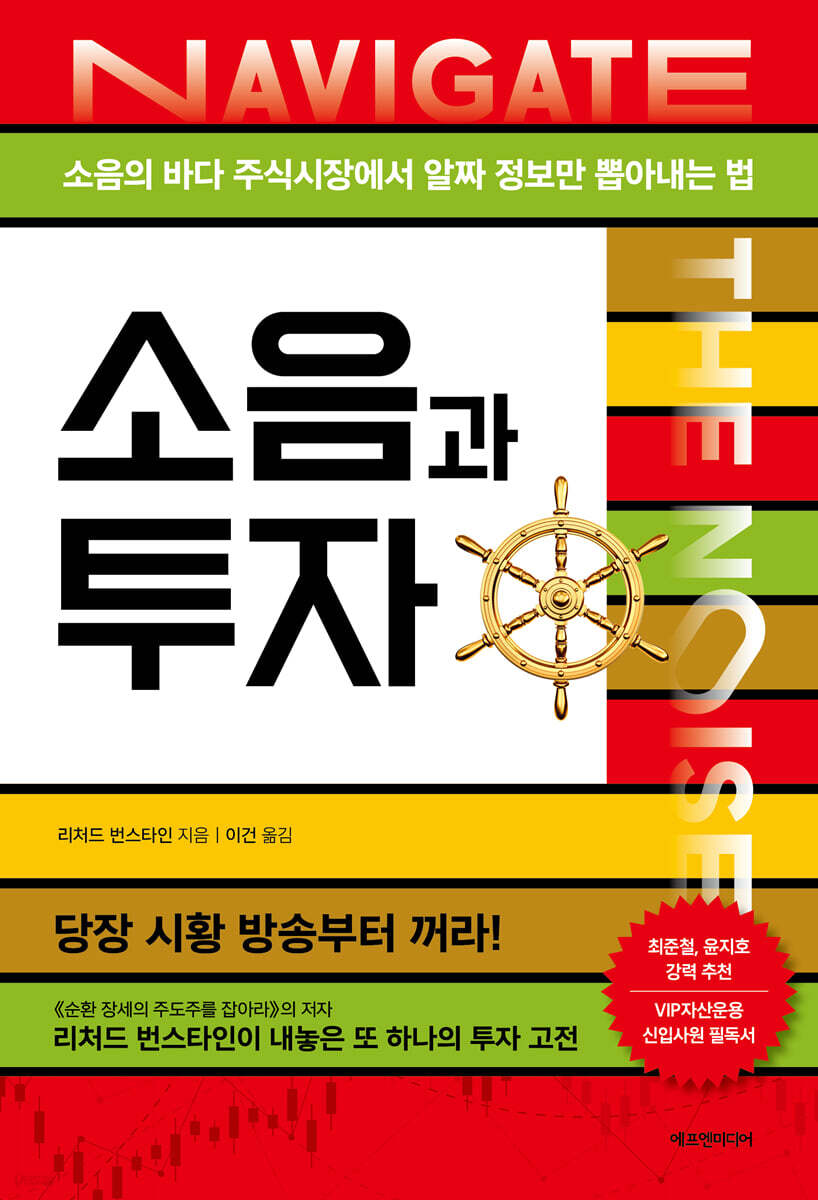
Noise and Investment
 |
Description
Book Introduction
Why can't value investors buy on time, and why can't growth investors sell on time? A Wall Street master's methodology for cutting through the noise and maximizing investment performance. A book that systematically organizes methods for distinguishing between "noise" and "good information" in the stock market, a sea of information filled with hype and rumors. Richard Bernstein, an investment guru with over 40 years of experience on Wall Street, shares techniques for cutting through the noise that interferes with decision-making and extracting valuable insights to maximize investment performance. This book introduces the earnings estimate life cycle, risk appetite measurement, distinguishing between good companies and good stocks, finding excellent analysts, and 12 noise filtering techniques, all with engaging case studies that even beginners can understand. The earnings estimate life cycle provides a quick overview of how popular stocks become unpopular. Avoid being late to buy popular stocks that are on a downward trend. The risk tolerance checklist helps you find the right investment style for your needs, preventing you from being swept away by the noise and taking on excessive risk. This checklist is useful not only for individual investors but also for analysts who deal with clients. It also suggests ways to cut through the noise that clouds your judgment between "good" and "bad" stocks, and how to find good stocks with high returns. According to the author, the main noise makers are various media outlets that provide investment information and fund managers who are evaluated based on short-term portfolio performance. Therefore, we will reveal how to filter out mere reporters and identify outstanding analysts, as well as the criteria for judging the correctness of stock analysis provided by fund managers. The "12 Noise Filtering Techniques" that can filter out even the advice of so-called investment experts are essential to check before investing. In an investment environment where it's difficult to trust anyone's word, mastering noise-filtering techniques has become a must-have for investing. |
- You can preview some of the book's contents.
Preview
index
Recommended Reading | Surviving in a Noise-Rich World · Yoon Ji-ho
Introduction | More information doesn't necessarily mean higher returns.
Part 1: How Noise Beguiles Investors
Chapter 1.
Noise is after your money
Forget about the information gap being closed | Why individual investors have performed so well | Noise is just information with a lot of content and no substance | Not all timely information is essential | Noise clouds insight | Information sellers and information users have different goals | Information and noise are difficult to distinguish | Noise costs a lot | Noise is more interesting | Ignore the Siren's Song
Chapter 2.
Noise encourages direct investment.
The lure of direct investment | Past performance does not guarantee future results | Performance: Is it the reward for risk or skill? | Is there such a thing as a free lunch? | Data mining: Serendipity or a shining star? | The case of a shining star | Testing investment strategies | Benchmarks for measuring strategy performance | Confirm your strategy with out-of-sample testing | 'Key stocks to hold for the long term' can lead to ruin | Even the strategies of seasoned investors sometimes fail.
Chapter 3.
Noise manipulates investor expectations.
Is it perception or reality that drives stock prices? | The Earnings Estimate Life Cycle | The Correlation Between Popularity and Earnings | Why Popular Stocks Become Unpopular | 'Good' and 'Bad' Investors Through the Earnings Estimate Life Cycle | Growth and Value Investing Through the Earnings Estimate Life Cycle | How Noise Causes Mistakes | Noise and Growth Investors | Noise and Value Investors | The Noise Life Cycle
Part 2 | Investment Strategies to Overcome the Noise
Chapter 4.
Strategies for Long-Term Investors
Obsessed with past performance | Noise and long-term investing don't mix | Today's hot stocks, tomorrow's underdogs | The key to asset and liability management | Three ripple effects of noise | Review your investment strategy based on time, not events.
Chapter 5.
The Impact of Noise on Diversification
Does Diversification Increase Returns? | Reduces Risk, Not Increases Returns | The Three Steps to Diversification | Diversify Total Capital Risk | Diversify Financial Asset Risk | Diversify Stock and Bond Portfolio Risk | How Noise Interferes with Diversification
Chapter 6.
Know your risk tolerance
A quiz to assess your risk appetite | What is risk? | Noise and stock charts | Don't judge risk by stock charts | How much risk are you willing to take? | Evaluation criteria: Peer group | Don't lose sleep over stock price fluctuations
* Appendix: Are Bonds Really Riskier Than Stocks?
Chapter 7.
Expand your time horizon
For aspiring day traders | Redefining risk | Does the time horizon have to be a one-year one? | Active funds and S&P 500 index funds | A three-year time horizon | A five-year time horizon | A 10-year time horizon: True long-term investing | Time reduces risk | Why day traders can't escape losses | Noise is concentrated in risky assets | The problem isn't the risk itself, but the lack of confidence in risk.
Part 3.
Noise filtering techniques to improve investment performance
Chapter 8.
Look for good stocks, not just good companies.
Definition of a good company | Good companies, bad stocks | A good company in my eyes is also a good company in others' eyes | Bad companies, good stocks | The proportion of good companies by industry | There is still no free lunch | Time horizon and loss probability | Bad companies can become bad stocks | Noise and company quality | Noise and unrated companies | Objective rating scales | Cases where noise distorts ratings: The tech bubble | Serious misjudgments about the technology sector
Chapter 9.
Find an excellent analyst
Analysts are disappearing | 7 characteristics of great analysts | Don't simply list facts | Present intelligently derived independent opinions | Distinguish between fundamental opinions and investment opinions | Do independent research | Use sound, tried-and-true metrics when analyzing companies | Don't give every stock a buy rating | Don't give up when criticized
Chapter 10.
Filter out the noise with style investing strategies.
What is style? | Why markets are segmented | Growth investing strategies | Value investing strategies | Growth stock investing strategies with reasonable prices | The cycle of style investing | The risks and returns of growth and value stocks | Factors affecting style investing performance | The impact of noise on growth and value stocks | Noise and the cost of capital, growth and value stocks | Noise and good companies, growth and value stocks
Chapter 11.
12 Filters to Filter Out Only Key Information
Question 1.
Why do you think that stock is better than other stocks? | Question 2.
What prompted you to consider investing? | Question 3.
Popular or neglected? | Question 4.
What time are we on the profit estimate life cycle? | Question 5.
Does it fit with your existing portfolio? | Question 6.
Do you think it's dangerous? | Question 7.
What are the criteria for assessing risk? | Question 8.
Is it a good company or a good stock? | Question 9.
Good company or bad company? | Question 10.
Is this a good time for good companies or bad companies? | Question 11.
What do you know that no one else knows? | Question 12.
Are you trying to predict the weather for Saturday on Monday?
annotation
Search
Introduction | More information doesn't necessarily mean higher returns.
Part 1: How Noise Beguiles Investors
Chapter 1.
Noise is after your money
Forget about the information gap being closed | Why individual investors have performed so well | Noise is just information with a lot of content and no substance | Not all timely information is essential | Noise clouds insight | Information sellers and information users have different goals | Information and noise are difficult to distinguish | Noise costs a lot | Noise is more interesting | Ignore the Siren's Song
Chapter 2.
Noise encourages direct investment.
The lure of direct investment | Past performance does not guarantee future results | Performance: Is it the reward for risk or skill? | Is there such a thing as a free lunch? | Data mining: Serendipity or a shining star? | The case of a shining star | Testing investment strategies | Benchmarks for measuring strategy performance | Confirm your strategy with out-of-sample testing | 'Key stocks to hold for the long term' can lead to ruin | Even the strategies of seasoned investors sometimes fail.
Chapter 3.
Noise manipulates investor expectations.
Is it perception or reality that drives stock prices? | The Earnings Estimate Life Cycle | The Correlation Between Popularity and Earnings | Why Popular Stocks Become Unpopular | 'Good' and 'Bad' Investors Through the Earnings Estimate Life Cycle | Growth and Value Investing Through the Earnings Estimate Life Cycle | How Noise Causes Mistakes | Noise and Growth Investors | Noise and Value Investors | The Noise Life Cycle
Part 2 | Investment Strategies to Overcome the Noise
Chapter 4.
Strategies for Long-Term Investors
Obsessed with past performance | Noise and long-term investing don't mix | Today's hot stocks, tomorrow's underdogs | The key to asset and liability management | Three ripple effects of noise | Review your investment strategy based on time, not events.
Chapter 5.
The Impact of Noise on Diversification
Does Diversification Increase Returns? | Reduces Risk, Not Increases Returns | The Three Steps to Diversification | Diversify Total Capital Risk | Diversify Financial Asset Risk | Diversify Stock and Bond Portfolio Risk | How Noise Interferes with Diversification
Chapter 6.
Know your risk tolerance
A quiz to assess your risk appetite | What is risk? | Noise and stock charts | Don't judge risk by stock charts | How much risk are you willing to take? | Evaluation criteria: Peer group | Don't lose sleep over stock price fluctuations
* Appendix: Are Bonds Really Riskier Than Stocks?
Chapter 7.
Expand your time horizon
For aspiring day traders | Redefining risk | Does the time horizon have to be a one-year one? | Active funds and S&P 500 index funds | A three-year time horizon | A five-year time horizon | A 10-year time horizon: True long-term investing | Time reduces risk | Why day traders can't escape losses | Noise is concentrated in risky assets | The problem isn't the risk itself, but the lack of confidence in risk.
Part 3.
Noise filtering techniques to improve investment performance
Chapter 8.
Look for good stocks, not just good companies.
Definition of a good company | Good companies, bad stocks | A good company in my eyes is also a good company in others' eyes | Bad companies, good stocks | The proportion of good companies by industry | There is still no free lunch | Time horizon and loss probability | Bad companies can become bad stocks | Noise and company quality | Noise and unrated companies | Objective rating scales | Cases where noise distorts ratings: The tech bubble | Serious misjudgments about the technology sector
Chapter 9.
Find an excellent analyst
Analysts are disappearing | 7 characteristics of great analysts | Don't simply list facts | Present intelligently derived independent opinions | Distinguish between fundamental opinions and investment opinions | Do independent research | Use sound, tried-and-true metrics when analyzing companies | Don't give every stock a buy rating | Don't give up when criticized
Chapter 10.
Filter out the noise with style investing strategies.
What is style? | Why markets are segmented | Growth investing strategies | Value investing strategies | Growth stock investing strategies with reasonable prices | The cycle of style investing | The risks and returns of growth and value stocks | Factors affecting style investing performance | The impact of noise on growth and value stocks | Noise and the cost of capital, growth and value stocks | Noise and good companies, growth and value stocks
Chapter 11.
12 Filters to Filter Out Only Key Information
Question 1.
Why do you think that stock is better than other stocks? | Question 2.
What prompted you to consider investing? | Question 3.
Popular or neglected? | Question 4.
What time are we on the profit estimate life cycle? | Question 5.
Does it fit with your existing portfolio? | Question 6.
Do you think it's dangerous? | Question 7.
What are the criteria for assessing risk? | Question 8.
Is it a good company or a good stock? | Question 9.
Good company or bad company? | Question 10.
Is this a good time for good companies or bad companies? | Question 11.
What do you know that no one else knows? | Question 12.
Are you trying to predict the weather for Saturday on Monday?
annotation
Search
Into the book
Economics and management books often present dense content in the beginning but then lose density in the second half, but Bernstein's book is different.
We will gradually unravel, in order of thought, what noise is and how to deal with it to become free from it.
Since the second half of the book does not deepen the first half but instead leads to various other cases, this book maintains focus until the end.
---From "Recommendations"
To be honest, the noise is interesting.
Noise excites us.
We brag about how we've made money with our latest picks, and we also tell you about new and popular stocks.
We like frequent trading because it's more fun.
In the long run, it is better to maintain a well-diversified portfolio for better performance.
But the reason people don't do that is because it's no fun.
---「Chapter 1.
From "Noise is after your money"
Why did I name it this way? The first letter alone reads "RANDO-M," meaning random! The stocks used in this strategy were selected completely at random.
The name is plausible, though (from "It's an absurd pun").
We randomly selected S&P 500 stocks using random numbers, bought them at the end of each year, and held them for one year.
I listed the S&P 500 stocks in order of market capitalization, generated a random number between 1 and 500, and purchased the corresponding stock.
If the random number 366 comes out, buy the stock ranked 366th in market capitalization in the S&P 500.
There is no economic logic to this strategy, it is simply random.
And yet, look at these backtest results:
The results are excellent!
---「Chapter 2.
From "Noise encourages direct investment"
Why do value investors buy stocks so early? It's probably because there's so much negative noise.
Growth investors tend to hold stocks for too long because positive news about the company's prospects encourages long-term holding.
The reason value investors are so quick to buy stocks is because there is a lot of bad news about the company.
They believe that companies with a lot of bad news can deliver earnings surprises even with a slight improvement in fundamentals.
However, the best time to buy stocks with a contrarian strategy is not when the news is overwhelmingly negative, but when there is no news at all.
---「Chapter 3.
From “Noise Manipulates Investor Expectations”
There are three advantages to reviewing your long-term investment strategy over time.
First, it prevents frequent trading due to noise.
Noise and hype can encourage frequent trading, but rebalancing your portfolio over time can help curb impulsive trading.
Second, you will keep your eyes on the goal.
When you get caught up in the noise, it's easy to lose sight of your goals, distracted by trivial incidents that will be forgotten in a few weeks.
Third, it prevents you from being distracted by noise and deviating from your existing investment strategy.
For example, if you establish an investment strategy but it doesn't produce results for a certain period of time, you may become distracted by the noise and easily replace it with a so-called "better" strategy.
---「Chapter 4.
From "Strategies for Long-Term Investors"
When diversifying investments internationally, it is more rational to buy small-cap stocks.
This is because small-cap stocks are mainly influenced by the domestic economy of the country, so they have a high diversification effect.
For example, if an American investor wants to diversify the risk of his or her American stock portfolio by investing in Japan, it would be rational to buy Japanese small-cap stocks.
This is because large Japanese companies have a large proportion of their sales in the U.S., so purchasing their stocks does not provide a significant diversification effect, whereas small Japanese companies are primarily influenced by the Japanese economy.
Even when foreign investors invest in the United States to diversify the risks of their international stock portfolios, it is rational to purchase small-cap U.S. stocks, whose performance is largely influenced by the U.S. economy.
---「Chapter 5.
From “The Impact of Noise on Diversification Investment”
In other words, choices 1 through 5 in both quizzes refer to the same asset.
Quiz 1 is just the name of the asset and Quiz 2 is just the return on the asset.
Both quizzes compare U.S. assets with emerging market assets, semiconductor stocks with food stocks, long-term Treasury bonds with short-term Treasury bonds, internet stocks with traditional retail stocks, and biotech stocks with insurance stocks.
Why don't your choices match in the two quizzes? In reality, it's rare for people taking these quizzes to choose the same choices.
---「Chapter 6.
Understand your risk tolerance
However, when the investment period is long and the investor is uncertain about the risk characteristics of the asset, the investor's time horizon can be significantly altered by noise.
In other words, the time horizon changes not because of the risk of the asset, but because investors are uncertain about the risk of the asset.
Investors who are fully aware of the risks of their assets are not surprised by losses or volatility.
And investors who know for sure the safety of their assets don't listen to the noise.
However, investors who believe their long-term investment assets are safe but are not sure of this can be greatly swayed by noise.
Investors who lack confidence are prone to succumbing to noise.
---「Chapter 7.
From "Expand Your Time Horizon"
Why don't securities analysts discuss competition and why doesn't Warren Buffett invest in tech stocks? I think it's the noise.
The more you know an industry or company, the less likely you are to be swept away by the noise.
We know our toothpaste and soda so well that we rarely fall for the hype about their manufacturers.
But because we know less about fiber optics than we do about toothpaste, it's easy to get excited when we hear the prospects of fiber optic manufacturers.
It is difficult to judge because there is no standard for comparison.
---「Chapter 8.
From "Find good stocks, not good companies"
It's a well-known fact that Wall Street analysts give more buy ratings than sell ratings.
There are several reasons for this.
A common response is that analysts are afraid to give the stock a sell rating because they fear their investment banking clients.
That's true to some extent, but the most fearful entities are institutional investors such as pension funds and asset management companies.
Institutional investors do not readily accept a decline in the stock price of a major stock when it is given a sell rating.
Because analyst evaluations are usually determined by votes from institutional investors, analysts are bound to fear institutional investors more than their clients.
---Chapter 9.
From "Find an Excellent Analyst"
Companies that had access to cheap capital thanks to the tech bubble's surge in stock prices began to change how they operated.
When a company raises capital at a PER of 50, the cost is reduced to one-tenth of that when it raises capital at a PER of 5.
By March 2000, funds with a near-zero cost of capital were pouring into the technology sector.
Because the stock was so overvalued, tech companies paid with stock instead of cash.
He acquired companies with stock, paid salaries, and even bought office furniture and coffee machines.
---「Chapter 10.
From "Cutting Out the Noise with Style Investment Strategies"
Do you prefer good companies? If the economy is slowing and profits are declining, good companies are advantageous. However, if the economy is booming and profits are rising, good companies are disadvantaged.
Remember that in the long run, stocks of bad companies outperform stocks of good companies.
If you're not confident in finding stocks of distressed companies that will yield high returns, consider investing in indirect investment products that invest in distressed or underperforming stocks.
We will gradually unravel, in order of thought, what noise is and how to deal with it to become free from it.
Since the second half of the book does not deepen the first half but instead leads to various other cases, this book maintains focus until the end.
---From "Recommendations"
To be honest, the noise is interesting.
Noise excites us.
We brag about how we've made money with our latest picks, and we also tell you about new and popular stocks.
We like frequent trading because it's more fun.
In the long run, it is better to maintain a well-diversified portfolio for better performance.
But the reason people don't do that is because it's no fun.
---「Chapter 1.
From "Noise is after your money"
Why did I name it this way? The first letter alone reads "RANDO-M," meaning random! The stocks used in this strategy were selected completely at random.
The name is plausible, though (from "It's an absurd pun").
We randomly selected S&P 500 stocks using random numbers, bought them at the end of each year, and held them for one year.
I listed the S&P 500 stocks in order of market capitalization, generated a random number between 1 and 500, and purchased the corresponding stock.
If the random number 366 comes out, buy the stock ranked 366th in market capitalization in the S&P 500.
There is no economic logic to this strategy, it is simply random.
And yet, look at these backtest results:
The results are excellent!
---「Chapter 2.
From "Noise encourages direct investment"
Why do value investors buy stocks so early? It's probably because there's so much negative noise.
Growth investors tend to hold stocks for too long because positive news about the company's prospects encourages long-term holding.
The reason value investors are so quick to buy stocks is because there is a lot of bad news about the company.
They believe that companies with a lot of bad news can deliver earnings surprises even with a slight improvement in fundamentals.
However, the best time to buy stocks with a contrarian strategy is not when the news is overwhelmingly negative, but when there is no news at all.
---「Chapter 3.
From “Noise Manipulates Investor Expectations”
There are three advantages to reviewing your long-term investment strategy over time.
First, it prevents frequent trading due to noise.
Noise and hype can encourage frequent trading, but rebalancing your portfolio over time can help curb impulsive trading.
Second, you will keep your eyes on the goal.
When you get caught up in the noise, it's easy to lose sight of your goals, distracted by trivial incidents that will be forgotten in a few weeks.
Third, it prevents you from being distracted by noise and deviating from your existing investment strategy.
For example, if you establish an investment strategy but it doesn't produce results for a certain period of time, you may become distracted by the noise and easily replace it with a so-called "better" strategy.
---「Chapter 4.
From "Strategies for Long-Term Investors"
When diversifying investments internationally, it is more rational to buy small-cap stocks.
This is because small-cap stocks are mainly influenced by the domestic economy of the country, so they have a high diversification effect.
For example, if an American investor wants to diversify the risk of his or her American stock portfolio by investing in Japan, it would be rational to buy Japanese small-cap stocks.
This is because large Japanese companies have a large proportion of their sales in the U.S., so purchasing their stocks does not provide a significant diversification effect, whereas small Japanese companies are primarily influenced by the Japanese economy.
Even when foreign investors invest in the United States to diversify the risks of their international stock portfolios, it is rational to purchase small-cap U.S. stocks, whose performance is largely influenced by the U.S. economy.
---「Chapter 5.
From “The Impact of Noise on Diversification Investment”
In other words, choices 1 through 5 in both quizzes refer to the same asset.
Quiz 1 is just the name of the asset and Quiz 2 is just the return on the asset.
Both quizzes compare U.S. assets with emerging market assets, semiconductor stocks with food stocks, long-term Treasury bonds with short-term Treasury bonds, internet stocks with traditional retail stocks, and biotech stocks with insurance stocks.
Why don't your choices match in the two quizzes? In reality, it's rare for people taking these quizzes to choose the same choices.
---「Chapter 6.
Understand your risk tolerance
However, when the investment period is long and the investor is uncertain about the risk characteristics of the asset, the investor's time horizon can be significantly altered by noise.
In other words, the time horizon changes not because of the risk of the asset, but because investors are uncertain about the risk of the asset.
Investors who are fully aware of the risks of their assets are not surprised by losses or volatility.
And investors who know for sure the safety of their assets don't listen to the noise.
However, investors who believe their long-term investment assets are safe but are not sure of this can be greatly swayed by noise.
Investors who lack confidence are prone to succumbing to noise.
---「Chapter 7.
From "Expand Your Time Horizon"
Why don't securities analysts discuss competition and why doesn't Warren Buffett invest in tech stocks? I think it's the noise.
The more you know an industry or company, the less likely you are to be swept away by the noise.
We know our toothpaste and soda so well that we rarely fall for the hype about their manufacturers.
But because we know less about fiber optics than we do about toothpaste, it's easy to get excited when we hear the prospects of fiber optic manufacturers.
It is difficult to judge because there is no standard for comparison.
---「Chapter 8.
From "Find good stocks, not good companies"
It's a well-known fact that Wall Street analysts give more buy ratings than sell ratings.
There are several reasons for this.
A common response is that analysts are afraid to give the stock a sell rating because they fear their investment banking clients.
That's true to some extent, but the most fearful entities are institutional investors such as pension funds and asset management companies.
Institutional investors do not readily accept a decline in the stock price of a major stock when it is given a sell rating.
Because analyst evaluations are usually determined by votes from institutional investors, analysts are bound to fear institutional investors more than their clients.
---Chapter 9.
From "Find an Excellent Analyst"
Companies that had access to cheap capital thanks to the tech bubble's surge in stock prices began to change how they operated.
When a company raises capital at a PER of 50, the cost is reduced to one-tenth of that when it raises capital at a PER of 5.
By March 2000, funds with a near-zero cost of capital were pouring into the technology sector.
Because the stock was so overvalued, tech companies paid with stock instead of cash.
He acquired companies with stock, paid salaries, and even bought office furniture and coffee machines.
---「Chapter 10.
From "Cutting Out the Noise with Style Investment Strategies"
Do you prefer good companies? If the economy is slowing and profits are declining, good companies are advantageous. However, if the economy is booming and profits are rising, good companies are disadvantaged.
Remember that in the long run, stocks of bad companies outperform stocks of good companies.
If you're not confident in finding stocks of distressed companies that will yield high returns, consider investing in indirect investment products that invest in distressed or underperforming stocks.
---「Chapter 11.
Among the 12 filtering methods that extract only the key information,
Among the 12 filtering methods that extract only the key information,
Publisher's Review
In a stock market overflowing with noise and hype,
Safety measures to survive and increase profits
In an age of information overload, having a lot of information isn't necessarily beneficial for stock investment.
Being swept up in information can easily lead to wrong decisions, and the cost of information increases, ultimately reducing investment returns.
This phenomenon has become even more severe as direct investment via mobile devices has become possible.
The information sellers who are popping up like mushrooms strongly encourage these investors to buy and sell directly.
The author argues that most of this information is noise and hype, and that few people are equipped to filter it properly.
It is said that subscription fees for home services, research services, investment letters, various software subscriptions, and database subscriptions can all be the cost of noise.
The damage from noise can be even more severe.
As a representative example, the book cites the overheating of the IT industry in the late 1990s.
In 1999, most individual investors concentrated their investments in the IT industry and achieved high returns, but the following year, the IT industry plummeted, causing huge losses for many individual investors.
Stocks that were considered emperor stocks and the best stocks in 1998 and 1999 became the worst stocks in 2000, driving many investors to the brink.
This book provides step-by-step guidance on how to distinguish between the noise of the stock market and the "real information" to not only secure your profits but also improve your investment performance.
It's the noise that makes it difficult to buy or sell on time!
Determine the optimal trading timing using the profit estimate life cycle.
The author says that even stock news and market information that investors frequently look at can be noise.
The phenomenon of most investors being swept up in market information and market consensus and making trading decisions in reverse is summarized through several examples.
In other words, you sell when you should buy, hold when you should sell, or buy more and suffer losses.
The "Profit Estimation Life Cycle" developed by the author accurately captures this trend, ensuring you never miss the optimal trading opportunity.
The profit estimate life cycle, which was also introduced in the previous work, "Catch the Leading Stock in the Cyclical Market," is explained in this book in connection with the noise life cycle.
As the popularity of a stock increases, the noise increases, and a vicious cycle is evident where more of the stock with increasing noise is bought.
It's also because of noise that it's difficult for value investors to buy cheaply and for growth investors to sell expensively.
When a company receives a barrage of bad news, value investors assume all the bad news is already priced in and view this as a buying opportunity. However, more often than not, the stock price continues to decline for a significant period of time.
Growth investors often miss the right time to sell, as positive news about the company encourages long-term holding.
Just by carefully reviewing Chapter 3, which focuses on the earnings estimate life cycle, you can safely protect your portfolio without being swept away by the noise.
If you're losing sleep over stock price fluctuations, you're taking on too much risk.
Know your risk tolerance!
Noise is also a cause for investors to take on excessive risks that do not match their risk tolerance.
The author says that before investing, it is important to properly understand whether your investment style is aggressive, defensive, or average, but surprisingly, most investors misunderstand this.
So risky assets can look safe, and safe assets can look risky.
The book provides five quizzes and detailed explanations to help you assess your risk tolerance.
It is a useful indicator not only for individual investors but also for financial advisors who deal with clients.
The author advises to be especially wary of short-term stock price charts, from the last two weeks to the last two years.
Media outlets that highlight this and recommend buying are likely just noise that draws attention to the best-performing assets.
If you listen to this noise, industries that have performed poorly so far will be left aside as neglected industries.
However, the author advises that investing in sectors that have performed best so far is very risky and that investors should instead look at underperforming sectors.
This is explained in more detail in Chapter 6.
The phenomenon of focusing on good companies is also due to noise!
A good company can be a bad stock, and a bad company can be a good stock.
Noise also affects investors' perceptions of the quality of a company and its stocks.
It is this noise that tempts us to judge 'good vs. bad' by looking at past stock price trends.
The author corrects investors' perceptions of good companies, good stocks, bad companies, and bad stocks, and encourages them to invest in good stocks rather than good companies.
In the long run, bad companies can actually be good stocks.
The book describes the noise in the technology industry in 1999-2000 as an example of how it led investors into major misunderstandings and misjudgments about 'good vs. bad.'
The profit growth rate shown in the chart trend line was just that kind of noise.
The author attempts to determine whether the profit increase is a cyclical rebound or a long-term trend.
How to Distinguish Between Noisemakers and Excellence Analysts
An analyst is someone who analyzes statistics from various reports published by companies and presents their own opinions.
However, many analysts simply convey facts and cloud investors' judgment with meaningless stories that are of no help in making investment decisions.
The author identifies analysts who fail to analyze and predict as noise makers and presents a method for identifying excellent analysts.
After defining seven characteristics of an outstanding analyst, we analyze the typical expressions used by analysts one by one and interpret their meaning.
It also explains how to interpret analyst opinions by dividing them into fundamental opinions and investment opinions.
12 Filtering Methods to Extract Only the Most Important Information
Check before investing to avoid noise.
Chapter 11 summarizes the final checklist before investing into 12 items.
The author emphasizes that just as pilots fill out a pre-flight checklist, it is essential for investors to review a pre-flight checklist.
The 12-step noise filtering system is a checklist that consolidates all the noise-blocking methods discussed above into a single checklist, allowing you to objectively assess your investment intentions and determine whether it is the right investment decision.
It forces you to check your own condition: whether you have selected stocks based on your own independent opinions, whether you are still fixated on good companies or popular stocks rather than good stocks, whether the current economic situation is favorable for good companies or bad companies, and whether you are obsessed with predictions with low accuracy due to being swept up in the noise.
It also helps you check where you stand in the profit estimate life cycle we saw in Chapter 3 and confirm the right trading timing.
The 12 Noise Filters will be a useful guide to navigating the noise and hype-filled world.
Safety measures to survive and increase profits
In an age of information overload, having a lot of information isn't necessarily beneficial for stock investment.
Being swept up in information can easily lead to wrong decisions, and the cost of information increases, ultimately reducing investment returns.
This phenomenon has become even more severe as direct investment via mobile devices has become possible.
The information sellers who are popping up like mushrooms strongly encourage these investors to buy and sell directly.
The author argues that most of this information is noise and hype, and that few people are equipped to filter it properly.
It is said that subscription fees for home services, research services, investment letters, various software subscriptions, and database subscriptions can all be the cost of noise.
The damage from noise can be even more severe.
As a representative example, the book cites the overheating of the IT industry in the late 1990s.
In 1999, most individual investors concentrated their investments in the IT industry and achieved high returns, but the following year, the IT industry plummeted, causing huge losses for many individual investors.
Stocks that were considered emperor stocks and the best stocks in 1998 and 1999 became the worst stocks in 2000, driving many investors to the brink.
This book provides step-by-step guidance on how to distinguish between the noise of the stock market and the "real information" to not only secure your profits but also improve your investment performance.
It's the noise that makes it difficult to buy or sell on time!
Determine the optimal trading timing using the profit estimate life cycle.
The author says that even stock news and market information that investors frequently look at can be noise.
The phenomenon of most investors being swept up in market information and market consensus and making trading decisions in reverse is summarized through several examples.
In other words, you sell when you should buy, hold when you should sell, or buy more and suffer losses.
The "Profit Estimation Life Cycle" developed by the author accurately captures this trend, ensuring you never miss the optimal trading opportunity.
The profit estimate life cycle, which was also introduced in the previous work, "Catch the Leading Stock in the Cyclical Market," is explained in this book in connection with the noise life cycle.
As the popularity of a stock increases, the noise increases, and a vicious cycle is evident where more of the stock with increasing noise is bought.
It's also because of noise that it's difficult for value investors to buy cheaply and for growth investors to sell expensively.
When a company receives a barrage of bad news, value investors assume all the bad news is already priced in and view this as a buying opportunity. However, more often than not, the stock price continues to decline for a significant period of time.
Growth investors often miss the right time to sell, as positive news about the company encourages long-term holding.
Just by carefully reviewing Chapter 3, which focuses on the earnings estimate life cycle, you can safely protect your portfolio without being swept away by the noise.
If you're losing sleep over stock price fluctuations, you're taking on too much risk.
Know your risk tolerance!
Noise is also a cause for investors to take on excessive risks that do not match their risk tolerance.
The author says that before investing, it is important to properly understand whether your investment style is aggressive, defensive, or average, but surprisingly, most investors misunderstand this.
So risky assets can look safe, and safe assets can look risky.
The book provides five quizzes and detailed explanations to help you assess your risk tolerance.
It is a useful indicator not only for individual investors but also for financial advisors who deal with clients.
The author advises to be especially wary of short-term stock price charts, from the last two weeks to the last two years.
Media outlets that highlight this and recommend buying are likely just noise that draws attention to the best-performing assets.
If you listen to this noise, industries that have performed poorly so far will be left aside as neglected industries.
However, the author advises that investing in sectors that have performed best so far is very risky and that investors should instead look at underperforming sectors.
This is explained in more detail in Chapter 6.
The phenomenon of focusing on good companies is also due to noise!
A good company can be a bad stock, and a bad company can be a good stock.
Noise also affects investors' perceptions of the quality of a company and its stocks.
It is this noise that tempts us to judge 'good vs. bad' by looking at past stock price trends.
The author corrects investors' perceptions of good companies, good stocks, bad companies, and bad stocks, and encourages them to invest in good stocks rather than good companies.
In the long run, bad companies can actually be good stocks.
The book describes the noise in the technology industry in 1999-2000 as an example of how it led investors into major misunderstandings and misjudgments about 'good vs. bad.'
The profit growth rate shown in the chart trend line was just that kind of noise.
The author attempts to determine whether the profit increase is a cyclical rebound or a long-term trend.
How to Distinguish Between Noisemakers and Excellence Analysts
An analyst is someone who analyzes statistics from various reports published by companies and presents their own opinions.
However, many analysts simply convey facts and cloud investors' judgment with meaningless stories that are of no help in making investment decisions.
The author identifies analysts who fail to analyze and predict as noise makers and presents a method for identifying excellent analysts.
After defining seven characteristics of an outstanding analyst, we analyze the typical expressions used by analysts one by one and interpret their meaning.
It also explains how to interpret analyst opinions by dividing them into fundamental opinions and investment opinions.
12 Filtering Methods to Extract Only the Most Important Information
Check before investing to avoid noise.
Chapter 11 summarizes the final checklist before investing into 12 items.
The author emphasizes that just as pilots fill out a pre-flight checklist, it is essential for investors to review a pre-flight checklist.
The 12-step noise filtering system is a checklist that consolidates all the noise-blocking methods discussed above into a single checklist, allowing you to objectively assess your investment intentions and determine whether it is the right investment decision.
It forces you to check your own condition: whether you have selected stocks based on your own independent opinions, whether you are still fixated on good companies or popular stocks rather than good stocks, whether the current economic situation is favorable for good companies or bad companies, and whether you are obsessed with predictions with low accuracy due to being swept up in the noise.
It also helps you check where you stand in the profit estimate life cycle we saw in Chapter 3 and confirm the right trading timing.
The 12 Noise Filters will be a useful guide to navigating the noise and hype-filled world.
GOODS SPECIFICS
- Publication date: November 25, 2022
- Page count, weight, size: 344 pages | 580g | 150*220*20mm
- ISBN13: 9791188754700
- ISBN10: 118875470X
You may also like
카테고리
korean


korean

![GQ KOREA Mark (Monthly): December [2025]](http://librairie.coreenne.fr/cdn/shop/files/8ef265dbbfbf186523ed75ba7319009d.jpg?v=1765340328&width=3840)


