

Currency Wars 4: Warring States Period
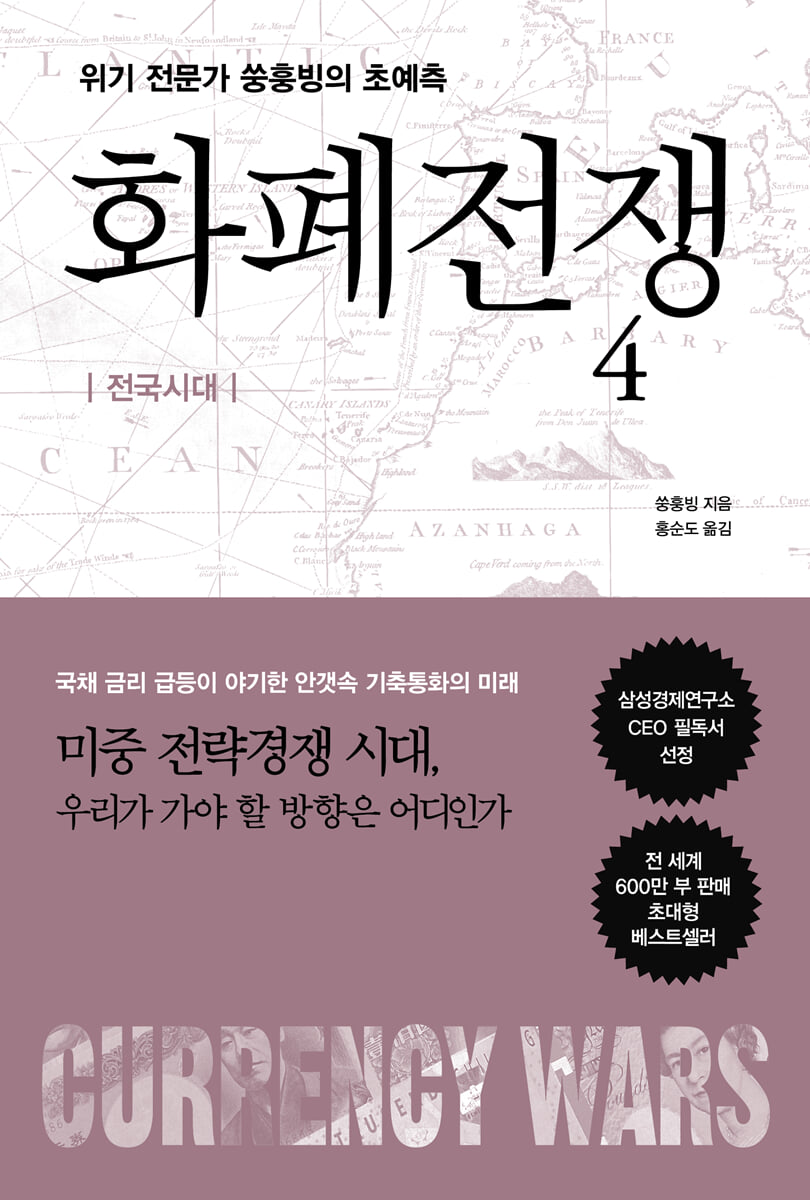 |
Description
Book Introduction
“The dollar doesn’t solve the problem!”
Unlimited quantitative easing, deflation fears, and gold prices hit record highs.
The Collapse of the Dollar Economy: A Prophecy of the Century
The latest revised edition of "Currency Wars 4: The Warring States Period," which generated significant buzz by predicting a financial hegemony competition between the United States and China, has been published.
This book, which has sold over 6 million copies in Korea and China alone, has become the bible of 'money', receiving overwhelming recommendations from numerous economic organizations and business figures, including the Samsung Economic Research Institute, since its first domestic publication in 2008.
While Volume 1 focuses on the history of American currency, Volume 2 looks back on the transformation of European finance.
And in Volume 3, the focus shifted to the currency changes and the rise and fall of nations in the Asian region over the past 100 years.
What makes Volume 4 different from its predecessors is that it goes beyond history and delves into the present and future.
Drawing on the historical experiences of each country in coping with dollar crises over time, this book focuses on the problems the global economy will face in the next decade, the responses governments will adopt, whether these measures will be effective, and the potential aftershocks if they proceed down the wrong path.
The author provides evidence based on history.
It is a fascinating account of the schemes and conspiracies the United States hatched to usurp Britain's financial hegemony and the process by which it ultimately succeeded.
It also covers the cat-and-mouse battles between currencies such as the dollar and the mark, and the dollar and the ruble, as well as the history of how a group of European elites launched and operated the single European currency.
It's like a financial mystery movie.
Beginning with the history of American finance 200 years ago and covering recent financial and economic issues, this book comprehensively summarizes the rise and fall of the global economy driven by finance into laws and suggests a path forward.
Unlimited quantitative easing, deflation fears, and gold prices hit record highs.
The Collapse of the Dollar Economy: A Prophecy of the Century
The latest revised edition of "Currency Wars 4: The Warring States Period," which generated significant buzz by predicting a financial hegemony competition between the United States and China, has been published.
This book, which has sold over 6 million copies in Korea and China alone, has become the bible of 'money', receiving overwhelming recommendations from numerous economic organizations and business figures, including the Samsung Economic Research Institute, since its first domestic publication in 2008.
While Volume 1 focuses on the history of American currency, Volume 2 looks back on the transformation of European finance.
And in Volume 3, the focus shifted to the currency changes and the rise and fall of nations in the Asian region over the past 100 years.
What makes Volume 4 different from its predecessors is that it goes beyond history and delves into the present and future.
Drawing on the historical experiences of each country in coping with dollar crises over time, this book focuses on the problems the global economy will face in the next decade, the responses governments will adopt, whether these measures will be effective, and the potential aftershocks if they proceed down the wrong path.
The author provides evidence based on history.
It is a fascinating account of the schemes and conspiracies the United States hatched to usurp Britain's financial hegemony and the process by which it ultimately succeeded.
It also covers the cat-and-mouse battles between currencies such as the dollar and the mark, and the dollar and the ruble, as well as the history of how a group of European elites launched and operated the single European currency.
It's like a financial mystery movie.
Beginning with the history of American finance 200 years ago and covering recent financial and economic issues, this book comprehensively summarizes the rise and fall of the global economy driven by finance into laws and suggests a path forward.
- You can preview some of the book's contents.
Preview
index
To Korean readers
introduction
Chapter 1: The Fierce Dollar Defeated in the First Expedition
The Mark Voluntarily Embraced the Pound | British Pound Marketing and the Birth of Foreign Exchange Reserves | The Dollar's Surprise Attack and Germany's Change of Heart | Keynes's Warning: "The Gold Standard is Dangerous" | The Dollar's Flanking Attack Challenges the Pound's Status as a Settlement Currency | America's Ambition: "Commanding Princes with Gold" | The Gold Exchange Standard: The Source of the Liquidity Flood | Exchange Rate Shocks and the "Franch Defense War" | The Fall of the Economy and the Vacuum of Money
Chapter 2: The Collapse of the Pound Bloc: The Dollar's Regency
The Collapse of the Gold Standard and the Formation of the Pound Bloc | Protect the Federal Reserve, 48 Hours to Escape the Crisis | The Great Depression That Made Three Rounds of Quantitative Easing Useless | "I Determine My Own Destiny!" | The Truth About America's Rise as a Superpower | The US Steals British Assets Like Robbing a House on Fire | The Lend-Lease Act, Under the Pretense of Aid, Destroyed the Pound Bloc | The Bretton Woods System: The Dollar Rules the World with Gold | The Final Blow That Collapsed the Pound Bloc
Chapter 3: The Cold War Between the United States and the Soviet Union
Kennan's Cold War Manifesto | The Russian Ruble and the New Economic Policy | The Debate Surrounding the Soviet Economic Development Model | Germany's Expansionary Ambition for the Ruble Empire | The Severe Soviet Food Crises: A Side Effect of Rapid Industrialization | Peak Oil Drives the Soviet Union to Destruction | The US Oil Weapons Offensive That Collapsed the Ruble Empire
Chapter 4: Europe's Strategic Alliances and the Rise and Confusion of the European Currency
The death of Roosevelt, who saved the moribund German industry | The replacement of the old and new marks and the beginning of the Cold War | The European Coal and Steel Community, the predecessor of the European Union and the euro | The 'Father of European Integration' and the 'Shadow Government' | The dollar's liquidity glut and the balance of plutocracy tipping toward Europe | The new financial continent, the eurodollar | Is the currency union the starting point or the end point of European integration? | The gold war | The collapse of the Bretton Woods system and the establishment of a debt empire.
Chapter 5: China and Japan's Industrialization Rivalry: Aiming for Resurgence
Russia's Marshall Plan, powered by the ruble | The Great Leap Forward and the Great Recession | Suppressing Rampaging Inflation with the Renminbi as a Material Standard | China Misses an Opportunity to Accelerate the Changing Trajectory of Industrialization | Japan's Industry, on the Brink of "Casting," Revived by MacArthur's "Land Reform" | Coal and Steel Production Boom and Inflation Under the Inclined Production Plan | The Dodge Plan: Bringing the Yen to the Bosom of the Dollar Empire | The National Income Doubling Plan That Invigorated Japan's Industrialization
Chapter 6: The Evolution of the Snake System from the Euro to the United States of Europe
De Gaulle's fall from power accelerates European integration | The US's misjudgment, which resulted in the loss of both crabs and snails by exporting food | The October 1973 oil shock that drove industrialized nations to ruin | The conflict between Europe, which seeks exchange rate stability, and the US, which seeks floating exchange rates | The dissolution of the Monnet Group leaves the European Union at a standstill | The European Action Committee, holding high the Monnet banner, takes action again | The Delors Commission, the final gateway to the European Monetary Union | The unification of Germany and the creation of the European Monetary Union | The genesis of the Euro Empire
Chapter 7: The Mirage of America's Peace Built on Debt Drive
Debt money, a malignant gene that kills the economy | A bloodless coup in finance, the SDR alternative account | Neoliberalism, where only the top 1% of the wealthy can hear the voices | Paul Volcker's chemotherapy that magically revived the dollar debt empire | Prosperity through borrowing | The dollar's crash | Greenspan, the ultimate savior of the financial market | Why the information revolution was short-lived
Chapter 8: Prospects for "China Model 3.0"
China's industrialization began with a tumultuous start | Rural industrialization, the first growth engine of the Chinese economy | Globalization, the second growth engine of the Chinese economy | China's two major export items: 'commodities' and 'savings' | Will China become the world's largest consumer market? | China's third growth engine: secondary industrialization of agriculture | Job creation: the second shortcut to expanding domestic demand | Is the real estate industry a spur to economic growth or a mere bubble? | The yuan needs a tough fight to break free from the dollar's dominance.
Chapter 9: The Warring States Period of Currency, Ya Yuan on the Horizon
Chimerica's Dilemma | The Decade of Risk After 2012 | Who Will Be the Euro's 'Savior'? | China on All Fronts | The Asian Economic Community | Hong Kong: A Bridgehead for the Asian Dollar Market | The Asian Monetary Union: A Strategic Direction for the Asian Monetary Fund | The Yuan or the Weak Yuan? That is the Question | The Warring States Period of the Dollar, the Euro, and the Weak Yuan
Reviews
Translator's Note
main
Search
introduction
Chapter 1: The Fierce Dollar Defeated in the First Expedition
The Mark Voluntarily Embraced the Pound | British Pound Marketing and the Birth of Foreign Exchange Reserves | The Dollar's Surprise Attack and Germany's Change of Heart | Keynes's Warning: "The Gold Standard is Dangerous" | The Dollar's Flanking Attack Challenges the Pound's Status as a Settlement Currency | America's Ambition: "Commanding Princes with Gold" | The Gold Exchange Standard: The Source of the Liquidity Flood | Exchange Rate Shocks and the "Franch Defense War" | The Fall of the Economy and the Vacuum of Money
Chapter 2: The Collapse of the Pound Bloc: The Dollar's Regency
The Collapse of the Gold Standard and the Formation of the Pound Bloc | Protect the Federal Reserve, 48 Hours to Escape the Crisis | The Great Depression That Made Three Rounds of Quantitative Easing Useless | "I Determine My Own Destiny!" | The Truth About America's Rise as a Superpower | The US Steals British Assets Like Robbing a House on Fire | The Lend-Lease Act, Under the Pretense of Aid, Destroyed the Pound Bloc | The Bretton Woods System: The Dollar Rules the World with Gold | The Final Blow That Collapsed the Pound Bloc
Chapter 3: The Cold War Between the United States and the Soviet Union
Kennan's Cold War Manifesto | The Russian Ruble and the New Economic Policy | The Debate Surrounding the Soviet Economic Development Model | Germany's Expansionary Ambition for the Ruble Empire | The Severe Soviet Food Crises: A Side Effect of Rapid Industrialization | Peak Oil Drives the Soviet Union to Destruction | The US Oil Weapons Offensive That Collapsed the Ruble Empire
Chapter 4: Europe's Strategic Alliances and the Rise and Confusion of the European Currency
The death of Roosevelt, who saved the moribund German industry | The replacement of the old and new marks and the beginning of the Cold War | The European Coal and Steel Community, the predecessor of the European Union and the euro | The 'Father of European Integration' and the 'Shadow Government' | The dollar's liquidity glut and the balance of plutocracy tipping toward Europe | The new financial continent, the eurodollar | Is the currency union the starting point or the end point of European integration? | The gold war | The collapse of the Bretton Woods system and the establishment of a debt empire.
Chapter 5: China and Japan's Industrialization Rivalry: Aiming for Resurgence
Russia's Marshall Plan, powered by the ruble | The Great Leap Forward and the Great Recession | Suppressing Rampaging Inflation with the Renminbi as a Material Standard | China Misses an Opportunity to Accelerate the Changing Trajectory of Industrialization | Japan's Industry, on the Brink of "Casting," Revived by MacArthur's "Land Reform" | Coal and Steel Production Boom and Inflation Under the Inclined Production Plan | The Dodge Plan: Bringing the Yen to the Bosom of the Dollar Empire | The National Income Doubling Plan That Invigorated Japan's Industrialization
Chapter 6: The Evolution of the Snake System from the Euro to the United States of Europe
De Gaulle's fall from power accelerates European integration | The US's misjudgment, which resulted in the loss of both crabs and snails by exporting food | The October 1973 oil shock that drove industrialized nations to ruin | The conflict between Europe, which seeks exchange rate stability, and the US, which seeks floating exchange rates | The dissolution of the Monnet Group leaves the European Union at a standstill | The European Action Committee, holding high the Monnet banner, takes action again | The Delors Commission, the final gateway to the European Monetary Union | The unification of Germany and the creation of the European Monetary Union | The genesis of the Euro Empire
Chapter 7: The Mirage of America's Peace Built on Debt Drive
Debt money, a malignant gene that kills the economy | A bloodless coup in finance, the SDR alternative account | Neoliberalism, where only the top 1% of the wealthy can hear the voices | Paul Volcker's chemotherapy that magically revived the dollar debt empire | Prosperity through borrowing | The dollar's crash | Greenspan, the ultimate savior of the financial market | Why the information revolution was short-lived
Chapter 8: Prospects for "China Model 3.0"
China's industrialization began with a tumultuous start | Rural industrialization, the first growth engine of the Chinese economy | Globalization, the second growth engine of the Chinese economy | China's two major export items: 'commodities' and 'savings' | Will China become the world's largest consumer market? | China's third growth engine: secondary industrialization of agriculture | Job creation: the second shortcut to expanding domestic demand | Is the real estate industry a spur to economic growth or a mere bubble? | The yuan needs a tough fight to break free from the dollar's dominance.
Chapter 9: The Warring States Period of Currency, Ya Yuan on the Horizon
Chimerica's Dilemma | The Decade of Risk After 2012 | Who Will Be the Euro's 'Savior'? | China on All Fronts | The Asian Economic Community | Hong Kong: A Bridgehead for the Asian Dollar Market | The Asian Monetary Union: A Strategic Direction for the Asian Monetary Fund | The Yuan or the Weak Yuan? That is the Question | The Warring States Period of the Dollar, the Euro, and the Weak Yuan
Reviews
Translator's Note
main
Search
Detailed image
.jpg)
Into the book
America's dream of incorporating the Soviet Union into the dollar empire through currency and trade has collapsed spectacularly.
Thus, the Cold War era finally came to an end.
A whopping $8 trillion was wasted on this Cold War, which lasted over 40 years.
Hundreds of thousands more people lost their lives.
Millions of families were also separated.
As a result, the Soviet Union chose a different path from the United States.
They began building a 'ruble empire' to counter the 'dollar empire'.
--- p.177
The troubles of the 20th century's loser, the United States, lie in the economy.
Europe's crisis also lies in politics.
So where does Asia's problem lie?
It can be seen as existing in past history.
The relationship between China and Japan is similar to that between France and Germany.
They were enemies in the past.
But now, we are as close yet distant as in-laws.
Looking at the economic development over the past 60 years since World War II, Japan was ahead in the 'first half' of the war.
However, in the second half, China is showing off its power and showing off its spirit.
At present, the abilities of both sides are almost equal.
So, can China ultimately surpass Japan? Or will Japan overcome its two-decade-long economic slump and re-emerge as a miracle? For now, the possibility of either scenario remains questionable.
This also means that China's capabilities have grown.
--- p.318
European integration has been through many hardships over the past half-century.
From the establishment of the European Coal and Steel Community to the birth of the Werner Plan, from the operation of the Snake System to the launch of the European Monetary Union, from the Delors Report to the Maastricht Treaty, from the establishment of the European Monetary Unit (ECU) to the establishment of the European Central Bank, I have experienced all the events of this turbulent period.
Then, finally, economic integration was achieved through the euro.
But the launch of the euro did not solve Europe's fundamental problems.
Rather, it caused more problems.
The euro's imminent crisis cannot be resolved without the creation of a European Treasury, a so-called "single European financial authority."
Furthermore, the ultimate goal of European integration cannot be achieved unless a 'United States of Europe' is created.
The euro is still evolving.
--- p.394
When the Soviet Union and the United States collapsed, China suddenly lost its way and wandered like a student who had lost his teacher.
But the reality was cold.
Whether it wants it or not, China is destined to be at the forefront of the globalization trend and assume a leadership role.
The entire world, from the United States struggling in the midst of a recession, to Europe reeling from a debt crisis, to its trading partners in Asia, is looking to China.
The situation has become one where we are just waiting for China to open its purse strings and stimulate the economy again to rescue the world from its misery.
What choice will China make?
--- p.530
The major East Asian countries of China, Japan, and South Korea each have fatal weaknesses.
China's greatest weakness is economic, Japan's greatest weakness is political, and South Korea's greatest weakness is military.
The weaknesses of all three countries were created by the United States.
But if China, Japan, and Korea unite, their individual weaknesses will not be a problem at all.
To break away from the dominance of Europe and the United States by forming an Asian common market centered around the three countries of Korea, China, and Japan.
I think this is the wish of all Asian countries.
Disputes between nations are ultimately about competing interests.
Rather than playing a zero-sum game that benefits no one, it is better to share existing profits.
Deng Xiaoping once proposed the idea that “we should put sovereignty issues on hold for discussion and seek common development.”
This is also a strategic principle that serves the fundamental interests of each Asian country.
I think now is the time to put this ideology into practice and put it into practice.
Thus, the Cold War era finally came to an end.
A whopping $8 trillion was wasted on this Cold War, which lasted over 40 years.
Hundreds of thousands more people lost their lives.
Millions of families were also separated.
As a result, the Soviet Union chose a different path from the United States.
They began building a 'ruble empire' to counter the 'dollar empire'.
--- p.177
The troubles of the 20th century's loser, the United States, lie in the economy.
Europe's crisis also lies in politics.
So where does Asia's problem lie?
It can be seen as existing in past history.
The relationship between China and Japan is similar to that between France and Germany.
They were enemies in the past.
But now, we are as close yet distant as in-laws.
Looking at the economic development over the past 60 years since World War II, Japan was ahead in the 'first half' of the war.
However, in the second half, China is showing off its power and showing off its spirit.
At present, the abilities of both sides are almost equal.
So, can China ultimately surpass Japan? Or will Japan overcome its two-decade-long economic slump and re-emerge as a miracle? For now, the possibility of either scenario remains questionable.
This also means that China's capabilities have grown.
--- p.318
European integration has been through many hardships over the past half-century.
From the establishment of the European Coal and Steel Community to the birth of the Werner Plan, from the operation of the Snake System to the launch of the European Monetary Union, from the Delors Report to the Maastricht Treaty, from the establishment of the European Monetary Unit (ECU) to the establishment of the European Central Bank, I have experienced all the events of this turbulent period.
Then, finally, economic integration was achieved through the euro.
But the launch of the euro did not solve Europe's fundamental problems.
Rather, it caused more problems.
The euro's imminent crisis cannot be resolved without the creation of a European Treasury, a so-called "single European financial authority."
Furthermore, the ultimate goal of European integration cannot be achieved unless a 'United States of Europe' is created.
The euro is still evolving.
--- p.394
When the Soviet Union and the United States collapsed, China suddenly lost its way and wandered like a student who had lost his teacher.
But the reality was cold.
Whether it wants it or not, China is destined to be at the forefront of the globalization trend and assume a leadership role.
The entire world, from the United States struggling in the midst of a recession, to Europe reeling from a debt crisis, to its trading partners in Asia, is looking to China.
The situation has become one where we are just waiting for China to open its purse strings and stimulate the economy again to rescue the world from its misery.
What choice will China make?
--- p.530
The major East Asian countries of China, Japan, and South Korea each have fatal weaknesses.
China's greatest weakness is economic, Japan's greatest weakness is political, and South Korea's greatest weakness is military.
The weaknesses of all three countries were created by the United States.
But if China, Japan, and Korea unite, their individual weaknesses will not be a problem at all.
To break away from the dominance of Europe and the United States by forming an Asian common market centered around the three countries of Korea, China, and Japan.
I think this is the wish of all Asian countries.
Disputes between nations are ultimately about competing interests.
Rather than playing a zero-sum game that benefits no one, it is better to share existing profits.
Deng Xiaoping once proposed the idea that “we should put sovereignty issues on hold for discussion and seek common development.”
This is also a strategic principle that serves the fundamental interests of each Asian country.
I think now is the time to put this ideology into practice and put it into practice.
--- p.636
Publisher's Review
The best economics book that explains the 'flow of money'
The "Currency Wars" series, upon its first publication, became a huge hit and became a mega-bestseller for its accurate predictions of economic trends and its detailed analysis of the historical truth behind economic problems.
The term 'currency war' is now widely cited in the media and has become a buzzword in the financial world.
The secrets that appeared in this series, unknown to the public, have been proven true by history.
All of the author's predictions came true.
The basis of this series is simple.
The point is to ‘predict the future through history.’
Song Hongbing said, “There are not many strange things in the world,” and that the essence of history is always the same, and the purpose of studying history is to predict the future.
Will the US economy, which underpins the global economy, fall into recession again? Will the debate over raising the US Treasury debt ceiling resurface after 2012? Will the European debt crisis fully intensify? Will the eurozone collapse scenario become a reality? Will China attempt to rescue Europe from this crisis? Will China's real estate bubble truly burst? Will the Chinese economy experience a hard or soft landing? How effectively will China suppress inflation? How will it handle its massive foreign exchange reserves? How far will the yuan appreciate? Will its globalization succeed? "Currency Wars 4: The Warring States Period" offers clear answers to these pressing questions regarding the global economy.
“The era of the new Cold War between the US and China,
“Which path should we take?”
The subtitle of this book is 'The Warring States Period'.
In an interview with a Chinese daily newspaper, the author explains the reason for choosing the subtitle “Warring States Period” as follows:
“In the future, it will be impossible for a specific country or system to dominate.
The current world map is centered around the United States, Europe, and Asia.
America has economic problems, Europe has political problems, and Asia has historical problems.
In the future, a warring states era will unfold where warlords will fight for power.”
The author said that the present era is marked by significant changes in the world's superpower landscape and is also marked by crises and challenges.
The problems brought to the surface by the US debt crisis will ultimately lead to the complete collapse of the dollar system.
Furthermore, it is argued that the symbiotic relationship that 'Chimerica' has maintained for the past 30 years based on political and economic interests will crack in the next 10 years, which will cause the world economy to experience a long-term recession and fall into a 'lost decade'. It also argues that Asian countries, including China, will have to change their economic growth models.
The argument is that the currency of a specific sovereign nation can no longer serve as the world's reserve currency, and that a "supranational currency" must be launched to solve this problem.
The author argues that this will usher in an era of currency wars between the dollar, euro, and yuan.
In his argument, the Asian single currency, the Asian yuan (ACU), stands out, not the yuan itself.
The yuan cannot replace the dollar as the world's reserve currency, and even if it does, it will face criticism.
He says that because it is difficult to compete with the dollar and the euro on one's own, Asian countries should unite with China at the center to launch an Asian economic community and create a yuan.
Only then can we enter an era of national currencies, along with the dollar and the euro.
All the prophecies in the "Currency Wars" series have come true.
This series is armed with facts and materials that surpass those of orthodox history books, and no one can deny that this book is a world financial forecast book that is faithful to history and politics.
It is still clear why we should read this book.
This is to understand the flow of global financial history and prepare for the coming "war without gunfire" by properly understanding currency, which is more important than nuclear weapons.
The "Currency Wars" series, upon its first publication, became a huge hit and became a mega-bestseller for its accurate predictions of economic trends and its detailed analysis of the historical truth behind economic problems.
The term 'currency war' is now widely cited in the media and has become a buzzword in the financial world.
The secrets that appeared in this series, unknown to the public, have been proven true by history.
All of the author's predictions came true.
The basis of this series is simple.
The point is to ‘predict the future through history.’
Song Hongbing said, “There are not many strange things in the world,” and that the essence of history is always the same, and the purpose of studying history is to predict the future.
Will the US economy, which underpins the global economy, fall into recession again? Will the debate over raising the US Treasury debt ceiling resurface after 2012? Will the European debt crisis fully intensify? Will the eurozone collapse scenario become a reality? Will China attempt to rescue Europe from this crisis? Will China's real estate bubble truly burst? Will the Chinese economy experience a hard or soft landing? How effectively will China suppress inflation? How will it handle its massive foreign exchange reserves? How far will the yuan appreciate? Will its globalization succeed? "Currency Wars 4: The Warring States Period" offers clear answers to these pressing questions regarding the global economy.
“The era of the new Cold War between the US and China,
“Which path should we take?”
The subtitle of this book is 'The Warring States Period'.
In an interview with a Chinese daily newspaper, the author explains the reason for choosing the subtitle “Warring States Period” as follows:
“In the future, it will be impossible for a specific country or system to dominate.
The current world map is centered around the United States, Europe, and Asia.
America has economic problems, Europe has political problems, and Asia has historical problems.
In the future, a warring states era will unfold where warlords will fight for power.”
The author said that the present era is marked by significant changes in the world's superpower landscape and is also marked by crises and challenges.
The problems brought to the surface by the US debt crisis will ultimately lead to the complete collapse of the dollar system.
Furthermore, it is argued that the symbiotic relationship that 'Chimerica' has maintained for the past 30 years based on political and economic interests will crack in the next 10 years, which will cause the world economy to experience a long-term recession and fall into a 'lost decade'. It also argues that Asian countries, including China, will have to change their economic growth models.
The argument is that the currency of a specific sovereign nation can no longer serve as the world's reserve currency, and that a "supranational currency" must be launched to solve this problem.
The author argues that this will usher in an era of currency wars between the dollar, euro, and yuan.
In his argument, the Asian single currency, the Asian yuan (ACU), stands out, not the yuan itself.
The yuan cannot replace the dollar as the world's reserve currency, and even if it does, it will face criticism.
He says that because it is difficult to compete with the dollar and the euro on one's own, Asian countries should unite with China at the center to launch an Asian economic community and create a yuan.
Only then can we enter an era of national currencies, along with the dollar and the euro.
All the prophecies in the "Currency Wars" series have come true.
This series is armed with facts and materials that surpass those of orthodox history books, and no one can deny that this book is a world financial forecast book that is faithful to history and politics.
It is still clear why we should read this book.
This is to understand the flow of global financial history and prepare for the coming "war without gunfire" by properly understanding currency, which is more important than nuclear weapons.
GOODS SPECIFICS
- Date of publication: September 14, 2020
- Page count, weight, size: 680 pages | 960g | 152*225*35mm
- ISBN13: 9788925589879
- ISBN10: 8925589877
You may also like
카테고리
korean


korean

![GQ KOREA Mark (Monthly): December [2025]](http://librairie.coreenne.fr/cdn/shop/files/8ef265dbbfbf186523ed75ba7319009d.jpg?v=1765340328&width=3840)


