

Leader phobia
 |
Description
Book Introduction
Everything you need to know about the new leadership that resonates with the MZ generation.
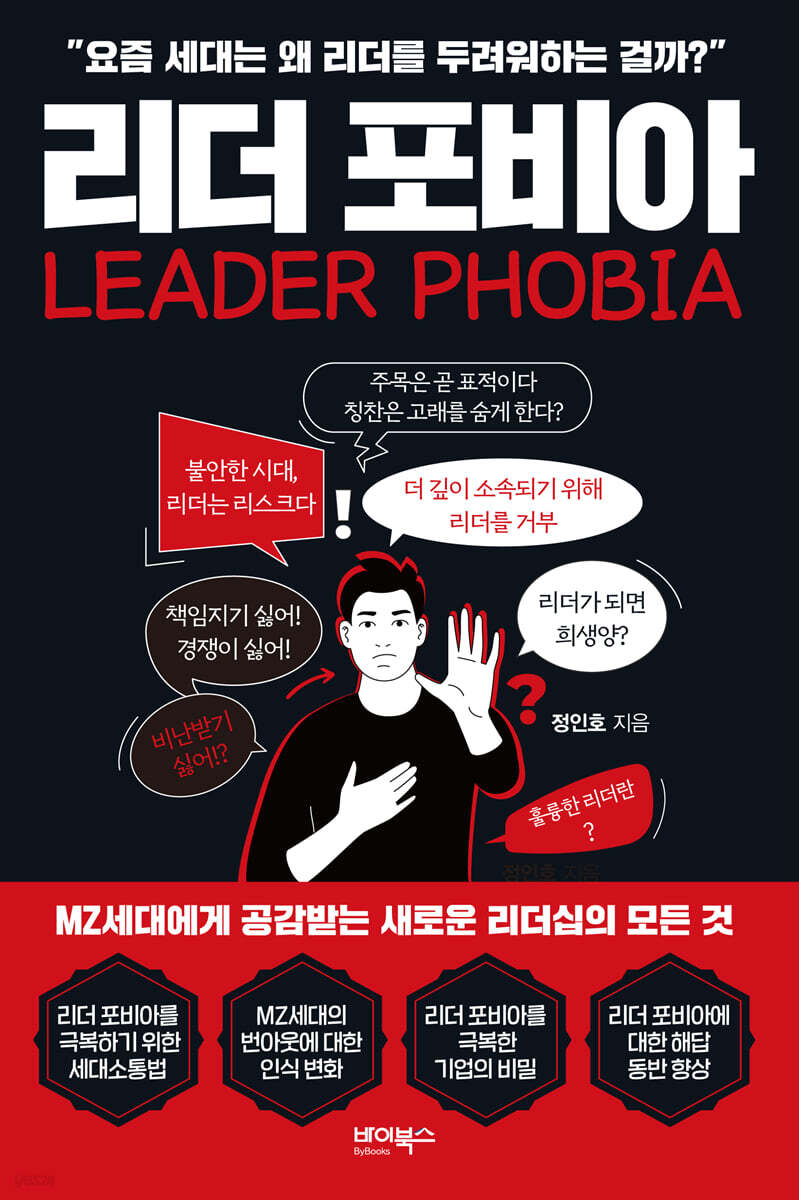
Inho Jeong, a business administration PhD, management critic, and CEO of GGL Leadership Group and Avangro, wrote “Leader Phobia” to capture everything about the new leadership that resonates with the MZ generation.
Drawing on his experience as a consultant, columnist, and writer, who has provided intellectual stimulation to many with his sharp insights and penetrating insights into the times, he presents a diagnosis and countermeasures for why today's generation fears leaders.
Through this book, let's cultivate the humility to lower expectations, the consistency to treat each person with sincerity, and the belief that today's small efforts lead to tomorrow's leap forward. Let's dream of joint improvement with today's generation and new leadership.
Inho Jeong, a business administration PhD, management critic, and CEO of GGL Leadership Group and Avangro, wrote “Leader Phobia” to capture everything about the new leadership that resonates with the MZ generation.
Drawing on his experience as a consultant, columnist, and writer, who has provided intellectual stimulation to many with his sharp insights and penetrating insights into the times, he presents a diagnosis and countermeasures for why today's generation fears leaders.
Through this book, let's cultivate the humility to lower expectations, the consistency to treat each person with sincerity, and the belief that today's small efforts lead to tomorrow's leap forward. Let's dream of joint improvement with today's generation and new leadership.
- You can preview some of the book's contents.
Preview
index
Prologue
1.
Why is today's generation afraid of leaders?
The formula 'the leader is the scapegoat'
The Weight of Leadership Responsibility | The Rise of Leader Phobia | Are Good Leaders More Dangerous? | From "Leader = Scapegoat" to "Leader = Object of Avoidance" | Organizations Create Leaders, but Sometimes They Devour Them!
In uncertain times, leadership is a risk.
The harsh realities that fuel anxiety | Generation Z: Struggling with Overpreparation | Imposter Syndrome among the digital generation | The Law of Total Life Pain | Self-Efficacy: The Core Foundation of Leadership | I Want to Do Well, Too!
Leader Phobia and the Trap of Competition
The Pros and Cons of Meritocracy | Differences in Career Perceptions Create Leader Phobia | The Crack Between Dreams and Reality | Metaphors of Inequality in Famous Paintings | Organizations Losing a Sense of Belonging | At the Edge of Competition | Let's Break Free from Meritocracy and Protect Our Humanity Through Solidarity
The Age of Paranoid Parenting
The Imprisonment Called Love | Children Deprived of Freedom | Resilience: The Painless Way to Raise Children | Talent-Development-Focused Parenting vs. Natural Growth vs. Overprotection and Emotional Neglect
Why does today's generation hate competition?
A Generation That Hates Competition Dreams of Equality? | The Rise of Heterarchy | Does Performance-Based Rewards Disrupt Group Balance?
2.
An age where leaders are feared, an age where leaders cannot be found.
Attention is the target
Team projects are perceived as burdens rather than collaborations | Standing out hurts | Anonymity encourages participation | Does praise make whales hide?
A world where even leaders can't stand without "Likes"
Tired of Managing Self-Image | The Mirror Prison of Social Media | Leaders Who Take Image and Emotional Risks Beyond Work and Action | The Real Me vs. the Modified Me
I belong nowhere, yet at the same time I belong everywhere.
The identity gap between the older generation and the current generation | The only difference is the method and standards | The era of loose but meaningful connections | Rejecting leaders for a deeper sense of belonging within the organization | Prefabricated belonging that allows for dynamic connections | The current generation wants to determine their own method of belonging
If you get it wrong, just pack it away
Generation X, which demonstrated the beginning and limits of individualism | Millennials, still individuals within a group | Generation Z, which demands personalized experiences | From individuals within a crowd to crowds within individuals
This is my first time doing this too.
When and how does leadership work? | Lack of time weakens a leader's judgment | Leadership failure is a systemic failure | The collapse of time awareness accelerated by digital technology and the crisis of leadership | Time is leadership | The paradox of spending more time on low-performing members | A time management matrix for efficient use of time
The Me Generation is back in the spotlight
The reemergence of micro-concepts in a more sophisticated and everyday form | Mi-ism, interpreting the world from the self-centered perspective | "Who am I?" becomes a realistic challenge | The pragmatic generation and leader phobia | Leader phobia is not an evasion of responsibility.
3.
Changing Leadership, Shaking Values
I don't really want to win
A generation that values the empathy of a few like-minded individuals over the approval of the majority | Generation Z, where work-life balance is paramount | A world-renowned physicist's strategy for targeting today's generation | Learned helplessness in the face of uncertainty | Job crafting: A way to survive in an uncertain world
Good person complex
Leaders Need Empathy, Not Charisma | The Difference Between Good People and Good Leaders | How to Overcome the Good Person Complex and Self-Affirmation | Don't Be Obsessed with Your Own Flaws
I am the master of my own destiny!
Younger generations prioritize freedom and flexibility over stability | The Dilbert Principle | Phenomena emerging from expanding self-determination | Loud Quitting: A Risk to Organizational Culture
The older generation didn't know about the burnout of today's generation.
Burnout caused by the obsession with growth / The gap in perception of burnout compared to the older generation / Misconceptions about burnout / Burnout is not caused by too much work / Burnout is not just an individual problem / How to solve burnout? / A sense of control over work prevents burnout / Inner confidence in work is necessary
We are the others!
Clear boundaries between public and private relationships / Small talk is still valid / Consideration is more important than speaking well / Let's observe lifestyles for effective communication / Leader phobia created by the need for psychological safety
4.
How to Overcome Leader Phobia
Leadership without a leader
The organizational value created by decentralization of power | The leadership you knew is over | Leaders need guides, not bosses | Leadership based on collaboration and networks, not authority, is needed.
A place ruins a person
When Positions Destroy People | The Secrets of Companies Overcoming Junior Phobia | Leader Phobia
How to Give Feedback That Overcomes Generational Gaps
When conflict diminishes, growth also stops | How to overcome generational differences with today's generations | Don't dictate.
How to Lead Today's Generation
Why does the current generation exhibit a stronger tendency toward "point-in-time discounting"? | Compensation for the current generation | Losses
Trigger your avoidance instincts | What's more important than a finished product?
New Leadership for Overcoming Leader Phobia
The Moment a Leader's Eyes Open | The First Step to a New Leadership Path | Recruiting Trusted Colleagues | Establishing Principles of Conduct | No Leader Is Perfect From the Start | The Answer to Leader Phobia: Mutual Improvement
References
1.
Why is today's generation afraid of leaders?
The formula 'the leader is the scapegoat'
The Weight of Leadership Responsibility | The Rise of Leader Phobia | Are Good Leaders More Dangerous? | From "Leader = Scapegoat" to "Leader = Object of Avoidance" | Organizations Create Leaders, but Sometimes They Devour Them!
In uncertain times, leadership is a risk.
The harsh realities that fuel anxiety | Generation Z: Struggling with Overpreparation | Imposter Syndrome among the digital generation | The Law of Total Life Pain | Self-Efficacy: The Core Foundation of Leadership | I Want to Do Well, Too!
Leader Phobia and the Trap of Competition
The Pros and Cons of Meritocracy | Differences in Career Perceptions Create Leader Phobia | The Crack Between Dreams and Reality | Metaphors of Inequality in Famous Paintings | Organizations Losing a Sense of Belonging | At the Edge of Competition | Let's Break Free from Meritocracy and Protect Our Humanity Through Solidarity
The Age of Paranoid Parenting
The Imprisonment Called Love | Children Deprived of Freedom | Resilience: The Painless Way to Raise Children | Talent-Development-Focused Parenting vs. Natural Growth vs. Overprotection and Emotional Neglect
Why does today's generation hate competition?
A Generation That Hates Competition Dreams of Equality? | The Rise of Heterarchy | Does Performance-Based Rewards Disrupt Group Balance?
2.
An age where leaders are feared, an age where leaders cannot be found.
Attention is the target
Team projects are perceived as burdens rather than collaborations | Standing out hurts | Anonymity encourages participation | Does praise make whales hide?
A world where even leaders can't stand without "Likes"
Tired of Managing Self-Image | The Mirror Prison of Social Media | Leaders Who Take Image and Emotional Risks Beyond Work and Action | The Real Me vs. the Modified Me
I belong nowhere, yet at the same time I belong everywhere.
The identity gap between the older generation and the current generation | The only difference is the method and standards | The era of loose but meaningful connections | Rejecting leaders for a deeper sense of belonging within the organization | Prefabricated belonging that allows for dynamic connections | The current generation wants to determine their own method of belonging
If you get it wrong, just pack it away
Generation X, which demonstrated the beginning and limits of individualism | Millennials, still individuals within a group | Generation Z, which demands personalized experiences | From individuals within a crowd to crowds within individuals
This is my first time doing this too.
When and how does leadership work? | Lack of time weakens a leader's judgment | Leadership failure is a systemic failure | The collapse of time awareness accelerated by digital technology and the crisis of leadership | Time is leadership | The paradox of spending more time on low-performing members | A time management matrix for efficient use of time
The Me Generation is back in the spotlight
The reemergence of micro-concepts in a more sophisticated and everyday form | Mi-ism, interpreting the world from the self-centered perspective | "Who am I?" becomes a realistic challenge | The pragmatic generation and leader phobia | Leader phobia is not an evasion of responsibility.
3.
Changing Leadership, Shaking Values
I don't really want to win
A generation that values the empathy of a few like-minded individuals over the approval of the majority | Generation Z, where work-life balance is paramount | A world-renowned physicist's strategy for targeting today's generation | Learned helplessness in the face of uncertainty | Job crafting: A way to survive in an uncertain world
Good person complex
Leaders Need Empathy, Not Charisma | The Difference Between Good People and Good Leaders | How to Overcome the Good Person Complex and Self-Affirmation | Don't Be Obsessed with Your Own Flaws
I am the master of my own destiny!
Younger generations prioritize freedom and flexibility over stability | The Dilbert Principle | Phenomena emerging from expanding self-determination | Loud Quitting: A Risk to Organizational Culture
The older generation didn't know about the burnout of today's generation.
Burnout caused by the obsession with growth / The gap in perception of burnout compared to the older generation / Misconceptions about burnout / Burnout is not caused by too much work / Burnout is not just an individual problem / How to solve burnout? / A sense of control over work prevents burnout / Inner confidence in work is necessary
We are the others!
Clear boundaries between public and private relationships / Small talk is still valid / Consideration is more important than speaking well / Let's observe lifestyles for effective communication / Leader phobia created by the need for psychological safety
4.
How to Overcome Leader Phobia
Leadership without a leader
The organizational value created by decentralization of power | The leadership you knew is over | Leaders need guides, not bosses | Leadership based on collaboration and networks, not authority, is needed.
A place ruins a person
When Positions Destroy People | The Secrets of Companies Overcoming Junior Phobia | Leader Phobia
How to Give Feedback That Overcomes Generational Gaps
When conflict diminishes, growth also stops | How to overcome generational differences with today's generations | Don't dictate.
How to Lead Today's Generation
Why does the current generation exhibit a stronger tendency toward "point-in-time discounting"? | Compensation for the current generation | Losses
Trigger your avoidance instincts | What's more important than a finished product?
New Leadership for Overcoming Leader Phobia
The Moment a Leader's Eyes Open | The First Step to a New Leadership Path | Recruiting Trusted Colleagues | Establishing Principles of Conduct | No Leader Is Perfect From the Start | The Answer to Leader Phobia: Mutual Improvement
References
Detailed image

Into the book
The problem is that many problems arise not because the leader is wrong, but because he or she is a leader.
When conflict arises or performance is low within an organization, members look for the cause at the top.
Even if a leader did nothing wrong, he or she is automatically placed in a position of responsibility in an atmosphere where people ask, “Shouldn’t you have done something better?”
Even the human side of a leader is consumed by the organization.
Emotional labor is taken for granted, and the role of listening to members' complaints becomes the leader's responsibility.
We should give comfort rather than be comforted, and we should be on the side of giving help rather than asking for help.
In this way, leaders increasingly suppress their emotions and fatigue and conform to the image expected of them by the organization.
And at some point, the leader becomes 'exhausted' by the organization.
Organizations think they are "raising" their leaders, but in reality, they are merely "holding them back."
Only the survivors become leaders.
However, the process of survival often presupposes psychological exhaustion, severance of relationships, isolation, and shifting of responsibility for the individual leader.
Organizations develop leaders, but they also isolate them and sometimes make them scapegoats for their failures.
Leader phobia is not a problem of individual leaders, nor is it a quirky trait unique to this generation.
It is a sobering reaction and defense mechanism to how the organization treats its leaders.
--- p.29-30
Many leaders tend to spend more time on low-performing members.
This may be a choice born of good intentions to help them and help them grow.
However, this may send the wrong message to the rest of the group:
“If you perform well, you may lose the leader’s attention.”
This creates a dynamic paradox within the organization.
Members who work hard and do well end up feeling left out, while members who need improvement end up monopolizing the leader's attention.
But organizations are not just groups that hit the average.
An organization is an ecosystem where excellent individuals set standards and those standards guide the direction of the entire organization.
As more time and feedback is focused on high-performing members, their performance and attitudes become a benchmark for the entire organization, and it naturally evolves in that direction.
Conversely, if a leader spends most of his or her time focusing on low-performing employees, top performers may feel alienated, which can lead to decreased motivation.
Of course, even if current performance is lacking, members with potential for growth need sufficient attention and time.
But that time should be a strategic investment for growth.
Rather than simply rushing to solve a problem and pouring all your leadership resources into it, it's important to look ahead to the organization's future and determine who deserves the most positive ripple effect throughout the organization.
--- p.124-125
Most directive impulses come from good intentions.
When a child is struggling, when a junior is lost, we want to help and say things like, “Do it this way,” “That’s not right,” or “Do it as I say.”
However, this is a typical approach that is perceived as disrespectful by today's younger generation.
The moment you receive instructions, your inner foundation of autonomy and subjectivity collapses.
As a result, they experience even deeper frustration and the psychological distance between generations grows wider.
Consider riding a bicycle.
No matter how many instructions you give, learning to ride a bicycle is something you learn by balancing with your body.
Likewise, how to be respected, how to learn the job, and how to realize leadership should be learned through experience, through the accumulation of small interactions, rather than through words.
But the directive skips this process and deprives the younger generation of the opportunity to figure it out for themselves.
Moreover, directives themselves can feel rude, which can demotivate and strain relationships.
Ultimately, questions are not just a skill; they are a cultural language that fosters respect, autonomy, and learning.
The question is “This person now
It is a declaration that “I will not judge or control this experience for you,” and that in itself makes the relationship equal.
This attitude is precisely the approach that today's organizations and societies absolutely need to grow together based on trust.
When conflict arises or performance is low within an organization, members look for the cause at the top.
Even if a leader did nothing wrong, he or she is automatically placed in a position of responsibility in an atmosphere where people ask, “Shouldn’t you have done something better?”
Even the human side of a leader is consumed by the organization.
Emotional labor is taken for granted, and the role of listening to members' complaints becomes the leader's responsibility.
We should give comfort rather than be comforted, and we should be on the side of giving help rather than asking for help.
In this way, leaders increasingly suppress their emotions and fatigue and conform to the image expected of them by the organization.
And at some point, the leader becomes 'exhausted' by the organization.
Organizations think they are "raising" their leaders, but in reality, they are merely "holding them back."
Only the survivors become leaders.
However, the process of survival often presupposes psychological exhaustion, severance of relationships, isolation, and shifting of responsibility for the individual leader.
Organizations develop leaders, but they also isolate them and sometimes make them scapegoats for their failures.
Leader phobia is not a problem of individual leaders, nor is it a quirky trait unique to this generation.
It is a sobering reaction and defense mechanism to how the organization treats its leaders.
--- p.29-30
Many leaders tend to spend more time on low-performing members.
This may be a choice born of good intentions to help them and help them grow.
However, this may send the wrong message to the rest of the group:
“If you perform well, you may lose the leader’s attention.”
This creates a dynamic paradox within the organization.
Members who work hard and do well end up feeling left out, while members who need improvement end up monopolizing the leader's attention.
But organizations are not just groups that hit the average.
An organization is an ecosystem where excellent individuals set standards and those standards guide the direction of the entire organization.
As more time and feedback is focused on high-performing members, their performance and attitudes become a benchmark for the entire organization, and it naturally evolves in that direction.
Conversely, if a leader spends most of his or her time focusing on low-performing employees, top performers may feel alienated, which can lead to decreased motivation.
Of course, even if current performance is lacking, members with potential for growth need sufficient attention and time.
But that time should be a strategic investment for growth.
Rather than simply rushing to solve a problem and pouring all your leadership resources into it, it's important to look ahead to the organization's future and determine who deserves the most positive ripple effect throughout the organization.
--- p.124-125
Most directive impulses come from good intentions.
When a child is struggling, when a junior is lost, we want to help and say things like, “Do it this way,” “That’s not right,” or “Do it as I say.”
However, this is a typical approach that is perceived as disrespectful by today's younger generation.
The moment you receive instructions, your inner foundation of autonomy and subjectivity collapses.
As a result, they experience even deeper frustration and the psychological distance between generations grows wider.
Consider riding a bicycle.
No matter how many instructions you give, learning to ride a bicycle is something you learn by balancing with your body.
Likewise, how to be respected, how to learn the job, and how to realize leadership should be learned through experience, through the accumulation of small interactions, rather than through words.
But the directive skips this process and deprives the younger generation of the opportunity to figure it out for themselves.
Moreover, directives themselves can feel rude, which can demotivate and strain relationships.
Ultimately, questions are not just a skill; they are a cultural language that fosters respect, autonomy, and learning.
The question is “This person now
It is a declaration that “I will not judge or control this experience for you,” and that in itself makes the relationship equal.
This attitude is precisely the approach that today's organizations and societies absolutely need to grow together based on trust.
--- p.232-234
Publisher's Review
Now is the era of leader phobia
“Now we must change the question.
It is no longer enough to simply ask, “How can I become a better leader?” as we did in the past.
The questions we need to ask now must be much more fundamental and essential.
“Why have people become afraid of being leaders? What makes leaders so shunned? And how can we overcome the phenomenon of leader phobia?”
Inho Jeong, a business administration PhD, management critic, and CEO of GGL Leadership Group and Avangro, wrote “Leader Phobia” to capture everything about the new leadership that resonates with the MZ generation.
Drawing on his experience as a consultant, columnist, and writer, who has provided intellectual stimulation to many with his sharp insights and penetrating insights into the times, he presents a diagnosis and countermeasures for why today's generation fears leaders.
Leader phobia is not a problem that can be explained simply by individual temperament or shirking responsibility.
It is not a matter of the will of one leader, but a structural result created by the entire organization and society.
I hope this book will provide an opportunity for leaders to no longer be feared, but instead establish themselves as crucial figures who foster collaboration and growth.
A generation that hates competition, dreams of equality?
“Today’s 20-somethings are different.
They cannot help but focus on the difference in starting points rather than the results, that is, the inequality before entering the competition.
'I don't have parents' money or connections', 'I didn't receive proper private education, and the opportunities to build my resume were unfair', 'No matter how hard I work, I can't beat them because they started out in an overwhelming environment'. These people feel that the results of their achievements are not a just reward, but a combination of social structure, luck, and environment.
“The idea is that if the competition itself is not fair, the results cannot be fair either.”
While more than half of adults viewed merit-based distribution as the fairest option, college students ranked it as the least fair option.
Why did such a stark difference arise? For the older generation, fairness in the world meant rewards were proportional to achievement, and that achievement was the result of hard work and ability.
Today's 20-somethings are different.
They cannot help but focus on the difference in starting points rather than the results, that is, the inequality before entering the competition.
The current generation has a strong sense of horizontalism.
They prefer a 'relationship on the same line' rather than a vertical hierarchy, and their definition of fairness is also closer to 'equality'.
For them, fairness is not about lining up achievements, but a structure that allows people to stand together without pushing each other away.
So, the burden of 'being a leader = going out of line with everyone else' creates leader phobia.
Burnout of the current generation that the older generation doesn't know about
“When we think of people who are vulnerable to burnout, we often think of low performers who lack enthusiasm for their work or fail to achieve results.
But in reality, the opposite is true.
People who are highly self-motivated, responsible, and passionate about their work are more likely to suffer from burnout.
“Those who experience burnout first within an organization are often those who voluntarily work overtime, lead projects, or take the lead on a team during a crisis.”
The older generation interprets the burnout of today's generation as a lack of resilience or mental strength, and even makes comments like, "Isn't it because they haven't really experienced hardship?"
However, the better the performance of an employee, the higher the organization's expectations naturally become, and the more effort they put in to meet those expectations.
In this vicious cycle that repeats itself, the person who works hard becomes the first to get tired.
Burnout is not simply a problem that arises from personal weakness.
This is what happens when unhealthy organizational structures operate in a way that exploits the energy of individuals.
One of the most crucial factors in preventing burnout is a sense of control over your work.
The key to reducing burnout lies in the meaning of work itself.
However, this is not something that only employees need to realize on their own.
Organizations need to make structural efforts to proactively design and communicate the value and importance of work.
Stimulate loss aversion
“Today’s generation responds more strongly to meaningful stimuli in the present than to rewards in the distant future.
Even if the results come later, the expectation of future rewards can be maintained if the process in between is immediately acknowledged.
In other words, by making people feel the value of their efforts even at this very moment, they gain the power to maintain motivation even if the reward is far away.”
Applying loss aversion to reward systems for today's generations could be effective in boosting performance.
For example, setting performance goals, paying bonuses first, and then withdrawing those bonuses if the goals are not met motivates employees more strongly.
The loss framing strategy suggests that stimulating the thought that 'you might lose the reward' can be a more powerful motivator than simply increasing the size of the reward.
What's the answer to leader phobia—the fear and distrust of traditional hierarchical leadership? It's collaborative improvement.
A leader is not someone who leads alone, but someone who walks with colleagues and lifts each other up.
Through "Leader Phobia," let's cultivate the humility to lower expectations, the consistency to treat each person with sincerity, and the belief that today's small efforts lead to tomorrow's leap forward. Let's dream of joint improvement with today's generation and new leadership.
“Now we must change the question.
It is no longer enough to simply ask, “How can I become a better leader?” as we did in the past.
The questions we need to ask now must be much more fundamental and essential.
“Why have people become afraid of being leaders? What makes leaders so shunned? And how can we overcome the phenomenon of leader phobia?”
Inho Jeong, a business administration PhD, management critic, and CEO of GGL Leadership Group and Avangro, wrote “Leader Phobia” to capture everything about the new leadership that resonates with the MZ generation.
Drawing on his experience as a consultant, columnist, and writer, who has provided intellectual stimulation to many with his sharp insights and penetrating insights into the times, he presents a diagnosis and countermeasures for why today's generation fears leaders.
Leader phobia is not a problem that can be explained simply by individual temperament or shirking responsibility.
It is not a matter of the will of one leader, but a structural result created by the entire organization and society.
I hope this book will provide an opportunity for leaders to no longer be feared, but instead establish themselves as crucial figures who foster collaboration and growth.
A generation that hates competition, dreams of equality?
“Today’s 20-somethings are different.
They cannot help but focus on the difference in starting points rather than the results, that is, the inequality before entering the competition.
'I don't have parents' money or connections', 'I didn't receive proper private education, and the opportunities to build my resume were unfair', 'No matter how hard I work, I can't beat them because they started out in an overwhelming environment'. These people feel that the results of their achievements are not a just reward, but a combination of social structure, luck, and environment.
“The idea is that if the competition itself is not fair, the results cannot be fair either.”
While more than half of adults viewed merit-based distribution as the fairest option, college students ranked it as the least fair option.
Why did such a stark difference arise? For the older generation, fairness in the world meant rewards were proportional to achievement, and that achievement was the result of hard work and ability.
Today's 20-somethings are different.
They cannot help but focus on the difference in starting points rather than the results, that is, the inequality before entering the competition.
The current generation has a strong sense of horizontalism.
They prefer a 'relationship on the same line' rather than a vertical hierarchy, and their definition of fairness is also closer to 'equality'.
For them, fairness is not about lining up achievements, but a structure that allows people to stand together without pushing each other away.
So, the burden of 'being a leader = going out of line with everyone else' creates leader phobia.
Burnout of the current generation that the older generation doesn't know about
“When we think of people who are vulnerable to burnout, we often think of low performers who lack enthusiasm for their work or fail to achieve results.
But in reality, the opposite is true.
People who are highly self-motivated, responsible, and passionate about their work are more likely to suffer from burnout.
“Those who experience burnout first within an organization are often those who voluntarily work overtime, lead projects, or take the lead on a team during a crisis.”
The older generation interprets the burnout of today's generation as a lack of resilience or mental strength, and even makes comments like, "Isn't it because they haven't really experienced hardship?"
However, the better the performance of an employee, the higher the organization's expectations naturally become, and the more effort they put in to meet those expectations.
In this vicious cycle that repeats itself, the person who works hard becomes the first to get tired.
Burnout is not simply a problem that arises from personal weakness.
This is what happens when unhealthy organizational structures operate in a way that exploits the energy of individuals.
One of the most crucial factors in preventing burnout is a sense of control over your work.
The key to reducing burnout lies in the meaning of work itself.
However, this is not something that only employees need to realize on their own.
Organizations need to make structural efforts to proactively design and communicate the value and importance of work.
Stimulate loss aversion
“Today’s generation responds more strongly to meaningful stimuli in the present than to rewards in the distant future.
Even if the results come later, the expectation of future rewards can be maintained if the process in between is immediately acknowledged.
In other words, by making people feel the value of their efforts even at this very moment, they gain the power to maintain motivation even if the reward is far away.”
Applying loss aversion to reward systems for today's generations could be effective in boosting performance.
For example, setting performance goals, paying bonuses first, and then withdrawing those bonuses if the goals are not met motivates employees more strongly.
The loss framing strategy suggests that stimulating the thought that 'you might lose the reward' can be a more powerful motivator than simply increasing the size of the reward.
What's the answer to leader phobia—the fear and distrust of traditional hierarchical leadership? It's collaborative improvement.
A leader is not someone who leads alone, but someone who walks with colleagues and lifts each other up.
Through "Leader Phobia," let's cultivate the humility to lower expectations, the consistency to treat each person with sincerity, and the belief that today's small efforts lead to tomorrow's leap forward. Let's dream of joint improvement with today's generation and new leadership.
GOODS SPECIFICS
- Date of issue: November 30, 2025
- Page count, weight, size: 260 pages | 140*210*20mm
- ISBN13: 9791158774004
- ISBN10: 1158774001
You may also like
카테고리
korean


korean

![GQ KOREA Mark (Monthly): December [2025]](http://librairie.coreenne.fr/cdn/shop/files/8ef265dbbfbf186523ed75ba7319009d.jpg?v=1765340328&width=3840)


