

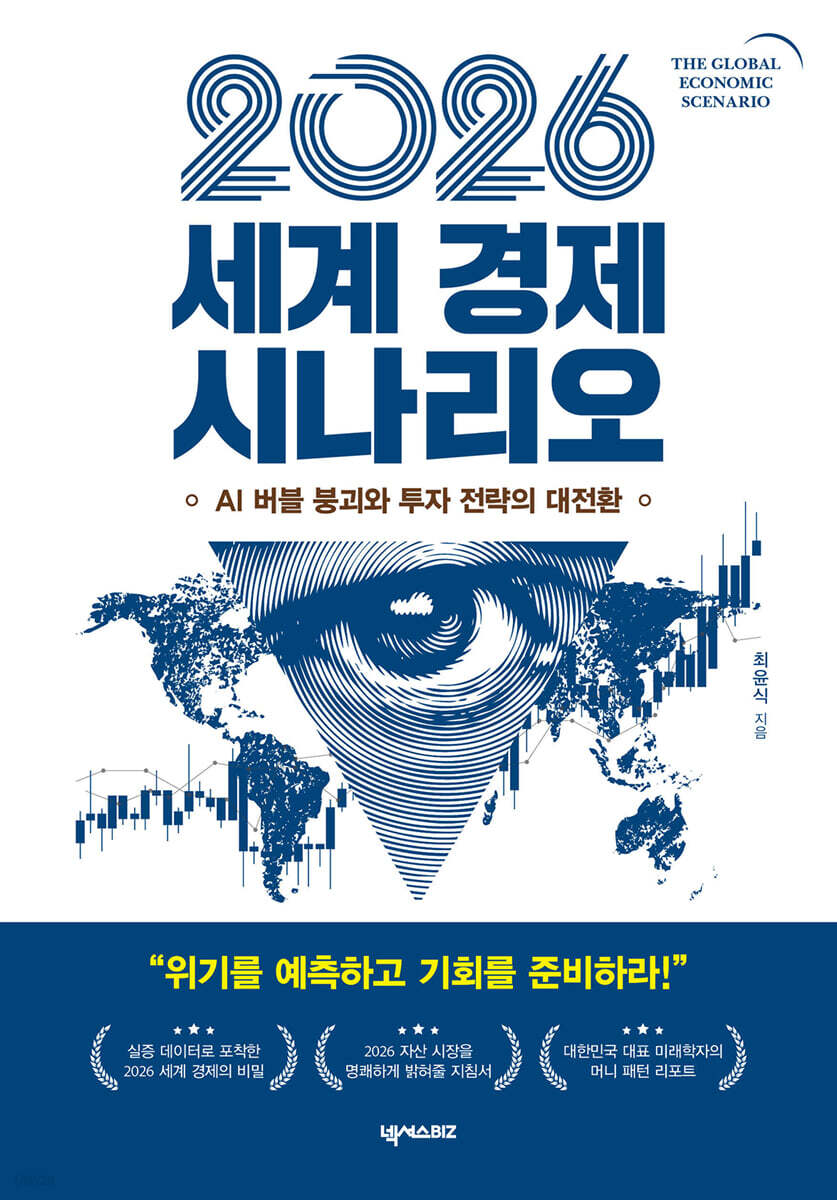
2026 World Economic Scenario
 |
Description
Book Introduction
“Anticipate crises and prepare for opportunities!”
○ Secrets of the 2026 Global Economy Captured with Empirical Data
○ A Guide to Clarifying the Asset Market in 2026
○ Money Pattern Report from Korea's Leading Futurist
“The economy is out of balance and assets are being reorganized.”
Now, it's time to redraw the map of wealth.
The global economy is teetering on the brink of unstable equilibrium, with overflowing liquidity, overheated AI investment, national finances reaching their structural limits, and interest rate and currency wars among countries colliding.
In 2026, that balance is broken.
This book provides a detailed assessment of the global economy in 2026, focusing on the collapse of the AI bubble, the debt crises in Europe and China, and the growing signs of a recession.
Furthermore, it will present scenario-based analysis and response strategies, serving as a compass for investors seeking opportunities amidst crises.
- What will the AI bubble burst look like?
- When and how will the debt crises in China and Europe explode?
- What are the signs of an economic downturn hidden behind the stock market dominated by excessive complacency?
- Can the Korean economy remain safe amid the global economic crisis?
- What investment assets will survive this crisis?
○ Secrets of the 2026 Global Economy Captured with Empirical Data
○ A Guide to Clarifying the Asset Market in 2026
○ Money Pattern Report from Korea's Leading Futurist
“The economy is out of balance and assets are being reorganized.”
Now, it's time to redraw the map of wealth.
The global economy is teetering on the brink of unstable equilibrium, with overflowing liquidity, overheated AI investment, national finances reaching their structural limits, and interest rate and currency wars among countries colliding.
In 2026, that balance is broken.
This book provides a detailed assessment of the global economy in 2026, focusing on the collapse of the AI bubble, the debt crises in Europe and China, and the growing signs of a recession.
Furthermore, it will present scenario-based analysis and response strategies, serving as a compass for investors seeking opportunities amidst crises.
- What will the AI bubble burst look like?
- When and how will the debt crises in China and Europe explode?
- What are the signs of an economic downturn hidden behind the stock market dominated by excessive complacency?
- Can the Korean economy remain safe amid the global economic crisis?
- What investment assets will survive this crisis?
- You can preview some of the book's contents.
Preview
index
* Introduction: 2026, the eve of the economic storm - It's time to shift positions.
PART 1.
The First Storm - The AI Bubble and the End of That Great Illusion
1.
Various indicators warning of a bubble
The AI bubble is already bursting.
95% of Companies Disappointed: MIT Media Lab Report
Silicon Valley's Hidden Danger: Pitchbook Report Part 1
AI Companies Running Out of Cash: Pitchbook Report ②
AI Falls into a Valley of Disillusionment: Gartner Report
2.
Direct abnormal signals seen by NVIDIA
How does a too successful king fall?
The Suspicious Deal Between NVIDIA and OpenAI
The emergence of AI models that use less GPUs
The AI investment market is in turmoil.
3. What the AI bubble will bring about
Will the Dot-Com Bubble Nightmare Return?: A Rapid Collapse Scenario
Can the worst be avoided?: A mild collapse scenario.
How to avoid the first storm
PART 2.
The Second Storm: Europe and China, the Debt Tsunami Awaits
1.
The European crisis begins in France
National Debt: A Time Bomb Hidden in the Liquidity Party
France, Europe's weak link
A crisis spreading across Europe
2.
China's growth engine stalls
Three Traps That Bind China
Trap One: The Deepening Real Estate Crisis and the Beginning of an Asset-Debt Depression
The second trap: a sharp decline in local governments' core revenue sources and fiscal collapse.
The Third Trap: The Dilemma of Paralyzing Growth Engines and Systemic Instability
Is the theory of China's Xi Jinping crisis a fiction?
3.
The tsunami caused by European and Chinese debt
If Europe collapses, America won't be safe either.
China's Demand Cliff: The Final Trigger to Burst the AI Bubble
What are the safe assets to avoid the second storm?
PART 3.
The Third Storm: The Shadow of Recession Hidden Behind Excessive Complacency
1.
2026 through the Minsky lens
A Sense of Security Breeds Instability: Minsky's Financial Instability Hypothesis
Signs of a 2026 Bubble: Minsky's Theory
The rush to junk bonds is a sign of a bubble ending.
2.
Signs of a Recession
The Fed's outlook for 2026 is different than it appears.
Signals of an Imminent Recession ①: Labor Market Indicators
Signals of an Imminent Recession ②: The Price Effect
Signs of an impending recession ③: Corporate sales and profit growth rates
Signs that American household spending power is in trouble
3.
A complex crisis scenario created by three storms
Two scenarios will clash in 2026.
Scenario 1: Normal Bubble, Normal Collapse
The Aftermath of Scenario 1: A Time of Compression and Rebalancing
Scenario 2: Extreme Bubble, Extreme Collapse
The Aftershock of Scenario 2: The Advent of a Complex Crisis
Anti-complaint positioning
PART 4.
Korea, the final destination of a complex crisis
1.
Korea, a powder keg where all storms converge
Triple Exposure: Why Can't Korea Avoid It?
The First Storm and Korea: The Semiconductor Kingdom Takes a Direct Hit from the AI Bubble Burst
The Second Storm and Korea: If China's Economy Collapses, Korea Will Fall First
The Third Storm and Korea: Excessive Complacency, Korea's Minsky Moment
2.
Korean survival scenario
Two futures ahead of us
Korean-style response strategy for survival and advancement
* Leaving remarks: The path of hope - survival comes from preparation, leap comes from insight.
* References
PART 1.
The First Storm - The AI Bubble and the End of That Great Illusion
1.
Various indicators warning of a bubble
The AI bubble is already bursting.
95% of Companies Disappointed: MIT Media Lab Report
Silicon Valley's Hidden Danger: Pitchbook Report Part 1
AI Companies Running Out of Cash: Pitchbook Report ②
AI Falls into a Valley of Disillusionment: Gartner Report
2.
Direct abnormal signals seen by NVIDIA
How does a too successful king fall?
The Suspicious Deal Between NVIDIA and OpenAI
The emergence of AI models that use less GPUs
The AI investment market is in turmoil.
3. What the AI bubble will bring about
Will the Dot-Com Bubble Nightmare Return?: A Rapid Collapse Scenario
Can the worst be avoided?: A mild collapse scenario.
How to avoid the first storm
PART 2.
The Second Storm: Europe and China, the Debt Tsunami Awaits
1.
The European crisis begins in France
National Debt: A Time Bomb Hidden in the Liquidity Party
France, Europe's weak link
A crisis spreading across Europe
2.
China's growth engine stalls
Three Traps That Bind China
Trap One: The Deepening Real Estate Crisis and the Beginning of an Asset-Debt Depression
The second trap: a sharp decline in local governments' core revenue sources and fiscal collapse.
The Third Trap: The Dilemma of Paralyzing Growth Engines and Systemic Instability
Is the theory of China's Xi Jinping crisis a fiction?
3.
The tsunami caused by European and Chinese debt
If Europe collapses, America won't be safe either.
China's Demand Cliff: The Final Trigger to Burst the AI Bubble
What are the safe assets to avoid the second storm?
PART 3.
The Third Storm: The Shadow of Recession Hidden Behind Excessive Complacency
1.
2026 through the Minsky lens
A Sense of Security Breeds Instability: Minsky's Financial Instability Hypothesis
Signs of a 2026 Bubble: Minsky's Theory
The rush to junk bonds is a sign of a bubble ending.
2.
Signs of a Recession
The Fed's outlook for 2026 is different than it appears.
Signals of an Imminent Recession ①: Labor Market Indicators
Signals of an Imminent Recession ②: The Price Effect
Signs of an impending recession ③: Corporate sales and profit growth rates
Signs that American household spending power is in trouble
3.
A complex crisis scenario created by three storms
Two scenarios will clash in 2026.
Scenario 1: Normal Bubble, Normal Collapse
The Aftermath of Scenario 1: A Time of Compression and Rebalancing
Scenario 2: Extreme Bubble, Extreme Collapse
The Aftershock of Scenario 2: The Advent of a Complex Crisis
Anti-complaint positioning
PART 4.
Korea, the final destination of a complex crisis
1.
Korea, a powder keg where all storms converge
Triple Exposure: Why Can't Korea Avoid It?
The First Storm and Korea: The Semiconductor Kingdom Takes a Direct Hit from the AI Bubble Burst
The Second Storm and Korea: If China's Economy Collapses, Korea Will Fall First
The Third Storm and Korea: Excessive Complacency, Korea's Minsky Moment
2.
Korean survival scenario
Two futures ahead of us
Korean-style response strategy for survival and advancement
* Leaving remarks: The path of hope - survival comes from preparation, leap comes from insight.
* References
Detailed image

Into the book
The world economy is a chain of connected dominoes.
When one piece falls, everything shakes.
When the US stumbles, factories in China close.
Naturally, a chain reaction will occur in Korea as well. The IMF projects that Korea's economic growth rate will barely rebound from 0.9% in 2025 to 1.8% in 2026.
However, this number should be viewed as a ‘precarious balance’ rather than ‘stability’.
Because the first dominoes—the US AI bubble, the stock market overheating, signs of a recession, and the sovereign debt explosion in China and Europe—have already been tipped.
The topic covered in this book is precisely those 'tilted pieces'.
When the first domino piece falls, you'll open your stock app while sipping your morning coffee and see your screen go completely blue.
"What's going on? It was fine until yesterday!" "AI stocks are crashing."
"OpenAI is in crisis due to funding shortages." "Did you see the news? France is reaching out to the IMF due to government debt." As these words are heard, the once peaceful surroundings are instantly thrown into chaos.
Doesn't this scene seem a little familiar? It's exactly like the scene in September 2000, when the dot-com bubble burst.
Every time I hear economists say, “2026 is stable,” I laugh.
Because I know that their jobs don't allow them to openly tell bad news.
But we must be different.
We must face the disaster that may occur.
Just as Trump's tariff policies shook global trade in 2025, an even bigger storm could come in 2026.
A crisis is an opportunity, but ignoring it leads to ruin.
By the end of this introduction, I hope you're thinking, "Yes, I should prepare myself."
When one piece falls, everything shakes.
When the US stumbles, factories in China close.
Naturally, a chain reaction will occur in Korea as well. The IMF projects that Korea's economic growth rate will barely rebound from 0.9% in 2025 to 1.8% in 2026.
However, this number should be viewed as a ‘precarious balance’ rather than ‘stability’.
Because the first dominoes—the US AI bubble, the stock market overheating, signs of a recession, and the sovereign debt explosion in China and Europe—have already been tipped.
The topic covered in this book is precisely those 'tilted pieces'.
When the first domino piece falls, you'll open your stock app while sipping your morning coffee and see your screen go completely blue.
"What's going on? It was fine until yesterday!" "AI stocks are crashing."
"OpenAI is in crisis due to funding shortages." "Did you see the news? France is reaching out to the IMF due to government debt." As these words are heard, the once peaceful surroundings are instantly thrown into chaos.
Doesn't this scene seem a little familiar? It's exactly like the scene in September 2000, when the dot-com bubble burst.
Every time I hear economists say, “2026 is stable,” I laugh.
Because I know that their jobs don't allow them to openly tell bad news.
But we must be different.
We must face the disaster that may occur.
Just as Trump's tariff policies shook global trade in 2025, an even bigger storm could come in 2026.
A crisis is an opportunity, but ignoring it leads to ruin.
By the end of this introduction, I hope you're thinking, "Yes, I should prepare myself."
--- From the text
Publisher's Review
Bubbles burst, debt piles up, and exchange rates fluctuate.
Are your assets safe in 2026?
In 2025, stocks, gold, and Bitcoin are simultaneously hitting record highs every day, raising rosy expectations.
But behind the scenes, several signs are being detected that are making investors uneasy.
The shadow of a bubble lurking behind the dazzling AI revolution, the stagnation of the real economy contrasting with the booming stock market, the pressure of national debt weighing on Europe and China, and the potential for Trump's tariff policies and geopolitical conflicts to ignite the flames at any moment.
Expert predictions for 2026 vary widely, ranging from optimism that stock prices will continue to rise for the foreseeable future to pessimism that a catastrophic bubble burst is imminent. However, they all agree that the current precarious balance could be disrupted at any moment.
Everyone's attention is focused on when that time will come, what the aftermath will be, and how each person should prepare and respond.
This book attempts to predict the complex crises that will be brought about by storms of different nature in 2026.
Chapter 1 delves into the true nature of the AI bubble, drawing on reports from various economic research institutes and Nvidia's trends.
Chapter 2 reveals the true face of the Chinese economy, caught in the three traps of real estate, local government, and growth engines, along with the European crisis that began in France.
Chapter 3 diagnoses bubble signs using Minsky's financial instability hypothesis and sharply analyzes key indicators that signal an economic downturn.
Finally, Chapter 4 forecasts the future Korea will face amidst rapid changes in the global economy and presents specific response strategies to survive and thrive in this crisis.
In 2026, we are entering a maelstrom of unprecedented, complex crises.
The success formulas of the past no longer work.
It is time to read the waves of change and take a new position.
This book, "2026 World Economic Scenario: The AI Bubble Burst and the Great Shift in Investment Strategy," presents insights and strategies to survive and thrive in the coming turbulent times.
Beyond simple predictions, we'll delve into the essence of the crisis based on a wealth of data, clearly demonstrating realistic investment solutions to protect your valuable assets.
Are your assets safe in 2026?
In 2025, stocks, gold, and Bitcoin are simultaneously hitting record highs every day, raising rosy expectations.
But behind the scenes, several signs are being detected that are making investors uneasy.
The shadow of a bubble lurking behind the dazzling AI revolution, the stagnation of the real economy contrasting with the booming stock market, the pressure of national debt weighing on Europe and China, and the potential for Trump's tariff policies and geopolitical conflicts to ignite the flames at any moment.
Expert predictions for 2026 vary widely, ranging from optimism that stock prices will continue to rise for the foreseeable future to pessimism that a catastrophic bubble burst is imminent. However, they all agree that the current precarious balance could be disrupted at any moment.
Everyone's attention is focused on when that time will come, what the aftermath will be, and how each person should prepare and respond.
This book attempts to predict the complex crises that will be brought about by storms of different nature in 2026.
Chapter 1 delves into the true nature of the AI bubble, drawing on reports from various economic research institutes and Nvidia's trends.
Chapter 2 reveals the true face of the Chinese economy, caught in the three traps of real estate, local government, and growth engines, along with the European crisis that began in France.
Chapter 3 diagnoses bubble signs using Minsky's financial instability hypothesis and sharply analyzes key indicators that signal an economic downturn.
Finally, Chapter 4 forecasts the future Korea will face amidst rapid changes in the global economy and presents specific response strategies to survive and thrive in this crisis.
In 2026, we are entering a maelstrom of unprecedented, complex crises.
The success formulas of the past no longer work.
It is time to read the waves of change and take a new position.
This book, "2026 World Economic Scenario: The AI Bubble Burst and the Great Shift in Investment Strategy," presents insights and strategies to survive and thrive in the coming turbulent times.
Beyond simple predictions, we'll delve into the essence of the crisis based on a wealth of data, clearly demonstrating realistic investment solutions to protect your valuable assets.
GOODS SPECIFICS
- Date of issue: November 25, 2025
- Page count, weight, size: 256 pages | 454g | 150*215*15mm
- ISBN13: 9791124028100
- ISBN10: 1124028102
You may also like
카테고리
korean


korean

![GQ KOREA Mark (Monthly): December [2025]](http://librairie.coreenne.fr/cdn/shop/files/8ef265dbbfbf186523ed75ba7319009d.jpg?v=1765340328&width=3840)


