

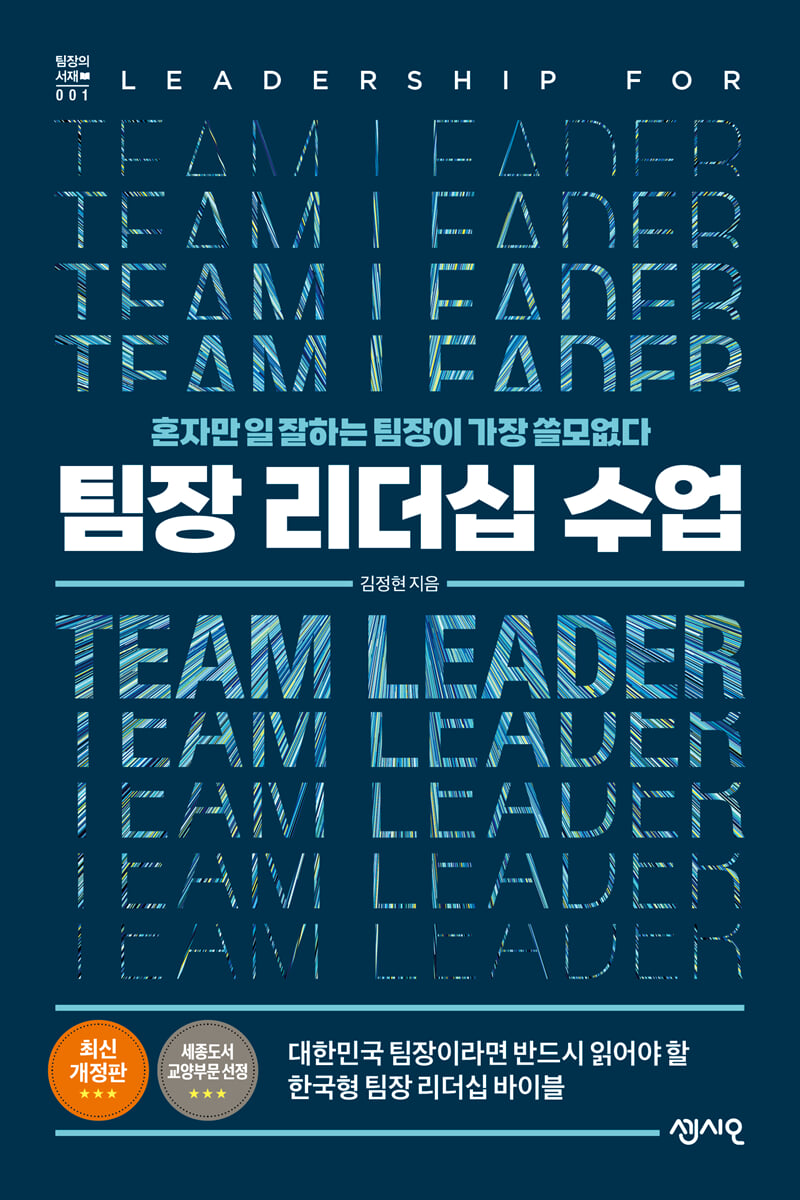
Team Leader Leadership Class
 |
Description
Book Introduction
A team leader who only works well on his own is the most useless.
The revised edition of the book, "Team Leader Leadership Class," which provided practical on-site leadership know-how to numerous leaders and team leaders in the industry, saying, "A team leader who works well alone actually causes harm to the company," has been published.
Compared to the leadership books introduced in Korea so far, which were primarily based on foreign organizational systems and cases, this book is thoroughly tailored to Korean organizations and companies.
In fact, immediately after its publication, it was praised as a "Korean-style team leader leadership book that perfectly suits our circumstances," and is considered an essential manual for over 20,000 team leaders.
The author of this book, Director Kim Jeong-hyeon, Korea's top team leader expert, emphasizes that "player-type team leaders who hold on to practical matters are the most useless in an organization."
If you work hard alone, you won't be able to see the whole team, which will ultimately take away the opportunity for team members to grow and lead to a decline in team performance.
Most team leaders believe that achieving results as a player is the way to contribute to the company.
But what the company wants from the team leader is 'team performance'.
No matter how excellent a team leader is, he or she cannot achieve the same results as five or seven people alone, but a team of three can.
The company expects team leaders to amplify and bring out the capabilities that can only be demonstrated as a team, not alone.
This is why team leaders need leadership.
We need to focus the team's strengths, ensure the entire team shares their goals, assign appropriate tasks that fit each team member's personality, and help them grow through those tasks.
You need to communicate with your team members without any squeaks, manage conflicts with other teams, and gain support from your superiors and the company.
Above all, the team leader must know how to control his own emotions.
The secret to achieving all of this is contained in the “Team Leader Leadership Class.”
It contains the special prescriptions of Director Kim Jeong-hyeon, Korea's top team leader expert who has improved the performance of team leaders in large corporations, public enterprises, and small and medium-sized enterprises.
This revised edition adds content on "collaboration," which was particularly requested in the field after the first edition was published, and provides guidance on effective "one-on-one" conversation methods to alleviate the complaints of team leaders who find performance interviews with team members awkward and difficult.
If you're a team leader who wants your team to grow but doesn't know how and is stuck in outdated leadership, or if you're a team leader who's still accustomed to working alone and finds people management more difficult than anything else, you'll find refreshing solutions in this book.
The revised edition of the book, "Team Leader Leadership Class," which provided practical on-site leadership know-how to numerous leaders and team leaders in the industry, saying, "A team leader who works well alone actually causes harm to the company," has been published.
Compared to the leadership books introduced in Korea so far, which were primarily based on foreign organizational systems and cases, this book is thoroughly tailored to Korean organizations and companies.
In fact, immediately after its publication, it was praised as a "Korean-style team leader leadership book that perfectly suits our circumstances," and is considered an essential manual for over 20,000 team leaders.
The author of this book, Director Kim Jeong-hyeon, Korea's top team leader expert, emphasizes that "player-type team leaders who hold on to practical matters are the most useless in an organization."
If you work hard alone, you won't be able to see the whole team, which will ultimately take away the opportunity for team members to grow and lead to a decline in team performance.
Most team leaders believe that achieving results as a player is the way to contribute to the company.
But what the company wants from the team leader is 'team performance'.
No matter how excellent a team leader is, he or she cannot achieve the same results as five or seven people alone, but a team of three can.
The company expects team leaders to amplify and bring out the capabilities that can only be demonstrated as a team, not alone.
This is why team leaders need leadership.
We need to focus the team's strengths, ensure the entire team shares their goals, assign appropriate tasks that fit each team member's personality, and help them grow through those tasks.
You need to communicate with your team members without any squeaks, manage conflicts with other teams, and gain support from your superiors and the company.
Above all, the team leader must know how to control his own emotions.
The secret to achieving all of this is contained in the “Team Leader Leadership Class.”
It contains the special prescriptions of Director Kim Jeong-hyeon, Korea's top team leader expert who has improved the performance of team leaders in large corporations, public enterprises, and small and medium-sized enterprises.
This revised edition adds content on "collaboration," which was particularly requested in the field after the first edition was published, and provides guidance on effective "one-on-one" conversation methods to alleviate the complaints of team leaders who find performance interviews with team members awkward and difficult.
If you're a team leader who wants your team to grow but doesn't know how and is stuck in outdated leadership, or if you're a team leader who's still accustomed to working alone and finds people management more difficult than anything else, you'll find refreshing solutions in this book.
- You can preview some of the book's contents.
Preview
index
Prologue: Team leaders determine a company's success or failure.
Chapter 1.
A good team member does not necessarily make a good team leader.
The team leader must do different work from his team members.
Stop doing other things and start by understanding your team members.
There's a fine line between a mentor and an old fart
Generation X manager, Generation M assistant manager, Generation Z employee
5 Essential Competencies for Team Leaders
[Leadership Check]
Chapter 2.
Explosive power happens when the entire team shares a goal _ Goal Setting
Clarify the team's reason for existence
Distinguish between goals and objectives
Goals should be easily understood by team members.
Clear goals engage team members.
[Leadership Check]
[A quick check-up: Test your knowledge of building a successful team]
Chapter 3.
The team leader who causes the greatest damage to the team is the one who works well alone. _Delegation of authority
A team leader must not do a better job than his team members.
The Real Reason You Should Delegate Work to Your Team Members
3 Things Team Leaders Must Do to Delegate Work Effectively
The ability of a team leader is to delegate tasks appropriate to the level of each team member.
5 Ways to Delegate Well
[Leadership Check]
Chapter 4.
One thing companies want from their team leaders: performance management.
The company wants the team's performance, not the team leader's.
Even the best team members don't perform well in the worst systems.
10 Criteria for Effective Performance Management
Make sure to formally review your team members' performance.
Don't be afraid to have one-on-one conversations with your team members.
[Leadership Check]
Chapter 5.
The Best Way to Grow Your Team Members: Coaching & Feedback
Don't manage the work, look at your team members.
How to Maximize the Effectiveness of Coaching
Four Types of Team Leader Feedback
Feedback skills that help team members grow
5 Principles of Feedback That Always Work
[Leadership Check]
Chapter 6.
Team leaders should not give up on their team members easily _ Conflict Management
Change the paradigm for viewing conflict within organizations.
From conflict to collaboration
Everyone deals with conflict differently.
4 Principles for Getting a Yes
Conflict Resolution Tips to Save Team Members and Organizations
[Leadership Check]
[A Brief Review, Part 1: Understanding the Six Paradigms of Conflict]
[A Brief Inspection 2: Conflict Management Diagnostic]
Chapter 7.
The Secret to Team Success Every Year: Teamwork & Motivation
If each team member is excellent but there is no performance,
Leadership should vary depending on the team's development stage.
Motivation Methods for Different Team Member Types
3 Ways to Maximize Motivation
[Leadership Check]
Chapter 8.
Managing your emotions is essential to understanding your team members' emotions: Emotional Leadership
Why Companies Want Team Leaders with High Emotional Intelligence
A team leader who is indifferent to his own feelings is dangerous.
Don't let your feelings become your attitude.
How to Move Your Team Members' Hearts
Emotional leadership that demonstrates strength in times of crisis
[Leadership Check]
[A Moment, Time for a Checkup: Emotional Leadership Diagnostic]
Chapter 9.
All problems start with the team leader's tone of voice _Communication
Team leaders recognized by their companies have a different way of speaking.
Deliberate Focus and BMW Listening
Johari's Window to Understand Me
Assertive Speaking: Achieving Relationships and Results at the Same Time
Analog + Digital = Digilog
SPEAK communication method of well-communicating organizations
[Leadership Check]
[A Brief Inspection 1: Listening Self-Test]
[A Brief Inspection 2: Johari's Window Diagnosis]
Epilogue: Overcome difficulties with an optimistic attitude.
Chapter 1.
A good team member does not necessarily make a good team leader.
The team leader must do different work from his team members.
Stop doing other things and start by understanding your team members.
There's a fine line between a mentor and an old fart
Generation X manager, Generation M assistant manager, Generation Z employee
5 Essential Competencies for Team Leaders
[Leadership Check]
Chapter 2.
Explosive power happens when the entire team shares a goal _ Goal Setting
Clarify the team's reason for existence
Distinguish between goals and objectives
Goals should be easily understood by team members.
Clear goals engage team members.
[Leadership Check]
[A quick check-up: Test your knowledge of building a successful team]
Chapter 3.
The team leader who causes the greatest damage to the team is the one who works well alone. _Delegation of authority
A team leader must not do a better job than his team members.
The Real Reason You Should Delegate Work to Your Team Members
3 Things Team Leaders Must Do to Delegate Work Effectively
The ability of a team leader is to delegate tasks appropriate to the level of each team member.
5 Ways to Delegate Well
[Leadership Check]
Chapter 4.
One thing companies want from their team leaders: performance management.
The company wants the team's performance, not the team leader's.
Even the best team members don't perform well in the worst systems.
10 Criteria for Effective Performance Management
Make sure to formally review your team members' performance.
Don't be afraid to have one-on-one conversations with your team members.
[Leadership Check]
Chapter 5.
The Best Way to Grow Your Team Members: Coaching & Feedback
Don't manage the work, look at your team members.
How to Maximize the Effectiveness of Coaching
Four Types of Team Leader Feedback
Feedback skills that help team members grow
5 Principles of Feedback That Always Work
[Leadership Check]
Chapter 6.
Team leaders should not give up on their team members easily _ Conflict Management
Change the paradigm for viewing conflict within organizations.
From conflict to collaboration
Everyone deals with conflict differently.
4 Principles for Getting a Yes
Conflict Resolution Tips to Save Team Members and Organizations
[Leadership Check]
[A Brief Review, Part 1: Understanding the Six Paradigms of Conflict]
[A Brief Inspection 2: Conflict Management Diagnostic]
Chapter 7.
The Secret to Team Success Every Year: Teamwork & Motivation
If each team member is excellent but there is no performance,
Leadership should vary depending on the team's development stage.
Motivation Methods for Different Team Member Types
3 Ways to Maximize Motivation
[Leadership Check]
Chapter 8.
Managing your emotions is essential to understanding your team members' emotions: Emotional Leadership
Why Companies Want Team Leaders with High Emotional Intelligence
A team leader who is indifferent to his own feelings is dangerous.
Don't let your feelings become your attitude.
How to Move Your Team Members' Hearts
Emotional leadership that demonstrates strength in times of crisis
[Leadership Check]
[A Moment, Time for a Checkup: Emotional Leadership Diagnostic]
Chapter 9.
All problems start with the team leader's tone of voice _Communication
Team leaders recognized by their companies have a different way of speaking.
Deliberate Focus and BMW Listening
Johari's Window to Understand Me
Assertive Speaking: Achieving Relationships and Results at the Same Time
Analog + Digital = Digilog
SPEAK communication method of well-communicating organizations
[Leadership Check]
[A Brief Inspection 1: Listening Self-Test]
[A Brief Inspection 2: Johari's Window Diagnosis]
Epilogue: Overcome difficulties with an optimistic attitude.
Detailed image

Into the book
The first concern of a team leader who wants to build a great team, not just a good team, is to get the "right" people on the bus he drives.
In other words, as a team leader, I find and place the 'right' people on my team.
--- p.12
The problem is that these monkeys climb on people's backs, crush them, make them suffer, and make a lot of noise.
Especially when you're newly appointed as a team leader, you may make a resolution to achieve something, but the problem is that that strong expectation and resolution don't last long.
Because the monkeys running around in the jungle start climbing onto the new team leader's back one by one, two by two, three by three...
If these monkeys are not dealt with properly, the team leader will soon become a stupid team leader, an incompetent team leader, or even be kicked out of the organization.
--- pp.43-44
Delegation of authority should be understood as an expansion of authority, not a distribution of authority.
Therefore, even if a team leader delegates his authority to a team member, his authority is not reduced (distributed) and new authority is not created for the team member.
Delegation of authority is not a zero-sum situation where the team leader gives authority and the team members receive authority.
The more authority is delegated, the more cooperation and authority among organization members expand, which is a positive-sum effect.
--- p.72
Modern organizations are clearly team-oriented, not individual-oriented.
Therefore, the team leader's performance is not evaluated based on the team leader's individual abilities, but rather on the team's performance, that is, the results created by the team members together.
In other words, the important role of a team leader is not to develop the team leader's personal capabilities, but to develop the capabilities of team members and connect them to team performance.
--- p.100
Empathy is often mistaken for agreeing with or approving of another person's opinion.
But that's not the case.
Empathy is acknowledging another person's position or viewpoint, even if that position is different from your own.
It is acknowledging a person's position or opinion, regardless of any judgment or validity.
--- p.256
However, now is the time to achieve results together with your team members.
Communication with team members has become essential to achieving results.
If a left-brain-centered cool-headedness is required when working, it can be said that a right-brain-centered sensibility is required when dealing with people.
In other words, as a team leader, I find and place the 'right' people on my team.
--- p.12
The problem is that these monkeys climb on people's backs, crush them, make them suffer, and make a lot of noise.
Especially when you're newly appointed as a team leader, you may make a resolution to achieve something, but the problem is that that strong expectation and resolution don't last long.
Because the monkeys running around in the jungle start climbing onto the new team leader's back one by one, two by two, three by three...
If these monkeys are not dealt with properly, the team leader will soon become a stupid team leader, an incompetent team leader, or even be kicked out of the organization.
--- pp.43-44
Delegation of authority should be understood as an expansion of authority, not a distribution of authority.
Therefore, even if a team leader delegates his authority to a team member, his authority is not reduced (distributed) and new authority is not created for the team member.
Delegation of authority is not a zero-sum situation where the team leader gives authority and the team members receive authority.
The more authority is delegated, the more cooperation and authority among organization members expand, which is a positive-sum effect.
--- p.72
Modern organizations are clearly team-oriented, not individual-oriented.
Therefore, the team leader's performance is not evaluated based on the team leader's individual abilities, but rather on the team's performance, that is, the results created by the team members together.
In other words, the important role of a team leader is not to develop the team leader's personal capabilities, but to develop the capabilities of team members and connect them to team performance.
--- p.100
Empathy is often mistaken for agreeing with or approving of another person's opinion.
But that's not the case.
Empathy is acknowledging another person's position or viewpoint, even if that position is different from your own.
It is acknowledging a person's position or opinion, regardless of any judgment or validity.
--- p.256
However, now is the time to achieve results together with your team members.
Communication with team members has become essential to achieving results.
If a left-brain-centered cool-headedness is required when working, it can be said that a right-brain-centered sensibility is required when dealing with people.
--- p.250
Publisher's Review
You never learned how to be a team leader properly.
The One and Only Book for Team Leaders in Korea
“The gap between target performance and reality is too large.”
“It’s faster for me to do the work than to give instructions.”
“I don’t know how to motivate my team members.”
The company demands high performance every year, and team members are always dissatisfied.
Only the team leader caught in the middle is dying.
For several years now, I've been left alone at the office to handle work after all my team members have left.
If you work harder than anyone else at work but still don't see results, it's likely that you haven't been working like a team leader.
Because he was recognized by the organization and became a team leader, he sticks to the way he has been working.
The problem is that what the team leader needs to do and what the team members need to do are completely different.
The team leader has to do different work than his team members.
In other words, team leaders must learn ‘how to work like team leaders.’
A team leader who is good at working alone is not wanted in an organization.
Ultimately, what an organization wants is a 'team' that works well and a 'team' that produces results.
The Best Leadership Lessons to Become a Great Team Leader
"I learned and practiced the role of a middle manager, which no one teaches you, from this book.", "When team building was difficult due to frequent resignations of team members, I found the answer with the methods suggested in this book.", "This is a must-read for aspiring team leaders." Immediately after its publication, it received positive reviews as "a Korean-style team leader leadership book that perfectly suits our circumstances.", and was chosen by 20,000 team leaders in Korea, "Team Leader Leadership Class" contains everything you need to know to become a team leader.
Chapters 1 through 5 focus on the core competencies that team leaders must know, including the role of the team leader, goal setting, delegation of authority, performance management, and coaching and feedback.
Chapters 6 through 9 delve into the nuances that team leaders often overlook when managing their teams, including conflict management, teamwork and motivation, emotional leadership, and communication skills.
In this revised edition, we've added two new topics that current team leaders and leaders have asked the author about most frequently since the first edition was published.
The first is 'Collaboration,' which explains how team leaders can resolve and collaborate with individuals and departments that frequently arise within organizations and cause fatal damage.
Another is the 'One-on-One' conversation, which contains the know-how to lead a 'One-on-One' conversation that diagnoses and evaluates team members' performance without difficulty and efficiently.
The greatest strength of this book is that it combines solid theory with vivid examples.
Because leadership theory originated from foreign academics, previous leadership books were difficult to apply to domestic organizational situations.
This book, written by the author, Korea's top team leader training expert and a veteran of over 20 years of organizational experience, offers insightful, practical leadership tailored to the realities of Korean business.
Additionally, to help you apply what you've learned to actual work situations, we provide reference materials such as the "Leadership Check," a reflective question that provides things for team leaders to think about for each chapter, and the self-diagnosis sheet "A Moment, Time for Checkup," which is highly useful in team leader training.
Not only is it easy for readers to understand and utilize on their own, it will also be highly useful as a teaching material for field training or workshops.
The One and Only Book for Team Leaders in Korea
“The gap between target performance and reality is too large.”
“It’s faster for me to do the work than to give instructions.”
“I don’t know how to motivate my team members.”
The company demands high performance every year, and team members are always dissatisfied.
Only the team leader caught in the middle is dying.
For several years now, I've been left alone at the office to handle work after all my team members have left.
If you work harder than anyone else at work but still don't see results, it's likely that you haven't been working like a team leader.
Because he was recognized by the organization and became a team leader, he sticks to the way he has been working.
The problem is that what the team leader needs to do and what the team members need to do are completely different.
The team leader has to do different work than his team members.
In other words, team leaders must learn ‘how to work like team leaders.’
A team leader who is good at working alone is not wanted in an organization.
Ultimately, what an organization wants is a 'team' that works well and a 'team' that produces results.
The Best Leadership Lessons to Become a Great Team Leader
"I learned and practiced the role of a middle manager, which no one teaches you, from this book.", "When team building was difficult due to frequent resignations of team members, I found the answer with the methods suggested in this book.", "This is a must-read for aspiring team leaders." Immediately after its publication, it received positive reviews as "a Korean-style team leader leadership book that perfectly suits our circumstances.", and was chosen by 20,000 team leaders in Korea, "Team Leader Leadership Class" contains everything you need to know to become a team leader.
Chapters 1 through 5 focus on the core competencies that team leaders must know, including the role of the team leader, goal setting, delegation of authority, performance management, and coaching and feedback.
Chapters 6 through 9 delve into the nuances that team leaders often overlook when managing their teams, including conflict management, teamwork and motivation, emotional leadership, and communication skills.
In this revised edition, we've added two new topics that current team leaders and leaders have asked the author about most frequently since the first edition was published.
The first is 'Collaboration,' which explains how team leaders can resolve and collaborate with individuals and departments that frequently arise within organizations and cause fatal damage.
Another is the 'One-on-One' conversation, which contains the know-how to lead a 'One-on-One' conversation that diagnoses and evaluates team members' performance without difficulty and efficiently.
The greatest strength of this book is that it combines solid theory with vivid examples.
Because leadership theory originated from foreign academics, previous leadership books were difficult to apply to domestic organizational situations.
This book, written by the author, Korea's top team leader training expert and a veteran of over 20 years of organizational experience, offers insightful, practical leadership tailored to the realities of Korean business.
Additionally, to help you apply what you've learned to actual work situations, we provide reference materials such as the "Leadership Check," a reflective question that provides things for team leaders to think about for each chapter, and the self-diagnosis sheet "A Moment, Time for Checkup," which is highly useful in team leader training.
Not only is it easy for readers to understand and utilize on their own, it will also be highly useful as a teaching material for field training or workshops.
GOODS SPECIFICS
- Date of issue: January 27, 2025
- Page count, weight, size: 316 pages | 145*210*30mm
- ISBN13: 9791166571671
You may also like
카테고리
korean


korean

![GQ KOREA Mark (Monthly): December [2025]](http://librairie.coreenne.fr/cdn/shop/files/8ef265dbbfbf186523ed75ba7319009d.jpg?v=1765340328&width=3840)


