

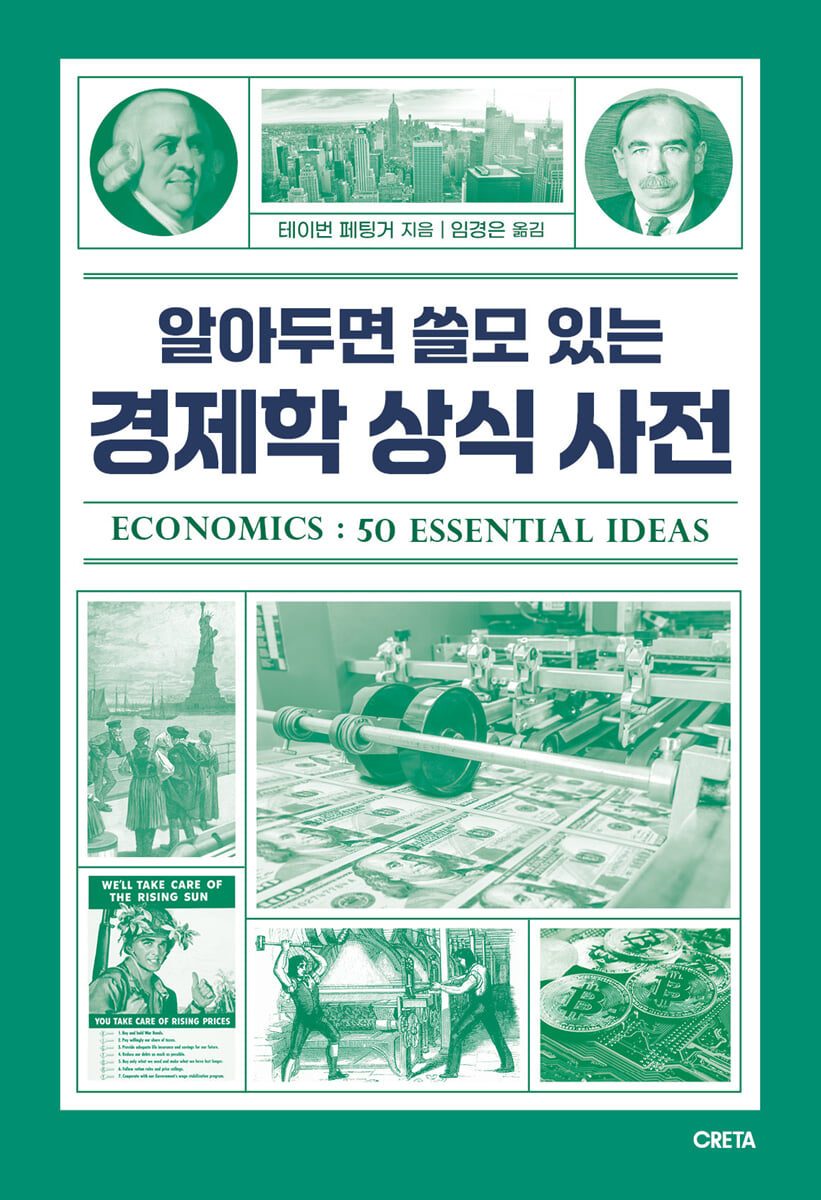
Dictionary of Useful Economics Knowledge
 |
Description
Book Introduction
Why has Amazon suffered operating losses for years?
Is the lowest price guarantee good for the customer?
Will the 35-hour workweek help alleviate unemployment?
Why do we keep scrolling?
How free is the free market?
Economics, which reveals the ever-changing world in detail.
Get through it in one volume!
Free market, minimum wage, privatization, sunk cost fallacy, housing market, boom and bust,
Happiness Economics, the Luddite Fallacy, and Capitalism's Economic Crisis
Even the conflicting views of Marx and Schumpeter on how things change…
We examine economics, a field that has undergone constant change over a long period of time, through 50 keywords.
Economics is fascinating despite all the variables and complex concepts.
All the variables that pop up in economics are an uncontrollable headache, but sometimes they come as interesting episodes.
That's the story of the Concorde passenger plane.
The economic loss from completing the passenger plane was obvious, but it was pushed through to the end because too much progress had already been made and it was symbolic of being a joint British-French project.
This is called the typical 'sunk cost fallacy'.
But even though it suffered financial losses, the Concorde remains one of the world's most famous passenger planes, capturing the imagination of many.
Sometimes, there are things that cannot be valued in money alone.
This book also covers some rather complex concepts, such as the bond market, modern monetary theory, the balance of payments, tariffs and free trade, and the multiplier effect.
These concepts may seem tedious to beginners in economics, but with a little patience and following the order of this book, they will become readily understandable.
『Useful Economics Dictionary』 has colorful photos, illustrations, and various diagrams appropriately arranged for readers.
Readers will be able to utilize this to experience a smooth introduction to economics.
Is the lowest price guarantee good for the customer?
Will the 35-hour workweek help alleviate unemployment?
Why do we keep scrolling?
How free is the free market?
Economics, which reveals the ever-changing world in detail.
Get through it in one volume!
Free market, minimum wage, privatization, sunk cost fallacy, housing market, boom and bust,
Happiness Economics, the Luddite Fallacy, and Capitalism's Economic Crisis
Even the conflicting views of Marx and Schumpeter on how things change…
We examine economics, a field that has undergone constant change over a long period of time, through 50 keywords.
Economics is fascinating despite all the variables and complex concepts.
All the variables that pop up in economics are an uncontrollable headache, but sometimes they come as interesting episodes.
That's the story of the Concorde passenger plane.
The economic loss from completing the passenger plane was obvious, but it was pushed through to the end because too much progress had already been made and it was symbolic of being a joint British-French project.
This is called the typical 'sunk cost fallacy'.
But even though it suffered financial losses, the Concorde remains one of the world's most famous passenger planes, capturing the imagination of many.
Sometimes, there are things that cannot be valued in money alone.
This book also covers some rather complex concepts, such as the bond market, modern monetary theory, the balance of payments, tariffs and free trade, and the multiplier effect.
These concepts may seem tedious to beginners in economics, but with a little patience and following the order of this book, they will become readily understandable.
『Useful Economics Dictionary』 has colorful photos, illustrations, and various diagrams appropriately arranged for readers.
Readers will be able to utilize this to experience a smooth introduction to economics.
- You can preview some of the book's contents.
Preview
index
Entering
01 Fascinating Medium Currency
02 Is economic growth always good?
03 The Unknown and Interesting Limits to Economic Growth
04 Supply and Demand by the Invisible Hand
05 The opportunity cost of losing something
06 iPhone division of labor in the making
07 Even a good thing can be harmful if taken in excess. The Limit Revolution
08 The Law of Diminishing Returns and Diminishing Marginal Utility
09 How Free Is the Free Market?
10 Double-Edged Sword Monopoly
11 A kind of strategic technology game theory
12 Pricing Strategies That Move Hearts
13 Why Coca-Cola Spends Billions on Advertising Elasticity
14 The Dilemma of Reform: Supply-side Policy
15 Important Cogwheel Attractions
16. Price control by applying the brakes
17 The difficult tightrope walk of inflation
18 Unopened Wallet Deflation
19 High prices + high unemployment (stagflation)
20 Vicious Cycle Economic Recession
21 Unemployment that shakes up individual lives
22 The Illusion of Being Smarter Than the Market Boom and Recession
23 Rich Uncle and Poor Nephew Government Borrowing
24 Public Goods for All
25 Public Interest vs.
Profit privatization
26 What You See When You Look at the Curve: The Bond Market
27 If you are curious about the value of a currency, check the exchange rate
28 Why is China buying US assets? Balance of payments
29 Monetary policy aimed at fine-tuning the economy
30 Liquidity trap: Hold cash and avoid investing
31 The multiplier effect that bites its own tail
32 Ways to Benefit from Comparative Advantage
33 people and cancer globalization
34 Tariffs and Free Trade: A Possible Opportunity
35 Same currency, different environment Euro
36 How to help is the key to foreign aid
37 Wealth begets wealth Inequality
38 A minimum wage system that naturally permeates the economy
39 Why We Keep Scrolling: Behavioral Economics
40 Moral hazards that are risky but worth taking
41 Alternative Macroeconomic Theories Modern Monetary Theory
42 Does a high GDP make you happy? Happiness Economics
43 External effects that occur to third parties
44 Carbon Pricing to Reduce Coal
45 Oil and alternative energy sources, not necessarily oil
46 When to Get Out: The Sunk Cost Fallacy
47 New Technology and the Luddite Fallacy
48 Creative Destruction Caused by Endless Change
49 Is the Impact of Immigration All Bad?
50 Who are the winners and losers in the housing market?
Search
Source of images and photos
01 Fascinating Medium Currency
02 Is economic growth always good?
03 The Unknown and Interesting Limits to Economic Growth
04 Supply and Demand by the Invisible Hand
05 The opportunity cost of losing something
06 iPhone division of labor in the making
07 Even a good thing can be harmful if taken in excess. The Limit Revolution
08 The Law of Diminishing Returns and Diminishing Marginal Utility
09 How Free Is the Free Market?
10 Double-Edged Sword Monopoly
11 A kind of strategic technology game theory
12 Pricing Strategies That Move Hearts
13 Why Coca-Cola Spends Billions on Advertising Elasticity
14 The Dilemma of Reform: Supply-side Policy
15 Important Cogwheel Attractions
16. Price control by applying the brakes
17 The difficult tightrope walk of inflation
18 Unopened Wallet Deflation
19 High prices + high unemployment (stagflation)
20 Vicious Cycle Economic Recession
21 Unemployment that shakes up individual lives
22 The Illusion of Being Smarter Than the Market Boom and Recession
23 Rich Uncle and Poor Nephew Government Borrowing
24 Public Goods for All
25 Public Interest vs.
Profit privatization
26 What You See When You Look at the Curve: The Bond Market
27 If you are curious about the value of a currency, check the exchange rate
28 Why is China buying US assets? Balance of payments
29 Monetary policy aimed at fine-tuning the economy
30 Liquidity trap: Hold cash and avoid investing
31 The multiplier effect that bites its own tail
32 Ways to Benefit from Comparative Advantage
33 people and cancer globalization
34 Tariffs and Free Trade: A Possible Opportunity
35 Same currency, different environment Euro
36 How to help is the key to foreign aid
37 Wealth begets wealth Inequality
38 A minimum wage system that naturally permeates the economy
39 Why We Keep Scrolling: Behavioral Economics
40 Moral hazards that are risky but worth taking
41 Alternative Macroeconomic Theories Modern Monetary Theory
42 Does a high GDP make you happy? Happiness Economics
43 External effects that occur to third parties
44 Carbon Pricing to Reduce Coal
45 Oil and alternative energy sources, not necessarily oil
46 When to Get Out: The Sunk Cost Fallacy
47 New Technology and the Luddite Fallacy
48 Creative Destruction Caused by Endless Change
49 Is the Impact of Immigration All Bad?
50 Who are the winners and losers in the housing market?
Search
Source of images and photos
Detailed image

Into the book
Few modern people would want to return to the living standards of the 18th century.
No matter how many problems there are in the modern economy, it is undeniable that living standards have improved significantly over the past few centuries.
Economics has served as a foundation for rapid changes in both living standards and social opportunities.
--- p.10
What's important is the process by which the economy grows.
If a country were to experience a surge in fossil fuel use, workers working longer hours, and a growing military, all of this would be reflected in rising GDP.
However, all three of these are likely to lower the people's standard of living.
That is, the environment is becoming more polluted, leisure time is decreasing, and weapons are literally manufactured for the purpose of killing.
--- p.23
The rosy picture of economic growth and environmental sustainability can be misleading.
As the economy develops, some visible pollutants may decrease.
For example, even if coal heating is banned, it would be relatively easy to switch to alternative heating methods as new technologies emerge.
However, even as some visible pollutants decrease, invisible toxins and external pollutants continue to increase.
Among them, there are substances that can only be fully recognized in the distant future.
--- p.30
A side effect of division of labor is that it creates 'economies of scale'.
Economies of scale mean that as production increases, average costs decrease.
If you only want to produce one car, there is no need to build a large-scale assembly line and division of labor system.
Only when mass producing automobiles does a factory with a thousand workers and an assembly line become valuable.
--- p.46
For some companies, the ultimate goal may be to capture as much market share as possible, even if it means bleeding at first.
This strategy of accepting immediate operating losses in order to continue to expand market share is exactly what Amazon has been doing for years.
--- p.71
Supply-side policies also include deregulation of the labor market.
This includes weakening union power and lowering the minimum wage.
It also seeks to abolish laws that protect workers, such as those that make it easier to fire workers or limit the maximum number of hours they work per week.
The idea is that if the labor market becomes more flexible, companies will enjoy cost savings and ultimately hire more new employees.
--- p.89
During the 2008 global financial crisis, we experienced both inflation of up to 5% and an economic recession.
Central banks around the world cut interest rates to 0.5%.
As a result, savers were worse off, and real wages for many workers fell because inflation outpaced wage growth.
In 2022, several central banks faced a similar dilemma.
Raising interest rates to try to curb inflation risks triggering a recession.
--- p.107
Another policy aimed at reducing unemployment is a limit on the maximum number of hours worked per week.
For example, France has set a maximum working week of 35 hours.
The logic is that if working hours per worker decrease, businesses will have to hire more employees, which will reduce unemployment.
But the reality is not that simple.
Instead of hiring more employees, companies will look for ways to squeeze more efficiency out of their existing employees in 35 hours.
--- p.134
As we can see from many examples throughout history, bubbles eventually burst.
Examples include the 19th-century British railway craze, the stock market surge of the 1920s and the subsequent Wall Street Crash of 1929, and the recent boom and bust of the cryptocurrency market.
A sharp question here is why, despite the painful endings of many past investment crazes, people can't escape the bubble.
The answer lies in psychological factors.
We think we're smarter than we started out, so we can take profits when asset prices rise and sell before they fall.
Another psychological factor is the tendency to trust the wisdom of crowds.
When most people buy real estate and stocks, and renowned experts advise that now is the time to buy, they follow the trend and join the investment crowd.
--- pp.137-138
A key factor in privatization is the attitude of regulatory authorities.
When authorities become victims of regulatory capture (where interest groups bribe the government to create regulations that benefit them), they may become overly lenient with the very companies they are supposed to regulate.
Then, companies that capture the regulators raise prices and make more profits.
On the other hand, companies complain that regulations are so strict that they cannot raise prices enough to make long-term investments.
--- p.157
We often choose the less bothersome option among the choices.
Unlike the rational individuals depicted in economics textbooks, we don't have time to weigh every decision individually.
Similarly, anyone who wishes to donate their organs after death must carry a card.
But taking a different approach, we could issue cards to people who refuse to donate their organs.
In other words, if we change organ donation to an opt-out system, the number of people who 'choose' to donate their organs will undoubtedly increase.
--- p.236
In the early 2000s, many banks and mortgage lenders couldn't resist the temptation to take big risks.
In fact, for several years they have been reaping huge bonuses by taking advantage of rising home prices and a surge in new mortgage lending.
But banks have taken excessive risks with these 'easy loans'.
Eventually, the bubble burst, exposing the financial world's bad loans to the world.
Banks faced a liquidity shock.
No matter how many problems there are in the modern economy, it is undeniable that living standards have improved significantly over the past few centuries.
Economics has served as a foundation for rapid changes in both living standards and social opportunities.
--- p.10
What's important is the process by which the economy grows.
If a country were to experience a surge in fossil fuel use, workers working longer hours, and a growing military, all of this would be reflected in rising GDP.
However, all three of these are likely to lower the people's standard of living.
That is, the environment is becoming more polluted, leisure time is decreasing, and weapons are literally manufactured for the purpose of killing.
--- p.23
The rosy picture of economic growth and environmental sustainability can be misleading.
As the economy develops, some visible pollutants may decrease.
For example, even if coal heating is banned, it would be relatively easy to switch to alternative heating methods as new technologies emerge.
However, even as some visible pollutants decrease, invisible toxins and external pollutants continue to increase.
Among them, there are substances that can only be fully recognized in the distant future.
--- p.30
A side effect of division of labor is that it creates 'economies of scale'.
Economies of scale mean that as production increases, average costs decrease.
If you only want to produce one car, there is no need to build a large-scale assembly line and division of labor system.
Only when mass producing automobiles does a factory with a thousand workers and an assembly line become valuable.
--- p.46
For some companies, the ultimate goal may be to capture as much market share as possible, even if it means bleeding at first.
This strategy of accepting immediate operating losses in order to continue to expand market share is exactly what Amazon has been doing for years.
--- p.71
Supply-side policies also include deregulation of the labor market.
This includes weakening union power and lowering the minimum wage.
It also seeks to abolish laws that protect workers, such as those that make it easier to fire workers or limit the maximum number of hours they work per week.
The idea is that if the labor market becomes more flexible, companies will enjoy cost savings and ultimately hire more new employees.
--- p.89
During the 2008 global financial crisis, we experienced both inflation of up to 5% and an economic recession.
Central banks around the world cut interest rates to 0.5%.
As a result, savers were worse off, and real wages for many workers fell because inflation outpaced wage growth.
In 2022, several central banks faced a similar dilemma.
Raising interest rates to try to curb inflation risks triggering a recession.
--- p.107
Another policy aimed at reducing unemployment is a limit on the maximum number of hours worked per week.
For example, France has set a maximum working week of 35 hours.
The logic is that if working hours per worker decrease, businesses will have to hire more employees, which will reduce unemployment.
But the reality is not that simple.
Instead of hiring more employees, companies will look for ways to squeeze more efficiency out of their existing employees in 35 hours.
--- p.134
As we can see from many examples throughout history, bubbles eventually burst.
Examples include the 19th-century British railway craze, the stock market surge of the 1920s and the subsequent Wall Street Crash of 1929, and the recent boom and bust of the cryptocurrency market.
A sharp question here is why, despite the painful endings of many past investment crazes, people can't escape the bubble.
The answer lies in psychological factors.
We think we're smarter than we started out, so we can take profits when asset prices rise and sell before they fall.
Another psychological factor is the tendency to trust the wisdom of crowds.
When most people buy real estate and stocks, and renowned experts advise that now is the time to buy, they follow the trend and join the investment crowd.
--- pp.137-138
A key factor in privatization is the attitude of regulatory authorities.
When authorities become victims of regulatory capture (where interest groups bribe the government to create regulations that benefit them), they may become overly lenient with the very companies they are supposed to regulate.
Then, companies that capture the regulators raise prices and make more profits.
On the other hand, companies complain that regulations are so strict that they cannot raise prices enough to make long-term investments.
--- p.157
We often choose the less bothersome option among the choices.
Unlike the rational individuals depicted in economics textbooks, we don't have time to weigh every decision individually.
Similarly, anyone who wishes to donate their organs after death must carry a card.
But taking a different approach, we could issue cards to people who refuse to donate their organs.
In other words, if we change organ donation to an opt-out system, the number of people who 'choose' to donate their organs will undoubtedly increase.
--- p.236
In the early 2000s, many banks and mortgage lenders couldn't resist the temptation to take big risks.
In fact, for several years they have been reaping huge bonuses by taking advantage of rising home prices and a surge in new mortgage lending.
But banks have taken excessive risks with these 'easy loans'.
Eventually, the bubble burst, exposing the financial world's bad loans to the world.
Banks faced a liquidity shock.
--- pp.240-241
Publisher's Review
A world that fluctuates according to money and the market
Economics has been constantly evolving over the centuries, with different perspectives on money and markets.
Riding the great wave of macroeconomics, great thinkers diagnosed the times and predicted the future.
Nations, corporations, and individuals are fiercely opposing or adapting to this current, and are writing economic history even at this very moment.
But why is everyone so helplessly captivated by money and the market? In a capitalist society, it's impossible to escape the structure of money and the market, and above all, humans possess desire.
The desire for the country to become more powerful, for corporations to gain monopolies, and for individuals to gain more profits.
This is directly connected to the free market.
The free market has the advantage that 'people's actions' pursuing their own interests ultimately promote the public interest.
Adam Smith's book, The Wealth of Nations, also describes this.
“It is not because the butcher, the brewer, or the baker are benevolent that we expect our dinner, but because they pursue their own interests.”
Such profit-seeking behavior has brought about economic growth, which can be called a blessing for humanity, and has lifted the majority of the population out of absolute poverty.
But at the same time, environmental pollution problems followed, and sometimes humans committed moral hazards that caused the economy to collapse.
Economics, the study of reality itself
Economics reveals the reality in which humans stand, here and now.
The current economic trend changes with today's exchange rate, the color of the stock window changes with oil price fluctuations, and deflation tightens your wallet.
Sometimes it is accompanied by anxiety about survival.
It's no longer surprising that companies are going bankrupt or that millions of workers are losing their jobs due to the emergence of new technologies.
A look at the book's 50 chapters, particularly those on unemployment, the Luddite fallacy, the minimum wage, deflation, and recessions, will reveal just how deeply the economy intervenes in our personal lives.
Additionally, chapters on globalization, division of labor, tariffs and free trade, the balance of payments, foreign aid, and comparative advantage will help you understand how many countries influence each other, while chapters on behavioral economics and happiness economics will help you understand the close relationship between human psychology and economics.
Economics presents numbers and graphs instead of ideal words.
Even though this approach may feel cold, there is a definite sense of security that comes from looking at reality through numbers.
Therefore, economics is a discipline that modern people, who are concerned about making a living, must have close at hand.
Ask seven economists a question and you'll get eight answers.
Economists offer reasonable opinions, but it's another matter to completely trust those opinions.
Thomas Malthus, who wrote "An Essay on the Principle of Population" in 1798, made a gloomy prediction that even if the food supply were increased, the starving population would increase even faster, making it impossible to overcome the food shortage.
But as time passed and population and per capita national income increased thanks to increased productivity and technological advancements, Malthus's theory was proven to be flawed.
Economists also present opposing viewpoints on the same issue.
Karl Marx said that capitalism was prone to collapse through war and economic crisis, but Joseph Schumpeter thought differently.
Rather, such crises were seen as stimulating economic growth and creating new ideas and technologies.
Because economics is a discipline with no clear answers, there is a joke that if you ask seven economists a question, you will get eight different answers.
However, rather than being disappointed by the lack of answers, it is better to use this as an opportunity to broaden your perspective on economics by understanding various theories.
Economics has been constantly evolving over the centuries, with different perspectives on money and markets.
Riding the great wave of macroeconomics, great thinkers diagnosed the times and predicted the future.
Nations, corporations, and individuals are fiercely opposing or adapting to this current, and are writing economic history even at this very moment.
But why is everyone so helplessly captivated by money and the market? In a capitalist society, it's impossible to escape the structure of money and the market, and above all, humans possess desire.
The desire for the country to become more powerful, for corporations to gain monopolies, and for individuals to gain more profits.
This is directly connected to the free market.
The free market has the advantage that 'people's actions' pursuing their own interests ultimately promote the public interest.
Adam Smith's book, The Wealth of Nations, also describes this.
“It is not because the butcher, the brewer, or the baker are benevolent that we expect our dinner, but because they pursue their own interests.”
Such profit-seeking behavior has brought about economic growth, which can be called a blessing for humanity, and has lifted the majority of the population out of absolute poverty.
But at the same time, environmental pollution problems followed, and sometimes humans committed moral hazards that caused the economy to collapse.
Economics, the study of reality itself
Economics reveals the reality in which humans stand, here and now.
The current economic trend changes with today's exchange rate, the color of the stock window changes with oil price fluctuations, and deflation tightens your wallet.
Sometimes it is accompanied by anxiety about survival.
It's no longer surprising that companies are going bankrupt or that millions of workers are losing their jobs due to the emergence of new technologies.
A look at the book's 50 chapters, particularly those on unemployment, the Luddite fallacy, the minimum wage, deflation, and recessions, will reveal just how deeply the economy intervenes in our personal lives.
Additionally, chapters on globalization, division of labor, tariffs and free trade, the balance of payments, foreign aid, and comparative advantage will help you understand how many countries influence each other, while chapters on behavioral economics and happiness economics will help you understand the close relationship between human psychology and economics.
Economics presents numbers and graphs instead of ideal words.
Even though this approach may feel cold, there is a definite sense of security that comes from looking at reality through numbers.
Therefore, economics is a discipline that modern people, who are concerned about making a living, must have close at hand.
Ask seven economists a question and you'll get eight answers.
Economists offer reasonable opinions, but it's another matter to completely trust those opinions.
Thomas Malthus, who wrote "An Essay on the Principle of Population" in 1798, made a gloomy prediction that even if the food supply were increased, the starving population would increase even faster, making it impossible to overcome the food shortage.
But as time passed and population and per capita national income increased thanks to increased productivity and technological advancements, Malthus's theory was proven to be flawed.
Economists also present opposing viewpoints on the same issue.
Karl Marx said that capitalism was prone to collapse through war and economic crisis, but Joseph Schumpeter thought differently.
Rather, such crises were seen as stimulating economic growth and creating new ideas and technologies.
Because economics is a discipline with no clear answers, there is a joke that if you ask seven economists a question, you will get eight different answers.
However, rather than being disappointed by the lack of answers, it is better to use this as an opportunity to broaden your perspective on economics by understanding various theories.
GOODS SPECIFICS
- Date of issue: July 22, 2024
- Page count, weight, size: 312 pages | 510g | 145*212*20mm
- ISBN13: 9791192742328
- ISBN10: 119274232X
You may also like
카테고리
korean


korean

![GQ KOREA Mark (Monthly): December [2025]](http://librairie.coreenne.fr/cdn/shop/files/8ef265dbbfbf186523ed75ba7319009d.jpg?v=1765340328&width=3840)


