

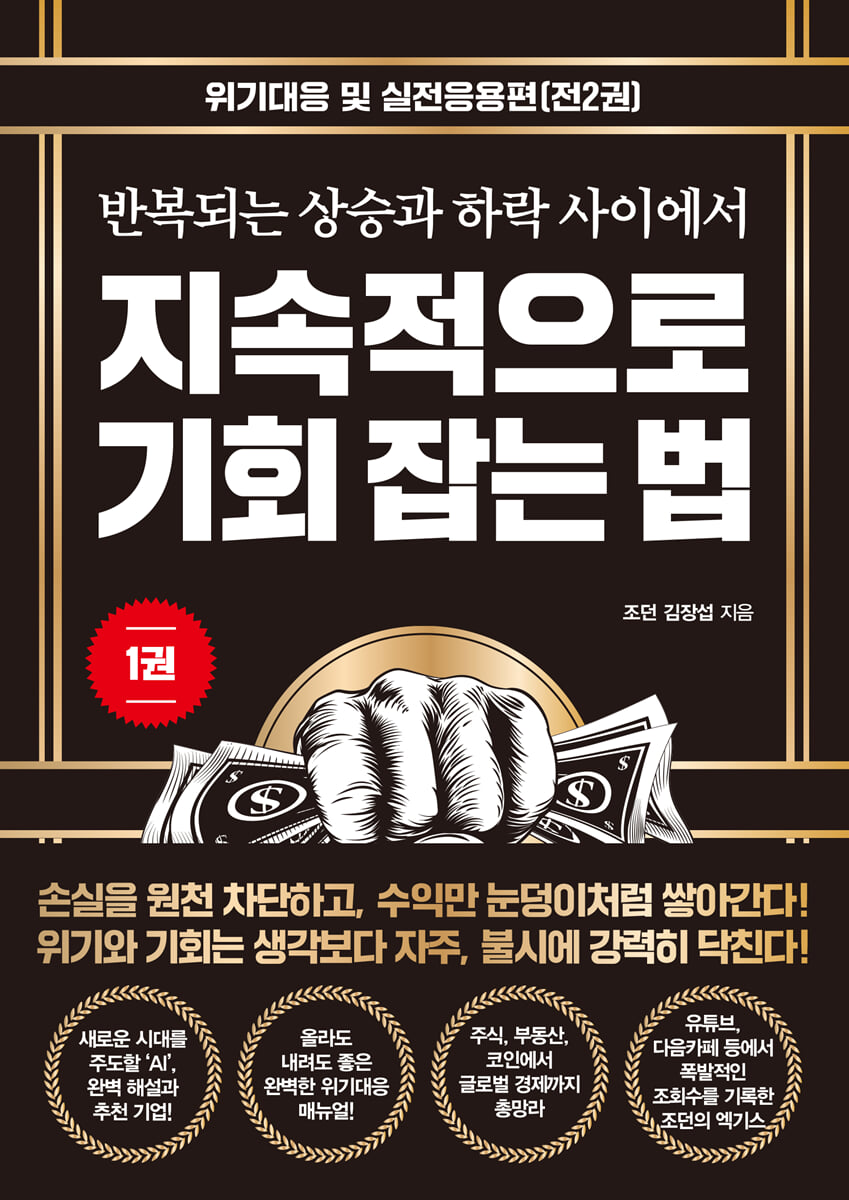
How to Seize Opportunities 1
 |
Description
Book Introduction
- A word from MD
-
A crisis is the greatest opportunity!This is a new book by Jordan Kim Jang-seop, who delivered unique insights and a new investment manual through 『Tomorrow's Wealth』 and 『Wealth Changer』.
The author's new investment solution is centered around the crises and opportunities that arise through repeated ups and downs.
Let's take a look at Jordan's manual for overcoming crises and turning them into opportunities to embark on the path to wealth.
April 23, 2024. Economics and Management PD Kim Sang-geun
A miraculous investment method that works whether you go up or down!
Change your destiny with this system!
Bestselling author Jordan (real name Kim Jang-seop), who received enthusiastic acclaim and great love from readers for his previous books, 『The Future of Real Estate in Korea』, 『The Future of Investment in the Era of the Fourth Industrial Revolution』, and 『Tomorrow's Wealth』 (2 volumes), presents deep insight and solutions this time, focusing on the uninvited guests that visit the asset and investment markets from time to time, such as 'crisis', and the 'opportunity' that comes afterward.
Whether it's stocks, real estate, coins, or bonds, investors who focus on them either only look up and try to go up or only look forward and try to run.
As a result, it is easy to fall over even small rocks.
Because there is no crisis response at all.
The more experienced an investor is, the more he or she becomes aware that investment assets do not always rise continuously, but rather are always lurking like landmines in between.
And the more exposed you are to that crisis, the more you are fully aware that the tower of hard work you have built up over time can crumble in an instant.
Numerous failure cases clearly prove this.
To reach the final destination of your investment and plant the flag of victory, you must first and foremost overcome the crisis.
No, it has to be to the extent that it can use the crisis to bring forward the arrival time.
Only by being able to put the saying, “A crisis is an opportunity,” into practice can we reach the point of true wealth.
In this book, the author (Jordan Kim Jang-seop) demonstrates through several examples what happens when you consistently ignore a crisis and how ineffective such behavior is.
And by using this crisis as an opportunity, he presents a simple yet powerful secret to becoming wealthy in no time.
In this book, Jordan meticulously describes, from an investor's perspective, how to prepare for, respond to, and anticipate crises that investors overlook or are aware of, and how to use these crises to accelerate their wealth growth.
In addition, it contains all of his secrets for managing crises well while at the same time accumulating maximum profits over a long period of time.
Change your destiny with this system!
Bestselling author Jordan (real name Kim Jang-seop), who received enthusiastic acclaim and great love from readers for his previous books, 『The Future of Real Estate in Korea』, 『The Future of Investment in the Era of the Fourth Industrial Revolution』, and 『Tomorrow's Wealth』 (2 volumes), presents deep insight and solutions this time, focusing on the uninvited guests that visit the asset and investment markets from time to time, such as 'crisis', and the 'opportunity' that comes afterward.
Whether it's stocks, real estate, coins, or bonds, investors who focus on them either only look up and try to go up or only look forward and try to run.
As a result, it is easy to fall over even small rocks.
Because there is no crisis response at all.
The more experienced an investor is, the more he or she becomes aware that investment assets do not always rise continuously, but rather are always lurking like landmines in between.
And the more exposed you are to that crisis, the more you are fully aware that the tower of hard work you have built up over time can crumble in an instant.
Numerous failure cases clearly prove this.
To reach the final destination of your investment and plant the flag of victory, you must first and foremost overcome the crisis.
No, it has to be to the extent that it can use the crisis to bring forward the arrival time.
Only by being able to put the saying, “A crisis is an opportunity,” into practice can we reach the point of true wealth.
In this book, the author (Jordan Kim Jang-seop) demonstrates through several examples what happens when you consistently ignore a crisis and how ineffective such behavior is.
And by using this crisis as an opportunity, he presents a simple yet powerful secret to becoming wealthy in no time.
In this book, Jordan meticulously describes, from an investor's perspective, how to prepare for, respond to, and anticipate crises that investors overlook or are aware of, and how to use these crises to accelerate their wealth growth.
In addition, it contains all of his secrets for managing crises well while at the same time accumulating maximum profits over a long period of time.
- You can preview some of the book's contents.
Preview
index
Volume 1: Crisis Response and Practical Application
Part 1: Keeping you safe in any situation and increasing your chances of becoming rich by 99.9%.
A Manual for Turning Crisis into Opportunity
Chapter 1: Jordan's Manual Summary: How long will we continue to face the same crises? Manual 1, 2, 3, 4, and 5
Chapter 2 Why Rebalancing?
TIP.
Why is the rebalancing rate 2.5%?
Chapter 3: Manual and Desire
How to Use the V-Shaped Rebalancing Manual in Chapter 4 (Go All-In on a 2-Section Rise)
*Bone-crushing, blunt capitalist humanities_If life is never lived for its own sake, it is empty.
Chapter 5: Application of Rebalancing to the V-Shaped Rebound from the 2020 COVID-19 Crisis
Chapter 6: The 2018 Fed Interest Rate Crisis: A Case Study of V-Shaped Rebalancing
Chapter 7: The 2011 US Credit Rating Crisis: A Case Study of V-Shaped Rebalancing
Chapter 8: Application of Rebalancing to the V-Shaped Rebound of the 2008 Financial Crisis
TIP.
How should you invest when the world's No. 1 and No. 2 positions change?
Chapter 9 TLT, IAU Hedge Tips
Chapter 10: All-time high and reference price
If you go all-in after a V-shaped rebound in Chapter 11 and the price drops by -3%
Chapter 12: All-in strategy after the V-shaped rebound
Chapter 13: Why You Shouldn't Rebalance After a V-Shaped Rebound During a Panic
*Bone-crushing, blunt capitalist humanities_You are an emotional trash can
Chapter 14 -3% End, Comparing the Period Manual and the V-Shaped Rebound Manual
2022 was a year of consistent declines. What would have been the returns if you had invested manually at the beginning of the year?
TIP.
If there is no plan, the ants will perish without a plan.
Chapter 16: The Most Dangerous Time in Stock Trading
*Bone-Cracking, Cracking Capitalism: Humanities_What Money Can't Buy
Chapter 17 Manual Noah's Ark
TIP.
Sell when the price reaches its peak and falls, and buy when the price reaches its bottom and rises.
Chapter 18: Will Tesla's stock price increase with rebalancing and piling strategies?
Chapter 19: Will Bitcoin's supply increase if it rebalances?
TIP.
If you're going to follow the manual, don't use your head.
Chapter 20: Rebalancing Only for Stocks Other Than the World's #1
Chapter 21: The Market Makes the Judgment, and Investors Follow the Manual
How can you fail if you sell 22 chapters? You have to sell to fail.
Chapter 23: It's Not Too Late to Invest Even if You're a Step Later - The Manual Must Be Used in Conjunction with World-Class Investments
*Bone-Cracking, Cracking Capitalist Humanities_The Life of Masters and Slaves
If the second part falls, it's welcome, and if it rises, it's good in itself.
Stock investment method
Chapter 24: Dollar Assets Are Best in Panic
Chapter 25: The Fearful Market: Those Who Survive Will Become Rich
Chapter 26: Lies in Stock Broadcasting
Chapter 27: No predictions.
Just respond
TIP.
Why Ants Fail in the Stock Market
Chapter 28: Stocks: Why Investing Based on Predictions Leads to Failure
Chapter 29: Should You Hold on Longer When the Stock Market Is Positive, or Longer When It's Negative?
*Bone-crushing, hard-hitting capitalist humanities_Why are we obsessed with money?
Chapter 30: Stocks Good for Inflation
Chapter 31: To become rich, you must not fall, but rather rise.
Chapter 32: When should you buy and sell cyclical stocks like those in Korea?
Chapter 33: Why Korean Market Participants' Goal Is Principal Recovery
Chapter 34: To become truly rich, invest 10 times in 10 years, and 100 times in 20 years.
Chapter 35: Why the Korean Stock Market is a Boxy Market
*Bone-Cracking, Crack-Cracking Capitalism: Humanities: When You're Poor, Everything Becomes Poor
Chapter 36: Buy stocks when they go up and sell them when they go down
Chapter 37 Stocks with Economic Moats
TIP.
Why Riding the Rise in Interest Rates Will Lead to Failure
Chapter 38: How to Get Rich in Stocks in 10 Years
Chapter 39: Good Stocks for Long-Term Investment
Chapter 40: People Who Invest Their Whole Lives But Never Get Rich vs.
A person who becomes rich automatically if you wait
Chapter 41: Warren Buffett is also all-in on the world's best stocks.
Chapter 42 10-Year Return Report Card, Korean Stocks 27% vs.
Foreign stocks 397%
Let's take a look at Chapter 43's yield.
Chapter 44: How to distinguish between good times (bullish) and bad times (bearish) in the stock market
Chapter 45: Billionaire Stockholder vs.
Who is richer among the 2 billion real estate tycoons?
Chapter 46: Why Many Investors Hesitate to Invest in the World's Best
TIP.
The answer is a perfect balance of long and short.
Chapter 47: The Path of Defensive Investment Overpowering Aggressive Investment
*Bone-crushing, hard-hitting capitalist humanities_Reality is hell
*Reference books
Part 1: Keeping you safe in any situation and increasing your chances of becoming rich by 99.9%.
A Manual for Turning Crisis into Opportunity
Chapter 1: Jordan's Manual Summary: How long will we continue to face the same crises? Manual 1, 2, 3, 4, and 5
Chapter 2 Why Rebalancing?
TIP.
Why is the rebalancing rate 2.5%?
Chapter 3: Manual and Desire
How to Use the V-Shaped Rebalancing Manual in Chapter 4 (Go All-In on a 2-Section Rise)
*Bone-crushing, blunt capitalist humanities_If life is never lived for its own sake, it is empty.
Chapter 5: Application of Rebalancing to the V-Shaped Rebound from the 2020 COVID-19 Crisis
Chapter 6: The 2018 Fed Interest Rate Crisis: A Case Study of V-Shaped Rebalancing
Chapter 7: The 2011 US Credit Rating Crisis: A Case Study of V-Shaped Rebalancing
Chapter 8: Application of Rebalancing to the V-Shaped Rebound of the 2008 Financial Crisis
TIP.
How should you invest when the world's No. 1 and No. 2 positions change?
Chapter 9 TLT, IAU Hedge Tips
Chapter 10: All-time high and reference price
If you go all-in after a V-shaped rebound in Chapter 11 and the price drops by -3%
Chapter 12: All-in strategy after the V-shaped rebound
Chapter 13: Why You Shouldn't Rebalance After a V-Shaped Rebound During a Panic
*Bone-crushing, blunt capitalist humanities_You are an emotional trash can
Chapter 14 -3% End, Comparing the Period Manual and the V-Shaped Rebound Manual
2022 was a year of consistent declines. What would have been the returns if you had invested manually at the beginning of the year?
TIP.
If there is no plan, the ants will perish without a plan.
Chapter 16: The Most Dangerous Time in Stock Trading
*Bone-Cracking, Cracking Capitalism: Humanities_What Money Can't Buy
Chapter 17 Manual Noah's Ark
TIP.
Sell when the price reaches its peak and falls, and buy when the price reaches its bottom and rises.
Chapter 18: Will Tesla's stock price increase with rebalancing and piling strategies?
Chapter 19: Will Bitcoin's supply increase if it rebalances?
TIP.
If you're going to follow the manual, don't use your head.
Chapter 20: Rebalancing Only for Stocks Other Than the World's #1
Chapter 21: The Market Makes the Judgment, and Investors Follow the Manual
How can you fail if you sell 22 chapters? You have to sell to fail.
Chapter 23: It's Not Too Late to Invest Even if You're a Step Later - The Manual Must Be Used in Conjunction with World-Class Investments
*Bone-Cracking, Cracking Capitalist Humanities_The Life of Masters and Slaves
If the second part falls, it's welcome, and if it rises, it's good in itself.
Stock investment method
Chapter 24: Dollar Assets Are Best in Panic
Chapter 25: The Fearful Market: Those Who Survive Will Become Rich
Chapter 26: Lies in Stock Broadcasting
Chapter 27: No predictions.
Just respond
TIP.
Why Ants Fail in the Stock Market
Chapter 28: Stocks: Why Investing Based on Predictions Leads to Failure
Chapter 29: Should You Hold on Longer When the Stock Market Is Positive, or Longer When It's Negative?
*Bone-crushing, hard-hitting capitalist humanities_Why are we obsessed with money?
Chapter 30: Stocks Good for Inflation
Chapter 31: To become rich, you must not fall, but rather rise.
Chapter 32: When should you buy and sell cyclical stocks like those in Korea?
Chapter 33: Why Korean Market Participants' Goal Is Principal Recovery
Chapter 34: To become truly rich, invest 10 times in 10 years, and 100 times in 20 years.
Chapter 35: Why the Korean Stock Market is a Boxy Market
*Bone-Cracking, Crack-Cracking Capitalism: Humanities: When You're Poor, Everything Becomes Poor
Chapter 36: Buy stocks when they go up and sell them when they go down
Chapter 37 Stocks with Economic Moats
TIP.
Why Riding the Rise in Interest Rates Will Lead to Failure
Chapter 38: How to Get Rich in Stocks in 10 Years
Chapter 39: Good Stocks for Long-Term Investment
Chapter 40: People Who Invest Their Whole Lives But Never Get Rich vs.
A person who becomes rich automatically if you wait
Chapter 41: Warren Buffett is also all-in on the world's best stocks.
Chapter 42 10-Year Return Report Card, Korean Stocks 27% vs.
Foreign stocks 397%
Let's take a look at Chapter 43's yield.
Chapter 44: How to distinguish between good times (bullish) and bad times (bearish) in the stock market
Chapter 45: Billionaire Stockholder vs.
Who is richer among the 2 billion real estate tycoons?
Chapter 46: Why Many Investors Hesitate to Invest in the World's Best
TIP.
The answer is a perfect balance of long and short.
Chapter 47: The Path of Defensive Investment Overpowering Aggressive Investment
*Bone-crushing, hard-hitting capitalist humanities_Reality is hell
*Reference books
Detailed image

Publisher's Review
AI will lead the next market. What companies are the top investments in the AI era?
Nvidia's endless rise has many investors making new investments in the company.
But will Nvidia continue to lead the AI era in the future?
The author sketches out a vision of the future AI era and explains why investors should be interested in AI.
Ultimately, money will continue to be released steadily in the future, and the released money will flow into the stock market.
Fields that aim to increase productivity, such as generative AI, appear promising.
We must rely on places that have a lot of climbing.
The market will let you know in stock prices where prices are rising the most.
Rather than buying cheap because it has fallen, if you look at it from a future value perspective, it may actually be cheaper to buy it when it is rising.
The reason stocks are cheap is because they have no future value, and the reason they are expensive is because they have high future value.
As the saying goes, "Get on a running horse."
The author, who defines a running horse as AI, recommends the best companies for investment in the AI era.
A grand outlook on the future of real estate in Korea, where crisis and opportunity coexist!
The stock market appears to be recovering from the crisis and finding stability, but in contrast, the real estate market is still littered with landmines.
Experts' opinions also vary.
There are certainly investors who are already hastily starting a second round of investment.
But is now really the time to invest? And what will the future of South Korean real estate look like? So, when and how should you invest?
The author honestly and frankly describes the future prospects of real estate in Korea, starting with the fundamental problems facing the industry.
As a former real estate investor and expert with a long career, he points out the risks of the mirage-like real estate market that he has experienced and offers realistic investment guidelines for surviving it.
Nevertheless, based on the immutable premise that 'a crisis is an opportunity,' we look forward to the once-in-a-lifetime opportunity that a crisis will bring.
In particular, this book is expected to create a big stir by revealing 'How to buy an apartment in Gangnam without spending a single penny of your own money.'
What this book throws at your financial life,
Important questions you should never overlook!
*How can I buy an apartment in Gangnam without spending a single penny of my own money?
*How far will AI change the world?
*Which companies will lead the AI era?
*Are we going to continue to face repeated crises? How can we turn them into opportunities?
*Can my wealth grow tenfold in ten years, or even a hundredfold in twenty years? Is that even possible?
*How can money accumulate over time and grow at an explosively fast rate?
*Is there really a universal cheat key that makes it better when you go up and even better when you go down?
*How should you respond when a stock market crash begins?
*Is the crash (crisis) really an opportunity?
*Why does this leisurely investment method outperform the fiercely competitive investment methods by tens, hundreds, or thousands of times?
*Should I divide the grains of rice and roll them, or should I roll a snowball to make a snowball?
Should I sell my assets now? If so, when should I buy them again?
*If buying and selling are difficult, how should I manage my assets to overcome the crisis?
*Will Jordan's manual apply to other assets like Tesla and Bitcoin?
*Why is the world's #1 investment the best?
*How to invest in stocks other than the world's best?
*The smaller the amount, the better you should utilize the crisis?
*How to catch the bottom in a crisis?
*Where and how should you invest in a crisis?
*1 billion shares vs.
Who is richer with 2 billion won in real estate?
*How to hold a stock that keeps rising without wavering for the long term?
*Why do crises and panics recur in capitalism?
Why hasn't Warren Buffett bought Tesla yet? And if so, when?
*What is the near future of real estate in South Korea?
*What will the exchange rate peak at? Could the high exchange rate become entrenched?
*Are we now entering an era of chronic high interest rates?
*How to distinguish between good times (bullish market) and bad times (bearish market) in the stock market?
*Will the crisis trigger within the United States or outside the United States?
*How can a salaried worker become rich step by step?
*What is the future of ChatGPT?
*If there was one way to get rich quicker?
A new Jordan-style manual, revised and supplemented!
In his previous books, Jordan coined the term "Masam's Law" (a 3% or greater drop in the Nasdaq is a strong signal of crisis).
There is already a widespread perception among many investors that a crash in the NASDAQ will be a crisis.
In this book, Jordan introduces a more advanced and complete manual based on newly accumulated data from the COVID-19 pandemic.
He is already applying it to his investments, and the investors who follow him are proving it with results.
If you apply his manual to investing, you don't have to worry, analyze, or invest fiercely.
When a crisis comes, you just have to welcome it.
In moments of explosive crisis when assets fluctuate greatly, all you have to do is follow the manual, cast a wide net, and prepare for a bountiful harvest.
There is no reason to lose sleep over investing, just enjoy life and do what you want to do.
Because the manual does all the work.
Normally, you dig for gold according to the manual, but when a crisis comes, it's like you've found a diamond mine.
Because you can grab bigger opportunities in a shorter period of time.
If you do nothing and don't recognize the crisis, it will literally be a crisis that will cause your assets to collapse. However, if you are armed with a manual, the crisis will be like a gift, presenting explosive profit opportunities and surging returns.
Therefore, after learning the manual, instead of fearing crises, you will welcome the frequent crises and understand, from a capitalist's perspective, why crises recur in the global economy.
A solid two-volume structure, covering everything from theory to practice, from investment methods to the global economy!
As always, these two books, crafted with insight, are structured so that anyone can easily learn Jordan's manual, apply it to their investments, and explore the current challenges facing the global economy, as well as its promising prospects and targets.
Additionally, just reading can help you develop insight into the economy.
Volume 1
In Volume 1 (Crisis Response and Practical Application), Jordan's manual is organized as an all-purpose cheat key that can help you be happy during the rising period and seize greater opportunities during the falling period (crisis).
He offers various investment systems he has developed over decades of data analysis, focusing on rebalancing, piling, and V-shaped rebound rebalancing.
Jordan calls his manual Noah's Ark, emphasizing that mastering it will enable you to make safe, all-in investments that can snowball into big investments.
Instead of diversifying investments or holding on without selling, we present investments that can increase your assets significantly and for a long time, increasing them by at least 10 times in 10 years and 100 times in 20 years.
This applies to everyone, but it will be an investment that will give your future to your young children in particular.
He also emphasizes that if you learn your own manual and apply it in more detail, you can shorten the ten-bagger period, which is when your assets increase tenfold.
His manual is not a simple long-short strategy that requires anticipating and adjusting directions.
It is a miraculous investment method that is profitable no matter what the situation.
It allows us to break free from the typical individual pattern of succumbing to the fear that often comes our way, as the human desires and greed that invite failure are excluded.
Volume 1 presents a more in-depth guide to investing in stocks, along with a manual, covering how to respond to the unexpected, and how to apply the manual to Bitcoin or common stocks (Tesla).
Volume 2
Volume 2 (Life Turnaround and Automatic Riches) first deals with the real estate issue, which is reaching a turning point.
He also emphasizes that real estate is facing both crisis and opportunity, and warns that we must be wary of a shock wave greater than the Lehman Brothers crisis in 2008.
The greater the crisis, the greater the opportunity.
It reveals the strategic positions that ordinary people should take during this time, and above all, it reveals the highlight of the second volume, 'How to Buy an Apartment in Gangnam Without Spending a Penny of Your Own Money.'
It also addresses exchange rate and inflation issues, and forecasts and introduces industries and companies that will lead the future.
We analyze the electric vehicle market, where a chicken game is in full swing, led by Tesla, and the emerging fields of Chat GPT and AI, along with predictions about where a second Lehman Brothers would fall.
In addition, the author examines the 'how to get rich the fastest' that he has come up with through deep thought, and proves what kind of results can be achieved if you add a cheat key called a manual.
Saying you can't get rich is just an excuse in front of this book!
If you have been frustrated on the brink of success, if no investment method has worked, if you no longer want to invest without sleep, if you are fed up with investments that go against your expectations, if you want to see your children grow up to be in the top 0.1% of the rich, or if you have resolved to become rich no matter what from now on, this book will be the most reliable guide.
Through Jordan's books, many people have achieved significant financial gains and found psychological stability.
And they have transformed into easy-going investors who earn tens, hundreds, and thousands of times more in excess profits than fiercely fighting investors.
Are you still anxious about a crisis? Do you believe that rising is the only way to achieve success? Do you feel discouraged when things fall? A crisis is the ultimate opportunity to become rich in a short period of time, a time of change where new wealthy people emerge! It has always been that way, it will be that way this time, and it will be that way in the future! Make "crisis is opportunity" a reality.
Don't be afraid.
The opportunity to become rich faster and easier has finally arrived! Discover Jordan's revised, improved, and enhanced system!
Nvidia's endless rise has many investors making new investments in the company.
But will Nvidia continue to lead the AI era in the future?
The author sketches out a vision of the future AI era and explains why investors should be interested in AI.
Ultimately, money will continue to be released steadily in the future, and the released money will flow into the stock market.
Fields that aim to increase productivity, such as generative AI, appear promising.
We must rely on places that have a lot of climbing.
The market will let you know in stock prices where prices are rising the most.
Rather than buying cheap because it has fallen, if you look at it from a future value perspective, it may actually be cheaper to buy it when it is rising.
The reason stocks are cheap is because they have no future value, and the reason they are expensive is because they have high future value.
As the saying goes, "Get on a running horse."
The author, who defines a running horse as AI, recommends the best companies for investment in the AI era.
A grand outlook on the future of real estate in Korea, where crisis and opportunity coexist!
The stock market appears to be recovering from the crisis and finding stability, but in contrast, the real estate market is still littered with landmines.
Experts' opinions also vary.
There are certainly investors who are already hastily starting a second round of investment.
But is now really the time to invest? And what will the future of South Korean real estate look like? So, when and how should you invest?
The author honestly and frankly describes the future prospects of real estate in Korea, starting with the fundamental problems facing the industry.
As a former real estate investor and expert with a long career, he points out the risks of the mirage-like real estate market that he has experienced and offers realistic investment guidelines for surviving it.
Nevertheless, based on the immutable premise that 'a crisis is an opportunity,' we look forward to the once-in-a-lifetime opportunity that a crisis will bring.
In particular, this book is expected to create a big stir by revealing 'How to buy an apartment in Gangnam without spending a single penny of your own money.'
What this book throws at your financial life,
Important questions you should never overlook!
*How can I buy an apartment in Gangnam without spending a single penny of my own money?
*How far will AI change the world?
*Which companies will lead the AI era?
*Are we going to continue to face repeated crises? How can we turn them into opportunities?
*Can my wealth grow tenfold in ten years, or even a hundredfold in twenty years? Is that even possible?
*How can money accumulate over time and grow at an explosively fast rate?
*Is there really a universal cheat key that makes it better when you go up and even better when you go down?
*How should you respond when a stock market crash begins?
*Is the crash (crisis) really an opportunity?
*Why does this leisurely investment method outperform the fiercely competitive investment methods by tens, hundreds, or thousands of times?
*Should I divide the grains of rice and roll them, or should I roll a snowball to make a snowball?
Should I sell my assets now? If so, when should I buy them again?
*If buying and selling are difficult, how should I manage my assets to overcome the crisis?
*Will Jordan's manual apply to other assets like Tesla and Bitcoin?
*Why is the world's #1 investment the best?
*How to invest in stocks other than the world's best?
*The smaller the amount, the better you should utilize the crisis?
*How to catch the bottom in a crisis?
*Where and how should you invest in a crisis?
*1 billion shares vs.
Who is richer with 2 billion won in real estate?
*How to hold a stock that keeps rising without wavering for the long term?
*Why do crises and panics recur in capitalism?
Why hasn't Warren Buffett bought Tesla yet? And if so, when?
*What is the near future of real estate in South Korea?
*What will the exchange rate peak at? Could the high exchange rate become entrenched?
*Are we now entering an era of chronic high interest rates?
*How to distinguish between good times (bullish market) and bad times (bearish market) in the stock market?
*Will the crisis trigger within the United States or outside the United States?
*How can a salaried worker become rich step by step?
*What is the future of ChatGPT?
*If there was one way to get rich quicker?
A new Jordan-style manual, revised and supplemented!
In his previous books, Jordan coined the term "Masam's Law" (a 3% or greater drop in the Nasdaq is a strong signal of crisis).
There is already a widespread perception among many investors that a crash in the NASDAQ will be a crisis.
In this book, Jordan introduces a more advanced and complete manual based on newly accumulated data from the COVID-19 pandemic.
He is already applying it to his investments, and the investors who follow him are proving it with results.
If you apply his manual to investing, you don't have to worry, analyze, or invest fiercely.
When a crisis comes, you just have to welcome it.
In moments of explosive crisis when assets fluctuate greatly, all you have to do is follow the manual, cast a wide net, and prepare for a bountiful harvest.
There is no reason to lose sleep over investing, just enjoy life and do what you want to do.
Because the manual does all the work.
Normally, you dig for gold according to the manual, but when a crisis comes, it's like you've found a diamond mine.
Because you can grab bigger opportunities in a shorter period of time.
If you do nothing and don't recognize the crisis, it will literally be a crisis that will cause your assets to collapse. However, if you are armed with a manual, the crisis will be like a gift, presenting explosive profit opportunities and surging returns.
Therefore, after learning the manual, instead of fearing crises, you will welcome the frequent crises and understand, from a capitalist's perspective, why crises recur in the global economy.
A solid two-volume structure, covering everything from theory to practice, from investment methods to the global economy!
As always, these two books, crafted with insight, are structured so that anyone can easily learn Jordan's manual, apply it to their investments, and explore the current challenges facing the global economy, as well as its promising prospects and targets.
Additionally, just reading can help you develop insight into the economy.
Volume 1
In Volume 1 (Crisis Response and Practical Application), Jordan's manual is organized as an all-purpose cheat key that can help you be happy during the rising period and seize greater opportunities during the falling period (crisis).
He offers various investment systems he has developed over decades of data analysis, focusing on rebalancing, piling, and V-shaped rebound rebalancing.
Jordan calls his manual Noah's Ark, emphasizing that mastering it will enable you to make safe, all-in investments that can snowball into big investments.
Instead of diversifying investments or holding on without selling, we present investments that can increase your assets significantly and for a long time, increasing them by at least 10 times in 10 years and 100 times in 20 years.
This applies to everyone, but it will be an investment that will give your future to your young children in particular.
He also emphasizes that if you learn your own manual and apply it in more detail, you can shorten the ten-bagger period, which is when your assets increase tenfold.
His manual is not a simple long-short strategy that requires anticipating and adjusting directions.
It is a miraculous investment method that is profitable no matter what the situation.
It allows us to break free from the typical individual pattern of succumbing to the fear that often comes our way, as the human desires and greed that invite failure are excluded.
Volume 1 presents a more in-depth guide to investing in stocks, along with a manual, covering how to respond to the unexpected, and how to apply the manual to Bitcoin or common stocks (Tesla).
Volume 2
Volume 2 (Life Turnaround and Automatic Riches) first deals with the real estate issue, which is reaching a turning point.
He also emphasizes that real estate is facing both crisis and opportunity, and warns that we must be wary of a shock wave greater than the Lehman Brothers crisis in 2008.
The greater the crisis, the greater the opportunity.
It reveals the strategic positions that ordinary people should take during this time, and above all, it reveals the highlight of the second volume, 'How to Buy an Apartment in Gangnam Without Spending a Penny of Your Own Money.'
It also addresses exchange rate and inflation issues, and forecasts and introduces industries and companies that will lead the future.
We analyze the electric vehicle market, where a chicken game is in full swing, led by Tesla, and the emerging fields of Chat GPT and AI, along with predictions about where a second Lehman Brothers would fall.
In addition, the author examines the 'how to get rich the fastest' that he has come up with through deep thought, and proves what kind of results can be achieved if you add a cheat key called a manual.
Saying you can't get rich is just an excuse in front of this book!
If you have been frustrated on the brink of success, if no investment method has worked, if you no longer want to invest without sleep, if you are fed up with investments that go against your expectations, if you want to see your children grow up to be in the top 0.1% of the rich, or if you have resolved to become rich no matter what from now on, this book will be the most reliable guide.
Through Jordan's books, many people have achieved significant financial gains and found psychological stability.
And they have transformed into easy-going investors who earn tens, hundreds, and thousands of times more in excess profits than fiercely fighting investors.
Are you still anxious about a crisis? Do you believe that rising is the only way to achieve success? Do you feel discouraged when things fall? A crisis is the ultimate opportunity to become rich in a short period of time, a time of change where new wealthy people emerge! It has always been that way, it will be that way this time, and it will be that way in the future! Make "crisis is opportunity" a reality.
Don't be afraid.
The opportunity to become rich faster and easier has finally arrived! Discover Jordan's revised, improved, and enhanced system!
GOODS SPECIFICS
- Date of issue: April 17, 2024
- Page count, weight, size: 339 pages | 476g | 148*210*20mm
- ISBN13: 9791192218762
- ISBN10: 1192218760
You may also like
카테고리
korean


korean

![GQ KOREA Mark (Monthly): December [2025]](http://librairie.coreenne.fr/cdn/shop/files/8ef265dbbfbf186523ed75ba7319009d.jpg?v=1765340328&width=3840)


