

risk
 |
Description
Book Introduction
God's Law of Turning Crisis into Opportunity
Peter L., author and world-renowned management consultant
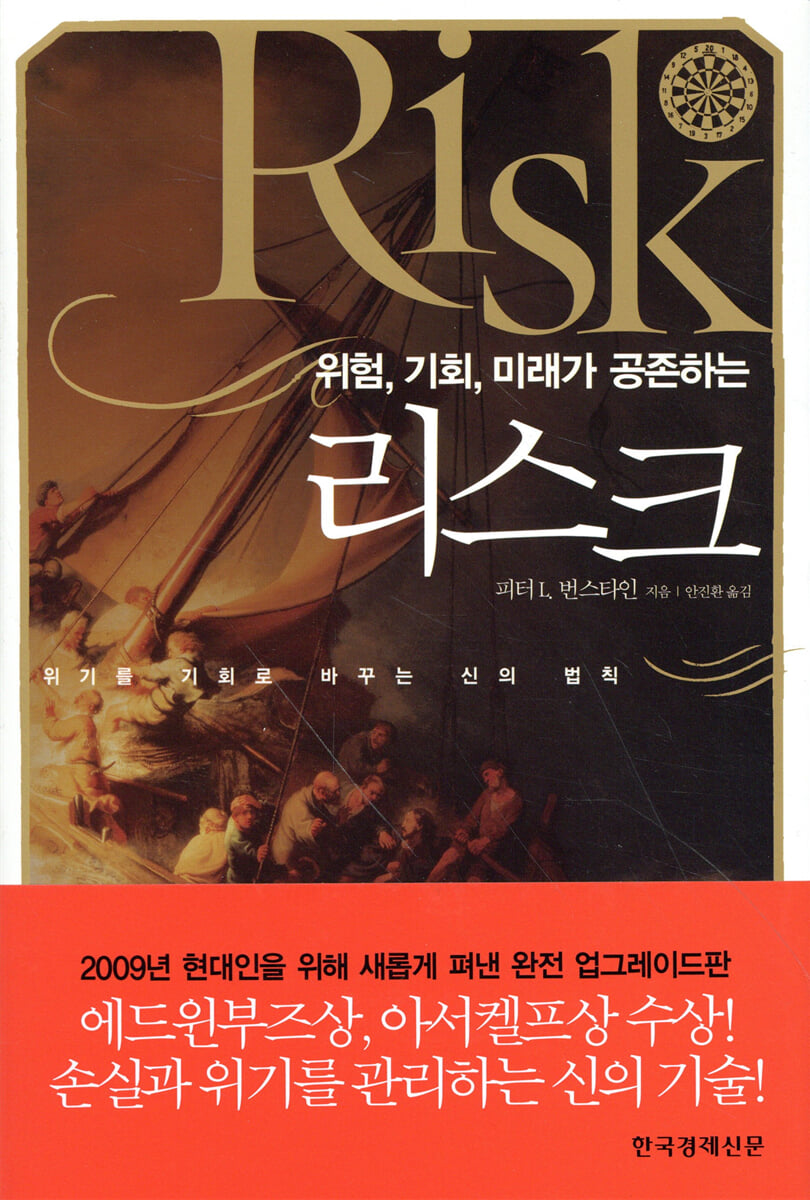
This is a book written by Bernstein about the history and development of risk.
This book explains, from a historical and philosophical perspective, when humanity began to recognize risk, how it overcame fear, tamed risk, and rationally accepted risks to create today's economic system.
It features stories from several thinkers who, with their brilliant insights, have uncovered ways to address the future from the present moment.
It presents a way to understand risk, a way to measure it, and a way to gauge its consequences.
Because choice is an area that only those with a challenging outlook on life worry about, risk is not fate but a 'choice'.
This book will be helpful to all readers, including managers who need to make investments or 'choices' for the present or future.
Peter L., author and world-renowned management consultant
This is a book written by Bernstein about the history and development of risk.
This book explains, from a historical and philosophical perspective, when humanity began to recognize risk, how it overcame fear, tamed risk, and rationally accepted risks to create today's economic system.
It features stories from several thinkers who, with their brilliant insights, have uncovered ways to address the future from the present moment.
It presents a way to understand risk, a way to measure it, and a way to gauge its consequences.
Because choice is an area that only those with a challenging outlook on life worry about, risk is not fate but a 'choice'.
This book will be helpful to all readers, including managers who need to make investments or 'choices' for the present or future.
- You can preview some of the book's contents.
Preview
index
Part 1: Risks Rooted in the Numeral System ~1200
01 _ Conquering Risks from the Renaissance and the Reformation
Discover 02_0
Part 2: The Great Discovery of Probability Theory, 1200-1700
03 _ A gambler's efforts to solve the problem of stake distribution
04 _ The French Three Musketeers Who Laid the Foundations of Probability Theory
05 _ Core concepts of statistics presented by a general store owner
Part 3: Theoretical Foundations of Choice and Decision 1700–1900
06 _ Measuring the Countless
07 _ Finding confidence in decision-making and choices
08 _ Order cannot be found without the precedence of disorder.
09 _ Measure anything
10_ Bet on 'regression to the mean'
11_ If you want to get the desired but uncertain profit
Part 4: Analysis of Investment Strategies 1900-1960
12_ Good luck
13 _ The Blessing of Uncertainty
14 _ Maximize utility to win
15_ Don't put all your eggs in one basket
Part 5: Judging the Benefits and Threats of Risk 1960~
16 _ Losses seem greater than gains
17 _ 'The price of buying' and 'the price of selling'
18 _ The fantastic world of derivatives
19 _ Remember the limitations of your computer
References
01 _ Conquering Risks from the Renaissance and the Reformation
Discover 02_0
Part 2: The Great Discovery of Probability Theory, 1200-1700
03 _ A gambler's efforts to solve the problem of stake distribution
04 _ The French Three Musketeers Who Laid the Foundations of Probability Theory
05 _ Core concepts of statistics presented by a general store owner
Part 3: Theoretical Foundations of Choice and Decision 1700–1900
06 _ Measuring the Countless
07 _ Finding confidence in decision-making and choices
08 _ Order cannot be found without the precedence of disorder.
09 _ Measure anything
10_ Bet on 'regression to the mean'
11_ If you want to get the desired but uncertain profit
Part 4: Analysis of Investment Strategies 1900-1960
12_ Good luck
13 _ The Blessing of Uncertainty
14 _ Maximize utility to win
15_ Don't put all your eggs in one basket
Part 5: Judging the Benefits and Threats of Risk 1960~
16 _ Losses seem greater than gains
17 _ 'The price of buying' and 'the price of selling'
18 _ The fantastic world of derivatives
19 _ Remember the limitations of your computer
References
Publisher's Review
- The Edwin G. Booz Award for the most insightful and innovative management book
Booz Award Winner!
- Received the Elizur Wright Memorial Award from the National Insurance Industry!
- Winner of the Clarence Arthur Kelp Award from the National Risk Association!
-A USA Today, Economist, Business Week, and New York Times bestseller!
In an age of fear and greed, those with the courage to take on challenges will rule the world.
The whole world is in the grip of a financial crisis.
Countries are increasing liquidity, reforming banking structures, and offering tax breaks, but no one can accurately predict when this crisis will end.
Even Korea, which has overcome a major crisis like the IMF, is tense and nervous as if it is experiencing this for the first time.
How should we live in this situation? Even without doing anything, our asset values are plummeting.
These are times when you lose out even if you just sit still.
Just looking at stocks, they have fallen more than 45% since the beginning of the year.
From now on, it is important to know how not to lose.
If you are pouring water into a cracked jar, the important thing at this point is not to pour too much water, but to accurately identify the crack in the jar.
From ancient times to the present, we have lived in an age of uncertainty.
However, humanity has turned that uncertainty into another opportunity and has made progress in all areas of life, including the economy.
If we continue to live 'riskily' as we have lived so far, we will overcome the current recession without any problems.
The word risk comes from an early Italian word meaning 'to dare'.
In this sense, risk is not fate, but a choice.
Choice is an area that only those with a challenging outlook on life worry about.
It can be changed at any time according to the individual's free will.
Risk is not about avoiding and hiding, but about seizing opportunities and taking on challenges.
◆ The Challenge of Risk
One person has 1,000 won.
I explained to him the opportunity to invest 1,000 won and earn 2,000 won.
But he also told me that I could lose 500 won if my investment failed.
Should this person invest or not? Usually, in this case, they invest.
Let's raise this person's amount a little more.
This time it's 100 million won.
If it goes well, you earn 200 million won, but if it fails, you lose 50 million won.
What about this situation? Unlike the previous example, it might require some time to think.
Why does this situation occur? Someone has researched the answer.
Jewish psychologists Kahneman and Tversky stated that people are willing to invest or gamble if the possible loss is within a level they can understand and tolerate.
In other words, if you can accurately recognize the losses you can afford, you can encounter many opportunities for challenge.
The opportunity for a challenge is not determined by the probability of success, but by the extent of the loss.
The challenge is not to win, but to minimize the chances of failure, which is where our opportunities arise.
Let's assume that a disease breaks out in a certain area and kills 600 people.
Let's say Plan A can save 200 people, and Plan B has a 33% chance of saving everyone and a 67% chance of saving no one.
Which plan would you choose? I would choose Plan A, which is risk-free.
Let's think about it another way.
Let's say Plan C kills 400 people, and Plan D has a 67% chance of killing everyone and a 33% chance of killing no one.
In this experiment, 78% of the subjects chose Plan D.
The perspectives are different, but the situation is the same.
This human psychology of perceiving the same situation differently and making completely different decisions is called 'loss aversion'.
As this experiment and the one above show, people abhor loss more than uncertainty.
Losses always seem greater than gains.
The negative stimulus that occurs to a person who loses 100,000 won is much greater than the positive stimulus that occurs to a person who finds 100,000 won.
From this perspective, losses add a greater psychological burden to us, but in reality, they do not.
It may be smaller than it appears.
Perhaps loss only happens in our hearts and minds.
Our will to challenge will become stronger as we make more objective judgments.
◆ The Blessing of Risk
Adam Smith, author of The Wealth of Nations, said this:
“If people are not tempted by any opportunity…then they will invest only after cold calculation, and naturally, there will not be much investment.” In other words, who will have the opportunity to succeed if they only think about failure?
The former Soviet Union also managed uncertainty through meticulous planning and calculation, but ultimately ended up socially and economically devastated.
The reason to identify risks is not to avoid them, but to challenge them.
It's about assessing my risk and finding a safer way to take on the challenge.
A market in recession and panic is not a place of despair where everything falls apart, but where a boom begins.
This book contains the stories of people who survived the recession and their records.
Among them, there is an interesting report card.
According to William Baumol of Princeton University, all of today's great powers once had mediocre economic performance.
Even the United States, the world's greatest superpower, had an economic structure inferior to that of Germany, Italy, and Sweden between 1899 and 1913.
And in the case of Japan, in 1870, it had the lowest per-worker production standard in the world.
In less than 140 years, the world economic landscape has been turned upside down.
Today's Republic of Korea is difficult, but we must consider risks to create tomorrow's Republic of Korea.
Conversely, if today were a boom, we might be looking forward to a rosy future tomorrow.
Today's challenges may be the cornerstones for tomorrow.
Booz Award Winner!
- Received the Elizur Wright Memorial Award from the National Insurance Industry!
- Winner of the Clarence Arthur Kelp Award from the National Risk Association!
-A USA Today, Economist, Business Week, and New York Times bestseller!
In an age of fear and greed, those with the courage to take on challenges will rule the world.
The whole world is in the grip of a financial crisis.
Countries are increasing liquidity, reforming banking structures, and offering tax breaks, but no one can accurately predict when this crisis will end.
Even Korea, which has overcome a major crisis like the IMF, is tense and nervous as if it is experiencing this for the first time.
How should we live in this situation? Even without doing anything, our asset values are plummeting.
These are times when you lose out even if you just sit still.
Just looking at stocks, they have fallen more than 45% since the beginning of the year.
From now on, it is important to know how not to lose.
If you are pouring water into a cracked jar, the important thing at this point is not to pour too much water, but to accurately identify the crack in the jar.
From ancient times to the present, we have lived in an age of uncertainty.
However, humanity has turned that uncertainty into another opportunity and has made progress in all areas of life, including the economy.
If we continue to live 'riskily' as we have lived so far, we will overcome the current recession without any problems.
The word risk comes from an early Italian word meaning 'to dare'.
In this sense, risk is not fate, but a choice.
Choice is an area that only those with a challenging outlook on life worry about.
It can be changed at any time according to the individual's free will.
Risk is not about avoiding and hiding, but about seizing opportunities and taking on challenges.
◆ The Challenge of Risk
One person has 1,000 won.
I explained to him the opportunity to invest 1,000 won and earn 2,000 won.
But he also told me that I could lose 500 won if my investment failed.
Should this person invest or not? Usually, in this case, they invest.
Let's raise this person's amount a little more.
This time it's 100 million won.
If it goes well, you earn 200 million won, but if it fails, you lose 50 million won.
What about this situation? Unlike the previous example, it might require some time to think.
Why does this situation occur? Someone has researched the answer.
Jewish psychologists Kahneman and Tversky stated that people are willing to invest or gamble if the possible loss is within a level they can understand and tolerate.
In other words, if you can accurately recognize the losses you can afford, you can encounter many opportunities for challenge.
The opportunity for a challenge is not determined by the probability of success, but by the extent of the loss.
The challenge is not to win, but to minimize the chances of failure, which is where our opportunities arise.
Let's assume that a disease breaks out in a certain area and kills 600 people.
Let's say Plan A can save 200 people, and Plan B has a 33% chance of saving everyone and a 67% chance of saving no one.
Which plan would you choose? I would choose Plan A, which is risk-free.
Let's think about it another way.
Let's say Plan C kills 400 people, and Plan D has a 67% chance of killing everyone and a 33% chance of killing no one.
In this experiment, 78% of the subjects chose Plan D.
The perspectives are different, but the situation is the same.
This human psychology of perceiving the same situation differently and making completely different decisions is called 'loss aversion'.
As this experiment and the one above show, people abhor loss more than uncertainty.
Losses always seem greater than gains.
The negative stimulus that occurs to a person who loses 100,000 won is much greater than the positive stimulus that occurs to a person who finds 100,000 won.
From this perspective, losses add a greater psychological burden to us, but in reality, they do not.
It may be smaller than it appears.
Perhaps loss only happens in our hearts and minds.
Our will to challenge will become stronger as we make more objective judgments.
◆ The Blessing of Risk
Adam Smith, author of The Wealth of Nations, said this:
“If people are not tempted by any opportunity…then they will invest only after cold calculation, and naturally, there will not be much investment.” In other words, who will have the opportunity to succeed if they only think about failure?
The former Soviet Union also managed uncertainty through meticulous planning and calculation, but ultimately ended up socially and economically devastated.
The reason to identify risks is not to avoid them, but to challenge them.
It's about assessing my risk and finding a safer way to take on the challenge.
A market in recession and panic is not a place of despair where everything falls apart, but where a boom begins.
This book contains the stories of people who survived the recession and their records.
Among them, there is an interesting report card.
According to William Baumol of Princeton University, all of today's great powers once had mediocre economic performance.
Even the United States, the world's greatest superpower, had an economic structure inferior to that of Germany, Italy, and Sweden between 1899 and 1913.
And in the case of Japan, in 1870, it had the lowest per-worker production standard in the world.
In less than 140 years, the world economic landscape has been turned upside down.
Today's Republic of Korea is difficult, but we must consider risks to create tomorrow's Republic of Korea.
Conversely, if today were a boom, we might be looking forward to a rosy future tomorrow.
Today's challenges may be the cornerstones for tomorrow.
GOODS SPECIFICS
- Date of issue: November 28, 2008
- Format: Hardcover book binding method guide
- Page count, weight, size: 536 pages | 860g | 153*224*35mm
- ISBN13: 9788947526883
- ISBN10: 8947526886
You may also like
카테고리
korean


korean

![GQ KOREA Mark (Monthly): December [2025]](http://librairie.coreenne.fr/cdn/shop/files/8ef265dbbfbf186523ed75ba7319009d.jpg?v=1765340328&width=3840)


