

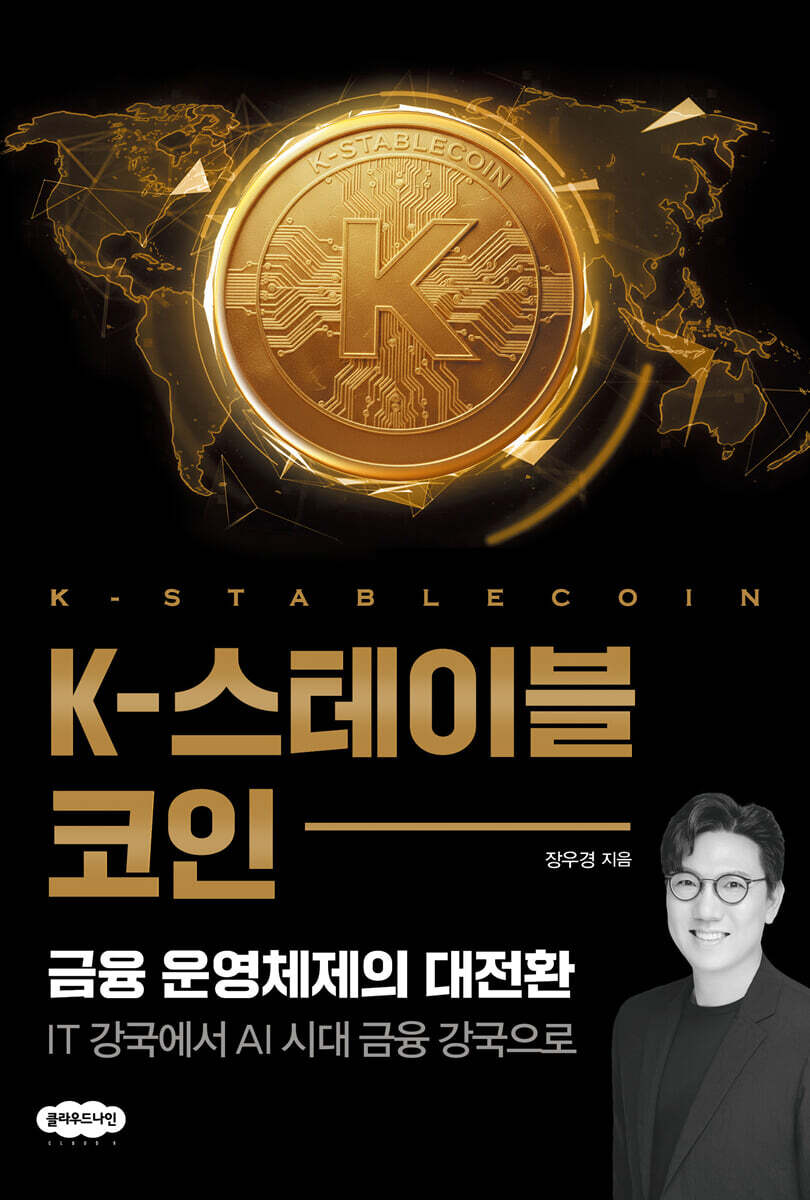
K-Stablecoins: A Revolutionary Transformation of the Financial System
 |
Description
Book Introduction
K-Stablecoin is not just a simple digital currency.
A financial operating system that connects payments, remittances, investments, insurance, and loans!
In short, this book is a strategic declaration that "Korea must leap forward as a financial powerhouse with a won stablecoin."
As dollar stablecoins dominate the global financial infrastructure, if Korea falls behind, the won risks being relegated to a local currency used only within the country.
The author emphasizes that K-stablecoins are no longer a technology but a national strategy, emphasizing that they are "a survival strategy for the Korean won in an era where currency borders are collapsing."
The starting point of this book is clear.
The reality is that the whole world has entered a new monetary order called the 'Money Reset' or the 'New Money Order'.
The US has institutionalized dollar stablecoins through the Genius Act, and Europe and Japan are also accelerating the race for national digital currencies.
The author describes this pace of change as "the digital dollar redesigning the world," and emphasizes that now is the time for Korea to redefine its financial system.
In this book, the author views stablecoins not simply as coins, but as a Korean-style financial operating system.
It is proposed as an infrastructure that combines various financial systems such as cards, insurance, securities, and remittances into one and designs a completely new financial ecosystem based on four axes: data, trust, speed, and cost.
In other words, K-Stablecoin can become a Korean-style integrated financial operating system as the internet of finance and the invisible infrastructure of finance.
The greatest strength of this book is that it is not a technical document, but a roadmap for a major financial transformation that contains a vision and implementation strategy.
This is the first attempt to view stablecoins not as investment vehicles but as a "new financial operating system," offering a national-level solution by multi-dimensionally connecting technology, policy, and economics.
The author argues that South Korea, which has grown into an IT powerhouse, must now expand its technological capabilities into the financial sector and leap forward as a "financial operating system powerhouse."
The significance of this book can be summarized in three points.
First, we examine stablecoins from the perspective of the entire financial system, weaving monetary hegemony and national strategy into a single narrative.
Second, it objectively examines the causes of past digital finance failures and presents feasible alternatives.
Third, we presented an integrated vision encompassing technology, policy, economy, and future industries.
This is a must-read strategy book for Korea to leap from an IT powerhouse to a financial powerhouse.
The author declares that “K-stablecoins are the key to unlocking the future of Korean finance.”
In this era of digital dollar rearmament, the country that takes the lead in this money reset will seize financial hegemony in the next century.
A financial operating system that connects payments, remittances, investments, insurance, and loans!
In short, this book is a strategic declaration that "Korea must leap forward as a financial powerhouse with a won stablecoin."
As dollar stablecoins dominate the global financial infrastructure, if Korea falls behind, the won risks being relegated to a local currency used only within the country.
The author emphasizes that K-stablecoins are no longer a technology but a national strategy, emphasizing that they are "a survival strategy for the Korean won in an era where currency borders are collapsing."
The starting point of this book is clear.
The reality is that the whole world has entered a new monetary order called the 'Money Reset' or the 'New Money Order'.
The US has institutionalized dollar stablecoins through the Genius Act, and Europe and Japan are also accelerating the race for national digital currencies.
The author describes this pace of change as "the digital dollar redesigning the world," and emphasizes that now is the time for Korea to redefine its financial system.
In this book, the author views stablecoins not simply as coins, but as a Korean-style financial operating system.
It is proposed as an infrastructure that combines various financial systems such as cards, insurance, securities, and remittances into one and designs a completely new financial ecosystem based on four axes: data, trust, speed, and cost.
In other words, K-Stablecoin can become a Korean-style integrated financial operating system as the internet of finance and the invisible infrastructure of finance.
The greatest strength of this book is that it is not a technical document, but a roadmap for a major financial transformation that contains a vision and implementation strategy.
This is the first attempt to view stablecoins not as investment vehicles but as a "new financial operating system," offering a national-level solution by multi-dimensionally connecting technology, policy, and economics.
The author argues that South Korea, which has grown into an IT powerhouse, must now expand its technological capabilities into the financial sector and leap forward as a "financial operating system powerhouse."
The significance of this book can be summarized in three points.
First, we examine stablecoins from the perspective of the entire financial system, weaving monetary hegemony and national strategy into a single narrative.
Second, it objectively examines the causes of past digital finance failures and presents feasible alternatives.
Third, we presented an integrated vision encompassing technology, policy, economy, and future industries.
This is a must-read strategy book for Korea to leap from an IT powerhouse to a financial powerhouse.
The author declares that “K-stablecoins are the key to unlocking the future of Korean finance.”
In this era of digital dollar rearmament, the country that takes the lead in this money reset will seize financial hegemony in the next century.
- You can preview some of the book's contents.
Preview
index
Introduction: Will Korea Join the Currency Hegemony War or Just Watch?
Chapter 1: Why Should K-Stablecoins Be Issued?
The advent of the Genius Act has ushered in a money reset.
The passage of the US Genius Act is a declaration of digital currency design. / Dollar stablecoins are a tool to strengthen dollar hegemony. / Without a won stablecoin, it will become a local currency. / The gunshots of a new currency hegemony competition have already rang out around the world.
Naver and Dunamu have become the signal for K-stablecoins.
What's the real meaning of Naver and Dunamu's merger? / K-stablecoins are a tool for expanding the won's monetary sovereignty and survival.
The battle for supremacy over stablecoins is heating up.
Who will be the first to create a successful K-stablecoin? / Big tech companies around the world are jumping into the money reset race. / Who will win the global stablecoin war? / K-stablecoins are essential tools for defense, offense, and survival.
Chapter 2: Becoming a Financial Powerhouse with K-Stablecoins
Let's take K-Stablecoin to the global stage.
This is an opportunity for South Korea to leap from a manufacturing powerhouse to a financial powerhouse, and it could become a major currency in the Korean Wave economic sphere and Asia.
CBDCs and stablecoins are a fantastic duo.
CBDCs and private stablecoins are complementary. The strengths of the Bank of Korea and private stablecoins should be combined.
K-Stablecoin Challenges Korea's SiFi Model
K-Stablecoins are ushering finance into a fully-fledged world of bits. A Korean-style SiFi model aims to become the key currency for Asia's digital economy.
Chapter 3: How K-Stablecoins Are Changing Finance
Card Companies: The Era of Real-Time Settlement
Card issuers can be game changers.
Insurance Companies: The Emergence of Sub-Second-Cycle Coverage
The insurance industry is shifting from product-centric to customer-centric. Insurance must evolve into a risk management platform.
Securities firms: 24-hour open markets
Token securities enable global distribution and real-time settlement. Hyper-personalized digital wrap accounts become a reality.
Exchanges: New Capital Markets
Digital asset exchanges will become comprehensive financial platforms, creating new capital markets as core infrastructure for the token economy.
All financial integration: one giant river
A complete overhaul of the fundamental financial infrastructure is underway. K-Stablecoin will become the unified operating system for all finance.
Map of the New Alliance
The Korean financial industry is entering a new era of mergers and acquisitions.
Chapter 4: K-Stablecoins Are Useful in the Agent Economy
The machine started making money
The machine economy maximizes the benefits of K-stablecoins / Stablecoins become the financial arms and legs of AI agents.
Hyperautomation × Hyperpersonalization × Hyperconnectivity = Financial Hyperinnovation
The evolution of artificial intelligence is creating massive waves in financial services. K-stablecoins could become a key foundation for hyper-connected finance.
A new partnership is being created in the agent economy.
In the era of autonomous finance, humans become both supervisors and designers. / In the financial ecosystem, humans remain the final sovereigns of finance.
Chapter 5: Bitcoin Gave Birth to the Coin Economy
A nine-page document that shook 500 years of financial history.
A completely different trust system from the existing financial system is emerging / Bitcoin is a currency created without a government or central bank.
Bitcoin has been portrayed as digital gold.
Bitcoin was born as a currency, but it became an investment asset. / Bitcoin went from being the "currency of freedom" to the "gold of the establishment."
Experiments Beyond Bitcoin Continue
Blockchain is a massive experiment, exploring diverse possibilities. Stablecoins connect blockchain and institutional finance.
Chapter 6: What Stablecoins Have Done in the Past 10 Years
Stablecoins are stable and
A sandbox currency with innovative potential / How do stablecoins differ from blockchain? / From digital currency to complex financial infrastructure.
Digital trust is a structure, not a slogan.
Lessons from the Tether, Luna, and USDCoin experiments: Transparent reserve management, security, and architectural compliance are crucial.
It becomes the operating system that operates all financial products.
How do regulations differ in the US, Europe, Japan, and Singapore? Stablecoins provide a stable means of transmitting information and value.
Chapter 7: Why Digital Finance Innovation Is Half-Finished
Fintech was innovative, but it had limitations.
Why Fintech Hasn't Completely Revolutionized Finance / K-Stablecoins Complete the Potential of Fintech
Internet banking was also a traditional financial system.
Internet banking has eliminated the constraints of time and space with a single click. Digital banking has enabled all transactions to be processed digitally. A financial operating system based on K-stablecoins is needed.
Mobile payments were convenient, but they created trust issues.
Mobile payments have turned smartphones into wallets, and financial apps have created data silos, deepening fragmentation.
Why Finance Is Siloed and Fragmented
The banking system is reverting to COBOL, a language from 40 years ago. / The Korean financial system is divided into functional and industry-specific areas.
Chapter 8: DeFi: Moving Toward New Possibilities
K-Stablecoins are a bridge between SiFi and DeFi.
Why DeFi Hasn't Become Mainstream Finance / K-Stablecoins Connect the Reality and Ideals of Finance
Strengthening economic sovereignty in a multipolar world order
K-stablecoins are essential for monetary sovereignty / Attempts to break away from the dollar-centric order continue.
Let's set sail from SiFi to DeFi.
How K-Stablecoins Will Become Global Assets / Ride the Huge Wave That Will Change the Financial Order
Chapter 9: Ultimately, finance is all about trust!
What people believe makes money
The essence of money is agreement and trust, not practicality.
Towards a new trust system
Financial innovation has been an opportunity for some and a shackle for others. / Let's consider who, how, and for whom trust is created.
Epilogue
In Seoul in 2030
Glossary of Terms
References
Chapter 1: Why Should K-Stablecoins Be Issued?
The advent of the Genius Act has ushered in a money reset.
The passage of the US Genius Act is a declaration of digital currency design. / Dollar stablecoins are a tool to strengthen dollar hegemony. / Without a won stablecoin, it will become a local currency. / The gunshots of a new currency hegemony competition have already rang out around the world.
Naver and Dunamu have become the signal for K-stablecoins.
What's the real meaning of Naver and Dunamu's merger? / K-stablecoins are a tool for expanding the won's monetary sovereignty and survival.
The battle for supremacy over stablecoins is heating up.
Who will be the first to create a successful K-stablecoin? / Big tech companies around the world are jumping into the money reset race. / Who will win the global stablecoin war? / K-stablecoins are essential tools for defense, offense, and survival.
Chapter 2: Becoming a Financial Powerhouse with K-Stablecoins
Let's take K-Stablecoin to the global stage.
This is an opportunity for South Korea to leap from a manufacturing powerhouse to a financial powerhouse, and it could become a major currency in the Korean Wave economic sphere and Asia.
CBDCs and stablecoins are a fantastic duo.
CBDCs and private stablecoins are complementary. The strengths of the Bank of Korea and private stablecoins should be combined.
K-Stablecoin Challenges Korea's SiFi Model
K-Stablecoins are ushering finance into a fully-fledged world of bits. A Korean-style SiFi model aims to become the key currency for Asia's digital economy.
Chapter 3: How K-Stablecoins Are Changing Finance
Card Companies: The Era of Real-Time Settlement
Card issuers can be game changers.
Insurance Companies: The Emergence of Sub-Second-Cycle Coverage
The insurance industry is shifting from product-centric to customer-centric. Insurance must evolve into a risk management platform.
Securities firms: 24-hour open markets
Token securities enable global distribution and real-time settlement. Hyper-personalized digital wrap accounts become a reality.
Exchanges: New Capital Markets
Digital asset exchanges will become comprehensive financial platforms, creating new capital markets as core infrastructure for the token economy.
All financial integration: one giant river
A complete overhaul of the fundamental financial infrastructure is underway. K-Stablecoin will become the unified operating system for all finance.
Map of the New Alliance
The Korean financial industry is entering a new era of mergers and acquisitions.
Chapter 4: K-Stablecoins Are Useful in the Agent Economy
The machine started making money
The machine economy maximizes the benefits of K-stablecoins / Stablecoins become the financial arms and legs of AI agents.
Hyperautomation × Hyperpersonalization × Hyperconnectivity = Financial Hyperinnovation
The evolution of artificial intelligence is creating massive waves in financial services. K-stablecoins could become a key foundation for hyper-connected finance.
A new partnership is being created in the agent economy.
In the era of autonomous finance, humans become both supervisors and designers. / In the financial ecosystem, humans remain the final sovereigns of finance.
Chapter 5: Bitcoin Gave Birth to the Coin Economy
A nine-page document that shook 500 years of financial history.
A completely different trust system from the existing financial system is emerging / Bitcoin is a currency created without a government or central bank.
Bitcoin has been portrayed as digital gold.
Bitcoin was born as a currency, but it became an investment asset. / Bitcoin went from being the "currency of freedom" to the "gold of the establishment."
Experiments Beyond Bitcoin Continue
Blockchain is a massive experiment, exploring diverse possibilities. Stablecoins connect blockchain and institutional finance.
Chapter 6: What Stablecoins Have Done in the Past 10 Years
Stablecoins are stable and
A sandbox currency with innovative potential / How do stablecoins differ from blockchain? / From digital currency to complex financial infrastructure.
Digital trust is a structure, not a slogan.
Lessons from the Tether, Luna, and USDCoin experiments: Transparent reserve management, security, and architectural compliance are crucial.
It becomes the operating system that operates all financial products.
How do regulations differ in the US, Europe, Japan, and Singapore? Stablecoins provide a stable means of transmitting information and value.
Chapter 7: Why Digital Finance Innovation Is Half-Finished
Fintech was innovative, but it had limitations.
Why Fintech Hasn't Completely Revolutionized Finance / K-Stablecoins Complete the Potential of Fintech
Internet banking was also a traditional financial system.
Internet banking has eliminated the constraints of time and space with a single click. Digital banking has enabled all transactions to be processed digitally. A financial operating system based on K-stablecoins is needed.
Mobile payments were convenient, but they created trust issues.
Mobile payments have turned smartphones into wallets, and financial apps have created data silos, deepening fragmentation.
Why Finance Is Siloed and Fragmented
The banking system is reverting to COBOL, a language from 40 years ago. / The Korean financial system is divided into functional and industry-specific areas.
Chapter 8: DeFi: Moving Toward New Possibilities
K-Stablecoins are a bridge between SiFi and DeFi.
Why DeFi Hasn't Become Mainstream Finance / K-Stablecoins Connect the Reality and Ideals of Finance
Strengthening economic sovereignty in a multipolar world order
K-stablecoins are essential for monetary sovereignty / Attempts to break away from the dollar-centric order continue.
Let's set sail from SiFi to DeFi.
How K-Stablecoins Will Become Global Assets / Ride the Huge Wave That Will Change the Financial Order
Chapter 9: Ultimately, finance is all about trust!
What people believe makes money
The essence of money is agreement and trust, not practicality.
Towards a new trust system
Financial innovation has been an opportunity for some and a shackle for others. / Let's consider who, how, and for whom trust is created.
Epilogue
In Seoul in 2030
Glossary of Terms
References
Detailed image
Into the book
Korea is one of the world's top 10 economies.
Samsung achieved global leadership in semiconductors, Hyundai in automobiles, POSCO in steel, and LG in displays.
But even during the 1997 foreign exchange crisis and the 2008 global financial crisis, we were helpless in the face of finance.
The won was treated as an emerging market currency, and Seoul lacked the status of a financial hub. No Korean financial institution rivaled JP Morgan, Goldman Sachs, or Citigroup.
What if Korea had also been a financial powerhouse? What if the won had been Asia's primary international settlement currency? Korea's international standing would have been completely different.
Paradoxically, I found hope in the ruins of the financial crisis.
It was fintech.
As traditional finance collapsed, technology began to redefine finance.
PayPal was revolutionizing money transfers, and Square was changing payments.
That's when I realized.
That Korea has a chance.
In finance, we may not be able to catch up with the US, but at the intersection of finance and technology, things may be different.
World-class ultra-high-speed internet, smartphone penetration, and digital infrastructure.
I believed that with Korea's technological prowess, it could achieve its dream of becoming a financial powerhouse through fintech.
--- p.6
“A dollar stablecoin could be a tool to strengthen, rather than threaten, dollar hegemony.”
This is the conclusion reached by a research team under the Treasury Department in the spring of 2024 after a year of in-depth analysis.
The requirement for stablecoin issuers to hold reserves of dollars and US Treasuries equivalent to the tokens they issue meant that a corresponding amount of demand for dollars was created.
Moreover, the dollar's influence could explode as 1.7 billion people around the world without bank accounts could now access dollars using just their smartphones.
The analysis suggested that stablecoins could play a similar role, just as the Eurodollar market in the 1960s strengthened the dollar's international standing.
Full-scale legislative work began in the summer of 2024, with Republicans and Democrats demonstrating rare bipartisan cooperation.
The core of the Genius Act, which was finally passed after dozens of amendments, was clear.
Stablecoin issuers would need to obtain government approval, hold reserves equivalent to the tokens issued in US Treasury bonds and US dollars, and undergo regular audits and disclosure obligations.
An insurance system was also introduced to protect consumers.
--- p.23~24
Looking at the global situation, each country has a different approach.
China successfully piloted its digital yuan at the Beijing Winter Olympics, securing its position as a leading country in CBDC (central bank digital currency).
The European Central Bank is set to decide on a digital euro by 2026, with a focus on balancing privacy and innovation.
The US is attempting a roundabout approach with a real-time payment system called FedNow, while simultaneously establishing a regulatory framework for private stablecoins.
Japan is taking a similar approach to Korea.
Singapore is focusing on a wholesale CBDC (Central Bank Digital Currency) while providing an innovation-friendly regulatory environment for private stablecoins.
The Bank of Korea began full-scale research on CBDC (Central Bank Digital Currency) in 2020.
--- p.63
Private stablecoins serve as the "fuel" of the digital economy.
It is a tool for innovation and expansion.
It is used in all digital economic activities, including global remittances, digital asset trading, DeFi (decentralized finance), and NFTs.
Companies are issuing K-stablecoins, building ecosystems, and expanding globally. They maintain their value based on CBDC (Central Bank Digital Currency) and can be exchanged for CBDC at any time.
This fuels the economy and accelerates the rapid growth of the digital economy.
This structure is called a two-tier system.
On the first floor, there is CBDC (Central Bank Digital Currency).
It is issued directly by the Bank of Korea, can be held by any citizen, and is used for small transactions and everyday payments.
Value stability is 100% guaranteed and operates primarily domestically.
On the second floor, there are private stablecoins.
Issued by regulated private companies, these can include banks, credit card companies, securities firms, or companies like Toss, Naver, or Kakao. They are 100% collateralized by CBDC (central bank digital currency) or bank deposits and are used for global transactions, digital asset trading, and large-scale transactions.
We operate globally, pursuing innovation and ecosystem expansion.
--- p.67
K-Stablecoin is a common payment method that connects all tokenized financial products.
But issuance alone is not enough to realize this vision.
For stablecoins to truly flow and create value, collaboration among players across all sectors of finance is essential.
It's virtually impossible for banks to build a stablecoin ecosystem on their own.
This is because although the issuance is done by the bank, distribution and utilization require the infrastructure of other players.
Reaching 20 million people requires more than just a banking app.
For payment, you need a card company, for investment, you need a securities company, and for cryptocurrency trading, you need an exchange.
Banks create money, but the rivers through which it flows are sold by others.
At this point, the Korean financial industry enters a new era of mergers and acquisitions.
The ecosystem competition centered around stablecoins is beginning.
And the outcome of this competition hinges on who can form the most effective alliance.
--- p.129~130
Korea also has the opportunity to participate in this global experiment.
K-stablecoins can offer a new model based on Korea's financial technology and regulatory expertise.
In particular, the advanced nature of K-banking, fast internet access, and high digital literacy provide favorable conditions for building a stablecoin ecosystem.
If we can create a model that simultaneously meets regulatory and innovation needs in remittance, payment, and investment infrastructure, a Korean stablecoin could become a global standard.
The important thing is to make good use of the lessons learned from previous experiments.
Meta's failure teaches us how important communication with regulators is.
The Terra-Luna incident demonstrated the dangers of excessive technological complexity.
The Tether controversy made me realize the need for transparency.
We can use these trials and errors as lessons to create a better model.
Samsung achieved global leadership in semiconductors, Hyundai in automobiles, POSCO in steel, and LG in displays.
But even during the 1997 foreign exchange crisis and the 2008 global financial crisis, we were helpless in the face of finance.
The won was treated as an emerging market currency, and Seoul lacked the status of a financial hub. No Korean financial institution rivaled JP Morgan, Goldman Sachs, or Citigroup.
What if Korea had also been a financial powerhouse? What if the won had been Asia's primary international settlement currency? Korea's international standing would have been completely different.
Paradoxically, I found hope in the ruins of the financial crisis.
It was fintech.
As traditional finance collapsed, technology began to redefine finance.
PayPal was revolutionizing money transfers, and Square was changing payments.
That's when I realized.
That Korea has a chance.
In finance, we may not be able to catch up with the US, but at the intersection of finance and technology, things may be different.
World-class ultra-high-speed internet, smartphone penetration, and digital infrastructure.
I believed that with Korea's technological prowess, it could achieve its dream of becoming a financial powerhouse through fintech.
--- p.6
“A dollar stablecoin could be a tool to strengthen, rather than threaten, dollar hegemony.”
This is the conclusion reached by a research team under the Treasury Department in the spring of 2024 after a year of in-depth analysis.
The requirement for stablecoin issuers to hold reserves of dollars and US Treasuries equivalent to the tokens they issue meant that a corresponding amount of demand for dollars was created.
Moreover, the dollar's influence could explode as 1.7 billion people around the world without bank accounts could now access dollars using just their smartphones.
The analysis suggested that stablecoins could play a similar role, just as the Eurodollar market in the 1960s strengthened the dollar's international standing.
Full-scale legislative work began in the summer of 2024, with Republicans and Democrats demonstrating rare bipartisan cooperation.
The core of the Genius Act, which was finally passed after dozens of amendments, was clear.
Stablecoin issuers would need to obtain government approval, hold reserves equivalent to the tokens issued in US Treasury bonds and US dollars, and undergo regular audits and disclosure obligations.
An insurance system was also introduced to protect consumers.
--- p.23~24
Looking at the global situation, each country has a different approach.
China successfully piloted its digital yuan at the Beijing Winter Olympics, securing its position as a leading country in CBDC (central bank digital currency).
The European Central Bank is set to decide on a digital euro by 2026, with a focus on balancing privacy and innovation.
The US is attempting a roundabout approach with a real-time payment system called FedNow, while simultaneously establishing a regulatory framework for private stablecoins.
Japan is taking a similar approach to Korea.
Singapore is focusing on a wholesale CBDC (Central Bank Digital Currency) while providing an innovation-friendly regulatory environment for private stablecoins.
The Bank of Korea began full-scale research on CBDC (Central Bank Digital Currency) in 2020.
--- p.63
Private stablecoins serve as the "fuel" of the digital economy.
It is a tool for innovation and expansion.
It is used in all digital economic activities, including global remittances, digital asset trading, DeFi (decentralized finance), and NFTs.
Companies are issuing K-stablecoins, building ecosystems, and expanding globally. They maintain their value based on CBDC (Central Bank Digital Currency) and can be exchanged for CBDC at any time.
This fuels the economy and accelerates the rapid growth of the digital economy.
This structure is called a two-tier system.
On the first floor, there is CBDC (Central Bank Digital Currency).
It is issued directly by the Bank of Korea, can be held by any citizen, and is used for small transactions and everyday payments.
Value stability is 100% guaranteed and operates primarily domestically.
On the second floor, there are private stablecoins.
Issued by regulated private companies, these can include banks, credit card companies, securities firms, or companies like Toss, Naver, or Kakao. They are 100% collateralized by CBDC (central bank digital currency) or bank deposits and are used for global transactions, digital asset trading, and large-scale transactions.
We operate globally, pursuing innovation and ecosystem expansion.
--- p.67
K-Stablecoin is a common payment method that connects all tokenized financial products.
But issuance alone is not enough to realize this vision.
For stablecoins to truly flow and create value, collaboration among players across all sectors of finance is essential.
It's virtually impossible for banks to build a stablecoin ecosystem on their own.
This is because although the issuance is done by the bank, distribution and utilization require the infrastructure of other players.
Reaching 20 million people requires more than just a banking app.
For payment, you need a card company, for investment, you need a securities company, and for cryptocurrency trading, you need an exchange.
Banks create money, but the rivers through which it flows are sold by others.
At this point, the Korean financial industry enters a new era of mergers and acquisitions.
The ecosystem competition centered around stablecoins is beginning.
And the outcome of this competition hinges on who can form the most effective alliance.
--- p.129~130
Korea also has the opportunity to participate in this global experiment.
K-stablecoins can offer a new model based on Korea's financial technology and regulatory expertise.
In particular, the advanced nature of K-banking, fast internet access, and high digital literacy provide favorable conditions for building a stablecoin ecosystem.
If we can create a model that simultaneously meets regulatory and innovation needs in remittance, payment, and investment infrastructure, a Korean stablecoin could become a global standard.
The important thing is to make good use of the lessons learned from previous experiments.
Meta's failure teaches us how important communication with regulators is.
The Terra-Luna incident demonstrated the dangers of excessive technological complexity.
The Tether controversy made me realize the need for transparency.
We can use these trials and errors as lessons to create a better model.
--- p.194
Publisher's Review
In the era of money reset, let's leap from an IT powerhouse to a financial powerhouse!
Presenting a vision for a Korean-style financial operating system through K-Stablecoins.
The world is now in the midst of a massive currency shift called the 'Money Reset'.
With the United States incorporating dollar stablecoins into its institutional framework, the global financial order has entered a completely new phase.
Money is no longer simply a means of payment.
It is now becoming a 'financial operating system' that operates around data, trust, speed, and connectivity.
Dollar stablecoins are becoming the standard language for international transactions, and Europe and Japan are also accelerating the institutionalization of stablecoins based on their own currencies.
This book presents the survival strategy that Korea must choose at this very turning point.
The author asserts that “if Korea fails to take the lead in this money reset, the won will remain a local currency used only within the country.”
K-Stablecoin is not a coin or financial product, but a national strategy to digitally expand the Korean won and connect the trust and network of the Korean economy to the world.
In other words, stablecoins are not a matter of technology, but of sovereignty, and the won stablecoin is a new operating system for building a Korean-style financial operating system.
The key point this book emphasizes is 'why now?'
The GENIUS Act, passed by the U.S. Congress, legalizes the issuance of dollar stablecoins, effectively formalizing the global expansion of the digital dollar.
This is not simply the emergence of a new currency, but rather a reorganization of sovereignty through financial infrastructure.
As the dollar becomes the dominant digital currency for international payments and asset transfers, each country's financial data and policies will inevitably become subordinate to the dollar ecosystem.
The author calls this “digital financial colonization” and warns, “If Korea doesn’t act now, the won will soon be pushed out of the global financial network.”
So how should Korea respond?
The author finds the answer in the ‘operationalization of finance.’
The current financial system is still fragmented and operates in a complex manner within different systems, including banking, credit cards, securities, insurance, and remittance.
The language of integration that breaks down this silo structure is K-stablecoin.
He likens stablecoins to the invisible infrastructure of finance, saying, "Only when banks, fintech, and public institutions are connected through a single protocol will Korean financial innovation be complete."
The book then analyzes the already-emerging private sector initiatives, such as the merger of Naver and Dunamu and the expansion of Toss and Kakao, emphasizing that Korea possesses substantial digital competitiveness. With world-class IT infrastructure and data capabilities, Korea possesses the technological capabilities to implement a K-stablecoin.
However, the problem is that the government is not providing a clear direction and is leaving it as an area outside the system.
The author proposes a "hybrid financial model" where the public sector regulates and the private sector innovates, arguing that the Bank of Korea, the Financial Services Commission, and private companies should each share roles to swiftly establish a won-denominated stablecoin ecosystem.
Another strength of this book is its honest reflection on the failures of the past decade.
Bitcoin was too volatile to function as a practical currency, and the collapses of Terra and Luna showed how dangerous trustless experiments can be.
Fintech also operates on top of the existing banking system and has not achieved fundamental innovation.
The author attributes this failure to “lack of integration and lack of trust.”
Even as technology advances rapidly, the essence of finance ultimately lies in the 'institutionalization of trust.'
Stablecoins are a tool that can technically design that trust, and they are not simply volatility stabilization devices, but protocols of trust.
The author presents specific examples of practical changes possible through K-stablecoins.
An integrated financial environment will be created where deposits, payments, remittances, and investments all operate on a single protocol, increasing the efficiency of overseas remittances and trade settlements, and establishing a blockchain-based real-time investment and insurance system.
Furthermore, it is anticipated that the Korean won's influence will expand through the cultural industry as K-stablecoins function as a new payment infrastructure in the content, gaming, and K-culture industries.
The latter part of the book explores the future economic changes that K-stablecoins will bring about through their combination with artificial intelligence.
In a hyper-automated world where AI autonomously handles payments and investments, stablecoins become a financial language that both humans and machines can trust.
The author defines this as the 'Agent Economy A2A, Agent-to-Agent' and explains that the future economy will move towards "an era where machines earn money instead of humans and execute financial transactions on their own."
K-Stablecoin is the language of our time, a foundation of common trust that enables humans and machines to transact together.
The author reestablishes trust at the heart of the debate surrounding stablecoins.
“Money is the institutionalization of trust, and the essence of finance is ultimately a question of how to design trust.” He emphasizes that technology is not replacing finance, but rather the process of implementing trust through technology is true innovation.
Therefore, K-Stablecoin is not a technical document, but a redesign of the social contract and an experiment in Korean-style trust infrastructure.
This book is not a technical book, but a national strategy book.
Stablecoins are both defensive and offensive weapons, a survival strategy that will transform IT powerhouses into financial powerhouses.
Having proven its global competitiveness in manufacturing and IT, Korea must now once again take the lead in the digitalization of finance.
The author says, “If we don’t act now, the won will disappear, but if we design it now, Korea could become the world’s first financial operating system powerhouse.”
Presenting a vision for a Korean-style financial operating system through K-Stablecoins.
The world is now in the midst of a massive currency shift called the 'Money Reset'.
With the United States incorporating dollar stablecoins into its institutional framework, the global financial order has entered a completely new phase.
Money is no longer simply a means of payment.
It is now becoming a 'financial operating system' that operates around data, trust, speed, and connectivity.
Dollar stablecoins are becoming the standard language for international transactions, and Europe and Japan are also accelerating the institutionalization of stablecoins based on their own currencies.
This book presents the survival strategy that Korea must choose at this very turning point.
The author asserts that “if Korea fails to take the lead in this money reset, the won will remain a local currency used only within the country.”
K-Stablecoin is not a coin or financial product, but a national strategy to digitally expand the Korean won and connect the trust and network of the Korean economy to the world.
In other words, stablecoins are not a matter of technology, but of sovereignty, and the won stablecoin is a new operating system for building a Korean-style financial operating system.
The key point this book emphasizes is 'why now?'
The GENIUS Act, passed by the U.S. Congress, legalizes the issuance of dollar stablecoins, effectively formalizing the global expansion of the digital dollar.
This is not simply the emergence of a new currency, but rather a reorganization of sovereignty through financial infrastructure.
As the dollar becomes the dominant digital currency for international payments and asset transfers, each country's financial data and policies will inevitably become subordinate to the dollar ecosystem.
The author calls this “digital financial colonization” and warns, “If Korea doesn’t act now, the won will soon be pushed out of the global financial network.”
So how should Korea respond?
The author finds the answer in the ‘operationalization of finance.’
The current financial system is still fragmented and operates in a complex manner within different systems, including banking, credit cards, securities, insurance, and remittance.
The language of integration that breaks down this silo structure is K-stablecoin.
He likens stablecoins to the invisible infrastructure of finance, saying, "Only when banks, fintech, and public institutions are connected through a single protocol will Korean financial innovation be complete."
The book then analyzes the already-emerging private sector initiatives, such as the merger of Naver and Dunamu and the expansion of Toss and Kakao, emphasizing that Korea possesses substantial digital competitiveness. With world-class IT infrastructure and data capabilities, Korea possesses the technological capabilities to implement a K-stablecoin.
However, the problem is that the government is not providing a clear direction and is leaving it as an area outside the system.
The author proposes a "hybrid financial model" where the public sector regulates and the private sector innovates, arguing that the Bank of Korea, the Financial Services Commission, and private companies should each share roles to swiftly establish a won-denominated stablecoin ecosystem.
Another strength of this book is its honest reflection on the failures of the past decade.
Bitcoin was too volatile to function as a practical currency, and the collapses of Terra and Luna showed how dangerous trustless experiments can be.
Fintech also operates on top of the existing banking system and has not achieved fundamental innovation.
The author attributes this failure to “lack of integration and lack of trust.”
Even as technology advances rapidly, the essence of finance ultimately lies in the 'institutionalization of trust.'
Stablecoins are a tool that can technically design that trust, and they are not simply volatility stabilization devices, but protocols of trust.
The author presents specific examples of practical changes possible through K-stablecoins.
An integrated financial environment will be created where deposits, payments, remittances, and investments all operate on a single protocol, increasing the efficiency of overseas remittances and trade settlements, and establishing a blockchain-based real-time investment and insurance system.
Furthermore, it is anticipated that the Korean won's influence will expand through the cultural industry as K-stablecoins function as a new payment infrastructure in the content, gaming, and K-culture industries.
The latter part of the book explores the future economic changes that K-stablecoins will bring about through their combination with artificial intelligence.
In a hyper-automated world where AI autonomously handles payments and investments, stablecoins become a financial language that both humans and machines can trust.
The author defines this as the 'Agent Economy A2A, Agent-to-Agent' and explains that the future economy will move towards "an era where machines earn money instead of humans and execute financial transactions on their own."
K-Stablecoin is the language of our time, a foundation of common trust that enables humans and machines to transact together.
The author reestablishes trust at the heart of the debate surrounding stablecoins.
“Money is the institutionalization of trust, and the essence of finance is ultimately a question of how to design trust.” He emphasizes that technology is not replacing finance, but rather the process of implementing trust through technology is true innovation.
Therefore, K-Stablecoin is not a technical document, but a redesign of the social contract and an experiment in Korean-style trust infrastructure.
This book is not a technical book, but a national strategy book.
Stablecoins are both defensive and offensive weapons, a survival strategy that will transform IT powerhouses into financial powerhouses.
Having proven its global competitiveness in manufacturing and IT, Korea must now once again take the lead in the digitalization of finance.
The author says, “If we don’t act now, the won will disappear, but if we design it now, Korea could become the world’s first financial operating system powerhouse.”
GOODS SPECIFICS
- Date of issue: November 11, 2025
- Page count, weight, size: 304 pages | 152*225*30mm
- ISBN13: 9791194534457
- ISBN10: 1194534457
You may also like
카테고리
korean


korean

![GQ KOREA Mark (Monthly): December [2025]](http://librairie.coreenne.fr/cdn/shop/files/8ef265dbbfbf186523ed75ba7319009d.jpg?v=1765340328&width=3840)


