![Seoul Review of Books (Quarterly): Issue 19 [2025]](http://librairie.coreenne.fr/cdn/shop/files/8b4834ad4d2f9926ef5900b2c597ce9b.jpg?v=1765346143&width=3840)

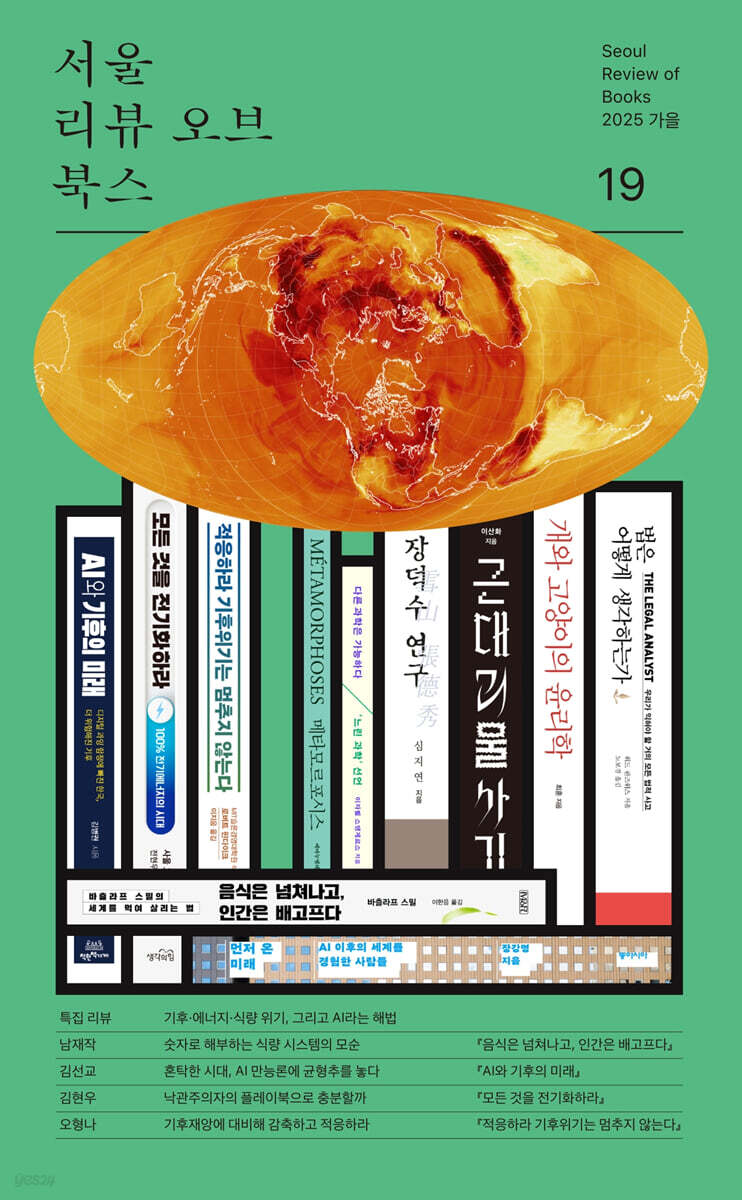
Seoul Review of Books (Quarterly): Issue 19 [2025]
 |
Description
Book Introduction
Four book reviews delving into the diverse issues of the climate crisis.
Special Review: Climate, Energy, and Food Crises, and AI as a Solution
From the AI era seen through Go to the problems of rapid science,
'Review' answers a wide range of questions
The special topic of the 19th issue (Fall 2025) of Seoul Review of Books is 'Climate, Energy, and Food Crises, and AI as a Solution.'
The climate, energy, and food crises facing humanity today are not separate crises.
In particular, AI technology is seen as both a factor in the crisis and a tool for solutions and innovation.
Editor-in-Chief Seok-Jun Kwon said, “The average temperature of the Earth has already exceeded the threshold set by the 2015 Paris Climate Agreement—a rise of 1.5 degrees Celsius compared to pre-industrial times—by the end of 2024, and (…) the Earth is getting hotter day by day, and it has been so until now, but it is highly likely that it will irreversibly change not only the climate, but also food, energy, and even our daily lives.”
The climate crisis caused by such rapid temperature rise is causing serious disruption to food and energy systems, which shows that the climate crisis should be viewed not as a simple environmental issue but as a comprehensive crisis that threatens the sustainability of civilization.
In this context, AI technology is attracting attention as an innovative tool to overcome the crisis facing humanity. However, it also carries the risk of exacerbating the crisis, as data centers require massive amounts of energy and significantly increase carbon emissions in the process.
Seok-Jun Kwon says, “Perhaps we should focus not on the superficial appearance of technology, but on the already ongoing climate, energy, and food crises and the complex interactions they will have on technological progress.”
Accordingly, the editorial board of Seoul Review of Books examines the various aspects and intersections of the climate crisis through the special topic, “Climate, Energy, and Food Crises, and AI as a Solution.”
The four book reviews address the following topics: “The Problems of the Food System,” “AI Technology and the Future of Climate,” “The Future of Energy,” and “The Need for Reduction and Adaptation.”
Agricultural scientist Nam Jae-jak reviews Vaclav Smil's "Food is Plenty, People Are Hungry" which examines the problems of the food system based on massive statistics and data; energy engineer Kim Seon-gyo reviews Kim Byeong-gwon's "AI and the Future of Climate" which reflects on the connection between digital transformation and ecological transformation; degrowth researcher Kim Hyeon-woo reviews Saul Griffiths' "Electrify Everything" which examines a future converted to 100% electric energy; and international scholar Oh Hyeong-na reviews Robert Findijk's "Adapt: The Climate Crisis Won't Stop" which argues that the climate crisis must be addressed through reduction and adaptation.
In the review corner, we select books that address different issues and introduce them to readers.
Literacy researcher Kim Seong-woo reads Jang Kang-myeong's "The Future That Came First," which examines the world of Go after the match between AlphaGo and Lee Se-dol, and raises a counterargument to the anxiety caused by AI and technological development.
Cartoonist Seonwoo Hoon points out that monsters are becoming increasingly close to our daily lives, disguised as science, through Lee Sang-hwa's "Modern Monster Fraud," which delves into incidents involving modern monsters.
Editorial board member Yoo Jeong-hoon reads Ward Farnsworth's "How the Law Thinks," which introduces various legal tools, and emphasizes that we can escape extreme thinking by keeping in mind how the law thinks.
In addition, in the Imago Mundi corner, editorial member Kim Hong-joong examines the metaphors of ‘repetition’ and ‘resurrection’ contained in the early thoughts of scientific anthropologist Bruno Latour through the cinema of Hungarian film director Miklós Jancsó.
In the Design Review corner, book designer Jin-gyu Choi shares his thoughts on 'open publishing' through the exhibition 'Publishing as an Event: Publications as an Open Process', and in the Book & Maker corner, Jae-wook Kim, who was in charge of the selection process for the 'Best Book of the 21st Century' recently conducted by the online bookstore Aladdin, shares his thoughts.
Special Review: Climate, Energy, and Food Crises, and AI as a Solution
From the AI era seen through Go to the problems of rapid science,
'Review' answers a wide range of questions
The special topic of the 19th issue (Fall 2025) of Seoul Review of Books is 'Climate, Energy, and Food Crises, and AI as a Solution.'
The climate, energy, and food crises facing humanity today are not separate crises.
In particular, AI technology is seen as both a factor in the crisis and a tool for solutions and innovation.
Editor-in-Chief Seok-Jun Kwon said, “The average temperature of the Earth has already exceeded the threshold set by the 2015 Paris Climate Agreement—a rise of 1.5 degrees Celsius compared to pre-industrial times—by the end of 2024, and (…) the Earth is getting hotter day by day, and it has been so until now, but it is highly likely that it will irreversibly change not only the climate, but also food, energy, and even our daily lives.”
The climate crisis caused by such rapid temperature rise is causing serious disruption to food and energy systems, which shows that the climate crisis should be viewed not as a simple environmental issue but as a comprehensive crisis that threatens the sustainability of civilization.
In this context, AI technology is attracting attention as an innovative tool to overcome the crisis facing humanity. However, it also carries the risk of exacerbating the crisis, as data centers require massive amounts of energy and significantly increase carbon emissions in the process.
Seok-Jun Kwon says, “Perhaps we should focus not on the superficial appearance of technology, but on the already ongoing climate, energy, and food crises and the complex interactions they will have on technological progress.”
Accordingly, the editorial board of Seoul Review of Books examines the various aspects and intersections of the climate crisis through the special topic, “Climate, Energy, and Food Crises, and AI as a Solution.”
The four book reviews address the following topics: “The Problems of the Food System,” “AI Technology and the Future of Climate,” “The Future of Energy,” and “The Need for Reduction and Adaptation.”
Agricultural scientist Nam Jae-jak reviews Vaclav Smil's "Food is Plenty, People Are Hungry" which examines the problems of the food system based on massive statistics and data; energy engineer Kim Seon-gyo reviews Kim Byeong-gwon's "AI and the Future of Climate" which reflects on the connection between digital transformation and ecological transformation; degrowth researcher Kim Hyeon-woo reviews Saul Griffiths' "Electrify Everything" which examines a future converted to 100% electric energy; and international scholar Oh Hyeong-na reviews Robert Findijk's "Adapt: The Climate Crisis Won't Stop" which argues that the climate crisis must be addressed through reduction and adaptation.
In the review corner, we select books that address different issues and introduce them to readers.
Literacy researcher Kim Seong-woo reads Jang Kang-myeong's "The Future That Came First," which examines the world of Go after the match between AlphaGo and Lee Se-dol, and raises a counterargument to the anxiety caused by AI and technological development.
Cartoonist Seonwoo Hoon points out that monsters are becoming increasingly close to our daily lives, disguised as science, through Lee Sang-hwa's "Modern Monster Fraud," which delves into incidents involving modern monsters.
Editorial board member Yoo Jeong-hoon reads Ward Farnsworth's "How the Law Thinks," which introduces various legal tools, and emphasizes that we can escape extreme thinking by keeping in mind how the law thinks.
In addition, in the Imago Mundi corner, editorial member Kim Hong-joong examines the metaphors of ‘repetition’ and ‘resurrection’ contained in the early thoughts of scientific anthropologist Bruno Latour through the cinema of Hungarian film director Miklós Jancsó.
In the Design Review corner, book designer Jin-gyu Choi shares his thoughts on 'open publishing' through the exhibition 'Publishing as an Event: Publications as an Open Process', and in the Book & Maker corner, Jae-wook Kim, who was in charge of the selection process for the 'Best Book of the 21st Century' recently conducted by the online bookstore Aladdin, shares his thoughts.
- You can preview some of the book's contents.
Preview
index
In the editorial office ∥ Kwon Seok-jun
Feature Review: The Climate, Energy, and Food Crises, and AI as a Solution
The Food System Dissected by Numbers · 『Food Is Abundant, People Are Hungry』 ∥ Nam Jae-jak
In a Turbulent Age, Counterbalancing the AI Omnipotence Theory · 『AI and the Future of Climate』 ∥ Kim Seon-gyo
Is the Optimist's Playbook Enough? · Electrify Everything ∥ Kim Hyun-woo
Reduce and Adapt to Climate Disaster · Adapt: The Climate Crisis Never Ends ∥ Oh Hyeong-na
Imago Mundi
Latour of the Theater∥ Kim Hong-joong
Design Review
Choose Your Own Adventure ∥ Jin-gyu Choi
Book & Maker
Lost in the List of Static Powers ∥ Kim Jae-wook
review
The Utopia of Artificial Intelligence, the Dystopia of Humanity · The Future That Came First ∥ Kim Seong-woo
Confessions of a Modern Man · 『Modern Monster Fraud』 ∥ Seonwoo Hoon
Dogs and Cats: Who Are They? · 『Ethics of Dogs and Cats』 ∥ Eom Seong-woo
How the Law Thinks and How People React · 『How the Law Thinks』 ∥ Yoo Jeong-hoon
Deliberations on the Practice of Rapid Science · 『Other Sciences Are Possible: A Declaration of 'Slow Science'』 ∥ Jeon Kwang-wook
Thinking Metamorphotically · 『Metamorphosis』 ∥ Lee Du-eun
The (Im)possibility of Colonial Politics · 『A Study of Jang Deok-su』 ∥ Hong Jong-wook
literature
Chinese Literature and Taiwanese Literature ∥ Kim Taek-gyu
A Classic of Ecological Civilization, 『Samguk Yusa』∥ Woo Seok-young
I'm reading it now
New Bookshelves
Feature Review: The Climate, Energy, and Food Crises, and AI as a Solution
The Food System Dissected by Numbers · 『Food Is Abundant, People Are Hungry』 ∥ Nam Jae-jak
In a Turbulent Age, Counterbalancing the AI Omnipotence Theory · 『AI and the Future of Climate』 ∥ Kim Seon-gyo
Is the Optimist's Playbook Enough? · Electrify Everything ∥ Kim Hyun-woo
Reduce and Adapt to Climate Disaster · Adapt: The Climate Crisis Never Ends ∥ Oh Hyeong-na
Imago Mundi
Latour of the Theater∥ Kim Hong-joong
Design Review
Choose Your Own Adventure ∥ Jin-gyu Choi
Book & Maker
Lost in the List of Static Powers ∥ Kim Jae-wook
review
The Utopia of Artificial Intelligence, the Dystopia of Humanity · The Future That Came First ∥ Kim Seong-woo
Confessions of a Modern Man · 『Modern Monster Fraud』 ∥ Seonwoo Hoon
Dogs and Cats: Who Are They? · 『Ethics of Dogs and Cats』 ∥ Eom Seong-woo
How the Law Thinks and How People React · 『How the Law Thinks』 ∥ Yoo Jeong-hoon
Deliberations on the Practice of Rapid Science · 『Other Sciences Are Possible: A Declaration of 'Slow Science'』 ∥ Jeon Kwang-wook
Thinking Metamorphotically · 『Metamorphosis』 ∥ Lee Du-eun
The (Im)possibility of Colonial Politics · 『A Study of Jang Deok-su』 ∥ Hong Jong-wook
literature
Chinese Literature and Taiwanese Literature ∥ Kim Taek-gyu
A Classic of Ecological Civilization, 『Samguk Yusa』∥ Woo Seok-young
I'm reading it now
New Bookshelves
Detailed image

Into the book
The summer of 2025 may be the coolest summer humanity will ever experience.
No, now even the concept of the four seasons may be fading away.
(……) What we really need to be concerned about at this point is not the superficial appearance of the technology that many people are excited about, but the climate, energy, and food crises that are already underway, and the complex interactions that these will have on technological progress.
--- p.2~3, from Kwon Seok-jun's "In the Editorial Office"
Smil's message of solving problems through proven practices rather than excessive technological fantasies is also valid in Korea.
However, the way it is implemented must be redesigned to take into account low self-sufficiency rates, complex supply chains, and the inevitable need for food diplomacy.
I hope that one day, a book will be published that truly addresses the future food system from the perspective of a country whose self-sufficiency rate is bound to be low.
Only then will we be able to reinterpret Smil's data in a Korean context and propose our own solutions.
--- p.25~26, from Nam Jae-jak, “Dissecting the Food System’s Contradictions with Numbers”
"AI and the Future of Climate" is a book that fundamentally questions how we should embrace technological innovation driven by AI in the era of climate crisis.
We are determined to place a heavy weight on the discourse of a community enthusiastic about cutting-edge technology.
As the AI craze sweeps the globe and governments and capitalists around the world blindly rush to develop super-scale AI, this book's warnings become even more dire. While we are gripped by the anxiety that falling behind in the race for AI supremacy will leave us with no future, we must face the reality that the existential risk of that future itself disappearing in the face of climate catastrophe is often overlooked.
--- p.39, from Kim Seon-gyo's "In a Turbid Age, Putting a Balance on the AI Omnipotence Theory"
The message of this book is as clear as its title.
We must comprehensively and rapidly reduce greenhouse gases from fossil fuel combustion, and this can only be achieved by transitioning to carbon-free power sources and power-consuming devices.
(……) However, such a comprehensive transformation is difficult to achieve if left to the market and individual actors, so we must share the picture of the transformation and discuss all means that can promote or enforce it.
This is precisely the story the author is attempting to tell.
--- p.44, from Kim Hyun-woo's "Is the Optimist's Playbook Enough?"
The author wants to limit the temperature rise to 2 degrees, but if various calculations show that this is unlikely, he argues that instead of simply resigning ourselves to the fact that "there is nothing we can do," we "should begin to adapt."
Because the most realistic and effective way is to invest in adaptation.
--- p.61~62, from Oh Hyeong-na's "Reduce and Adapt to Prepare for Climate Disaster"
The image of the people depicted in “Red Psalm” is overwhelming.
Of course, in this film, the people are also shown as beings oppressed by those in power.
The powerlessness of the people leads to the disastrous results of defeat, humiliation, and even mass murder.
The people are defeated.
However, the power depicted in “Red Psalm” cannot completely subdue the weak people.
The people confront power with dance and song, with a vitality, cheerfulness, desire and beauty of unknown origin.
The confrontation itself continues.
The people are the beings of resurrection.
Even if you die, you will come back to life.
--- p.86, from Kim Hong-joong's "Latour of the Theater"
Aren't the trees in the forest also "publications"? Unless we limit publications to artificial achievements created by humans.
If we recognize both the creative environment and the creative stories as publications, then clouds and rivers are publications.
Furthermore, countless lives live by reading the clouds and rivers and writing their own existence within that world.
There will be someone who will read these traces again, and to him all of this will be read as a kind of publication.
When we perceive it this way, wouldn't publishing as an event, as a process, open our eyes to all conversations within the emerging world?
--- p.99, from Jin-gyu Choi's "Choose Your Own Adventure"
The question was posed to summarize a period in the 21st century, but the subtitle, “A book to remember, a book to be with,” had an aspect of implying continuity.
The list will continue to evolve and grow, never to be completed.
We asked questions, but it seemed like it wasn't an attempt to reach a conclusion, but rather an attempt to ask each other what questions we had.
A list of books with more people participating would create a more complex maze to navigate.
Just like last winter, when I heard the voices of political entities that had not been called out before amidst the crowds that filled the square.
The footsteps of the lost will open new paths beyond the paths designed by the algorithm.
--- p.112, from Kim Jae-wook's "Lost Among the List of Blackouts"
I believe that at the core of the new values that humanity must create is 'building a society where we can live well together even if we are not excellent.'
It ultimately aims for a world where ‘excellence’ and ‘difference’ are synonymous.
The concept of excellence will not easily disappear.
You'll dance better than I can imagine, and I'll be able to talk a little more about literacy than you.
But that might not be far from the idea that we are simply different, that humans are inherently diverse.
--- p.131, from Kim Seong-woo's "Artificial Intelligence's Utopia, Human Dystopia?"
"Modern monsters" were both fictions, a combination of the perceptions and imaginations of the people of the time, and realities with scientific basis. While modern monsters, such as UFOs, aliens, and chupacabras (blood-sucking monsters), intertwined with media, are not addressed, the appropriate distance of modernity may be a more appropriate way to reflect on the present.
Because we now live in an age where we believe that monsters, that is, the Other, are not hiding in some uncivilized place, but are hiding in our society in human form, and that only by eradicating them can our society truly be at peace.
--- p.135~136, from Seonwoo Hoon's "Confessions of a Modern Man"
The number of people keeping pets in our country has now exceeded 15 million, and among them, the presence of dogs and cats is overwhelming.
But do humans truly treat them ethically? We still control and dominate them, even though we regard them as "family" occupying the center of our living rooms.
Even if you kindly take your dog for a walk or mercifully wash it, it is ultimately the human's choice as the owner.
How should we treat these creatures, who straddle the line between love and dominance? Can dogs be both our friends and food? Do "butlers" truly protect cats' freedom?
--- p.147, from "Dogs and Cats, Who Are They?" by Seong-Woo Eom
The questions we should ask the law and lawyers are not necessarily about justice and fairness, what powers should be given to judges and prosecutors, or why some lawyers fight against injustice while others distort the law for personal gain.
We must ask what specific factors influence the behavior of the National Assembly, which makes laws, the government, which enforces laws, and the courts, which interpret and apply laws, and how people's incentives and behavior will change as laws and systems change.
--- p.166, from Yoo Jeong-hoon's "How Do Laws Think and How Do People React?"
A civilized scientist is not simply a cultured individual, but rather someone who has the ability to evaluate the results of innovation and participate in shaping public value.
Slow science is ultimately a proposal for a democratic practice that asks whether science can engage with other groups in new ways.
--- p.175~176, from Jeon Bang-wook, “Deliberation on the Practice of Rapid Science”
The message that 『Metamorphosis』 gives us is clear.
It means that we should no longer understand the world as a 'home'.
Life is not something that is settled or possessed, but rather it is constantly moving, transforming, and interpenetrating with one another.
The world we live in is a journey in progress, and within it, every being is a living 'cocoon' and a planet.
The experience of reading Kochia's book dismantles the image of the ecological 'home' we have long been accustomed to, and instead invites us into an endless wandering of thought.
And in the process of transformation that encompasses humans and non-humans, individuals and species, the Earth and the universe, it makes us look back at the meaning of ‘me’ once again.
--- p.187~188, from Lee Du-eun's "Metamorphotic Thinking"
Jang Deok-su's ideology and practice raise the weighty question of whether politics is possible in a colony.
His efforts toward individual development and social salvation were the continual undertone of our modern and contemporary history, which cannot be reduced to the conflict between colonization and decolonization, or left and right.
It's easy to be captivated by the brilliance of Syngman Rhee and Kim Gu, but perhaps Jang Deok-su was the true architect of the Republic of Korea, a nation steeped in glory and shame.
--- p.211, from Hong Jong-wook's "(Im)possibility in the Colonial Era"
During the Seoul International Book Fair, about ten Taiwanese publishers visited Paju Book City.
At that time, as a non-executive director of the Paju Book City Cultural Foundation, I had a Q&A session with them, and one of them asked, “Why are Taiwanese novels so popular in Korea?”
Instead of giving a detailed answer, I answered succinctly, “Taiwanese novels have filled the void left by Chinese novels in the Korean reading world.”
At that time, Taiwanese publishers all burst into laughter.
How did they understand what I said?
--- p.219~220, from Kim Taek-gyu's "Chinese Literature and Taiwanese Literature"
The idea of gradually giving up the space that humans have occupied to non-human beings is also an unacceptable idea to those who uphold human supremacy.
However, if you grew up reading the stories of 『Samguk Yusa』 or are steeped in the spirit of 『Samguk Yusa』, wouldn't your reaction be different?
No, shouldn't it be different?
This is because 『Samguk Yusa』 continuously contains thoughts and emotions that can create or serve as the basis for the norms of ecological civilization.
In fact, Koreans do not need to borrow the spiritual strength to open up an ecological civilization from abroad.
New materialism and object-oriented ontology are philosophies worth considering, but they are not essential for this land.
No, now even the concept of the four seasons may be fading away.
(……) What we really need to be concerned about at this point is not the superficial appearance of the technology that many people are excited about, but the climate, energy, and food crises that are already underway, and the complex interactions that these will have on technological progress.
--- p.2~3, from Kwon Seok-jun's "In the Editorial Office"
Smil's message of solving problems through proven practices rather than excessive technological fantasies is also valid in Korea.
However, the way it is implemented must be redesigned to take into account low self-sufficiency rates, complex supply chains, and the inevitable need for food diplomacy.
I hope that one day, a book will be published that truly addresses the future food system from the perspective of a country whose self-sufficiency rate is bound to be low.
Only then will we be able to reinterpret Smil's data in a Korean context and propose our own solutions.
--- p.25~26, from Nam Jae-jak, “Dissecting the Food System’s Contradictions with Numbers”
"AI and the Future of Climate" is a book that fundamentally questions how we should embrace technological innovation driven by AI in the era of climate crisis.
We are determined to place a heavy weight on the discourse of a community enthusiastic about cutting-edge technology.
As the AI craze sweeps the globe and governments and capitalists around the world blindly rush to develop super-scale AI, this book's warnings become even more dire. While we are gripped by the anxiety that falling behind in the race for AI supremacy will leave us with no future, we must face the reality that the existential risk of that future itself disappearing in the face of climate catastrophe is often overlooked.
--- p.39, from Kim Seon-gyo's "In a Turbid Age, Putting a Balance on the AI Omnipotence Theory"
The message of this book is as clear as its title.
We must comprehensively and rapidly reduce greenhouse gases from fossil fuel combustion, and this can only be achieved by transitioning to carbon-free power sources and power-consuming devices.
(……) However, such a comprehensive transformation is difficult to achieve if left to the market and individual actors, so we must share the picture of the transformation and discuss all means that can promote or enforce it.
This is precisely the story the author is attempting to tell.
--- p.44, from Kim Hyun-woo's "Is the Optimist's Playbook Enough?"
The author wants to limit the temperature rise to 2 degrees, but if various calculations show that this is unlikely, he argues that instead of simply resigning ourselves to the fact that "there is nothing we can do," we "should begin to adapt."
Because the most realistic and effective way is to invest in adaptation.
--- p.61~62, from Oh Hyeong-na's "Reduce and Adapt to Prepare for Climate Disaster"
The image of the people depicted in “Red Psalm” is overwhelming.
Of course, in this film, the people are also shown as beings oppressed by those in power.
The powerlessness of the people leads to the disastrous results of defeat, humiliation, and even mass murder.
The people are defeated.
However, the power depicted in “Red Psalm” cannot completely subdue the weak people.
The people confront power with dance and song, with a vitality, cheerfulness, desire and beauty of unknown origin.
The confrontation itself continues.
The people are the beings of resurrection.
Even if you die, you will come back to life.
--- p.86, from Kim Hong-joong's "Latour of the Theater"
Aren't the trees in the forest also "publications"? Unless we limit publications to artificial achievements created by humans.
If we recognize both the creative environment and the creative stories as publications, then clouds and rivers are publications.
Furthermore, countless lives live by reading the clouds and rivers and writing their own existence within that world.
There will be someone who will read these traces again, and to him all of this will be read as a kind of publication.
When we perceive it this way, wouldn't publishing as an event, as a process, open our eyes to all conversations within the emerging world?
--- p.99, from Jin-gyu Choi's "Choose Your Own Adventure"
The question was posed to summarize a period in the 21st century, but the subtitle, “A book to remember, a book to be with,” had an aspect of implying continuity.
The list will continue to evolve and grow, never to be completed.
We asked questions, but it seemed like it wasn't an attempt to reach a conclusion, but rather an attempt to ask each other what questions we had.
A list of books with more people participating would create a more complex maze to navigate.
Just like last winter, when I heard the voices of political entities that had not been called out before amidst the crowds that filled the square.
The footsteps of the lost will open new paths beyond the paths designed by the algorithm.
--- p.112, from Kim Jae-wook's "Lost Among the List of Blackouts"
I believe that at the core of the new values that humanity must create is 'building a society where we can live well together even if we are not excellent.'
It ultimately aims for a world where ‘excellence’ and ‘difference’ are synonymous.
The concept of excellence will not easily disappear.
You'll dance better than I can imagine, and I'll be able to talk a little more about literacy than you.
But that might not be far from the idea that we are simply different, that humans are inherently diverse.
--- p.131, from Kim Seong-woo's "Artificial Intelligence's Utopia, Human Dystopia?"
"Modern monsters" were both fictions, a combination of the perceptions and imaginations of the people of the time, and realities with scientific basis. While modern monsters, such as UFOs, aliens, and chupacabras (blood-sucking monsters), intertwined with media, are not addressed, the appropriate distance of modernity may be a more appropriate way to reflect on the present.
Because we now live in an age where we believe that monsters, that is, the Other, are not hiding in some uncivilized place, but are hiding in our society in human form, and that only by eradicating them can our society truly be at peace.
--- p.135~136, from Seonwoo Hoon's "Confessions of a Modern Man"
The number of people keeping pets in our country has now exceeded 15 million, and among them, the presence of dogs and cats is overwhelming.
But do humans truly treat them ethically? We still control and dominate them, even though we regard them as "family" occupying the center of our living rooms.
Even if you kindly take your dog for a walk or mercifully wash it, it is ultimately the human's choice as the owner.
How should we treat these creatures, who straddle the line between love and dominance? Can dogs be both our friends and food? Do "butlers" truly protect cats' freedom?
--- p.147, from "Dogs and Cats, Who Are They?" by Seong-Woo Eom
The questions we should ask the law and lawyers are not necessarily about justice and fairness, what powers should be given to judges and prosecutors, or why some lawyers fight against injustice while others distort the law for personal gain.
We must ask what specific factors influence the behavior of the National Assembly, which makes laws, the government, which enforces laws, and the courts, which interpret and apply laws, and how people's incentives and behavior will change as laws and systems change.
--- p.166, from Yoo Jeong-hoon's "How Do Laws Think and How Do People React?"
A civilized scientist is not simply a cultured individual, but rather someone who has the ability to evaluate the results of innovation and participate in shaping public value.
Slow science is ultimately a proposal for a democratic practice that asks whether science can engage with other groups in new ways.
--- p.175~176, from Jeon Bang-wook, “Deliberation on the Practice of Rapid Science”
The message that 『Metamorphosis』 gives us is clear.
It means that we should no longer understand the world as a 'home'.
Life is not something that is settled or possessed, but rather it is constantly moving, transforming, and interpenetrating with one another.
The world we live in is a journey in progress, and within it, every being is a living 'cocoon' and a planet.
The experience of reading Kochia's book dismantles the image of the ecological 'home' we have long been accustomed to, and instead invites us into an endless wandering of thought.
And in the process of transformation that encompasses humans and non-humans, individuals and species, the Earth and the universe, it makes us look back at the meaning of ‘me’ once again.
--- p.187~188, from Lee Du-eun's "Metamorphotic Thinking"
Jang Deok-su's ideology and practice raise the weighty question of whether politics is possible in a colony.
His efforts toward individual development and social salvation were the continual undertone of our modern and contemporary history, which cannot be reduced to the conflict between colonization and decolonization, or left and right.
It's easy to be captivated by the brilliance of Syngman Rhee and Kim Gu, but perhaps Jang Deok-su was the true architect of the Republic of Korea, a nation steeped in glory and shame.
--- p.211, from Hong Jong-wook's "(Im)possibility in the Colonial Era"
During the Seoul International Book Fair, about ten Taiwanese publishers visited Paju Book City.
At that time, as a non-executive director of the Paju Book City Cultural Foundation, I had a Q&A session with them, and one of them asked, “Why are Taiwanese novels so popular in Korea?”
Instead of giving a detailed answer, I answered succinctly, “Taiwanese novels have filled the void left by Chinese novels in the Korean reading world.”
At that time, Taiwanese publishers all burst into laughter.
How did they understand what I said?
--- p.219~220, from Kim Taek-gyu's "Chinese Literature and Taiwanese Literature"
The idea of gradually giving up the space that humans have occupied to non-human beings is also an unacceptable idea to those who uphold human supremacy.
However, if you grew up reading the stories of 『Samguk Yusa』 or are steeped in the spirit of 『Samguk Yusa』, wouldn't your reaction be different?
No, shouldn't it be different?
This is because 『Samguk Yusa』 continuously contains thoughts and emotions that can create or serve as the basis for the norms of ecological civilization.
In fact, Koreans do not need to borrow the spiritual strength to open up an ecological civilization from abroad.
New materialism and object-oriented ontology are philosophies worth considering, but they are not essential for this land.
--- p.219~220, from Woo Seok-young's "Classic of Ecological Civilization, Samguk Yusa"
Publisher's Review
Feature Review: The Climate, Energy, and Food Crises, and AI as a Solution
“The summer of 2025 may be the coolest summer humanity will ever experience.
No, now even the concept of four seasons may be fading away.
(……) Perhaps what we really need to be concerned about at this point is not the superficial appearance of the technology that many people are so excited about, but the climate, energy, and food crises that are already underway, and the complex interactions that these will have on technological progress.”
―Kwon Seok-jun, from “In the Editorial Room”
The climate crisis is not simply an environmental issue.
It is shaking up the entire energy and food systems, threatening the very foundations of human survival.
Now more proactive actions and efforts are urgently needed.
To do this, we need to ask a variety of questions: what triggers the climate crisis, how it exacerbates energy and food problems, and how we should respond.
To help you find answers to these questions, I present four impressive books.
Experts in diverse fields, including agricultural science, energy engineering, degrowth studies, and international politics, each read and critiqued different books, but they all point out that the climate crisis is not simply an environmental issue, but is fundamentally shaking the food and energy systems, economic growth, and the framework of international cooperation.
Some argue that we need to reexamine our food system in a Korean context, while others emphasize the need for an ecological transition in a society steeped in technological optimism.
Some researchers question the discourse on electrification that excludes degrowth, while others point out that in a world of increasing uncertainty, investments in adaptation, as well as reduction, are urgently needed.
Although their discussions began from different perspectives, they ultimately converged on the common thread that responding to the climate crisis requires thinking simultaneously about energy and food, technology and society, and reduction and adaptation.
“Smil’s message is also valid in Korea.
However, the way of implementing it must be redesigned considering the low self-sufficiency rate, complex supply chain, and the inevitable need for food diplomacy.” Nam Jae-jak (agricultural scientist, director of the Korea Institute of Precision Agriculture) discusses Vaclav Smil’s “Food Plenty, People Hungry” in “Dissecting the Contradictions of the Food System in Numbers.”
Nam Jae-jak traces Smil's attempts to dissect the food system based on massive data, and discovers its contradictions and dangers.
However, it is difficult to directly apply Smil's perspective to Korea, which has a low food self-sufficiency rate, and it is hoped that an article will be published that analyzes the food system from the perspective of a country that cannot help but have a low self-sufficiency rate.
“By shedding new light on climate and ecological issues, which had been obscured by the discourse on digital innovation, amidst the runaway AI, the author raises fundamental questions about technological omnipotence and sends another important message of transition.” In “In a Turbid Age, Placing a Counterweight to the Theory of AI Omnipotence,” Kim Seon-gyo (energy engineer) discusses Kim Byeong-gwon’s “AI and the Future of Climate,” and points out the duality of AI technology: while it can contribute to improving energy efficiency, it can also promote massive power consumption.
He points out that Korea, which boasts a rapid transition based on a globally leading digital infrastructure, also faces structural limitations such as an energy-intensive industrial structure and a low share of renewable energy.
Therefore, he emphasizes that for Korea to move toward a sustainable future, it needs a strategy that balances digital transformation with ecological transformation, rather than relying solely on technological optimism.
“As important as the call to ‘electrify everything’ is to think about and discuss all things climate and energy in a future-oriented and realistic way.” In “Is an Optimist’s Playbook Enough?”, Hyunwoo Kim (Director of the Degrowth and Alternatives Institute) examines Saul Griffiths’ “Electrify Everything” and focuses on Griffiths’s claim that only a 100% electric energy transition can control the rise in global temperatures, and the various Sankey chart data that supports his claim.
However, Kim Hyun-woo questions Griffith's optimistic path of pursuing a growing economy while excluding degrowth.
“If the possibility of limitation is low through various calculations, rather than just giving up and saying ‘there’s nothing we can do,’ we argue that ‘we must start adapting. ’” In “Reduce and Adapt to Prepare for Climate Disaster,” Oh Hyeong-na (international scholar, professor at Kyung Hee University) uses Robert Findijk’s “Adapt: The Climate Crisis Never Ends” to reveal that humanity does not know exactly the impact of the climate crisis or the direction of climate change, and that this uncertainty is a factor hindering climate measures.
Furthermore, he emphasizes that it is irresponsible to only invest in limiting temperature rise amid uncertainty, and that active investment in adaptation is also necessary.
Review: Seeing the World Through Books
This review introduces books that explore diverse questions surrounding humans and society.
Literature researcher Kim Seong-woo examines Jang Kang-myeong's novel, "The Future That Came First," and introduces his own thoughts on embracing the coming AI era.
Cartoonist Seonwoo Hoon reads science fiction writer Lee San-hwa's "Modern Monster Fraud" and says that monsters reflect the fears and desires of the people of the time, and points out that the monsters of the future may be none other than ourselves.
Ethicist Seong-Woo Eom points out the contradictory ethics of humans in their treatment of dogs and cats through Choi Hoon's "Ethics of Dogs and Cats."
Yoo Jeong-hoon, an attorney and editorial board member of this paper, introduces various legal thinking tools and explains why legal thinking is necessary through Ward Farnsworth's "How the Law Thinks."
Biologist Jeon Bang-wook reads Isabelle Stangers's "Another Science Is Possible: A 'Slow Science' Manifesto" and introduces slow science as the only option for creating a sustainable future.
Chinese literature scholar Lee Du-eun twists the definitions of birth and death through the concept of 'metamorphosis' mentioned in Emanuela Coccia's 'Metamorphosis', and further attempts to think of the ecology trapped in the paradigm of the family as an endlessly wandering planet.
Historian Hong Jong-wook proposes to shed new light on Jang Deok-su, the hidden architect of South Korea's anti-communist democracy, through Shim Ji-yeon's "A Study of Jang Deok-su."
“I believe that at the core of the new values that humans must create is ‘building a society where we can live well together even if we are not excellent.’” Kim Seong-woo (literacy researcher) discusses novelist Jang Kang-myeong’s ‘The Future That Came First’ in ‘The Utopia of Artificial Intelligence, the Dystopia of Humanity.’
Kim Seong-woo takes an interesting look at the rapidly changing landscape of the Go world after the AlphaGo match and the author's concerns.
However, he said, “It is regrettable that the comparison between fields with very different characteristics, such as Baduk and literature, is somewhat loose, and that there seems to be an oversimplification in presenting an alternative to ‘value-driven technology.’”
“Only when we realize that a part of ourselves is a monster may we have finally reached the future.” In “Confessions of a Modern Human,” cartoonist Seonwoo Hoon introduces science fiction writer Lee San-hwa’s “Modern Monster Fraud.”
Seonwoo Hoon points out that modern monsters have not disappeared due to scientific advancements, but rather are drawing closer to us, using scientific evidence as a survival strategy.
He says that monsters are no longer confined to an unknown space, but have permeated our daily lives, and that in the near future, human existence itself will reveal aspects of the monster.
"Can dogs be both our friends and food? Are 'butlers' truly protecting cats' freedom?" Eom Seong-woo (ethicist, associate professor at Seoul National University) addresses the ethics of dogs and cats in "Dogs and Cats: Who Are They?"
In an era with a pet population of 15 million, he evaluated the book as “a book that philosophically reflects on the ethics of domesticated animals through dogs and cats, the most familiar to us,” and said, “By focusing on the structural imbalance in human-animal relationships, we will be able to gain the philosophical imagination necessary to reconstruct those relationships.”
“If you follow the flow of legal thought presented in this book, you will be able to agree more easily than before that such polar opposites do not help solve the problem.” In “How the Law Thinks and How People React,” Yoo Jeong-hoon (attorney, editorial board member of this magazine) reads Ward Farnsworth’s “How the Law Thinks.”
Yoo Jeong-hoon explains the legal and economic thinking behind the various legal thinking tools introduced in the book.
This suggests that the core of the law is not to permit or prohibit certain behaviors, but to make people aware of the consequences of their actions and choose alternatives, and that extreme thinking does not help solve problems.
“Slow science is ultimately a proposal for democratic practice that asks whether science can connect with other groups in new ways.” In “Deliberation on the Practice of Fast Science,” Jeon Bang-wook (biologist) introduces Isabelle Stangers’ “Other Sciences Are Possible: A Manifesto for ‘Slow Science’.”
Jeon Bang-wook emphasizes that to follow the path of slow science, which is presented as the only option for creating a sustainable future, researchers must take responsibility for their own results and “not shield themselves from the questions of the interested public.”
“The world we live in is always a journey in progress, and within it, all beings are living ‘cocoons’ and planets.” Lee Du-eun (Chinese literature scholar) introduces Emanuele Coccia’s ‘Metamorphosis’ in “Thinking Metamorphotically.”
Metamorphosis, as Kochia calls it, refers to the process by which living things continually borrow other bodies and forms to continue themselves.
Through this, we shake up the existing concepts of birth and death, and further liberate ecology from the “domestic paradigm” and dream of ecology as planetary science.
Lee Du-eun follows the thoughts of these coaches and discovers the ancient Chinese philosopher, Zhuangzi, in them.
“Jang Deok-su’s ideology and practice raise a weighty question: is politics possible in a colony?” Hong Jong-wook (historian) examines Shim Ji-yeon’s “Study of Jang Deok-su” in “The (Im)possibility of Colonial Politics.”
Hong Jong-wook examines Jang Deok-su's life, which spanned both the independence movement and pro-Japanese activities, from various perspectives, and states that he was "the hidden architect of anti-communist democracy" and that "Jang Deok-su's contributions to the introduction of democracy and a market economy system were not insignificant."
Through this, it is revealed to the public that there was a new figure of equal importance to Kim Gu and Syngman Rhee.
Imago Mundi: Reading the World through Images
“The people are defeated.
However, the power depicted in “Red Psalm” cannot completely subdue the weak people.
The people confront power with dance and song, with a vitality, cheerfulness, desire and beauty of unknown origin.
The confrontation itself continues.
The people are the beings of resurrection.
“Even if you die, you will come back to life.”
The Imago Mundi corner features Kim Hong-joong’s (editorial member of this magazine, sociologist) article “Latour of the Theater.”
For his doctoral dissertation, scientific anthropologist Bruno Latour studied Hungarian filmmaker Miklós Jancsó's The Red Psalm.
Here, by examining the cinema of Miklós Jancsó, Kim Hong-joong discovers the figure of a young theologian who draws ‘resurrection’ and ‘repetition’ rather than the figure of a scientific anthropologist who speaks of ‘actors’ or ‘networks’ familiar to Latourians.
Furthermore, Kim Hong-joong points out that this metaphor of ‘resurrection’ and ‘repetition’ did not remain limited to Latour’s youth, but continued into his later thoughts.
Design Review
“Adventures are born in the folds that unfold and unfold.
“If you think about it this way, a book is not a passive vessel containing language, but rather a living, active environment.”
This design review is “Choose Your Own Adventure” by book designer Jin-gyu Choi.
Jin-gyu Choi explores his impressions of graphic designer Su-jin Kwon's exhibition, "Publishing as an Event: Publications as an Open Process," focusing on one of the exhibited pieces, "Book Chain."
He shows that books are not just vessels containing language, but can be active environments in themselves, and that adventures arise from the folds that unfold and fold.
Furthermore, we joyfully embrace the infinite possibilities of open publishing, remembering that everything surrounding us can be a publication that creates its own story.
Book & Maker: The Romance and Everyday Life of Publishing
“A list of books with more people participating
“I wish I could create a more complex maze and wander through it.”
Book & Maker included "Reading the Path Between the List of Blackouts" by Jae-wook Kim, who works at the online bookstore Aladdin.
In this article, Kim Jae-wook shares his thoughts and the selection process for the 'Best Book of the 21st Century' conducted by Aladdin.
The list of 809 books recommended by 106 respondents is full of concerns and reflections about our society, including anxiety about martial law.
Kim Jae-wook wants people to wander through that labyrinthine list for a long time.
And I hope to create a bigger maze so that more people can wander through it.
Literature: A Rich Reading Material
The literature section includes essays by Kim Taek-gyu, who translated various Chinese books such as The True Story of Ah Q, The Life of Emperor Luo, and Book Fish, and Woo Seok-yeong, an ecological philosopher and writer.
In “Chinese Literature and Taiwanese Literature,” Kim Taek-gyu emphasizes the need to distinguish between Chinese literature and Taiwanese literature in Chinese literature since the 1950s.
He points out the reality that Taiwanese literature resonates more strongly than Chinese literature in Korea today, and confronts head-on the political and cultural sensitivities behind this.
Woo Seok-young's "Classic of Ecological Civilization, Samguk Yusa" examines Samguk Yusa from a completely different perspective, that is, from the perspective of a civilization that can coexist with ecology.
Although the attempt to read Samguk Yusa through an ecological perspective may seem unfamiliar, Woo Seok-young uses its tales and traditions to shed light on today's climate crisis.
This interpretation, which asks a new question about the relationship between nature and humanity, revives Samguk Yusa not as a simple classic but as a text that seeks a sustainable civilization.
“Korea also needs a specialized book review magazine.”
"Which" books should we read, why, and how? Seoul Review of Books, which launched with Issue 0 in December 2020 and celebrates its fourth anniversary in the spring of 2025, seeks the answers in book reviews.
The 18-member editorial team selects topics and books through lengthy discussions, writes book reviews, then circulates them internally to hear criticism and revise the writing accordingly.
Just as we critique and criticize other people's books, we also go through the same critical process with our own writing.
The quarterly book review magazine Seoul Review of Books was born from the question, "What is a good book review?" and the hope that "Korea would have a book review magazine with a living history and tradition."
The editorial committee of 18 members, active in various fields including sociology, anthropology, economics, natural science, history, literature, history of science and technology, philosophy, architecture, linguistics, political science, media, physics, biology, law, book design, and art, gathered together to form the journal.
The purpose is to properly emphasize the importance of important books, to raise a critical voice against widely known but poorly written books, and to discover and introduce books that have not received much attention.
“The summer of 2025 may be the coolest summer humanity will ever experience.
No, now even the concept of four seasons may be fading away.
(……) Perhaps what we really need to be concerned about at this point is not the superficial appearance of the technology that many people are so excited about, but the climate, energy, and food crises that are already underway, and the complex interactions that these will have on technological progress.”
―Kwon Seok-jun, from “In the Editorial Room”
The climate crisis is not simply an environmental issue.
It is shaking up the entire energy and food systems, threatening the very foundations of human survival.
Now more proactive actions and efforts are urgently needed.
To do this, we need to ask a variety of questions: what triggers the climate crisis, how it exacerbates energy and food problems, and how we should respond.
To help you find answers to these questions, I present four impressive books.
Experts in diverse fields, including agricultural science, energy engineering, degrowth studies, and international politics, each read and critiqued different books, but they all point out that the climate crisis is not simply an environmental issue, but is fundamentally shaking the food and energy systems, economic growth, and the framework of international cooperation.
Some argue that we need to reexamine our food system in a Korean context, while others emphasize the need for an ecological transition in a society steeped in technological optimism.
Some researchers question the discourse on electrification that excludes degrowth, while others point out that in a world of increasing uncertainty, investments in adaptation, as well as reduction, are urgently needed.
Although their discussions began from different perspectives, they ultimately converged on the common thread that responding to the climate crisis requires thinking simultaneously about energy and food, technology and society, and reduction and adaptation.
“Smil’s message is also valid in Korea.
However, the way of implementing it must be redesigned considering the low self-sufficiency rate, complex supply chain, and the inevitable need for food diplomacy.” Nam Jae-jak (agricultural scientist, director of the Korea Institute of Precision Agriculture) discusses Vaclav Smil’s “Food Plenty, People Hungry” in “Dissecting the Contradictions of the Food System in Numbers.”
Nam Jae-jak traces Smil's attempts to dissect the food system based on massive data, and discovers its contradictions and dangers.
However, it is difficult to directly apply Smil's perspective to Korea, which has a low food self-sufficiency rate, and it is hoped that an article will be published that analyzes the food system from the perspective of a country that cannot help but have a low self-sufficiency rate.
“By shedding new light on climate and ecological issues, which had been obscured by the discourse on digital innovation, amidst the runaway AI, the author raises fundamental questions about technological omnipotence and sends another important message of transition.” In “In a Turbid Age, Placing a Counterweight to the Theory of AI Omnipotence,” Kim Seon-gyo (energy engineer) discusses Kim Byeong-gwon’s “AI and the Future of Climate,” and points out the duality of AI technology: while it can contribute to improving energy efficiency, it can also promote massive power consumption.
He points out that Korea, which boasts a rapid transition based on a globally leading digital infrastructure, also faces structural limitations such as an energy-intensive industrial structure and a low share of renewable energy.
Therefore, he emphasizes that for Korea to move toward a sustainable future, it needs a strategy that balances digital transformation with ecological transformation, rather than relying solely on technological optimism.
“As important as the call to ‘electrify everything’ is to think about and discuss all things climate and energy in a future-oriented and realistic way.” In “Is an Optimist’s Playbook Enough?”, Hyunwoo Kim (Director of the Degrowth and Alternatives Institute) examines Saul Griffiths’ “Electrify Everything” and focuses on Griffiths’s claim that only a 100% electric energy transition can control the rise in global temperatures, and the various Sankey chart data that supports his claim.
However, Kim Hyun-woo questions Griffith's optimistic path of pursuing a growing economy while excluding degrowth.
“If the possibility of limitation is low through various calculations, rather than just giving up and saying ‘there’s nothing we can do,’ we argue that ‘we must start adapting. ’” In “Reduce and Adapt to Prepare for Climate Disaster,” Oh Hyeong-na (international scholar, professor at Kyung Hee University) uses Robert Findijk’s “Adapt: The Climate Crisis Never Ends” to reveal that humanity does not know exactly the impact of the climate crisis or the direction of climate change, and that this uncertainty is a factor hindering climate measures.
Furthermore, he emphasizes that it is irresponsible to only invest in limiting temperature rise amid uncertainty, and that active investment in adaptation is also necessary.
Review: Seeing the World Through Books
This review introduces books that explore diverse questions surrounding humans and society.
Literature researcher Kim Seong-woo examines Jang Kang-myeong's novel, "The Future That Came First," and introduces his own thoughts on embracing the coming AI era.
Cartoonist Seonwoo Hoon reads science fiction writer Lee San-hwa's "Modern Monster Fraud" and says that monsters reflect the fears and desires of the people of the time, and points out that the monsters of the future may be none other than ourselves.
Ethicist Seong-Woo Eom points out the contradictory ethics of humans in their treatment of dogs and cats through Choi Hoon's "Ethics of Dogs and Cats."
Yoo Jeong-hoon, an attorney and editorial board member of this paper, introduces various legal thinking tools and explains why legal thinking is necessary through Ward Farnsworth's "How the Law Thinks."
Biologist Jeon Bang-wook reads Isabelle Stangers's "Another Science Is Possible: A 'Slow Science' Manifesto" and introduces slow science as the only option for creating a sustainable future.
Chinese literature scholar Lee Du-eun twists the definitions of birth and death through the concept of 'metamorphosis' mentioned in Emanuela Coccia's 'Metamorphosis', and further attempts to think of the ecology trapped in the paradigm of the family as an endlessly wandering planet.
Historian Hong Jong-wook proposes to shed new light on Jang Deok-su, the hidden architect of South Korea's anti-communist democracy, through Shim Ji-yeon's "A Study of Jang Deok-su."
“I believe that at the core of the new values that humans must create is ‘building a society where we can live well together even if we are not excellent.’” Kim Seong-woo (literacy researcher) discusses novelist Jang Kang-myeong’s ‘The Future That Came First’ in ‘The Utopia of Artificial Intelligence, the Dystopia of Humanity.’
Kim Seong-woo takes an interesting look at the rapidly changing landscape of the Go world after the AlphaGo match and the author's concerns.
However, he said, “It is regrettable that the comparison between fields with very different characteristics, such as Baduk and literature, is somewhat loose, and that there seems to be an oversimplification in presenting an alternative to ‘value-driven technology.’”
“Only when we realize that a part of ourselves is a monster may we have finally reached the future.” In “Confessions of a Modern Human,” cartoonist Seonwoo Hoon introduces science fiction writer Lee San-hwa’s “Modern Monster Fraud.”
Seonwoo Hoon points out that modern monsters have not disappeared due to scientific advancements, but rather are drawing closer to us, using scientific evidence as a survival strategy.
He says that monsters are no longer confined to an unknown space, but have permeated our daily lives, and that in the near future, human existence itself will reveal aspects of the monster.
"Can dogs be both our friends and food? Are 'butlers' truly protecting cats' freedom?" Eom Seong-woo (ethicist, associate professor at Seoul National University) addresses the ethics of dogs and cats in "Dogs and Cats: Who Are They?"
In an era with a pet population of 15 million, he evaluated the book as “a book that philosophically reflects on the ethics of domesticated animals through dogs and cats, the most familiar to us,” and said, “By focusing on the structural imbalance in human-animal relationships, we will be able to gain the philosophical imagination necessary to reconstruct those relationships.”
“If you follow the flow of legal thought presented in this book, you will be able to agree more easily than before that such polar opposites do not help solve the problem.” In “How the Law Thinks and How People React,” Yoo Jeong-hoon (attorney, editorial board member of this magazine) reads Ward Farnsworth’s “How the Law Thinks.”
Yoo Jeong-hoon explains the legal and economic thinking behind the various legal thinking tools introduced in the book.
This suggests that the core of the law is not to permit or prohibit certain behaviors, but to make people aware of the consequences of their actions and choose alternatives, and that extreme thinking does not help solve problems.
“Slow science is ultimately a proposal for democratic practice that asks whether science can connect with other groups in new ways.” In “Deliberation on the Practice of Fast Science,” Jeon Bang-wook (biologist) introduces Isabelle Stangers’ “Other Sciences Are Possible: A Manifesto for ‘Slow Science’.”
Jeon Bang-wook emphasizes that to follow the path of slow science, which is presented as the only option for creating a sustainable future, researchers must take responsibility for their own results and “not shield themselves from the questions of the interested public.”
“The world we live in is always a journey in progress, and within it, all beings are living ‘cocoons’ and planets.” Lee Du-eun (Chinese literature scholar) introduces Emanuele Coccia’s ‘Metamorphosis’ in “Thinking Metamorphotically.”
Metamorphosis, as Kochia calls it, refers to the process by which living things continually borrow other bodies and forms to continue themselves.
Through this, we shake up the existing concepts of birth and death, and further liberate ecology from the “domestic paradigm” and dream of ecology as planetary science.
Lee Du-eun follows the thoughts of these coaches and discovers the ancient Chinese philosopher, Zhuangzi, in them.
“Jang Deok-su’s ideology and practice raise a weighty question: is politics possible in a colony?” Hong Jong-wook (historian) examines Shim Ji-yeon’s “Study of Jang Deok-su” in “The (Im)possibility of Colonial Politics.”
Hong Jong-wook examines Jang Deok-su's life, which spanned both the independence movement and pro-Japanese activities, from various perspectives, and states that he was "the hidden architect of anti-communist democracy" and that "Jang Deok-su's contributions to the introduction of democracy and a market economy system were not insignificant."
Through this, it is revealed to the public that there was a new figure of equal importance to Kim Gu and Syngman Rhee.
Imago Mundi: Reading the World through Images
“The people are defeated.
However, the power depicted in “Red Psalm” cannot completely subdue the weak people.
The people confront power with dance and song, with a vitality, cheerfulness, desire and beauty of unknown origin.
The confrontation itself continues.
The people are the beings of resurrection.
“Even if you die, you will come back to life.”
The Imago Mundi corner features Kim Hong-joong’s (editorial member of this magazine, sociologist) article “Latour of the Theater.”
For his doctoral dissertation, scientific anthropologist Bruno Latour studied Hungarian filmmaker Miklós Jancsó's The Red Psalm.
Here, by examining the cinema of Miklós Jancsó, Kim Hong-joong discovers the figure of a young theologian who draws ‘resurrection’ and ‘repetition’ rather than the figure of a scientific anthropologist who speaks of ‘actors’ or ‘networks’ familiar to Latourians.
Furthermore, Kim Hong-joong points out that this metaphor of ‘resurrection’ and ‘repetition’ did not remain limited to Latour’s youth, but continued into his later thoughts.
Design Review
“Adventures are born in the folds that unfold and unfold.
“If you think about it this way, a book is not a passive vessel containing language, but rather a living, active environment.”
This design review is “Choose Your Own Adventure” by book designer Jin-gyu Choi.
Jin-gyu Choi explores his impressions of graphic designer Su-jin Kwon's exhibition, "Publishing as an Event: Publications as an Open Process," focusing on one of the exhibited pieces, "Book Chain."
He shows that books are not just vessels containing language, but can be active environments in themselves, and that adventures arise from the folds that unfold and fold.
Furthermore, we joyfully embrace the infinite possibilities of open publishing, remembering that everything surrounding us can be a publication that creates its own story.
Book & Maker: The Romance and Everyday Life of Publishing
“A list of books with more people participating
“I wish I could create a more complex maze and wander through it.”
Book & Maker included "Reading the Path Between the List of Blackouts" by Jae-wook Kim, who works at the online bookstore Aladdin.
In this article, Kim Jae-wook shares his thoughts and the selection process for the 'Best Book of the 21st Century' conducted by Aladdin.
The list of 809 books recommended by 106 respondents is full of concerns and reflections about our society, including anxiety about martial law.
Kim Jae-wook wants people to wander through that labyrinthine list for a long time.
And I hope to create a bigger maze so that more people can wander through it.
Literature: A Rich Reading Material
The literature section includes essays by Kim Taek-gyu, who translated various Chinese books such as The True Story of Ah Q, The Life of Emperor Luo, and Book Fish, and Woo Seok-yeong, an ecological philosopher and writer.
In “Chinese Literature and Taiwanese Literature,” Kim Taek-gyu emphasizes the need to distinguish between Chinese literature and Taiwanese literature in Chinese literature since the 1950s.
He points out the reality that Taiwanese literature resonates more strongly than Chinese literature in Korea today, and confronts head-on the political and cultural sensitivities behind this.
Woo Seok-young's "Classic of Ecological Civilization, Samguk Yusa" examines Samguk Yusa from a completely different perspective, that is, from the perspective of a civilization that can coexist with ecology.
Although the attempt to read Samguk Yusa through an ecological perspective may seem unfamiliar, Woo Seok-young uses its tales and traditions to shed light on today's climate crisis.
This interpretation, which asks a new question about the relationship between nature and humanity, revives Samguk Yusa not as a simple classic but as a text that seeks a sustainable civilization.
“Korea also needs a specialized book review magazine.”
"Which" books should we read, why, and how? Seoul Review of Books, which launched with Issue 0 in December 2020 and celebrates its fourth anniversary in the spring of 2025, seeks the answers in book reviews.
The 18-member editorial team selects topics and books through lengthy discussions, writes book reviews, then circulates them internally to hear criticism and revise the writing accordingly.
Just as we critique and criticize other people's books, we also go through the same critical process with our own writing.
The quarterly book review magazine Seoul Review of Books was born from the question, "What is a good book review?" and the hope that "Korea would have a book review magazine with a living history and tradition."
The editorial committee of 18 members, active in various fields including sociology, anthropology, economics, natural science, history, literature, history of science and technology, philosophy, architecture, linguistics, political science, media, physics, biology, law, book design, and art, gathered together to form the journal.
The purpose is to properly emphasize the importance of important books, to raise a critical voice against widely known but poorly written books, and to discover and introduce books that have not received much attention.
GOODS SPECIFICS
- Date of issue: September 15, 2025
- Page count, weight, size: 236 pages | 394g | 140*225*14mm
- ISBN13: 9791199403321
- ISBN10: 1199403326
You may also like
카테고리
korean


korean

![GQ KOREA Mark (Monthly): December [2025]](http://librairie.coreenne.fr/cdn/shop/files/8ef265dbbfbf186523ed75ba7319009d.jpg?v=1765340328&width=3840)


