![NewPhilosopher (Quarterly): Vol. 15 [2021]](http://librairie.coreenne.fr/cdn/shop/files/3e13293e814aba3cc6b4ba72d6394cfc.jpg?v=1765347195&width=3840)

NewPhilosopher (Quarterly): Vol. 15 [2021]
 |
Description
Book Introduction
Lifestyle Philosophy Magazine [New Philosopher] Issue 15
_ “Thinking about the universe”
The race to dominate space
Recently, eccentric businessmen from the US and the UK have been clashing over space.
Recently, Amazon founder Jeff Bezos announced that 82-year-old Wally Funk will be an honorary passenger on the space probe 'New Shepard', which will be launched on July 20th to commemorate the 52nd anniversary of the moon landing.
Wally Funk passed the NASA astronaut test in 1961, but was unable to achieve her dream because she was a woman.
Then, British space exploration startup Virgin Galactic announced that it would launch its space exploration rocket 'Unity' on July 11.
Richard Branson, who leads Virgin Galactic, doesn't seem willing to give up the title of "first civilian space travel" easily.
Of course, the two companies' space travel is not the glamorous and long journey often seen in science fiction novels or movies.
It is essentially a space trip in name only, a 10-minute trip across the Karma Line, the boundary between the Earth's atmosphere and space at an altitude of 100 kilometers.
Some people have grander plans than a short space voyage that merely touches the edge of the universe.
SpaceX, founded by Tesla CEO Elon Musk, has openly talked about "real" space travel, where people spend several days in space, and even a Mars colony project.
Now, space is no longer the fantastical world seen in photos and videos sent by space probes that have gone far into space, or in science fiction movies.
The universe is now a real world that is close enough to be grasped in our hands.
_ “Thinking about the universe”
The race to dominate space
Recently, eccentric businessmen from the US and the UK have been clashing over space.
Recently, Amazon founder Jeff Bezos announced that 82-year-old Wally Funk will be an honorary passenger on the space probe 'New Shepard', which will be launched on July 20th to commemorate the 52nd anniversary of the moon landing.
Wally Funk passed the NASA astronaut test in 1961, but was unable to achieve her dream because she was a woman.
Then, British space exploration startup Virgin Galactic announced that it would launch its space exploration rocket 'Unity' on July 11.
Richard Branson, who leads Virgin Galactic, doesn't seem willing to give up the title of "first civilian space travel" easily.
Of course, the two companies' space travel is not the glamorous and long journey often seen in science fiction novels or movies.
It is essentially a space trip in name only, a 10-minute trip across the Karma Line, the boundary between the Earth's atmosphere and space at an altitude of 100 kilometers.
Some people have grander plans than a short space voyage that merely touches the edge of the universe.
SpaceX, founded by Tesla CEO Elon Musk, has openly talked about "real" space travel, where people spend several days in space, and even a Mars colony project.
Now, space is no longer the fantastical world seen in photos and videos sent by space probes that have gone far into space, or in science fiction movies.
The universe is now a real world that is close enough to be grasped in our hands.
Detailed image
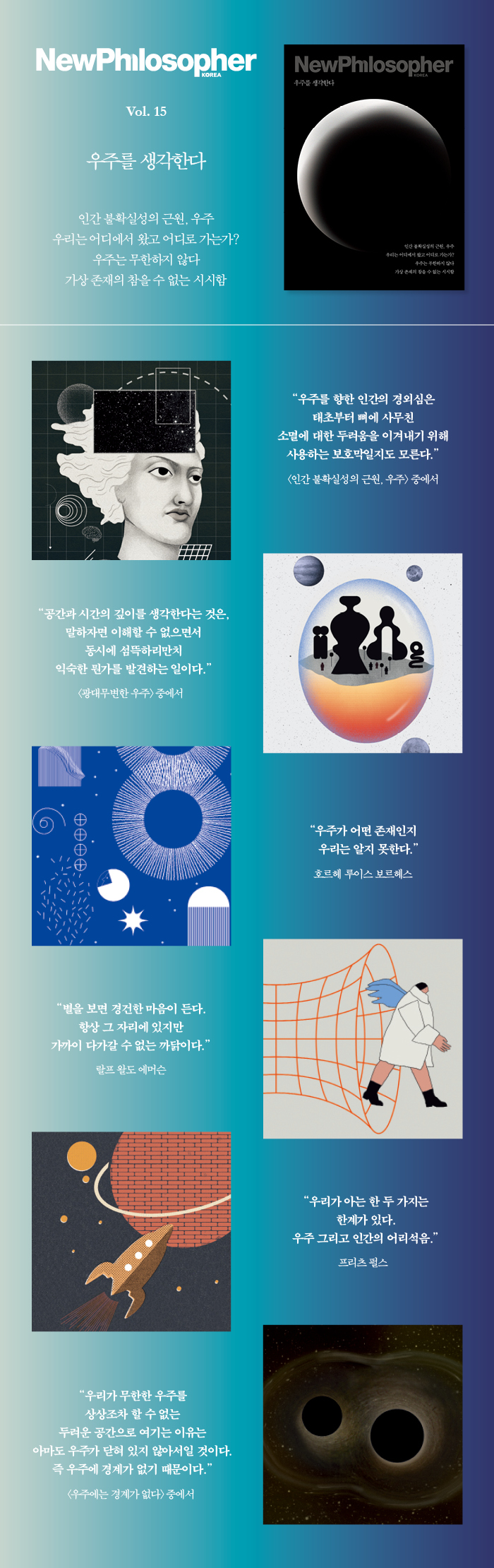
Into the book
As I observe old starlight with my children, I am reminded of the beginning of time and images of the distant universe.
In this way, we share some of the knowledge that the human species understands.
I hope that my children will be able to observe the stars I see with them now, and so gaze into the distant past.
Ultimately, everything, including us, will return to the empty space between the stars.
As time goes by, the starlight will gradually fade away.
Everything will pass.
But now, here, we can at least grasp the outline of that star.
And when we put it all together, we can see ourselves.
--- p.
24
Space is a source of human uncertainty.
And this is the most realistic challenge.
Our awe and exploration of the universe is a defense against the single, obvious discovery that we are alone in the vast universe.
Human awe for the universe may be a protective shield used to overcome the fear of extinction that has been ingrained in our bones since the beginning of time.
--- p.
30
Finally, it must be accompanied by reflection on one's personal life.
The question of where our lives came from and where they are going is a very interesting one.
The three strands of questions I've just mentioned have one thing in common: they lead us to look back at the past and understand the future.
If the study of cosmology, black holes, dark matter, and dark energy is one axis, the study of planets outside the solar system is another axis, and the search for life forms the final axis, forming a grand question.
--- pp.
48~49
Another problem is the lack of a clear legal status for space colonization or other non-confrontational and permissible activities in space.
In the past, when new land was discovered, instead of agreeing to divide the land fairly among the various nations, they would fight over who would take it.
Would things be different on Mars or another celestial body? Would every nation on Earth have the right to claim territory in space? Or should ownership be determined by the nation with the superior economic and scientific capabilities to claim space territory? These questions are currently unanswerable.
But before space colonization can become a reality, an answer must be given.
No, you have to decide what answer to give.
We must also decide what form of government the countries and groups that pioneer space exploration should adopt.
--- p.
72
Because I continued to work on problems outside of mainstream astronomy, I was able to work at my own pace and wasn't pressured to keep up with trends.
I'm not trying to present this method as an example to you, but simply to show that there are different approaches to science.
There are certainly different approaches to science.
I hope that some of you can forge your own path through the complex sociology of science.
Science is competitive, aggressive, and demanding.
Science also stimulates imagination, inspiration and encouragement.
You can do it too.
Each and every one of you can change the world.
Because you are made of the stuff of stars and are connected to the universe.
In this way, we share some of the knowledge that the human species understands.
I hope that my children will be able to observe the stars I see with them now, and so gaze into the distant past.
Ultimately, everything, including us, will return to the empty space between the stars.
As time goes by, the starlight will gradually fade away.
Everything will pass.
But now, here, we can at least grasp the outline of that star.
And when we put it all together, we can see ourselves.
--- p.
24
Space is a source of human uncertainty.
And this is the most realistic challenge.
Our awe and exploration of the universe is a defense against the single, obvious discovery that we are alone in the vast universe.
Human awe for the universe may be a protective shield used to overcome the fear of extinction that has been ingrained in our bones since the beginning of time.
--- p.
30
Finally, it must be accompanied by reflection on one's personal life.
The question of where our lives came from and where they are going is a very interesting one.
The three strands of questions I've just mentioned have one thing in common: they lead us to look back at the past and understand the future.
If the study of cosmology, black holes, dark matter, and dark energy is one axis, the study of planets outside the solar system is another axis, and the search for life forms the final axis, forming a grand question.
--- pp.
48~49
Another problem is the lack of a clear legal status for space colonization or other non-confrontational and permissible activities in space.
In the past, when new land was discovered, instead of agreeing to divide the land fairly among the various nations, they would fight over who would take it.
Would things be different on Mars or another celestial body? Would every nation on Earth have the right to claim territory in space? Or should ownership be determined by the nation with the superior economic and scientific capabilities to claim space territory? These questions are currently unanswerable.
But before space colonization can become a reality, an answer must be given.
No, you have to decide what answer to give.
We must also decide what form of government the countries and groups that pioneer space exploration should adopt.
--- p.
72
Because I continued to work on problems outside of mainstream astronomy, I was able to work at my own pace and wasn't pressured to keep up with trends.
I'm not trying to present this method as an example to you, but simply to show that there are different approaches to science.
There are certainly different approaches to science.
I hope that some of you can forge your own path through the complex sociology of science.
Science is competitive, aggressive, and demanding.
Science also stimulates imagination, inspiration and encouragement.
You can do it too.
Each and every one of you can change the world.
Because you are made of the stuff of stars and are connected to the universe.
--- p.
120
120
Publisher's Review
A necessary challenge vs.
It's still too early
Issue 15 of New Philosopher, with the theme of “Thinking about the Universe,” reflects on the space called space, which stimulates human endless desire.
Although humanity's challenge toward space began in earnest in the mid-20th century, humanity has in fact longed for space since the age of mythology.
Icarus, the son of Daedalus in Greek mythology, flew endlessly toward the sun with wings made of bird feathers woven with thread and wax.
Even though he knew the wax would melt and fall into the sea soon.
On the other hand, the early humans moved their places of life from time to time following the movements of the stars.
Contrary to myth, human desire was a desperate struggle for life.
Whatever the reason, the universe, symbolized by the sun and stars, was something inseparable from human life.
Tom Chatfield, a philosopher of technology and author, points out that contemplating the vastness of the universe is no different from recognizing the limitations of human existence, which is “just a blink in time and space.”
In [The Vast Universe], he argues that the evolutionary strategy of living things was carried out within the magnificent appearance of the universe, and that conforming to that order is the true duty of humans.
“In the end, everything, including us, will return to the empty space between the stars.”
As we study the vast universe, one thing we must guard against is the tendency to “judge everything by human standards and experience.”
In his interview [Where do we come from and where are we going?], Günter Hassinger, Director of the European Space Agency, emphasizes that the only question facing humans who yearn for space should be, “Where did we come from and where are we going?”
He emphasizes that studying the universe is like exploring the true nature of humanity, and that by doing so, we can trace humanity's past, present, and future.
In that vein, he views the current exploration race, including space tourism, positively.
However, it is still premature, and there are still many areas for concern, he argues.
“Of course, it seems premature.
There's no way to make a lot of money from space tourism right now.
But even people 100 years ago would not have known that airplanes would become so commercialized.
I believe that someday space tourism will become like that.
The only concern is that if everyone rushes into this field, space could become crowded.
Space debris that spacecraft leave behind in space has already emerged as a risk factor.
“As the amount of debris floating in space increases, the risk of launching new spacecraft also increases.”
When cooperation, not competition, conflict, or clashes, is needed
In "The Trouble You've Got," author Clarissa Sibeck Montefiore points out that while colonizing Mars isn't insurmountable, the risks are enormous.
First of all, it is not easy to make the Martian environment habitable for Earthlings.
There are many hurdles to overcome to overcome challenges such as temperatures of minus 60 degrees Celsius and high carbon dioxide levels.
Without knowing where and how much of Mars' resources are available, humans would need to transport Earth's resources indefinitely to Mars to establish a settlement there.
He quotes American aerospace engineer Robert Zubrin:
“The key issue in space development is transportation.
A key issue in settlement is the ability to convert the planet's raw materials into resources.
… …we should be able to grow food on Mars.
“It should be able to make all kinds of materials, such as steel, glass, plastic, and ceramic.”
That's not the only challenge.
Currently, space exploration and development are exclusive to the so-called advanced countries.
In his interview, "The Universe Belongs to No One," neuroscientist and geopolitician Naif Al-Rodhan warns against competing claims to ownership of space.
He argues that the Outer Space Treaty, adopted by the United Nations in 1967, prohibits anyone from monopolizing space.
But the parties to the treaty at the time could not have imagined that this treaty would become a problem during their lifetime.
At the time, the possibility of space colonization was literally slim.
But as the 21st century dawned, space colonies became increasingly feasible.
It is clear as day that the conflict that follows competition and the conflict that results from the conflict will lead to conflict.
Just as humans in the past, when discovering a new continent, “would fight over who would take it instead of agreeing to divide it fairly,” it is clear that this will also happen in space.
The solution for the knife Al-Rodhan is ultimately cooperation.
“In the long run, the greatest threat to space property rights is a situation where a nation claims a portion of space as its own territory and uses military force to defend that territory.
But for now, the danger is even greater as space becomes far more congested with space debris and the militarization of space becomes more severe, with countries launching weaponized satellites and using them against space, Earth, or other countries.
A concerted effort is urgently needed to halt the militarization of space and remove the growing amount of space debris from Earth's orbit.
“This will require enormous financial and technological resources, and everyone must contribute.”
The place where we will live forever is not space, but Earth.
Ultimately, the problem is the desire to understand or conquer the vast world of the universe while living in a limited space called Earth.
In his book, Living in 3 Dimensions and Understanding the Universe, philosopher Tim Dean points out the paradoxical behavior of humans who live on Earth and act as if they understand the universe.
He emphasizes that “when we look back at the history of mankind, which has been thoroughly established and evolved on this land,” it is “just too much effort” for humans to be concerned about the unknown world of space.
He argues that human efforts to understand the universe would be essentially futile if “we had not evolved to perceive it as it really is.”
“The answer is right here.
We did not evolve to perceive the world as it is.
I simply perceived the world as a place where I would not be lacking in leaving behind more descendants.
Recognizing only the three-dimensional plane and time was enough to complete the mission.
“If we look back at the history of humanity, which has thoroughly taken root and evolved on this earth, it would have been an excessive effort to worry about four-dimensional spacetime and hyperbolic manifolds.”
Edward Wilson, a world authority on ant research and a renowned scholar of integration, has always focused on human existence or nature.
In "The Meaning of Human Existence," he says that we must now go beyond the question of "what kind of" being we are and answer the question of "why" we exist.
Humans, beings who are “simpler than we think,” are “a self-made, independent, solitary, and fragile species adapted to living in a biological world.”
In that vein, he emphasizes that “each species has only one habitable planet, and therefore only one chance for immortality.”
While science, which seeks to uncover the mysteries of the universe, must constantly expand its scope, Wilson says that what we must do is acknowledge the value of the land we stand on and, at the same time, live immortal there.
What if our gaze were always turned toward the unknown world of space, while our hands and feet were turned toward ourselves and our surroundings?
Maybe that's why we were born on Earth.
It's still too early
Issue 15 of New Philosopher, with the theme of “Thinking about the Universe,” reflects on the space called space, which stimulates human endless desire.
Although humanity's challenge toward space began in earnest in the mid-20th century, humanity has in fact longed for space since the age of mythology.
Icarus, the son of Daedalus in Greek mythology, flew endlessly toward the sun with wings made of bird feathers woven with thread and wax.
Even though he knew the wax would melt and fall into the sea soon.
On the other hand, the early humans moved their places of life from time to time following the movements of the stars.
Contrary to myth, human desire was a desperate struggle for life.
Whatever the reason, the universe, symbolized by the sun and stars, was something inseparable from human life.
Tom Chatfield, a philosopher of technology and author, points out that contemplating the vastness of the universe is no different from recognizing the limitations of human existence, which is “just a blink in time and space.”
In [The Vast Universe], he argues that the evolutionary strategy of living things was carried out within the magnificent appearance of the universe, and that conforming to that order is the true duty of humans.
“In the end, everything, including us, will return to the empty space between the stars.”
As we study the vast universe, one thing we must guard against is the tendency to “judge everything by human standards and experience.”
In his interview [Where do we come from and where are we going?], Günter Hassinger, Director of the European Space Agency, emphasizes that the only question facing humans who yearn for space should be, “Where did we come from and where are we going?”
He emphasizes that studying the universe is like exploring the true nature of humanity, and that by doing so, we can trace humanity's past, present, and future.
In that vein, he views the current exploration race, including space tourism, positively.
However, it is still premature, and there are still many areas for concern, he argues.
“Of course, it seems premature.
There's no way to make a lot of money from space tourism right now.
But even people 100 years ago would not have known that airplanes would become so commercialized.
I believe that someday space tourism will become like that.
The only concern is that if everyone rushes into this field, space could become crowded.
Space debris that spacecraft leave behind in space has already emerged as a risk factor.
“As the amount of debris floating in space increases, the risk of launching new spacecraft also increases.”
When cooperation, not competition, conflict, or clashes, is needed
In "The Trouble You've Got," author Clarissa Sibeck Montefiore points out that while colonizing Mars isn't insurmountable, the risks are enormous.
First of all, it is not easy to make the Martian environment habitable for Earthlings.
There are many hurdles to overcome to overcome challenges such as temperatures of minus 60 degrees Celsius and high carbon dioxide levels.
Without knowing where and how much of Mars' resources are available, humans would need to transport Earth's resources indefinitely to Mars to establish a settlement there.
He quotes American aerospace engineer Robert Zubrin:
“The key issue in space development is transportation.
A key issue in settlement is the ability to convert the planet's raw materials into resources.
… …we should be able to grow food on Mars.
“It should be able to make all kinds of materials, such as steel, glass, plastic, and ceramic.”
That's not the only challenge.
Currently, space exploration and development are exclusive to the so-called advanced countries.
In his interview, "The Universe Belongs to No One," neuroscientist and geopolitician Naif Al-Rodhan warns against competing claims to ownership of space.
He argues that the Outer Space Treaty, adopted by the United Nations in 1967, prohibits anyone from monopolizing space.
But the parties to the treaty at the time could not have imagined that this treaty would become a problem during their lifetime.
At the time, the possibility of space colonization was literally slim.
But as the 21st century dawned, space colonies became increasingly feasible.
It is clear as day that the conflict that follows competition and the conflict that results from the conflict will lead to conflict.
Just as humans in the past, when discovering a new continent, “would fight over who would take it instead of agreeing to divide it fairly,” it is clear that this will also happen in space.
The solution for the knife Al-Rodhan is ultimately cooperation.
“In the long run, the greatest threat to space property rights is a situation where a nation claims a portion of space as its own territory and uses military force to defend that territory.
But for now, the danger is even greater as space becomes far more congested with space debris and the militarization of space becomes more severe, with countries launching weaponized satellites and using them against space, Earth, or other countries.
A concerted effort is urgently needed to halt the militarization of space and remove the growing amount of space debris from Earth's orbit.
“This will require enormous financial and technological resources, and everyone must contribute.”
The place where we will live forever is not space, but Earth.
Ultimately, the problem is the desire to understand or conquer the vast world of the universe while living in a limited space called Earth.
In his book, Living in 3 Dimensions and Understanding the Universe, philosopher Tim Dean points out the paradoxical behavior of humans who live on Earth and act as if they understand the universe.
He emphasizes that “when we look back at the history of mankind, which has been thoroughly established and evolved on this land,” it is “just too much effort” for humans to be concerned about the unknown world of space.
He argues that human efforts to understand the universe would be essentially futile if “we had not evolved to perceive it as it really is.”
“The answer is right here.
We did not evolve to perceive the world as it is.
I simply perceived the world as a place where I would not be lacking in leaving behind more descendants.
Recognizing only the three-dimensional plane and time was enough to complete the mission.
“If we look back at the history of humanity, which has thoroughly taken root and evolved on this earth, it would have been an excessive effort to worry about four-dimensional spacetime and hyperbolic manifolds.”
Edward Wilson, a world authority on ant research and a renowned scholar of integration, has always focused on human existence or nature.
In "The Meaning of Human Existence," he says that we must now go beyond the question of "what kind of" being we are and answer the question of "why" we exist.
Humans, beings who are “simpler than we think,” are “a self-made, independent, solitary, and fragile species adapted to living in a biological world.”
In that vein, he emphasizes that “each species has only one habitable planet, and therefore only one chance for immortality.”
While science, which seeks to uncover the mysteries of the universe, must constantly expand its scope, Wilson says that what we must do is acknowledge the value of the land we stand on and, at the same time, live immortal there.
What if our gaze were always turned toward the unknown world of space, while our hands and feet were turned toward ourselves and our surroundings?
Maybe that's why we were born on Earth.
GOODS SPECIFICS
- Date of issue: July 5, 2021
- Page count, weight, size: 164 pages | 180*245*20mm
- ISBN13: 2510257713403
You may also like
카테고리
korean


korean

![GQ KOREA Mark (Monthly): December [2025]](http://librairie.coreenne.fr/cdn/shop/files/8ef265dbbfbf186523ed75ba7319009d.jpg?v=1765340328&width=3840)


