

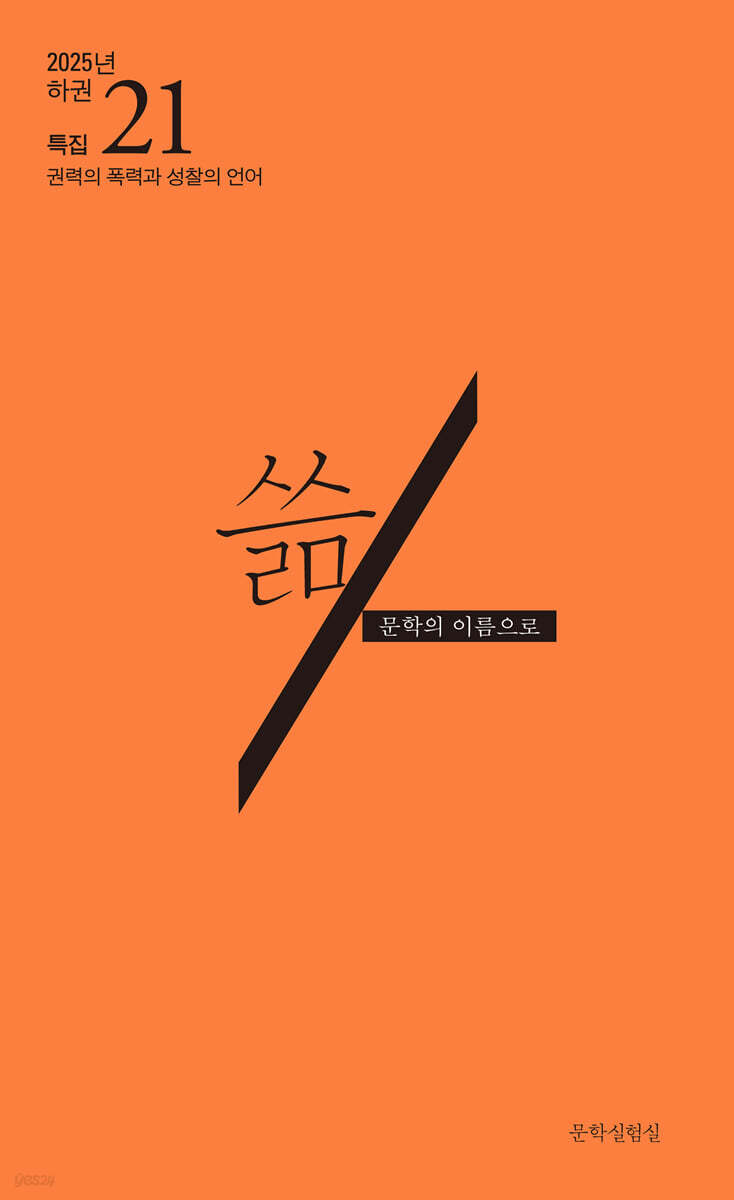
In the Name of Literature (Half Year): Volume 2, 2025
 |
Description
Book Introduction
A special feature on “The Violence of Power and the Language of Reflection,” which reflects on the martial law situation from a literary perspective.
I hereby declare.
I declare.
Dismissed.
Words uttered as predicates define what the subject intends and command the hearer to carry out the action.
If the subject's entity is the subject of power that exercises the authority of the state and law, the predicate forces the subject's purpose to be carried out.
In Sophocles' Antigone, Creon's proclamation is also a statement of positive law.
Creon forbids the funeral of his nephew, who has become an enemy.
Those words are the language of violence that can even sentence citizens who violate the proclamation to death.
The effectiveness of that word arises from the premise of the benefit of the community and the happiness of its citizens.
However, Antigone disobeys Creon's decree.
She holds her brother's funeral according to the unwritten laws of the gods rather than the decree of Creon, who is merely a human.
It is an unwritten law of the gods that anyone who dies must be given a funeral.
“We were born to love one another, not to hate one another.” Antigone’s words, which violate positive law.
It is the ethics of useless words that resist power.
It is a literary question that useless words pose to the useful words of positive law.
In that sense, the language of literature may be the question itself that resists the execution of the predicate and doubts the subject of the predicate.
I hereby declare.
I declare.
Dismissed.
Words uttered as predicates define what the subject intends and command the hearer to carry out the action.
If the subject's entity is the subject of power that exercises the authority of the state and law, the predicate forces the subject's purpose to be carried out.
In Sophocles' Antigone, Creon's proclamation is also a statement of positive law.
Creon forbids the funeral of his nephew, who has become an enemy.
Those words are the language of violence that can even sentence citizens who violate the proclamation to death.
The effectiveness of that word arises from the premise of the benefit of the community and the happiness of its citizens.
However, Antigone disobeys Creon's decree.
She holds her brother's funeral according to the unwritten laws of the gods rather than the decree of Creon, who is merely a human.
It is an unwritten law of the gods that anyone who dies must be given a funeral.
“We were born to love one another, not to hate one another.” Antigone’s words, which violate positive law.
It is the ethics of useless words that resist power.
It is a literary question that useless words pose to the useful words of positive law.
In that sense, the language of literature may be the question itself that resists the execution of the predicate and doubts the subject of the predicate.
- You can preview some of the book's contents.
Preview
index
Special Feature: The Violence of Power and the Language of Reflection
1.
Civil War, Language, and the Secrets of Carl Schmitt and His Family | Kim Hang
2.
On the Partiality and Plurality of Power: Thoughts on Directly Elected Presidents and Martial Law | Kim Tae-hwan
3.
The Vulnerability of Legal Language and the Rule of Law: From the Constitutional Court's Ruling on the President's Impeachment | Kim Yeon-mi
4.
Ontology Between "Not Yet" and "Already": Violence and Literature | Han Rae-hee
5.
The Triumph of Rebellion and the Failure of Tragedy: Reading Camus's "Martial Law" | Moon Kyung-hoon
6.
The Social Contract and the Origins of the State (and Violence) _ Rereading Lee Cheong-jun's "Your Heaven" | Lee Su-hyeong
7.
The Grammar of Destruction and Memory: A Community in Conflict with Lim Cheol-woo's "Spring Day" | Kim Yo-seop
With a Special Feature - Voices from the Field: Awareness of Political Crisis and Literary Responses
1.
Moving with Silence and Power | Kim Na-young
2.
Kim Hye-soon 1 | Kim Yi-gang
3.
I Lost My Way to Write | Park Ji-il
4.
Kim Dan's Winter | Jin Yeon-ju
Poetry and novels
The Deep Side of the Old Bookstore and Two Other Books | Kim Yeon-deok
Suspicions about the site of the removed wart, Part 2 | Seo Young-cheo
Sinkhole and 2 others | Shin Yong-mok
Other people | Anyun
Black one-piece | Lee Ju-ran
That's the point | Jeong Gi-hyeon
Giil and 2 others | Jeong Woo-shin
Hongok | Joo Yi-hyun
Text Experiment Space
Congratulatory message | Seo Ije
11th Literature Lab Forum
_Some Notes on the Overseas Literature School_World Literature as a Liberal Arts | Kim Dong-sik
_The Critical Existence of the Postwar Foreign Literary Generation_ Focusing on Kim Bong-gu, Song Wook, and Jeong Myeong-hwan | Lee Eun-ji
Kim Hyun on Reading Barthes and the Three Propositions He Reinterpreted | Seohyun Ahn
Announcement of the 11th Kim Hyun Literary Award Winners
Introduction to the Kim Hyun Literary Society
Words of selection
The salamander's path is indicated by a dotted line. | Sim Ji-ah
Me and Literature | Yang Seon-hyeong
The Poetics of Wandering Award-Winning Writers: Sim Ji-ah's Theory | Song Hyun-ji
Dusk and Illusion_Yang Seon-hyeong-ron | Lee So
That experiment back then
The Politics of Violence and Allusion There_Kim Hye-sun's Poetry Collection: A Star's Hell | Song Seung-hwan
This language now
Capitalism and the Death Drive: Kim Ahn's "Mazeppa" and Kim Geun's "From to" | Park Dae-hyun
These current educational novels: Yoon Seong-hee's "Slow-Moving Heart" and Lee Shin-jo's "Your Season, My Weather" | Yang Sun-mo
Don't You Know What Love Is Just Because You're Old? - Baek Su-rin's "Everything About a Spring Night" and Wi Su-jeong's "The Night We Don't Have" | Kang Ji-hee
Literature Lab New Book Review
The Curve of False Shadows_Kim Sol's Short Story Collection "Pure Contradiction" | Jo Dae-han
1.
Civil War, Language, and the Secrets of Carl Schmitt and His Family | Kim Hang
2.
On the Partiality and Plurality of Power: Thoughts on Directly Elected Presidents and Martial Law | Kim Tae-hwan
3.
The Vulnerability of Legal Language and the Rule of Law: From the Constitutional Court's Ruling on the President's Impeachment | Kim Yeon-mi
4.
Ontology Between "Not Yet" and "Already": Violence and Literature | Han Rae-hee
5.
The Triumph of Rebellion and the Failure of Tragedy: Reading Camus's "Martial Law" | Moon Kyung-hoon
6.
The Social Contract and the Origins of the State (and Violence) _ Rereading Lee Cheong-jun's "Your Heaven" | Lee Su-hyeong
7.
The Grammar of Destruction and Memory: A Community in Conflict with Lim Cheol-woo's "Spring Day" | Kim Yo-seop
With a Special Feature - Voices from the Field: Awareness of Political Crisis and Literary Responses
1.
Moving with Silence and Power | Kim Na-young
2.
Kim Hye-soon 1 | Kim Yi-gang
3.
I Lost My Way to Write | Park Ji-il
4.
Kim Dan's Winter | Jin Yeon-ju
Poetry and novels
The Deep Side of the Old Bookstore and Two Other Books | Kim Yeon-deok
Suspicions about the site of the removed wart, Part 2 | Seo Young-cheo
Sinkhole and 2 others | Shin Yong-mok
Other people | Anyun
Black one-piece | Lee Ju-ran
That's the point | Jeong Gi-hyeon
Giil and 2 others | Jeong Woo-shin
Hongok | Joo Yi-hyun
Text Experiment Space
Congratulatory message | Seo Ije
11th Literature Lab Forum
_Some Notes on the Overseas Literature School_World Literature as a Liberal Arts | Kim Dong-sik
_The Critical Existence of the Postwar Foreign Literary Generation_ Focusing on Kim Bong-gu, Song Wook, and Jeong Myeong-hwan | Lee Eun-ji
Kim Hyun on Reading Barthes and the Three Propositions He Reinterpreted | Seohyun Ahn
Announcement of the 11th Kim Hyun Literary Award Winners
Introduction to the Kim Hyun Literary Society
Words of selection
The salamander's path is indicated by a dotted line. | Sim Ji-ah
Me and Literature | Yang Seon-hyeong
The Poetics of Wandering Award-Winning Writers: Sim Ji-ah's Theory | Song Hyun-ji
Dusk and Illusion_Yang Seon-hyeong-ron | Lee So
That experiment back then
The Politics of Violence and Allusion There_Kim Hye-sun's Poetry Collection: A Star's Hell | Song Seung-hwan
This language now
Capitalism and the Death Drive: Kim Ahn's "Mazeppa" and Kim Geun's "From to" | Park Dae-hyun
These current educational novels: Yoon Seong-hee's "Slow-Moving Heart" and Lee Shin-jo's "Your Season, My Weather" | Yang Sun-mo
Don't You Know What Love Is Just Because You're Old? - Baek Su-rin's "Everything About a Spring Night" and Wi Su-jeong's "The Night We Don't Have" | Kang Ji-hee
Literature Lab New Book Review
The Curve of False Shadows_Kim Sol's Short Story Collection "Pure Contradiction" | Jo Dae-han
Publisher's Review
1.
Civil War, Language, and the Secrets of Carl Schmitt and His Family | Kim Hang
2.
On the Partiality and Plurality of Power: Thoughts on Directly Elected Presidents and Martial Law | Kim Tae-hwan
3.
The Vulnerability of Legal Language and the Rule of Law: From the Constitutional Court's Ruling on the President's Impeachment | Kim Yeon-mi
4.
Ontology Between "Not Yet" and "Already": Violence and Literature | Han Rae-hee
5.
The Triumph of 'Rebellion' and the Failure of 'Tragedy' _ Reading Camus's 'Martial Law' | Moon Kyung-hoon
6.
The Social Contract and the Origins of the State (and Violence) _ Rereading Lee Cheong-jun's "Your Heaven" | Lee Su-hyeong
7.
The Grammar of Destruction and Memory: A Community in Conflict with Lim Cheol-woo's "Spring Day" | Kim Yo-seop
With a Special Feature - Voices from the Field: Awareness of Political Crisis and Literary Responses
1.
Moving with Silence and Power | Kim Na-young
2.
Kim Hye-soon 1 | Kim Yi-gang
3.
I Lost My Way to Write | Park Ji-il
4.
Kim Dan's Winter | Jin Yeon-ju
The 11th Literature Lab Forum: Foreign Literature as the "Other"
The theme of the 11th [Literature Lab Forum] this year is “Foreign Literature as the ‘Other.’”
As you know, in 1925, colonial Korean students studying abroad in Tokyo formed the 'Foreign Literature Research Association' and published the first issue of Overseas Literature in 1927.
A hundred years later, in 2024, a symbolic event occurred: a Korean novelist won the Nobel Prize in Literature.
The history of the full-scale encounter between foreign literature and Korean literature that unfolded in the meantime.
It raises questions and reflections on the process of seeking the modernity of Korean literature and advancing toward world literature while accepting foreign literature as the 'other.'
_Some Notes on the Overseas Literature School_World Literature as a Liberal Arts | Kim Dong-sik
_The Critical Existence of the Postwar Foreign Literary Generation_ Focusing on Kim Bong-gu, Song Wook, and Jeong Myeong-hwan | Lee Eun-ji
Kim Hyun on Reading Barthes and the Three Propositions He Reinterpreted | Seohyun Ahn
Poetry, novels, and plays
In the column [Poetry and Novels], where you will immediately fall into its richness once you start reading, poets Kim Yeon-deok, Seo Yeong-cheo, Shin Yong-mok, and Jeong Woo-shin, and novelists Ahn Yun, Lee Ju-ran, Jeong Gi-hyeon, and Joo I-hyeon, who have come together across generations, present their own unique creative worlds in a colorful way.
Text Experiment Space
In this issue of [Text Experiment Space], Seo Ije presents “Chukmun (祝文)” and provides another new reading experience through the form of “je (祭) writing.”
That experiment back then
[That Experiment at That Time] reads the third poetry collection, Hell of a Star (1988), by poet Kim Hye-sun, who has recently been spreading her poetic world around the world.
Through the first edition of his poetry collection, Song Seung-hwan closely examines the 'politics of suggestion' that resisted the political violence and oppression of women of the time.
This critique is even more interesting because it is closely linked to the theme of this special issue.
This language now
In [This Language Now], three critiques focus on two volumes of poetry and four novels.
Park Dae-hyun reads Kim Ahn's "Mazeppa" and Kim Geun's "From to" as attempts to formalize the outline of the capitalist subject.
Yang Sun-mo looked back on the acceptability of novels through the re-meaning of educational novels through Yoon Seong-hee's "A Slow-Going Heart" and Lee Shin-jo's "Your Season, My Weather."
And Kang Ji-hee analyzes Baek Su-rin's "Everything About Spring Night" and Wi Su-jeong's "The Night We Don't Have" as the faces of old age newly revealed in imperfect rhythms.
All of these works open new interests for readers with their unique perspectives.
Announcement of the 11th Kim Hyun Literary Award Winners
Poet Shim Ji-ah and novelist Yang Seon-hyeong were selected as the winners of the 11th [Kim Hyun Literary Award].
Sim Ji-ah was evaluated as “expanding our thinking in a way that makes our understanding of the world more detailed through free imagination about the world of the nature of things,” and Yang Seon-hyeong was evaluated as “an artist who enjoys the freedom of ‘illusion’ to the fullest extent,” and “the language he created between reflection and fantasy.”
The structures of the fishery were evaluated as “heterogeneous and avant-garde to the extent that it is difficult to find examples of them in the history of Korean literature.”
On behalf of Kim Hyun, I congratulate the two award winners, who are pursuing their own linguistic explorations in the avant-garde of Korean literature.
The theories of Song Hyun-ji and Lee So will provide an opportunity to gauge the achievements of that language exploration.
Literature Lab New Book Review
In [Literature Lab New Book Review], Cho Dae-han evaluates Kim Sol's new short story collection, Pure Contradiction, as "a triumph of absence over reality and a feast of ecstatic lies" in the mimetic dimension, and recommends immersing oneself in "the pleasure of shade brought about by the curves of false shadows."
Civil War, Language, and the Secrets of Carl Schmitt and His Family | Kim Hang
2.
On the Partiality and Plurality of Power: Thoughts on Directly Elected Presidents and Martial Law | Kim Tae-hwan
3.
The Vulnerability of Legal Language and the Rule of Law: From the Constitutional Court's Ruling on the President's Impeachment | Kim Yeon-mi
4.
Ontology Between "Not Yet" and "Already": Violence and Literature | Han Rae-hee
5.
The Triumph of 'Rebellion' and the Failure of 'Tragedy' _ Reading Camus's 'Martial Law' | Moon Kyung-hoon
6.
The Social Contract and the Origins of the State (and Violence) _ Rereading Lee Cheong-jun's "Your Heaven" | Lee Su-hyeong
7.
The Grammar of Destruction and Memory: A Community in Conflict with Lim Cheol-woo's "Spring Day" | Kim Yo-seop
With a Special Feature - Voices from the Field: Awareness of Political Crisis and Literary Responses
1.
Moving with Silence and Power | Kim Na-young
2.
Kim Hye-soon 1 | Kim Yi-gang
3.
I Lost My Way to Write | Park Ji-il
4.
Kim Dan's Winter | Jin Yeon-ju
The 11th Literature Lab Forum: Foreign Literature as the "Other"
The theme of the 11th [Literature Lab Forum] this year is “Foreign Literature as the ‘Other.’”
As you know, in 1925, colonial Korean students studying abroad in Tokyo formed the 'Foreign Literature Research Association' and published the first issue of Overseas Literature in 1927.
A hundred years later, in 2024, a symbolic event occurred: a Korean novelist won the Nobel Prize in Literature.
The history of the full-scale encounter between foreign literature and Korean literature that unfolded in the meantime.
It raises questions and reflections on the process of seeking the modernity of Korean literature and advancing toward world literature while accepting foreign literature as the 'other.'
_Some Notes on the Overseas Literature School_World Literature as a Liberal Arts | Kim Dong-sik
_The Critical Existence of the Postwar Foreign Literary Generation_ Focusing on Kim Bong-gu, Song Wook, and Jeong Myeong-hwan | Lee Eun-ji
Kim Hyun on Reading Barthes and the Three Propositions He Reinterpreted | Seohyun Ahn
Poetry, novels, and plays
In the column [Poetry and Novels], where you will immediately fall into its richness once you start reading, poets Kim Yeon-deok, Seo Yeong-cheo, Shin Yong-mok, and Jeong Woo-shin, and novelists Ahn Yun, Lee Ju-ran, Jeong Gi-hyeon, and Joo I-hyeon, who have come together across generations, present their own unique creative worlds in a colorful way.
Text Experiment Space
In this issue of [Text Experiment Space], Seo Ije presents “Chukmun (祝文)” and provides another new reading experience through the form of “je (祭) writing.”
That experiment back then
[That Experiment at That Time] reads the third poetry collection, Hell of a Star (1988), by poet Kim Hye-sun, who has recently been spreading her poetic world around the world.
Through the first edition of his poetry collection, Song Seung-hwan closely examines the 'politics of suggestion' that resisted the political violence and oppression of women of the time.
This critique is even more interesting because it is closely linked to the theme of this special issue.
This language now
In [This Language Now], three critiques focus on two volumes of poetry and four novels.
Park Dae-hyun reads Kim Ahn's "Mazeppa" and Kim Geun's "From to" as attempts to formalize the outline of the capitalist subject.
Yang Sun-mo looked back on the acceptability of novels through the re-meaning of educational novels through Yoon Seong-hee's "A Slow-Going Heart" and Lee Shin-jo's "Your Season, My Weather."
And Kang Ji-hee analyzes Baek Su-rin's "Everything About Spring Night" and Wi Su-jeong's "The Night We Don't Have" as the faces of old age newly revealed in imperfect rhythms.
All of these works open new interests for readers with their unique perspectives.
Announcement of the 11th Kim Hyun Literary Award Winners
Poet Shim Ji-ah and novelist Yang Seon-hyeong were selected as the winners of the 11th [Kim Hyun Literary Award].
Sim Ji-ah was evaluated as “expanding our thinking in a way that makes our understanding of the world more detailed through free imagination about the world of the nature of things,” and Yang Seon-hyeong was evaluated as “an artist who enjoys the freedom of ‘illusion’ to the fullest extent,” and “the language he created between reflection and fantasy.”
The structures of the fishery were evaluated as “heterogeneous and avant-garde to the extent that it is difficult to find examples of them in the history of Korean literature.”
On behalf of Kim Hyun, I congratulate the two award winners, who are pursuing their own linguistic explorations in the avant-garde of Korean literature.
The theories of Song Hyun-ji and Lee So will provide an opportunity to gauge the achievements of that language exploration.
Literature Lab New Book Review
In [Literature Lab New Book Review], Cho Dae-han evaluates Kim Sol's new short story collection, Pure Contradiction, as "a triumph of absence over reality and a feast of ecstatic lies" in the mimetic dimension, and recommends immersing oneself in "the pleasure of shade brought about by the curves of false shadows."
GOODS SPECIFICS
- Date of issue: September 30, 2025
- Page count, weight, size: 532 pages | 140*240*35mm
- ISBN13: 9772465795005
- ISBN10: 24657956
You may also like
카테고리
korean


korean

![GQ KOREA Mark (Monthly): December [2025]](http://librairie.coreenne.fr/cdn/shop/files/8ef265dbbfbf186523ed75ba7319009d.jpg?v=1765340328&width=3840)


