

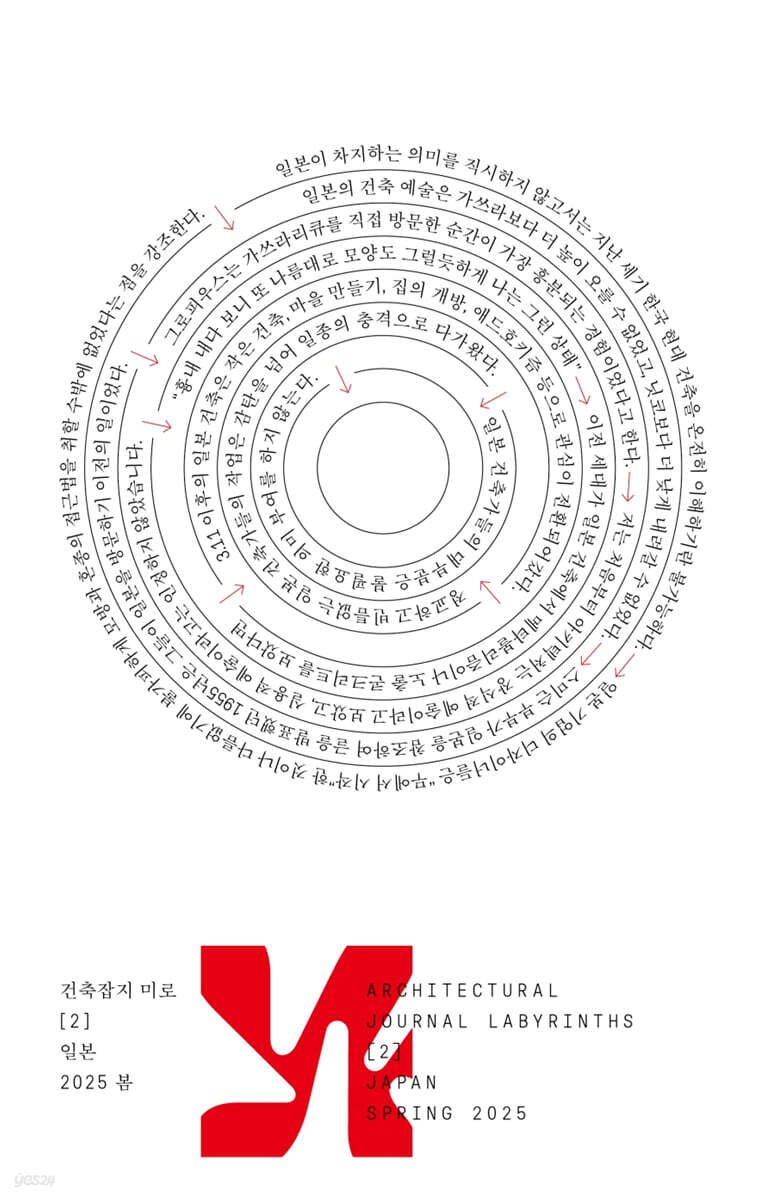
Labyrinth 2: Japan Spring 2025
 |
Description
Book Introduction
The architectural magazine 『Miro』, published three times a year, aims to discover and record the discourse of modern Korean architecture.
A text-based magazine consisting solely of articles focusing on a selected topic each issue, the theme of the second issue is “Japan.”
A text-based magazine consisting solely of articles focusing on a selected topic each issue, the theme of the second issue is “Japan.”
- You can preview some of the book's contents.
Preview
index
While compiling 『Labyrinth 2: Japan』
Cho Hyun-jung and two Tokyo University graduate architects: Kim Soo-geun and Park Chun-myung
Lee Yeon-kyung and Tatsuo Matsui, Ulsan Urban Planning Division
Park Hae-cheon · Korean Industrial Design Encounters Contemporaries via Japan: Two Scenes from the Mid- to Late 1980s
Bruno Taut / Park Jeong-hyeon (translator) · The Fundamentals of Japanese Architecture
Jeon Tae-gyu · New Brutalism and the Image of Japanese Architecture
Kim Ki-won · Discovered Traditions
Lee Kang-min, translator of Architecture and Japan
Kim Hyeon-seop, Go Yu-seop, Park Dong-jin, Hong Yun-sik, and Park Gil-ryong: Translation and Acceptance of Western Modern Architecture during the Japanese Colonial Period
Go Jae-hyeop: How Will You Live?
Park Chang-hyun · A Very Personal Transformation of Work: A Mirror Called Japan
Understanding, Choi Jae-pil · If you look at the two worlds overlapping
Im Tae-byeong · Current trends in Japanese architecture
Lee Yang-jae · Japanese Architecture as an Industry
Min Seong-hui · Questioning Architecture in an Uncertain Age: A Review of Jun Matsumura's "The Architect Who Doesn't Build"
Lim Tae-hee and Writings by Japanese Architects
Cho Hyun-jung and two Tokyo University graduate architects: Kim Soo-geun and Park Chun-myung
Lee Yeon-kyung and Tatsuo Matsui, Ulsan Urban Planning Division
Park Hae-cheon · Korean Industrial Design Encounters Contemporaries via Japan: Two Scenes from the Mid- to Late 1980s
Bruno Taut / Park Jeong-hyeon (translator) · The Fundamentals of Japanese Architecture
Jeon Tae-gyu · New Brutalism and the Image of Japanese Architecture
Kim Ki-won · Discovered Traditions
Lee Kang-min, translator of Architecture and Japan
Kim Hyeon-seop, Go Yu-seop, Park Dong-jin, Hong Yun-sik, and Park Gil-ryong: Translation and Acceptance of Western Modern Architecture during the Japanese Colonial Period
Go Jae-hyeop: How Will You Live?
Park Chang-hyun · A Very Personal Transformation of Work: A Mirror Called Japan
Understanding, Choi Jae-pil · If you look at the two worlds overlapping
Im Tae-byeong · Current trends in Japanese architecture
Lee Yang-jae · Japanese Architecture as an Industry
Min Seong-hui · Questioning Architecture in an Uncertain Age: A Review of Jun Matsumura's "The Architect Who Doesn't Build"
Lim Tae-hee and Writings by Japanese Architects
Publisher's Review
Why We Ask About Japan Again
It would be unreasonable for a small magazine published three times a year to feature the architecture of a single country as a special topic, without limiting the scope to a specific period, person, or current trend.
However, if the reader of this book is currently working in the Korean architectural world, “Japanese” architecture will feel like a much more suitable magazine topic than American, Vietnamese, Mexican, or French architecture.
When it comes to the Korean architectural world today, Japan is a much clearer focus than other countries.
Japan was the biggest, yet most hidden, or wanted to be hidden, partner of modern Korean architecture.
『Labyrinth』 No. 2 summons this typist.
Even if we have to deal with a very small part of it in a very distracting way.
Filter called Japan
Since the word 'architecture' itself is a Japanese translation, we must look to Japan to talk about the beginning of architecture.
The same goes for the words architecture, modern and contemporary.
Kangmin Lee meticulously traces the circumstances that led Japan to choose 'architecture' as its translation and its aftermath.
Here we can see that the most deep-rooted conflict in Korean architecture, the separation between architects and architectural historians, was anticipated.
This article will be a great antidote to articles that ask how faithful architecture is to the word architecture, which dates back to Greece (usually leading to the conclusion that there is no such architecture in Korea).
Kim Hyeon-seop reaffirms that Korean architects' understanding of modern architecture during the Japanese colonial period was achieved through Japanese translations.
The first Korean authors to write about Western modern architecture, such as Go Yu-seop, Park Dong-jin, Hong Yun-sik, and Park Gil-ryong, were wearing the glasses of Japan.
Japanese architecture through Western eyes
The writings of Western architects in the early 20th century had a significant influence on Japanese architecture's rise to international fame.
Japan, the only country outside the West to have followed the path of imperialism, was an object of fascination for European architects.
They repeatedly said that modernity can be found in Japanese tradition.
Kim Ki-won critically interprets Ise Jingu and Katsura Rikyu, as read by Bruno Taut, and Jeon Tae-gyu traces fragments of Japanese architecture that were influenced by the brutalism that arose in postwar Britain.
And I translated and published Bruno Taut's "Fundamentals of Japanese Architecture," which is one of the origins of this perspective.
Bruno Taut, who was active in various organizations such as the German Werkbund, the Art Workers' Council, and the Glass Chain, was one of the most important architects in Germany in the 1910s and 1920s.
This article, based on a speech Taut gave in Japan in 1935, helped create the myth of Japanese architecture.
You can witness how he interpreted traditional Japanese architecture through the eyes of a contemporary European and what he sought to learn from Japanese architecture.
Parallel universes of Japan and Korea
The journey of overcoming the architecture learned in Japan and seeking out something Korean is a narrative shared by all modern Korean architects.
The myth of Kim Swoo-geun, who, after experiencing the controversy over the Buyeo Museum's Japanese influence in 1967, focused on Korean elements and ushered in the era of space in the 1970s, also belongs here.
On the other hand, Park Chun-myung, who won the Namsan National Assembly Building design competition with Kim Swoo-geun in 1961 and has been active in Korea since then, is rarely seen in the field of architectural discourse.
Jo Hyun-jung compares these two architects who started from the same starting point but took completely different paths.
For Park Chun-myung, whose work mostly involved high-rise buildings or large-scale projects for large corporations, Japan was, to borrow Jo Hyun-jung's words, "the right answer."
Japan did not play the role of the answer only in architecture.
The greater traces of Japan that remained in the city became a faint but indelible outline of the urban planning that unfolded across the country in the 1960s.
Lee Yeon-kyung talks about the Ulsan urban planning process, a representative example of early urban planning, and the hidden hand of Japanese urban planners who worked on it.
In home appliances and industrial design, Japan was also a model answer to past exam questions.
Park Hae-cheon's writing, which depicts the efforts of the Goldstar Design Research Institute to acquire a sense of belonging to the same era by moving between imitation and creation, future and past, tells us that similar things have happened in various fields.
The path taken in architecture and industrial design can be expanded to include automobiles, movies, and popular music.
How Korean architects view Japan these days
Comparing Tokyo and Seoul, Go Jae-hyeop says that the conditions for architectural practice are completely different.
If Tokyo is sterilized and sealed with plastic wrap, Seoul is covered in Vantablack paint.
In Seoul, where architecture has turned a blind eye to reality for the sake of propriety, it is diagnosed that architecture is already dead.
The idea that the architecture we knew or assumed should be possible (or never was) is simply not possible naturally leads to concerns about the work itself.
Park Chang-hyun explores the possibility of moving beyond the role of an architect, who focuses solely on drawing plans and delivering them to contractors (a standard definition of an architect since the Renaissance).
For architects who share similar perspectives, Japan remains a close reference, but the focus is not on the forms of buildings or new technologies, but rather on the way life unfolds in a shrinking society.
The attitude of paying attention to everyday life and discovering possibilities different from existing architecture can be easily confirmed in the writings of Lee Hae-deun and Choi Jae-pil.
Japanese Architecture as Text
What this special feature makes clear is that the power of Japanese architecture is produced through text.
As Lim Tae-hee pointed out, Japan is where architects are most actively publishing text-based books.
The language accumulated over decades provides a way to read their practice and, conversely, gives authority to their work.
Tae-Byeong Lim, who has been continuously following the trends of contemporary Japanese architecture for over 30 years, introduces the genealogy of Japanese architects in detail, but on the other hand, this article also serves as a rich list of recommended books.
Jun Matsumura's "The Architect Who Doesn't Build" was translated in 2024 and caused a huge stir.
Min Seong-hui's review of this book goes beyond an introduction to the book and expands into suggestions for architects anxious about an uncertain future.
Within the vast field of architecture, 『Miro』 is a magazine that primarily deals with architecture as culture, theory, history, and criticism.
Nevertheless, it was impossible to completely ignore the legal, institutional, and industrial aspects of Japanese architecture.
The achievements of outstanding Japanese architecture are based on an industrial system that produces high-quality, ordinary buildings.
This part is supplemented by Lee Yang-jae's writing.
It would be unreasonable for a small magazine published three times a year to feature the architecture of a single country as a special topic, without limiting the scope to a specific period, person, or current trend.
However, if the reader of this book is currently working in the Korean architectural world, “Japanese” architecture will feel like a much more suitable magazine topic than American, Vietnamese, Mexican, or French architecture.
When it comes to the Korean architectural world today, Japan is a much clearer focus than other countries.
Japan was the biggest, yet most hidden, or wanted to be hidden, partner of modern Korean architecture.
『Labyrinth』 No. 2 summons this typist.
Even if we have to deal with a very small part of it in a very distracting way.
Filter called Japan
Since the word 'architecture' itself is a Japanese translation, we must look to Japan to talk about the beginning of architecture.
The same goes for the words architecture, modern and contemporary.
Kangmin Lee meticulously traces the circumstances that led Japan to choose 'architecture' as its translation and its aftermath.
Here we can see that the most deep-rooted conflict in Korean architecture, the separation between architects and architectural historians, was anticipated.
This article will be a great antidote to articles that ask how faithful architecture is to the word architecture, which dates back to Greece (usually leading to the conclusion that there is no such architecture in Korea).
Kim Hyeon-seop reaffirms that Korean architects' understanding of modern architecture during the Japanese colonial period was achieved through Japanese translations.
The first Korean authors to write about Western modern architecture, such as Go Yu-seop, Park Dong-jin, Hong Yun-sik, and Park Gil-ryong, were wearing the glasses of Japan.
Japanese architecture through Western eyes
The writings of Western architects in the early 20th century had a significant influence on Japanese architecture's rise to international fame.
Japan, the only country outside the West to have followed the path of imperialism, was an object of fascination for European architects.
They repeatedly said that modernity can be found in Japanese tradition.
Kim Ki-won critically interprets Ise Jingu and Katsura Rikyu, as read by Bruno Taut, and Jeon Tae-gyu traces fragments of Japanese architecture that were influenced by the brutalism that arose in postwar Britain.
And I translated and published Bruno Taut's "Fundamentals of Japanese Architecture," which is one of the origins of this perspective.
Bruno Taut, who was active in various organizations such as the German Werkbund, the Art Workers' Council, and the Glass Chain, was one of the most important architects in Germany in the 1910s and 1920s.
This article, based on a speech Taut gave in Japan in 1935, helped create the myth of Japanese architecture.
You can witness how he interpreted traditional Japanese architecture through the eyes of a contemporary European and what he sought to learn from Japanese architecture.
Parallel universes of Japan and Korea
The journey of overcoming the architecture learned in Japan and seeking out something Korean is a narrative shared by all modern Korean architects.
The myth of Kim Swoo-geun, who, after experiencing the controversy over the Buyeo Museum's Japanese influence in 1967, focused on Korean elements and ushered in the era of space in the 1970s, also belongs here.
On the other hand, Park Chun-myung, who won the Namsan National Assembly Building design competition with Kim Swoo-geun in 1961 and has been active in Korea since then, is rarely seen in the field of architectural discourse.
Jo Hyun-jung compares these two architects who started from the same starting point but took completely different paths.
For Park Chun-myung, whose work mostly involved high-rise buildings or large-scale projects for large corporations, Japan was, to borrow Jo Hyun-jung's words, "the right answer."
Japan did not play the role of the answer only in architecture.
The greater traces of Japan that remained in the city became a faint but indelible outline of the urban planning that unfolded across the country in the 1960s.
Lee Yeon-kyung talks about the Ulsan urban planning process, a representative example of early urban planning, and the hidden hand of Japanese urban planners who worked on it.
In home appliances and industrial design, Japan was also a model answer to past exam questions.
Park Hae-cheon's writing, which depicts the efforts of the Goldstar Design Research Institute to acquire a sense of belonging to the same era by moving between imitation and creation, future and past, tells us that similar things have happened in various fields.
The path taken in architecture and industrial design can be expanded to include automobiles, movies, and popular music.
How Korean architects view Japan these days
Comparing Tokyo and Seoul, Go Jae-hyeop says that the conditions for architectural practice are completely different.
If Tokyo is sterilized and sealed with plastic wrap, Seoul is covered in Vantablack paint.
In Seoul, where architecture has turned a blind eye to reality for the sake of propriety, it is diagnosed that architecture is already dead.
The idea that the architecture we knew or assumed should be possible (or never was) is simply not possible naturally leads to concerns about the work itself.
Park Chang-hyun explores the possibility of moving beyond the role of an architect, who focuses solely on drawing plans and delivering them to contractors (a standard definition of an architect since the Renaissance).
For architects who share similar perspectives, Japan remains a close reference, but the focus is not on the forms of buildings or new technologies, but rather on the way life unfolds in a shrinking society.
The attitude of paying attention to everyday life and discovering possibilities different from existing architecture can be easily confirmed in the writings of Lee Hae-deun and Choi Jae-pil.
Japanese Architecture as Text
What this special feature makes clear is that the power of Japanese architecture is produced through text.
As Lim Tae-hee pointed out, Japan is where architects are most actively publishing text-based books.
The language accumulated over decades provides a way to read their practice and, conversely, gives authority to their work.
Tae-Byeong Lim, who has been continuously following the trends of contemporary Japanese architecture for over 30 years, introduces the genealogy of Japanese architects in detail, but on the other hand, this article also serves as a rich list of recommended books.
Jun Matsumura's "The Architect Who Doesn't Build" was translated in 2024 and caused a huge stir.
Min Seong-hui's review of this book goes beyond an introduction to the book and expands into suggestions for architects anxious about an uncertain future.
Within the vast field of architecture, 『Miro』 is a magazine that primarily deals with architecture as culture, theory, history, and criticism.
Nevertheless, it was impossible to completely ignore the legal, institutional, and industrial aspects of Japanese architecture.
The achievements of outstanding Japanese architecture are based on an industrial system that produces high-quality, ordinary buildings.
This part is supplemented by Lee Yang-jae's writing.
GOODS SPECIFICS
- Date of issue: April 30, 2025
- Page count, weight, size: 248 pages | 142*225*20mm
- ISBN13: 9791190853644
- ISBN10: 1190853647
You may also like
카테고리
korean


korean

![GQ KOREA Mark (Monthly): December [2025]](http://librairie.coreenne.fr/cdn/shop/files/8ef265dbbfbf186523ed75ba7319009d.jpg?v=1765340328&width=3840)


