

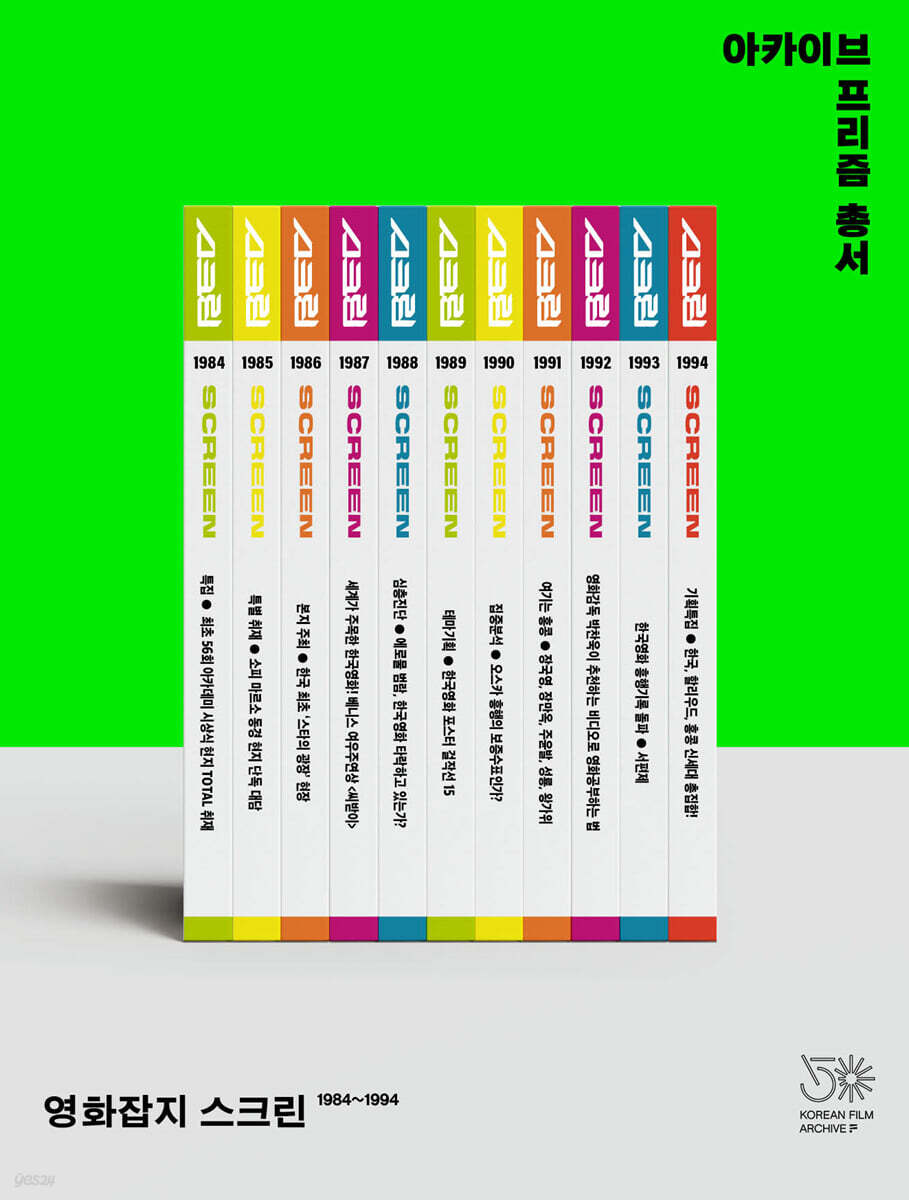
Film magazine Screen 1984-1994
 |
Description
Book Introduction
Reply 1984-1994 [Screen]
40 years ago, the film magazine [Screen] was born.
After 40 years, the 10 years of [Screen] have been revived as a single volume of archives.
In March 1984, when Korean films were called 'arson', when magazines were being forcibly shut down due to the media merger of the Fifth Republic, and when the only popular film magazine was the 'Japanese magazine' in front of the Chinese Embassy in Myeongdong, the film magazine [Screen] was born.
The inaugural issue sold out in just three days, ushering in an era of Korean "film magazines" amidst enthusiastic reader response.
Back then, for those of us who loved movies, [Screen] was a beloved movie magazine with covers featuring "bookend stars" like Brooke Shields, Sophie Marceau, and Phoebe Cates, a must-read book filled with the latest movie news, and full-color bromides of popular stars.
From the first issue in March 1984 to the December 1994 issue, the film magazine [Screen], which captured the turbulent times of Korean cinema over the past 10 years, has been condensed into one volume, [Archive Prism Series: Film Magazine Screen 1984-1994], and has been revived after 40 years.
40 years ago, the film magazine [Screen] was born.
After 40 years, the 10 years of [Screen] have been revived as a single volume of archives.
In March 1984, when Korean films were called 'arson', when magazines were being forcibly shut down due to the media merger of the Fifth Republic, and when the only popular film magazine was the 'Japanese magazine' in front of the Chinese Embassy in Myeongdong, the film magazine [Screen] was born.
The inaugural issue sold out in just three days, ushering in an era of Korean "film magazines" amidst enthusiastic reader response.
Back then, for those of us who loved movies, [Screen] was a beloved movie magazine with covers featuring "bookend stars" like Brooke Shields, Sophie Marceau, and Phoebe Cates, a must-read book filled with the latest movie news, and full-color bromides of popular stars.
From the first issue in March 1984 to the December 1994 issue, the film magazine [Screen], which captured the turbulent times of Korean cinema over the past 10 years, has been condensed into one volume, [Archive Prism Series: Film Magazine Screen 1984-1994], and has been revived after 40 years.
- You can preview some of the book's contents.
Preview
index
In publishing the book
Cover Collection 1984-1994
Screen Star 100
Screen Masterpiece Theater
Review Special
Bookinbuk [Screen] 40th Anniversary Special Edition
Turning the pages of memories
1984~1994 [Screen] Look Back
Readers' Choice: Best Actors 1984-1994
[Screen] and the video industry
The film world of young people on [Screen]
Special symposium to commemorate the 40th anniversary of the founding
Screen Issue
Screen talk talk
Reader Page
Reader's Voice & Monitor Reporter's Seat
Screen comics
Crossword Puzzle Quiz
Reader Survey
Jong
Cover Collection 1984-1994
Screen Star 100
Screen Masterpiece Theater
Review Special
Bookinbuk [Screen] 40th Anniversary Special Edition
Turning the pages of memories
1984~1994 [Screen] Look Back
Readers' Choice: Best Actors 1984-1994
[Screen] and the video industry
The film world of young people on [Screen]
Special symposium to commemorate the 40th anniversary of the founding
Screen Issue
Screen talk talk
Reader Page
Reader's Voice & Monitor Reporter's Seat
Screen comics
Crossword Puzzle Quiz
Reader Survey
Jong
Into the book
The monthly magazine [Screen], which began with the March 1984 issue, was published for nearly 30 years until 2010.
Excluding [Cine21], it is probably one of the longest-running film magazines in the history of Korean cinema.
In that respect, [Screen] can be said to be the most important source material that fully captures the trends and history of modern Korean film culture and discourse since the 1980s.
Above all, this 1980s collection is significant in that it captures the period when [Screen] was the only popular film magazine.
Of course, its value does not come solely from its rarity.
[Screen] has been accompanying the changes in Korean film history, or, to put it somewhat exaggeratedly, modern history, with its own concerns and direction.
And the result of that deliberation, reflecting the readers' desires and the film industry's public opinion, was faithfully filled with a vast space of 300 to 350 pages.
As a result, the editors of the time, without even realizing it, created the most important source material for the history of Korean cinema in the 1980s.
---From "1980s Monthly [Screen] Collection Release"
This film, which has been scorned and despised by critics and the public alike, is Peckinpah's true masterpiece, a crown jewel of American B-movies, a most original döbümi, and a rare example of pure modern art film.
Park Chan-wook (film director)
--- p.76
Looking at the table of contents introducing the contents of the magazine each month is dizzying.
The heterogeneous content that seems more like ‘division’ than ‘classification’ shows its presence, and the arrangement is rough.
Still, everything that should be there is there, and nothing that should not be there is there.
That's why [screen] is so great at this time.
It effortlessly pulls off 'crossovers' and 'mix and matches' that would have been unimaginable if it had been a magazine with a long history and sophisticated polish.
Park Hye-eun (Editor-in-Chief of The Screen)
---From "Northern North"
Even if readers could watch theatrical films at home by pressing a button on their computers, I want them to come to the theater to see my films.
Isn't the best part of movies on the big screen? Lim Sung-min (actor)
--- p.93
In a word, modern movies can be said to be movies about 'feeling'.
There is no drama or philosophical anguish in it.
If it's just 'love', it's 'love', and there's no 'climax' or 'ending' in sight.
Kim Ki-young (film director)
--- p.116
Why do you make movies?
I don't make movies.
Ingmar Bergman (film director)
--- p.122
Why is it that simply looking at all of human history through a camera, in a documentary style, is a much more moving and interesting task?
I'd like to make a documentary someday that is completely unedited.
Of course, the content perspective of my work is ‘feminism.’
Byun Young-joo (film director)
Excluding [Cine21], it is probably one of the longest-running film magazines in the history of Korean cinema.
In that respect, [Screen] can be said to be the most important source material that fully captures the trends and history of modern Korean film culture and discourse since the 1980s.
Above all, this 1980s collection is significant in that it captures the period when [Screen] was the only popular film magazine.
Of course, its value does not come solely from its rarity.
[Screen] has been accompanying the changes in Korean film history, or, to put it somewhat exaggeratedly, modern history, with its own concerns and direction.
And the result of that deliberation, reflecting the readers' desires and the film industry's public opinion, was faithfully filled with a vast space of 300 to 350 pages.
As a result, the editors of the time, without even realizing it, created the most important source material for the history of Korean cinema in the 1980s.
---From "1980s Monthly [Screen] Collection Release"
This film, which has been scorned and despised by critics and the public alike, is Peckinpah's true masterpiece, a crown jewel of American B-movies, a most original döbümi, and a rare example of pure modern art film.
Park Chan-wook (film director)
--- p.76
Looking at the table of contents introducing the contents of the magazine each month is dizzying.
The heterogeneous content that seems more like ‘division’ than ‘classification’ shows its presence, and the arrangement is rough.
Still, everything that should be there is there, and nothing that should not be there is there.
That's why [screen] is so great at this time.
It effortlessly pulls off 'crossovers' and 'mix and matches' that would have been unimaginable if it had been a magazine with a long history and sophisticated polish.
Park Hye-eun (Editor-in-Chief of The Screen)
---From "Northern North"
Even if readers could watch theatrical films at home by pressing a button on their computers, I want them to come to the theater to see my films.
Isn't the best part of movies on the big screen? Lim Sung-min (actor)
--- p.93
In a word, modern movies can be said to be movies about 'feeling'.
There is no drama or philosophical anguish in it.
If it's just 'love', it's 'love', and there's no 'climax' or 'ending' in sight.
Kim Ki-young (film director)
--- p.116
Why do you make movies?
I don't make movies.
Ingmar Bergman (film director)
--- p.122
Why is it that simply looking at all of human history through a camera, in a documentary style, is a much more moving and interesting task?
I'd like to make a documentary someday that is completely unedited.
Of course, the content perspective of my work is ‘feminism.’
Byun Young-joo (film director)
--- p.128
Publisher's Review
Bookend stars including Brooke Shields, Sophie Marceau, and Phoebe Cates
Masters such as Akira Kurosawa, Aki Kaurismaki, and Eric Rohmer,
'Hong Kong stars' such as Jackie Chan, Chow Yun-fat, Leslie Cheung, Joey Wong, and Lin Cheung-ha
A glance at the melting pot of film magazines that coexist!
What kind of film magazine was your [Screen]? For some, it's the cover featuring "bookend stars" like Brooke Shields, Sophie Marceau, and Phoebe Cates. For others, it's a must-read for studying the film theories of master foreign directors rarely seen in Korea, like Akira Kurosawa, Aki Kaurismaki, and Eric Rohmer. For others, it's the bromides and "hanbok photos" of Hong Kong stars like Jackie Chan, Chow Yun-fat, Leslie Cheung, Joey Wong, and Lin Cheung-ha.
In 1984, when there were no popular film magazines in Korea, [Screen] was like a melting pot that melted together color pictorials of foreign stars, news of new releases from Hollywood and Europe, various issues from Chungmuro, and even film history and film theory into a single magazine.
From movies to pop culture content, from pop music to plays, TV, and dramas, everything popular at the time was on the screen.
We've put everything we loved into the Archive Prism series [Film Magazine Screen 1984-1994].
[Screen] A collection of 130 covers from the first issue over 11 years.
Exclusive color pictorials of the best stars of the time [Screen],
Choi In-ho, Lee Eo-ryeong, Kim Ki-young, Yoo Hyun-mok, and former President Kim Dae-jung's sharp remarks
A rare and valuable archive collection
The Archive Prism Series [Film Magazine Screen 1984-1994] satisfies the collecting desires of film enthusiasts by carefully selecting valuable materials from the first 11 years of the film magazine [Screen] published from March 1984 to 2010.
You can meet the '100 Screen Stars' including a collection of 130 covers newly created by the Korean Film Archive's '[Screen] Restoration Project', classic stars such as James Dean and Audrey Hepburn, 'bookend stars' such as Brooke Shields, Sophie Marceau, and Phoebe Cates, Hong Kong stars such as Chow Yun-fat, Leslie Cheung, Joey Wong, and Lin Qingxia, Korean teen stars such as Kim Hye-soo, Lee Sang-ah, Cho Yong-won, Shim Eun-ha, and Kim Hye-soo, and color pictorials of world stars Kang Soo-yeon, Jeon Do-yeon, Lee Jung-jae, and Lee Byung-hun from their debut days.
You can also see the true value of 'Archive' by reconfirming the point where past perspectives and present interpretations meet through sharp reviews of films now considered masterpieces, issues that filled the pages of [Screen] at a time when Chungmuro was filled with aspirations for 'New Wave' Korean films, and more.
A modern 'archive part' like an art catalogue,
The 'Book in Book Part', which restores the 1980s [screen] retro design
A unique design that fuses the times
The Archive Prism series [Film Magazine Screen 1984-1994] was produced in two special sections.
The archive section, which reorganizes the contents of the 130 issues of the monthly [Screen] from its inaugural issue to its December 1994 issue, into five themes, has been produced with a modern design like an art catalog.
At the same time, the 'Book in Book' section, which sheds light on the value and significance of [Screen], which celebrates its 40th anniversary in 2024, from a contemporary perspective, restores the retro design of the monthly [Screen] from the 1980s, bringing back memories for film lovers.
Additionally, it was planned to link to the Korean Film Archive's [1980s Screen Collection] via QR code, allowing you to view more diverse [screen] content.
He who sees the past will see the future.
The Korean film industry 40 years ago is surprisingly similar to the present.
Through this book, modern readers will encounter a time when video threatened theaters, when new directors were racing to connect with a new generation of audiences, and will gain valuable insights into the Korean film industry today, 40 years later.
There is no such thing as a magazine being discontinued.
There is only a break.
[Movie Magazine Screen 1984-1994] reminds us of the reason why we cannot throw away magazines even as time passes.
A good magazine becomes a unique curation in itself and an archive worth keeping.
This book will be the first step toward awakening the long-dormant [screen] in a new form.
Masters such as Akira Kurosawa, Aki Kaurismaki, and Eric Rohmer,
'Hong Kong stars' such as Jackie Chan, Chow Yun-fat, Leslie Cheung, Joey Wong, and Lin Cheung-ha
A glance at the melting pot of film magazines that coexist!
What kind of film magazine was your [Screen]? For some, it's the cover featuring "bookend stars" like Brooke Shields, Sophie Marceau, and Phoebe Cates. For others, it's a must-read for studying the film theories of master foreign directors rarely seen in Korea, like Akira Kurosawa, Aki Kaurismaki, and Eric Rohmer. For others, it's the bromides and "hanbok photos" of Hong Kong stars like Jackie Chan, Chow Yun-fat, Leslie Cheung, Joey Wong, and Lin Cheung-ha.
In 1984, when there were no popular film magazines in Korea, [Screen] was like a melting pot that melted together color pictorials of foreign stars, news of new releases from Hollywood and Europe, various issues from Chungmuro, and even film history and film theory into a single magazine.
From movies to pop culture content, from pop music to plays, TV, and dramas, everything popular at the time was on the screen.
We've put everything we loved into the Archive Prism series [Film Magazine Screen 1984-1994].
[Screen] A collection of 130 covers from the first issue over 11 years.
Exclusive color pictorials of the best stars of the time [Screen],
Choi In-ho, Lee Eo-ryeong, Kim Ki-young, Yoo Hyun-mok, and former President Kim Dae-jung's sharp remarks
A rare and valuable archive collection
The Archive Prism Series [Film Magazine Screen 1984-1994] satisfies the collecting desires of film enthusiasts by carefully selecting valuable materials from the first 11 years of the film magazine [Screen] published from March 1984 to 2010.
You can meet the '100 Screen Stars' including a collection of 130 covers newly created by the Korean Film Archive's '[Screen] Restoration Project', classic stars such as James Dean and Audrey Hepburn, 'bookend stars' such as Brooke Shields, Sophie Marceau, and Phoebe Cates, Hong Kong stars such as Chow Yun-fat, Leslie Cheung, Joey Wong, and Lin Qingxia, Korean teen stars such as Kim Hye-soo, Lee Sang-ah, Cho Yong-won, Shim Eun-ha, and Kim Hye-soo, and color pictorials of world stars Kang Soo-yeon, Jeon Do-yeon, Lee Jung-jae, and Lee Byung-hun from their debut days.
You can also see the true value of 'Archive' by reconfirming the point where past perspectives and present interpretations meet through sharp reviews of films now considered masterpieces, issues that filled the pages of [Screen] at a time when Chungmuro was filled with aspirations for 'New Wave' Korean films, and more.
A modern 'archive part' like an art catalogue,
The 'Book in Book Part', which restores the 1980s [screen] retro design
A unique design that fuses the times
The Archive Prism series [Film Magazine Screen 1984-1994] was produced in two special sections.
The archive section, which reorganizes the contents of the 130 issues of the monthly [Screen] from its inaugural issue to its December 1994 issue, into five themes, has been produced with a modern design like an art catalog.
At the same time, the 'Book in Book' section, which sheds light on the value and significance of [Screen], which celebrates its 40th anniversary in 2024, from a contemporary perspective, restores the retro design of the monthly [Screen] from the 1980s, bringing back memories for film lovers.
Additionally, it was planned to link to the Korean Film Archive's [1980s Screen Collection] via QR code, allowing you to view more diverse [screen] content.
He who sees the past will see the future.
The Korean film industry 40 years ago is surprisingly similar to the present.
Through this book, modern readers will encounter a time when video threatened theaters, when new directors were racing to connect with a new generation of audiences, and will gain valuable insights into the Korean film industry today, 40 years later.
There is no such thing as a magazine being discontinued.
There is only a break.
[Movie Magazine Screen 1984-1994] reminds us of the reason why we cannot throw away magazines even as time passes.
A good magazine becomes a unique curation in itself and an archive worth keeping.
This book will be the first step toward awakening the long-dormant [screen] in a new form.
GOODS SPECIFICS
- Date of issue: December 20, 2024
- Page count, weight, size: 212 pages | 884g | 225*298*10mm
- ISBN13: 9788993056730
- ISBN10: 8993056730
You may also like
카테고리
korean


korean

![GQ KOREA Mark (Monthly): December [2025]](http://librairie.coreenne.fr/cdn/shop/files/8ef265dbbfbf186523ed75ba7319009d.jpg?v=1765340328&width=3840)


