![NewPhilosopher (Quarterly): Vol. 29 [2025]](http://librairie.coreenne.fr/cdn/shop/files/0e5af59fc10683a7bf69612ab4f5bb31.jpg?v=1765377737&width=3840)

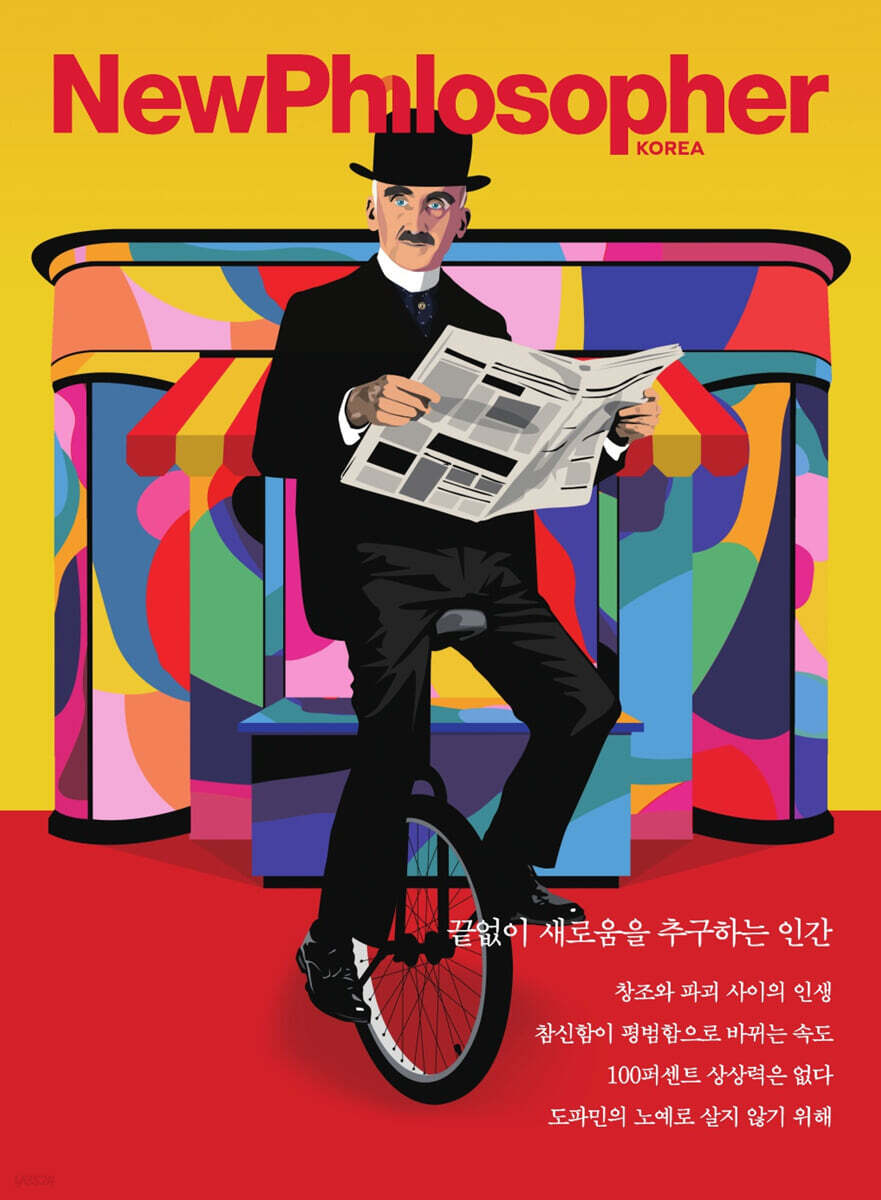
NewPhilosopher (Quarterly): Vol. 29 [2025]
 |
Description
Book Introduction
The origin of all inventions and discoveries, and of all the development of civilization throughout history, lies undoubtedly in the human instinct to pursue new things.
Ancient philosophers such as Cicero also warned against humans' blind love for new things.
The desire for novelty can positively transform humans and even serve as a driving force behind the development of civilization. However, the indulgence and greed for novelty itself has never led to desirable results, as countless stories of war and conflict throughout history attest.
In the deluge of data, the newness of the present age has become another power that eats up our time and money under the pretext of new information and satisfying our curiosity.
Ancient philosophers such as Cicero also warned against humans' blind love for new things.
The desire for novelty can positively transform humans and even serve as a driving force behind the development of civilization. However, the indulgence and greed for novelty itself has never led to desirable results, as countless stories of war and conflict throughout history attest.
In the deluge of data, the newness of the present age has become another power that eats up our time and money under the pretext of new information and satisfying our curiosity.
- You can preview some of the book's contents.
Preview
index
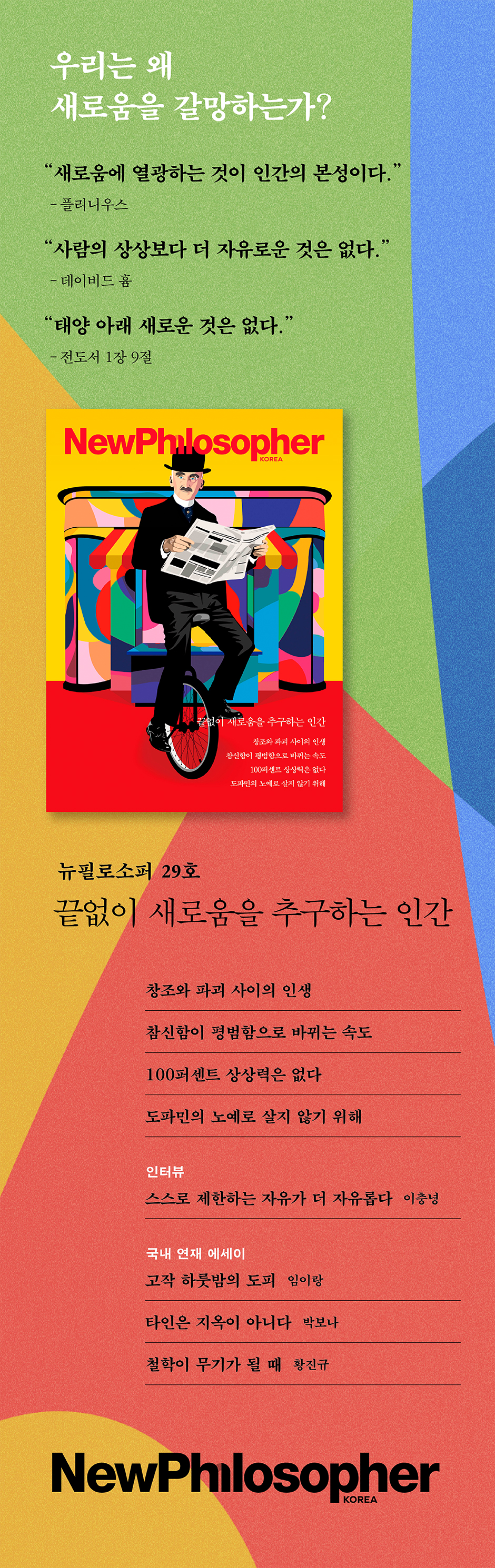
8 _ News from Nowhere
16 _ Intro _ Why do humans crave novelty? _ Jean Borg
18 _ Beginning _ When we turn our eyes to birth rather than death _ Mariana Alessandri
26 _ Philosophy _ Modern Philosophy Not Bound by Plato _ Nigel Warburton
34 _ Opinion _ People Who Try to Outrun Their Time _ Marina Benjamin
40 _ Comic _ The Ontological Shopping Network _ Corey Moller
42 _ Balance _ The Emptiness at the End of Newness _ Antonia Case
52 _ Future _ The Speed at which Novelty Turns into Ordinary _ Tom Chatfield
60 _ Imagination _ There is no such thing as 100 percent imagination _ Patrick Stokes
66 _ Interview _ How to avoid being a slave to dopamine _ Daniel Z.
Lieberman
82 _ Modernism _ Modernism that is no longer novel _ André Dao
88 _ Artist _ Landscapes through Color and Geometry _ Melissa Chandon
96 _ Change _ Life Between Creation and Destruction _ Antonia Case
112 _ Interview _ Newness as Recombination, Not Creation _ Michael North
126 _ Novelty _ A History of Novelty _ Michael North
130 _ Interview _ Self-limited freedom is more freedom _ Lee Chung-nyeong
154 _ Space and _ A mere one-night escape _ Im and
162 _ Thinking in pictures _ Other people are not hell _ Park Bona
170 _ Knowledge and Life _ When Philosophy Becomes a Weapon _ Hwang Jin-gyu
178 _ Our library
16 _ Intro _ Why do humans crave novelty? _ Jean Borg
18 _ Beginning _ When we turn our eyes to birth rather than death _ Mariana Alessandri
26 _ Philosophy _ Modern Philosophy Not Bound by Plato _ Nigel Warburton
34 _ Opinion _ People Who Try to Outrun Their Time _ Marina Benjamin
40 _ Comic _ The Ontological Shopping Network _ Corey Moller
42 _ Balance _ The Emptiness at the End of Newness _ Antonia Case
52 _ Future _ The Speed at which Novelty Turns into Ordinary _ Tom Chatfield
60 _ Imagination _ There is no such thing as 100 percent imagination _ Patrick Stokes
66 _ Interview _ How to avoid being a slave to dopamine _ Daniel Z.
Lieberman
82 _ Modernism _ Modernism that is no longer novel _ André Dao
88 _ Artist _ Landscapes through Color and Geometry _ Melissa Chandon
96 _ Change _ Life Between Creation and Destruction _ Antonia Case
112 _ Interview _ Newness as Recombination, Not Creation _ Michael North
126 _ Novelty _ A History of Novelty _ Michael North
130 _ Interview _ Self-limited freedom is more freedom _ Lee Chung-nyeong
154 _ Space and _ A mere one-night escape _ Im and
162 _ Thinking in pictures _ Other people are not hell _ Park Bona
170 _ Knowledge and Life _ When Philosophy Becomes a Weapon _ Hwang Jin-gyu
178 _ Our library
Detailed image
Into the book
Chasing new things is like trying to seize tomorrow.
It's about drawing the horizon of the future closer so that you can see and feel what tomorrow will bring.
I think novelty and time cannot be separated.
To put it in extreme terms, the resolute pursuit of novelty seems like an attempt to get ahead of time.
▲ People Trying to Outrun Their Time _ Marina Benjamin (p. 36)
The problem with what the Internet offers is that it distorts reward-based learning by feeding us byte-sized rewards.
For example, rewards like social media followers, interesting emails, and disaster news stories reinforce the habit of repeatedly checking social media, email accounts, and online news.
The problem here is, as we all know, addiction occurs when something is repeated.
Before long, you'll be checking the internet over and over again, like a drug or gambling addict, with no expectation of reward.
▲ The Emptiness at the End of Newness _ Antonia Case (p. 47)
Like Hofstadter, I feel both awe and discomfort at the achievements and implications of technologies like artificial intelligence.
But I also feel deep uncertainty.
Every day I vacillate between joy and fear, between hope and cynicism.
What worries me most is the flip side of our desire for novelty.
I worry about how quickly shocking novelty can become ordinary, how easily we can confuse the order we were born into with the nature of things.
▲ The Speed at which Novelty Turns into Ordinary _ Tom Chatfield (p. 56)
Dopamine is powerful.
Overcoming that addiction is extremely difficult, but not impossible.
Is there a way powerful enough to rival dopamine and free us from this bondage? The answer is social interaction.
It's about having a good time with someone.
You're not meeting that person to seduce them or sell them something.
I'm not even planning a vacation with that person in the future.
When you just enjoy being with that person, there is no dopamine there.
Everything returns to the present, to the present chemistry.
▲ To avoid being a slave to dopamine _ Daniel Z.
Lieberman (p. 78)
Modernism helped to raise the curtain on newness by smuggling the new along with the old.
Herein lies the irony.
Modernist artists were undoubtedly successful in shocking their audiences.
But to achieve consistent success, we had to constantly find new ways to deliver impact.
As time went on, modernist art became so successful that its ability to truly shock gradually faded.
▲ Modernism is no longer novel _ André Dao (p. 86)
The 'renew' that Pound shouted is already happening to us, whether we like it or not.
We have no choice but to immerse ourselves in the flow of life, a process of endless innovation and creation, where opposing forces clash and conflict repeatedly before reaching their own solutions.
Philosopher Alan Watts says:
“The only way to understand change is to jump into it, move with it, and dance with it.”
Life Between Creation and Destruction _ Antonia Case (100 pages)
It's about drawing the horizon of the future closer so that you can see and feel what tomorrow will bring.
I think novelty and time cannot be separated.
To put it in extreme terms, the resolute pursuit of novelty seems like an attempt to get ahead of time.
▲ People Trying to Outrun Their Time _ Marina Benjamin (p. 36)
The problem with what the Internet offers is that it distorts reward-based learning by feeding us byte-sized rewards.
For example, rewards like social media followers, interesting emails, and disaster news stories reinforce the habit of repeatedly checking social media, email accounts, and online news.
The problem here is, as we all know, addiction occurs when something is repeated.
Before long, you'll be checking the internet over and over again, like a drug or gambling addict, with no expectation of reward.
▲ The Emptiness at the End of Newness _ Antonia Case (p. 47)
Like Hofstadter, I feel both awe and discomfort at the achievements and implications of technologies like artificial intelligence.
But I also feel deep uncertainty.
Every day I vacillate between joy and fear, between hope and cynicism.
What worries me most is the flip side of our desire for novelty.
I worry about how quickly shocking novelty can become ordinary, how easily we can confuse the order we were born into with the nature of things.
▲ The Speed at which Novelty Turns into Ordinary _ Tom Chatfield (p. 56)
Dopamine is powerful.
Overcoming that addiction is extremely difficult, but not impossible.
Is there a way powerful enough to rival dopamine and free us from this bondage? The answer is social interaction.
It's about having a good time with someone.
You're not meeting that person to seduce them or sell them something.
I'm not even planning a vacation with that person in the future.
When you just enjoy being with that person, there is no dopamine there.
Everything returns to the present, to the present chemistry.
▲ To avoid being a slave to dopamine _ Daniel Z.
Lieberman (p. 78)
Modernism helped to raise the curtain on newness by smuggling the new along with the old.
Herein lies the irony.
Modernist artists were undoubtedly successful in shocking their audiences.
But to achieve consistent success, we had to constantly find new ways to deliver impact.
As time went on, modernist art became so successful that its ability to truly shock gradually faded.
▲ Modernism is no longer novel _ André Dao (p. 86)
The 'renew' that Pound shouted is already happening to us, whether we like it or not.
We have no choice but to immerse ourselves in the flow of life, a process of endless innovation and creation, where opposing forces clash and conflict repeatedly before reaching their own solutions.
Philosopher Alan Watts says:
“The only way to understand change is to jump into it, move with it, and dance with it.”
Life Between Creation and Destruction _ Antonia Case (100 pages)
---- From the text
Publisher's Review
Will the anxiety of the end make us crave new things?
_Why humanity longs for newness
It is a natural human instinct to seek out new things rather than boring old ones, such as liking new things, experiencing new tastes, and being willing to pay for new challenges even if it means trying something new for the first time in one's life.
And that's not all. Modern people, who enter the online world and quickly scroll and click, also constantly touch their screens, sometimes with intense focus, sometimes out of habit, to find new information.
Companies work hard every day to develop new products that are at least slightly different from previous products.
Even media outlets that report on the world's big and small news strive to meet the criteria of "new news," even if long-standing incidents are still ongoing.
Issue 29 of "New Philosopher" examines why humanity so desperately craves the unfamiliar changes of newness, and how much pursuit and control must be applied through the light and dark sides of newness.
The philosopher Jean Baudrillard understood that the speed at which we consume new things, information, and events is a crucial factor in fooling ourselves into forgetting our fear of death.
In other words, the anxiety about the end of life makes us more and more intoxicated with new things in our daily lives.
Ultimately, even if we cannot say that consuming new things is an illusion, there is a high probability that it will remain a short-lived pleasure that will not last long.
The new thing you buy will no longer be new tomorrow.
Modernism, which was a new art movement, has become just one of the old art movements in the 21st century.
CS
In Lewis's satirical novel The Screwtape Letters, the main character, the devil, tells his nephew how he can corrupt the human soul, saying, "Now he will beg with open arms to be distracted from his purpose... for his attention, now lost, can be both occupied and unoccupied at the same time."
It was realized that the addiction to novelty is a fatal weakness of human nature.
But it is clear that for humanity, novelty is still a fundamental device that cannot be given up.
As author Antonia Case puts it, all that is required is the discernment to embrace both what has persisted from the past and what needs to be created anew, or to make rational choices.
Ultimately, the key is to find the perfect balance between preserving the status quo and embracing new ideas or innovations.
(Page 49)
Newness as 'recombination' rather than 'creation'
_ An interview with two scholars who offer completely different perspectives on innovation.
This issue of New Philosopher features a conversation between two scholars who each approach the concept of newness from different perspectives.
Michael North, a literary critic and professor of English at UCLA, urges us to recognize novelty not as a creative concept of "making something new from nothing," like discovery or invention, but as "recombining something that already existed."
Even without citing the biblical verse, "There is nothing new under the sun," many thinkers argue that since humans cannot create matter or energy, they can only create new things by recombining what already exists.
Rather than being fixated on the absolute concept of creating something from nothing, it is emphasized that newness should be accepted in a gradual and social context.
Daniel Z., a clinical professor of psychiatry and behavioral sciences at George Washington University.
Lieberman focuses on the hormone dopamine, which is the source of momentary pleasure and happiness, and believes that this has a significant impact on the mechanisms of the human mind that seek and crave novelty.
While it's true that dopamine provides positive signals for motivation and achievement in our lives, the addiction and tolerance that arise from an excess of dopamine can ruin our lives by falling into the momentary temptation of peripheral interest and novelty.
Not only drugs, but also ultra-processed foods, social media, and casual sex can cause excessive secretion of dopamine, potentially turning you into a "dopamine slave."
Philosophers' thoughts on newness are also diverse.
While humans living in the present suffer from a primal anxiety about moving toward death, that is, the end, and existentialists also spoke of the inevitability of death, political philosopher Hannah Arendt specifically called for attention to 'birth'.
If humans were merely replicas, "repeats of identical models capable of reproduction," there would be reason for despair, but each human being is a unique being, capable of doing the unexpected.
As Arendt said, who called the birth of something new, a positive interpretation of something new, a "world-saving miracle," this can be interpreted to mean that humans are the beginning itself, and therefore can begin anything.
To borrow Arendt's words, we can begin anything because we are the beginning itself.
In short, humans are born to act, we are born to support, to oppose, to create, and to correct.
We can learn from Hannah Arendt that those who are obsessed with novelty lose their own nature while seeking novelty from nothing.
(Page 22)
'I became freer by limiting my own freedom.'
The story of a young philosopher who became a YouTuber with 200,000 subscribers.
Since the last issue, New Philosopher has been interviewing domestic figures, and in this issue, we have published a conversation with Lee Chung-nyeong, a philosophy YouTuber and young philosopher.
He began his career as a philosophy messenger, a YouTuber who spreads everyday philosophy in easy language rather than pursuing a doctorate after returning from studying abroad in Germany, and began to unravel the philosophy that was thought to be accessible only through books by communicating with the public in front of a camera and microphone.
With over 200,000 subscribers, a level of success not easily attainable for a YouTuber specializing in the humanities, he offers unique perspectives, drawing on his academic background in philosophy, the literature of various philosophers, and most importantly, combining the two to arrive at his own conclusions.
He says, "When we limit our own freedom, we become freer," and makes an unexpected diagnosis of "whispers of freedom" as a way to effectively control humans in the present age.
“Limiting freedom does not mean voluntarily depriving yourself of all freedom, but rather creating your own boundaries that you must not cross and maintain in certain areas.
… … is a state of being freely subordinated to this line.
This state is actually more stable than a state where everything is open.
It's about creating a closed floor and leaving the rest of your life open to the world.
“In fact, I think the closed floor allows us to explore the remaining options more reliably.” (Page 150)
_Why humanity longs for newness
It is a natural human instinct to seek out new things rather than boring old ones, such as liking new things, experiencing new tastes, and being willing to pay for new challenges even if it means trying something new for the first time in one's life.
And that's not all. Modern people, who enter the online world and quickly scroll and click, also constantly touch their screens, sometimes with intense focus, sometimes out of habit, to find new information.
Companies work hard every day to develop new products that are at least slightly different from previous products.
Even media outlets that report on the world's big and small news strive to meet the criteria of "new news," even if long-standing incidents are still ongoing.
Issue 29 of "New Philosopher" examines why humanity so desperately craves the unfamiliar changes of newness, and how much pursuit and control must be applied through the light and dark sides of newness.
The philosopher Jean Baudrillard understood that the speed at which we consume new things, information, and events is a crucial factor in fooling ourselves into forgetting our fear of death.
In other words, the anxiety about the end of life makes us more and more intoxicated with new things in our daily lives.
Ultimately, even if we cannot say that consuming new things is an illusion, there is a high probability that it will remain a short-lived pleasure that will not last long.
The new thing you buy will no longer be new tomorrow.
Modernism, which was a new art movement, has become just one of the old art movements in the 21st century.
CS
In Lewis's satirical novel The Screwtape Letters, the main character, the devil, tells his nephew how he can corrupt the human soul, saying, "Now he will beg with open arms to be distracted from his purpose... for his attention, now lost, can be both occupied and unoccupied at the same time."
It was realized that the addiction to novelty is a fatal weakness of human nature.
But it is clear that for humanity, novelty is still a fundamental device that cannot be given up.
As author Antonia Case puts it, all that is required is the discernment to embrace both what has persisted from the past and what needs to be created anew, or to make rational choices.
Ultimately, the key is to find the perfect balance between preserving the status quo and embracing new ideas or innovations.
(Page 49)
Newness as 'recombination' rather than 'creation'
_ An interview with two scholars who offer completely different perspectives on innovation.
This issue of New Philosopher features a conversation between two scholars who each approach the concept of newness from different perspectives.
Michael North, a literary critic and professor of English at UCLA, urges us to recognize novelty not as a creative concept of "making something new from nothing," like discovery or invention, but as "recombining something that already existed."
Even without citing the biblical verse, "There is nothing new under the sun," many thinkers argue that since humans cannot create matter or energy, they can only create new things by recombining what already exists.
Rather than being fixated on the absolute concept of creating something from nothing, it is emphasized that newness should be accepted in a gradual and social context.
Daniel Z., a clinical professor of psychiatry and behavioral sciences at George Washington University.
Lieberman focuses on the hormone dopamine, which is the source of momentary pleasure and happiness, and believes that this has a significant impact on the mechanisms of the human mind that seek and crave novelty.
While it's true that dopamine provides positive signals for motivation and achievement in our lives, the addiction and tolerance that arise from an excess of dopamine can ruin our lives by falling into the momentary temptation of peripheral interest and novelty.
Not only drugs, but also ultra-processed foods, social media, and casual sex can cause excessive secretion of dopamine, potentially turning you into a "dopamine slave."
Philosophers' thoughts on newness are also diverse.
While humans living in the present suffer from a primal anxiety about moving toward death, that is, the end, and existentialists also spoke of the inevitability of death, political philosopher Hannah Arendt specifically called for attention to 'birth'.
If humans were merely replicas, "repeats of identical models capable of reproduction," there would be reason for despair, but each human being is a unique being, capable of doing the unexpected.
As Arendt said, who called the birth of something new, a positive interpretation of something new, a "world-saving miracle," this can be interpreted to mean that humans are the beginning itself, and therefore can begin anything.
To borrow Arendt's words, we can begin anything because we are the beginning itself.
In short, humans are born to act, we are born to support, to oppose, to create, and to correct.
We can learn from Hannah Arendt that those who are obsessed with novelty lose their own nature while seeking novelty from nothing.
(Page 22)
'I became freer by limiting my own freedom.'
The story of a young philosopher who became a YouTuber with 200,000 subscribers.
Since the last issue, New Philosopher has been interviewing domestic figures, and in this issue, we have published a conversation with Lee Chung-nyeong, a philosophy YouTuber and young philosopher.
He began his career as a philosophy messenger, a YouTuber who spreads everyday philosophy in easy language rather than pursuing a doctorate after returning from studying abroad in Germany, and began to unravel the philosophy that was thought to be accessible only through books by communicating with the public in front of a camera and microphone.
With over 200,000 subscribers, a level of success not easily attainable for a YouTuber specializing in the humanities, he offers unique perspectives, drawing on his academic background in philosophy, the literature of various philosophers, and most importantly, combining the two to arrive at his own conclusions.
He says, "When we limit our own freedom, we become freer," and makes an unexpected diagnosis of "whispers of freedom" as a way to effectively control humans in the present age.
“Limiting freedom does not mean voluntarily depriving yourself of all freedom, but rather creating your own boundaries that you must not cross and maintain in certain areas.
… … is a state of being freely subordinated to this line.
This state is actually more stable than a state where everything is open.
It's about creating a closed floor and leaving the rest of your life open to the world.
“In fact, I think the closed floor allows us to explore the remaining options more reliably.” (Page 150)
GOODS SPECIFICS
- Date of issue: January 3, 2025
- Page count, weight, size: 180 pages | 180*245*20mm
- ISBN13: 9772586476005
- ISBN10: 25864769
You may also like
카테고리
korean


korean

![GQ KOREA Mark (Monthly): December [2025]](http://librairie.coreenne.fr/cdn/shop/files/8ef265dbbfbf186523ed75ba7319009d.jpg?v=1765340328&width=3840)


