

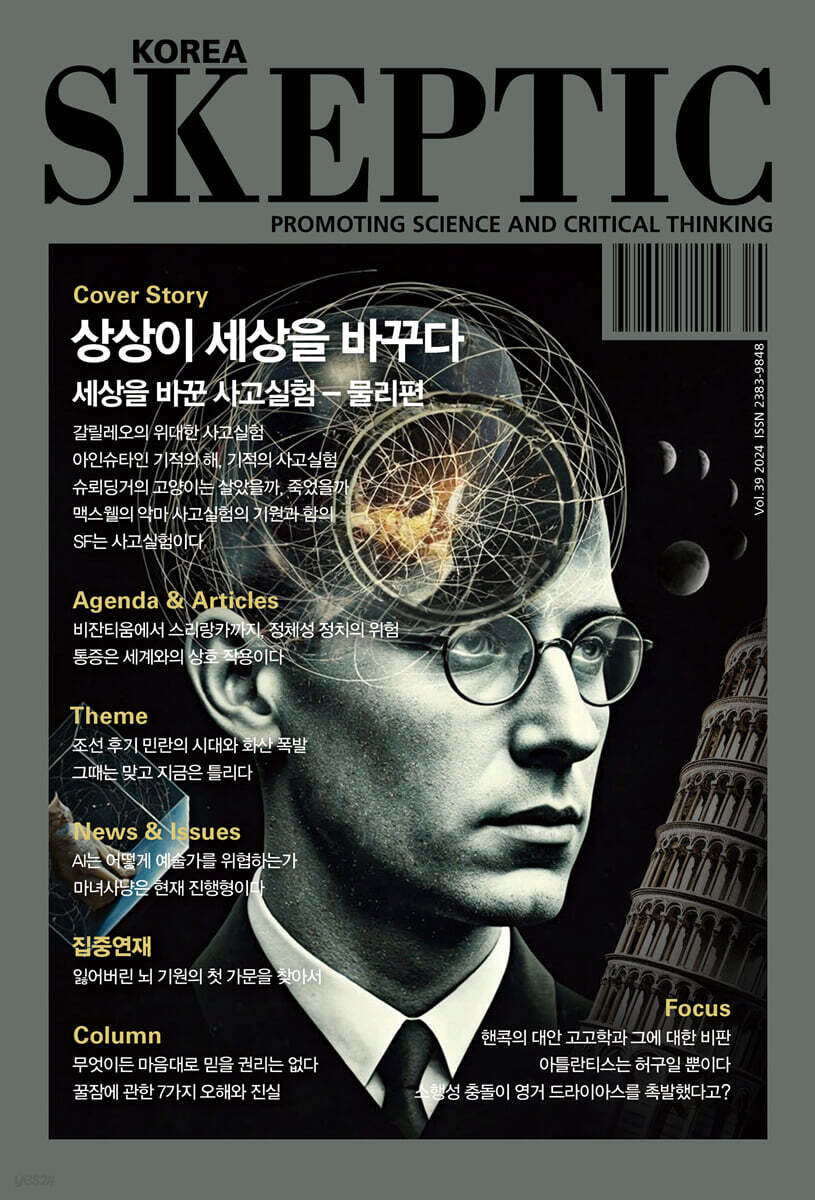
SKEPTIC Korea (quarterly): Issue 39
 |
Description
Book Introduction
Can imagination change the world? In the age of generative AI, what creative qualities are required for human survival? The power of imagination is explored through the thought experiments of legendary scientists.
Hancock's never-ending obsession with lost civilizations.
What are the problems with Hancock's catastrophe hypothesis? Was volcanic eruptions behind the Hong Gyeong-rae Rebellion and other civil unrest in the late Joseon Dynasty? A History of Korea Through Climate.
A new perspective on the pain that connects the world and the body.
Generative AI threatens artists.
From Byzantium to Sri Lanka, how identity politics poses a threat to society. Issue 39 of Skeptic is full of fascinating articles.
Hancock's never-ending obsession with lost civilizations.
What are the problems with Hancock's catastrophe hypothesis? Was volcanic eruptions behind the Hong Gyeong-rae Rebellion and other civil unrest in the late Joseon Dynasty? A History of Korea Through Climate.
A new perspective on the pain that connects the world and the body.
Generative AI threatens artists.
From Byzantium to Sri Lanka, how identity politics poses a threat to society. Issue 39 of Skeptic is full of fascinating articles.
- You can preview some of the book's contents.
Preview
index
olumn
You have no right to believe whatever you want - Daniel Dunicula
7 Myths and Truths About Good Sleep - Kim Hyun
Theme
The Age of Civil War and Volcanic Eruptions in the Late Joseon Dynasty - Park Jeong-jae
Right then, wrong now - Afternoon
Cover Story: Imagination Changes the World: Thought Experiments That Changed the World - Physics
Galileo's Great Thought Experiment - Kim Beom-jun
Einstein's Miracle Year, Miraculous Thought Experiment - Kim Chan-ju
Is Schrödinger's Cat Alive or Dead? - Lee Kang-young
The Origins and Implications of Maxwell's Demon Thought Experiment - Kim Jae-young
Science Fiction is a Thought Experiment - Hong Seong-wook
News & Issues
How AI Threatens Artists - Kate Brunots
The witch hunt is ongoing - Leo Igwe
Intensive series
In Search of the First Family of the Lost Brain Origin - Lee Dae-han
Focus: An unending obsession with lost civilizations
Hancock's Alternative Archaeology and Its Criticisms - Michael Shermer
Atlantis is a myth - Mark Defant
Did an Asteroid Impact Trigger the Younger Dryas? - Mark Voslau
Agenda & Articles
From Byzantium to Sri Lanka: The Perils of Identity Politics - Jens Kurt Heike
Pain is an interaction with the world - Woo Chung-wan
You have no right to believe whatever you want - Daniel Dunicula
7 Myths and Truths About Good Sleep - Kim Hyun
Theme
The Age of Civil War and Volcanic Eruptions in the Late Joseon Dynasty - Park Jeong-jae
Right then, wrong now - Afternoon
Cover Story: Imagination Changes the World: Thought Experiments That Changed the World - Physics
Galileo's Great Thought Experiment - Kim Beom-jun
Einstein's Miracle Year, Miraculous Thought Experiment - Kim Chan-ju
Is Schrödinger's Cat Alive or Dead? - Lee Kang-young
The Origins and Implications of Maxwell's Demon Thought Experiment - Kim Jae-young
Science Fiction is a Thought Experiment - Hong Seong-wook
News & Issues
How AI Threatens Artists - Kate Brunots
The witch hunt is ongoing - Leo Igwe
Intensive series
In Search of the First Family of the Lost Brain Origin - Lee Dae-han
Focus: An unending obsession with lost civilizations
Hancock's Alternative Archaeology and Its Criticisms - Michael Shermer
Atlantis is a myth - Mark Defant
Did an Asteroid Impact Trigger the Younger Dryas? - Mark Voslau
Agenda & Articles
From Byzantium to Sri Lanka: The Perils of Identity Politics - Jens Kurt Heike
Pain is an interaction with the world - Woo Chung-wan
Detailed image

Publisher's Review
▼ Cover Story: Imagination Changes the World, Thought Experiments That Changed the World - Physics
In a society dominated by technology, can imagination truly transform the world? In the future, humans will struggle to keep up with AI in their ability to produce optimal results within established knowledge systems.
This is why creativity is being emphasized as the core of human intelligence with the emergence of generative AI.
At times like these, we need to keep in mind that humanity's decisive advances have been achieved by breaking existing frameworks and establishing new ones.
In fact, this idea can be confirmed through numerous examples in the history of science, and the progress of science has always been accompanied by free thought experiments by scientists.
In this issue's cover story, we explore the thinking of physics giants and how their imaginations have transformed the world.
Contrary to the impression that physics is only about mathematically rigorous logic, the giants of physics have instead used metaphors to freely examine the essence of problems from various angles.
Physicists' thought experiments, such as Schrödinger's cat, a tank moving at the speed of light, and a shell in a vacuum, have twisted previously accepted ideas and created new breakthroughs.
It can truly be said that imagination changed the world.
In this cover story, we explore the thought laboratories of physics giants who changed the world, from Galileo to Maxwell.
In addition, I would like to look at science fiction, which has recently been receiving a lot of attention, in the context of thought experiments.
▼ Focus: The Endless Obsession with Lost Civilizations
Ancient Apocalypse was released on Netflix in November 2022.
Directed and starring Graham Hancock, famous for Fingerprints of the Gods, the series captivates viewers with stunning visuals set against the backdrop of majestic ancient ruins around the world and a compelling theory about the existence of an advanced ancient civilization and a cometary impact that wiped them out in an instant.
Hancock complains that the mainstream archaeological community doesn't take his theories seriously, and he wants to use the series to show viewers how compelling his theories are through flashy visuals.
Even Michael Shermer, who usually criticized Hancock, was so captivated by the series that he watched it twice in a row.
Hancock's claims in the video seem plausible.
Aren't the Great Pyramid of Cholula and Gunung Padang in Indonesia and other ancient structures too magnificent to have been built by hunter-gatherers?
But if you examine his arguments in text and dissect them piece by piece, you will see how absurd his basis is.
Hancock's claim that ancient ruins around the world are all traces of the survivors of the lost civilization Atlantis is riddled with flaws.
In this Focus, we will critically examine Hancock's claims that mislead viewers with flashy visuals.
It is time to end the long obsession with lost Atlantis that began in Fingerprints of the Gods.
▼ Hong Gyeong-rae's rebellion was caused by a volcanic eruption?
“It is said that the famine in Honam was the most severe during the Eulbyeong famine, but I heard from the elderly that this year’s situation is worse than that of the Eulbyeong famine.
If so, this is truly something that has not happened in 100 years.
Mothers have abandoned their children and husbands have separated from their wives, so the streets are littered with dead bodies and wandering beggars.
If they could even get food to eat, they would surely disperse and go in all directions, but the famine is the same everywhere, so where can they prolong their lives?” This is a memorial submitted to the king by Gwangju governor Song Ji-ryeom in the winter of 1809, recorded in the Annals of King Sunjo.
It was a drought that only comes once in a hundred years.
A great famine swept the country.
This trend continued until 1811, eventually leading to the Hong Gyeong-rae Rebellion.
Professor Park Jeong-jae of Seoul National University's Department of Geography says that the low temperatures of the Little Ice Age and government corruption alone do not sufficiently explain Hong Gyeong-rae's Rebellion.
He points out that behind it was an unidentified volcanic eruption whose identity has not yet been identified.
In many ways, Sunjo was not helped by the weather.
Then, in 1815, the famous Tambora volcano erupted.
The eruption of Mount Tambora also affected the Korean Peninsula.
But this time, it wasn't a drought, it was a flood.
The author examines in detail the impact of volcanic eruptions on the period of civil unrest in the late Joseon Dynasty, examining the different outcomes each brought about.
He critically examines how dangerous the "white sky," recently proposed as a solution to the problem of global warming, could be, given the example of volcanic eruptions in the late Joseon Dynasty.
From Byzantium to Sri Lanka: The Perils of Identity Politics
Byzantium in the 6th century was a city so divided that people attacked each other viciously not only in the streets but also in the churches.
And this division culminated in the Nika riots of 523, in which 30,000 people died.
The Nika riots were not the race riots we imagine today.
The problem was the chariot race.
The Blue Team and Green Team, representing each tank team, proudly wore their respective team uniforms.
Each team was very loyal to its own faction and color.
But the rivalry between the two continued for a long time.
The story is that there was conflict between the two, but it did not lead to a serious problem for a long time.
So what was the problem? Author Jens Kurt Heike points out that the problem lies in "identity politics."
We humans are a species that is naturally sensitive to even the smallest differences between groups.
And such a nature can be taken to the extreme by policies or politics that emphasize differences and reinforce them through compensation.
The author points out that the case is the Naka surge, and that the Naka surge has varied throughout history at different times and places.
The author traces identity politics in Sri Lanka, showing how simple differences between groups can be driven to extremes through politics.
▼ The witch hunt isn't over.
When we think of 'witch hunts', we usually think of the Middle Ages.
The perception is that it is a product of religious ideology.
But what if the witch hunt is ongoing? On January 1, 2024, Malawian skeptic Wonderful Mkuche shared a video of a witch hunt that took place on December 28, 2023.
It was a scene where local rioters were burying an old man.
The woman was accused of causing the death of a family member who had passed away the previous day.
This happened when the family met with a fortune teller.
Local vigilantes kidnapped a woman and planned to bury her alive, accusing her of being a witch who had killed her relatives.
This is just one example of the witch hunt that is still ongoing in Africa today.
Leo Igwe, a human rights activist in Africa, exposes the current state of witch-hunting in Africa and explains why a skeptical movement is needed.
Also, Skeptic No. 39
- Professor Kim Hyeon, a psychotherapist and psychologist, discusses the conditions necessary for a good night's sleep based on the latest research in '7 Misconceptions and Truths About Good Sleep'.
Were bilaterians originally a lineage with brains, or did their descendants convergently evolve? In "In Search of the Lost First Lineage of Brain Origin," evolutionary geneticist Professor Lee Dae-han examines recent innovations in bilaterian research.
- In 'How AI Threatens Artists,' musician Kate Brunoz discusses how AI is being used in the real-world music scene and analyzes how AI threatens the lives of artists.
In a society dominated by technology, can imagination truly transform the world? In the future, humans will struggle to keep up with AI in their ability to produce optimal results within established knowledge systems.
This is why creativity is being emphasized as the core of human intelligence with the emergence of generative AI.
At times like these, we need to keep in mind that humanity's decisive advances have been achieved by breaking existing frameworks and establishing new ones.
In fact, this idea can be confirmed through numerous examples in the history of science, and the progress of science has always been accompanied by free thought experiments by scientists.
In this issue's cover story, we explore the thinking of physics giants and how their imaginations have transformed the world.
Contrary to the impression that physics is only about mathematically rigorous logic, the giants of physics have instead used metaphors to freely examine the essence of problems from various angles.
Physicists' thought experiments, such as Schrödinger's cat, a tank moving at the speed of light, and a shell in a vacuum, have twisted previously accepted ideas and created new breakthroughs.
It can truly be said that imagination changed the world.
In this cover story, we explore the thought laboratories of physics giants who changed the world, from Galileo to Maxwell.
In addition, I would like to look at science fiction, which has recently been receiving a lot of attention, in the context of thought experiments.
▼ Focus: The Endless Obsession with Lost Civilizations
Ancient Apocalypse was released on Netflix in November 2022.
Directed and starring Graham Hancock, famous for Fingerprints of the Gods, the series captivates viewers with stunning visuals set against the backdrop of majestic ancient ruins around the world and a compelling theory about the existence of an advanced ancient civilization and a cometary impact that wiped them out in an instant.
Hancock complains that the mainstream archaeological community doesn't take his theories seriously, and he wants to use the series to show viewers how compelling his theories are through flashy visuals.
Even Michael Shermer, who usually criticized Hancock, was so captivated by the series that he watched it twice in a row.
Hancock's claims in the video seem plausible.
Aren't the Great Pyramid of Cholula and Gunung Padang in Indonesia and other ancient structures too magnificent to have been built by hunter-gatherers?
But if you examine his arguments in text and dissect them piece by piece, you will see how absurd his basis is.
Hancock's claim that ancient ruins around the world are all traces of the survivors of the lost civilization Atlantis is riddled with flaws.
In this Focus, we will critically examine Hancock's claims that mislead viewers with flashy visuals.
It is time to end the long obsession with lost Atlantis that began in Fingerprints of the Gods.
▼ Hong Gyeong-rae's rebellion was caused by a volcanic eruption?
“It is said that the famine in Honam was the most severe during the Eulbyeong famine, but I heard from the elderly that this year’s situation is worse than that of the Eulbyeong famine.
If so, this is truly something that has not happened in 100 years.
Mothers have abandoned their children and husbands have separated from their wives, so the streets are littered with dead bodies and wandering beggars.
If they could even get food to eat, they would surely disperse and go in all directions, but the famine is the same everywhere, so where can they prolong their lives?” This is a memorial submitted to the king by Gwangju governor Song Ji-ryeom in the winter of 1809, recorded in the Annals of King Sunjo.
It was a drought that only comes once in a hundred years.
A great famine swept the country.
This trend continued until 1811, eventually leading to the Hong Gyeong-rae Rebellion.
Professor Park Jeong-jae of Seoul National University's Department of Geography says that the low temperatures of the Little Ice Age and government corruption alone do not sufficiently explain Hong Gyeong-rae's Rebellion.
He points out that behind it was an unidentified volcanic eruption whose identity has not yet been identified.
In many ways, Sunjo was not helped by the weather.
Then, in 1815, the famous Tambora volcano erupted.
The eruption of Mount Tambora also affected the Korean Peninsula.
But this time, it wasn't a drought, it was a flood.
The author examines in detail the impact of volcanic eruptions on the period of civil unrest in the late Joseon Dynasty, examining the different outcomes each brought about.
He critically examines how dangerous the "white sky," recently proposed as a solution to the problem of global warming, could be, given the example of volcanic eruptions in the late Joseon Dynasty.
From Byzantium to Sri Lanka: The Perils of Identity Politics
Byzantium in the 6th century was a city so divided that people attacked each other viciously not only in the streets but also in the churches.
And this division culminated in the Nika riots of 523, in which 30,000 people died.
The Nika riots were not the race riots we imagine today.
The problem was the chariot race.
The Blue Team and Green Team, representing each tank team, proudly wore their respective team uniforms.
Each team was very loyal to its own faction and color.
But the rivalry between the two continued for a long time.
The story is that there was conflict between the two, but it did not lead to a serious problem for a long time.
So what was the problem? Author Jens Kurt Heike points out that the problem lies in "identity politics."
We humans are a species that is naturally sensitive to even the smallest differences between groups.
And such a nature can be taken to the extreme by policies or politics that emphasize differences and reinforce them through compensation.
The author points out that the case is the Naka surge, and that the Naka surge has varied throughout history at different times and places.
The author traces identity politics in Sri Lanka, showing how simple differences between groups can be driven to extremes through politics.
▼ The witch hunt isn't over.
When we think of 'witch hunts', we usually think of the Middle Ages.
The perception is that it is a product of religious ideology.
But what if the witch hunt is ongoing? On January 1, 2024, Malawian skeptic Wonderful Mkuche shared a video of a witch hunt that took place on December 28, 2023.
It was a scene where local rioters were burying an old man.
The woman was accused of causing the death of a family member who had passed away the previous day.
This happened when the family met with a fortune teller.
Local vigilantes kidnapped a woman and planned to bury her alive, accusing her of being a witch who had killed her relatives.
This is just one example of the witch hunt that is still ongoing in Africa today.
Leo Igwe, a human rights activist in Africa, exposes the current state of witch-hunting in Africa and explains why a skeptical movement is needed.
Also, Skeptic No. 39
- Professor Kim Hyeon, a psychotherapist and psychologist, discusses the conditions necessary for a good night's sleep based on the latest research in '7 Misconceptions and Truths About Good Sleep'.
Were bilaterians originally a lineage with brains, or did their descendants convergently evolve? In "In Search of the Lost First Lineage of Brain Origin," evolutionary geneticist Professor Lee Dae-han examines recent innovations in bilaterian research.
- In 'How AI Threatens Artists,' musician Kate Brunoz discusses how AI is being used in the real-world music scene and analyzes how AI threatens the lives of artists.
GOODS SPECIFICS
- Date of issue: September 6, 2024
- Page count, weight, size: 276 pages | 524g | 170*250*20mm
- ISBN13: 9772383984000
- ISBN10: 23839848
You may also like
카테고리
korean


korean

![GQ KOREA Mark (Monthly): December [2025]](http://librairie.coreenne.fr/cdn/shop/files/8ef265dbbfbf186523ed75ba7319009d.jpg?v=1765340328&width=3840)


