![NewPhilosopher (Quarterly): Vol. 22 [2023]](http://librairie.coreenne.fr/cdn/shop/files/586bb7e6d367c4faeb10211193c2b498.jpg?v=1765378616&width=3840)

NewPhilosopher (Quarterly): Vol. 22 [2023]
 |
Description
Book Introduction
Life philosophy magazine "New Philosopher"
vol.
22: About Courage
The word 'courageous' is undoubtedly a positive compliment.
While there is the valor of a soldier risking his life in battle or a firefighter venturing through flames to save lives, we experience countless instances of personal courage in adapting to unfamiliar situations.
However, it is not uncommon to see cases where the energy of courage is used for personal greed or for acts of corruption.
Issue 22 of New Philosopher features the personal confessions of real people living in the present day, scholars who explain the meaning of courage through approaches encompassing philosophy and psychology, and the various approaches and concerns of ancient philosophers such as Socrates who struggled to understand the true nature of courage.
vol.
22: About Courage
The word 'courageous' is undoubtedly a positive compliment.
While there is the valor of a soldier risking his life in battle or a firefighter venturing through flames to save lives, we experience countless instances of personal courage in adapting to unfamiliar situations.
However, it is not uncommon to see cases where the energy of courage is used for personal greed or for acts of corruption.
Issue 22 of New Philosopher features the personal confessions of real people living in the present day, scholars who explain the meaning of courage through approaches encompassing philosophy and psychology, and the various approaches and concerns of ancient philosophers such as Socrates who struggled to understand the true nature of courage.
- You can preview some of the book's contents.
Preview
index
8 _ News from Nowhere
16 _ Intro _ The Identity of Courage _ Antonia Case
20 _ Philosophy _ Life is 'Salto Mortale' anyway _ Patrick Stokes
26 _ Human _ When Beliefs Threaten My Life _ Nigel Warburton
38 _ Behavior _ The Philosophy of a Jump Biker _ Antonia Case
46 _ Artist _ An Old Tale to Calm Fear _ John Caple
56 _ Philosophy _ Who will be the hero in uncertain times? _ Tom Chatfield
64 _ Relationship _ The Mechanism of 'Revealing Your Inner Feelings' _ Marina Benjamin
72 _ Interview _ The Lonely Path of Studying the Psychology of Courage _ Cynthia Fury
88 _ Feature _ Allowing Fear into My Life _ Antonia Case
96 _ Opinion _ Taking Control of Your Life with Courage _ Clarissa Seebeck Montefiore
102 _ Art _ Infinite Freedom in a Remote Landscape _ Philippe Charles Jacquet
108 _ People _ Brave to some, natural to others _ Jacqueline Winspear
118 - Thinking _ Where will this faith take me? _ Mariana Alessandri
126 - Classics _ The Courage to Be Myself _ Erich Fromm
134 _ Column _ Endurance, Destiny as a Name _ Antonia Case
142 _ Interview _ The Courage to Hear Dissenting Opinions _ Linda Rabier
158 _ Our Library
16 _ Intro _ The Identity of Courage _ Antonia Case
20 _ Philosophy _ Life is 'Salto Mortale' anyway _ Patrick Stokes
26 _ Human _ When Beliefs Threaten My Life _ Nigel Warburton
38 _ Behavior _ The Philosophy of a Jump Biker _ Antonia Case
46 _ Artist _ An Old Tale to Calm Fear _ John Caple
56 _ Philosophy _ Who will be the hero in uncertain times? _ Tom Chatfield
64 _ Relationship _ The Mechanism of 'Revealing Your Inner Feelings' _ Marina Benjamin
72 _ Interview _ The Lonely Path of Studying the Psychology of Courage _ Cynthia Fury
88 _ Feature _ Allowing Fear into My Life _ Antonia Case
96 _ Opinion _ Taking Control of Your Life with Courage _ Clarissa Seebeck Montefiore
102 _ Art _ Infinite Freedom in a Remote Landscape _ Philippe Charles Jacquet
108 _ People _ Brave to some, natural to others _ Jacqueline Winspear
118 - Thinking _ Where will this faith take me? _ Mariana Alessandri
126 - Classics _ The Courage to Be Myself _ Erich Fromm
134 _ Column _ Endurance, Destiny as a Name _ Antonia Case
142 _ Interview _ The Courage to Hear Dissenting Opinions _ Linda Rabier
158 _ Our Library
Detailed image

Into the book
Courage is not jumping off a cliff into the deep, swirling waters below.
It's about facing the fact that I'm already floating in deep water.
There is no self-aggrandizement here from the diving swimmer.
Kierkegaard says, “It is a proud thing to have taken risks.”
“To not dare to leave that place, to run away, or to climb higher, to risk danger, but to acknowledge that you are there, to confess that you are led there by circumstances and providence, is humility.”
---p.25 From “Life is ‘Salto Mortale’ anyway _ Patrick Stokes”
Courage can only be understood through action.
And if we can't define courage, teaching it to our youth will be a very difficult virtue.
To become brave, you must consistently gain experience and confidently challenge the limits of what is possible.
Essentially, the only way to understand courage is to continually practice it in your daily life.
---p.42 From "The Philosophy of a Jump Biker _ Antonia Case"
When we listen to the situations that the experimental participants reported, they said that they were not afraid at the moment when they acted bravely.
Because at the time, I was hyper-focused on the goal I wanted to achieve.
Even when people are scared, they are not afraid that something bad will happen, but that they are afraid that they will not be able to prevent something bad from happening.
So, if a child runs out into the road, nine times out of ten, don't the parents quickly chase after them?
It would be the same if a car were to rush at you.
Because they are much more afraid of their baby getting hurt than themselves.
---p.77 From "The Lonely Road of Studying the 'Psychology of Courage' _ Cynthia Fury"
As Aristotle said, courage is “the mean between fear [phobos] and composure [tharsos].”
A life without complete certainty, security, and fear is impossible in the first place.
In life, “now is the time.”
There will never come a point where you think, “I am completely prepared and comfortable.”
The web concludes:
“If you wait for the fear to go away first, you will never do it.
Because fear never goes away.”
---p.91 From "Allowing Fear into My Life _ Antonia Case"
Matthew Beard explains:
Aristotle believed that the brave man fears only what is worth fearing.
Courage means knowing what to fear and responding appropriately to that fear.
For Aristotle, what matters is not simply whether or not we face our fears, but why we face them and what we fear.” He added:
“It is important to have a reason for wanting to overcome fear.
“Only by knowing this reason can we distinguish courage from cowardice and recklessness.”
---p.99 From “Taking Control of My Life with Courage _ Clarissa Seebeck Montefiore”
In a world where freedom of the press is being criticized and 'cancel culture' is spreading, there is one issue that is often underestimated.
The problem with such an attitude is that it weakens the will to learn to listen to opinions that one dislikes.
In the process of examining why some damage occurred, there is a tendency to equate a kind of 'discomfort' with actual, physical damage.
However, this kind of thinking process hinders the practice of free discourse, which is a characteristic of a tolerant and free society.
It's about facing the fact that I'm already floating in deep water.
There is no self-aggrandizement here from the diving swimmer.
Kierkegaard says, “It is a proud thing to have taken risks.”
“To not dare to leave that place, to run away, or to climb higher, to risk danger, but to acknowledge that you are there, to confess that you are led there by circumstances and providence, is humility.”
---p.25 From “Life is ‘Salto Mortale’ anyway _ Patrick Stokes”
Courage can only be understood through action.
And if we can't define courage, teaching it to our youth will be a very difficult virtue.
To become brave, you must consistently gain experience and confidently challenge the limits of what is possible.
Essentially, the only way to understand courage is to continually practice it in your daily life.
---p.42 From "The Philosophy of a Jump Biker _ Antonia Case"
When we listen to the situations that the experimental participants reported, they said that they were not afraid at the moment when they acted bravely.
Because at the time, I was hyper-focused on the goal I wanted to achieve.
Even when people are scared, they are not afraid that something bad will happen, but that they are afraid that they will not be able to prevent something bad from happening.
So, if a child runs out into the road, nine times out of ten, don't the parents quickly chase after them?
It would be the same if a car were to rush at you.
Because they are much more afraid of their baby getting hurt than themselves.
---p.77 From "The Lonely Road of Studying the 'Psychology of Courage' _ Cynthia Fury"
As Aristotle said, courage is “the mean between fear [phobos] and composure [tharsos].”
A life without complete certainty, security, and fear is impossible in the first place.
In life, “now is the time.”
There will never come a point where you think, “I am completely prepared and comfortable.”
The web concludes:
“If you wait for the fear to go away first, you will never do it.
Because fear never goes away.”
---p.91 From "Allowing Fear into My Life _ Antonia Case"
Matthew Beard explains:
Aristotle believed that the brave man fears only what is worth fearing.
Courage means knowing what to fear and responding appropriately to that fear.
For Aristotle, what matters is not simply whether or not we face our fears, but why we face them and what we fear.” He added:
“It is important to have a reason for wanting to overcome fear.
“Only by knowing this reason can we distinguish courage from cowardice and recklessness.”
---p.99 From “Taking Control of My Life with Courage _ Clarissa Seebeck Montefiore”
In a world where freedom of the press is being criticized and 'cancel culture' is spreading, there is one issue that is often underestimated.
The problem with such an attitude is that it weakens the will to learn to listen to opinions that one dislikes.
In the process of examining why some damage occurred, there is a tendency to equate a kind of 'discomfort' with actual, physical damage.
However, this kind of thinking process hinders the practice of free discourse, which is a characteristic of a tolerant and free society.
---p.155 From “The Courage to Hear Dissenting Opinions _ Linda Ravie”
Publisher's Review
Time to think about courage
The courage presented in this issue is distinctly different from bravery.
It does not refer to the courage [bravery] that is displayed naturally as if it were a personality trait, but rather to the courage [courage] that is exerted through effort to overcome fear and weakness.
The philosopher Kierkegaard uses the example of a swimmer attempting a dive from a high place, demonstrating the courage to jump, but he limits this to the courage of one's own voluntary challenge.
But if a mountaineer were lost in the mountains and could only escape a maze by jumping from a high place, he would have no choice but to attempt a dizzying leap.
The courage at this time becomes the courage that can be expressed as 'courage'.
I see it as courage that leads to action, even though it is scary, frightening, and something you want to avoid.
How an individual's beliefs can manifest as courage in the face of an oppressive society is well known through numerous historical facts.
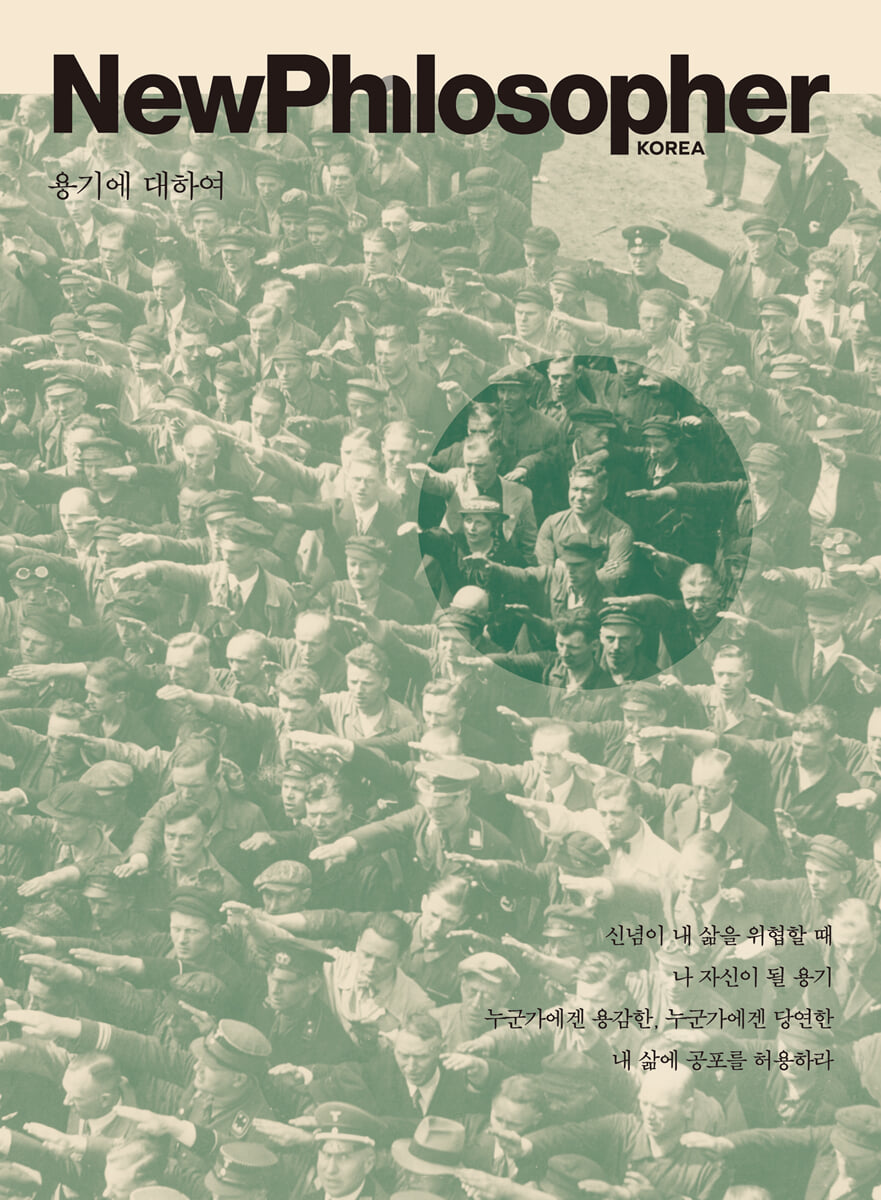
Among them, one large black and white photograph in the text catches the eye.
This is a photo of many workers gathered at a ship launching ceremony in Hamburg, Germany in 1936.
Everyone simultaneously raised one arm forward in the salute, shouting 'Heil Hitler'.
But if you look closely at the crowd, you can see just one person, a man with his arms crossed and a frown on his face.
The act of refusing to act as forced must be full of a feeling of rebellion, but if this act is an expression of resistance against the oppression of the German Nazis, then it is not rebellion but courage full of conviction.
However, it is not always right to resist the state when it demands compliance.
Conspiracy theorists, anti-vaccine activists, and fanatics of heretical religions are all speaking out with courage and voice, each with their own beliefs.
Do all those who remain true to their conscience and believe in the righteousness possess noble courage? If that belief carries potential danger and falsehood, can we truly accept such courage as courage? Amidst this contradiction and confusion, Aristotle summarizes the situation as follows:
For Aristotle, courage is not simply facing fear.
His comments are made within a larger discussion about the nature of virtue and the importance of doing the right thing.
Because without a trustworthy conscience, there is no guarantee that anyone will do the right thing simply by following their inner voice.
… … It is not easy to be grounded in reality, to have a clear idea of right and wrong, and to judge without deceiving oneself. rmfjgrp d
Defining Courage as a "Worthy Adventure"
This issue features interviews with two humanists.
There is a conversation with psychologist Cynthia Fury, who has been conducting research on the rare but inevitably lonely field of "courage psychology," and at the end of the book, there is a detailed conversation with Linda Rabier, a professor of philosophy at MIT.
Unlike typical articles, this fascinating conversation between a psychologist and a philosopher with an interviewer, sometimes sharp and sometimes revealing, will provide readers with the joy of reflection.
Professor Cynthia Fury introduces her own definition of courage, which even Aristotle was unable to reach a conclusion on.
Courage is, as it were, a 'worthwhile adventure'.
If the 'courage' desperately needed to achieve one's desires or to escape danger that confronts oneself ends up harming others and bringing about malicious consequences, then this courage cannot be called true courage.
Haven't we seen countless incidents where reckless chivalry caused social controversy?
That is why Professor Fury argues that true courage is achieved only when the well-intentioned goal of “value” and the inner courage of “adventure” are combined, as defined by the term “worthy adventure.”
On the other hand, as philosopher Professor Linda Rabier mentioned in her book, “Plato and the Virtue of Courage,” “courage is an essential virtue in politics,” and that a country cannot help but value the virtue of “courage” more than “justice.”
For humans who must make decisions frequently, 'courage' is not only the power to try something, but also the power to decide what not to try.
This is also why the 'virtue of moderation', which ancient philosophers have repeatedly mentioned, is directly applied to the virtue of courage.
Courage lies in the middle ground, where you are neither too fearful nor too reckless.
Socrates gives an interesting definition of courage: "The power to stand firm in what reason tells us is best when faced with something we fear."
Therefore, those who do not know what is best must try hard to use their reason to find out… … In such cases, courage becomes the ability to protect truth and opinion to the best of one's ability, in order to determine what is truly terrible and what should or should not be feared.
Brave to some, natural to others
Indirectly experiencing the various types of heroes contained in the book also provides readers with both interest and a sense of challenge.
The courage of August Landmesser, who fought against the Nazis as mentioned above, may not be an easy challenge for ordinary people to emulate. However, if we consider that the history of mankind is the result of the courage of countless criminals, big and small, it would not be an exaggeration to say that I am that protagonist.
How about this photo of workers building the Empire State Building in the 1920s?
For the workers standing exhausted on the dizzying steel structures of high-rise buildings, without even the most advanced safety equipment available today, this precarious moment was not an extreme sport, but rather a normal part of their daily lives as they made a living.
For them, the reality of floating in the air at a high altitude without safety equipment has become a familiarity that has gone beyond courage and paralyzed their courage.
The story of Australian biker Robbie Maddison, famous for his motorcycle stunts, offers another form of courage.
He has successfully raced across the split London Bridge drawbridge, traversed the air, and landed on the other side, navigated the Panama Canal's house-sized waves, and even attempted a challenge that defies human ability: jumping from a helicopter 5,000 meters in the air on a motorcycle.
Onlookers can only applaud with admiration, but what is going on in the minds of this biker who constantly challenges such bizarre dangers?
“Whenever I had a difficult moment challenging a scary and dangerous stunt, I always muttered this to myself.
'This is what I wanted!' Then the fear quickly disappears.
In fact, there is no point in backing down in that situation.
“You have to see if your dreams will come true or if you’ll die because of them.”
It may seem like a cliché, but ultimately the essence of courage is simple.
It was all about believing in your dream, believing that it was possible, and then going for it.
Editor: New Philosopher Editorial Department
The New Philosopher is a quarterly journal first published in Australia in 2013 that explores the profound philosophical thought accumulated by humanity to find the prototype of a “more fulfilling life.”
The founding goal of The New Philosopher is to help readers “live happier and freer lives,” and it offers sharp insights into the modern society dominated by consumerism and technocracy.
The theme that "New Philosopher" explores is life in the "here and now."
It presents a humanistic perspective on various topics such as human life and the identity that supports that life, as well as literature, philosophy, history, and art.
We believe that independence is important in presenting a methodology for living out humanities and philosophical perspectives, and so we have been publishing the magazine without advertisements since its launch in 2013.
The Korean edition of New Philosopher also publishes the magazine without any advertising to develop this spirit.
Translators: Seong So-hee, Song Ye-seul, Choi Yi-hyeon, Kang Yi-su
The courage presented in this issue is distinctly different from bravery.
It does not refer to the courage [bravery] that is displayed naturally as if it were a personality trait, but rather to the courage [courage] that is exerted through effort to overcome fear and weakness.
The philosopher Kierkegaard uses the example of a swimmer attempting a dive from a high place, demonstrating the courage to jump, but he limits this to the courage of one's own voluntary challenge.
But if a mountaineer were lost in the mountains and could only escape a maze by jumping from a high place, he would have no choice but to attempt a dizzying leap.
The courage at this time becomes the courage that can be expressed as 'courage'.
I see it as courage that leads to action, even though it is scary, frightening, and something you want to avoid.
How an individual's beliefs can manifest as courage in the face of an oppressive society is well known through numerous historical facts.
Among them, one large black and white photograph in the text catches the eye.
This is a photo of many workers gathered at a ship launching ceremony in Hamburg, Germany in 1936.
Everyone simultaneously raised one arm forward in the salute, shouting 'Heil Hitler'.
But if you look closely at the crowd, you can see just one person, a man with his arms crossed and a frown on his face.
The act of refusing to act as forced must be full of a feeling of rebellion, but if this act is an expression of resistance against the oppression of the German Nazis, then it is not rebellion but courage full of conviction.
However, it is not always right to resist the state when it demands compliance.
Conspiracy theorists, anti-vaccine activists, and fanatics of heretical religions are all speaking out with courage and voice, each with their own beliefs.
Do all those who remain true to their conscience and believe in the righteousness possess noble courage? If that belief carries potential danger and falsehood, can we truly accept such courage as courage? Amidst this contradiction and confusion, Aristotle summarizes the situation as follows:
For Aristotle, courage is not simply facing fear.
His comments are made within a larger discussion about the nature of virtue and the importance of doing the right thing.
Because without a trustworthy conscience, there is no guarantee that anyone will do the right thing simply by following their inner voice.
… … It is not easy to be grounded in reality, to have a clear idea of right and wrong, and to judge without deceiving oneself. rmfjgrp d
Defining Courage as a "Worthy Adventure"
This issue features interviews with two humanists.
There is a conversation with psychologist Cynthia Fury, who has been conducting research on the rare but inevitably lonely field of "courage psychology," and at the end of the book, there is a detailed conversation with Linda Rabier, a professor of philosophy at MIT.
Unlike typical articles, this fascinating conversation between a psychologist and a philosopher with an interviewer, sometimes sharp and sometimes revealing, will provide readers with the joy of reflection.
Professor Cynthia Fury introduces her own definition of courage, which even Aristotle was unable to reach a conclusion on.
Courage is, as it were, a 'worthwhile adventure'.
If the 'courage' desperately needed to achieve one's desires or to escape danger that confronts oneself ends up harming others and bringing about malicious consequences, then this courage cannot be called true courage.
Haven't we seen countless incidents where reckless chivalry caused social controversy?
That is why Professor Fury argues that true courage is achieved only when the well-intentioned goal of “value” and the inner courage of “adventure” are combined, as defined by the term “worthy adventure.”
On the other hand, as philosopher Professor Linda Rabier mentioned in her book, “Plato and the Virtue of Courage,” “courage is an essential virtue in politics,” and that a country cannot help but value the virtue of “courage” more than “justice.”
For humans who must make decisions frequently, 'courage' is not only the power to try something, but also the power to decide what not to try.
This is also why the 'virtue of moderation', which ancient philosophers have repeatedly mentioned, is directly applied to the virtue of courage.
Courage lies in the middle ground, where you are neither too fearful nor too reckless.
Socrates gives an interesting definition of courage: "The power to stand firm in what reason tells us is best when faced with something we fear."
Therefore, those who do not know what is best must try hard to use their reason to find out… … In such cases, courage becomes the ability to protect truth and opinion to the best of one's ability, in order to determine what is truly terrible and what should or should not be feared.
Brave to some, natural to others
Indirectly experiencing the various types of heroes contained in the book also provides readers with both interest and a sense of challenge.
The courage of August Landmesser, who fought against the Nazis as mentioned above, may not be an easy challenge for ordinary people to emulate. However, if we consider that the history of mankind is the result of the courage of countless criminals, big and small, it would not be an exaggeration to say that I am that protagonist.
How about this photo of workers building the Empire State Building in the 1920s?
For the workers standing exhausted on the dizzying steel structures of high-rise buildings, without even the most advanced safety equipment available today, this precarious moment was not an extreme sport, but rather a normal part of their daily lives as they made a living.
For them, the reality of floating in the air at a high altitude without safety equipment has become a familiarity that has gone beyond courage and paralyzed their courage.
The story of Australian biker Robbie Maddison, famous for his motorcycle stunts, offers another form of courage.
He has successfully raced across the split London Bridge drawbridge, traversed the air, and landed on the other side, navigated the Panama Canal's house-sized waves, and even attempted a challenge that defies human ability: jumping from a helicopter 5,000 meters in the air on a motorcycle.
Onlookers can only applaud with admiration, but what is going on in the minds of this biker who constantly challenges such bizarre dangers?
“Whenever I had a difficult moment challenging a scary and dangerous stunt, I always muttered this to myself.
'This is what I wanted!' Then the fear quickly disappears.
In fact, there is no point in backing down in that situation.
“You have to see if your dreams will come true or if you’ll die because of them.”
It may seem like a cliché, but ultimately the essence of courage is simple.
It was all about believing in your dream, believing that it was possible, and then going for it.
Editor: New Philosopher Editorial Department
The New Philosopher is a quarterly journal first published in Australia in 2013 that explores the profound philosophical thought accumulated by humanity to find the prototype of a “more fulfilling life.”
The founding goal of The New Philosopher is to help readers “live happier and freer lives,” and it offers sharp insights into the modern society dominated by consumerism and technocracy.
The theme that "New Philosopher" explores is life in the "here and now."
It presents a humanistic perspective on various topics such as human life and the identity that supports that life, as well as literature, philosophy, history, and art.
We believe that independence is important in presenting a methodology for living out humanities and philosophical perspectives, and so we have been publishing the magazine without advertisements since its launch in 2013.
The Korean edition of New Philosopher also publishes the magazine without any advertising to develop this spirit.
Translators: Seong So-hee, Song Ye-seul, Choi Yi-hyeon, Kang Yi-su
GOODS SPECIFICS
- Date of issue: April 3, 2023
- Page count, weight, size: 160 pages | 452g | 180*245*13mm
- ISBN13: 2511829990406
You may also like
카테고리
korean


korean

![GQ KOREA Mark (Monthly): December [2025]](http://librairie.coreenne.fr/cdn/shop/files/8ef265dbbfbf186523ed75ba7319009d.jpg?v=1765340328&width=3840)


