![NewPhilosopher (Quarterly): Vol. 4 [2018]](http://librairie.coreenne.fr/cdn/shop/files/26841e6da1eab4ea64a0efc2e1687ebf.jpg?v=1765412417&width=3840)

NewPhilosopher (Quarterly): Vol. 4 [2018]
 |
Description
index
8 News From Nowhere
18 Feature Play for a Full Life _ Oliver Berkman
24 Feature The Boundary Between Play and Work _ Mariana Alessandri
30 Feature Play, Serious and Trivial at the Same Time _ Emily Ryall
38 Feature The Nature of Sports and Games _ Nigel Warburton
44 Feature It's Just a Game? _ Patrick Stokes
50 Comic Risks _ Colley Moller
56 Feature Let's Get the Kids Out _ Tiffany Jenkins
62 Feature Play Like a Child _ Ed Smith
68 Feature Crucial Values That Foster Creativity _ Marina Benjamin
76 Feature The Function of Sport and Ethnic Consciousness _ Clarissa Sebag Montefiore
82 Feature Bread and Circuses _ André Dao
90 Classic Readings: The Silent War _ George Orwell
96 Classic Reading In Praise of Laziness _ Bertrand Russell
102 Classic Reading: The Pied Piper by Robert Browning
104 6 Thinkers Play
110 Essay Federer: Physical, But Not Just That _ David Foster Wallace
122 Opinion: A Hymn to Romantic Baseball _ Lee Yong-gyun
128 Opinion Soccer, a sport for everyone _ Kang Kyung-hee
134 Opinion The Aesthetics of Defeat _ Go Jae-yeol
140 Interview Football Makes Even Ten-Year-Olds Talk _ Simon Critchley
152 Feature Just Give It a Try! _ David Papineau
158 Critic Prisoner's Dilemma Game _ Steve Kuhn
162 Our Library
Column 164 The Freedom to Choose Laziness _ Tim Dean
172 Interview: My Life Philosophy: 13 Questions, 13 Answers _ Hilary Lawson
18 Feature Play for a Full Life _ Oliver Berkman
24 Feature The Boundary Between Play and Work _ Mariana Alessandri
30 Feature Play, Serious and Trivial at the Same Time _ Emily Ryall
38 Feature The Nature of Sports and Games _ Nigel Warburton
44 Feature It's Just a Game? _ Patrick Stokes
50 Comic Risks _ Colley Moller
56 Feature Let's Get the Kids Out _ Tiffany Jenkins
62 Feature Play Like a Child _ Ed Smith
68 Feature Crucial Values That Foster Creativity _ Marina Benjamin
76 Feature The Function of Sport and Ethnic Consciousness _ Clarissa Sebag Montefiore
82 Feature Bread and Circuses _ André Dao
90 Classic Readings: The Silent War _ George Orwell
96 Classic Reading In Praise of Laziness _ Bertrand Russell
102 Classic Reading: The Pied Piper by Robert Browning
104 6 Thinkers Play
110 Essay Federer: Physical, But Not Just That _ David Foster Wallace
122 Opinion: A Hymn to Romantic Baseball _ Lee Yong-gyun
128 Opinion Soccer, a sport for everyone _ Kang Kyung-hee
134 Opinion The Aesthetics of Defeat _ Go Jae-yeol
140 Interview Football Makes Even Ten-Year-Olds Talk _ Simon Critchley
152 Feature Just Give It a Try! _ David Papineau
158 Critic Prisoner's Dilemma Game _ Steve Kuhn
162 Our Library
Column 164 The Freedom to Choose Laziness _ Tim Dean
172 Interview: My Life Philosophy: 13 Questions, 13 Answers _ Hilary Lawson
Detailed image
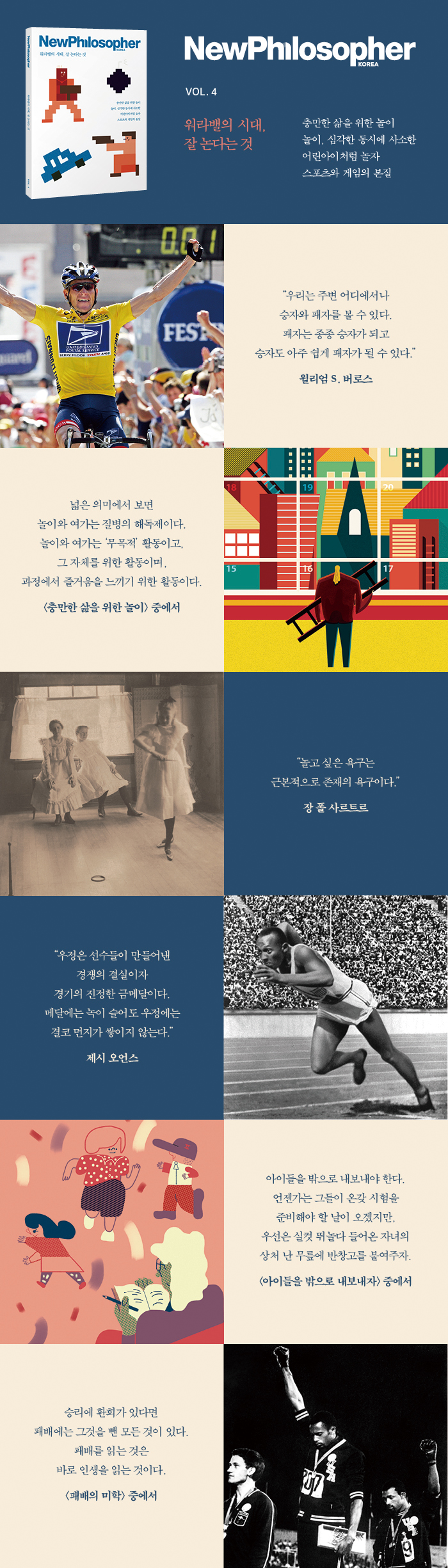
Into the book
In a broad sense, play and leisure are antidotes to disease.
Play and leisure are 'purposeless' activities, activities for their own sake, activities to feel pleasure in the process.
In a society that instrumentalizes time and is obsessed with productivity, even taking a moment to play can be a radical act.
This is why so many aimless activities are often condemned as mere laziness.
However, if we define 'time wasting' as using time for values other than future gain, then we can see that wasting time is a necessary element and a source of motivation for human life.
--- p.20∼21 ▲ Play for a Full Life _ Oliver Burkman
Hawijingah argued that play is a magical realm that exists outside of normal rules and regulations.
In it, all things and concepts can ignore their original properties.
A tree branch transforms into a magic wand, an ordinary child becomes an astronaut and talks to aliens, and you score the decisive penalty against Brazil in the World Cup final.
--- p.32 ▲ Play, serious and trivial at the same time _ Emily Ryall
We need to get the kids out.
Someday they will have to prepare for all sorts of tests, but for now, let's put a bandage on the child's injured knee after playing around to their heart's content.
Adults must be mature enough to allow children to live like children.
Now is the time for them to have fun.
--- p.60 ▲ Let the Kids Go Out _ Tiffany Jenkins
Modern sporting events have evolved primarily in Britain and the United States into events that attract large crowds and generate savage passion.
This epidemic soon spread throughout the world.
Football and boxing are the most violent and intense sports that have spread to the most countries.
There is little disagreement that all of this is deeply related to the rise of nationalism.
In other words, it is related to the fanatic habit of modern people who identify themselves with a huge power group and view everything through the framework of competitive perception.
--- p.94 ▲ The Silent War _ George Orwell
The number 9 in baseball is attractive.
The last digit in the single-digit number is 9, which is our number.
It is not the 1, 2, and 3 who stand at the forefront and believe they control the world, but the '9's' around us who quietly do their work that truly change the world.
In the winter of 2016, it was not the 1st, 2nd, or 3rd generation that gathered in the square holding candles, but the 9th generation.
That's how the world changed.
So, baseball can change the world.
"Romantic baseball," a style of baseball that is home-loving, people-centered, and played in the park, rather than tightly organized fights, can change the world.
The idea is that if more people loved baseball, the world would become a better and more romantic place to live.
--- p.126 ▲ A Hymn for Romantic Baseball _ Lee Yong-gyun
The 'dignity of defeat' is important.
Because in reality, our lives are filled with defeats.
Success is possible only when all conditions are met, but failure occurs immediately when just one condition is not met.
It is a planet where failure, not success, is in the orbit of daily life.
Our personal history is filled with memories of failure, not success.
If success is a special dish eaten only on holidays, failure is an everyday dish.
Play and leisure are 'purposeless' activities, activities for their own sake, activities to feel pleasure in the process.
In a society that instrumentalizes time and is obsessed with productivity, even taking a moment to play can be a radical act.
This is why so many aimless activities are often condemned as mere laziness.
However, if we define 'time wasting' as using time for values other than future gain, then we can see that wasting time is a necessary element and a source of motivation for human life.
--- p.20∼21 ▲ Play for a Full Life _ Oliver Burkman
Hawijingah argued that play is a magical realm that exists outside of normal rules and regulations.
In it, all things and concepts can ignore their original properties.
A tree branch transforms into a magic wand, an ordinary child becomes an astronaut and talks to aliens, and you score the decisive penalty against Brazil in the World Cup final.
--- p.32 ▲ Play, serious and trivial at the same time _ Emily Ryall
We need to get the kids out.
Someday they will have to prepare for all sorts of tests, but for now, let's put a bandage on the child's injured knee after playing around to their heart's content.
Adults must be mature enough to allow children to live like children.
Now is the time for them to have fun.
--- p.60 ▲ Let the Kids Go Out _ Tiffany Jenkins
Modern sporting events have evolved primarily in Britain and the United States into events that attract large crowds and generate savage passion.
This epidemic soon spread throughout the world.
Football and boxing are the most violent and intense sports that have spread to the most countries.
There is little disagreement that all of this is deeply related to the rise of nationalism.
In other words, it is related to the fanatic habit of modern people who identify themselves with a huge power group and view everything through the framework of competitive perception.
--- p.94 ▲ The Silent War _ George Orwell
The number 9 in baseball is attractive.
The last digit in the single-digit number is 9, which is our number.
It is not the 1, 2, and 3 who stand at the forefront and believe they control the world, but the '9's' around us who quietly do their work that truly change the world.
In the winter of 2016, it was not the 1st, 2nd, or 3rd generation that gathered in the square holding candles, but the 9th generation.
That's how the world changed.
So, baseball can change the world.
"Romantic baseball," a style of baseball that is home-loving, people-centered, and played in the park, rather than tightly organized fights, can change the world.
The idea is that if more people loved baseball, the world would become a better and more romantic place to live.
--- p.126 ▲ A Hymn for Romantic Baseball _ Lee Yong-gyun
The 'dignity of defeat' is important.
Because in reality, our lives are filled with defeats.
Success is possible only when all conditions are met, but failure occurs immediately when just one condition is not met.
It is a planet where failure, not success, is in the orbit of daily life.
Our personal history is filled with memories of failure, not success.
If success is a special dish eaten only on holidays, failure is an everyday dish.
--- p.135 ▲ The Aesthetics of Defeat _ Go Jae-yeol
Publisher's Review
Life philosophy magazine New Philosopher, Issue 4
In the age of work-life balance, playing well is key.
'Play' has become obsolete in modern society.
This is the era of work and life balance.
As more and more people seek to reduce long working hours and achieve a balance between work and personal life, there is also a growing movement to find new values and meaning in leisure.
No matter what anyone says, isn't the core of leisure 'play'?
In fact, 'playing well' can be said to be the greatest joy in enjoying leisure time.
The theme of the 4th issue of New Philosopher is 'The Era of Work-Life Balance: What Does It Mean to Play Well?'
Modern people live their lives racing against the clock.
I think that if you waste even a day, or even a minute, or a second, you will fall behind the times.
I believe that if you can't adapt to change and don't do anything, you will fall behind in the competition.
This is why even short breaks and even children's play are decreasing.
In a world where time is instrumentalized, leisurely idling is not the “standard way of experiencing time in developed countries.”
The problem is that modern society is systematically taking play away from all generations, including children.
Schools around the world are fundamentally excluding teaching about the usefulness of play in education and are increasing only activities related to academics.
It teaches us that play is useless, as if it were a discarded object.
For adults, play was a word that was too embarrassing to even mention.
But play is a gift that gives us “exhilarating pleasure that liberates us from the boredom of everyday life.”
Issue 4 of New Philosopher sheds new light on the value of seemingly obsolete play and games.
Because even in seemingly insignificant games, we can learn the meaning of life and realize the value of life.
Play and Leisure: Antidotes to Disease
In “Play for a Full Life,” American author Oliver Berkman says that “play and leisure” are the “antidotes to the disease” that cure modern people’s obsession with time.
Play is an enemy in modern society, which is obsessed with productivity, because it is “a purposeless activity, an activity for its own sake, and an activity to feel pleasure in the process.”
But play, the “radical activity” that it is, even though it may seem like a waste of time, is “a source of motivation and an essential element for human life.”
Carl Jung's words, "No creative work has ever been born without play," prove this.
In “The Boundaries of Play and Work,” philosopher Mariana Alessandri emphasizes that adults “distinguish between play and work, inadvertently teaching children that work is hard and play is useless.”
The point is that the standards of adults are ultimately destroying the world of innocence.
Michel de Montaigne's words, "We must remember that children at play are not simply playing, but are putting their whole heart and soul into it with the utmost sincerity," are worth pondering.
Play, something serious yet trivial
Play has a dual nature.
Play has both serious and trivial aspects.
Emily Ryall, who teaches exercise philosophy at the University of Gloucestershire in England, emphasizes in her book, “Play, Serious and Trivial,” that “play, games, and sports have the contradictory properties of being both trivial and serious.”
“Doing things that are not absolutely necessary for the sake of enjoyment” is called play, and people create stricter rules for this purpose and enjoy it.
Maybe that's why.
Johan Huizinga once described play as “a magical realm that exists outside of normal rules and regulations.”
Some authors argue that adults should also enter that magical realm.
Ed Smith, a former professional cricketer and author, encourages adults to play like children in his book, "Play Like a Child."
The reason adults cannot enjoy play or games is because of the social environment that is obsessed with grades.
Professional athletes may do this because their performance directly affects their salary, but there is no reason why ordinary people should do this in everything.
Ed Smith emphasizes that the best compliment a person can give is "He's like a child absorbed in play," rather than "He's a machine that does everything well."
If we could get children out and let adults play like children, the world would explode with creativity.
In her book, “Crucial Values for Nurturing Creativity,” British author Marina Benjamin says, “Through creative ideas that arise by detour, creative ideas that arise by chance from side branches, we can reach a point of our goal without losing sight of it.”
Because creative ideas that can focus on goals only come from an open environment.
His words, “Creativity is closely related to taking risks and is directly related to play,” could become a proverb for our times.
Work-life balance and playing well
Issue 4 of New Philosopher also explores various implications regarding sports.
Clarissa Sebag Montefiore, who has written for various publications including The New York Times and Time, says in “Sport and the Function of Ethnic Consciousness” that the essence of sport is “the expression of savagery that is carefully disciplined, tolerated by society, and even encouraged.”
Although there are many positive aspects to sports, such as challenging human limits and continuous development through competition, ultimately, sports are a vessel that contains the “desire for violence.”
The gladiator fights that took place in the Roman Colosseum were also disguised as sports, and today's sports created by their descendants are not much different.
By strengthening its ties to capitalism, sports reinforce a frightening desire for violence.
Korean writers' writing is relatively flexible.
In “A Hymn for Romantic Baseball,” Lee Yong-gyun, a baseball reporter for the Kyunghyang Shinmun, presents the unique implications of the number “9” in baseball from a new perspective.
In “Soccer, a Sport for Everyone,” literary critic Kang Kyung-hee says that the “burning fighting spirit and pure passion for scoring goals” shown by soccer will create “a fair, equal, and enjoyable world.”
Meanwhile, reporter Ko Jae-yeol of SisaIN testifies through various incidents encountered while reporting that everyday life is a world of competition without boundaries.
It is right there that we must train ourselves to learn defeat.
“If there is joy in victory, there is everything else in defeat.”
“To read defeat is to read life.”
What is play to modern people?
Is it just a secondary thing, a brief moment of rest that gives you new strength?
In a society that pursues work-life balance, play should be a part of children's lives, and it is a topic that should never be neglected by adults.
This can be clearly supported by Jean-Paul Sartre's words, "The desire to play is fundamentally a desire to exist."
Issue 4 of New Philosopher explores the three-dimensional aspects and meaning of our society through the theme of “The Era of Work-Life Balance: What Does It Mean to Play Well?”
Let's discover what virtues and balance in life can be achieved through the philosophy of play.
In the age of work-life balance, playing well is key.
'Play' has become obsolete in modern society.
This is the era of work and life balance.
As more and more people seek to reduce long working hours and achieve a balance between work and personal life, there is also a growing movement to find new values and meaning in leisure.
No matter what anyone says, isn't the core of leisure 'play'?
In fact, 'playing well' can be said to be the greatest joy in enjoying leisure time.
The theme of the 4th issue of New Philosopher is 'The Era of Work-Life Balance: What Does It Mean to Play Well?'
Modern people live their lives racing against the clock.
I think that if you waste even a day, or even a minute, or a second, you will fall behind the times.
I believe that if you can't adapt to change and don't do anything, you will fall behind in the competition.
This is why even short breaks and even children's play are decreasing.
In a world where time is instrumentalized, leisurely idling is not the “standard way of experiencing time in developed countries.”
The problem is that modern society is systematically taking play away from all generations, including children.
Schools around the world are fundamentally excluding teaching about the usefulness of play in education and are increasing only activities related to academics.
It teaches us that play is useless, as if it were a discarded object.
For adults, play was a word that was too embarrassing to even mention.
But play is a gift that gives us “exhilarating pleasure that liberates us from the boredom of everyday life.”
Issue 4 of New Philosopher sheds new light on the value of seemingly obsolete play and games.
Because even in seemingly insignificant games, we can learn the meaning of life and realize the value of life.
Play and Leisure: Antidotes to Disease
In “Play for a Full Life,” American author Oliver Berkman says that “play and leisure” are the “antidotes to the disease” that cure modern people’s obsession with time.
Play is an enemy in modern society, which is obsessed with productivity, because it is “a purposeless activity, an activity for its own sake, and an activity to feel pleasure in the process.”
But play, the “radical activity” that it is, even though it may seem like a waste of time, is “a source of motivation and an essential element for human life.”
Carl Jung's words, "No creative work has ever been born without play," prove this.
In “The Boundaries of Play and Work,” philosopher Mariana Alessandri emphasizes that adults “distinguish between play and work, inadvertently teaching children that work is hard and play is useless.”
The point is that the standards of adults are ultimately destroying the world of innocence.
Michel de Montaigne's words, "We must remember that children at play are not simply playing, but are putting their whole heart and soul into it with the utmost sincerity," are worth pondering.
Play, something serious yet trivial
Play has a dual nature.
Play has both serious and trivial aspects.
Emily Ryall, who teaches exercise philosophy at the University of Gloucestershire in England, emphasizes in her book, “Play, Serious and Trivial,” that “play, games, and sports have the contradictory properties of being both trivial and serious.”
“Doing things that are not absolutely necessary for the sake of enjoyment” is called play, and people create stricter rules for this purpose and enjoy it.
Maybe that's why.
Johan Huizinga once described play as “a magical realm that exists outside of normal rules and regulations.”
Some authors argue that adults should also enter that magical realm.
Ed Smith, a former professional cricketer and author, encourages adults to play like children in his book, "Play Like a Child."
The reason adults cannot enjoy play or games is because of the social environment that is obsessed with grades.
Professional athletes may do this because their performance directly affects their salary, but there is no reason why ordinary people should do this in everything.
Ed Smith emphasizes that the best compliment a person can give is "He's like a child absorbed in play," rather than "He's a machine that does everything well."
If we could get children out and let adults play like children, the world would explode with creativity.
In her book, “Crucial Values for Nurturing Creativity,” British author Marina Benjamin says, “Through creative ideas that arise by detour, creative ideas that arise by chance from side branches, we can reach a point of our goal without losing sight of it.”
Because creative ideas that can focus on goals only come from an open environment.
His words, “Creativity is closely related to taking risks and is directly related to play,” could become a proverb for our times.
Work-life balance and playing well
Issue 4 of New Philosopher also explores various implications regarding sports.
Clarissa Sebag Montefiore, who has written for various publications including The New York Times and Time, says in “Sport and the Function of Ethnic Consciousness” that the essence of sport is “the expression of savagery that is carefully disciplined, tolerated by society, and even encouraged.”
Although there are many positive aspects to sports, such as challenging human limits and continuous development through competition, ultimately, sports are a vessel that contains the “desire for violence.”
The gladiator fights that took place in the Roman Colosseum were also disguised as sports, and today's sports created by their descendants are not much different.
By strengthening its ties to capitalism, sports reinforce a frightening desire for violence.
Korean writers' writing is relatively flexible.
In “A Hymn for Romantic Baseball,” Lee Yong-gyun, a baseball reporter for the Kyunghyang Shinmun, presents the unique implications of the number “9” in baseball from a new perspective.
In “Soccer, a Sport for Everyone,” literary critic Kang Kyung-hee says that the “burning fighting spirit and pure passion for scoring goals” shown by soccer will create “a fair, equal, and enjoyable world.”
Meanwhile, reporter Ko Jae-yeol of SisaIN testifies through various incidents encountered while reporting that everyday life is a world of competition without boundaries.
It is right there that we must train ourselves to learn defeat.
“If there is joy in victory, there is everything else in defeat.”
“To read defeat is to read life.”
What is play to modern people?
Is it just a secondary thing, a brief moment of rest that gives you new strength?
In a society that pursues work-life balance, play should be a part of children's lives, and it is a topic that should never be neglected by adults.
This can be clearly supported by Jean-Paul Sartre's words, "The desire to play is fundamentally a desire to exist."
Issue 4 of New Philosopher explores the three-dimensional aspects and meaning of our society through the theme of “The Era of Work-Life Balance: What Does It Mean to Play Well?”
Let's discover what virtues and balance in life can be achieved through the philosophy of play.
GOODS SPECIFICS
- Date of issue: October 1, 2018
- Page count, weight, size: 172 pages | 478g | 180*245*12mm
- ISBN13: 2564994389001
You may also like
카테고리
korean


korean

![GQ KOREA Mark (Monthly): December [2025]](http://librairie.coreenne.fr/cdn/shop/files/8ef265dbbfbf186523ed75ba7319009d.jpg?v=1765340328&width=3840)


